
Oracle Critical Patch Update October 2016
Released October 2016 · Oracle's advisory ↗ · ← Critical Patch Update, July 2016 · Critical Patch Update, January 2017 →
205 CVEs in this release, one square each
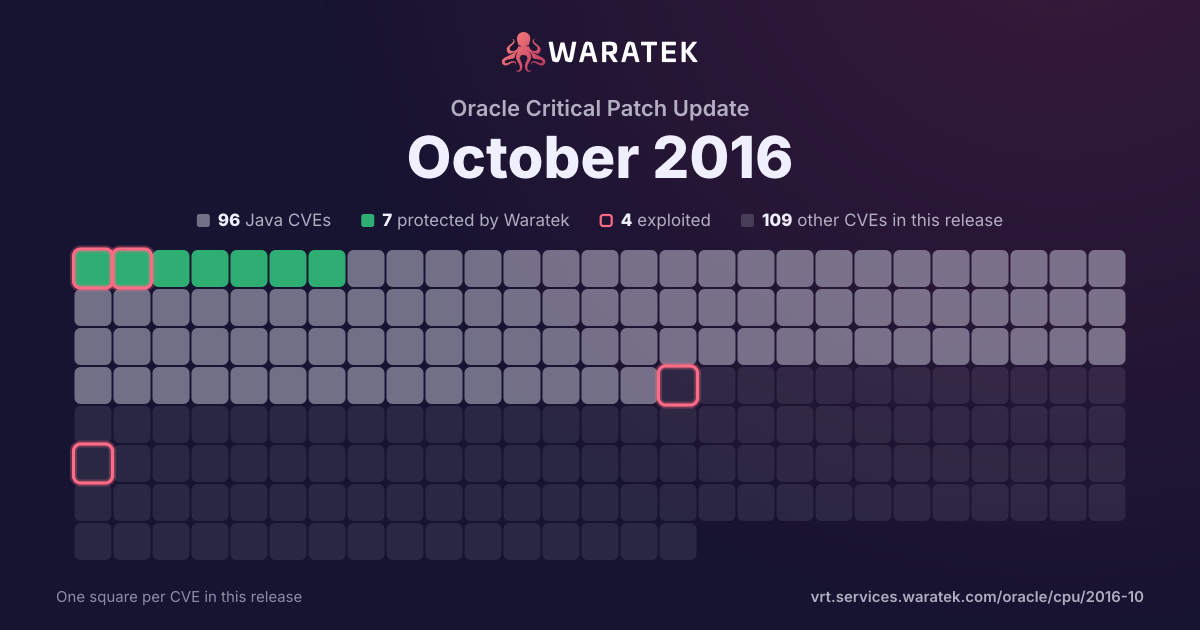
By status
7Protected by Waratek2Mitigation candidate87No exploit published39Outside Waratek scope68Not applicable2Withdrawn CVE
4Exploited, marked by the ring
No exploit published. For 83 of them, Oracle's security advisory is the source of public detail.
Protected by Waratek. Waratek RASP can block exploitation of these on systems that have not applied the patch yet.
Overview 54 matches · 35 in Waratek scope · 2 protected · 1 exploited · 1 CISA KEV · 2 public PoC · 2 EPSS ≥ 0.5
54matches
35in Waratek scope64.8%
2protected3.7%
1exploited1.9%
1CISA KEV1.9%
2public PoC3.7%
2EPSS ≥ 0.53.7%
Protected by Waratek
2
3.7%
Rule in development
0
0.0%
Mitigation candidate
1
1.9%
No exploit published
32
59.3%
Outside Waratek scope
4
7.4%
Not applicable
15
27.8%
Withdrawn CVE
0
0.0%
blocked by ARMR today
2
3.7%
partly blocked
0
0.0%
not blocked
52
96.3%
not established
0
0.0%
unrecorded
0
0.0%
Exploited
1
1.9%
Working exploit published
1
1.9%
Proof of concept only
0
0.0%
Forecast only
1
1.9%
No public exploit
51
94.4%
split by
peak 45 / month
Feb 161
Outside Waratek scope1
High1
not blocked1
No public exploit1
Mar 161
Outside Waratek scope1
High1
not blocked1
No public exploit1
Apr 161
Protected by Waratek1
High1
blocked by ARMR today1
Exploited1
May 161
Not applicable1
High1
not blocked1
No public exploit1
Jun 160
Jul 163
Protected by Waratek1
Outside Waratek scope1
Not applicable1
High3
blocked by ARMR today1
not blocked2
No public exploit3
Aug 160
Sep 161
Not applicable1
High1
not blocked1
Forecast only1
Oct 1645
Mitigation candidate1
No exploit published32
Outside Waratek scope1
Not applicable11
High45
not blocked45
Working exploit published1
No public exploit44
Nov 160
Dec 160
Jan 170
Feb 171
Not applicable1
High1
not blocked1
No public exploit1
Feb 16Apr 16Jun 16Aug 16Oct 16Dec 16Feb 17
| CVE | Severity | Published▾ | Status | Exploitation | Description |
|---|---|---|---|---|---|
| CVE-2016-1881 | High | 2017-02-15 | Not applicable | No public exploit | The kernel in FreeBSD 9.3, 10.1, and 10.2 allows local users to cause a denial of service (crash) or potentially gain privilege via a crafted Linux compatibility layer setgroups system call. |
| CVE-2016-8296 | High | 2016-10-25 | No exploit published | No public exploit | Unspecified vulnerability in the PeopleSoft Enterprise PeopleTools component in Oracle PeopleSoft Products 8.54 and 8.55 allows remote authenticated users to affect confidentiality and integrity via vectors related to LDAP. |
| CVE-2016-8293 | High | 2016-10-25 | No exploit published | No public exploit | Unspecified vulnerability in the PeopleSoft Enterprise PeopleTools component in Oracle PeopleSoft Products 8.54 and 8.55 allows remote attackers to affect confidentiality and integrity via vectors related to Integration Broker, a different vulnerability than CVE-2016-5529 and CVE-2016-5530. |
| CVE-2016-8291 | High | 2016-10-25 | No exploit published | No public exploit | Unspecified vulnerability in the PeopleSoft Enterprise PeopleTools component in Oracle PeopleSoft Products 8.54 and 8.55 allows remote attackers to affect confidentiality and integrity via vectors related to Mobile Application Platform. |
| CVE-2016-8281 | High | 2016-10-25 | No exploit published | No public exploit | Unspecified vulnerability in the Oracle Platform Security for Java component in Oracle Fusion Middleware 12.1.3.0.0, 12.2.1.0.0, and 12.2.1.1.0 allows remote authenticated users to affect confidentiality, integrity, and availability via unknown vectors, a different vulnerability than CVE-2016-5536. |
| CVE-2016-5625 | High | 2016-10-25 | Not applicable | No public exploit | Unspecified vulnerability in Oracle MySQL 5.7.14 and earlier allows local users to affect confidentiality, integrity, and availability via vectors related to Server: Packaging. |
| CVE-2016-5619 | High | 2016-10-25 | No exploit published | No public exploit | Unspecified vulnerability in the Oracle FLEXCUBE Universal Banking component in Oracle Financial Services Applications 11.3.0, 11.4.0, 12.0.1 through 12.0.3, 12.1.0, and 12.2.0 allows remote authenticated users to affect confidentiality and integrity via vectors related to INFRA, a different vulnerability than CVE-2016-5620. |
| CVE-2016-5607 | High | 2016-10-25 | No exploit published | No public exploit | Unspecified vulnerability in the Oracle FLEXCUBE Universal Banking component in Oracle Financial Services Applications 11.3.0, 11.4.0, 12.0.1 through 12.0.3, 12.1.0, and 12.2.0 allows remote authenticated users to affect confidentiality, integrity, and availability via vectors related to INFRA. |
| CVE-2016-5595 | High | 2016-10-25 | No exploit published | No public exploit | Unspecified vulnerability in the Oracle Customer Interaction History component in Oracle E-Business Suite 12.1.1 through 12.1.3, 12.2.3, and 12.2.4 allows remote attackers to affect confidentiality and integrity via unknown vectors, a different vulnerability than CVE-2016-5592. |
| CVE-2016-5593 | High | 2016-10-25 | No exploit published | No public exploit | Unspecified vulnerability in the Oracle Customer Interaction History component in Oracle E-Business Suite 12.1.1 through 12.1.3, 12.2.3, and 12.2.4 allows remote attackers to affect confidentiality and integrity via unknown vectors, a different vulnerability than CVE-2016-5587 and CVE-2016-5591. |
| CVE-2016-5592 | High | 2016-10-25 | No exploit published | No public exploit | Unspecified vulnerability in the Oracle Customer Interaction History component in Oracle E-Business Suite 12.1.1 through 12.1.3, 12.2.3, and 12.2.4 allows remote attackers to affect confidentiality and integrity via unknown vectors, a different vulnerability than CVE-2016-5595. |
| CVE-2016-5591 | High | 2016-10-25 | No exploit published | No public exploit | Unspecified vulnerability in the Oracle Customer Interaction History component in Oracle E-Business Suite 12.1.1 through 12.1.3, 12.2.3, and 12.2.4 allows remote attackers to affect confidentiality and integrity via unknown vectors, a different vulnerability than CVE-2016-5587 and CVE-2016-5593. |
| CVE-2016-5589 | High | 2016-10-25 | No exploit published | No public exploit | Unspecified vulnerability in the Oracle CRM Technical Foundation component in Oracle E-Business Suite 12.1.1 through 12.1.3 and 12.2.3 through 12.2.6 allows remote attackers to affect confidentiality and integrity via unknown vectors. |
| CVE-2016-5588 | High | 2016-10-25 | Not applicable | No public exploit | Unspecified vulnerability in the Oracle Outside In Technology component in Oracle Fusion Middleware 8.4.0 and 8.5.1 through 8.5.3 allows remote attackers to affect confidentiality, integrity, and availability via vectors related to Outside In Filters, a different vulnerability than CVE-2016-5558, CVE-2016-5574, CVE-2016-5577, CVE-2016-5578, and CVE-2016-5579. |
| CVE-2016-5587 | High | 2016-10-25 | No exploit published | No public exploit | Unspecified vulnerability in the Oracle Customer Interaction History component in Oracle E-Business Suite 12.1.1 through 12.1.3, 12.2.3, and 12.2.4 allows remote attackers to affect confidentiality and integrity via unknown vectors, a different vulnerability than CVE-2016-5591 and CVE-2016-5593. |
| CVE-2016-5586 | High | 2016-10-25 | No exploit published | No public exploit | Unspecified vulnerability in the Oracle Email Center component in Oracle E-Business Suite 12.1.1 through 12.1.3 and 12.2.3 through 12.2.6 allows remote attackers to affect confidentiality and integrity via unknown vectors. |
| CVE-2016-5579 | High | 2016-10-25 | Not applicable | No public exploit | Unspecified vulnerability in the Oracle Outside In Technology component in Oracle Fusion Middleware 8.4.0 and 8.5.1 through 8.5.3 allows remote attackers to affect confidentiality, integrity, and availability via vectors related to Outside In Filters, a different vulnerability than CVE-2016-5558, CVE-2016-5574, CVE-2016-5577, CVE-2016-5578, and CVE-2016-5588. |
| CVE-2016-5578 | High | 2016-10-25 | Not applicable | No public exploit | Unspecified vulnerability in the Oracle Outside In Technology component in Oracle Fusion Middleware 8.4.0 and 8.5.1 through 8.5.3 allows remote attackers to affect confidentiality, integrity, and availability via vectors related to Outside In Filters, a different vulnerability than CVE-2016-5558, CVE-2016-5574, CVE-2016-5577, CVE-2016-5579, and CVE-2016-5588. |
| CVE-2016-5577 | High | 2016-10-25 | Not applicable | No public exploit | Unspecified vulnerability in the Oracle Outside In Technology component in Oracle Fusion Middleware 8.4.0 and 8.5.1 through 8.5.3 allows remote attackers to affect confidentiality, integrity, and availability via vectors related to Outside In Filters, a different vulnerability than CVE-2016-5558, CVE-2016-5574, CVE-2016-5578, CVE-2016-5579, and CVE-2016-5588. |
| CVE-2016-5574 | High | 2016-10-25 | Not applicable | No public exploit | Unspecified vulnerability in the Oracle Outside In Technology component in Oracle Fusion Middleware 8.4.0 and 8.5.1 through 8.5.3 allows remote attackers to affect confidentiality, integrity, and availability via vectors related to Outside In Filters, a different vulnerability than CVE-2016-5558, CVE-2016-5577, CVE-2016-5578, CVE-2016-5579, and CVE-2016-5588. |
| CVE-2016-5573 | High | 2016-10-25 | Outside Waratek scope | No public exploit | Unspecified vulnerability in Oracle Java SE 6u121, 7u111, 8u102; and Java SE Embedded 8u101 allows remote attackers to affect confidentiality, integrity, and availability via vectors related to Hotspot, a different vulnerability than CVE-2016-5582. |
| CVE-2016-5565 | High | 2016-10-25 | No exploit published | No public exploit | Unspecified vulnerability in the Oracle Hospitality OPERA 5 Property Services component in Oracle Hospitality Applications 5.4.0.0 through 5.4.3.0, 5.5.0.0, and 5.5.1.0 allows remote authenticated users to affect confidentiality via vectors related to OPERA. |
| CVE-2016-5564 | High | 2016-10-25 | No exploit published | No public exploit | Unspecified vulnerability in the Oracle Hospitality OPERA 5 Property Services component in Oracle Hospitality Applications 5.4.0.0 through 5.4.3.0, 5.5.0.0, and 5.5.1.0 allows remote authenticated users to affect confidentiality, integrity, and availability via vectors related to OPERA. |
| CVE-2016-5563 | High | 2016-10-25 | No exploit published | No public exploit | Unspecified vulnerability in the Oracle Hospitality OPERA 5 Property Services component in Oracle Hospitality Applications 5.4.0.0 through 5.4.3.0, 5.5.0.0, and 5.5.1.0 allows remote administrators to affect confidentiality, integrity, and availability via vectors related to OPERA. |
| CVE-2016-5562 | High | 2016-10-25 | No exploit published | No public exploit | Unspecified vulnerability in the Oracle iProcurement component in Oracle E-Business Suite 12.1.1 through 12.1.3 and 12.2.3 through 12.2.6 allows remote authenticated users to affect confidentiality and integrity via unknown vectors. |
| CVE-2016-5558 | High | 2016-10-25 | Not applicable | No public exploit | Unspecified vulnerability in the Oracle Outside In Technology component in Oracle Fusion Middleware 8.4.0 and 8.5.1 through 8.5.3 allows remote attackers to affect confidentiality, integrity, and availability via vectors related to Outside In Filters, a different vulnerability than CVE-2016-5574, CVE-2016-5577, CVE-2016-5578, CVE-2016-5579, and CVE-2016-5588. |
| CVE-2016-5557 | High | 2016-10-25 | No exploit published | No public exploit | Unspecified vulnerability in the Oracle Advanced Pricing component in Oracle E-Business Suite 12.1.1 through 12.1.3 and 12.2.3 through 12.2.6 allows remote attackers to affect confidentiality and integrity via unknown vectors. |
| CVE-2016-5544 | High | 2016-10-25 | Not applicable | No public exploit | Unspecified vulnerability in Oracle Sun Solaris 10 and 11.3 allows local users to affect confidentiality, integrity, and availability via vectors related to Kernel/X86. |
| CVE-2016-5539 | High | 2016-10-25 | No exploit published | No public exploit | Unspecified vulnerability in the Oracle Retail Xstore Payment component in Oracle Retail Applications 1.x allows local users to affect confidentiality, integrity, and availability via unknown vectors. |
| CVE-2016-5536 | High | 2016-10-25 | No exploit published | No public exploit | Unspecified vulnerability in the Oracle Platform Security for Java component in Oracle Fusion Middleware 12.1.3.0.0, 12.2.1.0.0, and 12.2.1.1.0 allows remote authenticated users to affect confidentiality, integrity, and availability via unknown vectors, a different vulnerability than CVE-2016-8281. |
| CVE-2016-5526 | High | 2016-10-25 | No exploit published | No public exploit | Unspecified vulnerability in the Oracle Agile PLM component in Oracle Supply Chain Products Suite 9.3.4 and 9.3.5 allows remote attackers to affect confidentiality, integrity, and availability via vectors related to Apache Tomcat. |
| CVE-2016-5523 | High | 2016-10-25 | No exploit published | No public exploit | Unspecified vulnerability in the Oracle Agile PLM component in Oracle Supply Chain Products Suite 9.3.4 and 9.3.5 allows remote authenticated users to affect confidentiality, integrity, and availability via vectors related to AutoVue Java Applet. |
| CVE-2016-5519 | High | 2016-10-25 | No exploit published | No public exploit | Unspecified vulnerability in the Oracle GlassFish Server component in Oracle Fusion Middleware 2.1.1, 3.0.1, and 3.1.2 allows remote authenticated users to affect confidentiality, integrity, and availability via vectors related to Java Server Faces. |
| CVE-2016-5518 | High | 2016-10-25 | No exploit published | No public exploit | Unspecified vulnerability in the Oracle Agile Engineering Data Management component in Oracle Supply Chain Products Suite 6.1.3.0 and 6.2.0.0 allows remote attackers to affect confidentiality, integrity, and availability via vectors related to webfileservices. |
| CVE-2016-5515 | High | 2016-10-25 | No exploit published | No public exploit | Unspecified vulnerability in the Oracle Agile PLM component in Oracle Supply Chain Products Suite 9.3.4 and 9.3.5 allows remote authenticated users to affect confidentiality, integrity, and availability via vectors related to RMIServlet. |
| CVE-2016-5514 | High | 2016-10-25 | No exploit published | No public exploit | Unspecified vulnerability in the Oracle Agile PLM component in Oracle Supply Chain Products Suite 9.3.4 and 9.3.5 allows remote authenticated users to affect confidentiality, integrity, and availability via vectors related to ExportServlet. |
| CVE-2016-5503 | High | 2016-10-25 | Not applicable | No public exploit | Unspecified vulnerability in the Sun ZFS Storage Appliance Kit (AK) component in Oracle Sun Systems Products Suite AK 2013 allows local users to affect confidentiality, integrity, and availability via vectors related to Core Services. |
| CVE-2016-5501 | High | 2016-10-25 | Not applicable | No public exploit | Unspecified vulnerability in the Oracle VM VirtualBox component before 5.0.28 and 5.1.x before 5.1.8 in Oracle Virtualization allows local users to affect confidentiality, integrity, and availability via vectors related to Core, a different vulnerability than CVE-2016-5538. |
| CVE-2016-5500 | High | 2016-10-25 | No exploit published | No public exploit | Unspecified vulnerability in the Oracle Discoverer component in Oracle Fusion Middleware 11.1.1.7.0 allows remote attackers to affect confidentiality via vectors related to Viewer. |
| CVE-2016-5495 | High | 2016-10-25 | No exploit published | No public exploit | Unspecified vulnerability in the Oracle Discoverer component in Oracle Fusion Middleware 11.1.1.7.0 allows remote attackers to affect confidentiality via vectors related to EUL Code & Schema. |
| CVE-2016-5492 | High | 2016-10-25 | Not applicable | No public exploit | Unspecified vulnerability in the Sun ZFS Storage Appliance Kit (AK) component in Oracle Sun Systems Products Suite AK 2013 allows local users to affect confidentiality and integrity via vectors related to SMB Users. |
| CVE-2016-5491 | High | 2016-10-25 | No exploit published | No public exploit | Unspecified vulnerability in the Oracle Commerce Service Center component in Oracle Commerce 10.0.3.5 and 10.2.0.5 allows remote attackers to affect confidentiality and integrity via unknown vectors. |
| CVE-2016-5489 | High | 2016-10-25 | No exploit published | No public exploit | Unspecified vulnerability in the Oracle iStore component in Oracle E-Business Suite 12.1.1 through 12.1.3, 12.2.3, and 12.2.4 allows remote attackers to affect confidentiality and integrity via vectors related to Runtime Catalog. |
| CVE-2016-5482 | High | 2016-10-25 | No exploit published | No public exploit | Unspecified vulnerability in the Oracle Commerce Guided Search component in Oracle Commerce 6.2.2, 6.3.0, 6.4.1.2, and 6.5.0 through 6.5.2 allows remote attackers to affect confidentiality and integrity via unknown vectors. |
| CVE-2016-3505 | High | 2016-10-25 | No exploit published | No public exploit | Unspecified vulnerability in the Oracle WebLogic Server component in Oracle Fusion Middleware 10.3.6.0, 12.1.3.0, and 12.2.1.0 allows remote authenticated users to affect confidentiality, integrity, and availability via vectors related to JavaServer Faces. |
| CVE-2016-3473 | High | 2016-10-25 | Mitigation candidate | Working exploit published | Unspecified vulnerability in the BI Publisher (formerly XML Publisher) component in Oracle Fusion Middleware 11.1.1.7.0, 11.1.1.9.0, and 12.2.1.0.0 allows remote authenticated users to affect confidentiality via unknown vectors. |
| CVE-2016-6304 | High | 2016-09-26 | Not applicable | Forecast only | Multiple memory leaks in t1_lib.c in OpenSSL before 1.0.1u, 1.0.2 before 1.0.2i, and 1.1.0 before 1.1.0a allow remote attackers to cause a denial of service (memory consumption) via large OCSP Status Request extensions. |
| CVE-2016-0635 | High | 2016-07-21 | Outside Waratek scope | No public exploit | Unspecified vulnerability in the Enterprise Manager Ops Center component in Oracle Enterprise Manager Grid Control 12.1.4, 12.2.2, and 12.3.2; the Oracle Health Sciences Information Manager component in Oracle Health Sciences Applications 1.2.8.3, 2.0.2.3, and 3.0.1.0; the Oracle Healthcare Master Person Index component in Oracle Health Sciences Applications 2.0.12, 3.0.0, and 4.0.1; the Oracle Documaker component in Oracle Insurance Applications before 12.5; the Oracle Insurance Calculation Engine component in Oracle Insurance Applications 9.7.1, 10.1.2, and 10.2.2; the Oracle Insurance Policy Administration J2EE and Oracle Insurance Rules Palette components in Oracle Insurance Applications 9.6.1, 9.7.1, 10.0.1, 10.1.2, 10.2.0, and 10.2.2; the Oracle Retail Integration Bus component in Oracle Retail Applications 15.0; the Oracle Retail Order Broker component in Oracle Retail Applications 5.1, 5.2, and 15.0; the Primavera Contract Management component in Oracle Primavera Products Suite 14.2; the Primavera P6 Enterprise Project Portfolio Management component in Oracle Primavera Products Suite 8.2, 8.3, 8.4, 15.1, 15.2, and 16.1; the Oracle Financial Services Analytical Applications Infrastructure component in Oracle Financial Services Applications 8.0.0, 8.0.1, 8.0.2, and 8.0.3; the Oracle Commerce Guided Search / Oracle Commerce Experience Manager component in Oracle Commerce 3.1.1, 3.1.2, 11.0, 11.1, and 11.2; the Oracle Agile PLM component in Oracle Supply Chain Products Suite 9.3.4 and 9.3.5; the Oracle Communications BRM - Elastic Charging Engine 11.2.0.0.0 and 11.3.0.0.0; the Oracle Enterprise Repository Enterprise Repository 12.1.3.0.0; the Oracle Financial Services Behavior Detection Platform 8.0.1 and 8.0.2; the Oracle Hyperion Essbase 12.2.1.1; the Oracle Tuxedo System and Applications Monitor (TSAM) 11.1.1.2.0, 11.1.1.2.1, 11.1.1.2.1, 12.1.1.1.0, 12.1.3.0.0, and 12.2.2.0.0; the Oracle Communications WebRTC Session Controller component of Oracle Communications Applications (subcomponent: Security (Spring)) 7.0, 7.1 and 7.2; the Oracle Endeca Information Discovery Integrator 3.2; the Converged Commerce component of Oracle Retail Applications 16.0.1; the Oracle Identity Manager 11.1.2.3.0; Oracle Enterprise Manager for MySQL Database 12.1.0.4; Oracle Retail Invoice Matching 12.0, 13.0, 13.1, 13.2, 14.0, and 14.1; Oracle Communications Performance Intelligence Center (PIC) Software Prior to 10.2.1 and the Oracle Knowledge component of Oracle Siebel CRM (subcomponent: AnswerFlow (Spring Framework)) version 8.5.1.0 - 8.5.1.7 and 8.6.0 allows remote authenticated users to affect confidentiality, integrity, and availability via unknown vectors. |
| CVE-2016-4979 | High | 2016-07-06 | Not applicable | No public exploit | The Apache HTTP Server 2.4.18 through 2.4.20, when mod_http2 and mod_ssl are enabled, does not properly recognize the "SSLVerifyClient require" directive for HTTP/2 request authorization, which allows remote attackers to bypass intended access restrictions by leveraging the ability to send multiple requests over a single connection and aborting a renegotiation. |
| CVE-2016-1181 | High | 2016-07-04 | Protected by Waratek | No public exploit | ActionServlet.java in Apache Struts 1 1.x through 1.3.10 mishandles multithreaded access to an ActionForm instance, which allows remote attackers to execute arbitrary code or cause a denial of service (unexpected memory access) via a multipart request, a related issue to CVE-2015-0899. |
| CVE-2016-2176 | High | 2016-05-05 | Not applicable | No public exploit | The X509_NAME_oneline function in crypto/x509/x509_obj.c in OpenSSL before 1.0.1t and 1.0.2 before 1.0.2h allows remote attackers to obtain sensitive information from process stack memory or cause a denial of service (buffer over-read) via crafted EBCDIC ASN.1 data. |
| CVE-2016-3081 | High | 2016-04-26 | Protected by Waratek | Exploited | Apache Struts 2.3.19 to 2.3.20.2, 2.3.21 to 2.3.24.1, and 2.3.25 to 2.3.28, when Dynamic Method Invocation is enabled, allow remote attackers to execute arbitrary code via method: prefix, related to chained expressions. |
| CVE-2016-1950 | High | 2016-03-13 | Outside Waratek scope | No public exploit | Heap-based buffer overflow in Mozilla Network Security Services (NSS) before 3.19.2.3 and 3.20.x and 3.21.x before 3.21.1, as used in Mozilla Firefox before 45.0 and Firefox ESR 38.x before 38.7, allows remote attackers to execute arbitrary code via crafted ASN.1 data in an X.509 certificate. |
| CVE-2016-0714 | High | 2016-02-25 | Outside Waratek scope | No public exploit | The session-persistence implementation in Apache Tomcat 6.x before 6.0.45, 7.x before 7.0.68, 8.x before 8.0.31, and 9.x before 9.0.0.M2 mishandles session attributes, which allows remote authenticated users to bypass intended SecurityManager restrictions and execute arbitrary code in a privileged context via a web application that places a crafted object in a session. |