
Oracle Critical Patch Update October 2016
Released October 2016 · Oracle's advisory ↗ · ← Critical Patch Update, July 2016 · Critical Patch Update, January 2017 →
205 CVEs in this release, one square each
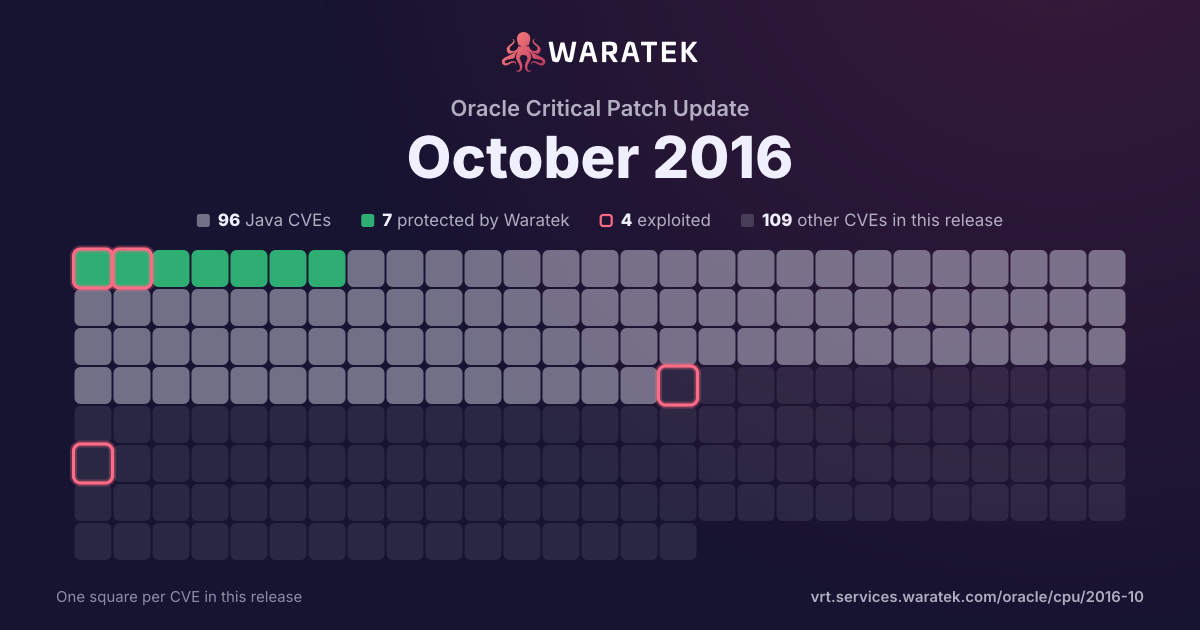
By status
7Protected by Waratek2Mitigation candidate87No exploit published39Outside Waratek scope68Not applicable2Withdrawn CVE
4Exploited, marked by the ring
No exploit published. For 83 of them, Oracle's security advisory is the source of public detail.
Protected by Waratek. Waratek RASP can block exploitation of these on systems that have not applied the patch yet.
Overview 198 matches · 89 in Waratek scope · 0 protected · 2 exploited · 0 CISA KEV · 9 public PoC · 8 EPSS ≥ 0.5
198matches
89in Waratek scope44.9%
0protected0.0%
2exploited1.0%
0CISA KEV0.0%
9public PoC4.5%
8EPSS ≥ 0.54.0%
Protected by Waratek
0
0.0%
Rule in development
0
0.0%
Mitigation candidate
2
1.0%
No exploit published
87
43.9%
Outside Waratek scope
39
19.7%
Not applicable
68
34.3%
Withdrawn CVE
2
1.0%
blocked by ARMR today
0
0.0%
partly blocked
0
0.0%
not blocked
198
100.0%
not established
0
0.0%
unrecorded
0
0.0%
Exploited
2
1.0%
Working exploit published
7
3.5%
Proof of concept only
0
0.0%
Forecast only
2
1.0%
No public exploit
187
94.4%
split by
peak 158 / quarter
Q1 131
Outside Waratek scope1
Medium1
not blocked1
Forecast only1
Q2 131
Outside Waratek scope1
Medium1
not blocked1
No public exploit1
Q3 130
Q4 130
Q1 143
No exploit published1
Outside Waratek scope2
Medium3
not blocked3
No public exploit3
Q2 144
Mitigation candidate1
No exploit published2
Outside Waratek scope1
High2
Medium2
not blocked4
Exploited1
Working exploit published1
No public exploit2
Q3 141
No exploit published1
Medium1
not blocked1
No public exploit1
Q4 142
Outside Waratek scope1
Not applicable1
Medium2
not blocked2
No public exploit2
Q1 159
Outside Waratek scope6
Not applicable3
High3
Medium6
not blocked9
Working exploit published1
No public exploit8
Q2 155
Outside Waratek scope4
Not applicable1
Medium5
not blocked5
No public exploit5
Q3 152
Outside Waratek scope2
Critical1
Medium1
not blocked2
Working exploit published1
No public exploit1
Q4 152
Outside Waratek scope2
Medium2
not blocked2
No public exploit2
Q1 163
Outside Waratek scope3
High2
Medium1
not blocked3
No public exploit3
Q2 162
Not applicable2
High1
Medium1
not blocked2
Working exploit published1
No public exploit1
Q3 164
Outside Waratek scope1
Not applicable3
Critical1
High3
not blocked4
Exploited1
Forecast only1
No public exploit2
Q4 16158
Mitigation candidate1
No exploit published83
Outside Waratek scope15
Not applicable57
Withdrawn CVE2
Critical10
High45
Medium85
Low16
Unknown2
not blocked158
Working exploit published3
No public exploit155
Q1 171
Not applicable1
High1
not blocked1
No public exploit1
Q1 13Q3 13Q1 14Q3 14Q1 15Q3 15Q1 16Q3 16Q1 17
| CVE | Severity | Published▾ | Status | Exploitation | Description |
|---|---|---|---|---|---|
| CVE-2016-5540 | Medium | 2016-10-25 | No exploit published | No public exploit | Unspecified vulnerability in the Oracle Retail Xstore Payment component in Oracle Retail Applications 1.x allows local users to affect confidentiality and integrity via unknown vectors. |
| CVE-2016-5539 | High | 2016-10-25 | No exploit published | No public exploit | Unspecified vulnerability in the Oracle Retail Xstore Payment component in Oracle Retail Applications 1.x allows local users to affect confidentiality, integrity, and availability via unknown vectors. |
| CVE-2016-5538 | Medium | 2016-10-25 | Not applicable | No public exploit | Unspecified vulnerability in the Oracle VM VirtualBox component before 5.0.28 and 5.1.x before 5.1.8 in Oracle Virtualization allows local users to affect confidentiality, integrity, and availability via vectors related to Core, a different vulnerability than CVE-2016-5501. |
| CVE-2016-5536 | High | 2016-10-25 | No exploit published | No public exploit | Unspecified vulnerability in the Oracle Platform Security for Java component in Oracle Fusion Middleware 12.1.3.0.0, 12.2.1.0.0, and 12.2.1.1.0 allows remote authenticated users to affect confidentiality, integrity, and availability via unknown vectors, a different vulnerability than CVE-2016-8281. |
| CVE-2016-5535 | Critical | 2016-10-25 | No exploit published | No public exploit | Unspecified vulnerability in the Oracle WebLogic Server component in Oracle Fusion Middleware 10.3.6.0, 12.1.3.0, 12.2.1.0, and 12.2.1.1 allows remote attackers to affect confidentiality, integrity, and availability via unknown vectors. |
| CVE-2016-5534 | Medium | 2016-10-25 | No exploit published | No public exploit | Unspecified vulnerability in the Siebel Apps - Customer Order Management component in Oracle Siebel CRM 16.1 allows remote authenticated users to affect confidentiality via unknown vectors. |
| CVE-2016-5533 | Medium | 2016-10-25 | No exploit published | No public exploit | Unspecified vulnerability in the Primavera P6 Enterprise Project Portfolio Management component in Oracle Primavera Products Suite 8.4, 15.x, and 16.x allows remote authenticated users to affect confidentiality and integrity via unknown vectors. |
| CVE-2016-5532 | Medium | 2016-10-25 | No exploit published | No public exploit | Unspecified vulnerability in the Oracle Shipping Execution component in Oracle E-Business Suite 12.1.1 through 12.1.3 and 12.2.3 through 12.2.6 allows remote attackers to affect confidentiality via vectors related to Workflow Events. |
| CVE-2016-5531 | Critical | 2016-10-25 | No exploit published | No public exploit | Unspecified vulnerability in the Oracle WebLogic Server component in Oracle Fusion Middleware 10.3.6.0, 12.1.3.0, and 12.2.1.0 allows remote attackers to affect confidentiality, integrity, and availability via vectors related to WLS-WebServices. |
| CVE-2016-5530 | Medium | 2016-10-25 | No exploit published | No public exploit | Unspecified vulnerability in the PeopleSoft Enterprise PeopleTools component in Oracle PeopleSoft Products 8.54 and 8.55 allows remote attackers to affect confidentiality and integrity via vectors related to Integration Broker, a different vulnerability than CVE-2016-5529 and CVE-2016-8293. |
| CVE-2016-5529 | Medium | 2016-10-25 | No exploit published | No public exploit | Unspecified vulnerability in the PeopleSoft Enterprise PeopleTools component in Oracle PeopleSoft Products 8.54 and 8.55 allows remote attackers to affect confidentiality and integrity via vectors related to Integration Broker, a different vulnerability than CVE-2016-5530 and CVE-2016-8293. |
| CVE-2016-5527 | Medium | 2016-10-25 | No exploit published | No public exploit | Unspecified vulnerability in the Oracle Agile PLM component in Oracle Supply Chain Products Suite 9.3.4 and 9.3.5 allows remote attackers to affect confidentiality via unknown vectors, a different vulnerability than CVE-2016-5524. |
| CVE-2016-5526 | High | 2016-10-25 | No exploit published | No public exploit | Unspecified vulnerability in the Oracle Agile PLM component in Oracle Supply Chain Products Suite 9.3.4 and 9.3.5 allows remote attackers to affect confidentiality, integrity, and availability via vectors related to Apache Tomcat. |
| CVE-2016-5525 | Low | 2016-10-25 | Not applicable | No public exploit | Unspecified vulnerability in the Solaris Cluster component in Oracle Sun Systems Products Suite 3.3 and 4.3 allows local users to affect integrity via vectors related to Cluster check files. |
| CVE-2016-5524 | Medium | 2016-10-25 | No exploit published | No public exploit | Unspecified vulnerability in the Oracle Agile PLM component in Oracle Supply Chain Products Suite 9.3.4 and 9.3.5 allows remote attackers to affect confidentiality via unknown vectors, a different vulnerability than CVE-2016-5527. |
| CVE-2016-5523 | High | 2016-10-25 | No exploit published | No public exploit | Unspecified vulnerability in the Oracle Agile PLM component in Oracle Supply Chain Products Suite 9.3.4 and 9.3.5 allows remote authenticated users to affect confidentiality, integrity, and availability via vectors related to AutoVue Java Applet. |
| CVE-2016-5522 | Medium | 2016-10-25 | No exploit published | No public exploit | Unspecified vulnerability in the Oracle Agile PLM component in Oracle Supply Chain Products Suite 9.3.4 and 9.3.5 allows remote authenticated users to affect confidentiality via unknown vectors. |
| CVE-2016-5521 | Medium | 2016-10-25 | No exploit published | No public exploit | Unspecified vulnerability in the Oracle Agile PLM component in Oracle Supply Chain Products Suite 9.3.4 and 9.3.5 allows remote attackers to affect confidentiality and integrity via unknown vectors, a different vulnerability than CVE-2016-5512. |
| CVE-2016-5519 | High | 2016-10-25 | No exploit published | No public exploit | Unspecified vulnerability in the Oracle GlassFish Server component in Oracle Fusion Middleware 2.1.1, 3.0.1, and 3.1.2 allows remote authenticated users to affect confidentiality, integrity, and availability via vectors related to Java Server Faces. |
| CVE-2016-5518 | High | 2016-10-25 | No exploit published | No public exploit | Unspecified vulnerability in the Oracle Agile Engineering Data Management component in Oracle Supply Chain Products Suite 6.1.3.0 and 6.2.0.0 allows remote attackers to affect confidentiality, integrity, and availability via vectors related to webfileservices. |
| CVE-2016-5517 | Medium | 2016-10-25 | No exploit published | No public exploit | Unspecified vulnerability in the Oracle Applications DBA component in Oracle E-Business Suite 12.1.3 allows local users to affect confidentiality via vectors related to AD Utilities. |
| CVE-2016-5516 | Medium | 2016-10-25 | Outside Waratek scope | No public exploit | Unspecified vulnerability in the Kernel PDB component in Oracle Database Server 12.1.0.2 allows local users to affect availability via unknown vectors. |
| CVE-2016-5515 | High | 2016-10-25 | No exploit published | No public exploit | Unspecified vulnerability in the Oracle Agile PLM component in Oracle Supply Chain Products Suite 9.3.4 and 9.3.5 allows remote authenticated users to affect confidentiality, integrity, and availability via vectors related to RMIServlet. |
| CVE-2016-5514 | High | 2016-10-25 | No exploit published | No public exploit | Unspecified vulnerability in the Oracle Agile PLM component in Oracle Supply Chain Products Suite 9.3.4 and 9.3.5 allows remote authenticated users to affect confidentiality, integrity, and availability via vectors related to ExportServlet. |
| CVE-2016-5513 | Medium | 2016-10-25 | No exploit published | No public exploit | Unspecified vulnerability in the Oracle Agile PLM component in Oracle Supply Chain Products Suite 9.3.4 and 9.3.5 allows remote authenticated users to affect confidentiality via vectors related to File Manager. |
| CVE-2016-5512 | Medium | 2016-10-25 | No exploit published | No public exploit | Unspecified vulnerability in the Oracle Agile PLM component in Oracle Supply Chain Products Suite 9.3.4 and 9.3.5 allows remote attackers to affect confidentiality and integrity via unknown vectors, a different vulnerability than CVE-2016-5521. |
| CVE-2016-5511 | Medium | 2016-10-25 | No exploit published | No public exploit | Unspecified vulnerability in the Oracle WebCenter Sites component in Oracle Fusion Middleware 12.2.1.0.0, 12.2.1.1.0, and 12.2.1.2.0 allows remote attackers to affect integrity via unknown vectors. |
| CVE-2016-5510 | Medium | 2016-10-25 | No exploit published | No public exploit | Unspecified vulnerability in the Oracle Agile PLM component in Oracle Supply Chain Products Suite 9.3.4 and 9.3.5 allows remote attackers to affect confidentiality via unknown vectors. |
| CVE-2016-5508 | Low | 2016-10-25 | Not applicable | No public exploit | Unspecified vulnerability in the Solaris Cluster component in Oracle Sun Systems Products Suite 4.3 allows local users to affect confidentiality via vectors related to Cluster Geo. |
| CVE-2016-5507 | Medium | 2016-10-25 | Not applicable | No public exploit | Unspecified vulnerability in Oracle MySQL 5.6.32 and earlier and 5.7.14 and earlier allows remote administrators to affect availability via vectors related to Server: InnoDB. |
| CVE-2016-5506 | Low | 2016-10-25 | No exploit published | No public exploit | Unspecified vulnerability in the Oracle Identity Manager component in Oracle Fusion Middleware allows local users to affect confidentiality and integrity via vectors related to App Server. |
| CVE-2016-5505 | Medium | 2016-10-25 | Outside Waratek scope | No public exploit | Unspecified vulnerability in the RDBMS Programmable Interface component in Oracle Database Server 11.2.0.4 and 12.1.0.2 allows local users to affect confidentiality via unknown vectors. |
| CVE-2016-5504 | Medium | 2016-10-25 | No exploit published | No public exploit | Unspecified vulnerability in the Oracle Agile Product Lifecycle Management for Process component in Oracle Supply Chain Products Suite 6.1.0.4, 6.1.1.6, and 6.2.0.0 allows local users to affect confidentiality via vectors related to Supplier Portal. |
| CVE-2016-5503 | High | 2016-10-25 | Not applicable | No public exploit | Unspecified vulnerability in the Sun ZFS Storage Appliance Kit (AK) component in Oracle Sun Systems Products Suite AK 2013 allows local users to affect confidentiality, integrity, and availability via vectors related to Core Services. |
| CVE-2016-5502 | Medium | 2016-10-25 | No exploit published | No public exploit | Unspecified vulnerability in the Oracle FLEXCUBE Universal Banking component in Oracle Financial Services Applications 11.3.0, 11.4.0, 12.0.1 through 12.0.3 allows remote authenticated users to affect confidentiality and integrity via vectors related to INFRA. |
| CVE-2016-5501 | High | 2016-10-25 | Not applicable | No public exploit | Unspecified vulnerability in the Oracle VM VirtualBox component before 5.0.28 and 5.1.x before 5.1.8 in Oracle Virtualization allows local users to affect confidentiality, integrity, and availability via vectors related to Core, a different vulnerability than CVE-2016-5538. |
| CVE-2016-5500 | High | 2016-10-25 | No exploit published | No public exploit | Unspecified vulnerability in the Oracle Discoverer component in Oracle Fusion Middleware 11.1.1.7.0 allows remote attackers to affect confidentiality via vectors related to Viewer. |
| CVE-2016-5499 | Low | 2016-10-25 | Outside Waratek scope | No public exploit | Unspecified vulnerability in the RDBMS Security component in Oracle Database Server 11.2.0.4 and 12.1.0.2 allows local users to affect confidentiality via unknown vectors, a different vulnerability than CVE-2016-5498. |
| CVE-2016-5498 | Low | 2016-10-25 | Outside Waratek scope | No public exploit | Unspecified vulnerability in the RDBMS Security component in Oracle Database Server 11.2.0.4 and 12.1.0.2 allows local users to affect confidentiality via unknown vectors, a different vulnerability than CVE-2016-5499. |
| CVE-2016-5497 | Medium | 2016-10-25 | Outside Waratek scope | No public exploit | Unspecified vulnerability in the RDBMS Security component in Oracle Database Server 12.1.0.2 allows local users to affect confidentiality, integrity, and availability via unknown vectors. |
| CVE-2016-5495 | High | 2016-10-25 | No exploit published | No public exploit | Unspecified vulnerability in the Oracle Discoverer component in Oracle Fusion Middleware 11.1.1.7.0 allows remote attackers to affect confidentiality via vectors related to EUL Code & Schema. |
| CVE-2016-5493 | Medium | 2016-10-25 | No exploit published | No public exploit | Unspecified vulnerability in the Oracle FLEXCUBE Private Banking component in Oracle Financial Services Applications 12.0.1 through 12.0.3 allows remote authenticated users to affect confidentiality and integrity via unknown vectors. |
| CVE-2016-5492 | High | 2016-10-25 | Not applicable | No public exploit | Unspecified vulnerability in the Sun ZFS Storage Appliance Kit (AK) component in Oracle Sun Systems Products Suite AK 2013 allows local users to affect confidentiality and integrity via vectors related to SMB Users. |
| CVE-2016-5491 | High | 2016-10-25 | No exploit published | No public exploit | Unspecified vulnerability in the Oracle Commerce Service Center component in Oracle Commerce 10.0.3.5 and 10.2.0.5 allows remote attackers to affect confidentiality and integrity via unknown vectors. |
| CVE-2016-5490 | Low | 2016-10-25 | No exploit published | No public exploit | Unspecified vulnerability in the Oracle FLEXCUBE Universal Banking component in Oracle Financial Services Applications 11.4.0 allows local users to affect confidentiality via vectors related to INFRA. |
| CVE-2016-5489 | High | 2016-10-25 | No exploit published | No public exploit | Unspecified vulnerability in the Oracle iStore component in Oracle E-Business Suite 12.1.1 through 12.1.3, 12.2.3, and 12.2.4 allows remote attackers to affect confidentiality and integrity via vectors related to Runtime Catalog. |
| CVE-2016-5488 | Medium | 2016-10-25 | No exploit published | No public exploit | Unspecified vulnerability in the Oracle WebLogic Server component in Oracle Fusion Middleware 10.3.6.0 and 12.1.3.0 allows remote attackers to affect availability via vectors related to Web Container, a different vulnerability than CVE-2016-3445. |
| CVE-2016-5487 | Medium | 2016-10-25 | Not applicable | No public exploit | Unspecified vulnerability in Oracle Sun Solaris 11.3 allows local users to affect confidentiality, integrity, and availability via unknown vectors. |
| CVE-2016-5486 | Medium | 2016-10-25 | Not applicable | No public exploit | Unspecified vulnerability in the Sun ZFS Storage Appliance Kit (AK) component in Oracle Sun Systems Products Suite AK 2013 allows local users to affect confidentiality via vectors related to Core Services. |
| CVE-2016-5482 | High | 2016-10-25 | No exploit published | No public exploit | Unspecified vulnerability in the Oracle Commerce Guided Search component in Oracle Commerce 6.2.2, 6.3.0, 6.4.1.2, and 6.5.0 through 6.5.2 allows remote attackers to affect confidentiality and integrity via unknown vectors. |
| CVE-2016-5481 | Low | 2016-10-25 | Not applicable | No public exploit | Unspecified vulnerability in the Sun ZFS Storage Appliance Kit (AK) component in Oracle Sun Systems Products Suite AK 2013 allows remote attackers to affect confidentiality via vectors related to Core Services. |
| CVE-2016-5480 | Low | 2016-10-25 | Not applicable | No public exploit | Unspecified vulnerability in Oracle Sun Solaris 10 allows local users to affect integrity via vectors related to Bash. |
| CVE-2016-5479 | Medium | 2016-10-25 | No exploit published | No public exploit | Unspecified vulnerability in the Oracle FLEXCUBE Universal Banking component in Oracle Financial Services Applications 11.3.0, 11.4.0, and 12.0.1 allows remote authenticated users to affect confidentiality via vectors related to INFRA. |
| CVE-2016-3562 | Low | 2016-10-25 | Outside Waratek scope | No public exploit | Unspecified vulnerability in the RDBMS Security and SQL*Plus components in Oracle Database Server 11.2.0.4 and 12.1.0.2 allows remote administrators to affect confidentiality via vectors related to DBA. |
| CVE-2016-3551 | Critical | 2016-10-25 | No exploit published | No public exploit | Unspecified vulnerability in the Oracle Web Services component in Oracle Fusion Middleware 11.1.1.7.0, 11.1.1.9.0, 12.1.3.0.0, and 12.2.1.0.0 allows remote attackers to affect confidentiality, integrity, and availability via vectors related to JAXWS Web Services Stack. |
| CVE-2016-3505 | High | 2016-10-25 | No exploit published | No public exploit | Unspecified vulnerability in the Oracle WebLogic Server component in Oracle Fusion Middleware 10.3.6.0, 12.1.3.0, and 12.2.1.0 allows remote authenticated users to affect confidentiality, integrity, and availability via vectors related to JavaServer Faces. |
| CVE-2016-3495 | Medium | 2016-10-25 | Not applicable | No public exploit | Unspecified vulnerability in Oracle MySQL 5.7.13 and earlier allows remote administrators to affect availability via vectors related to Server: InnoDB. |
| CVE-2016-3492 | Medium | 2016-10-25 | Not applicable | No public exploit | Unspecified vulnerability in Oracle MySQL 5.5.51 and earlier, 5.6.32 and earlier, and 5.7.14 and earlier allows remote authenticated users to affect availability via vectors related to Server: Optimizer. |
| CVE-2016-3473 | High | 2016-10-25 | Mitigation candidate | Working exploit published | Unspecified vulnerability in the BI Publisher (formerly XML Publisher) component in Oracle Fusion Middleware 11.1.1.7.0, 11.1.1.9.0, and 12.2.1.0.0 allows remote authenticated users to affect confidentiality via unknown vectors. |
| CVE-2016-6304 | High | 2016-09-26 | Not applicable | Forecast only | Multiple memory leaks in t1_lib.c in OpenSSL before 1.0.1u, 1.0.2 before 1.0.2i, and 1.1.0 before 1.1.0a allow remote attackers to cause a denial of service (memory consumption) via large OCSP Status Request extensions. |
| CVE-2016-6662 | Critical | 2016-09-20 | Not applicable | Exploited | Oracle MySQL through 5.5.52, 5.6.x through 5.6.33, and 5.7.x through 5.7.15; MariaDB before 5.5.51, 10.0.x before 10.0.27, and 10.1.x before 10.1.17; and Percona Server before 5.5.51-38.1, 5.6.x before 5.6.32-78.0, and 5.7.x before 5.7.14-7 allow local users to create arbitrary configurations and bypass certain protection mechanisms by setting general_log_file to a my.cnf configuration. NOTE: this can be leveraged to execute arbitrary code with root privileges by setting malloc_lib. NOTE: the affected MySQL version information is from Oracle's October 2016 CPU. Oracle has not commented on third-party claims that the issue was silently patched in MySQL 5.5.52, 5.6.33, and 5.7.15. |
| CVE-2016-0635 | High | 2016-07-21 | Outside Waratek scope | No public exploit | Unspecified vulnerability in the Enterprise Manager Ops Center component in Oracle Enterprise Manager Grid Control 12.1.4, 12.2.2, and 12.3.2; the Oracle Health Sciences Information Manager component in Oracle Health Sciences Applications 1.2.8.3, 2.0.2.3, and 3.0.1.0; the Oracle Healthcare Master Person Index component in Oracle Health Sciences Applications 2.0.12, 3.0.0, and 4.0.1; the Oracle Documaker component in Oracle Insurance Applications before 12.5; the Oracle Insurance Calculation Engine component in Oracle Insurance Applications 9.7.1, 10.1.2, and 10.2.2; the Oracle Insurance Policy Administration J2EE and Oracle Insurance Rules Palette components in Oracle Insurance Applications 9.6.1, 9.7.1, 10.0.1, 10.1.2, 10.2.0, and 10.2.2; the Oracle Retail Integration Bus component in Oracle Retail Applications 15.0; the Oracle Retail Order Broker component in Oracle Retail Applications 5.1, 5.2, and 15.0; the Primavera Contract Management component in Oracle Primavera Products Suite 14.2; the Primavera P6 Enterprise Project Portfolio Management component in Oracle Primavera Products Suite 8.2, 8.3, 8.4, 15.1, 15.2, and 16.1; the Oracle Financial Services Analytical Applications Infrastructure component in Oracle Financial Services Applications 8.0.0, 8.0.1, 8.0.2, and 8.0.3; the Oracle Commerce Guided Search / Oracle Commerce Experience Manager component in Oracle Commerce 3.1.1, 3.1.2, 11.0, 11.1, and 11.2; the Oracle Agile PLM component in Oracle Supply Chain Products Suite 9.3.4 and 9.3.5; the Oracle Communications BRM - Elastic Charging Engine 11.2.0.0.0 and 11.3.0.0.0; the Oracle Enterprise Repository Enterprise Repository 12.1.3.0.0; the Oracle Financial Services Behavior Detection Platform 8.0.1 and 8.0.2; the Oracle Hyperion Essbase 12.2.1.1; the Oracle Tuxedo System and Applications Monitor (TSAM) 11.1.1.2.0, 11.1.1.2.1, 11.1.1.2.1, 12.1.1.1.0, 12.1.3.0.0, and 12.2.2.0.0; the Oracle Communications WebRTC Session Controller component of Oracle Communications Applications (subcomponent: Security (Spring)) 7.0, 7.1 and 7.2; the Oracle Endeca Information Discovery Integrator 3.2; the Converged Commerce component of Oracle Retail Applications 16.0.1; the Oracle Identity Manager 11.1.2.3.0; Oracle Enterprise Manager for MySQL Database 12.1.0.4; Oracle Retail Invoice Matching 12.0, 13.0, 13.1, 13.2, 14.0, and 14.1; Oracle Communications Performance Intelligence Center (PIC) Software Prior to 10.2.1 and the Oracle Knowledge component of Oracle Siebel CRM (subcomponent: AnswerFlow (Spring Framework)) version 8.5.1.0 - 8.5.1.7 and 8.6.0 allows remote authenticated users to affect confidentiality, integrity, and availability via unknown vectors. |
| CVE-2016-4979 | High | 2016-07-06 | Not applicable | No public exploit | The Apache HTTP Server 2.4.18 through 2.4.20, when mod_http2 and mod_ssl are enabled, does not properly recognize the "SSLVerifyClient require" directive for HTTP/2 request authorization, which allows remote attackers to bypass intended access restrictions by leveraging the ability to send multiple requests over a single connection and aborting a renegotiation. |
| CVE-2016-2176 | High | 2016-05-05 | Not applicable | No public exploit | The X509_NAME_oneline function in crypto/x509/x509_obj.c in OpenSSL before 1.0.1t and 1.0.2 before 1.0.2h allows remote attackers to obtain sensitive information from process stack memory or cause a denial of service (buffer over-read) via crafted EBCDIC ASN.1 data. |
| CVE-2016-2107 | Medium | 2016-05-05 | Not applicable | Working exploit published | The AES-NI implementation in OpenSSL before 1.0.1t and 1.0.2 before 1.0.2h does not consider memory allocation during a certain padding check, which allows remote attackers to obtain sensitive cleartext information via a padding-oracle attack against an AES CBC session. NOTE: this vulnerability exists because of an incorrect fix for CVE-2013-0169. |
| CVE-2016-1950 | High | 2016-03-13 | Outside Waratek scope | No public exploit | Heap-based buffer overflow in Mozilla Network Security Services (NSS) before 3.19.2.3 and 3.20.x and 3.21.x before 3.21.1, as used in Mozilla Firefox before 45.0 and Firefox ESR 38.x before 38.7, allows remote attackers to execute arbitrary code via crafted ASN.1 data in an X.509 certificate. |
| CVE-2016-0714 | High | 2016-02-25 | Outside Waratek scope | No public exploit | The session-persistence implementation in Apache Tomcat 6.x before 6.0.45, 7.x before 7.0.68, 8.x before 8.0.31, and 9.x before 9.0.0.M2 mishandles session attributes, which allows remote authenticated users to bypass intended SecurityManager restrictions and execute arbitrary code in a privileged context via a web application that places a crafted object in a session. |
| CVE-2015-3197 | Medium | 2016-02-15 | Outside Waratek scope | No public exploit | ssl/s2_srvr.c in OpenSSL 1.0.1 before 1.0.1r and 1.0.2 before 1.0.2f does not prevent use of disabled ciphers, which makes it easier for man-in-the-middle attackers to defeat cryptographic protection mechanisms by performing computations on SSLv2 traffic, related to the get_client_master_key and get_client_hello functions. |
| CVE-2015-3195 | Medium | 2015-12-06 | Outside Waratek scope | No public exploit | The ASN1_TFLG_COMBINE implementation in crypto/asn1/tasn_dec.c in OpenSSL before 0.9.8zh, 1.0.0 before 1.0.0t, 1.0.1 before 1.0.1q, and 1.0.2 before 1.0.2e mishandles errors caused by malformed X509_ATTRIBUTE data, which allows remote attackers to obtain sensitive information from process memory by triggering a decoding failure in a PKCS#7 or CMS application. |
| CVE-2015-7940 | Medium | 2015-11-09 | Outside Waratek scope | No public exploit | The Bouncy Castle Java library before 1.51 does not validate a point is withing the elliptic curve, which makes it easier for remote attackers to obtain private keys via a series of crafted elliptic curve Diffie Hellman (ECDH) key exchanges, aka an "invalid curve attack." |
| CVE-2015-3253 | Critical | 2015-08-13 | Outside Waratek scope | No public exploit | The MethodClosure class in runtime/MethodClosure.java in Apache Groovy 1.7.0 through 2.4.3 allows remote attackers to execute arbitrary code or cause a denial of service via a crafted serialized object. |
| CVE-2015-1793 | Medium | 2015-07-09 | Outside Waratek scope | Working exploit published | The X509_verify_cert function in crypto/x509/x509_vfy.c in OpenSSL 1.0.1n, 1.0.1o, 1.0.2b, and 1.0.2c does not properly process X.509 Basic Constraints cA values during identification of alternative certificate chains, which allows remote attackers to spoof a Certification Authority role and trigger unintended certificate verifications via a valid leaf certificate. |
| CVE-2015-1791 | Medium | 2015-06-12 | Not applicable | No public exploit | Race condition in the ssl3_get_new_session_ticket function in ssl/s3_clnt.c in OpenSSL before 0.9.8zg, 1.0.0 before 1.0.0s, 1.0.1 before 1.0.1n, and 1.0.2 before 1.0.2b, when used for a multi-threaded client, allows remote attackers to cause a denial of service (double free and application crash) or possibly have unspecified other impact by providing a NewSessionTicket during an attempt to reuse a ticket that had been obtained earlier. |
| CVE-2015-2568 | Medium | 2015-04-16 | Outside Waratek scope | No public exploit | Unspecified vulnerability in Oracle MySQL Server 5.5.41 and earlier, and 5.6.22 and earlier, allows remote attackers to affect availability via unknown vectors related to Server : Security : Privileges. |
| CVE-2015-0500 | Medium | 2015-04-16 | Outside Waratek scope | No public exploit | Unspecified vulnerability in Oracle MySQL Server 5.6.23 and earlier allows remote authenticated users to affect availability via unknown vectors. |
| CVE-2015-0433 | Medium | 2015-04-16 | Outside Waratek scope | No public exploit | Unspecified vulnerability in Oracle MySQL Server 5.5.41 and earlier, and 5.6.22 and earlier, allows remote authenticated users to affect availability via vectors related to InnoDB : DML. |
| CVE-2015-0423 | Medium | 2015-04-16 | Outside Waratek scope | No public exploit | Unspecified vulnerability in Oracle MySQL Server 5.6.22 and earlier allows remote authenticated users to affect availability via unknown vectors related to Optimizer. |
| CVE-2015-1351 | High | 2015-03-30 | Not applicable | No public exploit | Use-after-free vulnerability in the _zend_shared_memdup function in zend_shared_alloc.c in the OPcache extension in PHP through 5.6.7 allows remote attackers to cause a denial of service or possibly have unspecified other impact via unknown vectors. |
| CVE-2015-0286 | Medium | 2015-03-19 | Not applicable | No public exploit | The ASN1_TYPE_cmp function in crypto/asn1/a_type.c in OpenSSL before 0.9.8zf, 1.0.0 before 1.0.0r, 1.0.1 before 1.0.1m, and 1.0.2 before 1.0.2a does not properly perform boolean-type comparisons, which allows remote attackers to cause a denial of service (invalid read operation and application crash) via a crafted X.509 certificate to an endpoint that uses the certificate-verification feature. |
| CVE-2014-0227 | Medium | 2015-02-16 | Outside Waratek scope | No public exploit | java/org/apache/coyote/http11/filters/ChunkedInputFilter.java in Apache Tomcat 6.x before 6.0.42, 7.x before 7.0.55, and 8.x before 8.0.9 does not properly handle attempts to continue reading data after an error has occurred, which allows remote attackers to conduct HTTP request smuggling attacks or cause a denial of service (resource consumption) by streaming data with malformed chunked transfer coding. |
| CVE-2015-0235 | High | 2015-01-28 | Outside Waratek scope | Working exploit published | Heap-based buffer overflow in the __nss_hostname_digits_dots function in glibc 2.2, and other 2.x versions before 2.18, allows context-dependent attackers to execute arbitrary code via vectors related to the (1) gethostbyname or (2) gethostbyname2 function, aka "GHOST." |
| CVE-2015-0411 | High | 2015-01-21 | Outside Waratek scope | No public exploit | Unspecified vulnerability in Oracle MySQL Server 5.5.40 and earlier, and 5.6.21 and earlier, allows remote attackers to affect confidentiality, integrity, and availability via unknown vectors related to Server : Security : Encryption. |
| CVE-2015-0409 | Medium | 2015-01-21 | Outside Waratek scope | No public exploit | Unspecified vulnerability in Oracle MySQL Server 5.6.21 and earlier allows remote authenticated users to affect availability via unknown vectors related to Optimizer. |
| CVE-2015-0382 | Medium | 2015-01-21 | Outside Waratek scope | No public exploit | Unspecified vulnerability in Oracle MySQL Server 5.5.40 and earlier and 5.6.21 and earlier allows remote attackers to affect availability via unknown vectors related to Server : Replication, a different vulnerability than CVE-2015-0381. |
| CVE-2015-0381 | Medium | 2015-01-21 | Outside Waratek scope | No public exploit | Unspecified vulnerability in Oracle MySQL Server 5.5.40 and earlier and 5.6.21 and earlier allows remote attackers to affect availability via unknown vectors related to Server : Replication, a different vulnerability than CVE-2015-0382. |
| CVE-2014-3571 | Medium | 2015-01-09 | Not applicable | No public exploit | OpenSSL before 0.9.8zd, 1.0.0 before 1.0.0p, and 1.0.1 before 1.0.1k allows remote attackers to cause a denial of service (NULL pointer dereference and application crash) via a crafted DTLS message that is processed with a different read operation for the handshake header than for the handshake body, related to the dtls1_get_record function in d1_pkt.c and the ssl3_read_n function in s3_pkt.c. |
| CVE-2014-9296 | Medium | 2014-12-20 | Not applicable | No public exploit | The receive function in ntp_proto.c in ntpd in NTP before 4.2.8 continues to execute after detecting a certain authentication error, which might allow remote attackers to trigger an unintended association change via crafted packets. |
| CVE-2010-5312 | Medium | 2014-11-24 | Outside Waratek scope | No public exploit | Cross-site scripting (XSS) vulnerability in jquery.ui.dialog.js in the Dialog widget in jQuery UI before 1.10.0 allows remote attackers to inject arbitrary web script or HTML via the title option. |
| CVE-2013-4444 | Medium | 2014-09-12 | No exploit published | No public exploit | Unrestricted file upload vulnerability in Apache Tomcat 7.x before 7.0.40, in certain situations involving outdated java.io.File code and a custom JMX configuration, allows remote attackers to execute arbitrary code by uploading and accessing a JSP file. |
| CVE-2014-0224 | High | 2014-06-05 | Outside Waratek scope | Exploited | OpenSSL before 0.9.8za, 1.0.0 before 1.0.0m, and 1.0.1 before 1.0.1h does not properly restrict processing of ChangeCipherSpec messages, which allows man-in-the-middle attackers to trigger use of a zero-length master key in certain OpenSSL-to-OpenSSL communications, and consequently hijack sessions or obtain sensitive information, via a crafted TLS handshake, aka the "CCS Injection" vulnerability. |
| CVE-2014-0099 | Medium | 2014-05-31 | No exploit published | No public exploit | Integer overflow in java/org/apache/tomcat/util/buf/Ascii.java in Apache Tomcat before 6.0.40, 7.x before 7.0.53, and 8.x before 8.0.4, when operated behind a reverse proxy, allows remote attackers to conduct HTTP request smuggling attacks via a crafted Content-Length HTTP header. |
| CVE-2014-0075 | Medium | 2014-05-31 | No exploit published | No public exploit | Integer overflow in the parseChunkHeader function in java/org/apache/coyote/http11/filters/ChunkedInputFilter.java in Apache Tomcat before 6.0.40, 7.x before 7.0.53, and 8.x before 8.0.4 allows remote attackers to cause a denial of service (resource consumption) via a malformed chunk size in chunked transfer coding of a request during the streaming of data. |
| CVE-2014-0050 | High | 2014-04-01 | Mitigation candidate | Working exploit published | MultipartStream.java in Apache Commons FileUpload before 1.3.1, as used in Apache Tomcat, JBoss Web, and other products, allows remote attackers to cause a denial of service (infinite loop and CPU consumption) via a crafted Content-Type header that bypasses a loop's intended exit conditions. |
| CVE-2014-2532 | Medium | 2014-03-18 | Outside Waratek scope | No public exploit | sshd in OpenSSH before 6.6 does not properly support wildcards on AcceptEnv lines in sshd_config, which allows remote attackers to bypass intended environment restrictions by using a substring located before a wildcard character. |
| CVE-2013-4322 | Medium | 2014-02-26 | No exploit published | No public exploit | Apache Tomcat before 6.0.39, 7.x before 7.0.50, and 8.x before 8.0.0-RC10 processes chunked transfer coding without properly handling (1) a large total amount of chunked data or (2) whitespace characters in an HTTP header value within a trailer field, which allows remote attackers to cause a denial of service by streaming data. NOTE: this vulnerability exists because of an incomplete fix for CVE-2012-3544. |
| CVE-2013-4286 | Medium | 2014-02-26 | Outside Waratek scope | No public exploit | Apache Tomcat before 6.0.39, 7.x before 7.0.47, and 8.x before 8.0.0-RC3, when an HTTP connector or AJP connector is used, does not properly handle certain inconsistent HTTP request headers, which allows remote attackers to trigger incorrect identification of a request's length and conduct request-smuggling attacks via (1) multiple Content-Length headers or (2) a Content-Length header and a "Transfer-Encoding: chunked" header. NOTE: this vulnerability exists because of an incomplete fix for CVE-2005-2090. |
| CVE-2013-2067 | Medium | 2013-06-01 | Outside Waratek scope | No public exploit | java/org/apache/catalina/authenticator/FormAuthenticator.java in the form authentication feature in Apache Tomcat 6.0.21 through 6.0.36 and 7.x before 7.0.33 does not properly handle the relationships between authentication requirements and sessions, which allows remote attackers to inject a request into a session by sending this request during completion of the login form, a variant of a session fixation attack. |
| CVE-2013-2566 | Medium | 2013-03-15 | Outside Waratek scope | Forecast only | The RC4 algorithm, as used in the TLS protocol and SSL protocol, has many single-byte biases, which makes it easier for remote attackers to conduct plaintext-recovery attacks via statistical analysis of ciphertext in a large number of sessions that use the same plaintext. |