
Oracle Critical Patch Update October 2016
Released October 2016 · Oracle's advisory ↗ · ← Critical Patch Update, July 2016 · Critical Patch Update, January 2017 →
205 CVEs in this release, one square each
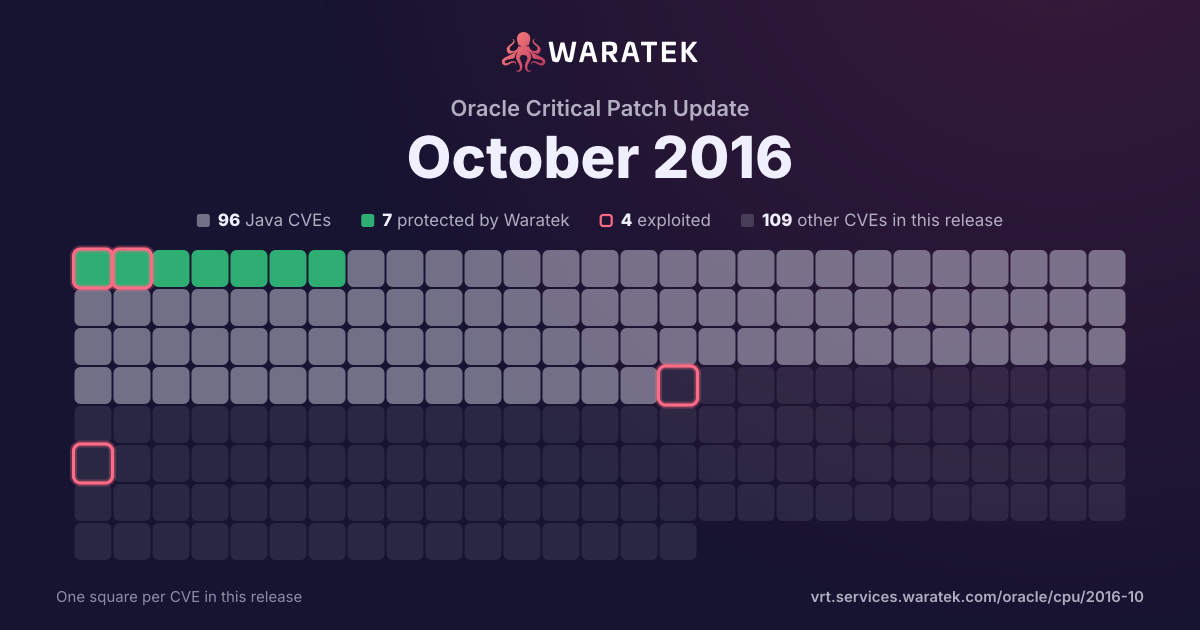
By status
7Protected by Waratek2Mitigation candidate87No exploit published39Outside Waratek scope68Not applicable2Withdrawn CVE
4Exploited, marked by the ring
No exploit published. For 83 of them, Oracle's security advisory is the source of public detail.
Protected by Waratek. Waratek RASP can block exploitation of these on systems that have not applied the patch yet.
Overview 9 matches · 1 protected · 0 exploited · 0 CISA KEV · 2 public PoC · 1 EPSS ≥ 0.5
Protected by Waratek
1
11.1%
Rule in development
0
0.0%
Mitigation candidate
2
22.2%
No exploit published
6
66.7%
blocked by ARMR today
1
11.1%
partly blocked
0
0.0%
not blocked
8
88.9%
not established
0
0.0%
unrecorded
0
0.0%
Exploited
0
0.0%
Working exploit published
2
22.2%
Proof of concept only
0
0.0%
Forecast only
0
0.0%
No public exploit
7
77.8%
split by
peak 7 / quarter
Q2 141
Mitigation candidate1
High1
not blocked1
Working exploit published1
Q3 140
Q4 140
Q1 150
Q2 150
Q3 150
Q4 150
Q1 160
Q2 160
Q3 161
Protected by Waratek1
High1
blocked by ARMR today1
No public exploit1
Q4 167
Mitigation candidate1
No exploit published6
High7
not blocked7
Working exploit published1
No public exploit6
Q2 14Q3 14Q4 14Q1 15Q2 15Q3 15Q4 15Q1 16Q2 16Q3 16Q4 16
| CVE | Severity | Published▾ | Status | Exploitation | Description |
|---|---|---|---|---|---|
| CVE-2016-8281 | High | 2016-10-25 | No exploit published | No public exploit | Unspecified vulnerability in the Oracle Platform Security for Java component in Oracle Fusion Middleware 12.1.3.0.0, 12.2.1.0.0, and 12.2.1.1.0 allows remote authenticated users to affect confidentiality, integrity, and availability via unknown vectors, a different vulnerability than CVE-2016-5536. |
| CVE-2016-5536 | High | 2016-10-25 | No exploit published | No public exploit | Unspecified vulnerability in the Oracle Platform Security for Java component in Oracle Fusion Middleware 12.1.3.0.0, 12.2.1.0.0, and 12.2.1.1.0 allows remote authenticated users to affect confidentiality, integrity, and availability via unknown vectors, a different vulnerability than CVE-2016-8281. |
| CVE-2016-5519 | High | 2016-10-25 | No exploit published | No public exploit | Unspecified vulnerability in the Oracle GlassFish Server component in Oracle Fusion Middleware 2.1.1, 3.0.1, and 3.1.2 allows remote authenticated users to affect confidentiality, integrity, and availability via vectors related to Java Server Faces. |
| CVE-2016-5500 | High | 2016-10-25 | No exploit published | No public exploit | Unspecified vulnerability in the Oracle Discoverer component in Oracle Fusion Middleware 11.1.1.7.0 allows remote attackers to affect confidentiality via vectors related to Viewer. |
| CVE-2016-5495 | High | 2016-10-25 | No exploit published | No public exploit | Unspecified vulnerability in the Oracle Discoverer component in Oracle Fusion Middleware 11.1.1.7.0 allows remote attackers to affect confidentiality via vectors related to EUL Code & Schema. |
| CVE-2016-3505 | High | 2016-10-25 | No exploit published | No public exploit | Unspecified vulnerability in the Oracle WebLogic Server component in Oracle Fusion Middleware 10.3.6.0, 12.1.3.0, and 12.2.1.0 allows remote authenticated users to affect confidentiality, integrity, and availability via vectors related to JavaServer Faces. |
| CVE-2016-3473 | High | 2016-10-25 | Mitigation candidate | Working exploit published | Unspecified vulnerability in the BI Publisher (formerly XML Publisher) component in Oracle Fusion Middleware 11.1.1.7.0, 11.1.1.9.0, and 12.2.1.0.0 allows remote authenticated users to affect confidentiality via unknown vectors. |
| CVE-2016-1181 | High | 2016-07-04 | Protected by Waratek | No public exploit | ActionServlet.java in Apache Struts 1 1.x through 1.3.10 mishandles multithreaded access to an ActionForm instance, which allows remote attackers to execute arbitrary code or cause a denial of service (unexpected memory access) via a multipart request, a related issue to CVE-2015-0899. |
| CVE-2014-0050 | High | 2014-04-01 | Mitigation candidate | Working exploit published | MultipartStream.java in Apache Commons FileUpload before 1.3.1, as used in Apache Tomcat, JBoss Web, and other products, allows remote attackers to cause a denial of service (infinite loop and CPU consumption) via a crafted Content-Type header that bypasses a loop's intended exit conditions. |