
Oracle Critical Patch Update October 2016
Released October 2016 · Oracle's advisory ↗ · ← Critical Patch Update, July 2016 · Critical Patch Update, January 2017 →
205 CVEs in this release, one square each
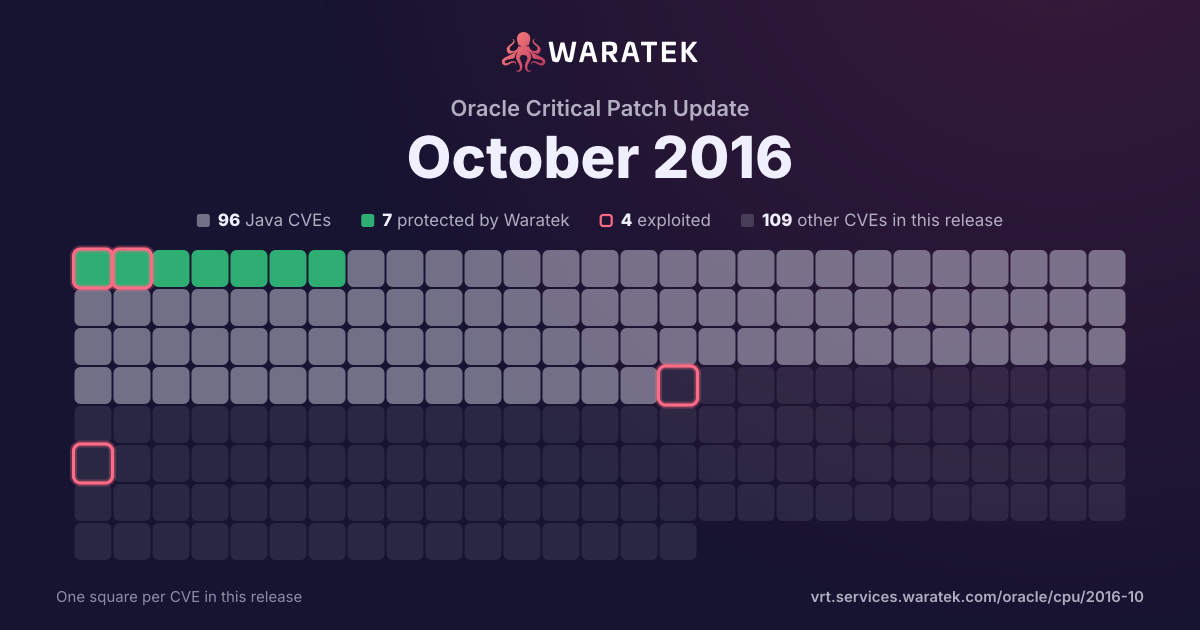
By status
7Protected by Waratek2Mitigation candidate87No exploit published39Outside Waratek scope68Not applicable2Withdrawn CVE
4Exploited, marked by the ring
No exploit published. For 83 of them, Oracle's security advisory is the source of public detail.
Protected by Waratek. Waratek RASP can block exploitation of these on systems that have not applied the patch yet.
Overview 14 matches · 1 protected · 0 exploited · 0 CISA KEV · 0 public PoC · 0 EPSS ≥ 0.5
Protected by Waratek
1
7.1%
Rule in development
0
0.0%
Mitigation candidate
0
0.0%
No exploit published
13
92.9%
blocked by ARMR today
1
7.1%
partly blocked
0
0.0%
not blocked
13
92.9%
not established
0
0.0%
unrecorded
0
0.0%
Exploited
0
0.0%
Working exploit published
0
0.0%
Proof of concept only
0
0.0%
Forecast only
0
0.0%
No public exploit
14
100.0%
split by
peak 13 / month
Jul 16Aug 16Sep 16Oct 16
| CVE | Severity | Published▾ | Status | Exploitation | Description |
|---|---|---|---|---|---|
| CVE-2016-5622 | Medium | 2016-10-25 | No exploit published | No public exploit | Unspecified vulnerability in the Oracle FLEXCUBE Universal Banking component in Oracle Financial Services Applications 11.3.0, 11.4.0, 12.0.1 through 12.0.3, 12.1.0, and 12.2.0 allows remote attackers to affect confidentiality and integrity via vectors related to INFRA. |
| CVE-2016-5621 | Medium | 2016-10-25 | No exploit published | No public exploit | Unspecified vulnerability in the Oracle FLEXCUBE Universal Banking component in Oracle Financial Services Applications 11.3.0, 11.4.0, 12.0.1 and 12.0.3, 12.1.0, and 12.2.0 allows remote authenticated users to affect confidentiality via vectors related to INFRA, a different vulnerability than CVE-2016-5603. |
| CVE-2016-5620 | Medium | 2016-10-25 | No exploit published | No public exploit | Unspecified vulnerability in the Oracle FLEXCUBE Universal Banking component in Oracle Financial Services Applications 11.3.0, 11.4.0, 12.0.1 through 12.0.3, 12.1.0, and 12.2.0 allows remote authenticated users to affect confidentiality and integrity via vectors related to INFRA, a different vulnerability than CVE-2016-5619. |
| CVE-2016-5619 | High | 2016-10-25 | No exploit published | No public exploit | Unspecified vulnerability in the Oracle FLEXCUBE Universal Banking component in Oracle Financial Services Applications 11.3.0, 11.4.0, 12.0.1 through 12.0.3, 12.1.0, and 12.2.0 allows remote authenticated users to affect confidentiality and integrity via vectors related to INFRA, a different vulnerability than CVE-2016-5620. |
| CVE-2016-5607 | High | 2016-10-25 | No exploit published | No public exploit | Unspecified vulnerability in the Oracle FLEXCUBE Universal Banking component in Oracle Financial Services Applications 11.3.0, 11.4.0, 12.0.1 through 12.0.3, 12.1.0, and 12.2.0 allows remote authenticated users to affect confidentiality, integrity, and availability via vectors related to INFRA. |
| CVE-2016-5603 | Medium | 2016-10-25 | No exploit published | No public exploit | Unspecified vulnerability in the Oracle FLEXCUBE Universal Banking component in Oracle Financial Services Applications 11.3.0, 11.4.0, 12.0.1 through 12.0.3, 12.1.0, and 12.2.0 allows remote authenticated users to affect confidentiality via vectors related to INFRA, a different vulnerability than CVE-2016-5621. |
| CVE-2016-5594 | Medium | 2016-10-25 | No exploit published | No public exploit | Unspecified vulnerability in the Oracle FLEXCUBE Universal Banking component in Oracle Financial Services Applications 11.3.0, 11.4.0, and 12.0.1 through 12.0.3 allows remote authenticated users to affect confidentiality via vectors related to INFRA. |
| CVE-2016-5569 | Medium | 2016-10-25 | No exploit published | No public exploit | Unspecified vulnerability in the Oracle FLEXCUBE Enterprise Limits and Collateral Management component in Oracle Financial Services Applications 12.0.0 and 12.1.0 allows remote authenticated users to affect confidentiality and integrity via unknown vectors. |
| CVE-2016-5543 | Medium | 2016-10-25 | No exploit published | No public exploit | Unspecified vulnerability in the Oracle FLEXCUBE Enterprise Limits and Collateral Management component in Oracle Financial Services Applications 12.0.0 and 12.1.0 allows remote attackers to affect confidentiality and integrity via vectors related to INFRA. |
| CVE-2016-5502 | Medium | 2016-10-25 | No exploit published | No public exploit | Unspecified vulnerability in the Oracle FLEXCUBE Universal Banking component in Oracle Financial Services Applications 11.3.0, 11.4.0, 12.0.1 through 12.0.3 allows remote authenticated users to affect confidentiality and integrity via vectors related to INFRA. |
| CVE-2016-5493 | Medium | 2016-10-25 | No exploit published | No public exploit | Unspecified vulnerability in the Oracle FLEXCUBE Private Banking component in Oracle Financial Services Applications 12.0.1 through 12.0.3 allows remote authenticated users to affect confidentiality and integrity via unknown vectors. |
| CVE-2016-5490 | Low | 2016-10-25 | No exploit published | No public exploit | Unspecified vulnerability in the Oracle FLEXCUBE Universal Banking component in Oracle Financial Services Applications 11.4.0 allows local users to affect confidentiality via vectors related to INFRA. |
| CVE-2016-5479 | Medium | 2016-10-25 | No exploit published | No public exploit | Unspecified vulnerability in the Oracle FLEXCUBE Universal Banking component in Oracle Financial Services Applications 11.3.0, 11.4.0, and 12.0.1 allows remote authenticated users to affect confidentiality via vectors related to INFRA. |
| CVE-2016-1181 | High | 2016-07-04 | Protected by Waratek | No public exploit | ActionServlet.java in Apache Struts 1 1.x through 1.3.10 mishandles multithreaded access to an ActionForm instance, which allows remote attackers to execute arbitrary code or cause a denial of service (unexpected memory access) via a multipart request, a related issue to CVE-2015-0899. |