
Oracle Critical Patch Update July 2016
Released July 2016 · Oracle's advisory ↗ · ← Critical Patch Update, April 2016 · Critical Patch Update, October 2016 →
222 CVEs in this release, one square each
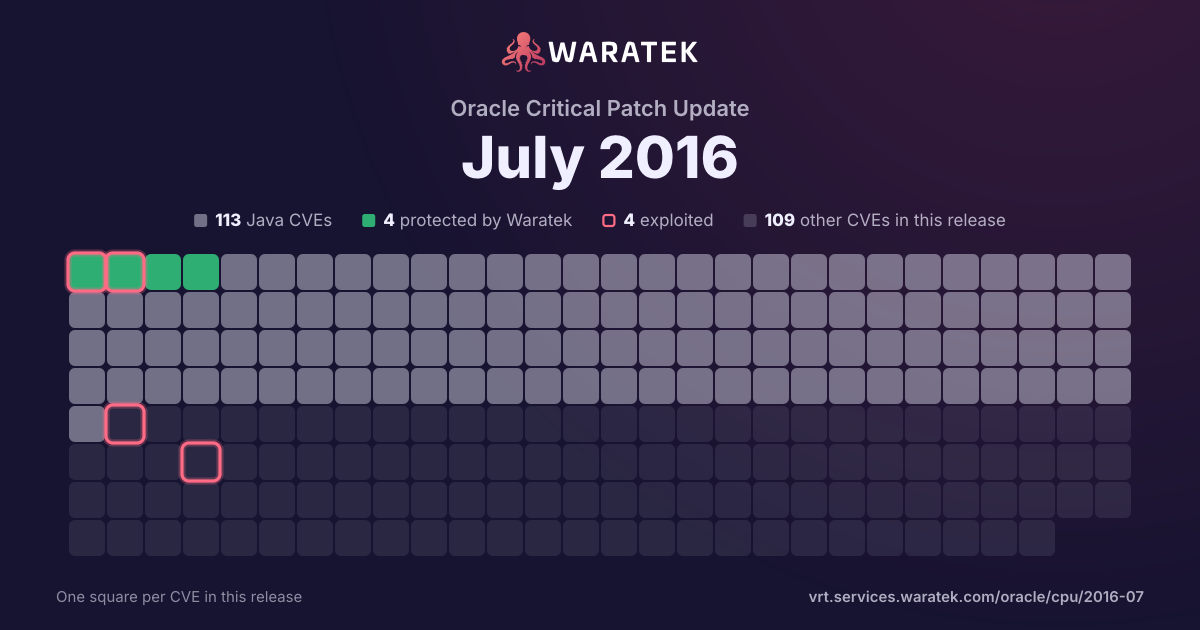
By status
4Protected by Waratek1Mitigation candidate108No exploit published30Outside Waratek scope79Not applicable
4Exploited, marked by the ring
No exploit published. For 108 of them, Oracle's security advisory is the source of public detail.
Protected by Waratek. Waratek RASP can block exploitation of these on systems that have not applied the patch yet.
Overview 2 matches · 0 in Waratek scope · 0 protected · 0 exploited · 0 CISA KEV · 1 public PoC · 1 EPSS ≥ 0.5
2matches
0in Waratek scope0.0%
0protected0.0%
0exploited0.0%
0CISA KEV0.0%
1public PoC50.0%
1EPSS ≥ 0.550.0%
Protected by Waratek
0
0.0%
Rule in development
0
0.0%
Mitigation candidate
0
0.0%
No exploit published
0
0.0%
Outside Waratek scope
0
0.0%
Not applicable
2
100.0%
Withdrawn CVE
0
0.0%
blocked by ARMR today
0
0.0%
partly blocked
0
0.0%
not blocked
2
100.0%
not established
0
0.0%
unrecorded
0
0.0%
Exploited
0
0.0%
Working exploit published
0
0.0%
Proof of concept only
1
50.0%
Forecast only
0
0.0%
No public exploit
1
50.0%
split by
peak 2 / month
Mar 16
| CVE | Severity | Published▾ | Status | Exploitation | Description |
|---|---|---|---|---|---|
| CVE-2016-0702 | Medium | 2016-03-03 | Not applicable | No public exploit | The MOD_EXP_CTIME_COPY_FROM_PREBUF function in crypto/bn/bn_exp.c in OpenSSL 1.0.1 before 1.0.1s and 1.0.2 before 1.0.2g does not properly consider cache-bank access times during modular exponentiation, which makes it easier for local users to discover RSA keys by running a crafted application on the same Intel Sandy Bridge CPU core as a victim and leveraging cache-bank conflicts, aka a "CacheBleed" attack. |
| CVE-2016-0800 | Medium | 2016-03-01 | Not applicable | Proof of concept only | The SSLv2 protocol, as used in OpenSSL before 1.0.1s and 1.0.2 before 1.0.2g and other products, requires a server to send a ServerVerify message before establishing that a client possesses certain plaintext RSA data, which makes it easier for remote attackers to decrypt TLS ciphertext data by leveraging a Bleichenbacher RSA padding oracle, aka a "DROWN" attack. |