
Oracle Critical Patch Update July 2016
Released July 2016 · Oracle's advisory ↗ · ← Critical Patch Update, April 2016 · Critical Patch Update, October 2016 →
222 CVEs in this release, one square each
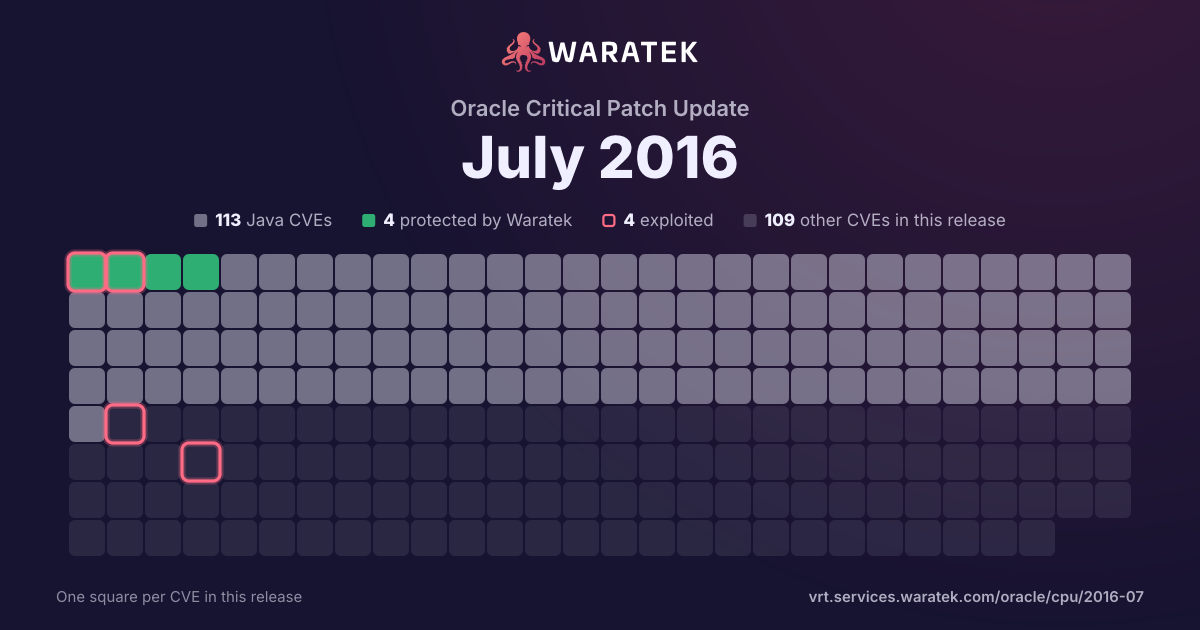
By status
4Protected by Waratek1Mitigation candidate108No exploit published30Outside Waratek scope79Not applicable
4Exploited, marked by the ring
No exploit published. For 108 of them, Oracle's security advisory is the source of public detail.
Protected by Waratek. Waratek RASP can block exploitation of these on systems that have not applied the patch yet.
Overview 218 matches · 109 in Waratek scope · 0 protected · 2 exploited · 0 CISA KEV · 9 public PoC · 11 EPSS ≥ 0.5
218matches
109in Waratek scope50.0%
0protected0.0%
2exploited0.9%
0CISA KEV0.0%
9public PoC4.1%
11EPSS ≥ 0.55.0%
Protected by Waratek
0
0.0%
Rule in development
0
0.0%
Mitigation candidate
1
0.5%
No exploit published
108
49.5%
Outside Waratek scope
30
13.8%
Not applicable
79
36.2%
Withdrawn CVE
0
0.0%
blocked by ARMR today
0
0.0%
partly blocked
0
0.0%
not blocked
218
100.0%
not established
0
0.0%
unrecorded
0
0.0%
split by
peak 191 / quarter
Q3 122
Outside Waratek scope1
Not applicable1
Medium2
not blocked2
Working exploit published1
No public exploit1
Q4 120
Q1 131
Outside Waratek scope1
Medium1
not blocked1
Forecast only1
Q2 131
Not applicable1
Medium1
not blocked1
No public exploit1
Q3 130
Q4 130
Q1 140
Q2 141
Outside Waratek scope1
High1
not blocked1
Exploited1
Q3 140
Q4 141
Outside Waratek scope1
Low1
not blocked1
Proof of concept only1
Q1 155
Outside Waratek scope2
Not applicable3
High1
Medium4
not blocked5
Exploited1
Working exploit published1
Forecast only1
No public exploit2
Q2 153
Outside Waratek scope1
Not applicable2
Medium2
Low1
not blocked3
Forecast only1
No public exploit2
Q3 154
Outside Waratek scope2
Not applicable2
Critical1
High1
Medium2
not blocked4
Working exploit published1
Forecast only1
No public exploit2
Q4 152
Outside Waratek scope1
Not applicable1
Critical2
not blocked2
No public exploit2
Q1 163
Outside Waratek scope1
Not applicable2
Medium3
not blocked3
Proof of concept only1
No public exploit2
Q2 162
Not applicable2
High1
Medium1
not blocked2
Working exploit published1
No public exploit1
Q3 16191
Mitigation candidate1
No exploit published108
Outside Waratek scope19
Not applicable63
Critical19
High61
Medium96
Low15
not blocked191
Working exploit published1
No public exploit190
Q4 160
Q1 171
Not applicable1
High1
not blocked1
No public exploit1
Q2 170
Q3 171
Not applicable1
High1
not blocked1
No public exploit1
Q3 12Q1 13Q3 13Q1 14Q3 14Q1 15Q3 15Q1 16Q3 16Q1 17Q3 17
| CVE | Severity | Published▾ | Status | Exploitation | Description |
|---|---|---|---|---|---|
| CVE-2015-3253 | Critical | 2015-08-13 | Outside Waratek scope | No public exploit | The MethodClosure class in runtime/MethodClosure.java in Apache Groovy 1.7.0 through 2.4.3 allows remote attackers to execute arbitrary code or cause a denial of service via a crafted serialized object. |
| CVE-2015-5600 | High | 2015-08-03 | Not applicable | No public exploit | The kbdint_next_device function in auth2-chall.c in sshd in OpenSSH through 6.9 does not properly restrict the processing of keyboard-interactive devices within a single connection, which makes it easier for remote attackers to conduct brute-force attacks or cause a denial of service (CPU consumption) via a long and duplicative list in the ssh -oKbdInteractiveDevices option, as demonstrated by a modified client that provides a different password for each pam element on this list. |
| CVE-2015-3183 | Medium | 2015-07-20 | Not applicable | Forecast only | The chunked transfer coding implementation in the Apache HTTP Server before 2.4.14 does not properly parse chunk headers, which allows remote attackers to conduct HTTP request smuggling attacks via a crafted request, related to mishandling of large chunk-size values and invalid chunk-extension characters in modules/http/http_filters.c. |
| CVE-2015-1793 | Medium | 2015-07-09 | Outside Waratek scope | Working exploit published | The X509_verify_cert function in crypto/x509/x509_vfy.c in OpenSSL 1.0.1n, 1.0.1o, 1.0.2b, and 1.0.2c does not properly process X.509 Basic Constraints cA values during identification of alternative certificate chains, which allows remote attackers to spoof a Certification Authority role and trigger unintended certificate verifications via a valid leaf certificate. |
| CVE-2015-3237 | Medium | 2015-06-22 | Not applicable | No public exploit | The smb_request_state function in cURL and libcurl 7.40.0 through 7.42.1 allows remote SMB servers to obtain sensitive information from memory or cause a denial of service (out-of-bounds read and crash) via crafted length and offset values. |
| CVE-2015-1791 | Medium | 2015-06-12 | Not applicable | No public exploit | Race condition in the ssl3_get_new_session_ticket function in ssl/s3_clnt.c in OpenSSL before 0.9.8zg, 1.0.0 before 1.0.0s, 1.0.1 before 1.0.1n, and 1.0.2 before 1.0.2b, when used for a multi-threaded client, allows remote attackers to cause a denial of service (double free and application crash) or possibly have unspecified other impact by providing a NewSessionTicket during an attempt to reuse a ticket that had been obtained earlier. |
| CVE-2015-2808 | Low | 2015-04-01 | Outside Waratek scope | Forecast only | The RC4 algorithm, as used in the TLS protocol and SSL protocol, does not properly combine state data with key data during the initialization phase, which makes it easier for remote attackers to conduct plaintext-recovery attacks against the initial bytes of a stream by sniffing network traffic that occasionally relies on keys affected by the Invariance Weakness, and then using a brute-force approach involving LSB values, aka the "Bar Mitzvah" issue. |
| CVE-2014-9708 | Medium | 2015-03-31 | Outside Waratek scope | Forecast only | Embedthis Appweb before 4.6.6 and 5.x before 5.2.1 allows remote attackers to cause a denial of service (NULL pointer dereference) via a Range header with an empty value, as demonstrated by "Range: x=,". |
| CVE-2015-0228 | Medium | 2015-03-08 | Not applicable | No public exploit | The lua_websocket_read function in lua_request.c in the mod_lua module in the Apache HTTP Server through 2.4.12 allows remote attackers to cause a denial of service (child-process crash) by sending a crafted WebSocket Ping frame after a Lua script has called the wsupgrade function. |
| CVE-2015-0235 | High | 2015-01-28 | Outside Waratek scope | Working exploit published | Heap-based buffer overflow in the __nss_hostname_digits_dots function in glibc 2.2, and other 2.x versions before 2.18, allows context-dependent attackers to execute arbitrary code via vectors related to the (1) gethostbyname or (2) gethostbyname2 function, aka "GHOST." |
| CVE-2015-0204 | Medium | 2015-01-09 | Not applicable | Exploited | The ssl3_get_key_exchange function in s3_clnt.c in OpenSSL before 0.9.8zd, 1.0.0 before 1.0.0p, and 1.0.1 before 1.0.1k allows remote SSL servers to conduct RSA-to-EXPORT_RSA downgrade attacks and facilitate brute-force decryption by offering a weak ephemeral RSA key in a noncompliant role, related to the "FREAK" issue. NOTE: the scope of this CVE is only client code based on OpenSSL, not EXPORT_RSA issues associated with servers or other TLS implementations. |
| CVE-2014-3571 | Medium | 2015-01-09 | Not applicable | No public exploit | OpenSSL before 0.9.8zd, 1.0.0 before 1.0.0p, and 1.0.1 before 1.0.1k allows remote attackers to cause a denial of service (NULL pointer dereference and application crash) via a crafted DTLS message that is processed with a different read operation for the handshake header than for the handshake body, related to the dtls1_get_record function in d1_pkt.c and the ssl3_read_n function in s3_pkt.c. |
| CVE-2014-3566 | Low | 2014-10-15 | Outside Waratek scope | Proof of concept only | The SSL protocol 3.0, as used in OpenSSL through 1.0.1i and other products, uses nondeterministic CBC padding, which makes it easier for man-in-the-middle attackers to obtain cleartext data via a padding-oracle attack, aka the "POODLE" issue. |
| CVE-2014-0224 | High | 2014-06-05 | Outside Waratek scope | Exploited | OpenSSL before 0.9.8za, 1.0.0 before 1.0.0m, and 1.0.1 before 1.0.1h does not properly restrict processing of ChangeCipherSpec messages, which allows man-in-the-middle attackers to trigger use of a zero-length master key in certain OpenSSL-to-OpenSSL communications, and consequently hijack sessions or obtain sensitive information, via a crafted TLS handshake, aka the "CCS Injection" vulnerability. |
| CVE-2013-2064 | Medium | 2013-06-15 | Not applicable | No public exploit | Integer overflow in X.org libxcb 1.9 and earlier allows X servers to trigger allocation of insufficient memory and a buffer overflow via vectors related to the read_packet function. |
| CVE-2013-2566 | Medium | 2013-03-15 | Outside Waratek scope | Forecast only | The RC4 algorithm, as used in the TLS protocol and SSL protocol, has many single-byte biases, which makes it easier for remote attackers to conduct plaintext-recovery attacks via statistical analysis of ciphertext in a large number of sessions that use the same plaintext. |
| CVE-2012-3137 | Medium | 2012-09-21 | Outside Waratek scope | Working exploit published | The authentication protocol in Oracle Database Server 10.2.0.3, 10.2.0.4, 10.2.0.5, 11.1.0.7, 11.2.0.2, and 11.2.0.3 allows remote attackers to obtain the session key and salt for arbitrary users, which leaks information about the cryptographic hash and makes it easier to conduct brute force password guessing attacks, aka "stealth password cracking vulnerability." |
| CVE-2012-3410 | Medium | 2012-08-27 | Not applicable | No public exploit | Stack-based buffer overflow in lib/sh/eaccess.c in GNU Bash before 4.2 patch 33 might allow local users to bypass intended restricted shell access via a long filename in /dev/fd, which is not properly handled when expanding the /dev/fd prefix. |