
Oracle Critical Patch Update July 2016
Released July 2016 · Oracle's advisory ↗ · ← Critical Patch Update, April 2016 · Critical Patch Update, October 2016 →
222 CVEs in this release, one square each
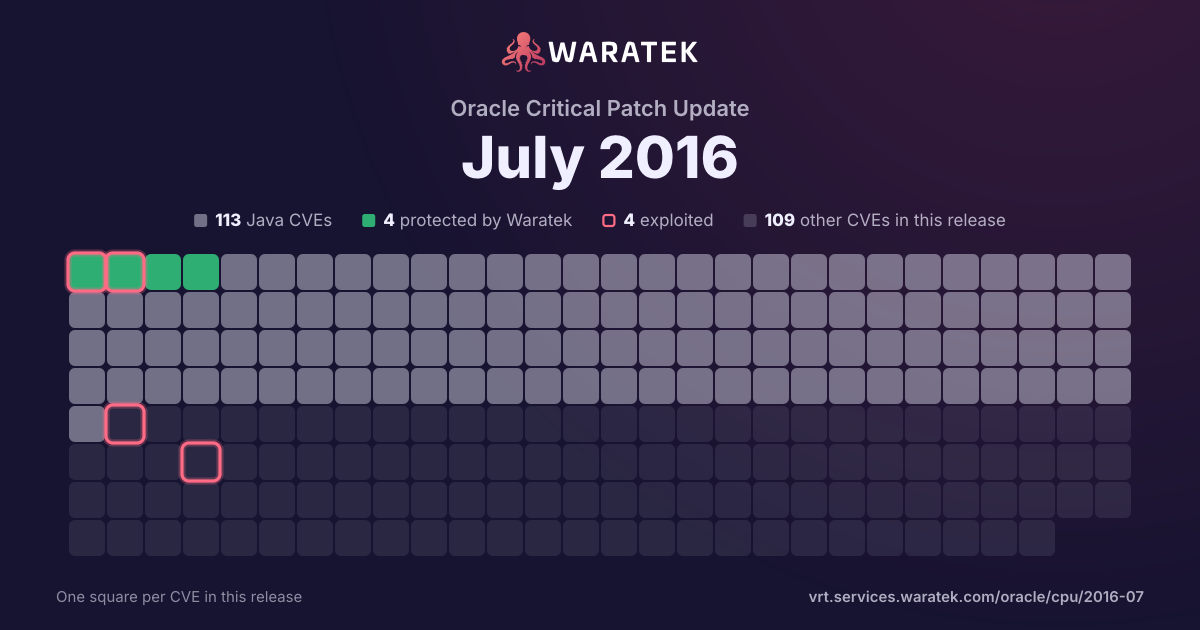
By status
4Protected by Waratek1Mitigation candidate108No exploit published30Outside Waratek scope79Not applicable
4Exploited, marked by the ring
No exploit published. For 108 of them, Oracle's security advisory is the source of public detail.
Protected by Waratek. Waratek RASP can block exploitation of these on systems that have not applied the patch yet.
Overview 5 matches · 0 in Waratek scope · 0 protected · 1 exploited · 0 CISA KEV · 2 public PoC · 2 EPSS ≥ 0.5
5matches
0in Waratek scope0.0%
0protected0.0%
1exploited20.0%
0CISA KEV0.0%
2public PoC40.0%
2EPSS ≥ 0.540.0%
Protected by Waratek
0
0.0%
Rule in development
0
0.0%
Mitigation candidate
0
0.0%
No exploit published
0
0.0%
Outside Waratek scope
3
60.0%
Not applicable
2
40.0%
Withdrawn CVE
0
0.0%
blocked by ARMR today
0
0.0%
partly blocked
0
0.0%
not blocked
5
100.0%
not established
0
0.0%
unrecorded
0
0.0%
Exploited
1
20.0%
Working exploit published
1
20.0%
Proof of concept only
0
0.0%
Forecast only
1
20.0%
No public exploit
2
40.0%
split by
peak 2 / quarter
Q3 122
Outside Waratek scope1
Not applicable1
Medium2
not blocked2
Working exploit published1
No public exploit1
Q4 120
Q1 131
Outside Waratek scope1
Medium1
not blocked1
Forecast only1
Q2 131
Not applicable1
Medium1
not blocked1
No public exploit1
Q3 130
Q4 130
Q1 140
Q2 141
Outside Waratek scope1
High1
not blocked1
Exploited1
Q3 12Q4 12Q1 13Q2 13Q3 13Q4 13Q1 14Q2 14
| CVE | Severity | Published▾ | Status | Exploitation | Description |
|---|---|---|---|---|---|
| CVE-2014-0224 | High | 2014-06-05 | Outside Waratek scope | Exploited | OpenSSL before 0.9.8za, 1.0.0 before 1.0.0m, and 1.0.1 before 1.0.1h does not properly restrict processing of ChangeCipherSpec messages, which allows man-in-the-middle attackers to trigger use of a zero-length master key in certain OpenSSL-to-OpenSSL communications, and consequently hijack sessions or obtain sensitive information, via a crafted TLS handshake, aka the "CCS Injection" vulnerability. |
| CVE-2013-2064 | Medium | 2013-06-15 | Not applicable | No public exploit | Integer overflow in X.org libxcb 1.9 and earlier allows X servers to trigger allocation of insufficient memory and a buffer overflow via vectors related to the read_packet function. |
| CVE-2013-2566 | Medium | 2013-03-15 | Outside Waratek scope | Forecast only | The RC4 algorithm, as used in the TLS protocol and SSL protocol, has many single-byte biases, which makes it easier for remote attackers to conduct plaintext-recovery attacks via statistical analysis of ciphertext in a large number of sessions that use the same plaintext. |
| CVE-2012-3137 | Medium | 2012-09-21 | Outside Waratek scope | Working exploit published | The authentication protocol in Oracle Database Server 10.2.0.3, 10.2.0.4, 10.2.0.5, 11.1.0.7, 11.2.0.2, and 11.2.0.3 allows remote attackers to obtain the session key and salt for arbitrary users, which leaks information about the cryptographic hash and makes it easier to conduct brute force password guessing attacks, aka "stealth password cracking vulnerability." |
| CVE-2012-3410 | Medium | 2012-08-27 | Not applicable | No public exploit | Stack-based buffer overflow in lib/sh/eaccess.c in GNU Bash before 4.2 patch 33 might allow local users to bypass intended restricted shell access via a long filename in /dev/fd, which is not properly handled when expanding the /dev/fd prefix. |