
Oracle Critical Patch Update July 2016
Released July 2016 · Oracle's advisory ↗ · ← Critical Patch Update, April 2016 · Critical Patch Update, October 2016 →
222 CVEs in this release, one square each
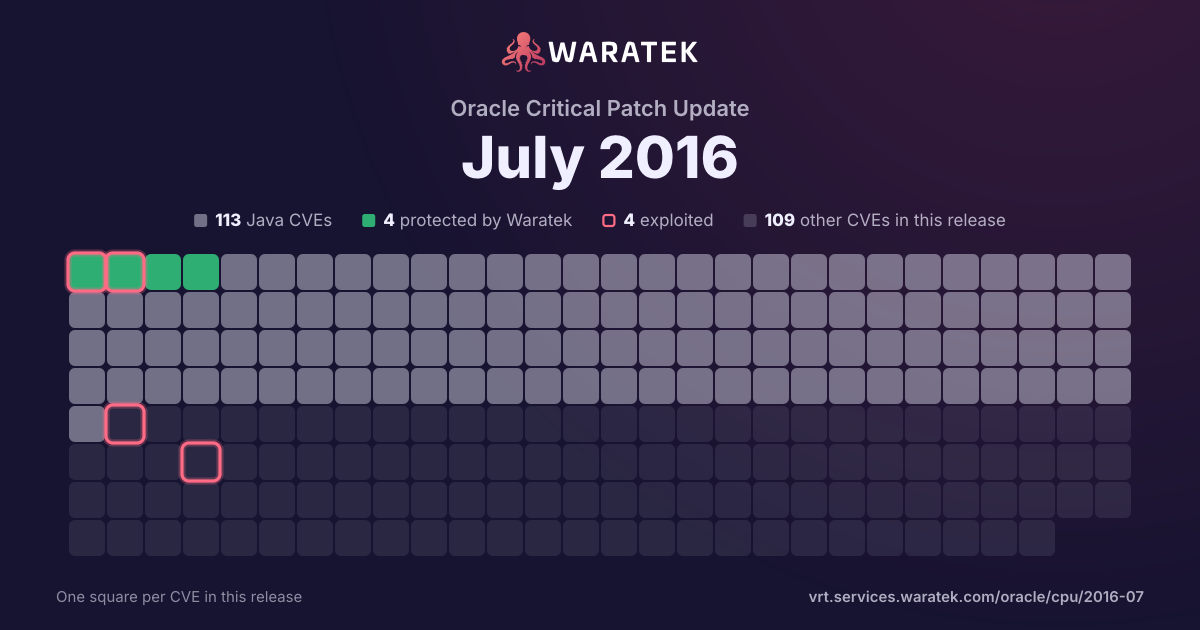
By status
4Protected by Waratek1Mitigation candidate108No exploit published30Outside Waratek scope79Not applicable
4Exploited, marked by the ring
No exploit published. For 108 of them, Oracle's security advisory is the source of public detail.
Protected by Waratek. Waratek RASP can block exploitation of these on systems that have not applied the patch yet.
Overview 2 matches · 0 in Waratek scope · 0 protected · 0 exploited · 0 CISA KEV
2matches
0in Waratek scope0.0%
0protected0.0%
0exploited0.0%
0CISA KEV0.0%
Protected by Waratek
0
0.0%
Rule in development
0
0.0%
Mitigation candidate
0
0.0%
No exploit published
0
0.0%
Outside Waratek scope
1
50.0%
Not applicable
1
50.0%
Withdrawn CVE
0
0.0%
blocked by ARMR today
0
0.0%
partly blocked
0
0.0%
not blocked
2
100.0%
not established
0
0.0%
unrecorded
0
0.0%
Exploited
0
0.0%
Working exploit published
0
0.0%
Proof of concept only
2
100.0%
Forecast only
0
0.0%
No public exploit
0
0.0%
split by
peak 1 / month
Nov 14Jan 15Mar 15May 15Jul 15Sep 15Nov 15Jan 16Mar 16
| CVE | Severity | Published▾ | Status | Exploitation | Description |
|---|---|---|---|---|---|
| CVE-2016-0800 | Medium | 2016-03-01 | Not applicable | Proof of concept only | The SSLv2 protocol, as used in OpenSSL before 1.0.1s and 1.0.2 before 1.0.2g and other products, requires a server to send a ServerVerify message before establishing that a client possesses certain plaintext RSA data, which makes it easier for remote attackers to decrypt TLS ciphertext data by leveraging a Bleichenbacher RSA padding oracle, aka a "DROWN" attack. |
| CVE-2014-3566 | Low | 2014-10-15 | Outside Waratek scope | Proof of concept only | The SSL protocol 3.0, as used in OpenSSL through 1.0.1i and other products, uses nondeterministic CBC padding, which makes it easier for man-in-the-middle attackers to obtain cleartext data via a padding-oracle attack, aka the "POODLE" issue. |