
Oracle Critical Patch Update October 2015
Released October 2015 · Oracle's advisory ↗ · ← Critical Patch Update, July 2015 · Critical Patch Update, January 2016 →
140 CVEs in this release, one square each
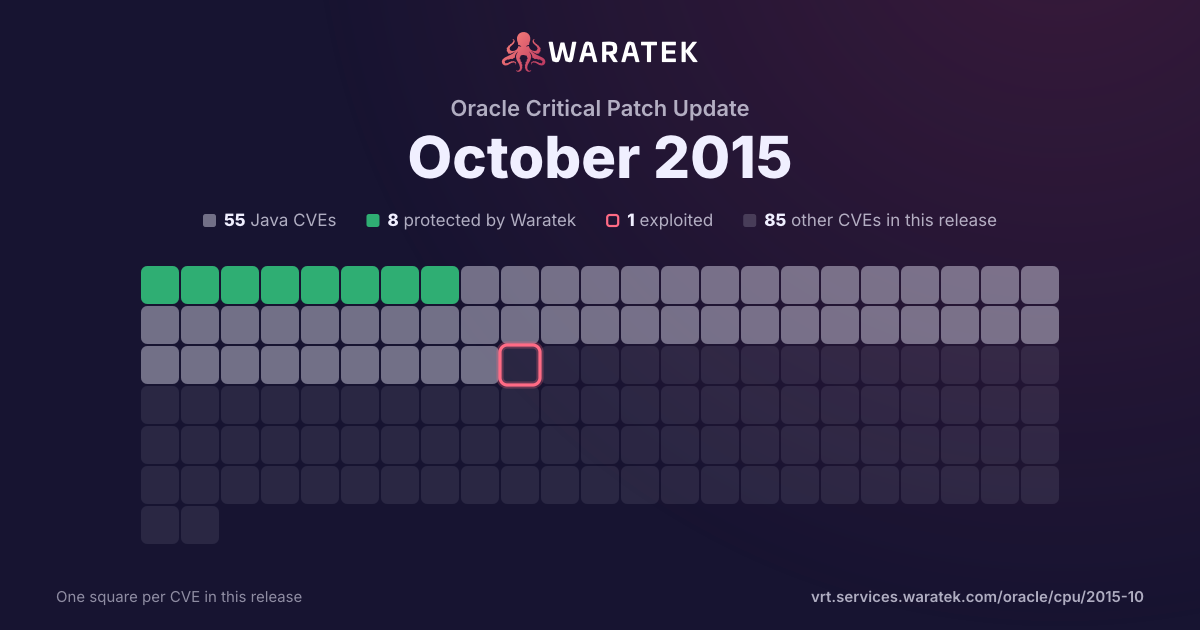
By status
8Protected by Waratek3Mitigation candidate44No exploit published34Outside Waratek scope51Not applicable
1Exploited, marked by the ring
No exploit published. For 44 of them, Oracle's security advisory is the source of public detail.
Protected by Waratek. Waratek RASP can block exploitation of these on systems that have not applied the patch yet.
Overview 11 matches · 1 in Waratek scope · 0 protected · 0 exploited · 0 CISA KEV · 3 public PoC · 3 EPSS ≥ 0.5
11matches
1in Waratek scope9.1%
0protected0.0%
0exploited0.0%
0CISA KEV0.0%
3public PoC27.3%
3EPSS ≥ 0.527.3%
Protected by Waratek
0
0.0%
Rule in development
0
0.0%
Mitigation candidate
1
9.1%
No exploit published
0
0.0%
Outside Waratek scope
3
27.3%
Not applicable
7
63.6%
Withdrawn CVE
0
0.0%
blocked by ARMR today
0
0.0%
partly blocked
0
0.0%
not blocked
11
100.0%
not established
0
0.0%
unrecorded
0
0.0%
Exploited
0
0.0%
Working exploit published
2
18.2%
Proof of concept only
1
9.1%
Forecast only
0
0.0%
No public exploit
8
72.7%
split by
peak 8 / year
19991
Not applicable1
Medium1
not blocked1
No public exploit1
20000
20010
20020
20030
20040
20050
20060
20070
20080
20090
20100
20110
20120
20130
20142
Mitigation candidate1
Not applicable1
High2
not blocked2
Working exploit published1
No public exploit1
20158
Outside Waratek scope3
Not applicable5
High3
Medium4
Low1
not blocked8
Working exploit published1
Proof of concept only1
No public exploit6
199920012003200520072009201120132015
| CVE | Severity | Published▾ | Status | Exploitation | Description |
|---|---|---|---|---|---|
| CVE-2015-1791 | Medium | 2015-06-12 | Not applicable | No public exploit | Race condition in the ssl3_get_new_session_ticket function in ssl/s3_clnt.c in OpenSSL before 0.9.8zg, 1.0.0 before 1.0.0s, 1.0.1 before 1.0.1n, and 1.0.2 before 1.0.2b, when used for a multi-threaded client, allows remote attackers to cause a denial of service (double free and application crash) or possibly have unspecified other impact by providing a NewSessionTicket during an attempt to reuse a ticket that had been obtained earlier. |
| CVE-2015-4000 | Low | 2015-05-21 | Outside Waratek scope | Proof of concept only | The TLS protocol 1.2 and earlier, when a DHE_EXPORT ciphersuite is enabled on a server but not on a client, does not properly convey a DHE_EXPORT choice, which allows man-in-the-middle attackers to conduct cipher-downgrade attacks by rewriting a ClientHello with DHE replaced by DHE_EXPORT and then rewriting a ServerHello with DHE_EXPORT replaced by DHE, aka the "Logjam" issue. |
| CVE-2015-3144 | High | 2015-04-24 | Outside Waratek scope | No public exploit | The fix_hostname function in cURL and libcurl 7.37.0 through 7.41.0 does not properly calculate an index, which allows remote attackers to cause a denial of service (out-of-bounds read or write and crash) or possibly have other unspecified impact via a zero-length host name, as demonstrated by "http://:80" and ":80." |
| CVE-2015-0286 | Medium | 2015-03-19 | Not applicable | No public exploit | The ASN1_TYPE_cmp function in crypto/asn1/a_type.c in OpenSSL before 0.9.8zf, 1.0.0 before 1.0.0r, 1.0.1 before 1.0.1m, and 1.0.2 before 1.0.2a does not properly perform boolean-type comparisons, which allows remote attackers to cause a denial of service (invalid read operation and application crash) via a crafted X.509 certificate to an endpoint that uses the certificate-verification feature. |
| CVE-2015-0235 | High | 2015-01-28 | Outside Waratek scope | Working exploit published | Heap-based buffer overflow in the __nss_hostname_digits_dots function in glibc 2.2, and other 2.x versions before 2.18, allows context-dependent attackers to execute arbitrary code via vectors related to the (1) gethostbyname or (2) gethostbyname2 function, aka "GHOST." |
| CVE-2014-7940 | High | 2015-01-22 | Not applicable | No public exploit | The collator implementation in i18n/ucol.cpp in International Components for Unicode (ICU) 52 through SVN revision 293126, as used in Google Chrome before 40.0.2214.91, does not initialize memory for a data structure, which allows remote attackers to cause a denial of service or possibly have unspecified other impact via a crafted character sequence. |
| CVE-2014-0191 | Medium | 2015-01-21 | Not applicable | No public exploit | The xmlParserHandlePEReference function in parser.c in libxml2 before 2.9.2, as used in Web Listener in Oracle HTTP Server in Oracle Fusion Middleware 11.1.1.7.0, 12.1.2.0, and 12.1.3.0 and other products, loads external parameter entities regardless of whether entity substitution or validation is enabled, which allows remote attackers to cause a denial of service (resource consumption) via a crafted XML document. |
| CVE-2014-3571 | Medium | 2015-01-09 | Not applicable | No public exploit | OpenSSL before 0.9.8zd, 1.0.0 before 1.0.0p, and 1.0.1 before 1.0.1k allows remote attackers to cause a denial of service (NULL pointer dereference and application crash) via a crafted DTLS message that is processed with a different read operation for the handshake header than for the handshake body, related to the dtls1_get_record function in d1_pkt.c and the ssl3_read_n function in s3_pkt.c. |
| CVE-2014-1569 | High | 2014-12-15 | Not applicable | No public exploit | The definite_length_decoder function in lib/util/quickder.c in Mozilla Network Security Services (NSS) before 3.16.2.4 and 3.17.x before 3.17.3 does not ensure that the DER encoding of an ASN.1 length is properly formed, which allows remote attackers to conduct data-smuggling attacks by using a long byte sequence for an encoding, as demonstrated by the SEC_QuickDERDecodeItem function's improper handling of an arbitrary-length encoding of 0x00. |
| CVE-2014-0050 | High | 2014-04-01 | Mitigation candidate | Working exploit published | MultipartStream.java in Apache Commons FileUpload before 1.3.1, as used in Apache Tomcat, JBoss Web, and other products, allows remote attackers to cause a denial of service (infinite loop and CPU consumption) via a crafted Content-Type header that bypasses a loop's intended exit conditions. |
| CVE-1999-0377 | Medium | 1999-02-22 | Not applicable | No public exploit | Process table attack in Unix systems allows a remote attacker to perform a denial of service by filling a machine's process tables through multiple connections to network services. |