
Oracle Critical Patch Update April 2015
Released April 2015 · Oracle's advisory ↗ · ← Critical Patch Update, January 2015 · Critical Patch Update, July 2015 →
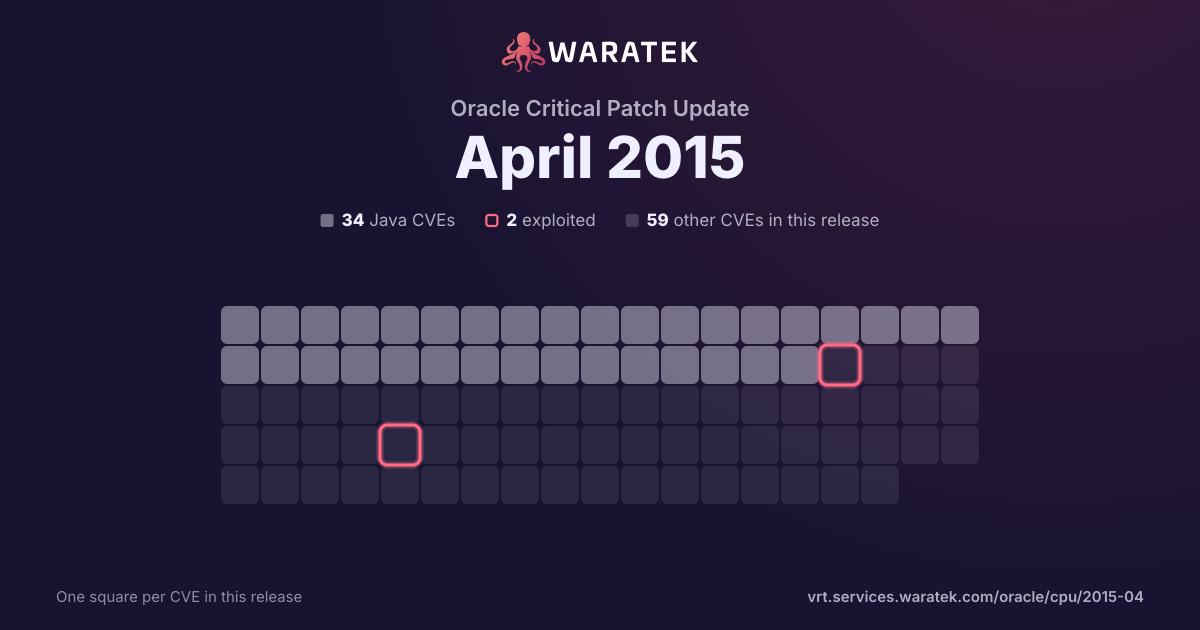
93 CVEs in this release, one square each
By status
3Mitigation candidate31No exploit published27Outside Waratek scope32Not applicable
2Exploited, marked by the ring
No exploit published. For 29 of them, Oracle's security advisory is the source of public detail.
Overview 3 matches · 0 in Waratek scope · 0 protected · 0 exploited · 0 CISA KEV · 0 public PoC · 0 EPSS ≥ 0.5
3matches
0in Waratek scope0.0%
0protected0.0%
0exploited0.0%
0CISA KEV0.0%
0public PoC0.0%
0EPSS ≥ 0.50.0%
Protected by Waratek
0
0.0%
Rule in development
0
0.0%
Mitigation candidate
0
0.0%
No exploit published
0
0.0%
Outside Waratek scope
1
33.3%
Not applicable
2
66.7%
Withdrawn CVE
0
0.0%
blocked by ARMR today
0
0.0%
partly blocked
0
0.0%
not blocked
3
100.0%
not established
0
0.0%
unrecorded
0
0.0%
Exploited
0
0.0%
Working exploit published
0
0.0%
Proof of concept only
0
0.0%
Forecast only
0
0.0%
No public exploit
3
100.0%
split by
peak 1 / month
Nov 13Dec 13Jan 14Feb 14Mar 14Apr 14May 14Jun 14Jul 14Aug 14Sep 14
| CVE | Severity | Published▾ | Status | Exploitation | Description |
|---|---|---|---|---|---|
| CVE-2014-1568 | High | 2014-09-25 | Not applicable | No public exploit | Mozilla Network Security Services (NSS) before 3.16.2.1, 3.16.x before 3.16.5, and 3.17.x before 3.17.1, as used in Mozilla Firefox before 32.0.3, Mozilla Firefox ESR 24.x before 24.8.1 and 31.x before 31.1.1, Mozilla Thunderbird before 24.8.1 and 31.x before 31.1.2, Mozilla SeaMonkey before 2.29.1, Google Chrome before 37.0.2062.124 on Windows and OS X, and Google Chrome OS before 37.0.2062.120, does not properly parse ASN.1 values in X.509 certificates, which makes it easier for remote attackers to spoof RSA signatures via a crafted certificate, aka a "signature malleability" issue. |
| CVE-2013-4286 | Medium | 2014-02-26 | Outside Waratek scope | No public exploit | Apache Tomcat before 6.0.39, 7.x before 7.0.47, and 8.x before 8.0.0-RC3, when an HTTP connector or AJP connector is used, does not properly handle certain inconsistent HTTP request headers, which allows remote attackers to trigger incorrect identification of a request's length and conduct request-smuggling attacks via (1) multiple Content-Length headers or (2) a Content-Length header and a "Transfer-Encoding: chunked" header. NOTE: this vulnerability exists because of an incomplete fix for CVE-2005-2090. |
| CVE-2013-4545 | Medium | 2013-11-23 | Not applicable | No public exploit | cURL and libcurl 7.18.0 through 7.32.0, when built with OpenSSL, disables the certificate CN and SAN name field verification (CURLOPT_SSL_VERIFYHOST) when the digital signature verification (CURLOPT_SSL_VERIFYPEER) is disabled, which allows man-in-the-middle attackers to spoof SSL servers via an arbitrary valid certificate. |