
Oracle Critical Patch Update April 2015
Released April 2015 · Oracle's advisory ↗ · ← Critical Patch Update, January 2015 · Critical Patch Update, July 2015 →
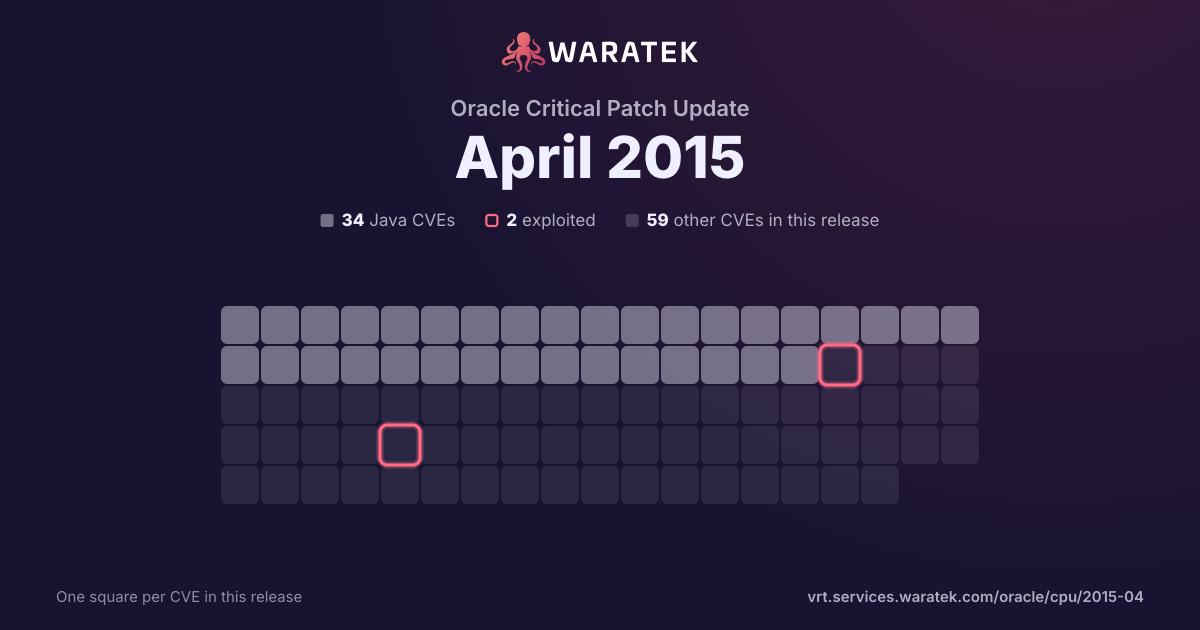
93 CVEs in this release, one square each
By status
3Mitigation candidate31No exploit published27Outside Waratek scope32Not applicable
2Exploited, marked by the ring
No exploit published. For 29 of them, Oracle's security advisory is the source of public detail.
Overview 93 matches · 34 in Waratek scope · 0 protected · 2 exploited · 0 CISA KEV · 8 public PoC · 5 EPSS ≥ 0.5
93matches
34in Waratek scope36.6%
0protected0.0%
2exploited2.2%
0CISA KEV0.0%
8public PoC8.6%
5EPSS ≥ 0.55.4%
Protected by Waratek
0
0.0%
Rule in development
0
0.0%
Mitigation candidate
3
3.2%
No exploit published
31
33.3%
Outside Waratek scope
27
29.0%
Not applicable
32
34.4%
Withdrawn CVE
0
0.0%
blocked by ARMR today
0
0.0%
partly blocked
0
0.0%
not blocked
93
100.0%
not established
0
0.0%
unrecorded
0
0.0%
split by
peak 82 / month
Nov 131
Not applicable1
Medium1
not blocked1
No public exploit1
Dec 130
Jan 140
Feb 141
Outside Waratek scope1
Medium1
not blocked1
No public exploit1
Mar 140
Apr 142
Mitigation candidate1
Outside Waratek scope1
High2
not blocked2
Exploited1
Working exploit published1
May 140
Jun 140
Jul 140
Aug 140
Sep 141
Not applicable1
High1
not blocked1
No public exploit1
Oct 141
Outside Waratek scope1
Low1
not blocked1
Proof of concept only1
Nov 140
Dec 142
Outside Waratek scope1
Not applicable1
Medium2
not blocked2
No public exploit2
Jan 153
Outside Waratek scope1
Not applicable2
High1
Medium2
not blocked3
Exploited1
Working exploit published1
No public exploit1
Feb 150
Mar 150
Apr 1582
Mitigation candidate2
No exploit published31
Outside Waratek scope22
Not applicable27
High12
Medium51
Low19
not blocked82
Working exploit published3
No public exploit79
Dec 13Feb 14Apr 14Jun 14Aug 14Oct 14Dec 14Feb 15Apr 15
| CVE | Severity | Published▾ | Status | Exploitation | Description |
|---|---|---|---|---|---|
| CVE-2015-2579 | Low | 2015-04-16 | No exploit published | No public exploit | Unspecified vulnerability in the Oracle Health Sciences Argus Safety component in Oracle Health Sciences Applications 8.0 allows local users to affect confidentiality via vectors related to BIP Installer. |
| CVE-2015-2578 | High | 2015-04-16 | Not applicable | No public exploit | Unspecified vulnerability in Oracle Sun Solaris 11.2 allows remote attackers to affect availability via vectors related to Kernel IDMap. |
| CVE-2015-2577 | High | 2015-04-16 | Not applicable | No public exploit | Unspecified vulnerability in Oracle Sun Solaris 10 allows local users to affect confidentiality, integrity, and availability via unknown vectors related to Accounting commands. |
| CVE-2015-2576 | Low | 2015-04-16 | Not applicable | No public exploit | Unspecified vulnerability in the MySQL Utilities component in Oracle MySQL 1.5.1 and earlier, when running on Windows, allows local users to affect integrity via unknown vectors related to Installation. |
| CVE-2015-2575 | Medium | 2015-04-16 | Not applicable | No public exploit | Unspecified vulnerability in the MySQL Connectors component in Oracle MySQL 5.1.34 and earlier allows remote authenticated users to affect confidentiality and integrity via unknown vectors related to Connector/J. |
| CVE-2015-2574 | Low | 2015-04-16 | Not applicable | No public exploit | Unspecified vulnerability in Oracle Sun Solaris 10 allows local users to affect confidentiality via unknown vectors related to Text Utilities. |
| CVE-2015-2573 | Medium | 2015-04-16 | Not applicable | No public exploit | Unspecified vulnerability in Oracle MySQL Server 5.5.41 and earlier, and 5.6.22 and earlier, allows remote authenticated users to affect availability via vectors related to DDL. |
| CVE-2015-2572 | Medium | 2015-04-16 | Not applicable | Working exploit published | Unspecified vulnerability in the Oracle Hyperion Smart View for Office component in Oracle Hyperion 11.1.2.5.216 and earlier, when running on Windows, allows local users to affect confidentiality, integrity, and availability via unknown vectors related to Core. |
| CVE-2015-2571 | Medium | 2015-04-16 | Not applicable | No public exploit | Unspecified vulnerability in Oracle MySQL Server 5.5.42 and earlier, and 5.6.23 and earlier, allows remote authenticated users to affect availability via unknown vectors related to Server : Optimizer. |
| CVE-2015-2570 | Medium | 2015-04-16 | No exploit published | No public exploit | Unspecified vulnerability in the Oracle Demand Planning component in Oracle Supply Chain Products Suite 11.5.10, 12.0, 12.1, and 12.2 allows remote authenticated users to affect confidentiality, integrity, and availability via unknown vectors related to Security. |
| CVE-2015-2568 | Medium | 2015-04-16 | Outside Waratek scope | No public exploit | Unspecified vulnerability in Oracle MySQL Server 5.5.41 and earlier, and 5.6.22 and earlier, allows remote attackers to affect availability via unknown vectors related to Server : Security : Privileges. |
| CVE-2015-2567 | Low | 2015-04-16 | Not applicable | No public exploit | Unspecified vulnerability in Oracle MySQL Server 5.6.23 and earlier allows remote authenticated users to affect availability via unknown vectors related to Server : Security : Privileges. |
| CVE-2015-2566 | Low | 2015-04-16 | Not applicable | No public exploit | Unspecified vulnerability in Oracle MySQL Server 5.6.22 and earlier allows remote authenticated users to affect availability via vectors related to DML. |
| CVE-2015-2565 | Medium | 2015-04-16 | No exploit published | No public exploit | Unspecified vulnerability in the Oracle Installed Base component in Oracle E-Business Suite 11.5.10.2, 12.0.4, 12.0.6, 12.1.1, 12.1.2, and 12.1.3 allows remote attackers to affect integrity via unknown vectors related to Create Item Instance. |
| CVE-2015-0511 | Low | 2015-04-16 | Not applicable | No public exploit | Unspecified vulnerability in Oracle MySQL Server 5.6.23 and earlier allows remote authenticated users to affect availability via unknown vectors related to Server : SP. |
| CVE-2015-0510 | Medium | 2015-04-16 | No exploit published | No public exploit | Unspecified vulnerability in the Oracle Commerce Platform component in Oracle Commerce Platform 9.4, 10.0, and 10.2 allows remote attackers to affect integrity via vectors related to Dynamo Application Framework - HTML Admin User Interface. |
| CVE-2015-0509 | Medium | 2015-04-16 | No exploit published | No public exploit | Unspecified vulnerability in the Oracle Hyperion BI+ component in Oracle Hyperion 11.1.2.2 and 11.1.2.3 allows remote attackers to affect integrity via unknown vectors related to Reporting and Analysis. |
| CVE-2015-0508 | Medium | 2015-04-16 | Not applicable | No public exploit | Unspecified vulnerability in Oracle MySQL Server 5.6.23 and earlier allows remote authenticated users to affect availability via unknown vectors related to Server : InnoDB, a different vulnerability than CVE-2015-0506. |
| CVE-2015-0507 | Low | 2015-04-16 | Not applicable | No public exploit | Unspecified vulnerability in Oracle MySQL Server 5.6.23 and earlier allows remote authenticated users to affect availability via unknown vectors related to Server : Memcached. |
| CVE-2015-0506 | Low | 2015-04-16 | Not applicable | No public exploit | Unspecified vulnerability in Oracle MySQL Server 5.6.23 and earlier allows remote authenticated users to affect availability via unknown vectors related to InnoDB, a different vulnerability than CVE-2015-0508. |
| CVE-2015-0505 | Low | 2015-04-16 | Not applicable | No public exploit | Unspecified vulnerability in Oracle MySQL Server 5.5.42 and earlier, and 5.6.23 and earlier, allows remote authenticated users to affect availability via vectors related to DDL. |
| CVE-2015-0504 | Low | 2015-04-16 | No exploit published | No public exploit | Unspecified vulnerability in the Oracle Application Object Library component in Oracle E-Business Suite 12.0.6 and 12.1.3 allows remote attackers to affect integrity via unknown vectors related to Error Messages. |
| CVE-2015-0503 | Medium | 2015-04-16 | Not applicable | No public exploit | Unspecified vulnerability in Oracle MySQL Server 5.6.23 and earlier allows remote authenticated users to affect availability via unknown vectors related to Server : Partition. |
| CVE-2015-0502 | Medium | 2015-04-16 | No exploit published | No public exploit | Unspecified vulnerability in the Siebel UI Framework component in Oracle Siebel CRM 8.1 and 8.2 allows remote attackers to affect integrity via unknown vectors related to Portal Framework. |
| CVE-2015-0501 | Medium | 2015-04-16 | Outside Waratek scope | No public exploit | Unspecified vulnerability in Oracle MySQL Server 5.5.42 and earlier, and 5.6.23 and earlier, allows remote authenticated users to affect availability via unknown vectors related to Server : Compiling. |
| CVE-2015-0500 | Medium | 2015-04-16 | Outside Waratek scope | No public exploit | Unspecified vulnerability in Oracle MySQL Server 5.6.23 and earlier allows remote authenticated users to affect availability via unknown vectors. |
| CVE-2015-0499 | Low | 2015-04-16 | Not applicable | No public exploit | Unspecified vulnerability in Oracle MySQL Server 5.5.42 and earlier, and 5.6.23 and earlier, allows remote authenticated users to affect availability via unknown vectors related to Server : Federated. |
| CVE-2015-0498 | Low | 2015-04-16 | Not applicable | No public exploit | Unspecified vulnerability in Oracle MySQL Server 5.6.23 and earlier allows remote authenticated users to affect availability via unknown vectors related to Replication. |
| CVE-2015-0497 | Medium | 2015-04-16 | No exploit published | No public exploit | Unspecified vulnerability in the PeopleSoft Enterprise Portal Interaction Hub component in Oracle PeopleSoft Products 9.1.00 allows remote attackers to affect integrity via unknown vectors related to Enterprise Portal. |
| CVE-2015-0496 | Medium | 2015-04-16 | No exploit published | No public exploit | Unspecified vulnerability in the PeopleSoft Enterprise PeopleTools component in Oracle PeopleSoft Products 8.53 and 8.54 allows remote authenticated users to affect confidentiality via vectors related to PIA Search Functionality. |
| CVE-2015-0495 | High | 2015-04-16 | No exploit published | No public exploit | Unspecified vulnerability in the Oracle Commerce Guided Search / Oracle Commerce Experience Manager component in Oracle Commerce Platform 3.x and 11.x allows remote attackers to affect confidentiality, integrity, and availability via unknown vectors related to Workbench. |
| CVE-2015-0494 | Medium | 2015-04-16 | No exploit published | No public exploit | Unspecified vulnerability in the Oracle Retail Central Office component in Oracle Retail Applications 13.1, 13.2, 13.3, 13.4, 14.0, and 14.1 allows remote attackers to affect integrity via unknown vectors. |
| CVE-2015-0493 | Low | 2015-04-16 | Mitigation candidate | Working exploit published | Unspecified vulnerability in the Oracle Outside In Technology component in Oracle Fusion Middleware 8.4.1, 8.5.0, and 8.5.1 allows local users to affect availability via unknown vectors related to Outside In Filters, a different vulnerability than CVE-2015-0474. |
| CVE-2015-0492 | High | 2015-04-16 | Outside Waratek scope | No public exploit | Unspecified vulnerability in Oracle Java SE 7u76 and 8u40, and JavaFX 2.2.76, allows remote attackers to affect confidentiality, integrity, and availability via unknown vectors, a different vulnerability than CVE-2015-0484. |
| CVE-2015-0491 | High | 2015-04-16 | Outside Waratek scope | No public exploit | Unspecified vulnerability in Oracle Java SE 5.0u81, 6u91, 7u76, and 8u40, and Java FX 2.2.76, allows remote attackers to affect confidentiality, integrity, and availability via unknown vectors related to 2D, a different vulnerability than CVE-2015-0459. |
| CVE-2015-0490 | Medium | 2015-04-16 | No exploit published | No public exploit | Unspecified vulnerability in the Oracle Agile Engineering Data Management component in Oracle Supply Chain Products Suite 6.1.3.0 allows remote authenticated users to affect confidentiality and integrity via vectors related to BAS - Base Component. |
| CVE-2015-0489 | Low | 2015-04-16 | No exploit published | No public exploit | Unspecified vulnerability in the Application Management Pack for Oracle E-Business Suite component in Oracle E-Business Suite AMP 121030 and 121020 allows local users to affect confidentiality via vectors related to EBS Plugin. |
| CVE-2015-0488 | Medium | 2015-04-16 | No exploit published | No public exploit | Unspecified vulnerability in Oracle Java SE 5.0u81, 6u91, 7u76, and 8u40, and JRockit R28.3.5, allows remote attackers to affect availability via vectors related to JSSE. |
| CVE-2015-0487 | Medium | 2015-04-16 | No exploit published | No public exploit | Unspecified vulnerability in the PeopleSoft Enterprise PeopleTools component in Oracle PeopleSoft Products 8.53 and 8.54 allows remote authenticated users to affect integrity via vectors related to PIA Core Technology, a different vulnerability than CVE-2015-0472. |
| CVE-2015-0486 | Medium | 2015-04-16 | Outside Waratek scope | No public exploit | Unspecified vulnerability in Oracle Java SE 8u40 allows remote attackers to affect confidentiality via unknown vectors related to Deployment. |
| CVE-2015-0485 | Low | 2015-04-16 | No exploit published | No public exploit | Unspecified vulnerability in the PeopleSoft Enterprise SCM Strategic Sourcing component in Oracle PeopleSoft Products 9.1 and 9.2 allows remote authenticated users to affect confidentiality via unknown vectors related to Security. |
| CVE-2015-0484 | Medium | 2015-04-16 | Outside Waratek scope | No public exploit | Unspecified vulnerability in Oracle Java SE 7u76 and 8u40, and Java FX 2.2.76, allows remote attackers to affect confidentiality, integrity, and availability via unknown vectors, a different vulnerability than CVE-2015-0492. |
| CVE-2015-0483 | Medium | 2015-04-16 | Outside Waratek scope | No public exploit | Unspecified vulnerability in the Core RDBMS component in Oracle Database Server 11.1.0.7, 11.2.0.3, 11.2.0.4, 12.1.0.1, and 12.1.0.2 allows remote authenticated users to affect integrity via unknown vectors. |
| CVE-2015-0482 | Medium | 2015-04-16 | No exploit published | No public exploit | Unspecified vulnerability in the Oracle WebLogic Server component in Oracle Fusion Middleware 12.1.2.0 and 12.1.3.0 allows remote authenticated users to affect confidentiality, integrity, and availability via vectors related to WLS-WebServices. |
| CVE-2015-0480 | Medium | 2015-04-16 | Outside Waratek scope | No public exploit | Unspecified vulnerability in Oracle Java SE 5.0u81, 6u91, 7u76, and 8u40 allows remote attackers to affect integrity and availability via unknown vectors related to Tools. |
| CVE-2015-0479 | Medium | 2015-04-16 | Outside Waratek scope | No public exploit | Unspecified vulnerability in the XDK and XDB - XML Database component in Oracle Database Server 11.2.0.3, 11.2.0.4, and 12.1.0.1 allows remote authenticated users to affect availability via unknown vectors. |
| CVE-2015-0478 | Medium | 2015-04-16 | No exploit published | No public exploit | Unspecified vulnerability in Oracle Java SE 5.0u81, 6u91, 7u76, and 8u40, and JRockit R28.3.5, allows remote attackers to affect confidentiality via vectors related to JCE. |
| CVE-2015-0477 | Medium | 2015-04-16 | Outside Waratek scope | No public exploit | Unspecified vulnerability in Oracle Java SE 5.0u81, 6u91, 7u76, and 8u40 allows remote attackers to affect integrity via unknown vectors related to Beans. |
| CVE-2015-0476 | Medium | 2015-04-16 | Not applicable | No public exploit | Unspecified vulnerability in the SQL Trace Analyzer component in Oracle Support Tools before 12.1.11 allows remote authenticated users to affect confidentiality and integrity via unknown vectors. |
| CVE-2015-0475 | Medium | 2015-04-16 | No exploit published | No public exploit | Unspecified vulnerability in the JD Edwards EnterpriseOne Technology component in Oracle JD Edwards Products 9.1 allows remote authenticated users to affect confidentiality via unknown vectors related to Web Runtime Security. |
| CVE-2015-0474 | Low | 2015-04-16 | Mitigation candidate | Working exploit published | Unspecified vulnerability in the Oracle Outside In Technology component in Oracle Fusion Middleware 8.4.1, 8.5.0, and 8.5.1 allows local users to affect availability via unknown vectors related to Outside In Filters, a different vulnerability than CVE-2015-0493. |
| CVE-2015-0473 | Medium | 2015-04-16 | No exploit published | No public exploit | Unspecified vulnerability in the Enterprise Manager Base Platform component in Oracle Enterprise Manager Grid Control MOS 12.1.0.5 and 12.1.0.6 allows remote attackers to affect integrity via unknown vectors related to My Oracle Support Plugin. |
| CVE-2015-0472 | Low | 2015-04-16 | No exploit published | No public exploit | Unspecified vulnerability in the PeopleSoft Enterprise PeopleTools component in Oracle PeopleSoft Products 8.53 and 8.54 allows remote authenticated users to affect integrity via vectors related to PIA Core Technology, a different vulnerability than CVE-2015-0487. |
| CVE-2015-0471 | Medium | 2015-04-16 | Not applicable | No public exploit | Unspecified vulnerability in Oracle Sun Solaris 10 and 11.2 allows local users to affect confidentiality, integrity, and availability via unknown vectors related to libelfsign. |
| CVE-2015-0470 | Medium | 2015-04-16 | Outside Waratek scope | No public exploit | Unspecified vulnerability in Oracle Java SE 8u40 allows remote attackers to affect integrity via unknown vectors related to Hotspot. |
| CVE-2015-0469 | High | 2015-04-16 | Outside Waratek scope | No public exploit | Unspecified vulnerability in Oracle Java SE 5.0u81, 6u91, 7u76, and 8u40 allows remote attackers to affect confidentiality, integrity, and availability via unknown vectors related to 2D. |
| CVE-2015-0466 | Medium | 2015-04-16 | No exploit published | No public exploit | Unspecified vulnerability in the Oracle Retail Back Office component in Oracle Retail Applications 12.0, 12.0IN, 13.0, 13.1, 13.2, 13.3, 13.4, 14.0, and 14.1 allows remote attackers to affect integrity via unknown vectors. |
| CVE-2015-0465 | Medium | 2015-04-16 | No exploit published | No public exploit | Unspecified vulnerability in the Oracle Transportation Management component in Oracle Supply Chain Products Suite 6.1, 6.2, 6.3.0, 6.3.1, 6.3.2, 6.3.3, 6.3.4, 6.3.5, and 6.3.6 allows remote authenticated users to affect confidentiality via unknown vectors related to UI Infrastructure. |
| CVE-2015-0464 | Medium | 2015-04-16 | No exploit published | No public exploit | Unspecified vulnerability in the Oracle Transportation Management component in Oracle Supply Chain Products Suite 6.1, 6.2, 6.3.0, 6.3.1, 6.3.2, 6.3.3, 6.3.4, 6.3.5, and 6.3.6 allows remote attackers to affect confidentiality via unknown vectors related to Security. |
| CVE-2015-0463 | Medium | 2015-04-16 | No exploit published | No public exploit | Unspecified vulnerability in the Oracle Transportation Management component in Oracle Supply Chain Products Suite 6.2, 6.3.0, 6.3.1, 6.3.2, 6.3.3, 6.3.4, 6.3.5, and 6.3.6 allows remote authenticated users to affect confidentiality via unknown vectors related to Security. |
| CVE-2015-0462 | Medium | 2015-04-16 | No exploit published | No public exploit | Unspecified vulnerability in the Oracle Transportation Management component in Oracle Supply Chain Products Suite 6.1, 6.2, 6.3.0, 6.3.1, 6.3.2, 6.3.3, 6.3.4, 6.3.5, and 6.3.6 allows remote authenticated users to affect confidentiality via unknown vectors related to Security. |
| CVE-2015-0461 | High | 2015-04-16 | No exploit published | No public exploit | Unspecified vulnerability in the Oracle Access Manager component in Oracle Fusion Middleware 11.1.1.5 and 11.1.1.7 allows remote authenticated users to affect confidentiality and integrity via unknown vectors related to Authentication Engine. |
| CVE-2015-0460 | High | 2015-04-16 | Outside Waratek scope | No public exploit | Unspecified vulnerability in Oracle Java SE 5.0u81, 6u91, 7u76, and 8u40 allows remote attackers to affect confidentiality, integrity, and availability via unknown vectors related to Hotspot. |
| CVE-2015-0459 | High | 2015-04-16 | Outside Waratek scope | No public exploit | Unspecified vulnerability in Oracle Java SE 5.0u81, 6u91, 7u76, and 8u40, and JavaFX 2.2.76, allows remote attackers to affect confidentiality, integrity, and availability via unknown vectors related to 2D, a different vulnerability than CVE-2015-0491. |
| CVE-2015-0458 | High | 2015-04-16 | Outside Waratek scope | No public exploit | Unspecified vulnerability in in Oracle Java SE 6u91, 7u76, and 8u40 allows remote attackers to affect confidentiality, integrity, and availability via unknown vectors related to Deployment. |
| CVE-2015-0457 | High | 2015-04-16 | Outside Waratek scope | No public exploit | Unspecified vulnerability in the Java VM component in Oracle Database Server 11.1.0.7, 11.2.0.3, 11.2.0.4, 12.1.0.1, and 12.1.0.2 allows remote authenticated users to affect confidentiality, integrity, and availability via unknown vectors, a different vulnerability than CVE-2015-2629. |
| CVE-2015-0456 | Medium | 2015-04-16 | Outside Waratek scope | No public exploit | Unspecified vulnerability in the Oracle WebCenter Portal component in Oracle Fusion Middleware 11.1.1.8.0 allows remote attackers to affect integrity via unknown vectors related to Portlet Services. |
| CVE-2015-0455 | Medium | 2015-04-16 | Outside Waratek scope | No public exploit | Unspecified vulnerability in the XDB - XML Database component in Oracle Database Server 11.2.0.3, 11.2.0.4, 12.1.0.1, and 12.1.0.2 allows remote authenticated users to affect confidentiality via unknown vectors. |
| CVE-2015-0453 | Low | 2015-04-16 | No exploit published | No public exploit | Unspecified vulnerability in the PeopleSoft Enterprise PeopleTools component in Oracle PeopleSoft Products 8.53 and 8.54 allows remote attackers to affect confidentiality via vectors related to PORTAL. |
| CVE-2015-0452 | Medium | 2015-04-16 | Not applicable | No public exploit | Unspecified vulnerability in the Oracle VM Server for SPARC component in Oracle Sun Systems Products Suite 3.1 and 3.2 allows remote attackers to affect confidentiality via unknown vectors related to Ldom Manager. |
| CVE-2015-0451 | Low | 2015-04-16 | No exploit published | No public exploit | Unspecified vulnerability in the Oracle OpenSSO component in Oracle Fusion Middleware 3.0-04 allows remote authenticated users to affect confidentiality via vectors related to OpenSSO Web Agents. |
| CVE-2015-0450 | Medium | 2015-04-16 | Outside Waratek scope | No public exploit | Unspecified vulnerability in the Oracle WebCenter Portal component in Oracle Fusion Middleware 11.1.1.8.0 allows remote attackers to affect integrity via unknown vectors related to WebCenter Spaces Application. |
| CVE-2015-0449 | Medium | 2015-04-16 | No exploit published | No public exploit | Unspecified vulnerability in the Oracle WebLogic Server component in Oracle Fusion Middleware 10.3.6.0, 12.1.1.0, and 12.1.2.0 allows remote attackers to affect integrity via unknown vectors related to Console. |
| CVE-2015-0448 | High | 2015-04-16 | Not applicable | No public exploit | Unspecified vulnerability in Oracle Sun Solaris 11.2 allows local users to affect confidentiality, integrity, and availability via vectors related to ZFS File system. |
| CVE-2015-0447 | Medium | 2015-04-16 | No exploit published | No public exploit | Unspecified vulnerability in the Oracle Applications Technology Stack component in Oracle E-Business Suite 11.5.10.2, 12.0.6, 12.1.3, 12.2.3, and 12.2.4 allows remote attackers to affect confidentiality via vectors related to Configurator DMZ rules. |
| CVE-2015-0441 | Medium | 2015-04-16 | Not applicable | No public exploit | Unspecified vulnerability in Oracle MySQL Server 5.5.41 and earlier, and 5.6.22 and earlier, allows remote authenticated users to affect availability via unknown vectors related to Server : Security : Encryption. |
| CVE-2015-0440 | Medium | 2015-04-16 | Not applicable | No public exploit | Unspecified vulnerability in the Oracle Knowledge component in Oracle Right Now Service Cloud 8.2.3.10.1 and 8.4.7.2 allows remote attackers to affect integrity via unknown vectors related to Information Manager Console. |
| CVE-2015-0439 | Medium | 2015-04-16 | Not applicable | No public exploit | Unspecified vulnerability in Oracle MySQL Server 5.6.22 and earlier allows remote authenticated users to affect availability via unknown vectors related to Server : InnoDB, a different vulnerability than CVE-2015-4756. |
| CVE-2015-0438 | Medium | 2015-04-16 | Not applicable | No public exploit | Unspecified vulnerability in Oracle MySQL Server 5.6.22 and earlier allows remote authenticated users to affect availability via unknown vectors related to Server : Partition. |
| CVE-2015-0433 | Medium | 2015-04-16 | Outside Waratek scope | No public exploit | Unspecified vulnerability in Oracle MySQL Server 5.5.41 and earlier, and 5.6.22 and earlier, allows remote authenticated users to affect availability via vectors related to InnoDB : DML. |
| CVE-2015-0423 | Medium | 2015-04-16 | Outside Waratek scope | No public exploit | Unspecified vulnerability in Oracle MySQL Server 5.6.22 and earlier allows remote authenticated users to affect availability via unknown vectors related to Optimizer. |
| CVE-2015-0405 | Medium | 2015-04-16 | Not applicable | No public exploit | Unspecified vulnerability in Oracle MySQL Server 5.6.22 and earlier allows remote authenticated users to affect availability via unknown vectors related to XA. |
| CVE-2015-0235 | High | 2015-01-28 | Outside Waratek scope | Working exploit published | Heap-based buffer overflow in the __nss_hostname_digits_dots function in glibc 2.2, and other 2.x versions before 2.18, allows context-dependent attackers to execute arbitrary code via vectors related to the (1) gethostbyname or (2) gethostbyname2 function, aka "GHOST." |
| CVE-2015-0204 | Medium | 2015-01-09 | Not applicable | Exploited | The ssl3_get_key_exchange function in s3_clnt.c in OpenSSL before 0.9.8zd, 1.0.0 before 1.0.0p, and 1.0.1 before 1.0.1k allows remote SSL servers to conduct RSA-to-EXPORT_RSA downgrade attacks and facilitate brute-force decryption by offering a weak ephemeral RSA key in a noncompliant role, related to the "FREAK" issue. NOTE: the scope of this CVE is only client code based on OpenSSL, not EXPORT_RSA issues associated with servers or other TLS implementations. |
| CVE-2014-3571 | Medium | 2015-01-09 | Not applicable | No public exploit | OpenSSL before 0.9.8zd, 1.0.0 before 1.0.0p, and 1.0.1 before 1.0.1k allows remote attackers to cause a denial of service (NULL pointer dereference and application crash) via a crafted DTLS message that is processed with a different read operation for the handshake header than for the handshake body, related to the dtls1_get_record function in d1_pkt.c and the ssl3_read_n function in s3_pkt.c. |
| CVE-2014-3569 | Medium | 2014-12-24 | Not applicable | No public exploit | The ssl23_get_client_hello function in s23_srvr.c in OpenSSL 0.9.8zc, 1.0.0o, and 1.0.1j does not properly handle attempts to use unsupported protocols, which allows remote attackers to cause a denial of service (NULL pointer dereference and daemon crash) via an unexpected handshake, as demonstrated by an SSLv3 handshake to a no-ssl3 application with certain error handling. NOTE: this issue became relevant after the CVE-2014-3568 fix. |
| CVE-2014-7809 | Medium | 2014-12-10 | Outside Waratek scope | No public exploit | Apache Struts 2.0.0 through 2.3.x before 2.3.20 uses predictable <s:token/> values, which allows remote attackers to bypass the CSRF protection mechanism. |
| CVE-2014-3566 | Low | 2014-10-15 | Outside Waratek scope | Proof of concept only | The SSL protocol 3.0, as used in OpenSSL through 1.0.1i and other products, uses nondeterministic CBC padding, which makes it easier for man-in-the-middle attackers to obtain cleartext data via a padding-oracle attack, aka the "POODLE" issue. |
| CVE-2014-1568 | High | 2014-09-25 | Not applicable | No public exploit | Mozilla Network Security Services (NSS) before 3.16.2.1, 3.16.x before 3.16.5, and 3.17.x before 3.17.1, as used in Mozilla Firefox before 32.0.3, Mozilla Firefox ESR 24.x before 24.8.1 and 31.x before 31.1.1, Mozilla Thunderbird before 24.8.1 and 31.x before 31.1.2, Mozilla SeaMonkey before 2.29.1, Google Chrome before 37.0.2062.124 on Windows and OS X, and Google Chrome OS before 37.0.2062.120, does not properly parse ASN.1 values in X.509 certificates, which makes it easier for remote attackers to spoof RSA signatures via a crafted certificate, aka a "signature malleability" issue. |
| CVE-2014-0112 | High | 2014-04-29 | Outside Waratek scope | Exploited | ParametersInterceptor in Apache Struts before 2.3.20 does not properly restrict access to the getClass method, which allows remote attackers to "manipulate" the ClassLoader and execute arbitrary code via a crafted request. NOTE: this vulnerability exists because of an incomplete fix for CVE-2014-0094. |
| CVE-2014-0050 | High | 2014-04-01 | Mitigation candidate | Working exploit published | MultipartStream.java in Apache Commons FileUpload before 1.3.1, as used in Apache Tomcat, JBoss Web, and other products, allows remote attackers to cause a denial of service (infinite loop and CPU consumption) via a crafted Content-Type header that bypasses a loop's intended exit conditions. |
| CVE-2013-4286 | Medium | 2014-02-26 | Outside Waratek scope | No public exploit | Apache Tomcat before 6.0.39, 7.x before 7.0.47, and 8.x before 8.0.0-RC3, when an HTTP connector or AJP connector is used, does not properly handle certain inconsistent HTTP request headers, which allows remote attackers to trigger incorrect identification of a request's length and conduct request-smuggling attacks via (1) multiple Content-Length headers or (2) a Content-Length header and a "Transfer-Encoding: chunked" header. NOTE: this vulnerability exists because of an incomplete fix for CVE-2005-2090. |
| CVE-2013-4545 | Medium | 2013-11-23 | Not applicable | No public exploit | cURL and libcurl 7.18.0 through 7.32.0, when built with OpenSSL, disables the certificate CN and SAN name field verification (CURLOPT_SSL_VERIFYHOST) when the digital signature verification (CURLOPT_SSL_VERIFYPEER) is disabled, which allows man-in-the-middle attackers to spoof SSL servers via an arbitrary valid certificate. |