
Oracle Critical Patch Update April 2015
Released April 2015 · Oracle's advisory ↗ · ← Critical Patch Update, January 2015 · Critical Patch Update, July 2015 →
93 CVEs in this release, one square each
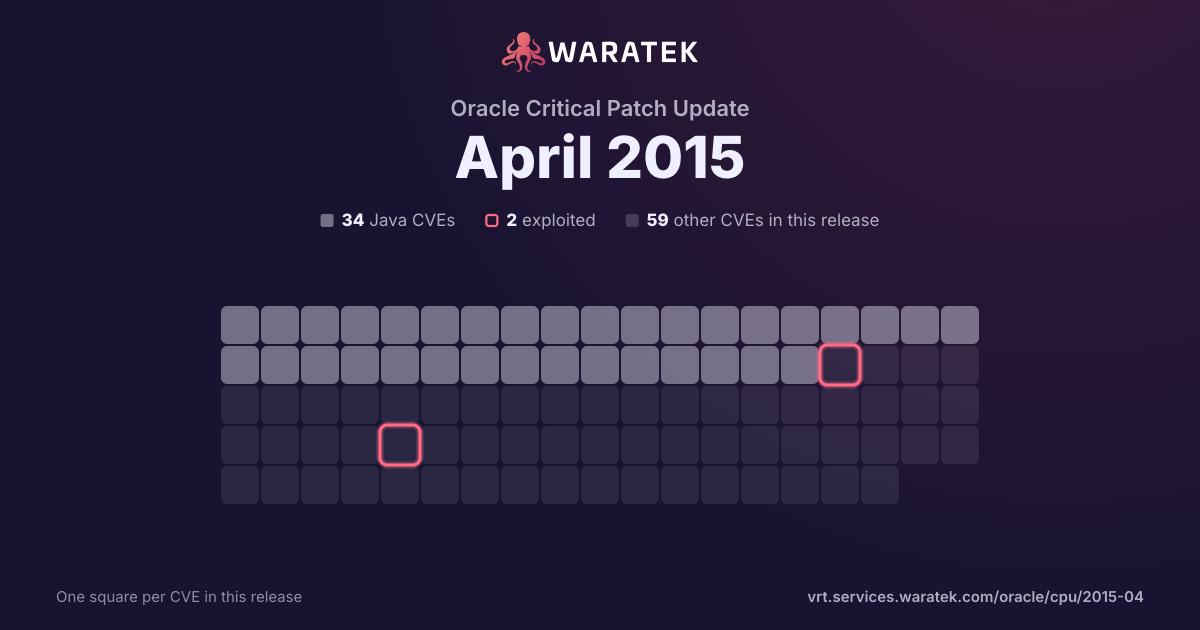
By status
3Mitigation candidate31No exploit published27Outside Waratek scope32Not applicable
2Exploited, marked by the ring
No exploit published. For 29 of them, Oracle's security advisory is the source of public detail.
Overview 32 matches · 0 in Waratek scope · 0 protected · 1 exploited · 0 CISA KEV · 2 public PoC · 1 EPSS ≥ 0.5
32matches
0in Waratek scope0.0%
0protected0.0%
1exploited3.1%
0CISA KEV0.0%
2public PoC6.2%
1EPSS ≥ 0.53.1%
Protected by Waratek
0
0.0%
Rule in development
0
0.0%
Mitigation candidate
0
0.0%
No exploit published
0
0.0%
Outside Waratek scope
0
0.0%
Not applicable
32
100.0%
Withdrawn CVE
0
0.0%
blocked by ARMR today
0
0.0%
partly blocked
0
0.0%
not blocked
32
100.0%
not established
0
0.0%
unrecorded
0
0.0%
Exploited
1
3.1%
Working exploit published
1
3.1%
Proof of concept only
0
0.0%
Forecast only
0
0.0%
No public exploit
30
93.8%
split by
peak 27 / month
Nov 131
Not applicable1
Medium1
not blocked1
No public exploit1
Dec 130
Jan 140
Feb 140
Mar 140
Apr 140
May 140
Jun 140
Jul 140
Aug 140
Sep 141
Not applicable1
High1
not blocked1
No public exploit1
Oct 140
Nov 140
Dec 141
Not applicable1
Medium1
not blocked1
No public exploit1
Jan 152
Not applicable2
Medium2
not blocked2
Exploited1
No public exploit1
Feb 150
Mar 150
Apr 1527
Not applicable27
High3
Medium14
Low10
not blocked27
Working exploit published1
No public exploit26
Dec 13Feb 14Apr 14Jun 14Aug 14Oct 14Dec 14Feb 15Apr 15
| CVE | Severity | Published▾ | Status | Exploitation | Description |
|---|---|---|---|---|---|
| CVE-2015-2578 | High | 2015-04-16 | Not applicable | No public exploit | Unspecified vulnerability in Oracle Sun Solaris 11.2 allows remote attackers to affect availability via vectors related to Kernel IDMap. |
| CVE-2015-2577 | High | 2015-04-16 | Not applicable | No public exploit | Unspecified vulnerability in Oracle Sun Solaris 10 allows local users to affect confidentiality, integrity, and availability via unknown vectors related to Accounting commands. |
| CVE-2015-2576 | Low | 2015-04-16 | Not applicable | No public exploit | Unspecified vulnerability in the MySQL Utilities component in Oracle MySQL 1.5.1 and earlier, when running on Windows, allows local users to affect integrity via unknown vectors related to Installation. |
| CVE-2015-2575 | Medium | 2015-04-16 | Not applicable | No public exploit | Unspecified vulnerability in the MySQL Connectors component in Oracle MySQL 5.1.34 and earlier allows remote authenticated users to affect confidentiality and integrity via unknown vectors related to Connector/J. |
| CVE-2015-2574 | Low | 2015-04-16 | Not applicable | No public exploit | Unspecified vulnerability in Oracle Sun Solaris 10 allows local users to affect confidentiality via unknown vectors related to Text Utilities. |
| CVE-2015-2573 | Medium | 2015-04-16 | Not applicable | No public exploit | Unspecified vulnerability in Oracle MySQL Server 5.5.41 and earlier, and 5.6.22 and earlier, allows remote authenticated users to affect availability via vectors related to DDL. |
| CVE-2015-2572 | Medium | 2015-04-16 | Not applicable | Working exploit published | Unspecified vulnerability in the Oracle Hyperion Smart View for Office component in Oracle Hyperion 11.1.2.5.216 and earlier, when running on Windows, allows local users to affect confidentiality, integrity, and availability via unknown vectors related to Core. |
| CVE-2015-2571 | Medium | 2015-04-16 | Not applicable | No public exploit | Unspecified vulnerability in Oracle MySQL Server 5.5.42 and earlier, and 5.6.23 and earlier, allows remote authenticated users to affect availability via unknown vectors related to Server : Optimizer. |
| CVE-2015-2567 | Low | 2015-04-16 | Not applicable | No public exploit | Unspecified vulnerability in Oracle MySQL Server 5.6.23 and earlier allows remote authenticated users to affect availability via unknown vectors related to Server : Security : Privileges. |
| CVE-2015-2566 | Low | 2015-04-16 | Not applicable | No public exploit | Unspecified vulnerability in Oracle MySQL Server 5.6.22 and earlier allows remote authenticated users to affect availability via vectors related to DML. |
| CVE-2015-0511 | Low | 2015-04-16 | Not applicable | No public exploit | Unspecified vulnerability in Oracle MySQL Server 5.6.23 and earlier allows remote authenticated users to affect availability via unknown vectors related to Server : SP. |
| CVE-2015-0508 | Medium | 2015-04-16 | Not applicable | No public exploit | Unspecified vulnerability in Oracle MySQL Server 5.6.23 and earlier allows remote authenticated users to affect availability via unknown vectors related to Server : InnoDB, a different vulnerability than CVE-2015-0506. |
| CVE-2015-0507 | Low | 2015-04-16 | Not applicable | No public exploit | Unspecified vulnerability in Oracle MySQL Server 5.6.23 and earlier allows remote authenticated users to affect availability via unknown vectors related to Server : Memcached. |
| CVE-2015-0506 | Low | 2015-04-16 | Not applicable | No public exploit | Unspecified vulnerability in Oracle MySQL Server 5.6.23 and earlier allows remote authenticated users to affect availability via unknown vectors related to InnoDB, a different vulnerability than CVE-2015-0508. |
| CVE-2015-0505 | Low | 2015-04-16 | Not applicable | No public exploit | Unspecified vulnerability in Oracle MySQL Server 5.5.42 and earlier, and 5.6.23 and earlier, allows remote authenticated users to affect availability via vectors related to DDL. |
| CVE-2015-0503 | Medium | 2015-04-16 | Not applicable | No public exploit | Unspecified vulnerability in Oracle MySQL Server 5.6.23 and earlier allows remote authenticated users to affect availability via unknown vectors related to Server : Partition. |
| CVE-2015-0499 | Low | 2015-04-16 | Not applicable | No public exploit | Unspecified vulnerability in Oracle MySQL Server 5.5.42 and earlier, and 5.6.23 and earlier, allows remote authenticated users to affect availability via unknown vectors related to Server : Federated. |
| CVE-2015-0498 | Low | 2015-04-16 | Not applicable | No public exploit | Unspecified vulnerability in Oracle MySQL Server 5.6.23 and earlier allows remote authenticated users to affect availability via unknown vectors related to Replication. |
| CVE-2015-0476 | Medium | 2015-04-16 | Not applicable | No public exploit | Unspecified vulnerability in the SQL Trace Analyzer component in Oracle Support Tools before 12.1.11 allows remote authenticated users to affect confidentiality and integrity via unknown vectors. |
| CVE-2015-0471 | Medium | 2015-04-16 | Not applicable | No public exploit | Unspecified vulnerability in Oracle Sun Solaris 10 and 11.2 allows local users to affect confidentiality, integrity, and availability via unknown vectors related to libelfsign. |
| CVE-2015-0452 | Medium | 2015-04-16 | Not applicable | No public exploit | Unspecified vulnerability in the Oracle VM Server for SPARC component in Oracle Sun Systems Products Suite 3.1 and 3.2 allows remote attackers to affect confidentiality via unknown vectors related to Ldom Manager. |
| CVE-2015-0448 | High | 2015-04-16 | Not applicable | No public exploit | Unspecified vulnerability in Oracle Sun Solaris 11.2 allows local users to affect confidentiality, integrity, and availability via vectors related to ZFS File system. |
| CVE-2015-0441 | Medium | 2015-04-16 | Not applicable | No public exploit | Unspecified vulnerability in Oracle MySQL Server 5.5.41 and earlier, and 5.6.22 and earlier, allows remote authenticated users to affect availability via unknown vectors related to Server : Security : Encryption. |
| CVE-2015-0440 | Medium | 2015-04-16 | Not applicable | No public exploit | Unspecified vulnerability in the Oracle Knowledge component in Oracle Right Now Service Cloud 8.2.3.10.1 and 8.4.7.2 allows remote attackers to affect integrity via unknown vectors related to Information Manager Console. |
| CVE-2015-0439 | Medium | 2015-04-16 | Not applicable | No public exploit | Unspecified vulnerability in Oracle MySQL Server 5.6.22 and earlier allows remote authenticated users to affect availability via unknown vectors related to Server : InnoDB, a different vulnerability than CVE-2015-4756. |
| CVE-2015-0438 | Medium | 2015-04-16 | Not applicable | No public exploit | Unspecified vulnerability in Oracle MySQL Server 5.6.22 and earlier allows remote authenticated users to affect availability via unknown vectors related to Server : Partition. |
| CVE-2015-0405 | Medium | 2015-04-16 | Not applicable | No public exploit | Unspecified vulnerability in Oracle MySQL Server 5.6.22 and earlier allows remote authenticated users to affect availability via unknown vectors related to XA. |
| CVE-2015-0204 | Medium | 2015-01-09 | Not applicable | Exploited | The ssl3_get_key_exchange function in s3_clnt.c in OpenSSL before 0.9.8zd, 1.0.0 before 1.0.0p, and 1.0.1 before 1.0.1k allows remote SSL servers to conduct RSA-to-EXPORT_RSA downgrade attacks and facilitate brute-force decryption by offering a weak ephemeral RSA key in a noncompliant role, related to the "FREAK" issue. NOTE: the scope of this CVE is only client code based on OpenSSL, not EXPORT_RSA issues associated with servers or other TLS implementations. |
| CVE-2014-3571 | Medium | 2015-01-09 | Not applicable | No public exploit | OpenSSL before 0.9.8zd, 1.0.0 before 1.0.0p, and 1.0.1 before 1.0.1k allows remote attackers to cause a denial of service (NULL pointer dereference and application crash) via a crafted DTLS message that is processed with a different read operation for the handshake header than for the handshake body, related to the dtls1_get_record function in d1_pkt.c and the ssl3_read_n function in s3_pkt.c. |
| CVE-2014-3569 | Medium | 2014-12-24 | Not applicable | No public exploit | The ssl23_get_client_hello function in s23_srvr.c in OpenSSL 0.9.8zc, 1.0.0o, and 1.0.1j does not properly handle attempts to use unsupported protocols, which allows remote attackers to cause a denial of service (NULL pointer dereference and daemon crash) via an unexpected handshake, as demonstrated by an SSLv3 handshake to a no-ssl3 application with certain error handling. NOTE: this issue became relevant after the CVE-2014-3568 fix. |
| CVE-2014-1568 | High | 2014-09-25 | Not applicable | No public exploit | Mozilla Network Security Services (NSS) before 3.16.2.1, 3.16.x before 3.16.5, and 3.17.x before 3.17.1, as used in Mozilla Firefox before 32.0.3, Mozilla Firefox ESR 24.x before 24.8.1 and 31.x before 31.1.1, Mozilla Thunderbird before 24.8.1 and 31.x before 31.1.2, Mozilla SeaMonkey before 2.29.1, Google Chrome before 37.0.2062.124 on Windows and OS X, and Google Chrome OS before 37.0.2062.120, does not properly parse ASN.1 values in X.509 certificates, which makes it easier for remote attackers to spoof RSA signatures via a crafted certificate, aka a "signature malleability" issue. |
| CVE-2013-4545 | Medium | 2013-11-23 | Not applicable | No public exploit | cURL and libcurl 7.18.0 through 7.32.0, when built with OpenSSL, disables the certificate CN and SAN name field verification (CURLOPT_SSL_VERIFYHOST) when the digital signature verification (CURLOPT_SSL_VERIFYPEER) is disabled, which allows man-in-the-middle attackers to spoof SSL servers via an arbitrary valid certificate. |