
Oracle Critical Patch Update July 2014
Released July 2014 · Oracle's advisory ↗ · ← Critical Patch Update, April 2014 · Critical Patch Update, October 2014 →
103 CVEs in this release, one square each
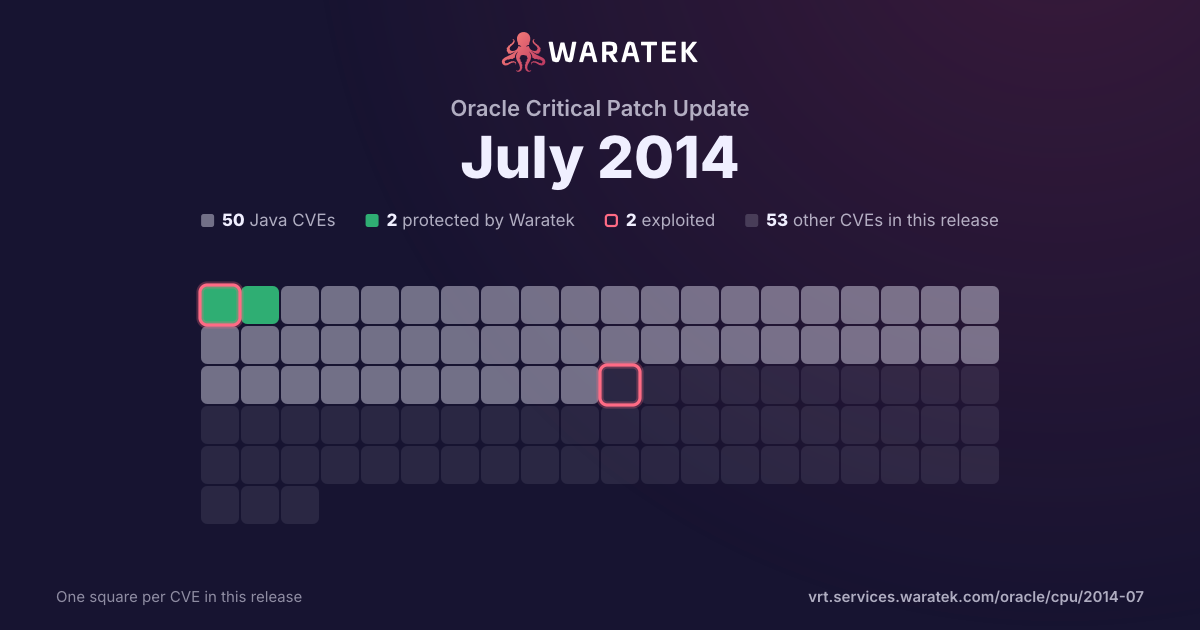
By status
2Protected by Waratek1Mitigation candidate47No exploit published27Outside Waratek scope26Not applicable
2Exploited, marked by the ring
No exploit published. For 45 of them, Oracle's security advisory is the source of public detail.
Protected by Waratek. Waratek RASP can block exploitation of these on systems that have not applied the patch yet.
Overview 11 matches · 1 in Waratek scope · 1 protected · 2 exploited · 0 CISA KEV · 2 public PoC · 2 EPSS ≥ 0.5
11matches
1in Waratek scope9.1%
1protected9.1%
2exploited18.2%
0CISA KEV0.0%
2public PoC18.2%
2EPSS ≥ 0.518.2%
Protected by Waratek
1
9.1%
Rule in development
0
0.0%
Mitigation candidate
0
0.0%
No exploit published
0
0.0%
Outside Waratek scope
6
54.5%
Not applicable
4
36.4%
Withdrawn CVE
0
0.0%
blocked by ARMR today
1
9.1%
partly blocked
0
0.0%
not blocked
10
90.9%
not established
0
0.0%
unrecorded
0
0.0%
Exploited
2
18.2%
Working exploit published
0
0.0%
Proof of concept only
0
0.0%
Forecast only
0
0.0%
No public exploit
9
81.8%
split by
peak 2 / month
Feb 131
Not applicable1
Medium1
not blocked1
No public exploit1
Mar 130
Apr 130
May 130
Jun 131
Outside Waratek scope1
Medium1
not blocked1
No public exploit1
Jul 132
Outside Waratek scope2
High2
not blocked2
No public exploit2
Aug 130
Sep 130
Oct 130
Nov 131
Not applicable1
High1
not blocked1
No public exploit1
Dec 130
Jan 140
Feb 142
Outside Waratek scope2
Medium2
not blocked2
No public exploit2
Mar 141
Not applicable1
Medium1
not blocked1
No public exploit1
Apr 141
Protected by Waratek1
High1
blocked by ARMR today1
Exploited1
May 141
Not applicable1
High1
not blocked1
No public exploit1
Jun 141
Outside Waratek scope1
High1
not blocked1
Exploited1
Feb 13Apr 13Jun 13Aug 13Oct 13Dec 13Feb 14Apr 14Jun 14
| CVE | Severity | Published▾ | Status | Exploitation | Description |
|---|---|---|---|---|---|
| CVE-2014-0224 | High | 2014-06-05 | Outside Waratek scope | Exploited | OpenSSL before 0.9.8za, 1.0.0 before 1.0.0m, and 1.0.1 before 1.0.1h does not properly restrict processing of ChangeCipherSpec messages, which allows man-in-the-middle attackers to trigger use of a zero-length master key in certain OpenSSL-to-OpenSSL communications, and consequently hijack sessions or obtain sensitive information, via a crafted TLS handshake, aka the "CCS Injection" vulnerability. |
| CVE-2014-0211 | High | 2014-05-15 | Not applicable | No public exploit | Multiple integer overflows in the (1) fs_get_reply, (2) fs_alloc_glyphs, and (3) fs_read_extent_info functions in X.Org libXfont before 1.4.8 and 1.4.9x before 1.4.99.901 allow remote font servers to execute arbitrary code via a crafted xfs reply, which triggers a buffer overflow. |
| CVE-2014-0114 | High | 2014-04-30 | Protected by Waratek | Exploited | Apache Commons BeanUtils, as distributed in lib/commons-beanutils-1.8.0.jar in Apache Struts 1.x through 1.3.10 and in other products requiring commons-beanutils through 1.9.2, does not suppress the class property, which allows remote attackers to "manipulate" the ClassLoader and execute arbitrary code via the class parameter, as demonstrated by the passing of this parameter to the getClass method of the ActionForm object in Struts 1. |
| CVE-2014-0098 | Medium | 2014-03-18 | Not applicable | No public exploit | The log_cookie function in mod_log_config.c in the mod_log_config module in the Apache HTTP Server before 2.4.8 allows remote attackers to cause a denial of service (segmentation fault and daemon crash) via a crafted cookie that is not properly handled during truncation. |
| CVE-2014-0033 | Medium | 2014-02-26 | Outside Waratek scope | No public exploit | org/apache/catalina/connector/CoyoteAdapter.java in Apache Tomcat 6.0.33 through 6.0.37 does not consider the disableURLRewriting setting when handling a session ID in a URL, which allows remote attackers to conduct session fixation attacks via a crafted URL. |
| CVE-2013-4286 | Medium | 2014-02-26 | Outside Waratek scope | No public exploit | Apache Tomcat before 6.0.39, 7.x before 7.0.47, and 8.x before 8.0.0-RC3, when an HTTP connector or AJP connector is used, does not properly handle certain inconsistent HTTP request headers, which allows remote attackers to trigger incorrect identification of a request's length and conduct request-smuggling attacks via (1) multiple Content-Length headers or (2) a Content-Length header and a "Transfer-Encoding: chunked" header. NOTE: this vulnerability exists because of an incomplete fix for CVE-2005-2090. |
| CVE-2013-1741 | High | 2013-11-18 | Not applicable | No public exploit | Integer overflow in Mozilla Network Security Services (NSS) 3.15 before 3.15.3 allows remote attackers to cause a denial of service or possibly have unspecified other impact via a large size value. |
| CVE-2013-3774 | High | 2013-07-17 | Outside Waratek scope | No public exploit | Unspecified vulnerability in the Network Layer component in Oracle Database Server 10.2.0.4, 10.2.0.5, 11.1.0.7, 11.2.0.2, 11.2.0.3, and 12.1.0.1 allows remote attackers to affect confidentiality, integrity, and availability via unknown vectors. |
| CVE-2013-3751 | High | 2013-07-17 | Outside Waratek scope | No public exploit | Unspecified vulnerability in the XML Parser component in Oracle Database Server 11.2.0.2, 11.2.0.3, and 12.1.0.1 allows remote authenticated users to affect confidentiality, integrity, and availability via unknown vectors. |
| CVE-2012-3544 | Medium | 2013-06-01 | Outside Waratek scope | No public exploit | Apache Tomcat 6.x before 6.0.37 and 7.x before 7.0.30 does not properly handle chunk extensions in chunked transfer coding, which allows remote attackers to cause a denial of service by streaming data. |
| CVE-2013-1620 | Medium | 2013-02-08 | Not applicable | No public exploit | The TLS implementation in Mozilla Network Security Services (NSS) does not properly consider timing side-channel attacks on a noncompliant MAC check operation during the processing of malformed CBC padding, which allows remote attackers to conduct distinguishing attacks and plaintext-recovery attacks via statistical analysis of timing data for crafted packets, a related issue to CVE-2013-0169. |