
Oracle Critical Patch Update July 2014
Released July 2014 · Oracle's advisory ↗ · ← Critical Patch Update, April 2014 · Critical Patch Update, October 2014 →
103 CVEs in this release, one square each
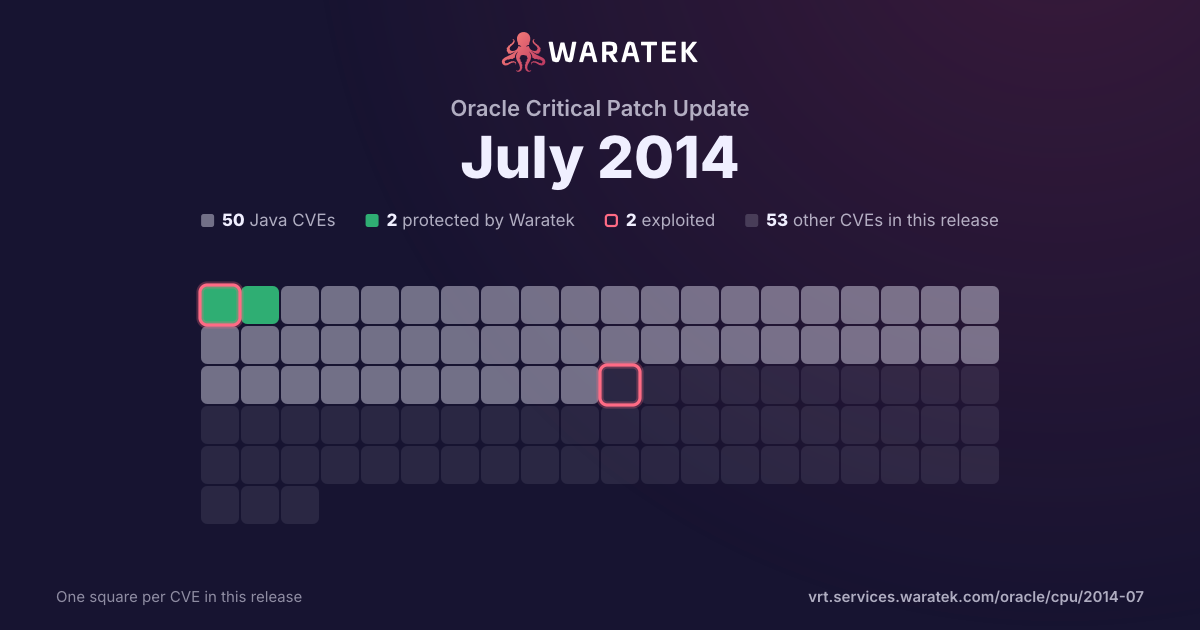
By status
2Protected by Waratek1Mitigation candidate47No exploit published27Outside Waratek scope26Not applicable
2Exploited, marked by the ring
No exploit published. For 45 of them, Oracle's security advisory is the source of public detail.
Protected by Waratek. Waratek RASP can block exploitation of these on systems that have not applied the patch yet.
Overview 4 matches · 2 in Waratek scope · 1 protected · 2 exploited · 0 CISA KEV · 2 EPSS ≥ 0.5
Protected by Waratek
1
25.0%
Rule in development
0
0.0%
Mitigation candidate
1
25.0%
No exploit published
0
0.0%
Outside Waratek scope
1
25.0%
Not applicable
1
25.0%
Withdrawn CVE
0
0.0%
blocked by ARMR today
1
25.0%
partly blocked
0
0.0%
not blocked
3
75.0%
not established
0
0.0%
unrecorded
0
0.0%
Exploited
2
50.0%
Working exploit published
2
50.0%
Proof of concept only
0
0.0%
Forecast only
0
0.0%
No public exploit
0
0.0%
| CVE | Severity | Published▾ | Status | Exploitation | Description |
|---|---|---|---|---|---|
| CVE-2014-4210 | Medium | 2014-07-17 | Mitigation candidate | Working exploit published | Unspecified vulnerability in the Oracle WebLogic Server component in Oracle Fusion Middleware 10.0.2.0 and 10.3.6.0 allows remote attackers to affect confidentiality via vectors related to WLS - Web Services. |
| CVE-2014-2477 | Low | 2014-07-17 | Not applicable | Working exploit published | Unspecified vulnerability in the Oracle VM VirtualBox component in Oracle Virtualization VirtualBox before 3.2.24, 4.0.26, 4.1.34, 4.2.26, and 4.3.12 allows local users to affect integrity and availability via unknown vectors related to Core, a different vulnerability than CVE-2014-2486. |
| CVE-2014-0224 | High | 2014-06-05 | Outside Waratek scope | Exploited | OpenSSL before 0.9.8za, 1.0.0 before 1.0.0m, and 1.0.1 before 1.0.1h does not properly restrict processing of ChangeCipherSpec messages, which allows man-in-the-middle attackers to trigger use of a zero-length master key in certain OpenSSL-to-OpenSSL communications, and consequently hijack sessions or obtain sensitive information, via a crafted TLS handshake, aka the "CCS Injection" vulnerability. |
| CVE-2014-0114 | High | 2014-04-30 | Protected by Waratek | Exploited | Apache Commons BeanUtils, as distributed in lib/commons-beanutils-1.8.0.jar in Apache Struts 1.x through 1.3.10 and in other products requiring commons-beanutils through 1.9.2, does not suppress the class property, which allows remote attackers to "manipulate" the ClassLoader and execute arbitrary code via the class parameter, as demonstrated by the passing of this parameter to the getClass method of the ActionForm object in Struts 1. |