
Oracle Critical Patch Update January 2014
Released January 2014 · Oracle's advisory ↗ · ← Critical Patch Update, October 2013 · Critical Patch Update, April 2014 →
135 CVEs in this release, one square each
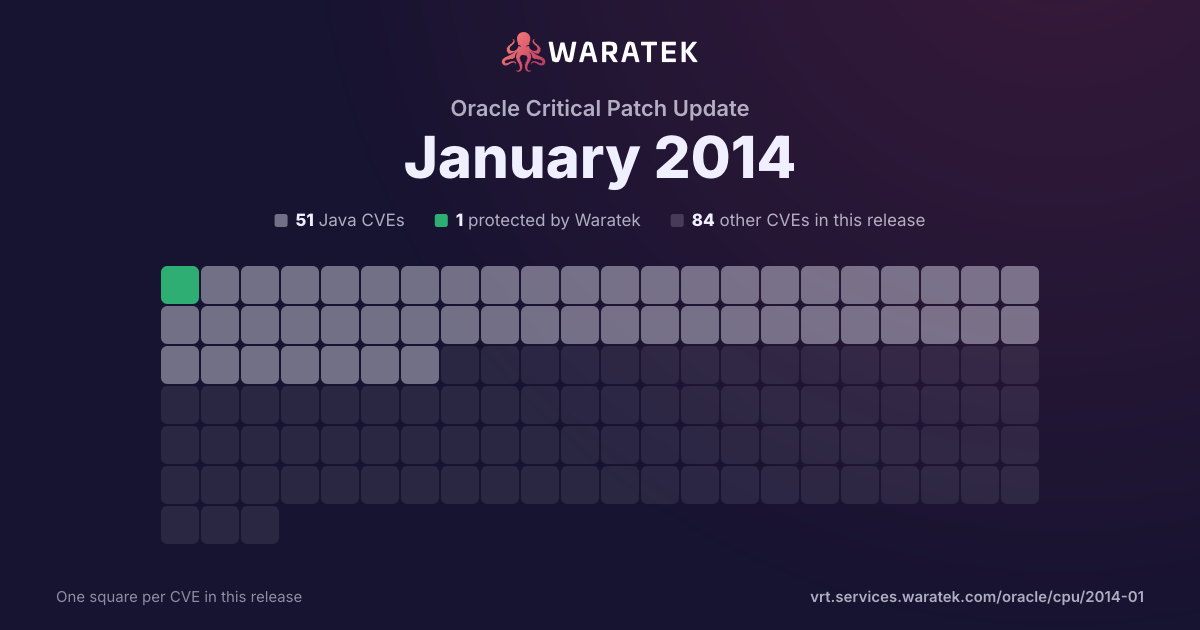
By status
1Protected by Waratek5Mitigation candidate45No exploit published44Outside Waratek scope40Not applicable
No exploit published. For 45 of them, Oracle's security advisory is the source of public detail.
Protected by Waratek. Waratek RASP can block exploitation of these on systems that have not applied the patch yet.
Overview 2 matches · 0 in Waratek scope · 0 protected · 0 exploited · 0 CISA KEV · 0 public PoC · 1 EPSS ≥ 0.5
2matches
0in Waratek scope0.0%
0protected0.0%
0exploited0.0%
0CISA KEV0.0%
0public PoC0.0%
1EPSS ≥ 0.550.0%
Protected by Waratek
0
0.0%
Rule in development
0
0.0%
Mitigation candidate
0
0.0%
No exploit published
0
0.0%
Outside Waratek scope
0
0.0%
Not applicable
2
100.0%
Withdrawn CVE
0
0.0%
blocked by ARMR today
0
0.0%
partly blocked
0
0.0%
not blocked
2
100.0%
not established
0
0.0%
unrecorded
0
0.0%
Exploited
0
0.0%
Working exploit published
0
0.0%
Proof of concept only
0
0.0%
Forecast only
1
50.0%
No public exploit
1
50.0%
split by
peak 1 / quarter
Q1 07Q3 07Q1 08Q3 08Q1 09Q3 09Q1 10Q3 10Q1 11Q3 11Q1 12Q3 12
| CVE | Severity | Published▾ | Status | Exploitation | Description |
|---|---|---|---|---|---|
| CVE-2012-4605 | Medium | 2012-08-23 | Not applicable | No public exploit | The default configuration of the SMTP component in Websense Email Security 6.1 through 7.3 enables weak SSL ciphers in the "SurfControl plc\SuperScout Email Filter\SMTP" registry key, which makes it easier for remote attackers to obtain sensitive information by sniffing the network and then conducting a brute-force attack against encrypted session data. |
| CVE-2007-0009 | Medium | 2007-02-26 | Not applicable | Forecast only | Stack-based buffer overflow in the SSLv2 support in Mozilla Network Security Services (NSS) before 3.11.5, as used by Firefox before 1.5.0.10 and 2.x before 2.0.0.2, Thunderbird before 1.5.0.10, SeaMonkey before 1.0.8, and certain Sun Java System server products before 20070611, allows remote attackers to execute arbitrary code via invalid "Client Master Key" length values. |