
Oracle Critical Patch Update January 2014
Released January 2014 · Oracle's advisory ↗ · ← Critical Patch Update, October 2013 · Critical Patch Update, April 2014 →
135 CVEs in this release, one square each
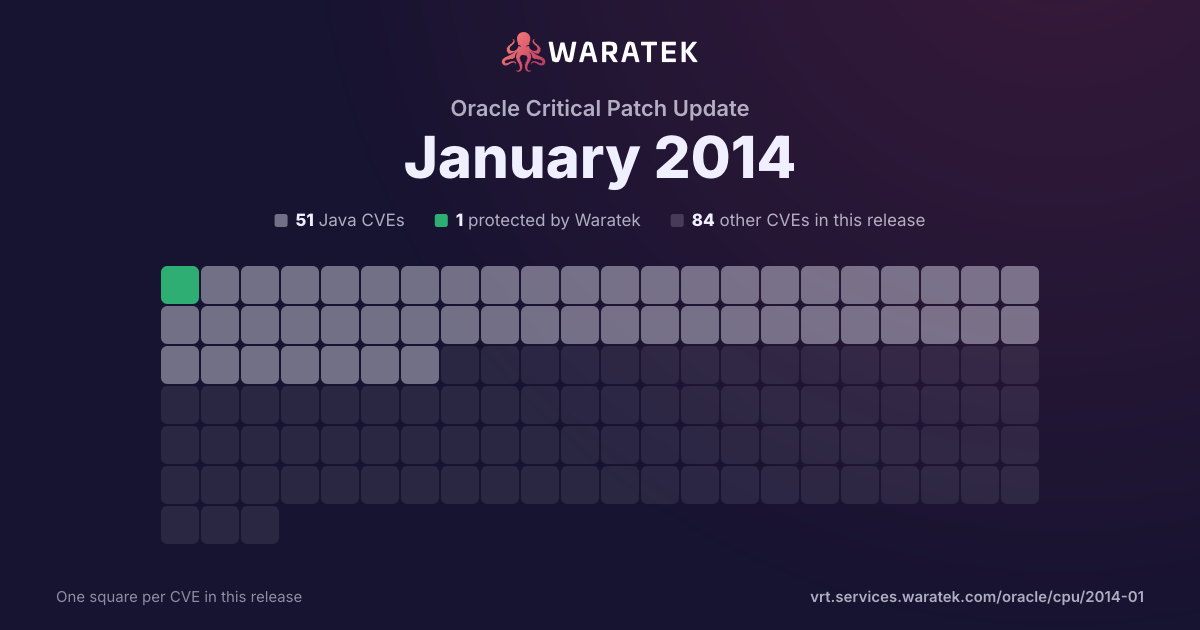
By status
1Protected by Waratek5Mitigation candidate45No exploit published44Outside Waratek scope40Not applicable
No exploit published. For 45 of them, Oracle's security advisory is the source of public detail.
Protected by Waratek. Waratek RASP can block exploitation of these on systems that have not applied the patch yet.
Overview 40 matches · 0 in Waratek scope · 0 protected · 0 exploited · 0 CISA KEV · 0 public PoC · 1 EPSS ≥ 0.5
40matches
0in Waratek scope0.0%
0protected0.0%
0exploited0.0%
0CISA KEV0.0%
0public PoC0.0%
1EPSS ≥ 0.52.5%
Protected by Waratek
0
0.0%
Rule in development
0
0.0%
Mitigation candidate
0
0.0%
No exploit published
0
0.0%
Outside Waratek scope
0
0.0%
Not applicable
40
100.0%
Withdrawn CVE
0
0.0%
blocked by ARMR today
0
0.0%
partly blocked
0
0.0%
not blocked
40
100.0%
not established
0
0.0%
unrecorded
0
0.0%
Exploited
0
0.0%
Working exploit published
0
0.0%
Proof of concept only
0
0.0%
Forecast only
1
2.5%
No public exploit
39
97.5%
split by
peak 32 / year
20031
Not applicable1
High1
not blocked1
No public exploit1
20040
20050
20060
20071
Not applicable1
Medium1
not blocked1
Forecast only1
20080
20090
20100
20110
20121
Not applicable1
Medium1
not blocked1
No public exploit1
20135
Not applicable5
High1
Medium4
not blocked5
No public exploit5
201432
Not applicable32
Medium16
Low16
not blocked32
No public exploit32
200320042005200620072008200920102011201220132014
| CVE | Severity | Published▾ | Status | Exploitation | Description |
|---|---|---|---|---|---|
| CVE-2014-0437 | Low | 2014-01-15 | Not applicable | No public exploit | Unspecified vulnerability in the MySQL Server component in Oracle MySQL 5.1.72 and earlier, 5.5.34 and earlier, and 5.6.14 and earlier allows remote authenticated users to affect availability via unknown vectors related to Optimizer. |
| CVE-2014-0433 | Medium | 2014-01-15 | Not applicable | No public exploit | Unspecified vulnerability in the MySQL Server component in Oracle MySQL 5.6.13 and earlier allows remote attackers to affect availability via unknown vectors related to Thread Pooling. |
| CVE-2014-0431 | Low | 2014-01-15 | Not applicable | No public exploit | Unspecified vulnerability in the MySQL Server component in Oracle MySQL 5.6.14 and earlier allows remote authenticated users to affect availability via unknown vectors related to InnoDB, a different vulnerability than CVE-2013-5881. |
| CVE-2014-0430 | Low | 2014-01-15 | Not applicable | No public exploit | Unspecified vulnerability in the MySQL Server component in Oracle MySQL 5.6.13 and earlier allows remote authenticated users to affect availability via unknown vectors related to Performance Schema. |
| CVE-2014-0427 | Low | 2014-01-15 | Not applicable | No public exploit | Unspecified vulnerability in the MySQL Server component in Oracle MySQL 5.6.13 and earlier allows remote authenticated users to affect availability via vectors related to FTS. |
| CVE-2014-0420 | Low | 2014-01-15 | Not applicable | No public exploit | Unspecified vulnerability in the MySQL Server component in Oracle MySQL 5.5.34 and earlier, and 5.6.14 and earlier, allows remote authenticated users to affect availability via unknown vectors related to Replication. |
| CVE-2014-0419 | Medium | 2014-01-15 | Not applicable | No public exploit | Unspecified vulnerability in the Oracle Secure Global Desktop (SGD) component in Oracle Virtualization SGD before 4.63 with December 2013 PSU, 4.71, 5.0 with December 2013 PSU, and 5.10 allows remote attackers to affect confidentiality, integrity, and availability via unknown vectors related to Administration Console and Workspace Web Applications. |
| CVE-2014-0412 | Medium | 2014-01-15 | Not applicable | No public exploit | Unspecified vulnerability in the MySQL Server component in Oracle MySQL 5.1.72 and earlier, 5.5.34 and earlier, and 5.6.14 and earlier allows remote authenticated users to affect availability via unknown vectors related to InnoDB. |
| CVE-2014-0407 | Low | 2014-01-15 | Not applicable | No public exploit | Unspecified vulnerability in the Oracle VM VirtualBox component in Oracle Virtualization VirtualBox prior to 3.2.20, 4.0.22, 4.1.30, 4.2.20, and 4.3.4 allows local users to affect confidentiality, integrity, and availability via unknown vectors related to Core, a different vulnerability than CVE-2014-0405. |
| CVE-2014-0406 | Low | 2014-01-15 | Not applicable | No public exploit | Unspecified vulnerability in the Oracle VM VirtualBox component in Oracle Virtualization VirtualBox prior to 3.2.20, 4.0.22, 4.1.30, 4.2.20, and 4.3.4 allows local users to affect integrity and availability via unknown vectors related to Core, a different vulnerability than CVE-2014-0404. |
| CVE-2014-0405 | Low | 2014-01-15 | Not applicable | No public exploit | Unspecified vulnerability in the Oracle VM VirtualBox component in Oracle Virtualization VirtualBox prior to 3.2.20, 4.0.22, 4.1.30, 4.2.20, and 4.3.4 allows local users to affect confidentiality, integrity, and availability via unknown vectors related to Core, a different vulnerability than CVE-2014-0407. |
| CVE-2014-0404 | Low | 2014-01-15 | Not applicable | No public exploit | Unspecified vulnerability in the Oracle VM VirtualBox component in Oracle Virtualization VirtualBox prior to 3.2.20, 4.0.22, 4.1.30, 4.2.20, and 4.3.4 allows local users to affect integrity and availability via unknown vectors related to Core, a different vulnerability than CVE-2014-0406. |
| CVE-2014-0402 | Medium | 2014-01-15 | Not applicable | No public exploit | Unspecified vulnerability in the MySQL Server component in Oracle MySQL 5.1.71 and earlier, 5.5.33 and earlier, and 5.6.13 and earlier allows remote authenticated users to affect availability via unknown vectors related to Locking. |
| CVE-2014-0401 | Medium | 2014-01-15 | Not applicable | No public exploit | Unspecified vulnerability in the MySQL Server component in Oracle MySQL 5.1.72 and earlier, 5.5.34 and earlier, and 5.6.14 and earlier allows remote authenticated users to affect availability via unknown vectors. |
| CVE-2014-0393 | Low | 2014-01-15 | Not applicable | No public exploit | Unspecified vulnerability in the MySQL Server component in Oracle MySQL 5.1.71 and earlier, 5.5.33 and earlier, and 5.6.13 and earlier allows remote authenticated users to affect integrity via unknown vectors related to InnoDB. |
| CVE-2014-0390 | Medium | 2014-01-15 | Not applicable | No public exploit | Unspecified vulnerability in Oracle Solaris 10 allows remote attackers to affect integrity via unknown vectors related to Java Web Console. |
| CVE-2014-0386 | Medium | 2014-01-15 | Not applicable | No public exploit | Unspecified vulnerability in the MySQL Server component in Oracle MySQL 5.1.71 and earlier, 5.5.33 and earlier, and 5.6.13 and earlier allows remote authenticated users to affect availability via unknown vectors related to Optimizer. |
| CVE-2013-5908 | Low | 2014-01-15 | Not applicable | No public exploit | Unspecified vulnerability in the MySQL Server component in Oracle MySQL 5.1.72 and earlier, 5.5.34 and earlier, and 5.6.14 and earlier allows remote attackers to affect availability via unknown vectors related to Error Handling. |
| CVE-2013-5894 | Medium | 2014-01-15 | Not applicable | No public exploit | Unspecified vulnerability in the MySQL Server component in Oracle MySQL 5.6.13 and earlier allows remote authenticated users to affect availability via unknown vectors related to InnoDB. |
| CVE-2013-5892 | Low | 2014-01-15 | Not applicable | No public exploit | Unspecified vulnerability in the Oracle VM VirtualBox component in Oracle Virtualization VirtualBox prior to 3.2.20, 4.0.22, 4.1.30, 4.2.22, and 4.3.6 allows local users to affect confidentiality, integrity, and availability via unknown vectors related to Core. |
| CVE-2013-5891 | Medium | 2014-01-15 | Not applicable | No public exploit | Unspecified vulnerability in the MySQL Server component in Oracle MySQL 5.5.33 and earlier and 5.6.13 and earlier allows remote authenticated users to affect availability via unknown vectors related to Partition. |
| CVE-2013-5885 | Low | 2014-01-15 | Not applicable | No public exploit | Unspecified vulnerability in Oracle Solaris 11.1 allows local users to affect integrity via unknown vectors related to Audit. |
| CVE-2013-5883 | Low | 2014-01-15 | Not applicable | No public exploit | Unspecified vulnerability in Oracle Solaris 8 allows local users to affect integrity and availability via unknown vectors related to Kernel. |
| CVE-2013-5882 | Medium | 2014-01-15 | Not applicable | No public exploit | Unspecified vulnerability in the MySQL Server component in Oracle MySQL 5.6.13 and earlier allows remote authenticated users to affect availability via unknown vectors related to Stored Procedures. |
| CVE-2013-5881 | Medium | 2014-01-15 | Not applicable | No public exploit | Unspecified vulnerability in the MySQL Server component in Oracle MySQL 5.6.14 and earlier allows remote authenticated users to affect availability via unknown vectors related to InnoDB, a different vulnerability than CVE-2014-0431. |
| CVE-2013-5876 | Medium | 2014-01-15 | Not applicable | No public exploit | Unspecified vulnerability in Oracle Solaris 10 and 11.1 allows local users to affect availability via unknown vectors related to Kernel, a different vulnerability than CVE-2014-0447. |
| CVE-2013-5875 | Low | 2014-01-15 | Not applicable | No public exploit | Unspecified vulnerability in Oracle Solaris 11.1 allows local users to affect integrity and availability via vectors related to Role Based Access Control (RBAC). |
| CVE-2013-5872 | Low | 2014-01-15 | Not applicable | No public exploit | Unspecified vulnerability in Oracle Solaris 10 and 11.1 allows local users to affect availability via vectors related to Name Service Cache Daemon (NSCD). |
| CVE-2013-5860 | Medium | 2014-01-15 | Not applicable | No public exploit | Unspecified vulnerability in the MySQL Server component in Oracle MySQL 5.6.14 and earlier allows remote authenticated users to affect availability via vectors related to GIS. |
| CVE-2013-5834 | Medium | 2014-01-15 | Not applicable | No public exploit | Unspecified vulnerability in Oracle Solaris 8 allows local users to affect confidentiality, integrity, and availability via unknown vectors related to ps. |
| CVE-2013-5833 | Medium | 2014-01-15 | Not applicable | No public exploit | Unspecified vulnerability in Oracle Solaris 8 and 9 allows local users to affect availability via unknown vectors related to Filesystem. |
| CVE-2013-5821 | Medium | 2014-01-15 | Not applicable | No public exploit | Unspecified vulnerability in Oracle Solaris 8, 9, 10, and 11.1 allows local users to affect confidentiality, integrity, and availability via vectors related to RPC. |
| CVE-2013-2924 | High | 2013-10-02 | Not applicable | No public exploit | Use-after-free vulnerability in International Components for Unicode (ICU), as used in Google Chrome before 30.0.1599.66 and other products, allows remote attackers to cause a denial of service or possibly have unspecified other impact via unknown vectors. |
| CVE-2013-1862 | Medium | 2013-06-10 | Not applicable | No public exploit | mod_rewrite.c in the mod_rewrite module in the Apache HTTP Server 2.2.x before 2.2.25 writes data to a log file without sanitizing non-printable characters, which might allow remote attackers to execute arbitrary commands via an HTTP request containing an escape sequence for a terminal emulator. |
| CVE-2013-1654 | Medium | 2013-03-20 | Not applicable | No public exploit | Puppet 2.7.x before 2.7.21 and 3.1.x before 3.1.1, and Puppet Enterprise 2.7.x before 2.7.2, does not properly negotiate the SSL protocol between client and master, which allows remote attackers to conduct SSLv2 downgrade attacks against SSLv3 sessions via unspecified vectors. |
| CVE-2012-3499 | Medium | 2013-02-26 | Not applicable | No public exploit | Multiple cross-site scripting (XSS) vulnerabilities in the Apache HTTP Server 2.2.x before 2.2.24-dev and 2.4.x before 2.4.4 allow remote attackers to inject arbitrary web script or HTML via vectors involving hostnames and URIs in the (1) mod_imagemap, (2) mod_info, (3) mod_ldap, (4) mod_proxy_ftp, and (5) mod_status modules. |
| CVE-2013-1620 | Medium | 2013-02-08 | Not applicable | No public exploit | The TLS implementation in Mozilla Network Security Services (NSS) does not properly consider timing side-channel attacks on a noncompliant MAC check operation during the processing of malformed CBC padding, which allows remote attackers to conduct distinguishing attacks and plaintext-recovery attacks via statistical analysis of timing data for crafted packets, a related issue to CVE-2013-0169. |
| CVE-2012-4605 | Medium | 2012-08-23 | Not applicable | No public exploit | The default configuration of the SMTP component in Websense Email Security 6.1 through 7.3 enables weak SSL ciphers in the "SurfControl plc\SuperScout Email Filter\SMTP" registry key, which makes it easier for remote attackers to obtain sensitive information by sniffing the network and then conducting a brute-force attack against encrypted session data. |
| CVE-2007-0009 | Medium | 2007-02-26 | Not applicable | Forecast only | Stack-based buffer overflow in the SSLv2 support in Mozilla Network Security Services (NSS) before 3.11.5, as used by Firefox before 1.5.0.10 and 2.x before 2.0.0.2, Thunderbird before 1.5.0.10, SeaMonkey before 1.0.8, and certain Sun Java System server products before 20070611, allows remote attackers to execute arbitrary code via invalid "Client Master Key" length values. |
| CVE-2003-1067 | High | 2003-06-19 | Not applicable | No public exploit | Multiple buffer overflows in the (1) dbm_open function, as used in ndbm and dbm, and the (2) dbminit function in Solaris 2.6 through 9 allow local users to gain root privileges via long arguments to Xsun or other programs that use these functions. |