
Oracle Critical Patch Update October 2013
Released October 2013 · Oracle's advisory ↗ · ← Critical Patch Update, July 2013 · Critical Patch Update, January 2014 →
124 CVEs in this release, one square each
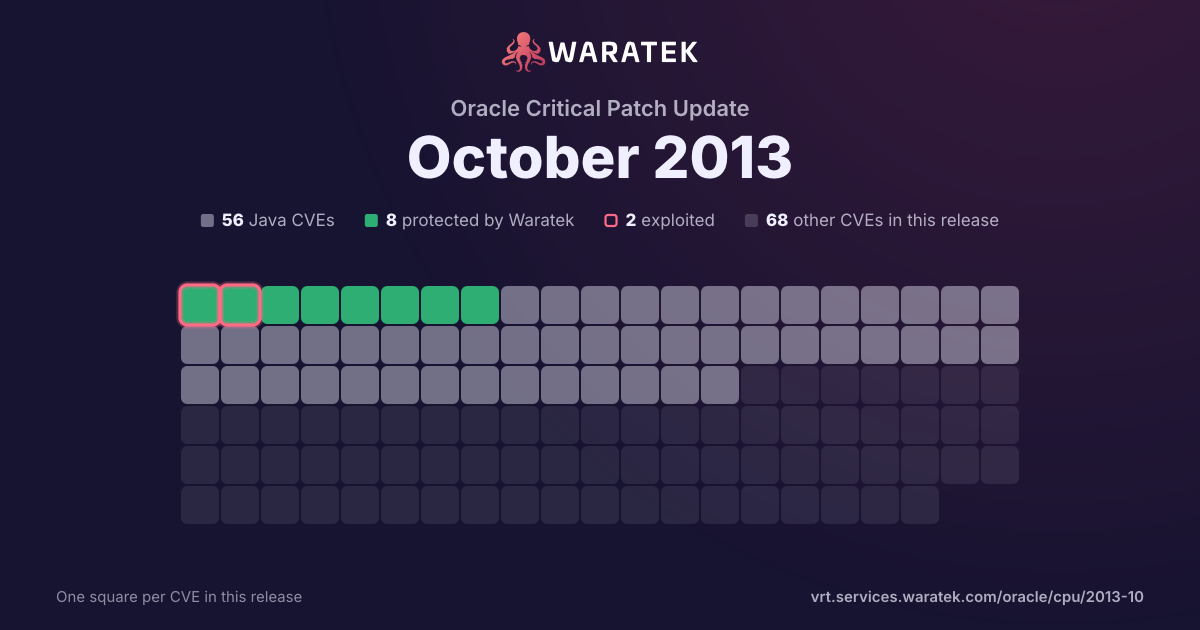
By status
8Protected by Waratek48No exploit published44Outside Waratek scope24Not applicable
2Exploited, marked by the ring
No exploit published. For 43 of them, Oracle's security advisory is the source of public detail.
Protected by Waratek. Waratek RASP can block exploitation of these on systems that have not applied the patch yet.
Overview 17 matches · 0 in Waratek scope · 0 protected · 0 exploited · 0 CISA KEV · 1 public PoC · 1 EPSS ≥ 0.5
17matches
0in Waratek scope0.0%
0protected0.0%
0exploited0.0%
0CISA KEV0.0%
1public PoC5.9%
1EPSS ≥ 0.55.9%
Protected by Waratek
0
0.0%
Rule in development
0
0.0%
Mitigation candidate
0
0.0%
No exploit published
0
0.0%
Outside Waratek scope
0
0.0%
Not applicable
17
100.0%
Withdrawn CVE
0
0.0%
blocked by ARMR today
0
0.0%
partly blocked
0
0.0%
not blocked
17
100.0%
not established
0
0.0%
unrecorded
0
0.0%
Exploited
0
0.0%
Working exploit published
0
0.0%
Proof of concept only
1
5.9%
Forecast only
0
0.0%
No public exploit
16
94.1%
split by
peak 15 / quarter
Q3 11Q4 11Q1 12Q2 12Q3 12Q4 12Q1 13Q2 13Q3 13Q4 13
| CVE | Severity | Published▾ | Status | Exploitation | Description |
|---|---|---|---|---|---|
| CVE-2013-5866 | Medium | 2013-10-16 | Not applicable | No public exploit | Unspecified vulnerability in Oracle Solaris 11.1 allows local users to affect confidentiality, integrity, and availability via unknown vectors related to Kernel. |
| CVE-2013-5864 | Medium | 2013-10-16 | Not applicable | No public exploit | Unspecified vulnerability in Oracle Solaris 10 and 11.1 allows local users to affect availability via vectors related to USB hub driver. |
| CVE-2013-5863 | Medium | 2013-10-16 | Not applicable | No public exploit | Unspecified vulnerability in Oracle Solaris 11.1 allows remote attackers to affect integrity via vectors related to IPS repository daemon. |
| CVE-2013-5862 | Medium | 2013-10-16 | Not applicable | No public exploit | Unspecified vulnerability in Oracle Solaris 10 and 11.1 allows local users to affect availability via vectors related to CPU performance counters (CPC) drivers, a different vulnerability than CVE-2014-4215. |
| CVE-2013-5861 | Medium | 2013-10-16 | Not applicable | No public exploit | Unspecified vulnerability in Oracle Solaris 11.1 allows remote attackers to affect availability via vectors related to Kernel/KSSL. |
| CVE-2013-5839 | Medium | 2013-10-16 | Not applicable | No public exploit | Unspecified vulnerability in Oracle Solaris 10 allows remote attackers to affect integrity via unknown vectors related to Oracle Java Web Console. |
| CVE-2013-5807 | Medium | 2013-10-16 | Not applicable | No public exploit | Unspecified vulnerability in Oracle MySQL Server 5.5.x through 5.5.32 and 5.6.x through 5.6.12 allows remote authenticated users to affect confidentiality and integrity via unknown vectors related to Replication. |
| CVE-2013-5786 | Medium | 2013-10-16 | Not applicable | No public exploit | Unspecified vulnerability in Oracle MySQL Server 5.6.12 and earlier allows remote authenticated users to affect availability via unknown vectors related to InnoDB, a different vulnerability than CVE-2013-5793. |
| CVE-2013-5781 | Medium | 2013-10-16 | Not applicable | No public exploit | Unspecified vulnerability in Oracle PARC Enterprise T4 Servers running Sun System Firmware before 8.3.0.b allows local users to affect confidentiality, integrity, and availability via vectors related to Sun System Firmware/Integrated Lights Out Manager (ILOM). |
| CVE-2013-5768 | Medium | 2013-10-16 | Not applicable | No public exploit | Unspecified vulnerability in the Siebel UI Framework component in Oracle Siebel CRM 8.1.1 and 8.2.2 allows remote authenticated users to affect integrity via unknown vectors related to ActiveX Controls. |
| CVE-2013-5767 | Medium | 2013-10-16 | Not applicable | No public exploit | Unspecified vulnerability in the MySQL Server component in Oracle MySQL 5.6.12 and earlier allows remote authenticated users to affect availability via unknown vectors related to Optimizer. |
| CVE-2013-3839 | Medium | 2013-10-16 | Not applicable | No public exploit | Unspecified vulnerability in the MySQL Server component in Oracle MySQL 5.1.70 and earlier, 5.5.32 and earlier, and 5.6.12 and earlier allows remote authenticated users to affect availability via unknown vectors related to Optimizer. |
| CVE-2013-3838 | Medium | 2013-10-16 | Not applicable | No public exploit | Unspecified vulnerability in Oracle SPARC Enterprise T & M Series Servers running Sun System Firmware before 6.7.13 for SPARC T1, 7.4.6.c for SPARC T2, 8.3.0.b for SPARC T3 & T4, 9.0.0.d for SPARC T5 and 9.0.1.e for SPARC M5 allows local users to affect availability via unknown vectors related to Sun System Firmware/Hypervisor. |
| CVE-2013-3837 | Medium | 2013-10-16 | Not applicable | No public exploit | Unspecified vulnerability in Oracle Solaris 10 and 11.1 allows remote attackers to affect availability via unknown vectors related to Cacao. |
| CVE-2013-3834 | Medium | 2013-10-16 | Not applicable | No public exploit | Unspecified vulnerability in the Oracle Secure Global Desktop component in Oracle Virtualization 5 allows remote attackers to affect availability via unknown vectors related to ttaauxserv. |
| CVE-2013-0149 | Medium | 2013-08-05 | Not applicable | No public exploit | The OSPF implementation in Cisco IOS 12.0 through 12.4 and 15.0 through 15.3, IOS-XE 2.x through 3.9.xS, ASA and PIX 7.x through 9.1, FWSM, NX-OS, and StarOS before 14.0.50488 does not properly validate Link State Advertisement (LSA) type 1 packets before performing operations on the LSA database, which allows remote attackers to cause a denial of service (routing disruption) or obtain sensitive packet information via a (1) unicast or (2) multicast packet, aka Bug IDs CSCug34485, CSCug34469, CSCug39762, CSCug63304, and CSCug39795. |
| CVE-2011-3389 | Medium | 2011-09-06 | Not applicable | Proof of concept only | The SSL protocol, as used in certain configurations in Microsoft Windows and Microsoft Internet Explorer, Mozilla Firefox, Google Chrome, Opera, and other products, encrypts data by using CBC mode with chained initialization vectors, which allows man-in-the-middle attackers to obtain plaintext HTTP headers via a blockwise chosen-boundary attack (BCBA) on an HTTPS session, in conjunction with JavaScript code that uses (1) the HTML5 WebSocket API, (2) the Java URLConnection API, or (3) the Silverlight WebClient API, aka a "BEAST" attack. |