
Oracle Critical Patch Update October 2013
Released October 2013 · Oracle's advisory ↗ · ← Critical Patch Update, July 2013 · Critical Patch Update, January 2014 →
124 CVEs in this release, one square each
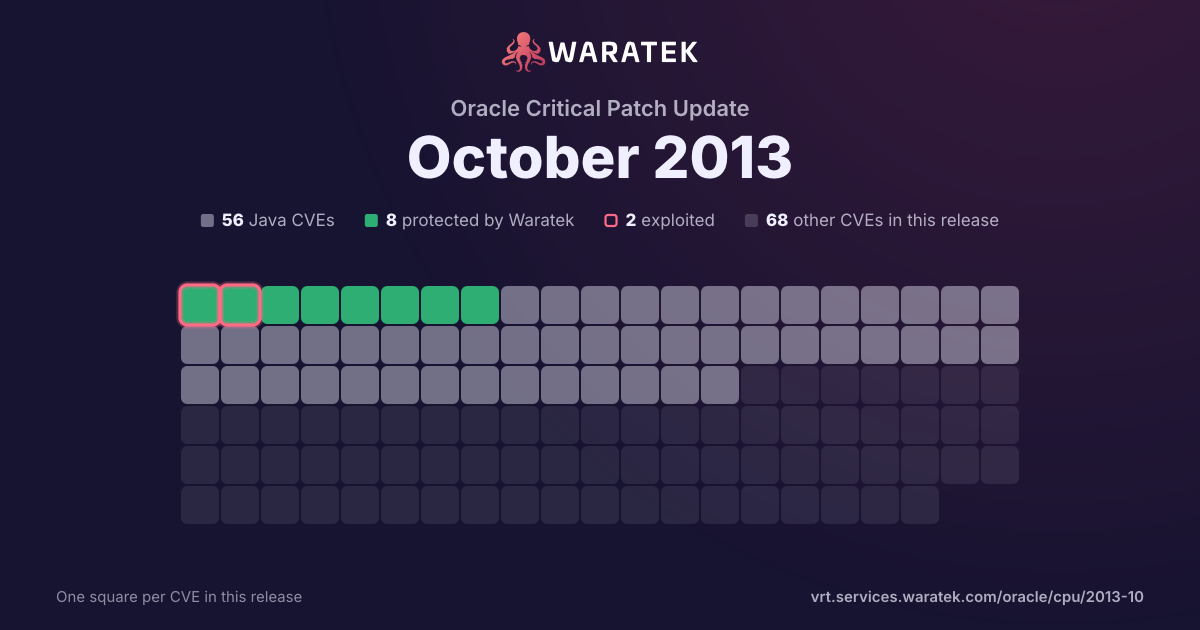
By status
8Protected by Waratek48No exploit published44Outside Waratek scope24Not applicable
2Exploited, marked by the ring
No exploit published. For 43 of them, Oracle's security advisory is the source of public detail.
Protected by Waratek. Waratek RASP can block exploitation of these on systems that have not applied the patch yet.
Overview 3 matches · 0 in Waratek scope · 0 protected · 0 exploited · 0 CISA KEV · 1 EPSS ≥ 0.5
Protected by Waratek
0
0.0%
Rule in development
0
0.0%
Mitigation candidate
0
0.0%
No exploit published
0
0.0%
Outside Waratek scope
0
0.0%
Not applicable
3
100.0%
Withdrawn CVE
0
0.0%
blocked by ARMR today
0
0.0%
partly blocked
0
0.0%
not blocked
3
100.0%
not established
0
0.0%
unrecorded
0
0.0%
Exploited
0
0.0%
Working exploit published
2
66.7%
Proof of concept only
1
33.3%
Forecast only
0
0.0%
No public exploit
0
0.0%
split by
peak 2 / quarter
Q3 11Q4 11Q1 12Q2 12Q3 12Q4 12Q1 13Q2 13Q3 13Q4 13
| CVE | Severity | Published▾ | Status | Exploitation | Description |
|---|---|---|---|---|---|
| CVE-2013-5791 | Low | 2013-10-16 | Not applicable | Working exploit published | Unspecified vulnerability in the Oracle Outside In Technology component in Oracle Fusion Middleware 8.4.0 and 8.4.1 allows context-dependent attackers to affect availability via unknown vectors related to Outside In Filters. NOTE: the previous information is from the October 2013 CPU. Oracle has not commented on claims from a third party that the issue is a stack-based buffer overflow in the Microsoft Access 1.x parser in vsacs.dll before 8.4.0.108 and before 8.4.1.52, which allows attackers to execute arbitrary code via a long field (aka column) name. |
| CVE-2013-3792 | Low | 2013-10-16 | Not applicable | Working exploit published | Unspecified vulnerability in the Oracle VM VirtualBox component in Oracle Virtualization VirtualBox prior to 3.2.18, 4.0.20, 4.1.28, and 4.2.18 allows local users to affect availability via unknown vectors related to Core. |
| CVE-2011-3389 | Medium | 2011-09-06 | Not applicable | Proof of concept only | The SSL protocol, as used in certain configurations in Microsoft Windows and Microsoft Internet Explorer, Mozilla Firefox, Google Chrome, Opera, and other products, encrypts data by using CBC mode with chained initialization vectors, which allows man-in-the-middle attackers to obtain plaintext HTTP headers via a blockwise chosen-boundary attack (BCBA) on an HTTPS session, in conjunction with JavaScript code that uses (1) the HTML5 WebSocket API, (2) the Java URLConnection API, or (3) the Silverlight WebClient API, aka a "BEAST" attack. |