
Oracle Critical Patch Update July 2013
Released July 2013 · Oracle's advisory ↗ · ← Java SE Critical Patch Update, June 2013 · Critical Patch Update, October 2013 →
89 CVEs in this release, one square each
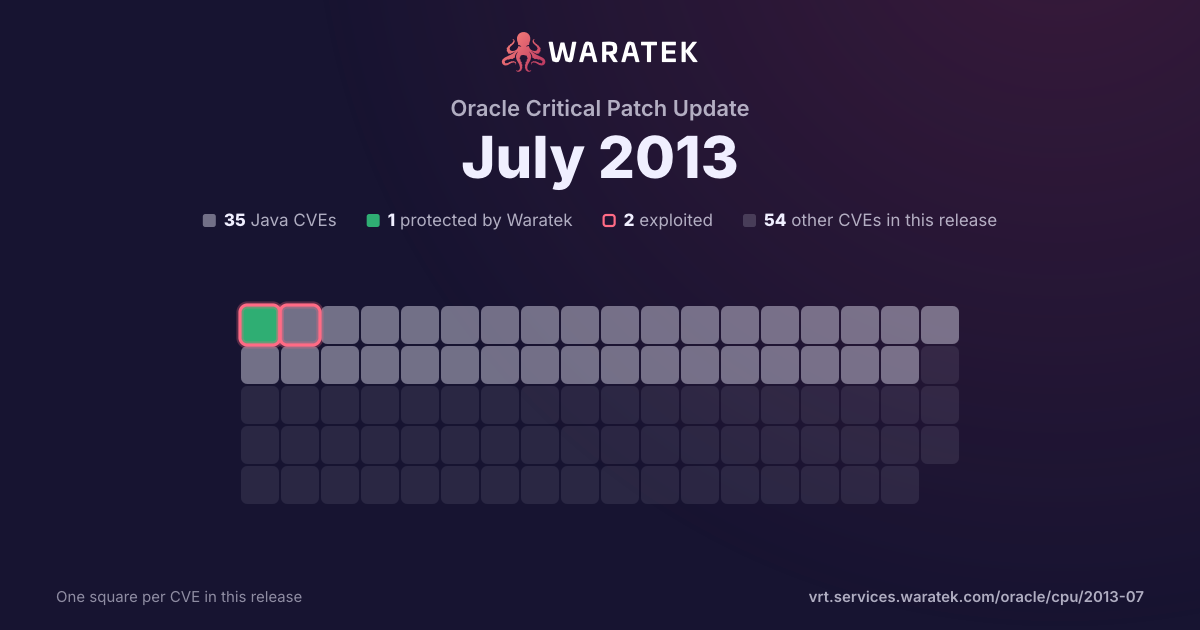
By status
1Protected by Waratek3Mitigation candidate31No exploit published8Outside Waratek scope46Not applicable
2Exploited, marked by the ring
No exploit published. For 31 of them, Oracle's security advisory is the source of public detail.
Protected by Waratek. Waratek RASP can block exploitation of these on systems that have not applied the patch yet.
Overview 2 matches · 0 in Waratek scope · 0 protected · 0 exploited · 0 CISA KEV · 1 public PoC · 0 EPSS ≥ 0.5
2matches
0in Waratek scope0.0%
0protected0.0%
0exploited0.0%
0CISA KEV0.0%
1public PoC50.0%
0EPSS ≥ 0.50.0%
Protected by Waratek
0
0.0%
Rule in development
0
0.0%
Mitigation candidate
0
0.0%
No exploit published
0
0.0%
Outside Waratek scope
1
50.0%
Not applicable
1
50.0%
Withdrawn CVE
0
0.0%
blocked by ARMR today
0
0.0%
partly blocked
0
0.0%
not blocked
2
100.0%
not established
0
0.0%
unrecorded
0
0.0%
Exploited
0
0.0%
Working exploit published
1
50.0%
Proof of concept only
0
0.0%
Forecast only
0
0.0%
No public exploit
1
50.0%
split by
peak 1 / month
May 11Jun 11Jul 11Aug 11Sep 11
| CVE | Severity | Published▾ | Status | Exploitation | Description |
|---|---|---|---|---|---|
| CVE-2011-3348 | Medium | 2011-09-20 | Outside Waratek scope | No public exploit | The mod_proxy_ajp module in the Apache HTTP Server before 2.2.21, when used with mod_proxy_balancer in certain configurations, allows remote attackers to cause a denial of service (temporary "error state" in the backend server) via a malformed HTTP request. |
| CVE-2011-0419 | Medium | 2011-05-16 | Not applicable | Working exploit published | Stack consumption vulnerability in the fnmatch implementation in apr_fnmatch.c in the Apache Portable Runtime (APR) library before 1.4.3 and the Apache HTTP Server before 2.2.18, and in fnmatch.c in libc in NetBSD 5.1, OpenBSD 4.8, FreeBSD, Apple Mac OS X 10.6, Oracle Solaris 10, and Android, allows context-dependent attackers to cause a denial of service (CPU and memory consumption) via *? sequences in the first argument, as demonstrated by attacks against mod_autoindex in httpd. |