
Oracle Critical Patch Update July 2013
Released July 2013 · Oracle's advisory ↗ · ← Java SE Critical Patch Update, June 2013 · Critical Patch Update, October 2013 →
89 CVEs in this release, one square each
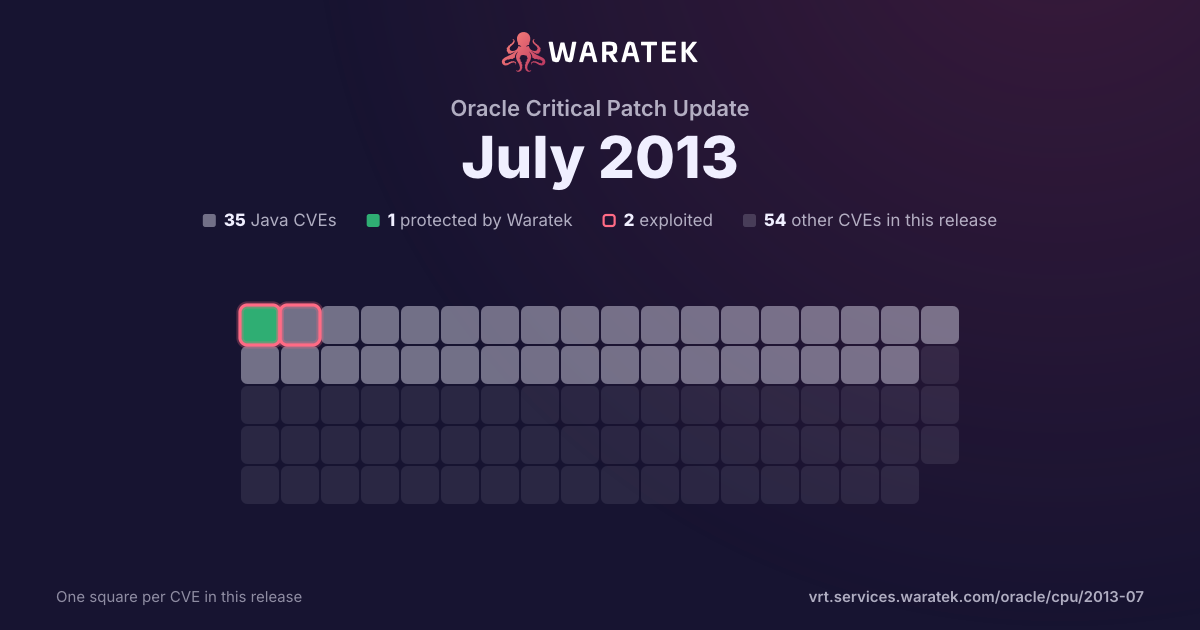
By status
1Protected by Waratek3Mitigation candidate31No exploit published8Outside Waratek scope46Not applicable
2Exploited, marked by the ring
No exploit published. For 31 of them, Oracle's security advisory is the source of public detail.
Protected by Waratek. Waratek RASP can block exploitation of these on systems that have not applied the patch yet.
Overview 3 matches · 1 in Waratek scope · 0 protected · 0 exploited · 0 CISA KEV · 1 public PoC
Protected by Waratek
0
0.0%
Rule in development
0
0.0%
Mitigation candidate
1
33.3%
No exploit published
0
0.0%
Outside Waratek scope
0
0.0%
Not applicable
2
66.7%
Withdrawn CVE
0
0.0%
blocked by ARMR today
0
0.0%
partly blocked
0
0.0%
not blocked
3
100.0%
not established
0
0.0%
unrecorded
0
0.0%
Exploited
0
0.0%
Working exploit published
1
33.3%
Proof of concept only
0
0.0%
Forecast only
2
66.7%
No public exploit
0
0.0%
split by
peak 1 / year
200520062007200820092010201120122013
| CVE | Severity | Published▾ | Status | Exploitation | Description |
|---|---|---|---|---|---|
| CVE-2013-3763 | Medium | 2013-07-17 | Mitigation candidate | Working exploit published | Unspecified vulnerability in the Oracle Endeca Server component in Oracle Fusion Middleware 7.4.0 and 7.5.1.1 allows remote authenticated users to affect confidentiality and integrity via unknown vectors, a different vulnerability than CVE-2013-3764. |
| CVE-2007-6388 | Medium | 2008-01-08 | Not applicable | Forecast only | Cross-site scripting (XSS) vulnerability in mod_status in the Apache HTTP Server 2.2.0 through 2.2.6, 2.0.35 through 2.0.61, and 1.3.2 through 1.3.39, when the server-status page is enabled, allows remote attackers to inject arbitrary web script or HTML via unspecified vectors. |
| CVE-2005-3352 | Medium | 2005-12-13 | Not applicable | Forecast only | Cross-site scripting (XSS) vulnerability in the mod_imap module of Apache httpd before 1.3.35-dev and Apache httpd 2.0.x before 2.0.56-dev allows remote attackers to inject arbitrary web script or HTML via the Referer when using image maps. |