
Oracle Critical Patch Update April 2010
Released April 2010 · Oracle's advisory ↗ · ← Java SE Critical Patch Update, March 2010 · Critical Patch Update, July 2010 →
47 CVEs in this release, one square each
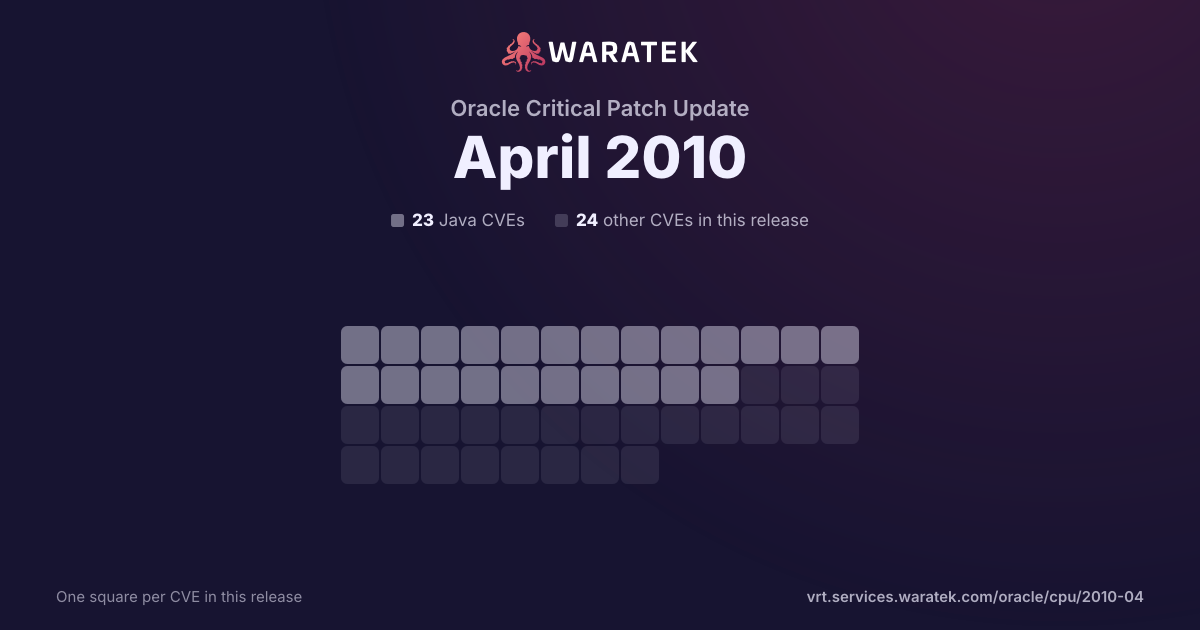
By status
No exploit published. For 24 of them, Oracle's security advisory is the source of public detail.
Overview 2 matches · 0 in Waratek scope · 0 protected · 0 exploited · 0 CISA KEV · 0 public PoC · 0 EPSS ≥ 0.5
2matches
0in Waratek scope0.0%
0protected0.0%
0exploited0.0%
0CISA KEV0.0%
0public PoC0.0%
0EPSS ≥ 0.50.0%
Protected by Waratek
0
0.0%
Rule in development
0
0.0%
Mitigation candidate
0
0.0%
No exploit published
0
0.0%
Outside Waratek scope
0
0.0%
Not applicable
2
100.0%
Withdrawn CVE
0
0.0%
blocked by ARMR today
0
0.0%
partly blocked
0
0.0%
not blocked
2
100.0%
not established
0
0.0%
unrecorded
0
0.0%
Exploited
0
0.0%
Working exploit published
0
0.0%
Proof of concept only
0
0.0%
Forecast only
0
0.0%
No public exploit
2
100.0%
split by
peak 1 / month
May 09Jun 09Jul 09Aug 09
| CVE | Severity | Published▾ | Status | Exploitation | Description |
|---|---|---|---|---|---|
| CVE-2009-2404 | High | 2009-08-03 | Not applicable | No public exploit | Heap-based buffer overflow in a regular-expression parser in Mozilla Network Security Services (NSS) before 3.12.3, as used in Firefox, Thunderbird, SeaMonkey, Evolution, Pidgin, and AOL Instant Messenger (AIM), allows remote SSL servers to cause a denial of service (application crash) or possibly execute arbitrary code via a long domain name in the subject's Common Name (CN) field of an X.509 certificate, related to the cert_TestHostName function. |
| CVE-2009-0688 | High | 2009-05-15 | Not applicable | No public exploit | Multiple buffer overflows in the CMU Cyrus SASL library before 2.1.23 might allow remote attackers to execute arbitrary code or cause a denial of service (application crash) via strings that are used as input to the sasl_encode64 function in lib/saslutil.c. |