
Java SE CPU Mar 2010
Released March 2010 · Oracle's advisory ↗ · ← Critical Patch Update, January 2010 · Critical Patch Update, April 2010 →
27 CVEs in this release, one square each
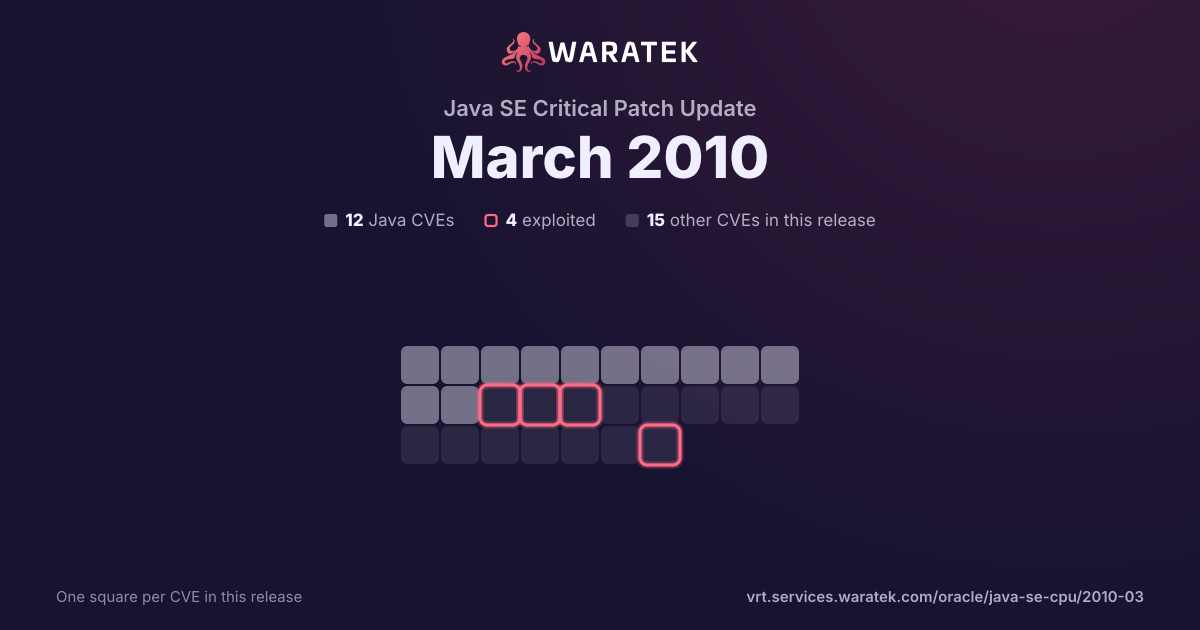
By status
1Mitigation candidate11No exploit published14Outside Waratek scope1Not applicable
4Exploited, marked by the ring
No exploit published. For 7 of them, Oracle's security advisory is the source of public detail.
Overview 12 matches · 0 protected · 0 exploited · 0 CISA KEV · 1 public PoC · 0 EPSS ≥ 0.5
Protected by Waratek
0
0.0%
Rule in development
0
0.0%
Mitigation candidate
1
8.3%
No exploit published
11
91.7%
blocked by ARMR today
0
0.0%
partly blocked
0
0.0%
not blocked
12
100.0%
not established
0
0.0%
unrecorded
0
0.0%
Exploited
0
0.0%
Working exploit published
1
8.3%
Proof of concept only
0
0.0%
Forecast only
0
0.0%
No public exploit
11
91.7%
| CVE | Severity | Published▾ | Status | Exploitation | Description |
|---|---|---|---|---|---|
| CVE-2010-0850 | High | 2010-04-01 | No exploit published | No public exploit | Unspecified vulnerability in the Java 2D component in Oracle Java SE and Java for Business 1.3.1_27 allows remote attackers to affect confidentiality, integrity, and availability via unknown vectors. |
| CVE-2010-0849 | High | 2010-04-01 | No exploit published | No public exploit | Unspecified vulnerability in the Java 2D component in Oracle Java SE and Java for Business 6 Update 18, 5.0 Update 23, 1.4.2_25, and 1.3.1_27 allows remote attackers to affect confidentiality, integrity, and availability via unknown vectors. NOTE: the previous information was obtained from the March 2010 CPU. Oracle has not commented on claims from a reliable researcher that this is a heap-based buffer overflow in a decoding routine used by the JPEGImageDecoderImpl interface, which allows code execution via a crafted JPEG image. |
| CVE-2010-0848 | High | 2010-04-01 | No exploit published | No public exploit | Unspecified vulnerability in the Java 2D component in Oracle Java SE and Java for Business 6 Update 18, 5.0 Update 23, 1.4.2_25, and 1.3.1_27 allows remote attackers to affect confidentiality, integrity, and availability via unknown vectors. |
| CVE-2010-0846 | High | 2010-04-01 | No exploit published | No public exploit | Unspecified vulnerability in the ImageIO component in Oracle Java SE and Java for Business 6 Update 18, 5.0 Update 23, 1.4.2_25, and 1.3.1_27 allows remote attackers to affect confidentiality, integrity, and availability via unknown vectors. NOTE: the previous information was obtained from the March 2010 CPU. Oracle has not commented on claims from a reliable researcher that this is a heap-based buffer overflow that allows remote attackers to execute arbitrary code, related to an "invalid assignment" and inconsistent length values in a JPEG image encoder (JPEGImageEncoderImpl). |
| CVE-2010-0844 | High | 2010-04-01 | No exploit published | No public exploit | Unspecified vulnerability in the Sound component in Oracle Java SE and Java for Business 6 Update 18, 5.0 Update 23, 1.4.2_25, and 1.3.1_27 allows remote attackers to affect confidentiality, integrity, and availability via unknown vectors. NOTE: the previous information was obtained from the March 2010 CPU. Oracle has not commented on claims from a reliable researcher that this is for improper parsing of a crafted MIDI stream when creating a MixerSequencer object, which causes a pointer to be corrupted and allows a NULL byte to be written to arbitrary memory. |
| CVE-2010-0843 | High | 2010-04-01 | No exploit published | No public exploit | Unspecified vulnerability in the Sound component in Oracle Java SE and Java for Business 6 Update 18, 5.0 Update 23, 1.4.2_25, and 1.3.1_27 allows remote attackers to affect confidentiality, integrity, and availability via unknown vectors. NOTE: the previous information was obtained from the March 2010 CPU. Oracle has not commented on claims from a reliable researcher that this is related to XNewPtr and improper handling of an integer parameter when allocating heap memory in the com.sun.media.sound libraries, which allows remote attackers to execute arbitrary code. |
| CVE-2010-0841 | High | 2010-04-01 | No exploit published | No public exploit | Unspecified vulnerability in the ImageIO component in Oracle Java SE and Java for Business 6 Update 18, 5.0 Update 23, and 1.4.2_25 allows remote attackers to affect confidentiality, integrity, and availability via unknown vectors. NOTE: the previous information was obtained from the March 2010 CPU. Oracle has not commented on claims from a reliable researcher that this is an integer overflow in the Java Runtime Environment that allows remote attackers to execute arbitrary code via a JPEG image that contains subsample dimensions with large values, related to JPEGImageReader and "stepX". |
| CVE-2010-0839 | High | 2010-04-01 | No exploit published | No public exploit | Unspecified vulnerability in the Sound component in Oracle Java SE and Java for Business 6 Update 18, 5.0 Update 23, 1.4.2_25, and 1.3.1_27 allows remote attackers to affect confidentiality, integrity, and availability via unknown vectors. |
| CVE-2010-0838 | High | 2010-04-01 | Mitigation candidate | Working exploit published | Unspecified vulnerability in the Java 2D component in Oracle Java SE and Java for Business 6 Update 18, 5.0, Update, and 23 allows remote attackers to affect confidentiality, integrity, and availability via unknown vectors. NOTE: the previous information was obtained from the March 2010 CPU. Oracle has not commented on claims from a reliable researcher that this is a stack-based buffer overflow using an untrusted size value in the readMabCurveData function in the CMM module in the JVM. |
| CVE-2010-0837 | High | 2010-04-01 | No exploit published | No public exploit | Unspecified vulnerability in the Pack200 component in Oracle Java SE and Java for Business 6 Update 18, 5.0, Update, and 23 allows remote attackers to affect confidentiality, integrity, and availability via unknown vectors. |
| CVE-2010-0093 | Medium | 2010-04-01 | No exploit published | No public exploit | Unspecified vulnerability in the Java Runtime Environment component in Oracle Java SE and Java for Business 6 Update 18, 5.0 Update 23, and 1.4.2_25 allows remote attackers to affect confidentiality, integrity, and availability via unknown vectors, a different vulnerability than CVE-2010-0095. |
| CVE-2010-0092 | Medium | 2010-04-01 | No exploit published | No public exploit | Unspecified vulnerability in the Java Runtime Environment component in Oracle Java SE and Java for Business 6 Update 18, and 5.0 Update 23 allows remote attackers to affect confidentiality, integrity, and availability via unknown vectors. |