
Oracle Critical Patch Update January 2010
Released January 2010 · Oracle's advisory ↗ · Java SE Critical Patch Update, March 2010 →
23 CVEs in this release, one square each
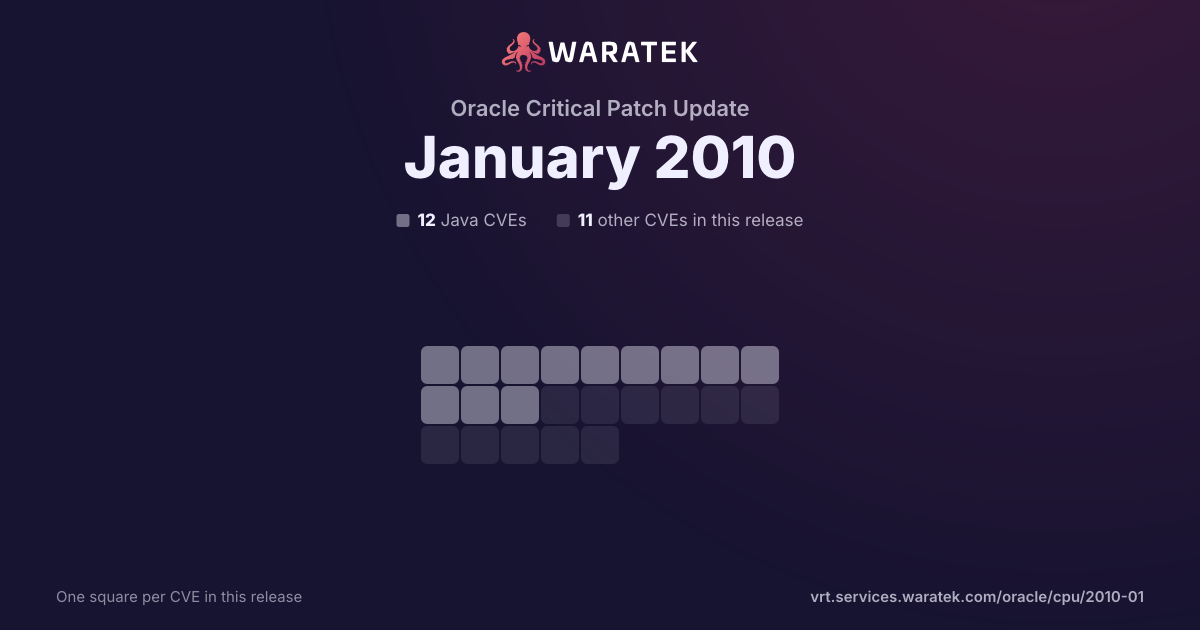
By status
No exploit published. For 11 of them, Oracle's security advisory is the source of public detail.
Overview 22 matches · 12 in Waratek scope · 0 protected · 0 exploited · 0 CISA KEV · 0 public PoC · 0 EPSS ≥ 0.5
22matches
12in Waratek scope54.5%
0protected0.0%
0exploited0.0%
0CISA KEV0.0%
0public PoC0.0%
0EPSS ≥ 0.50.0%
Protected by Waratek
0
0.0%
Rule in development
0
0.0%
Mitigation candidate
0
0.0%
No exploit published
12
54.5%
Outside Waratek scope
8
36.4%
Not applicable
2
9.1%
Withdrawn CVE
0
0.0%
blocked by ARMR today
0
0.0%
partly blocked
0
0.0%
not blocked
22
100.0%
not established
0
0.0%
unrecorded
0
0.0%
Exploited
0
0.0%
Working exploit published
0
0.0%
Proof of concept only
0
0.0%
Forecast only
0
0.0%
No public exploit
22
100.0%
split by
peak 21 / month
Aug 09Sep 09Oct 09Nov 09Dec 09Jan 10
| CVE | Severity | Published▾ | Status | Exploitation | Description |
|---|---|---|---|---|---|
| CVE-2010-0080 | Medium | 2010-01-13 | No exploit published | No public exploit | Unspecified vulnerability in the PeopleSoft Enterprise HCM - eProfile component in Oracle PeopleSoft Enterprise and JD Edwards EnterpriseOne 8.9 Bundle, #21 and 9.0 Bundle #11 allows remote authenticated users to affect confidentiality and integrity via unknown vectors. |
| CVE-2010-0079 | High | 2010-01-13 | No exploit published | No public exploit | Multiple vulnerabilities in the JRockit component in BEA Product Suite R27.6.5 using JRE/JDK 1.4.2, 5, and 6 allow remote attackers to affect confidentiality, integrity, and availability via unknown vectors. NOTE: this CVE identifier overlaps CVE-2009-3867, CVE-2009-3868, CVE-2009-3869, CVE-2009-3871, CVE-2009-3872, CVE-2009-3873, CVE-2009-3874, CVE-2009-3875, CVE-2009-3876, and CVE-2009-3877. |
| CVE-2010-0078 | Medium | 2010-01-13 | No exploit published | No public exploit | Unspecified vulnerability in the WebLogic Server component in BEA Product Suite 9.0, 9.1, 9.2MP3, 10.0MP2, and 10.3.1 allows remote attackers to affect availability via unknown vectors. |
| CVE-2010-0077 | Medium | 2010-01-13 | No exploit published | No public exploit | Unspecified vulnerability in the CRM Technical Foundation (mobile) component in Oracle E-Business Suite 11.5.10.2, 12.0.6, and 12.1.2 allows remote attackers to affect confidentiality and integrity via unknown vectors. |
| CVE-2010-0076 | Medium | 2010-01-13 | Outside Waratek scope | No public exploit | Unspecified vulnerability in the Application Express Application Builder component in Oracle Database 3.2.1.00.10 allows remote authenticated users to affect confidentiality, integrity, and availability via unknown vectors. |
| CVE-2010-0075 | Medium | 2010-01-13 | No exploit published | No public exploit | Unspecified vulnerability in the Oracle HRMS (Self Service) component in Oracle E-Business Suite 11.5.10.2, 12.0.6, and 12.1.1 allows remote attackers to affect confidentiality via unknown vectors. |
| CVE-2010-0074 | Medium | 2010-01-13 | No exploit published | No public exploit | Unspecified vulnerability in the WebLogic Server component in BEA Product Suite 7.0SP7, 8.1SP6, 9.0, 9.1, 9.2MP3, 10.0MP2, and 10.3.1 allows remote attackers to affect availability via unknown vectors. |
| CVE-2010-0072 | High | 2010-01-13 | Not applicable | No public exploit | Unspecified vulnerability in the Oracle Secure Backup component in Oracle Secure Backup 10.2.0.3 allows remote attackers to affect confidentiality, integrity, and availability via unknown vectors. NOTE: the previous information was obtained from the January 2010 CPU. Oracle has not commented on claims from a reliable researcher that this is a buffer overflow in observiced.exe that allows remote attackers to execute arbitrary code via vectors related to a "reverse lookup of connections" to TCP port 10000. |
| CVE-2010-0070 | Medium | 2010-01-13 | No exploit published | No public exploit | Unspecified vulnerability in the Oracle Containers for J2EE component in Oracle Application Server 10.1.2.3 and 10.1.3.4 allows remote attackers to affect integrity via unknown vectors. |
| CVE-2010-0069 | Medium | 2010-01-13 | No exploit published | No public exploit | Unspecified vulnerability in the WebLogic Server component in BEA Product Suite 7.0, SP7, 8.1SP6, 9.0, 9.1, 9.2MP3, 10.0MP1, and 10.3.0 allows remote attackers to affect integrity via unknown vectors. |
| CVE-2010-0068 | Medium | 2010-01-13 | No exploit published | No public exploit | Unspecified vulnerability in the WebLogic Server component in BEA Product Suite 9.0, 9.1, 9.2MP2, and 10.0 allows remote attackers to affect confidentiality via unknown vectors. |
| CVE-2010-0067 | Medium | 2010-01-13 | No exploit published | No public exploit | Unspecified vulnerability in the Oracle Containers for J2EE component in Oracle Application Server 10.1.2.3 and 10.1.3.4 allows remote attackers to affect confidentiality via unknown vectors. |
| CVE-2010-0066 | Medium | 2010-01-13 | Not applicable | No public exploit | Unspecified vulnerability in the Access Manager Identity Server component in Oracle Application Server 7.0.4.3 and 10.1.4.2 allows remote attackers to affect integrity via unknown vectors. |
| CVE-2009-3416 | Medium | 2010-01-13 | No exploit published | No public exploit | Unspecified vulnerability in the Oracle Application Object Library component in Oracle E-Business Suite 11.5.10.2, 12.0.6, and 12.1.1 allows remote attackers to affect integrity via unknown vectors. |
| CVE-2009-3415 | High | 2010-01-13 | Outside Waratek scope | No public exploit | Unspecified vulnerability in the Oracle OLAP component in Oracle Database 9.2.0.8, 9.2.0.8DV, 10.1.0.5, and 10.2.0.3 allows remote authenticated users to affect confidentiality, integrity, and availability via unknown vectors. |
| CVE-2009-3414 | Medium | 2010-01-13 | Outside Waratek scope | No public exploit | Unspecified vulnerability in the Oracle Spatial component in Oracle Database 9.2.0.8, 9.2.0.8DV, 10.1.0.5, and 10.2.0.3 allows remote authenticated users to affect confidentiality and integrity via unknown vectors, a different vulnerability than CVE-2008-3976 and CVE-2009-3413. |
| CVE-2009-3413 | Low | 2010-01-13 | Outside Waratek scope | No public exploit | Unspecified vulnerability in the Oracle Spatial component in Oracle Database 9.2.0.8, 9.2.0.8DV, 10.1.0.5, and 10.2.0.3 allows remote authenticated users to affect confidentiality and integrity via unknown vectors, a different vulnerability than CVE-2008-3976 and CVE-2009-3414. |
| CVE-2009-3412 | Low | 2010-01-13 | Outside Waratek scope | No public exploit | Unspecified vulnerability in the Unzip component in Oracle Database 9.2.0.8, 9.2.0.8DV, and 10.1.0.5; and Oracle Application Server 10.1.2.3; allows local users to affect confidentiality via unknown vectors. |
| CVE-2009-3411 | Medium | 2010-01-13 | Outside Waratek scope | No public exploit | Unspecified vulnerability in the Oracle Data Pump component in Oracle Database 11.1.0.7, 10.2.0.3, 10.2.0.4, 10.1.0.5, 9.2.0.8, and 9.2.0.8DV allows remote authenticated users to affect confidentiality and integrity via unknown vectors. |
| CVE-2009-3410 | Low | 2010-01-13 | Outside Waratek scope | No public exploit | Unspecified vulnerability in the RDBMS component in Oracle Database 11.1.0.7, 10.2.0.3, 10.2.0.4, 10.1.0.5, 9.2.0.8, and 9.2.0.8DV allows remote authenticated users to affect confidentiality and integrity via unknown vectors. |
| CVE-2009-1996 | Medium | 2010-01-13 | Outside Waratek scope | No public exploit | Unspecified vulnerability in the Logical Standby component in Oracle Database allows remote authenticated users to affect integrity via unknown vectors. |
| CVE-2009-2625 | Medium | 2009-08-06 | No exploit published | No public exploit | XMLScanner.java in Apache Xerces2 Java, as used in Sun Java Runtime Environment (JRE) in JDK and JRE 6 before Update 15 and JDK and JRE 5.0 before Update 20, and in other products, allows remote attackers to cause a denial of service (infinite loop and application hang) via malformed XML input, as demonstrated by the Codenomicon XML fuzzing framework. |