
Oracle Critical Patch Update January 2010
Released January 2010 · Oracle's advisory ↗ · Java SE Critical Patch Update, March 2010 →
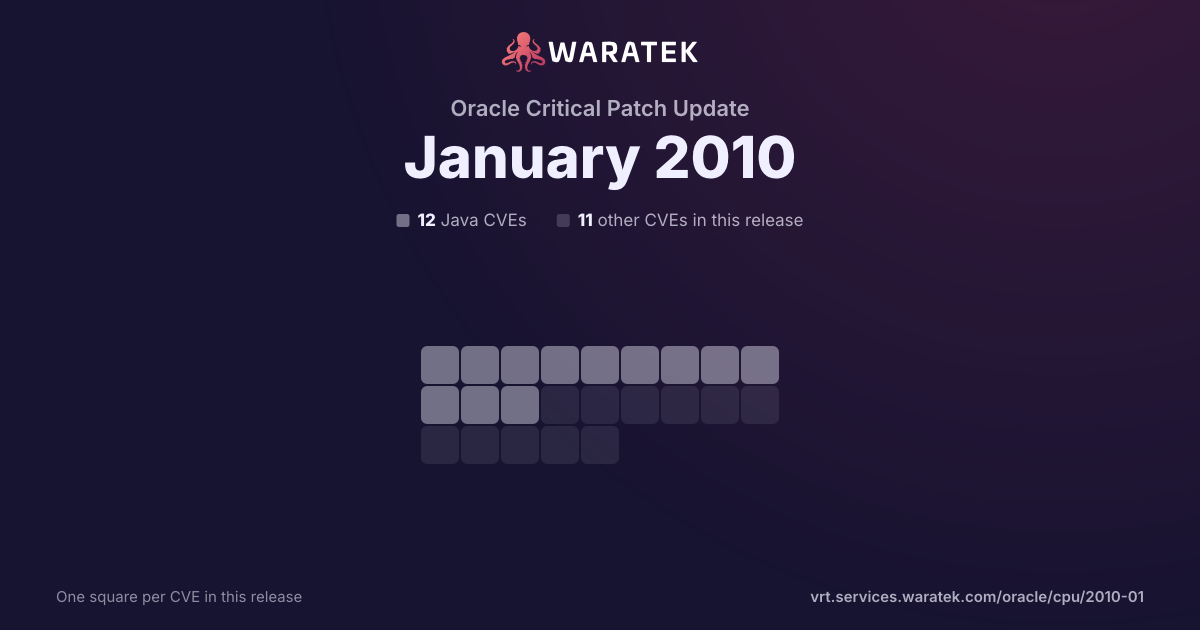
23 CVEs in this release, one square each
By status
No exploit published. For 11 of them, Oracle's security advisory is the source of public detail.
Overview 1 match · 0 protected · 0 exploited · 0 CISA KEV · 0 public PoC · 0 EPSS ≥ 0.5
1match
0protected0.0%
0exploited0.0%
0CISA KEV0.0%
0public PoC0.0%
0EPSS ≥ 0.50.0%
Protected by Waratek
0
0.0%
Rule in development
0
0.0%
Mitigation candidate
0
0.0%
No exploit published
1
100.0%
blocked by ARMR today
0
0.0%
partly blocked
0
0.0%
not blocked
1
100.0%
not established
0
0.0%
unrecorded
0
0.0%
Exploited
0
0.0%
Working exploit published
0
0.0%
Proof of concept only
0
0.0%
Forecast only
0
0.0%
No public exploit
1
100.0%
split by
peak 1 / month
Aug 09
| CVE | Severity | Published▾ | Status | Exploitation | Description |
|---|---|---|---|---|---|
| CVE-2009-2625 | Medium | 2009-08-06 | No exploit published | No public exploit | XMLScanner.java in Apache Xerces2 Java, as used in Sun Java Runtime Environment (JRE) in JDK and JRE 6 before Update 15 and JDK and JRE 5.0 before Update 20, and in other products, allows remote attackers to cause a denial of service (infinite loop and application hang) via malformed XML input, as demonstrated by the Codenomicon XML fuzzing framework. |