
Java SE CPU Feb 2013
Released February 2013 · Oracle's advisory ↗ · ← Critical Patch Update, January 2013 · Critical Patch Update, April 2013 →
55 CVEs in this release, one square each
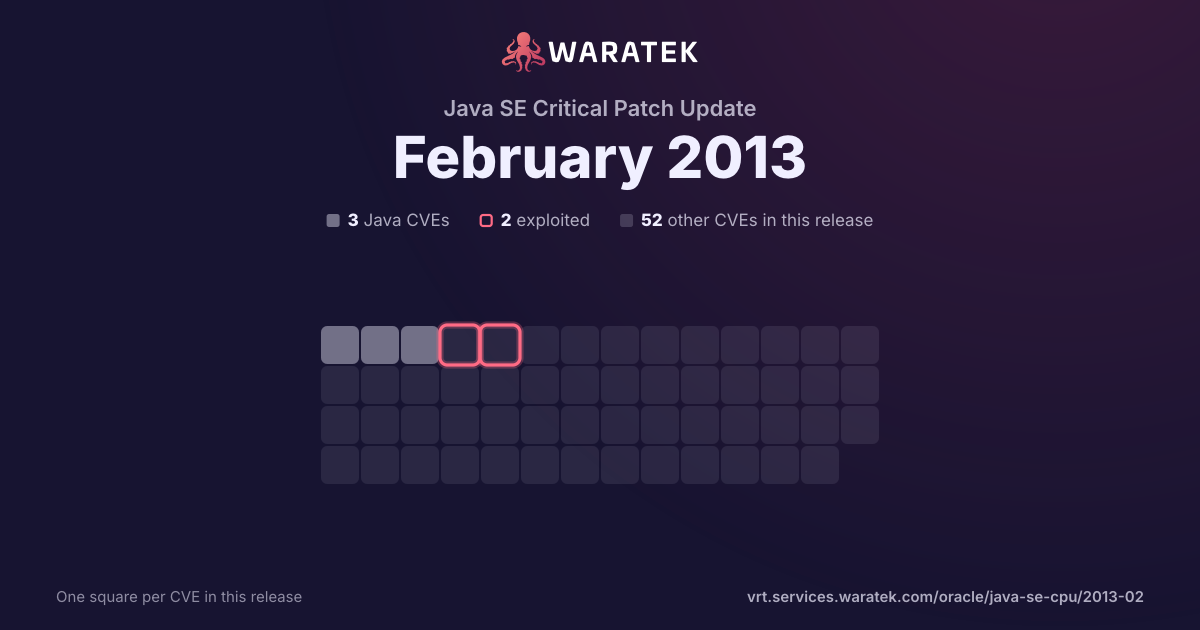
By status
No exploit published. For 2 of them, Oracle's security advisory is the source of public detail.
Overview 35 matches · 0 in Waratek scope · 0 protected · 1 exploited · 0 CISA KEV · 0 public PoC · 0 EPSS ≥ 0.5
35matches
0in Waratek scope0.0%
0protected0.0%
1exploited2.9%
0CISA KEV0.0%
0public PoC0.0%
0EPSS ≥ 0.50.0%
Protected by Waratek
0
0.0%
Rule in development
0
0.0%
Mitigation candidate
0
0.0%
No exploit published
0
0.0%
Outside Waratek scope
35
100.0%
Not applicable
0
0.0%
Withdrawn CVE
0
0.0%
blocked by ARMR today
0
0.0%
partly blocked
0
0.0%
not blocked
35
100.0%
not established
0
0.0%
unrecorded
0
0.0%
Exploited
1
2.9%
Working exploit published
0
0.0%
Proof of concept only
0
0.0%
Forecast only
0
0.0%
No public exploit
34
97.1%
split by
peak 34 / month
Jan 13Feb 13
| CVE | Severity | Published▾ | Status | Exploitation | Description |
|---|---|---|---|---|---|
| CVE-2013-1487 | High | 2013-02-20 | Outside Waratek scope | No public exploit | Unspecified vulnerability in the Java Runtime Environment component in Oracle Java SE 7 Update 13 and earlier and 6 Update 39 and earlier allows remote attackers to affect confidentiality, integrity, and availability via unknown vectors related to Deployment. |
| CVE-2013-1486 | High | 2013-02-20 | Outside Waratek scope | No public exploit | Unspecified vulnerability in the Java Runtime Environment (JRE) component in Oracle Java SE 7 Update 13 and earlier, 6 Update 39 and earlier, and 5.0 Update 39 and earlier allows remote attackers to affect confidentiality, integrity, and availability via vectors related to JMX. |
| CVE-2013-1484 | High | 2013-02-20 | Outside Waratek scope | No public exploit | Unspecified vulnerability in the Java Runtime Environment (JRE) component in Oracle Java SE 7 Update 13 and earlier allows remote attackers to affect confidentiality, integrity, and availability via unknown vectors related to Libraries. |
| CVE-2013-1483 | High | 2013-02-02 | Outside Waratek scope | No public exploit | Unspecified vulnerability in the JavaFX component in Oracle Java SE JavaFX 2.2.4 and earlier allows remote attackers to affect confidentiality, integrity, and availability via unknown vectors, a different vulnerability than other CVEs listed in the February 2013 CPU. |
| CVE-2013-1482 | High | 2013-02-02 | Outside Waratek scope | No public exploit | Unspecified vulnerability in the JavaFX component in Oracle Java SE JavaFX 2.2.4 and earlier allows remote attackers to affect confidentiality, integrity, and availability via unknown vectors, a different vulnerability than other CVEs listed in the February 2013 CPU. |
| CVE-2013-1481 | High | 2013-02-02 | Outside Waratek scope | No public exploit | Unspecified vulnerability in the Java Runtime Environment (JRE) component in Oracle Java SE 6 through Update 38, 5.0 through Update 38, and 1.4.2_40 and earlier allows remote attackers to affect confidentiality, integrity, and availability via unknown vectors related to Sound. |
| CVE-2013-1479 | High | 2013-02-02 | Outside Waratek scope | No public exploit | Unspecified vulnerability in the Java Runtime Environment (JRE) component in Oracle Java SE 7 through Update 11, 6 through Update 38, and JavaFX 2.2.4 and earlier allows remote attackers to affect confidentiality, integrity, and availability via unknown vectors. |
| CVE-2013-1477 | High | 2013-02-02 | Outside Waratek scope | No public exploit | Unspecified vulnerability in the JavaFX component in Oracle Java SE JavaFX 2.2.4 and earlier allows remote attackers to affect confidentiality, integrity, and availability via unknown vectors, a different vulnerability than other CVEs listed in the February 2013 CPU. |
| CVE-2013-1476 | High | 2013-02-02 | Outside Waratek scope | No public exploit | Unspecified vulnerability in the Java Runtime Environment (JRE) component in Oracle Java SE 7 through Update 11, 6 through Update 38, 5.0 through Update 38, and 1.4.2_40 and earlier, and OpenJDK 6 and 7, allows remote attackers to affect confidentiality, integrity, and availability via vectors related to CORBA, a different vulnerability than CVE-2013-0441 and CVE-2013-1475. NOTE: the previous information is from the February 2013 CPU. Oracle has not commented on claims from another vendor that this issue allows remote attackers to bypass Java sandbox restrictions via "certain value handler constructors." |
| CVE-2013-1475 | High | 2013-02-02 | Outside Waratek scope | No public exploit | Unspecified vulnerability in the Java Runtime Environment (JRE) component in Oracle Java SE 7 through Update 11, 6 through Update 38, 5.0 through Update 38, and 1.4.2_40 and earlier, and OpenJDK 6 and 7, allows remote attackers to affect confidentiality, integrity, and availability via vectors related to CORBA. NOTE: the previous information is from the February 2013 CPU. Oracle has not commented on claims from another vendor that this issue is related to "IIOP type reuse management" in ObjectStreamClass.java. |
| CVE-2013-1474 | High | 2013-02-02 | Outside Waratek scope | No public exploit | Unspecified vulnerability in the JavaFX component in Oracle Java SE JavaFX 2.2.4 and earlier allows remote attackers to affect confidentiality, integrity, and availability via unknown vectors, a different vulnerability than other CVEs listed in the February 2013 CPU. |
| CVE-2013-1472 | High | 2013-02-02 | Outside Waratek scope | No public exploit | Unspecified vulnerability in the JavaFX component in Oracle Java SE JavaFX 2.2.4 and earlier allows remote attackers to affect confidentiality, integrity, and availability via unknown vectors, a different vulnerability than other CVEs listed in the February 2013 CPU. |
| CVE-2013-0450 | High | 2013-02-02 | Outside Waratek scope | No public exploit | Unspecified vulnerability in the Java Runtime Environment (JRE) component in Oracle Java SE 7 through Update 11, 6 through Update 38, and 5.0 through Update 38, and OpenJDK 6 and 7, allows remote attackers to affect confidentiality, integrity, and availability via vectors related to JMX. NOTE: the previous information is from the February 2013 CPU. Oracle has not commented on claims from another vendor that this issue is related to improper checks of "access control context" in the JMX RequiredModelMBean class. |
| CVE-2013-0447 | High | 2013-02-02 | Outside Waratek scope | No public exploit | Unspecified vulnerability in the JavaFX component in Oracle Java SE JavaFX 2.2.4 and earlier allows remote attackers to affect confidentiality, integrity, and availability via unknown vectors, a different vulnerability than other CVEs listed in the February 2013 CPU. |
| CVE-2013-0446 | High | 2013-02-02 | Outside Waratek scope | No public exploit | Unspecified vulnerability in the Java Runtime Environment (JRE) component in Oracle Java SE 7 through Update 11 and 6 through Update 38 allows remote attackers to affect confidentiality, integrity, and availability via unknown vectors related to Deployment, a different vulnerability than other CVEs listed in the February 2013 CPU. |
| CVE-2013-0445 | High | 2013-02-02 | Outside Waratek scope | No public exploit | Unspecified vulnerability in the Java Runtime Environment (JRE) component in Oracle Java SE 7 through Update 11, 6 through Update 38, and 5.0 through Update 38, and OpenJDK 6 and 7, allows remote attackers to affect confidentiality, integrity, and availability via vectors related to AWT. NOTE: the previous information is from the February 2013 CPU. Oracle has not commented on claims from another vendor that this issue is related to an improper check of "privileges of the code" that bypasses the sandbox. |
| CVE-2013-0444 | High | 2013-02-02 | Outside Waratek scope | No public exploit | Unspecified vulnerability in the Java Runtime Environment (JRE) component in Oracle Java SE 7 through Update 11, and OpenJDK 7, allows remote attackers to affect confidentiality, integrity, and availability via unknown vectors related to Beans. NOTE: the previous information is from the February 2013 CPU. Oracle has not commented on claims from another vendor that this issue is related to "insufficient checks for cached results" by the Java Beans MethodFinder, which might allow attackers to access methods that should only be accessible to privileged code. |
| CVE-2013-0442 | High | 2013-02-02 | Outside Waratek scope | No public exploit | Unspecified vulnerability in the Java Runtime Environment (JRE) component in Oracle Java SE 7 through Update 11, 6 through Update 38, 5.0 through Update 38, and 1.4.2_40 and earlier, and OpenJDK 6 and 7, allows remote attackers to affect confidentiality, integrity, and availability via vectors related to AWT. NOTE: the previous information is from the February 2013 CPU. Oracle has not commented on claims from another vendor that this issue is related to an improper check of "privileges of the code" that bypasses the sandbox. |
| CVE-2013-0441 | High | 2013-02-02 | Outside Waratek scope | No public exploit | Unspecified vulnerability in the Java Runtime Environment (JRE) component in Oracle Java SE 7 through Update 11, 6 through Update 38, 5.0 through Update 38, and 1.4.2_40 and earlier, and OpenJDK 6 and 7, allows remote attackers to affect confidentiality, integrity, and availability via vectors related to CORBA, a different vulnerability than CVE-2013-1476 and CVE-2013-1475. NOTE: the previous information is from the February 2013 CPU. Oracle has not commented on claims from another vendor that this issue allows remote attackers to bypass Java sandbox restrictions via certain methods that should not be serialized, aka "missing serialization restriction." |
| CVE-2013-0439 | High | 2013-02-02 | Outside Waratek scope | No public exploit | Unspecified vulnerability in the JavaFX component in Oracle Java SE JavaFX 2.2.4 and earlier allows remote attackers to affect confidentiality, integrity, and availability via unknown vectors, a different vulnerability than other CVEs listed in the February 2013 CPU. |
| CVE-2013-0436 | High | 2013-02-02 | Outside Waratek scope | No public exploit | Unspecified vulnerability in the JavaFX component in Oracle Java SE JavaFX 2.2.4 and earlier allows remote attackers to affect confidentiality, integrity, and availability via unknown vectors, a different vulnerability than other CVEs listed in the February 2013 CPU. |
| CVE-2013-0429 | High | 2013-02-02 | Outside Waratek scope | No public exploit | Unspecified vulnerability in the Java Runtime Environment (JRE) component in Oracle Java SE 7 through Update 11, 6 through Update 38, and 5.0 through Update 38, and OpenJDK 6 and 7, allows remote attackers to affect confidentiality, integrity, and availability via vectors related to CORBA. NOTE: the previous information is from the February 2013 CPU. Oracle has not commented on claims from another vendor that this issue involves the creation of a single PresentationManager that is shared across multiple thread groups, which allows remote attackers to bypass Java sandbox restrictions. |
| CVE-2013-0428 | High | 2013-02-02 | Outside Waratek scope | No public exploit | Unspecified vulnerability in the Java Runtime Environment (JRE) component in Oracle Java SE 7 through Update 11, 6 through Update 38, 5.0 through Update 38, and 1.4.2_40 and earlier, and OpenJDK 6 and 7, allows remote attackers to affect confidentiality, integrity, and availability via unknown vectors related to Libraries, a different vulnerability than CVE-2013-0425 and CVE-2013-0426. NOTE: the previous information is from the February 2013 CPU. Oracle has not commented on claims from another vendor that this issue is related to "incorrect checks for proxy classes" in the Reflection API. |
| CVE-2013-0426 | High | 2013-02-02 | Outside Waratek scope | No public exploit | Unspecified vulnerability in the Java Runtime Environment (JRE) component in Oracle Java SE 7 through Update 11, 6 through Update 38, 5.0 through Update 38, and 1.4.2_40 and earlier, and OpenJDK 6 and 7, allows remote attackers to affect confidentiality, integrity, and availability via unknown vectors related to Libraries, a different vulnerability than CVE-2013-0425 and CVE-2013-0428. NOTE: the previous information is from the February 2013 CPU. Oracle has not commented on claims from another vendor that this issue is related to incorrect "access control checks" in the logging API that allow remote attackers to bypass Java sandbox restrictions. |
| CVE-2013-0425 | High | 2013-02-02 | Outside Waratek scope | No public exploit | Unspecified vulnerability in the Java Runtime Environment (JRE) component in Oracle Java SE 7 through Update 11, 6 through Update 38, 5.0 through Update 38, and 1.4.2_40 and earlier, and OpenJDK 6 and 7, allows remote attackers to affect confidentiality, integrity, and availability via unknown vectors related to Libraries, a different vulnerability than CVE-2013-0428 and CVE-2013-0426. NOTE: the previous information is from the February 2013 CPU. Oracle has not commented on claims from another vendor that this issue is related to incorrect "access control checks" in the logging API that allow remote attackers to bypass Java sandbox restrictions. |
| CVE-2013-0423 | High | 2013-02-02 | Outside Waratek scope | No public exploit | Unspecified vulnerability in the Java Runtime Environment (JRE) component in Oracle Java SE 7 through Update 11 and 6 through Update 38 allows remote attackers to affect confidentiality, integrity, and availability via unknown vectors related to Deployment, a different vulnerability than other CVEs listed in the February 2013 CPU. |
| CVE-2013-0419 | High | 2013-02-02 | Outside Waratek scope | No public exploit | Unspecified vulnerability in the Java Runtime Environment (JRE) component in Oracle Java SE 7 through Update 11 and 6 through Update 38 allows remote attackers to affect confidentiality, integrity, and availability via unknown vectors related to Deployment, a different vulnerability than other CVEs listed in the February 2013 CPU. |
| CVE-2013-0351 | High | 2013-02-02 | Outside Waratek scope | No public exploit | Unspecified vulnerability in the Java Runtime Environment (JRE) component in Oracle Java SE 7 through Update 11 and 6 through Update 38 allows remote attackers to affect confidentiality, integrity, and availability via unknown vectors related to Deployment, a different vulnerability than other CVEs listed in the February 2013 CPU. |
| CVE-2012-4305 | High | 2013-02-02 | Outside Waratek scope | No public exploit | Unspecified vulnerability in the JavaFX component in Oracle Java SE JavaFX 2.2.4 and earlier allows remote attackers to affect confidentiality, integrity, and availability via unknown vectors, a different vulnerability than other CVEs listed in the February 2013 CPU. NOTE: the previous information is from the February 2013 CPU. Oracle has not commented on claims from a third party that the issue allows remote attackers to execute arbitrary code via vectors related to an "invalid type cast" and exposed native methods in the T2KGlyph class. |
| CVE-2012-4301 | High | 2013-02-02 | Outside Waratek scope | No public exploit | Unspecified vulnerability in the JavaFX component in Oracle Java SE JavaFX 2.2.4 and earlier allows remote attackers to affect confidentiality, integrity, and availability via unknown vectors, a different vulnerability than other CVEs listed in the February 2013 CPU. NOTE: the previous information is from the February 2013 CPU. Oracle has not commented on claims from a third party that this issue allows remote attackers to execute arbitrary code via an "invalid type case" in the init method of the D3DShader class in the com.sun.prism.d3d package. CPU. |
| CVE-2012-3342 | High | 2013-02-02 | Outside Waratek scope | No public exploit | Unspecified vulnerability in the Java Runtime Environment (JRE) component in Oracle Java SE 7 through Update 11 and 6 through Update 38 allows remote attackers to affect confidentiality, integrity, and availability via unknown vectors related to Deployment, a different vulnerability than other CVEs listed in the February 2013 CPU. |
| CVE-2012-3213 | High | 2013-02-02 | Outside Waratek scope | Exploited | Unspecified vulnerability in the Java Runtime Environment (JRE) component in Oracle Java SE 7 through Update 11 and 6 through Update 38 allows remote attackers to affect confidentiality, integrity, and availability via unknown vectors related to Scripting. |
| CVE-2012-1543 | High | 2013-02-02 | Outside Waratek scope | No public exploit | Unspecified vulnerability in the JavaFX component in Oracle Java SE JavaFX 2.2.4 and earlier allows remote attackers to affect confidentiality, integrity, and availability via unknown vectors, a different vulnerability than other CVEs listed in the February 2013 CPU. NOTE: the previous information is from the February 2013 CPU. Oracle has not commented on claims from a third party that the issue is due to an invalid type cast in the JSObject class. |
| CVE-2012-1541 | High | 2013-02-02 | Outside Waratek scope | No public exploit | Unspecified vulnerability in the Java Runtime Environment (JRE) component in Oracle Java SE 7 through Update 11 and 6 through Update 38 allows remote attackers to affect confidentiality, integrity, and availability via unknown vectors related to Deployment, a different vulnerability than other CVEs listed in the February 2013 CPU. NOTE: the previous information is from the February 2013 CPU. Oracle has not commented on claims from a third party that the issue is due to an interaction error in between the JRE plug-in for WebKit-based browsers and the Javascript engine, which allows remote attackers to execute arbitrary code by modifying DOM nodes that contain applet elements in a way that triggers an incorrect reference count and a use after free. |
| CVE-2013-1489 | High | 2013-01-31 | Outside Waratek scope | No public exploit | Unspecified vulnerability in the Java Runtime Environment (JRE) component in Oracle Java SE 7 Update 10 and Update 11, when running on Windows using Internet Explorer, Firefox, Opera, and Google Chrome, allows remote attackers to bypass the "Very High" security level of the Java Control Panel and execute unsigned Java code without prompting the user via unknown vectors, aka "Issue 53" and the "Java Security Slider" vulnerability. |