
Java SE CPU Feb 2013
Released February 2013 · Oracle's advisory ↗ · ← Critical Patch Update, January 2013 · Critical Patch Update, April 2013 →
55 CVEs in this release, one square each
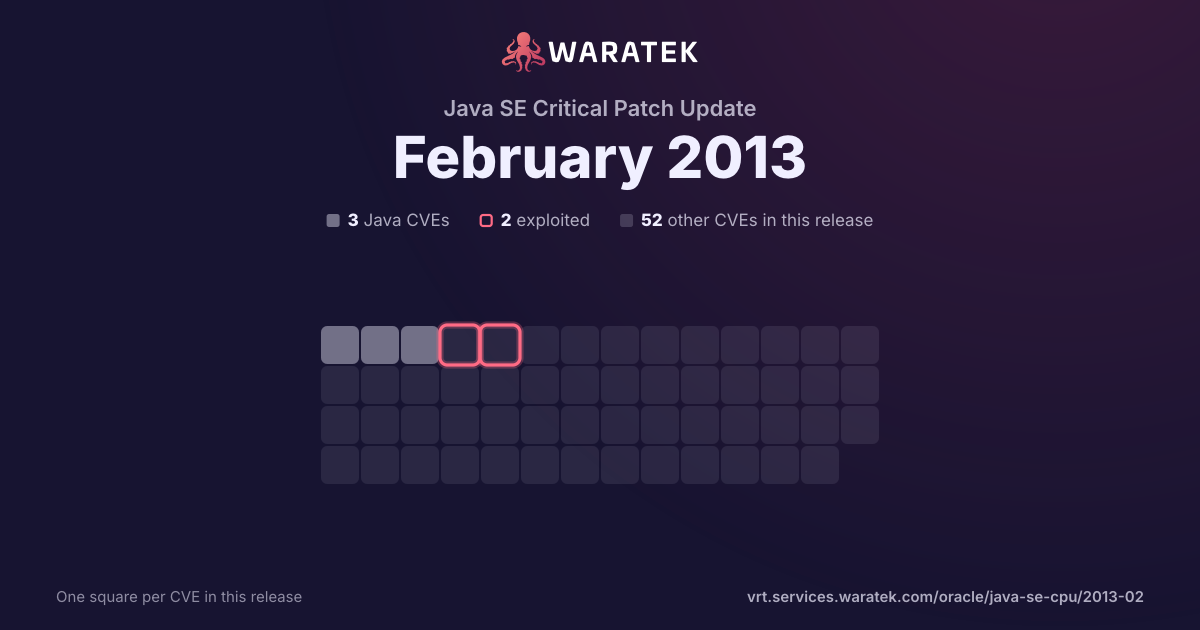
By status
No exploit published. For 2 of them, Oracle's security advisory is the source of public detail.
Overview 15 matches · 0 in Waratek scope · 0 protected · 0 exploited · 0 CISA KEV · 0 public PoC · 0 EPSS ≥ 0.5
15matches
0in Waratek scope0.0%
0protected0.0%
0exploited0.0%
0CISA KEV0.0%
0public PoC0.0%
0EPSS ≥ 0.50.0%
Protected by Waratek
0
0.0%
Rule in development
0
0.0%
Mitigation candidate
0
0.0%
No exploit published
0
0.0%
Outside Waratek scope
15
100.0%
Not applicable
0
0.0%
Withdrawn CVE
0
0.0%
blocked by ARMR today
0
0.0%
partly blocked
0
0.0%
not blocked
15
100.0%
not established
0
0.0%
unrecorded
0
0.0%
Exploited
0
0.0%
Working exploit published
0
0.0%
Proof of concept only
0
0.0%
Forecast only
0
0.0%
No public exploit
15
100.0%
split by
peak 15 / month
Feb 13
| CVE | Severity | Published▾ | Status | Exploitation | Description |
|---|---|---|---|---|---|
| CVE-2013-1485 | Medium | 2013-02-20 | Outside Waratek scope | No public exploit | Unspecified vulnerability in the Java Runtime Environment (JRE) component in Oracle Java SE 7 Update 13 and earlier allows remote attackers to affect integrity via unknown vectors related to Libraries. |
| CVE-2013-1473 | Medium | 2013-02-02 | Outside Waratek scope | No public exploit | Unspecified vulnerability in the Java Runtime Environment (JRE) component in Oracle Java SE 7 through Update 11 and 6 through Update 38 allows remote attackers to affect integrity via unknown vectors related to Deployment. |
| CVE-2013-0449 | Medium | 2013-02-02 | Outside Waratek scope | No public exploit | Unspecified vulnerability in the Java Runtime Environment (JRE) component in Oracle Java SE 7 through Update 11 allows remote attackers to affect confidentiality via unknown vectors related to Deployment. |
| CVE-2013-0448 | Medium | 2013-02-02 | Outside Waratek scope | No public exploit | Unspecified vulnerability in the Java Runtime Environment (JRE) component in Oracle Java SE 7 through Update 11 allows remote attackers to affect integrity via unknown vectors related to Libraries. |
| CVE-2013-0443 | Medium | 2013-02-02 | Outside Waratek scope | No public exploit | Unspecified vulnerability in the Java Runtime Environment (JRE) component in Oracle Java SE 7 through Update 11, 6 through Update 38, 5.0 through Update 38, and 1.4.2_40 and earlier, and OpenJDK 6 and 7, allows remote attackers to affect confidentiality and integrity via vectors related to JSSE. NOTE: the previous information is from the February 2013 CPU. Oracle has not commented on claims from another vendor that this issue is related to incorrect validation of Diffie-Hellman keys, which allows remote attackers to conduct a "small subgroup attack" to force the use of weak session keys or obtain sensitive information about the private key. |
| CVE-2013-0440 | Medium | 2013-02-02 | Outside Waratek scope | No public exploit | Unspecified vulnerability in the Java Runtime Environment (JRE) component in Oracle Java SE 7 through Update 11, 6 through Update 38, 5.0 through Update 38, and 1.4.2_40 and earlier, and OpenJDK 7, allows remote attackers to affect availability via vectors related to JSSE. NOTE: the previous information is from the February 2013 CPU. Oracle has not commented on claims from another vendor that this issue is related to CPU consumption in the SSL/TLS implementation via a large number of ClientHello packets that are not properly handled by (1) ClientHandshaker.java and (2) ServerHandshaker.java. |
| CVE-2013-0438 | Medium | 2013-02-02 | Outside Waratek scope | No public exploit | Unspecified vulnerability in the Java Runtime Environment (JRE) component in Oracle Java SE 7 through Update 11 and 6 through Update 38 allows remote attackers to affect confidentiality via unknown vectors related to Deployment. |
| CVE-2013-0435 | Medium | 2013-02-02 | Outside Waratek scope | No public exploit | Unspecified vulnerability in the Java Runtime Environment (JRE) component in Oracle Java SE 7 through Update 11 and 6 through Update 38, and OpenJDK 6 and 7, allows remote attackers to affect confidentiality via vectors related to JAX-WS. NOTE: the previous information is from the February 2013 CPU. Oracle has not commented on claims from another vendor that this issue is related to improper restriction of com.sun.xml.internal packages and "Better handling of UI elements." |
| CVE-2013-0434 | Medium | 2013-02-02 | Outside Waratek scope | No public exploit | Unspecified vulnerability in the Java Runtime Environment (JRE) component in Oracle Java SE 7 through Update 11, 6 through Update 38, 5.0 through Update 38, and 1.4.2_40 and earlier, and OpenJDK 6 and 7, allows remote attackers to affect confidentiality via vectors related to JAXP. NOTE: the previous information is from the February 2013 CPU. Oracle has not commented on claims from another vendor that this issue is related to the public declaration of the loadPropertyFile method in the JAXP FuncSystemProperty class, which allows remote attackers to obtain sensitive information. |
| CVE-2013-0433 | Medium | 2013-02-02 | Outside Waratek scope | No public exploit | Unspecified vulnerability in the Java Runtime Environment (JRE) component in Oracle Java SE 7 through Update 11, 6 through Update 38, and 5.0 through Update 38, and OpenJDK 6 and 7, allows remote attackers to affect integrity via unknown vectors related to Networking. NOTE: the previous information is from the February 2013 CPU. Oracle has not commented on claims from another vendor that this issue allows remote attackers to avoid triggering an exception during the deserialization of invalid InetSocketAddress data. |
| CVE-2013-0432 | Medium | 2013-02-02 | Outside Waratek scope | No public exploit | Unspecified vulnerability in the Java Runtime Environment (JRE) component in Oracle Java SE 7 through Update 11, 6 through Update 38, 5.0 through Update 38, and 1.4.2_40 and earlier, and OpenJDK 6 and 7, allows remote attackers to affect confidentiality and integrity via vectors related to AWT. NOTE: the previous information is from the February 2013 CPU. Oracle has not commented on claims from another vendor that this issue is related to "insufficient clipboard access premission checks." |
| CVE-2013-0430 | Medium | 2013-02-02 | Outside Waratek scope | No public exploit | Unspecified vulnerability in the Java Runtime Environment (JRE) component in Oracle Java SE 7 through Update 11 and 6 through Update 38, allows local users to affect confidentiality, integrity, and availability via unknown vectors related to the installation process of the client. |
| CVE-2013-0427 | Medium | 2013-02-02 | Outside Waratek scope | No public exploit | Unspecified vulnerability in the Java Runtime Environment (JRE) component in Oracle Java SE 7 through Update 11, 6 through Update 38, and 5.0 through Update 38, and OpenJDK 6 and 7, allows remote attackers to affect integrity via unknown vectors related to Libraries. NOTE: the previous information is from the February 2013 CPU. Oracle has not commented on claims from another vendor that this issue allows remote attackers to interrupt certain threads that should not be interrupted. |
| CVE-2013-0424 | Medium | 2013-02-02 | Outside Waratek scope | No public exploit | Unspecified vulnerability in the Java Runtime Environment (JRE) component in Oracle Java SE 7 through Update 11, 6 through Update 38, 5.0 through Update 38, and 1.4.2_40 and earlier, and OpenJDK 7, allows remote attackers to affect integrity via vectors related to RMI. NOTE: the previous information is from the February 2013 CPU. Oracle has not commented on claims from another vendor that this issue is related to cross-site scripting (XSS) in the sun.rmi.transport.proxy CGIHandler class that does not properly handle error messages in a (1) command or (2) port number. |
| CVE-2013-0409 | Medium | 2013-02-02 | Outside Waratek scope | No public exploit | Unspecified vulnerability in the Java Runtime Environment (JRE) component in Oracle Java SE 7 through Update 11, 6 through Update 38, and 5.0 through Update 38 allows remote attackers to affect confidentiality via vectors related to JMX. |