
Java SE CPU Feb 2013
Released February 2013 · Oracle's advisory ↗ · ← Critical Patch Update, January 2013 · Critical Patch Update, April 2013 →
55 CVEs in this release, one square each
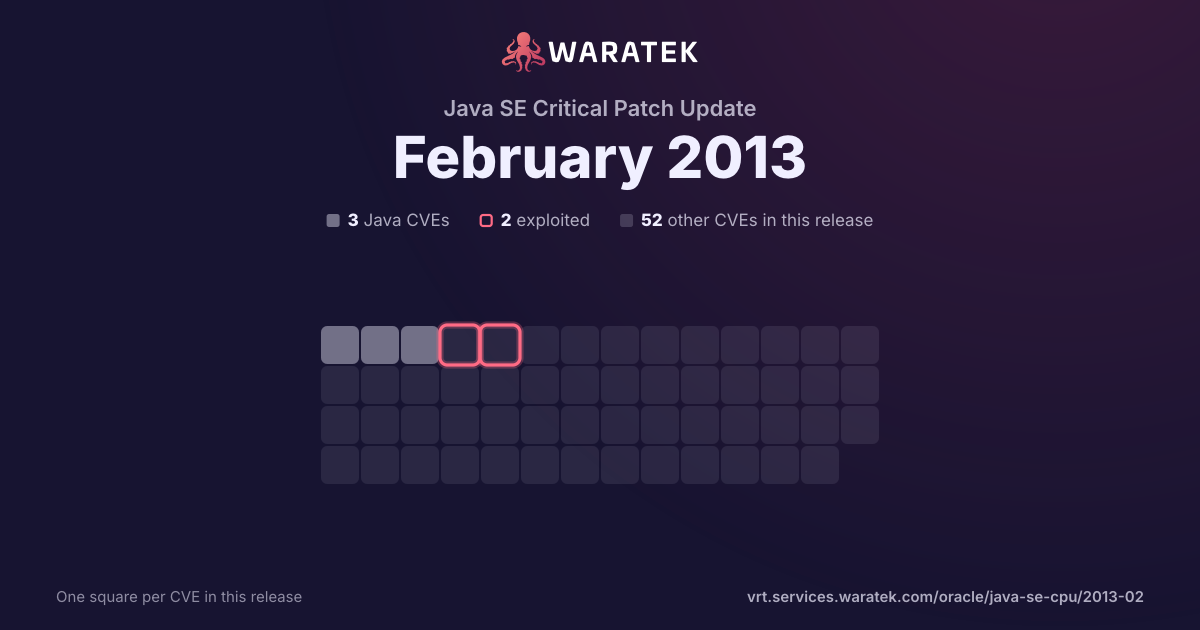
By status
No exploit published. For 2 of them, Oracle's security advisory is the source of public detail.
Overview 2 matches · 0 in Waratek scope · 0 protected · 1 exploited · 1 CISA KEV · 1 public PoC · 1 EPSS ≥ 0.5
2matches
0in Waratek scope0.0%
0protected0.0%
1exploited50.0%
1CISA KEV50.0%
1public PoC50.0%
1EPSS ≥ 0.550.0%
Protected by Waratek
0
0.0%
Rule in development
0
0.0%
Mitigation candidate
0
0.0%
No exploit published
0
0.0%
Outside Waratek scope
2
100.0%
Not applicable
0
0.0%
Withdrawn CVE
0
0.0%
blocked by ARMR today
0
0.0%
partly blocked
0
0.0%
not blocked
2
100.0%
not established
0
0.0%
unrecorded
0
0.0%
Exploited
1
50.0%
Working exploit published
0
0.0%
Proof of concept only
0
0.0%
Forecast only
0
0.0%
No public exploit
1
50.0%
split by
peak 2 / month
Jan 13
| CVE | Severity | Published▾ | Status | Exploitation | Description |
|---|---|---|---|---|---|
| CVE-2013-1489 | High | 2013-01-31 | Outside Waratek scope | No public exploit | Unspecified vulnerability in the Java Runtime Environment (JRE) component in Oracle Java SE 7 Update 10 and Update 11, when running on Windows using Internet Explorer, Firefox, Opera, and Google Chrome, allows remote attackers to bypass the "Very High" security level of the Java Control Panel and execute unsigned Java code without prompting the user via unknown vectors, aka "Issue 53" and the "Java Security Slider" vulnerability. |
| CVE-2013-0431 | Low | 2013-01-31 | Outside Waratek scope | Exploited | Unspecified vulnerability in the Java Runtime Environment (JRE) component in Oracle Java SE 7 through Update 11, and OpenJDK 7, allows user-assisted remote attackers to bypass the Java security sandbox via unspecified vectors related to JMX, aka "Issue 52," a different vulnerability than CVE-2013-1490. |