
Java SE CPU Oct 2011
Released October 2011 · Oracle's advisory ↗ · ← Critical Patch Update, October 2011 · Critical Patch Update, January 2012 →
20 CVEs in this release, one square each
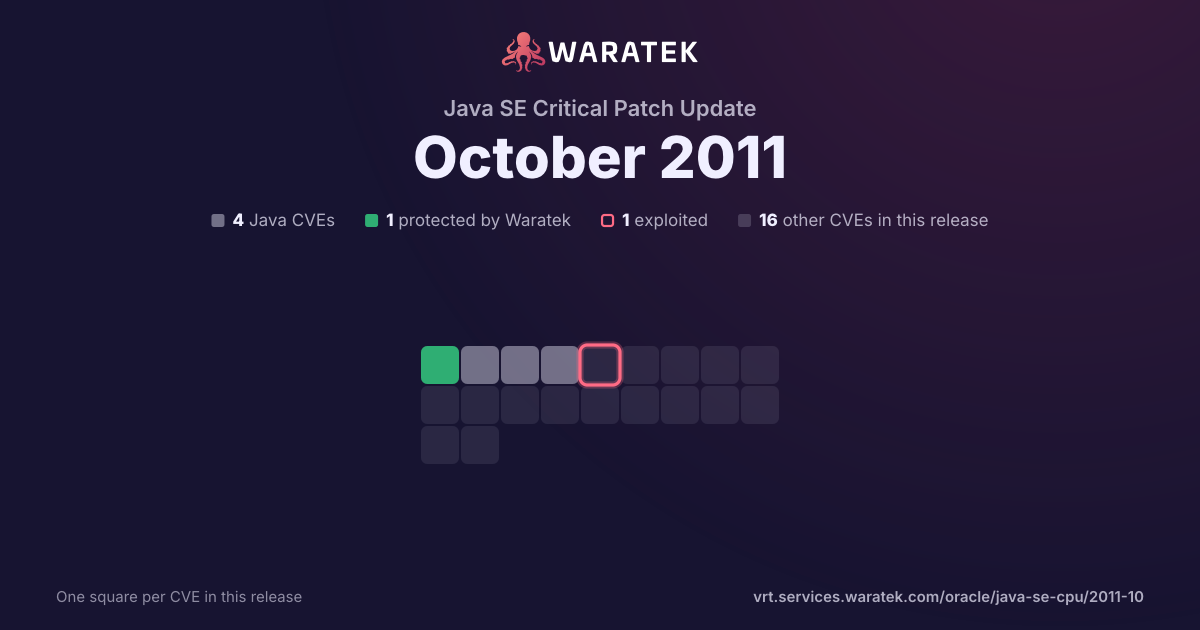
By status
1Protected by Waratek3No exploit published15Outside Waratek scope1Not applicable
1Exploited, marked by the ring
No exploit published. For 1 of them, Oracle's security advisory is the source of public detail.
Protected by Waratek. Waratek RASP can block exploitation of these on systems that have not applied the patch yet.
Overview 1 match · 0 in Waratek scope · 0 protected · 0 exploited · 0 CISA KEV
1match
0in Waratek scope0.0%
0protected0.0%
0exploited0.0%
0CISA KEV0.0%
Protected by Waratek
0
0.0%
Rule in development
0
0.0%
Mitigation candidate
0
0.0%
No exploit published
0
0.0%
Outside Waratek scope
0
0.0%
Not applicable
1
100.0%
Withdrawn CVE
0
0.0%
blocked by ARMR today
0
0.0%
partly blocked
0
0.0%
not blocked
1
100.0%
not established
0
0.0%
unrecorded
0
0.0%
Exploited
0
0.0%
Working exploit published
0
0.0%
Proof of concept only
1
100.0%
Forecast only
0
0.0%
No public exploit
0
0.0%
| CVE | Severity | Published▾ | Status | Exploitation | Description |
|---|---|---|---|---|---|
| CVE-2011-3389 | Medium | 2011-09-06 | Not applicable | Proof of concept only | The SSL protocol, as used in certain configurations in Microsoft Windows and Microsoft Internet Explorer, Mozilla Firefox, Google Chrome, Opera, and other products, encrypts data by using CBC mode with chained initialization vectors, which allows man-in-the-middle attackers to obtain plaintext HTTP headers via a blockwise chosen-boundary attack (BCBA) on an HTTPS session, in conjunction with JavaScript code that uses (1) the HTML5 WebSocket API, (2) the Java URLConnection API, or (3) the Silverlight WebClient API, aka a "BEAST" attack. |