
Java SE CPU Mar 2010
Released March 2010 · Oracle's advisory ↗ · ← Critical Patch Update, January 2010 · Critical Patch Update, April 2010 →
27 CVEs in this release, one square each
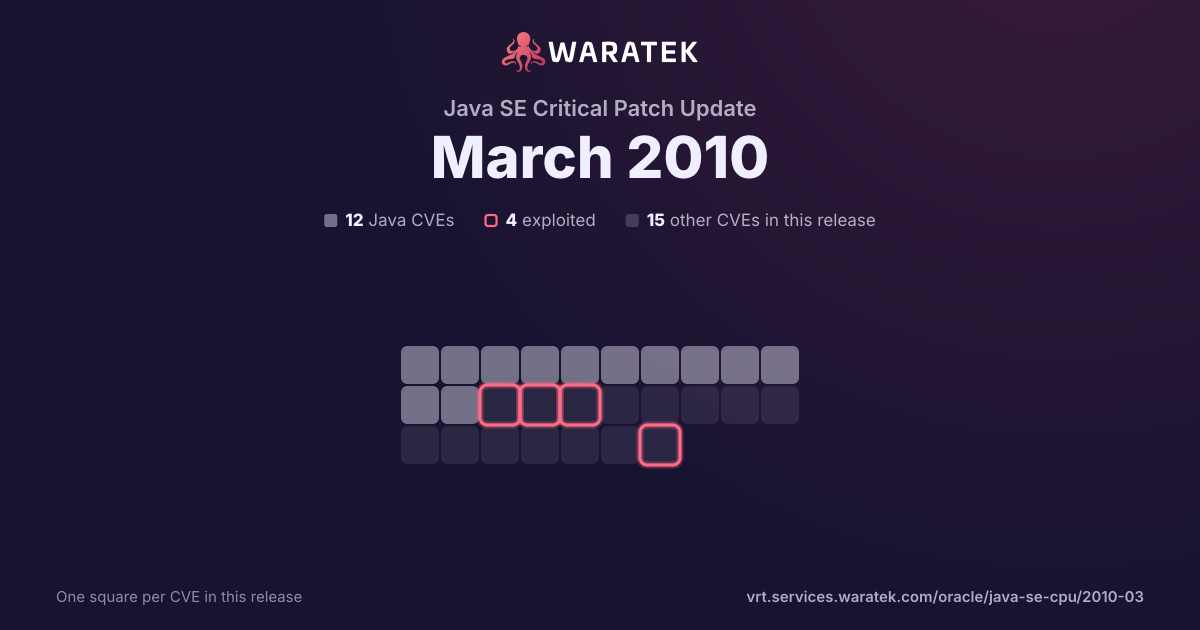
By status
1Mitigation candidate11No exploit published14Outside Waratek scope1Not applicable
4Exploited, marked by the ring
No exploit published. For 7 of them, Oracle's security advisory is the source of public detail.
Overview 2 matches · 0 in Waratek scope · 0 protected · 0 CISA KEV
2matches
0in Waratek scope0.0%
0protected0.0%
0CISA KEV0.0%
Protected by Waratek
0
0.0%
Rule in development
0
0.0%
Mitigation candidate
0
0.0%
No exploit published
0
0.0%
Outside Waratek scope
2
100.0%
Not applicable
0
0.0%
Withdrawn CVE
0
0.0%
blocked by ARMR today
0
0.0%
partly blocked
0
0.0%
not blocked
2
100.0%
not established
0
0.0%
unrecorded
0
0.0%
Exploited
2
100.0%
Working exploit published
0
0.0%
Proof of concept only
0
0.0%
Forecast only
0
0.0%
No public exploit
0
0.0%
| CVE | Severity | Published▾ | Status | Exploitation | Description |
|---|---|---|---|---|---|
| CVE-2010-0842 | High | 2010-04-01 | Outside Waratek scope | Exploited | Unspecified vulnerability in the Sound component in Oracle Java SE and Java for Business 6 Update 18, 5.0 Update 23, 1.4.2_25, and 1.3.1_27 allows remote attackers to affect confidentiality, integrity, and availability via unknown vectors. NOTE: the previous information was obtained from the March 2010 CPU. Oracle has not commented on claims from a reliable researcher that this is an uncontrolled array index that allows remote attackers to execute arbitrary code via a MIDI file with a crafted MixerSequencer object, related to the GM_Song structure. |
| CVE-2010-0094 | High | 2010-04-01 | Outside Waratek scope | Exploited | Unspecified vulnerability in the Java Runtime Environment component in Oracle Java SE and Java for Business 6 Update 18 and 5.0 Update 23 allows remote attackers to affect confidentiality, integrity, and availability via unknown vectors. NOTE: the previous information was obtained from the March 2010 CPU. Oracle has not commented on claims from a reliable researcher that this is due to missing privilege checks during deserialization of RMIConnectionImpl objects, which allows remote attackers to call system-level Java functions via the ClassLoader of a constructor that is being deserialized. |