
Oracle Critical Security Patch Update November 2026
Released November 2026 · Oracle's advisory ↗ · ← Critical Patch Update, October 2026
942 CVEs in this release, one square each
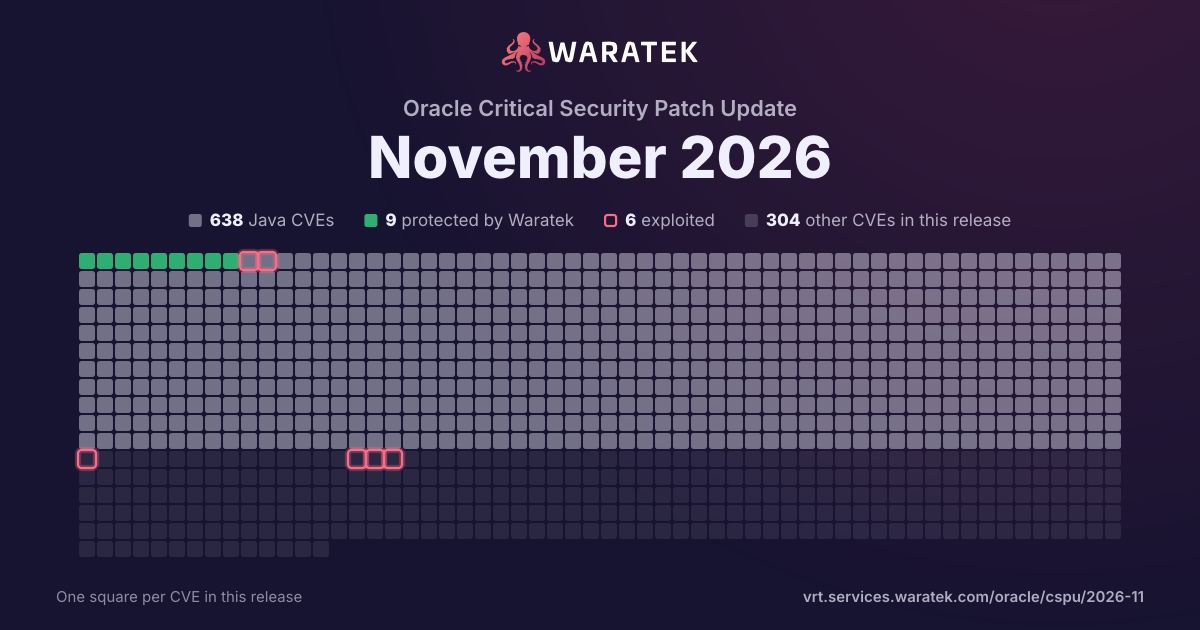
By status
9Protected by Waratek4Mitigation candidate625No exploit published15Outside Waratek scope289Not applicable
6Exploited, marked by the ring
No exploit published. For 554 of them, Oracle's security advisory is the source of public detail.
Protected by Waratek. Waratek RASP can block exploitation of these on systems that have not applied the patch yet.
Overview 136 matches · 0 in Waratek scope · 0 protected · 1 exploited · 0 CISA KEV · 2 public PoC · 0 EPSS ≥ 0.5
136matches
0in Waratek scope0.0%
0protected0.0%
1exploited0.7%
0CISA KEV0.0%
2public PoC1.5%
0EPSS ≥ 0.50.0%
Protected by Waratek
0
0.0%
Rule in development
0
0.0%
Mitigation candidate
0
0.0%
No exploit published
0
0.0%
Outside Waratek scope
0
0.0%
Not applicable
136
100.0%
Withdrawn CVE
0
0.0%
blocked by ARMR today
0
0.0%
partly blocked
0
0.0%
not blocked
136
100.0%
not established
0
0.0%
unrecorded
0
0.0%
Exploited
1
0.7%
Working exploit published
0
0.0%
Proof of concept only
42
30.9%
Forecast only
0
0.0%
No public exploit
93
68.4%
split by
peak 63 / quarter
Q3 221
Not applicable1
High1
not blocked1
No public exploit1
Q4 220
Q1 230
Q2 230
Q3 231
Not applicable1
High1
not blocked1
Proof of concept only1
Q4 230
Q1 240
Q2 240
Q3 240
Q4 241
Not applicable1
High1
not blocked1
Proof of concept only1
Q1 251
Not applicable1
High1
not blocked1
Proof of concept only1
Q2 250
Q3 250
Q4 250
Q1 264
Not applicable4
High4
not blocked4
No public exploit4
Q2 2614
Not applicable14
High14
not blocked14
Proof of concept only3
No public exploit11
Q3 2651
Not applicable51
High51
not blocked51
Proof of concept only19
No public exploit32
Q4 2663
Not applicable63
High63
not blocked63
Exploited1
Proof of concept only17
No public exploit45
Q4 22Q2 23Q4 23Q2 24Q4 24Q2 25Q4 25Q2 26Q4 26
| CVE | Severity | Published▾ | Status | Exploitation | Description |
|---|---|---|---|---|---|
| CVE-2026-127428 | High | 2026-11-17 | Not applicable | No public exploit | Vulnerability in the MySQL Server, MySQL Cluster product of Oracle MySQL (component: Server: GIS). Supported versions that are affected are MySQL Server: 8.4.0-8.4.13, 9.7.0-9.7.4, 26.10; MySQL Cluster: 8.0.0-8.0.50, 8.4.0-8.4.13, 9.7.0-9.7.4 and 26.10. Easily exploitable vulnerability allows low privileged attacker with network access via multiple protocols to compromise MySQL Server, MySQL Cluster. Successful attacks of this vulnerability can result in unauthorized ability to cause a hang or frequently repeatable crash (complete DOS) of MySQL Server, MySQL Cluster and unauthorized read access to a subset of MySQL Server, MySQL Cluster accessible data. CVSS 3.1 Base Score 7.1 (Confidentiality and Availability impacts). CVSS Vector: (CVSS:3.1/AV:N/AC:L/PR:L/UI:N/S:U/C:L/I:N/A:H). |
| CVE-2026-127427 | High | 2026-11-17 | Not applicable | No public exploit | Vulnerability in the Oracle VM VirtualBox product of Oracle Virtualization (component: Core). The supported version that is affected is 7.2.22. Easily exploitable vulnerability allows unauthenticated attacker with network access via RDP to compromise Oracle VM VirtualBox. Successful attacks of this vulnerability can result in unauthorized ability to cause a hang or frequently repeatable crash (complete DOS) of Oracle VM VirtualBox. CVSS 3.1 Base Score 7.5 (Availability impacts). CVSS Vector: (CVSS:3.1/AV:N/AC:L/PR:N/UI:N/S:U/C:N/I:N/A:H). |
| CVE-2026-127426 | High | 2026-11-17 | Not applicable | No public exploit | Vulnerability in the Oracle VM VirtualBox product of Oracle Virtualization (component: Core). The supported version that is affected is 7.2.22. Easily exploitable vulnerability allows unauthenticated attacker with access to the physical communication segment attached to the hardware where the Oracle VM VirtualBox executes to compromise Oracle VM VirtualBox. While the vulnerability is in Oracle VM VirtualBox, attacks may significantly impact additional products (scope change). Successful attacks of this vulnerability can result in unauthorized access to critical data or complete access to all Oracle VM VirtualBox accessible data. CVSS 3.1 Base Score 7.4 (Confidentiality impacts). CVSS Vector: (CVSS:3.1/AV:A/AC:L/PR:N/UI:N/S:C/C:H/I:N/A:N). |
| CVE-2026-127425 | High | 2026-11-17 | Not applicable | No public exploit | Vulnerability in the Oracle VM VirtualBox product of Oracle Virtualization (component: Core). The supported version that is affected is 7.2.22. Easily exploitable vulnerability allows high privileged attacker with logon to the infrastructure where Oracle VM VirtualBox executes to compromise Oracle VM VirtualBox. While the vulnerability is in Oracle VM VirtualBox, attacks may significantly impact additional products (scope change). Successful attacks of this vulnerability can result in unauthorized creation, deletion or modification access to critical data or all Oracle VM VirtualBox accessible data as well as unauthorized read access to a subset of Oracle VM VirtualBox accessible data and unauthorized ability to cause a hang or frequently repeatable crash (complete DOS) of Oracle VM VirtualBox. CVSS 3.1 Base Score 8.1 (Confidentiality, Integrity and Availability impacts). CVSS Vector: (CVSS:3.1/AV:L/AC:L/PR:H/UI:N/S:C/C:L/I:H/A:H). |
| CVE-2026-127423 | High | 2026-11-17 | Not applicable | No public exploit | Vulnerability in the Oracle VM VirtualBox product of Oracle Virtualization (component: Core). The supported version that is affected is 7.2.22. Easily exploitable vulnerability allows unauthenticated attacker with logon to the infrastructure where Oracle VM VirtualBox executes to compromise Oracle VM VirtualBox. Successful attacks require human interaction from a person other than the attacker. Successful attacks of this vulnerability can result in unauthorized creation, deletion or modification access to critical data or all Oracle VM VirtualBox accessible data and unauthorized ability to cause a hang or frequently repeatable crash (complete DOS) of Oracle VM VirtualBox. CVSS 3.1 Base Score 7.1 (Integrity and Availability impacts). CVSS Vector: (CVSS:3.1/AV:L/AC:L/PR:N/UI:R/S:U/C:N/I:H/A:H). |
| CVE-2026-127422 | High | 2026-11-17 | Not applicable | No public exploit | Vulnerability in the Oracle VM VirtualBox product of Oracle Virtualization (component: Core). The supported version that is affected is 7.2.22. Easily exploitable vulnerability allows unauthenticated attacker with logon to the infrastructure where Oracle VM VirtualBox executes to compromise Oracle VM VirtualBox. Successful attacks require human interaction from a person other than the attacker. Successful attacks of this vulnerability can result in unauthorized creation, deletion or modification access to critical data or all Oracle VM VirtualBox accessible data and unauthorized ability to cause a hang or frequently repeatable crash (complete DOS) of Oracle VM VirtualBox. CVSS 3.1 Base Score 7.1 (Integrity and Availability impacts). CVSS Vector: (CVSS:3.1/AV:L/AC:L/PR:N/UI:R/S:U/C:N/I:H/A:H). |
| CVE-2026-127421 | High | 2026-11-17 | Not applicable | No public exploit | Vulnerability in the Oracle VM VirtualBox product of Oracle Virtualization (component: Core). The supported version that is affected is 7.2.22. Easily exploitable vulnerability allows unauthenticated attacker with logon to the infrastructure where Oracle VM VirtualBox executes to compromise Oracle VM VirtualBox. Successful attacks require human interaction from a person other than the attacker and while the vulnerability is in Oracle VM VirtualBox, attacks may significantly impact additional products (scope change). Successful attacks of this vulnerability can result in takeover of Oracle VM VirtualBox. CVSS 3.1 Base Score 8.6 (Confidentiality, Integrity and Availability impacts). CVSS Vector: (CVSS:3.1/AV:L/AC:L/PR:N/UI:R/S:C/C:H/I:H/A:H). |
| CVE-2026-127414 | High | 2026-11-17 | Not applicable | No public exploit | Vulnerability in the Oracle VM VirtualBox product of Oracle Virtualization (component: Core). The supported version that is affected is 7.2.22. Easily exploitable vulnerability allows unauthenticated attacker with logon to the infrastructure where Oracle VM VirtualBox executes to compromise Oracle VM VirtualBox. Successful attacks require human interaction from a person other than the attacker. Successful attacks of this vulnerability can result in unauthorized creation, deletion or modification access to critical data or all Oracle VM VirtualBox accessible data and unauthorized ability to cause a hang or frequently repeatable crash (complete DOS) of Oracle VM VirtualBox. CVSS 3.1 Base Score 7.1 (Integrity and Availability impacts). CVSS Vector: (CVSS:3.1/AV:L/AC:L/PR:N/UI:R/S:U/C:N/I:H/A:H). |
| CVE-2026-127413 | High | 2026-11-17 | Not applicable | No public exploit | Vulnerability in the Oracle VM VirtualBox product of Oracle Virtualization (component: Core). The supported version that is affected is 7.2.22. Easily exploitable vulnerability allows unauthenticated attacker with network access via RDP to compromise Oracle VM VirtualBox. Successful attacks of this vulnerability can result in unauthorized ability to cause a hang or frequently repeatable crash (complete DOS) of Oracle VM VirtualBox. CVSS 3.1 Base Score 7.5 (Availability impacts). CVSS Vector: (CVSS:3.1/AV:N/AC:L/PR:N/UI:N/S:U/C:N/I:N/A:H). |
| CVE-2026-127402 | High | 2026-11-17 | Not applicable | No public exploit | Vulnerability in the Oracle AutoVue product of Oracle Supply Chain (component: Security). The supported version that is affected is 21.1.0. Difficult to exploit vulnerability allows unauthenticated attacker with network access via HTTP to compromise Oracle AutoVue. Successful attacks of this vulnerability can result in takeover of Oracle AutoVue. CVSS 3.1 Base Score 8.1 (Confidentiality, Integrity and Availability impacts). CVSS Vector: (CVSS:3.1/AV:N/AC:H/PR:N/UI:N/S:U/C:H/I:H/A:H). |
| CVE-2026-127339 | High | 2026-11-17 | Not applicable | No public exploit | Vulnerability in the Oracle AutoVue product of Oracle Supply Chain (component: Security). The supported version that is affected is 21.1.0. Easily exploitable vulnerability allows unauthenticated attacker with logon to the infrastructure where Oracle AutoVue executes to compromise Oracle AutoVue. While the vulnerability is in Oracle AutoVue, attacks may significantly impact additional products (scope change). Successful attacks of this vulnerability can result in unauthorized creation, deletion or modification access to critical data or all Oracle AutoVue accessible data. CVSS 3.1 Base Score 7.1 (Integrity impacts). CVSS Vector: (CVSS:3.1/AV:L/AC:L/PR:N/UI:N/S:C/C:N/I:H/A:N). |
| CVE-2026-127337 | High | 2026-11-17 | Not applicable | No public exploit | Vulnerability in the Oracle AutoVue product of Oracle Supply Chain (component: Security). The supported version that is affected is 21.1.0. Easily exploitable vulnerability allows unauthenticated attacker with logon to the infrastructure where Oracle AutoVue executes to compromise Oracle AutoVue. While the vulnerability is in Oracle AutoVue, attacks may significantly impact additional products (scope change). Successful attacks of this vulnerability can result in unauthorized access to critical data or complete access to all Oracle AutoVue accessible data as well as unauthorized update, insert or delete access to some of Oracle AutoVue accessible data. CVSS 3.1 Base Score 7.9 (Confidentiality and Integrity impacts). CVSS Vector: (CVSS:3.1/AV:L/AC:L/PR:N/UI:N/S:C/C:H/I:L/A:N). |
| CVE-2026-127334 | High | 2026-11-17 | Not applicable | No public exploit | Vulnerability in the Oracle AutoVue product of Oracle Supply Chain (component: Security). The supported version that is affected is 21.1.0. Easily exploitable vulnerability allows low privileged attacker with network access via HTTP to compromise Oracle AutoVue. Successful attacks of this vulnerability can result in takeover of Oracle AutoVue. CVSS 3.1 Base Score 8.8 (Confidentiality, Integrity and Availability impacts). CVSS Vector: (CVSS:3.1/AV:N/AC:L/PR:L/UI:N/S:U/C:H/I:H/A:H). |
| CVE-2026-127331 | High | 2026-11-17 | Not applicable | No public exploit | Vulnerability in the Oracle AutoVue product of Oracle Supply Chain (component: Security). The supported version that is affected is 21.1.0. Easily exploitable vulnerability allows unauthenticated attacker with network access via HTTP to compromise Oracle AutoVue. Successful attacks of this vulnerability can result in unauthorized ability to cause a hang or frequently repeatable crash (complete DOS) of Oracle AutoVue. CVSS 3.1 Base Score 7.5 (Availability impacts). CVSS Vector: (CVSS:3.1/AV:N/AC:L/PR:N/UI:N/S:U/C:N/I:N/A:H). |
| CVE-2026-127330 | High | 2026-11-17 | Not applicable | No public exploit | Vulnerability in the Oracle AutoVue product of Oracle Supply Chain (component: Security). The supported version that is affected is 21.1.0. Difficult to exploit vulnerability allows unauthenticated attacker with network access via HTTP to compromise Oracle AutoVue. Successful attacks of this vulnerability can result in takeover of Oracle AutoVue. CVSS 3.1 Base Score 8.1 (Confidentiality, Integrity and Availability impacts). CVSS Vector: (CVSS:3.1/AV:N/AC:H/PR:N/UI:N/S:U/C:H/I:H/A:H). |
| CVE-2026-127329 | High | 2026-11-17 | Not applicable | No public exploit | Vulnerability in the Oracle AutoVue product of Oracle Supply Chain (component: Security). The supported version that is affected is 21.1.0. Difficult to exploit vulnerability allows unauthenticated attacker with network access via HTTP to compromise Oracle AutoVue. Successful attacks of this vulnerability can result in takeover of Oracle AutoVue. CVSS 3.1 Base Score 8.1 (Confidentiality, Integrity and Availability impacts). CVSS Vector: (CVSS:3.1/AV:N/AC:H/PR:N/UI:N/S:U/C:H/I:H/A:H). |
| CVE-2026-127328 | High | 2026-11-17 | Not applicable | No public exploit | Vulnerability in the Oracle AutoVue product of Oracle Supply Chain (component: Security). The supported version that is affected is 21.1.0. Difficult to exploit vulnerability allows unauthenticated attacker with network access via HTTP to compromise Oracle AutoVue. Successful attacks of this vulnerability can result in takeover of Oracle AutoVue. CVSS 3.1 Base Score 8.1 (Confidentiality, Integrity and Availability impacts). CVSS Vector: (CVSS:3.1/AV:N/AC:H/PR:N/UI:N/S:U/C:H/I:H/A:H). |
| CVE-2026-127319 | High | 2026-11-17 | Not applicable | No public exploit | Vulnerability in the Oracle AutoVue product of Oracle Supply Chain (component: Security). The supported version that is affected is 21.1.0. Easily exploitable vulnerability allows low privileged attacker with network access via HTTP to compromise Oracle AutoVue. Successful attacks of this vulnerability can result in unauthorized access to critical data or complete access to all Oracle AutoVue accessible data as well as unauthorized update, insert or delete access to some of Oracle AutoVue accessible data. CVSS 3.1 Base Score 7.1 (Confidentiality and Integrity impacts). CVSS Vector: (CVSS:3.1/AV:N/AC:L/PR:L/UI:N/S:U/C:H/I:L/A:N). |
| CVE-2026-127308 | High | 2026-11-17 | Not applicable | No public exploit | Vulnerability in the Oracle AutoVue product of Oracle Supply Chain (component: Security). The supported version that is affected is 21.1.0. Easily exploitable vulnerability allows unauthenticated attacker with network access via HTTP to compromise Oracle AutoVue. Successful attacks require human interaction from a person other than the attacker. Successful attacks of this vulnerability can result in unauthorized creation, deletion or modification access to critical data or all Oracle AutoVue accessible data as well as unauthorized access to critical data or complete access to all Oracle AutoVue accessible data. CVSS 3.1 Base Score 8.1 (Confidentiality and Integrity impacts). CVSS Vector: (CVSS:3.1/AV:N/AC:L/PR:N/UI:R/S:U/C:H/I:H/A:N). |
| CVE-2026-127307 | High | 2026-11-17 | Not applicable | No public exploit | Vulnerability in the Oracle AutoVue product of Oracle Supply Chain (component: Security). The supported version that is affected is 21.1.0. Easily exploitable vulnerability allows low privileged attacker with network access via HTTP to compromise Oracle AutoVue. Successful attacks of this vulnerability can result in takeover of Oracle AutoVue. CVSS 3.1 Base Score 8.8 (Confidentiality, Integrity and Availability impacts). CVSS Vector: (CVSS:3.1/AV:N/AC:L/PR:L/UI:N/S:U/C:H/I:H/A:H). |
| CVE-2026-127306 | High | 2026-11-17 | Not applicable | No public exploit | Vulnerability in the Oracle AutoVue product of Oracle Supply Chain (component: Security Related Issues). The supported version that is affected is 21.1.0. Easily exploitable vulnerability allows unauthenticated attacker with network access via HTTP to compromise Oracle AutoVue. While the vulnerability is in Oracle AutoVue, attacks may significantly impact additional products (scope change). Successful attacks of this vulnerability can result in unauthorized access to critical data or complete access to all Oracle AutoVue accessible data. CVSS 3.1 Base Score 8.6 (Confidentiality impacts). CVSS Vector: (CVSS:3.1/AV:N/AC:L/PR:N/UI:N/S:C/C:H/I:N/A:N). |
| CVE-2026-114981 | High | 2026-11-17 | Not applicable | No public exploit | Vulnerability in the Oracle AutoVue product of Oracle Supply Chain (component: Security Related Issues). The supported version that is affected is 21.1.0. Difficult to exploit vulnerability allows low privileged attacker with network access via HTTP to compromise Oracle AutoVue. Successful attacks of this vulnerability can result in takeover of Oracle AutoVue. CVSS 3.1 Base Score 7.5 (Confidentiality, Integrity and Availability impacts). CVSS Vector: (CVSS:3.1/AV:N/AC:H/PR:L/UI:N/S:U/C:H/I:H/A:H). |
| CVE-2026-114951 | High | 2026-11-17 | Not applicable | No public exploit | Vulnerability in the MySQL Server, MySQL Cluster product of Oracle MySQL (component: Server: Logging). Supported versions that are affected are MySQL Server: 8.4.0-8.4.13, 9.7.0-9.7.4, 26.10; MySQL Cluster: 8.0.0-8.0.50, 8.4.0-8.4.13, 9.7.0-9.7.4 and 26.10. Easily exploitable vulnerability allows high privileged attacker with network access via multiple protocols to compromise MySQL Server, MySQL Cluster. Successful attacks of this vulnerability can result in takeover of MySQL Server, MySQL Cluster. CVSS 3.1 Base Score 7.2 (Confidentiality, Integrity and Availability impacts). CVSS Vector: (CVSS:3.1/AV:N/AC:L/PR:H/UI:N/S:U/C:H/I:H/A:H). |
| CVE-2026-114950 | High | 2026-11-17 | Not applicable | No public exploit | Vulnerability in the MySQL Server, MySQL Cluster product of Oracle MySQL (component: Server: Optimizer). Supported versions that are affected are MySQL Server: 8.4.0-8.4.13, 9.7.0-9.7.4, 26.10; MySQL Cluster: 8.0.0-8.0.50, 8.4.0-8.4.13, 9.7.0-9.7.4 and 26.10. Easily exploitable vulnerability allows high privileged attacker with network access via multiple protocols to compromise MySQL Server, MySQL Cluster. Successful attacks of this vulnerability can result in takeover of MySQL Server, MySQL Cluster. CVSS 3.1 Base Score 7.2 (Confidentiality, Integrity and Availability impacts). CVSS Vector: (CVSS:3.1/AV:N/AC:L/PR:H/UI:N/S:U/C:H/I:H/A:H). |
| CVE-2026-114949 | High | 2026-11-17 | Not applicable | No public exploit | Vulnerability in the MySQL Server, MySQL Cluster product of Oracle MySQL (component: Server: Replication). Supported versions that are affected are MySQL Server: 8.4.0-8.4.13, 9.7.0-9.7.4, 26.10; MySQL Cluster: 8.0.0-8.0.50, 8.4.0-8.4.13, 9.7.0-9.7.4 and 26.10. Easily exploitable vulnerability allows high privileged attacker with network access via multiple protocols to compromise MySQL Server, MySQL Cluster. Successful attacks of this vulnerability can result in takeover of MySQL Server, MySQL Cluster. CVSS 3.1 Base Score 7.2 (Confidentiality, Integrity and Availability impacts). CVSS Vector: (CVSS:3.1/AV:N/AC:L/PR:H/UI:N/S:U/C:H/I:H/A:H). |
| CVE-2026-118628 | High | 2026-11-04 | Not applicable | No public exploit | MLflow get-artifacts Server-Side Request Forgery Information Disclosure Vulnerability. This vulnerability allows remote attackers to disclose sensitive information on affected installations of MLflow. Authentication is not required to exploit this vulnerability. The specific flaw exists within the get-artifacts function. The issue results from the lack of proper validation of a URI prior to accessing resources. An attacker can leverage this vulnerability to disclose information in the context of the server. Was ZDI-CAN-28192. |
| CVE-2026-118627 | High | 2026-11-04 | Not applicable | No public exploit | MLflow SHAP load_explainer Deserialization of Untrusted Data Remote Code Execution Vulnerability. This vulnerability allows remote attackers to execute arbitrary code on affected installations of MLflow. User interaction is required to exploit this vulnerability in that the target must visit a malicious page or open a malicious file. The specific flaw exists within the loading of SHAP explainer models. The issue results from the lack of proper validation of user-supplied data, which can result in deserialization of untrusted data. An attacker can leverage this vulnerability to execute code in the context of the current user. Was ZDI-CAN-30301. |
| CVE-2026-118623 | High | 2026-11-04 | Not applicable | No public exploit | MLflow PickleEvaluationArtifact Deserialization of Untrusted Data Remote Code Execution Vulnerability. This vulnerability allows remote attackers to execute arbitrary code on affected installations of MLflow. User interaction is required to exploit this vulnerability in that the target must visit a malicious page or open a malicious file. The specific flaw exists within the parsing of pickle files. The issue results from the lack of proper validation of user-supplied data, which can result in deserialization of untrusted data. An attacker can leverage this vulnerability to execute code in the context of the current process. Was ZDI-CAN-29513. |
| CVE-2026-116690 | High | 2026-10-27 | Not applicable | Exploited | MLflow is an open source AI engineering platform for agents, large language models, and machine learning models. From 3.10.0 until 3.17.0, the prompt branch in _create_model_version() accepts schemeless relative sources because path validation runs only when a source has a URL scheme, and mlflow.prompt.is_prompt is interpreted by tag presence rather than a true value. A remote caller can store a server-local path as the model version artifact location and use /api/2.0/mlflow/model-versions/get-artifact to read files accessible to the MLflow server process. Default unauthenticated servers require no privileges, while basic-auth deployments are exposed to authenticated users who can create registered models. This issue is fixed in version 3.17.0. |
| CVE-2026-106069 | High | 2026-10-23 | Not applicable | No public exploit | A flaw in Node.js TLS hostname verification can cause a server certificate to be validated against a different IP address than the one the client connected to, when the host is a non-canonical IPv4 literal with a leading zero, such as `0127.0.0.1`. `tls.checkServerIdentity()` normalizes the host following the WHATWG URL rules, which read a leading-zero octet as octal (`0127.0.0.1` becomes `87.0.0.1`), while the connection is made through the operating system resolver, which on some platforms such as macOS reads it as decimal (`127.0.0.1`). A server at the connected address can then be authenticated with a certificate issued for another IP address. This vulnerability affects Node.js **26.x**, **24.x**, and **22.x**. |
| CVE-2026-105483 | High | 2026-10-23 | Not applicable | No public exploit | A flaw in Node.js TLS hostname verification allows a certificate without a matching IP address SAN to authenticate a connection to an IPv4 address when the host is written with non-ASCII characters, such as fullwidth digits (`127.0.0.1`). `tls.checkServerIdentity()` did not recognize such hosts as IP addresses, even though they normalize and resolve to a regular IPv4 address, and matched them against the certificate DNS names and Common Name instead. A certificate containing `DNS:127.0.0.1` or `DNS:*.0.0.1` could therefore be accepted for an IP endpoint it was not issued for. This is a regression introduced after the fix for CVE-2026-48618. This vulnerability affects Node.js **26.x** and **24.x**. |
| CVE-2026-105482 | High | 2026-10-23 | Not applicable | Proof of concept only | A flaw in Node.js DNS resolution allows hostnames containing a NUL byte to be silently truncated by the dns.resolve*() functions and dns.reverse(). This is an incomplete fix of CVE-2026-48930, which only covered dns.lookup() and the net/tls host options. Because the name is passed to c-ares as a C string, resolving attacker.example\0.trusted.example queries attacker.example and returns its records without any error. Applications that validate a hostname, for example against a domain allowlist, and then resolve it with dns.resolve*() can act on records for a different name than the one they validated. This vulnerability affects Node.js 26.x, 24.x, and 22.x. |
| CVE-2026-94266 | High | 2026-10-20 | Not applicable | Proof of concept only | libcurl could accidentally return a URL for `curl_easy_getinfo()`'s `CURLINFO_EFFECTIVE_URL` option containing credentials, even though neither the URL provided to libcurl nor the redirected URL did. |
| CVE-2026-92391 | High | 2026-10-20 | Not applicable | Proof of concept only | A deeply nested multipart MIME structure constructed via the public API causes a stack overflow in libcurl during normal cleanup operations. An excessive recursion depth within `curl_mime_free` leads to unbounded stack frame allocation during structure traversal, ultimately crashing the host process. |
| CVE-2026-92390 | High | 2026-10-20 | Not applicable | Proof of concept only | When invoked with `--remote-header-name` (`-J`), curl fails to preserve its documented anti-clobbering protection if an intermediate 103 Early Hints response precedes the final HTTP response, or if an `ETag` header is processed before `Content-Disposition` under `--etag-save`. This flaw allows an HTTP(S) server to overwrite an existing local file specified in the `Content-Disposition` header despite the presence of the `-J` non-overwrite constraint. |
| CVE-2026-92389 | High | 2026-10-20 | Not applicable | Proof of concept only | libcurl's TFTP state machine fails to validate state transitions against the requested transfer direction, accepting opening server responses for both reads and writes interchangeably. A malicious TFTP server can respond to a download request in a way that forces the client into transmit mode, prompting libcurl to consume and transmit data from the handle's persistent `CURLOPT_READDATA` pointer - including data remaining from unrelated prior operations, such as an HTTP POST request executed on a reused handle. |
| CVE-2026-92387 | High | 2026-10-20 | Not applicable | Proof of concept only | By permanently omitting the final control-response line, a malicious FTP, IMAP, POP3, or SMTP server can exploit libcurl and completely bypass its configured transfer timeout mechanism, indefinitely blocking all concurrent transfers bound to the same multi-handle. |
| CVE-2026-92386 | High | 2026-10-20 | Not applicable | Proof of concept only | When writing a long cookie name and value to a Netscape cookie jar, a remote HTTP server can make `curl` write a record that exceeds its line-length parsing limit. Consequently, any subsequent `curl` invocation reading from that same cookie jar using `--cookie` silently aborts parsing prematurely upon encountering the too long line, ignoring all subsequent valid cookies in the file. |
| CVE-2026-87865 | High | 2026-10-20 | Not applicable | Proof of concept only | When libcurl uses libssh2 with a hashed `known_hosts` file, an unrelated initial entry can cause host key validation to report a key *mismatch* as a *missing* key to the `CURLOPT_SSH_KEYFUNCTION` callback. |
| CVE-2026-87864 | High | 2026-10-20 | Not applicable | Proof of concept only | Enabling `CURLOPT_CRLF` causes curl to advertise the raw input byte count in the `IMAP APPEND {N}` literal while transmitting line-ending expanded data. The server reads only $N$ bytes for the payload, causing the remaining overflow bytes to be interpreted and executed as pipelined IMAP commands within the authenticated session. |
| CVE-2026-87863 | High | 2026-10-20 | Not applicable | Proof of concept only | An authenticated HTTPS origin can supply an HSTS `max-age` value that the parser accepts, but time serialization later fails to process. On 64-bit systems, extreme max-age values compute an absolute expiry within standard time integer limits that exceeds calendar time structure bounds. During cache saves, the original HSTS file is truncated before writing a temporary replacement; when serialization fails, the temporary file is deleted, leaving an empty or partial cache. Because the save error is silently ignored during cleanup, curl exits successfully despite the data loss. |
| CVE-2026-87862 | High | 2026-10-20 | Not applicable | Proof of concept only | Importing a `includeSubDomains` parent HSTS entry before a longer-lived child entry, silently drops the child. Consequently, when the parent expires, the child's valid HSTS policy is lost, causing curl to issue unencrypted HTTP requests rather than upgrading to HTTPS. |
| CVE-2026-86415 | High | 2026-10-20 | Not applicable | No public exploit | libcurl's connection cache match function never considers the automatic client certificate option, so a cached, already authenticated Schannel connection can be handed to a transfer that got redirected to a different origin, even though the code explicitly switched off the auto client cert option for that transfer to prevent exactly this. |
| CVE-2026-86412 | High | 2026-10-20 | Not applicable | Proof of concept only | A remote HTTP server can set a cookie that curl accepts and writes to a Netscape cookie jar but cannot reload. On the next invocation using the same path for `--cookie` and `--cookie-jar`, curl fails before connecting, then the cleanup procedure replaces the jar with an empty file, deleting cookies for unrelated domains. |
| CVE-2026-86410 | High | 2026-10-20 | Not applicable | Proof of concept only | A flaw in the curl command line tool's logic makes it only set SSH host verification options when interacting directly using SFTP or SCP, and not as a result of following a redirect. |
| CVE-2026-86409 | High | 2026-10-20 | Not applicable | Proof of concept only | Setting `CURLOPT_AWS_SIGV4` to NULL but does not disable SigV4 authentication, contrary to expectations and documentation. A subsequent transfer on the same handle still sends an `Authorization: AWS4-HMAC-SHA256` header to whatever URL isset next, leaking state information. |
| CVE-2026-107929 | High | 2026-10-20 | Not applicable | Proof of concept only | When `CURLOPT_INTERFACE` (or the command line tool's `--interface` option) is set with one of the documented prefixes (`if!`, `host!`, `ifhost!`), that binding is not part of the connection reuse key, so a later transfer asking for a different source can silently reuse an existing connection and go out from the earlier transfer's source address |
| CVE-2026-107928 | High | 2026-10-20 | Not applicable | Proof of concept only | When curl is built with GnuTLS, a malicious WebSocket server can make curl send memory past its send buffer. This is due to an out of bounds read following when `gnutls_record_send()` returns a number of bytes sent **greater than the number of bytes it was given to send**. GnuTLS does that after a blocked send. |
| CVE-2026-92392 | High | 2026-10-14 | Not applicable | Proof of concept only | During an upload, curl mishandles HTTP/2 `RST_STREAM` received from the server (with reason `HTTP_1_1_REQUIRED` or `REFUSED_STREAM`) leading to a use after free of a `struct Curl_easy` object. |
| CVE-2026-77214 | High | 2026-10-07 | Not applicable | No public exploit | libexpat before commit 13c5f63 contains a heap buffer over-read vulnerability in xmlparse.c. XML_ParseBuffer advances the parse buffer end with parser->m_bufferEnd += len using a caller-supplied length that is not validated against the allocated buffer size, so repeated XML_ParseBuffer calls move m_bufferEnd past the end of the heap allocation and subsequent parsing reads out of bounds. Reaching this path requires a parse buffer to already be present; otherwise XML_ParseBuffer returns XML_ERROR_NO_BUFFER. A buffer is present after a prior call to XML_GetBuffer, either directly (the common case) or indirectly through a prior XML_Parse call that allocates the buffer internally. The over-read discloses adjacent heap memory to the calling application, recovering heap pointers, libc function pointers, and code pointers sufficient to defeat ASLR and build further exploitation primitives. |
| CVE-2026-93546 | High | 2026-10-01 | Not applicable | No public exploit | Integer overflow in mod_dav_fs in Apache HTTP Server through 2.4.68 allows an authenticated WebDAV client with write access to crash worker processes and persistently corrupt a directory's property database via PROPPATCH requests declaring many XML namespaces. |
| CVE-2026-73637 | High | 2026-10-01 | Not applicable | No public exploit | Use after free in mod_auth_digest in Apache Software Foundation Apache HTTP Server before 2.4.69 on all platforms allows an unauthenticated remote client to cause authentication state corruption via concurrent Digest authentication requests when AuthDigestNcCheck is enabled or AuthDigestNonceLifetime is set to 0. Users are recommended to upgrade to version 2.4.69, which fixes this issue. |
| CVE-2026-73636 | High | 2026-10-01 | Not applicable | No public exploit | Authentication bypass by capture-replay in mod_auth_digest in Apache Software Foundation Apache HTTP Server 2.4.x on all platforms allows a man-in-the-middle (MITM) attacker to replay captured digest authentication credentials via crafted requests that trigger garbage collection of the client's shared memory entry when AuthDigestNonceLifetime is set to 0. Users are recommended to upgrade to version 2.4.69, which fixes this issue. |
| CVE-2026-63718 | High | 2026-10-01 | Not applicable | No public exploit | Inconsistent Interpretation of HTTP Requests ('HTTP Request/Response Smuggling') response smuggling vulnerability in Apache HTTP Server via mod_proxy_uwsgi and a crafted uwsgi response with Transfer-Encoding. This issue affects Apache HTTP Server: from 2.4.30 through 2.4.68. |
| CVE-2026-63686 | High | 2026-10-01 | Not applicable | No public exploit | A NULL pointer dereference in mod_xml2enc in Apache Software Foundation Apache HTTP Server before 2.4.69 on all platforms allows an untrusted backend server to cause a denial of service via a proxied response with a charset whose conversion partially succeeds then fails. Users are recommended to upgrade to version 2.4.69, which fixes this issue. |
| CVE-2026-63292 | High | 2026-10-01 | Not applicable | No public exploit | Stack-based buffer overflow in mod_vhost_alias in Apache Software Foundation Apache HTTP Server through 2.4.68 on all platforms allows a remote client to cause a denial of service or potentially execute arbitrary code via an HTTP request with a Host header exceeding 8192 bytes when VirtualDocumentRoot uses a hostname format specifier and LimitRequestFieldSize is raised above the default. Users are recommended to upgrade to version 2.4.69, which fixes this issue. |
| CVE-2026-63045 | High | 2026-10-01 | Not applicable | No public exploit | Improper validation of FTP PASV reply address in mod_proxy_ftp in Apache Software Foundation Apache HTTP Server through 2.4.68 on all platforms allows, in forward proxy configurations, an untrusted FTP server to cause the proxy to open a data connection to an arbitrary third-party host via a crafted PASV response. Users are recommended to upgrade to version 2.4.69, which fixes this issue. |
| CVE-2026-59685 | High | 2026-10-01 | Not applicable | No public exploit | Out-of-bounds Write vulnerability in Apache HTTP Server on Windows while processing paths with 8.3 names that may grow when expanded. This issue affects Apache HTTP Server: from 2.4.0 through 2.4.68. |
| CVE-2026-56449 | High | 2026-10-01 | Not applicable | No public exploit | Out-of-bounds Write vulnerability in Apache HTTP Server's mod_proxy_html with crafted HTTP response bodies. This issue affects Apache HTTP Server version 2.4.68. |
| CVE-2026-56153 | High | 2026-10-01 | Not applicable | No public exploit | Out-of-bounds Write vulnerability in Apache HTTP Server's mod_charset_lite. This issue affects Apache HTTP Server: from 2.4.0 through 2.4.68. |
| CVE-2026-48005 | High | 2026-10-01 | Not applicable | No public exploit | Missing authentication checks in mod_auth_digest in Apache Software Foundation Apache HTTP Server before 2.4.69 on all platforms allows an unauthenticated remote client to cause a denial of service (forced re-authentication) via forged Authorization headers when Digest authentication is enabled with AuthDigestNcCheck . Users are recommended to upgrade to version 2.4.69, which fixes this issue. |
| CVE-2026-47360 | High | 2026-10-01 | Not applicable | No public exploit | Exposure of Sensitive Information to an Unauthorized Actor vulnerability in Apache HTTP Server's mod_session_cookie module. When SessionCookieRemove changes across internal redirects, the session cookie may still be passed to a backend server. This issue affects Apache HTTP Server: from 2.4.0 through 2.4.68. |
| CVE-2026-46729 | High | 2026-10-01 | Not applicable | No public exploit | NULL Pointer Dereference vulnerability in Apache HTTP Servers mod_heartmonitor over unicast listener. This issue affects Apache HTTP Server: from 2.4.0 through 2.4.68. |
| CVE-2026-19553 | High | 2026-09-30 | Not applicable | No public exploit | ssl.SSLContext.wrap_bio() didn't require the server_hostname argument to not be None if ssl.SSLContext.check_hostname was set. Due to a missing parameter check in SSLObject, if the server_hostname argument isn't supplied then hostname verification would be silently skipped. This defect could lead to programs where certificate hostname verification *appeared* to be succeeding with SSLContext.check_hostname = True and no ValueError being raised due to misconfiguration. If the program passes a server_hostname value that isn't an empty string or None to any of these APIs then certificate hostname verification proceeds as expected and the program is not affected by this vulnerability. Mitigating this vulnerability doesn't require updating Python or applying the patch. To mitigate, pass a valid non-None and non-empty server_hostname value to SSLContext.wrap_bio(), asyncio.create_connection(), or asyncio.loop.start_tls() and certificate hostname verification will proceed as expected. Upgrading to the latest version of Python or applying the patch only changes the behavior from silently skipping hostname verification to raising a ValueError, similar to SSLContext.wrap_socket(), when server_hostname isn't supplied. |
| CVE-2026-84784 | High | 2026-09-29 | Not applicable | No public exploit | Issue summary: A malicious remote peer may flood the local QUIC stack with NEW_CONNECTION_ID frames by avoiding a limit check on how many connection IDs the remote QUIC stack can use. Impact summary: The local QUIC stack sends a RETIRE_CONN_ID frame for every NEW_CONNECTION_ID frame it receives. The RETIRE_CONN_ID frame is dispatched via the Control Frame Queue (CFQ). If the remote peer also withholds ACKs, then it can force the local stack to allocate ~400MB (depending on ACK delay). CWE: CWE-770: Allocation of Resources Without Limits or Throttling Description: RFC 9000 sections 5.1.1 and 5.1.2 [1] describe the mechanism by which a remote peer can notify the local QUIC stack to change the destination connection ID (a.k.a. CID) the local stack uses to identify the connection at the remote peer. Each CID is associated with a sequence number. The sequence number is transmitted in NEW_CONNECTION_ID and RETIRE_CONNECTION_ID frames to identify the CID which is being either associated with a connection or retired. The remote peer sends a NEW_CONNECTION_ID frame to let the local stack know a new CID is being associated with an existing connection. The NEW_CONNECTION_ID frame carries the new CID, its sequence number, and the retire-prior-to number. The retire-prior-to identifies existing CIDs that are to be retired. The local QUIC stack must send a RETIRE_CONNECTION_ID for every destination CID whose sequence number is less than retire-prior-to. The CID becomes retired after the local stack receives an ACK for its RETIRE_CONNECTION_ID frame. Although the OpenSSL QUIC stack supports at most one destination CID for every connection, it can be tricked into processing more than one RETIRE_CONNECTION_ID frame per connection. The OpenSSL QUIC stack currently retires the destination CID as soon as it receives the NEW_CONNECTION_ID, while in fact the destination CID must be retired after an ACK for the RETIRE_CONNECTION_ID frame is received. Correcting the flawed logic also fixes the backlog growth. [1] https://datatracker.ietf.org/doc/html/rfc9000#name-issuing-connection-ids FIPS impact: no The FIPS module is not affected as the QUIC implementation is outside of the OpenSSL FIPS module boundary. |
| CVE-2026-84782 | High | 2026-09-29 | Not applicable | No public exploit | Issue summary: The DTLS retransmission logic does not correctly handle a handshake message write that is suspended part-way through. The retransmitted message can be read past the message buffer and the retransmission overwrites the internal state the suspended write needs to resume correctly. Impact summary: The retransmitted message can disclose a heap memory to the peer as plaintext handshake data or cause a crash and a Denial of Service when the read reaches an unmapped memory region. CWE: CWE-125: Out-of-bounds Read Description: DTLS handshake messages can be written out in multiple fragments, and a write can suspend mid-message (returning WANT_WRITE) if the underlying transport temporarily cannot accept more data. While such a write is suspended, the DTLS retransmission timer may independently fire and ask the retransmission logic to resend an earlier, already-acknowledged-as-sent message from its retransmit queue. The retransmission logic reused the same internal buffer and position tracking as the message that was still being written, without resetting the position back to the start of the message being retransmitted. As a result the retransmission was read starting from wherever the suspended write had left off, producing a mislabelled message whose body was leftover bytes from the other, larger message still in flight - content that was never meant to be sent at that point, and which could run past the end of the allocated buffer. Separately, even when the retransmission is positioned correctly, allowing it to run to completion while another write is suspended overwrites the same shared bookkeeping that the suspended write depends on to resume. When the application later resumes the suspended write (via a subsequent SSL_read(), SSL_write(), SSL_accept(), or SSL_connect() call), it finds that bookkeeping in a state inconsistent with the message and aborts the process in a debugging build. The fix resets the retransmission's read position to the start of the message before resending, and skips retransmission entirely whenever a handshake write is still suspended, deferring to the next call that resumes it instead. FIPS impact: no The affected code is outside the FIPS module boundary. |
| CVE-2026-72897 | High | 2026-09-29 | Not applicable | No public exploit | Issue summary: A TLS server that calls SSL_set_SSL_CTX() to switch a connection to a different SSL_CTX part way through a handshake may access memory beyond the end of an internal array if the replacement context knows about more provider signature algorithms than the context the connection was created from. Applications which never call SSL_set_SSL_CTX() are not affected. Impact summary: A remote peer may be able to cause a small out-of-bounds read, and in some circumstances a fixed-value out-of-bounds write, on the server heap. This may lead to a Denial of Service. CWE: CWE-787: Out-of-bounds Write Description: A TLS connection records how many certificate slots it has when it is created, taken from the SSL_CTX that created it: the built-in certificate types plus one slot for each provider TLS-SIGALG entry that context was aware of. That count sizes an internal array of per-slot certificate validity flags. An application may replace a connection's SSL_CTX part way through the handshake by calling SSL_set_SSL_CTX(), most commonly from a servername callback in order to serve a different virtual host. Doing so did not refresh the recorded count. A provider signature algorithm's slot index is its position in the list of whichever context resolves it, so if the replacement context is aware of more of them than the original, an algorithm offered by the peer can resolve to an index beyond the end of the array. Processing the peer's signature algorithms then reads one four byte word past the end for each such algorithm and, where the word read is zero, writes a fixed value over it. A peer offering many of them can corrupt heap metadata and abort the process. Only provider signature algorithms which occupy one of the excess slots, and which the server also has configured, have this effect. Codepoints the replacement context does not recognise are discarded without being resolved to a slot, and provider signature algorithms are usable only from TLS 1.3. The two contexts must therefore be aware of different numbers of provider signature algorithms, which requires separate library contexts, a provider loaded between the two being created, or providers which differ in what they advertise - in 4.0, for example, the default provider advertises SM2 where the FIPS provider does not. A deployment meeting the condition is also unable to negotiate the affected algorithms with legitimate clients, since the same stale count hides the corresponding certificates, so the misconfiguration is likely to be noticed. For that reason, and because the configuration is not the default, this issue has been assessed as Low severity. FIPS impact: no No FIPS modules are affected by this issue as the affected code is outside the OpenSSL FIPS module boundary. |
| CVE-2026-54873 | High | 2026-09-29 | Not applicable | No public exploit | Issue summary: QUIC process may keep memory for QUIC packet buffer for much longer period than necessary. Impact summary: Remote peer can exploit this vulnerability by sending maliciously crafted packets, making the local QUIC stack to keep the memory for packet buffers allocated. The time for which the memory remains allocated is entirely under the control of the potentially malicious remote peer. CWE: CWE-770: Allocation of Resources Without Limits or Throttling Description: To save copy operation from the packet buffer to the stream reassemble buffer the QUIC stack leaves the stream data on the packet buffer waiting to be copied to a buffer provided by the local receiving application. The QUIC stack releases a reference to the packet buffer only after the data are copied to the application buffer. This design is more efficient for legitimate data transfers but enables an attacker to allocate a lot more memory than actually required by the data kept in the receiving stream buffer. To mitigate the vulnerability, the QUIC stack now calculates and monitors memory overhead for every stream. The memory overhead for a single stream frame is calculated as a difference between the size of the whole packet that carries the stream frame and the size of the stream frame itself. The memory overhead for a single stream frame is added to the total (cumulative) memory overhead QUIC stack keeps for each stream. Once the cumulative memory overhead exceeds 64kB, the QUIC stack moves the stream frame data from the packet buffer to the stream buffer, starting with the next packet received. FIPS impact: no The FIPS module is not affected as the QUIC implementation is outside of the OpenSSL FIPS module boundary. |
| CVE-2026-102633 | High | 2026-09-29 | Not applicable | No public exploit | libexpat versions 2.7.2 through 2.8.5 contain an integer overflow vulnerability in expat_realloc() function on 32-bit platforms when computing allocation sizes. Attackers supplying malicious XML to applications parsing with vulnerable libexpat can cause heap buffer overflow, memory corruption, or denial of service. |
| CVE-2026-88816 | High | 2026-09-28 | Not applicable | No public exploit | DBI versions before 1.654 for Perl incorrectly treat numeric values as strings in FetchHashKeyName. fetchrow_hashref uses the string pointer of the FetchHashKeyName attribute as the key name without stringifying it first. When FetchHashKeyName has been set to an integer (IV) or floating-point (NV) value, that pointer is invalid, so reading the key name triggers a segmentation fault. This can be triggered with the following code: my $dbh = DBI->connect( "dbi:ExampleP:", "", "", { RaiseError => 0, PrintError => 0 } ); $dbh->{FetchHashKeyName} = 42; my $sth = $dbh->prepare("select mode, size, name from ."); $sth->execute; $sth->fetchrow_hashref; |
| CVE-2026-102278 | High | 2026-09-28 | Not applicable | No public exploit | The brace-expansion library generates arbitrary strings containing a common prefix and suffix. Prior to 1.1.20, 2.1.6, 3.0.8, and 5.0.11, deeply nested brace groups cause expand_() to recurse once per nesting level at comma-member and single-set expansion sites, exhausting the native stack before output limits can apply and potentially terminating the Node.js process. expand_ performs uncontrolled recursion for nested brace alternatives and single-part sets. deeply nested brace groups supplied as an untrusted pattern. expand_ is affected. expand is affected. Comma members is affected. Single set is affected. native stack exhaustion during nested sub-expansion. process-terminating denial of service. This issue is fixed in versions 1.1.20, 2.1.6, 3.0.8, and 5.0.11. |
| CVE-2026-102276 | High | 2026-09-28 | Not applicable | No public exploit | The brace-expansion library generates arbitrary strings containing a common prefix and suffix. Prior to 1.1.19, 2.1.5, 3.0.7, and 5.0.10, crafted brace patterns can exhaust the native stack in parseCommaParts because parseCommaParts recursively processes the remainder once per brace group and uses push.apply to pass every element of a very large comma-part array as a function argument. Patterns containing many comma-separated brace groups trigger the recursive path, while the large array triggers the argument-array path without deep recursion. These paths cause recursive and argument-array native stack exhaustion before max or maxLength can limit output, potentially terminating the Node.js process in a process-terminating denial of service. This issue is fixed in versions 1.1.19, 2.1.5, 3.0.7, and 5.0.10. |
| CVE-2026-102274 | High | 2026-09-28 | Not applicable | Proof of concept only | PyJWT is a Python implementation of JSON Web Token standards. From 2.9.0 until 2.14.0, PyJWKSet does not catch the plain ValueError raised for malformed RSA JWK components by RSAAlgorithm.from_jwk in jwt/api_jwk.py. This occurs when a JWK Set contains a malformed RSA key alongside otherwise usable keys. As a result, one malformed member aborts construction of the entire PyJWKSet. Consequently, applications can experience authentication failures or request-level denial of service. This issue is fixed in version 2.14.0. |
| CVE-2026-102273 | High | 2026-09-28 | Not applicable | No public exploit | PyJWT is a Python implementation of JSON Web Token standards. From 2.13.0 until 2.14.0, PyJWT HMACAlgorithm.prepare_key is affected because HMAC key guard only recognizes top-level public JWK forms and misses container representations. This occurs when an application allows HMAC and asymmetric algorithms and passes a public JWK container as the raw key. As a result, public asymmetric key material is accepted as the HMAC secret. Consequently, an attacker who knows the public key can forge a token with arbitrary authenticated claims. This issue is fixed in version 2.14.0. |
| CVE-2026-102272 | High | 2026-09-28 | Not applicable | Proof of concept only | PyJWT is a Python implementation of JSON Web Token standards. From 2.13.0 until 2.14.0, HMACAlgorithm.prepare_key in jwt/algorithms.py is affected because raw-JWK detector does not normalize accepted Unicode byte-order marks before checking for JSON. This occurs when a public JWK is prefixed with a UTF-8 BOM and used in a mixed-algorithm verification path. As a result, public JWK bypasses asymmetric-key detection and becomes the HMAC secret. Consequently, an attacker who knows the public key can forge authenticated tokens. This issue is fixed in version 2.14.0. |
| CVE-2026-102271 | High | 2026-09-28 | Not applicable | Proof of concept only | PyJWT is a Python implementation of JSON Web Token standards. From 2.4.0 until 2.14.0, PyJWT HMACAlgorithm.prepare_key is affected because asymmetric-key guard relies on textual markers that are absent from DER encoding. This occurs when an application mixes HMAC and asymmetric algorithms and supplies a DER public key as the shared verification key. As a result, PyJWT uses public DER bytes as an HMAC secret. Consequently, an attacker who knows the public key can forge authenticated HMAC tokens. This issue is fixed in version 2.14.0. |
| CVE-2026-101918 | High | 2026-09-28 | Not applicable | Proof of concept only | PyJWT is a Python implementation of JSON Web Token standards. From 2.0.0a1 until 2.15.0, PyJWT PyJWKClient.get_signing_key_from_jwt is affected because payload parser catches ValueError but not RecursionError. This occurs when an attacker-controlled recursively nested payload reaches json.loads. As a result, documented PyJWT exception handling does not contain the failure. Consequently, an unauthenticated request can raise an exception that may produce an HTTP 500 response. The advisory-defined affected implementation also includes jwt/api_jwt.py, verify_signature=False. This issue is fixed in version 2.15.0. |
| CVE-2026-101917 | High | 2026-09-28 | Not applicable | Proof of concept only | PyJWT is a Python implementation of JSON Web Token standards. Prior to 2.14.0, PyJWT get_signing_key_from_jwt is affected because unknown kid misses force refreshes without a negative cache or minimum refresh interval. This occurs when unauthenticated tokens repeatedly use the same unknown kid or varying kid values absent from the cached JWKS. As a result, each cache miss causes PyJWKClient to refresh the JWKS. Consequently, attacker traffic can amplify outbound requests to the configured JWKS endpoint. This issue is fixed in version 2.14.0. |
| CVE-2026-67419 | High | 2026-09-25 | Not applicable | Proof of concept only | RabbitMQ is a messaging and streaming broker. Prior to 4.3.5, an authenticated user who can bind a queue to a topic exchange and publish to it can use consecutive # segments in a binding key to make both topic matchers revisit the same trie-node and routing-key-suffix states without memoization. The matcher materializes duplicate destinations before deduplication, causing combinatorial CPU work and memory pressure that can disrupt routing for all tenants. This vulnerability is fixed in 4.3.5. |
| CVE-2026-67410 | High | 2026-09-25 | Not applicable | Proof of concept only | RabbitMQ is a messaging and streaming broker. From 4.2.0 until 4.3.3 and 4.2.9, OAuth2 Client Secret Exposed via Unauthenticated JavaScript Endpoint (CWE-200). when OAuth2 authentication is enabled for the RabbitMQ Management UI and the configured flow, IDP use a client secret, the oauthclientsecret configuration value is included in the JavaScript served by the unauthenticated endpoint /js/oidc-oauth/bootstrap.js. Any user who can reach the management UI port can retrieve the OAuth2 client secret without Files: deps/rabbitmqmanagement/src/rabbitmgmtwmauth.erl, line 186 deps/rabbitmqmanagement/src/rabbitmgmtoauthbootstrap.erl, lines 35-50 deps/rabbitmqmanagement/src/rabbitmgmtdispatcher.erl, lines 45-49 (route registration) Code Path: 1. The route /js/oidc-oauth/bootstrap.js is registered as a plain Cowboy handler (rabbitmgmtdispatcher.erl:46): Credential exposure for the affected configuration: OAuth2 client secret is accessible without any authentication Token theft: Attacker can complete the authorization code flow using stolen authorization codes Client impersonation: Attacker can make requests. Any RabbitMQ deployment with: This issue is fixed in versions 4.3.3 and 4.2.9. |
| CVE-2026-67409 | High | 2026-09-25 | Not applicable | Proof of concept only | RabbitMQ is a messaging and streaming broker. From 3.13.0 until 4.3.3, 4.2.9, 4.1.14, 4.0.23, and 3.13.18, JWKS Fetch Ignores HTTP Response Status Code - Signing Key Destruction Causes Authentication DoS (CWE-252). the JWKS key fetching mechanism in uaajwt.erl does not validate the HTTP response status code when downloading signing keys from the OAuth2 provider's JWKS endpoint. Non-200 responses (including 4xx and 5xx errors) are processed identically to successful responses. When the JWKS endpoint returns an error response with a valid-JSON body that lacks a keys field, all previously cached signing keys are destroyed, causing a persistent authentication denial of Files: deps/rabbitmqauthbackendoauth2/src/uaajwt.erl, lines 50-63 deps/rabbitmqauthbackendoauth2/src/uaajwks.erl, lines 5-7 deps/rabbitmqauthbackendoauth2/src/rabbitoauth2provider.erl, lines 98-107 Bug 1: HTTP status code ignored (uaajwt.erl:50-63): The Erlang httpc module returns {ok, {{HttpVersion, StatusCode, ReasonPhrase}, Headers, Body}}. The pattern {ok, {, , JwksBody}} matches ANY successful HTTP transaction Persistent authentication DoS: Once keys are destroyed, ALL OAuth2/JWT authentication fails for all users until a new successful JWKS refresh occurs Amplification: A single attacker can deny access to all legitimate OAuth2 users across the entire RabbitMQ. This issue is fixed in versions 4.3.3, 4.2.9, 4.1.14, 4.0.23, and 3.13.18. |
| CVE-2026-67408 | High | 2026-09-25 | Not applicable | Proof of concept only | RabbitMQ is a messaging and streaming broker. From 4.1.0 until 4.3.3, 4.2.9, and 4.1.11, Stream Management Super-Stream Binding Keys Allocation Allows Low-Privilege Node Denial of Service. rabbitMQ 4.3.1 with rabbitmqstreammanagement enabled accepts PUT /api/stream/super-streams/{vhost}/{name} requests from an authenticated management user that can access the target vhost. When the request body contains the binding-keys field, the handler parses the attacker-controlled comma-separated string and builds the full stream-name list before checking whether the user has permission to configure the resulting streams. A low-privileged management user with vhost access but no configure, write, or read permission can therefore force large transient allocations before the resource permission check. In a 768 MB memory-limited container, one HTTP PUT with about 4.5 MB of JSON body killed the RabbitMQ container with Docker state exited true An authenticated low-privileged management user can kill a memory-limited RabbitMQ node with one HTTP This issue is fixed in versions 4.3.3, 4.2.9, and 4.1.11. |
| CVE-2026-67239 | High | 2026-09-25 | Not applicable | No public exploit | RabbitMQ is a messaging and streaming broker. From 3.13.0 until 3.13.18 and 4.0.23 and 4.1.14 and 4.2.9 and 4.3.3, Stored XSS via TLS peer-certificate DN in stream-management UI (sibling of V-11). lines 102/106/110 render peercertsubject / peercertissuer with raw <%= %> and no fmtstring(). RFC4514 backslash-escaping of </> is HTML-inert and bypassable (<img ... //>). Requires non-default config: a stream TLS listener with verifypeer and an attacker-obtainable trusted cert with a malicious Same as the connection.ejs finding, against operators viewing the stream-connection detail rabbitmqstream + rabbitmqstreammanagement enabled with a TLS listener using verifypeer Attacker can obtain a certificate signed by a CA the listener trusts, with attacker-chosen DN An operator views the. This issue is fixed in versions 3.13.18 and 4.0.23 and 4.1.14 and 4.2.9 and 4.3.3. |
| CVE-2026-67237 | High | 2026-09-25 | Not applicable | No public exploit | RabbitMQ is a messaging and streaming broker. From 4.2.0 until 4.2.8 and 4.3.2, set_token_auth/2 inserted a bearer token from the Authorization header or access_token cookie into OAuth bootstrap JavaScript without escaping, allowing attacker-controlled token content to execute JavaScript in the management UI origin. The endpoint is exposed before authentication only when management.oauth_enabled is true, and exploitation through the cookie path additionally requires the attacker to plant an access_token cookie on the management host. This issue is fixed in versions 4.2.8 and 4.3.2. |
| CVE-2026-67236 | High | 2026-09-25 | Not applicable | No public exploit | RabbitMQ is a messaging and streaming broker. From 4.2.0 until 4.2.8 and 4.3.2, a successful POST /login caused is_authorized/2 to set an auth cookie containing base64-encoded username:password credentials without HttpOnly, Secure, SameSite, or expiration protections. Because base64 is encoding rather than encryption, an attacker with same-origin cross-site scripting, an HTTP-readable network position, or local access to the browser cookie store could recover the actual login credentials; older browsers that treated an absent SameSite attribute as None also sent the cookie cross-site. This issue is fixed in versions 4.2.8 and 4.3.2. |
| CVE-2026-67238 | High | 2026-09-23 | Not applicable | No public exploit | RabbitMQ is a messaging and streaming broker. Prior to versions 4.2.7 and 4.3.1, rabbit_pid_codec:decompose_from_binary/1 parses a caller-supplied ETF-encoded binary and calls binary_to_atom(Node, utf8) on the node-name field. It is reached from rabbit_volatile_queue:pid_from_name/2, which is invoked for any queue name / routing key beginning amq.rabbitmq.reply-to.. The CandidateNodes membership check happens after the atom is created, and the surrounding try/catch cannot reclaim atoms (they are never GC'd). binary_to_existing_atom is not used. Any authenticated AMQP client can crash the entire Erlang VM (all vhosts, all connections) with ~1M cheap requests. Preconditions include Authenticated AMQP 0-9-1 connection to any vhost No per-connection rate limit low enough to make ~1M operations infeasible. This issue is fixed in versions 4.2.7 and 4.3.1. |
| CVE-2026-89161 | High | 2026-09-11 | Not applicable | No public exploit | In PCRE2 before 10.48, pcre2_jit_match mishandles a previously copied subject being passed in as a context. An incorrect free operation can occur. |
| CVE-2026-82209 | High | 2026-09-06 | Not applicable | Proof of concept only | When libpsl support is enabled, libcurl fails to enforce the Public Suffix List boundary check when processing a `Set-Cookie` header where the `Domain` attribute explicitly matches an origin host that is itself a public suffix (e.g., `Domain=co.uk` set by `co.uk`). Instead of coercing it into a strict host-only cookie, libcurl saves the cookie with wildcard domain scope (`.co.uk`). Consequently, the cookie is inappropriately included in subsequent outbound requests or HTTP redirects to arbitrary sibling subdomains under the same public suffix (e.g., `attacker.co.uk`). |
| CVE-2026-82208 | High | 2026-09-06 | Not applicable | Proof of concept only | With the wolfSSL backend, when CA caching is enabled and an `CURLOPT_SSL_CTX_FUNCTION` callback replaces the trust store, libcurl can silently reinstall the cached store after the callback returns. A certificate trusted by the cached store but rejected by the callback-selected store is then incorrectly accepted. |
| CVE-2026-80231 | High | 2026-09-06 | Not applicable | Proof of concept only | A flaw in libcurl makes it wrongly reuse an existing HTTPS connection setup for a given hostname even when using a different Native CA Store setting (`CURLSSLOPT_NATIVE_CA`) than when the connection was created. |
| CVE-2026-80230 | High | 2026-09-06 | Not applicable | Proof of concept only | When `CURLOPT_PINNEDPUBLICKEY` is configured alongside options that disable standard peer verification (`CURLOPT_SSL_VERIFYPEER = 0` and `CURLOPT_SSL_VERIFYHOST = 0`), libcurl fails to enforce public key pinning on connections established without a presented server certificate. Bypassing the pinning check under these disabled-verification conditions allows unauthenticated connections to succeed when they should be rejected. |
| CVE-2026-13608 | High | 2026-09-06 | Not applicable | Proof of concept only | A flaw in the libcurl SASL negotiation for LDAP authentication allows an incomplete handshake sequence to be misinterpreted as a successful cryptographic verification. An attacker executing a Man-in-the-Middle (MITM) attack can inject a premature or shortcut response that bypasses complete peer validation. |
| CVE-2026-86144 | High | 2026-09-05 | Not applicable | No public exploit | In xinclude in libxml2 before 2.15.4, xmlXIncludeProcess and xmlXIncludeProcessTree do not propagate parseFlags. This has security relevance for, for example, the XML_PARSE_NONET flag, if (without it) a custom resource loader accesses the internet and triggers XML external entity injection, SSRF, or a denial of service (e.g., for an attacker-controlled internet resource that is intentionally slow). |
| CVE-2026-86143 | High | 2026-09-05 | Not applicable | No public exploit | In xmlIO in libxml2 before 2.15.4, an inconsistency in xmlOutputWriteCallback and xmlBufUse causes negative lengths to reach write callbacks, aka a lack of a check for integer overflow before calling writecallback. This has security relevance for many types of uses of that length value within a callback. |
| CVE-2026-86142 | High | 2026-09-05 | Not applicable | No public exploit | In libxml2 before 2.15.4, there is a heap-based buffer overflow in xmlXPtrEvalXPtrPart because of xmlXPtrEval xpointer length saturation. |
| CVE-2026-86140 | High | 2026-09-05 | Not applicable | No public exploit | In libxml2 before 2.15.4, xmlSnprintfElements in valid.c has a strcat stack-based buffer overflow. |
| CVE-2026-86139 | High | 2026-09-05 | Not applicable | No public exploit | In libxml2 before 2.15.4, xmlURIEscapeStr in uri.c has an integer overflow. |
| CVE-2026-86138 | High | 2026-09-05 | Not applicable | No public exploit | In libxml2 before 2.15.4, xmlDictAddQString in dict.c has an integer overflow and resultant heap-based buffer overflow. |
| CVE-2026-85396 | High | 2026-09-03 | Not applicable | No public exploit | rubyzip versions before 3.4.0 contain a path traversal vulnerability in Zip::Entry#extract that fails to properly validate extraction paths using prefix comparison without trailing separators. Attackers can craft archive entries with names like ../upload_backup/owned.sh to write files outside the intended extraction directory into sibling paths sharing the destination prefix. |
| CVE-2026-54874 | High | 2026-08-25 | Not applicable | No public exploit | Issue summary: Receiving a DTLS record for a future epoch while a handshake is in progress causes OpenSSL to buffer far more memory than the record itself requires. Impact summary: A peer can use a small amount of network traffic to make an OpenSSL DTLS endpoint retain a disproportionately large amount of memory, which may lead to a Denial of Service. CWE: CWE-405: Asymmetric Resource Consumption (Amplification) Description: While a DTLS handshake is in progress, a peer may legitimately have already moved on to the next epoch (for example, having sent its ChangeCipherSpec and Finished messages) before the local endpoint has processed the same transition, typically because of reordering on the underlying UDP transport. OpenSSL buffers such early records so that they can be processed once the local endpoint catches up. Buffering a record currently retains the entire read buffer it arrived in, which is sized to hold the largest possible DTLS record (around 16 kilobytes), rather than just the bytes that make up the record itself. Up to 100 such records may be buffered per connection. As a result, a peer that sends a stream of small forged records claiming to belong to the next epoch can cause an OpenSSL DTLS endpoint to retain around 1.7 megabytes of memory, despite sending only a small fraction of that amount of data over the network. An attacker therefore gains a memory amplification factor of around 1200, and can multiply the effect across as many associations as it is able to open, making this a remote memory exhaustion Denial of Service risk for DTLS servers. Since the memory retained per connection remains bounded, and any limit an application already places on the number of concurrent associations also bounds the total exposure, this issue has been assessed as Low severity. FIPS impact: no No FIPS modules are affected by this issue as the affected code is outside the OpenSSL FIPS module boundary. OpenSSL 4.0, 3.6, 3.5, 3.4, 3.0, 1.1.1 and 1.0.2 are vulnerable to this issue. OpenSSL 4.0 users should upgrade to OpenSSL 4.0.2. OpenSSL 3.6 users should upgrade to OpenSSL 3.6.4. OpenSSL 3.5 users should upgrade to OpenSSL 3.5.8. OpenSSL 3.4 users should upgrade to OpenSSL 3.4.7. OpenSSL 3.0 users should upgrade to OpenSSL 3.0.22. Premium support customers only: OpenSSL 1.1.1 users should upgrade to OpenSSL 1.1.1zi OpenSSL 1.0.2 users should upgrade to OpenSSL 1.0.2zr This issue was reported on 18 May 2026 by Amazon Web Services. The fix has been developed by Matt Caswell. -- cut (non-publishing metadata for internal use) -- Reported by: Amazon Web Services Fixed by: Matt Caswell |