
Oracle Critical Security Patch Update November 2026
Released November 2026 · Oracle's advisory ↗ · ← Critical Patch Update, October 2026
942 CVEs in this release, one square each
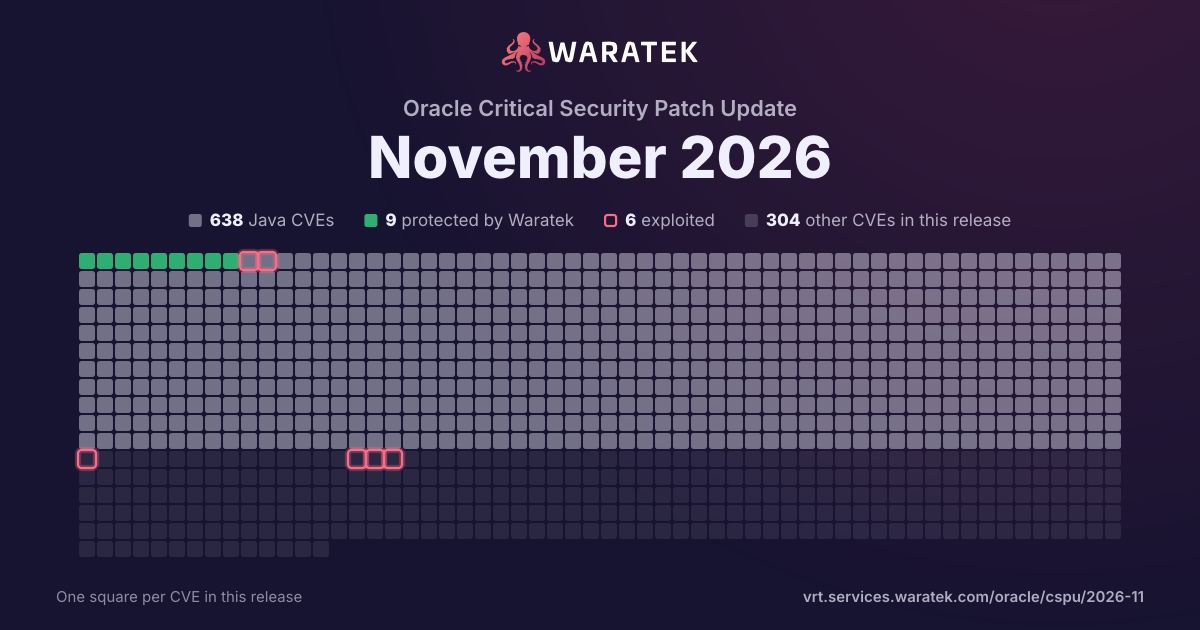
By status
9Protected by Waratek3Mitigation candidate626No exploit published15Outside Waratek scope289Not applicable
8Exploited, marked by the ring
No exploit published. For 547 of them, Oracle's security advisory is the source of public detail.
Protected by Waratek. Waratek RASP can block exploitation of these on systems that have not applied the patch yet.
Overview 52 matches · 24 in Waratek scope · 3 protected · 3 exploited · 2 CISA KEV · 4 public PoC · 1 EPSS ≥ 0.5
52matches
24in Waratek scope46.2%
3protected5.8%
3exploited5.8%
2CISA KEV3.8%
4public PoC7.7%
1EPSS ≥ 0.51.9%
Protected by Waratek
3
5.8%
Rule in development
0
0.0%
Mitigation candidate
1
1.9%
No exploit published
20
38.5%
Outside Waratek scope
1
1.9%
Not applicable
27
51.9%
Withdrawn CVE
0
0.0%
blocked by ARMR today
3
5.8%
partly blocked
0
0.0%
not blocked
49
94.2%
not established
0
0.0%
unrecorded
0
0.0%
Exploited
3
5.8%
Working exploit published
0
0.0%
Proof of concept only
18
34.6%
Forecast only
0
0.0%
No public exploit
31
59.6%
split by
peak 26 / quarter
Q1 221
Protected by Waratek1
Critical1
blocked by ARMR today1
Proof of concept only1
Q2 221
Protected by Waratek1
Critical1
blocked by ARMR today1
Proof of concept only1
Q3 220
Q4 220
Q1 230
Q2 230
Q3 230
Q4 230
Q1 240
Q2 240
Q3 240
Q4 240
Q1 250
Q2 250
Q3 250
Q4 251
Mitigation candidate1
Critical1
not blocked1
Exploited1
Q1 260
Q2 263
No exploit published1
Not applicable2
Critical3
not blocked3
No public exploit3
Q3 2626
Protected by Waratek1
No exploit published12
Not applicable13
Critical26
blocked by ARMR today1
not blocked25
Proof of concept only9
No public exploit17
Q4 2620
No exploit published7
Outside Waratek scope1
Not applicable12
Critical20
not blocked20
Exploited2
Proof of concept only7
No public exploit11
Q2 22Q4 22Q2 23Q4 23Q2 24Q4 24Q2 25Q4 25Q2 26Q4 26
| CVE | Severity | Published▾ | Status | Exploitation | Description |
|---|---|---|---|---|---|
| CVE-2026-116692 | Critical | 2026-10-27 | Not applicable | Exploited | MLflow is an open source AI engineering platform for agents, large language models, and machine learning models. From 3.12.0rc0 until 3.17.0, third-party scorer deserialization in mlflow/genai/scorers/base.py accepts request-selected descendants of THIRD_PARTY_SCORER_ALLOWED_MODULES rather than requiring an exact allowed module. A caller can use MLflow artifact endpoints to place a Python module beneath a writable allowed package and submit its module and class through /ajax-api/3.0/mlflow/scorer/invoke. Scorer.model_validate_json() imports the module and constructs the class before trace processing. Authentication-disabled deployments permit this code execution without credentials, while basic-auth deployments require a principal capable of creating an experiment and run and uploading artifacts. In either configuration, the allowed scorer package must be writable by the server process. This issue is fixed in version 3.17.0. |
| CVE-2026-115557 | Critical | 2026-10-24 | Not applicable | No public exploit | Python has added a denylist for known compromised certificates to the "ssl" module to ensure user safety even without certificate revocation configured. Known compromised certificates will automatically be rejected regardless of the SSLContext policy configuration. |
| CVE-2026-114820 | Critical | 2026-10-24 | No exploit published | No public exploit | Vulnerability in the Oracle Java SE, Oracle GraalVM for JDK, Oracle GraalVM Enterprise Edition product of Oracle Java SE (component: JSSE). Supported versions that are affected are Oracle Java SE: 8u511-b32, 8u511-perf-b32, 11.0.33.0.2, 17.0.21.0.2, 21.0.13.0.2, 25.0.5.0.2, 27.0.1.0.2; Oracle GraalVM for JDK: 17.0.21.0.2 and 21.0.13.0.2; Oracle GraalVM Enterprise Edition: 21.3.20.0.2. Easily exploitable vulnerability allows unauthenticated attacker with network access via multiple protocols to compromise Oracle Java SE, Oracle GraalVM for JDK, Oracle GraalVM Enterprise Edition. Successful attacks of this vulnerability can result in unauthorized creation, deletion or modification access to critical data or all Oracle Java SE, Oracle GraalVM for JDK, Oracle GraalVM Enterprise Edition accessible data as well as unauthorized access to critical data or complete access to all Oracle Java SE, Oracle GraalVM for JDK, Oracle GraalVM Enterprise Edition accessible data. Note: This vulnerability can be exploited by using APIs in the specified Component, e.g., through a web service which supplies data to the APIs. This vulnerability also applies to Java deployments, typically in clients running sandboxed Java Web Start applications or sandboxed Java applets, that load and run untrusted code (e.g., code that comes from the internet) and rely on the Java sandbox for security. CVSS 3.1 Base Score 9.1 (Confidentiality and Integrity impacts). CVSS Vector: (CVSS:3.1/AV:N/AC:L/PR:N/UI:N/S:U/C:H/I:H/A:N). |
| CVE-2026-111497 | Critical | 2026-10-22 | Outside Waratek scope | Exploited | A buffer overflow vulnerability in the Brotli decoder (c/dec/decode.c) in Google Brotli versions 1.0.3 through 1.2.0 on all platforms allows a remote unauthenticated attacker to corrupt adjacent decoder state memory, disclose sensitive memory contents, cause a denial of service, or potentially execute arbitrary code using a crafted Brotli-compressed stream. Users need to update any Brotli libraries or binaries between 1.0.3 through 1.2.0 to the latest available version: 1.0.10 or 1.1.1 or 1.2.1. |
| CVE-2026-91403 | Critical | 2026-10-21 | No exploit published | No public exploit | Vulnerability in the Oracle Java SE, Oracle GraalVM for JDK, Oracle GraalVM Enterprise Edition product of Oracle Java SE (component: JSSE). Supported versions that are affected are Oracle Java SE: 8u511, 8u511-perf, 11.0.33, 17.0.21, 21.0.13, 25.0.5, 27.0.1; Oracle GraalVM for JDK: 17.0.21 and 21.0.13; Oracle GraalVM Enterprise Edition: 21.3.20. Easily exploitable vulnerability allows unauthenticated attacker with network access via multiple protocols to compromise Oracle Java SE, Oracle GraalVM for JDK, Oracle GraalVM Enterprise Edition. Successful attacks of this vulnerability can result in unauthorized creation, deletion or modification access to critical data or all Oracle Java SE, Oracle GraalVM for JDK, Oracle GraalVM Enterprise Edition accessible data as well as unauthorized access to critical data or complete access to all Oracle Java SE, Oracle GraalVM for JDK, Oracle GraalVM Enterprise Edition accessible data. Note: This vulnerability can be exploited by using APIs in the specified Component, e.g., through a web service which supplies data to the APIs. This vulnerability also applies to Java deployments, typically in clients running sandboxed Java Web Start applications or sandboxed Java applets, that load and run untrusted code (e.g., code that comes from the internet) and rely on the Java sandbox for security. CVSS 3.1 Base Score 9.1 (Confidentiality and Integrity impacts). CVSS Vector: (CVSS:3.1/AV:N/AC:L/PR:N/UI:N/S:U/C:H/I:H/A:N). |
| CVE-2026-94265 | Critical | 2026-10-20 | Not applicable | Proof of concept only | When processing an HTTP redirect to a URL containing userinfo (a `username:password` component), curl might erroneously retain and re-transmit the original host's HTTP Negotiate authentication state. Consequently, a malicious server can trigger a redirect containing arbitrary userinfo to force curl to send a freshly minted Kerberos ticket—generated using the ambient identity of the client process to an untrusted third-party host, effectively bypassing the domain-scoping restrictions normally enforced by the absence of `--location-trusted`. |
| CVE-2026-92388 | Critical | 2026-10-20 | Not applicable | Proof of concept only | When an FTP wildcard `LIST` operation fails, libcurl omits the restoration path meant for successful listings, leaving the write callback set to the internal listing parser and the write callback data pointing directly to the easy handle. Subsequent reuse of this handle triggers an immediate crash, and cloning it via `curl_easy_duphandle()` copies this corrupted state into the duplicate. If the original handle is subsequently freed, executing a transfer on the cloned handle causes a heap use-after-free read against the dangling handle reference; alternatively, reusing the original or cloned handle while changing only `CURLOPT_WRITEDATA` (and omitting `CURLOPT_WRITEFUNCTION`) results in type confusion, forcing the internal parser to interpret incoming server response bytes into memory at the application-supplied write data pointer. |
| CVE-2026-87866 | Critical | 2026-10-20 | Not applicable | Proof of concept only | When built with wolfSSL, curl can successfully validate a pinned public key hash against a key the TLS peer does not possess. During the TLS handshake, wolfSSL validates the connection, but curl's subsequent re-parsing of the same certificate - tricked by a manipulated validity length field - extracts and matches a different embedded key, incorrectly authorizing the pinned public key. |
| CVE-2026-87861 | Critical | 2026-10-20 | Not applicable | Proof of concept only | When using ambient user credentials, an HTTP request directed to one origin may be dispatched over a connection previously authenticated via Negotiate for a different origin, leaving the request's intended credentials unused. |
| CVE-2026-86414 | Critical | 2026-10-20 | Not applicable | Proof of concept only | An HTTP proxy can trick libcurl into sending the origin's credentials (Basic password, or a Negotiate/Kerberos ticket) to the proxy itself, by answering the `CONNECT` tunnel request with 401 `WWW-Authenticate:` instead of the expected 407 `Proxy-Authenticate:`. |
| CVE-2026-86413 | Critical | 2026-10-20 | Not applicable | Proof of concept only | When using an *ambient user* in a first transfer doing Negotiate authentication and asked to follow redirects, curl could pass on its credential details to an unrelated second origin when asked to redirect there. |
| CVE-2026-86411 | Critical | 2026-10-20 | Not applicable | Proof of concept only | An `ftp://` transfer configured with `CURLUSESSL_NONE` can reuse a pooled FTP control connection that a previous easy handle upgraded with `STARTTLS` and authenticated using a client certificate. The second handle performs neither a new TLS handshake nor a new FTP login, so the server continues to authorize it under the first handle's certificate identity. |
| CVE-2026-101356 | Critical | 2026-10-20 | No exploit published | No public exploit | Incorrect object recycling and re-use vulnerability in Apache Tomcat affecting HTTP/2 processing of asynchronous servlets can trigger request and/or response mix-up between users. This issue affects Apache Tomcat: from 11.0.22 through 11.0.26, from 10.1.55 through 10.1.60, from 9.0.118 through 9.0.122. Users are recommended to upgrade to version 11.0.27, 10.1.61 or 9.0.123, which fixes the issue. |
| CVE-2026-101296 | Critical | 2026-10-20 | No exploit published | No public exploit | A missing critical step in authentication vulnerability in Apache Tomcat when the JNDI realm was configured with with a non GSSAPI SASL authentication mechanism allowed attackers to authenticate without providing the correct password. This issue affects Apache Tomcat: from 11.0.0-M1 through 11.0.26, from 10.1.0-M1 through 10.1.60, from 9.0.0.M1 through 9.0.122. The following versions were EOL at the time the CVE was created but are known to be affected: from 8.5.0 through 8.5.100, from 7.0.0 through 7.0.109. Other unsupported versions may also be affected. Users are recommended to upgrade to version 11.0.27, 10.1.61 or 9.0.123, which fix the issue. |
| CVE-2026-97468 | Critical | 2026-10-09 | No exploit published | No public exploit | Apache CXF's STSTokenValidator and Security Token Service (STS) cached validated security tokens under a non-cryptographic 32-bit hash of the token (Java Arrays.hashCode/hashCode()), and treated a cache hit as proof that the presented token had already been validated. An attacker could craft a token (for example a UsernameToken or a self-signed SAML Assertion) whose hash collides with a cached entry. The token would then be accepted without password validation, signature trust verification or a call to the STS. This could let the attacker authenticate as another user and, through STS token validation or renewal, obtain STS-signed tokens for that identity. Users are recommended to upgrade to versions 4.2.4 or 4.1.9 or 3.6.13, which fix this issue. |
| CVE-2026-71575 | Critical | 2026-10-09 | No exploit published | No public exploit | The max_age authentication-freshness check in OidcClientCodeRequestFilter was inoperative due to a milliseconds/seconds unit mismatch and an inverted comparison polarity. Any relying party using setMaxAgeOffset to enforce re-authentication would silently accept sessions of any age, bypassing step-up authentication policies. Users are recommended to upgrade to versions 4.2.4 or 4.1.9 or 3.6.13, which fix this issue. |
| CVE-2026-107938 | Critical | 2026-10-09 | No exploit published | No public exploit | In Apache CXF, the Netty-based HTTP client transport (cxf-rt-transports-http-netty-client) did not verify that the hostname in the server’s TLS certificate matched the host being called. This applied over both HTTP/1.1 and HTTP/2, even when disableCNCheck was left at its default value of false. The certificate chain was validated against the configured trust store, but the endpoint’s identity was not. A network attacker able to intercept traffic could present any certificate trusted by the client, such as a publicly issued certificate for a domain they control, and impersonate the target service. They could then read or modify the exchanged messages, including credentials. Users are recommended to upgrade to versions 4.2.4 or 4.1.9 or 3.6.13, which fix this issue. |
| CVE-2026-59797 | Critical | 2026-10-01 | Not applicable | No public exploit | Improper Privilege Management vulnerability in Apache HTTP Server's mod_ssl via SSLRequire and file-related expressions. This issue affects Apache HTTP Server: from 2.4.0 through 2.4.68. |
| CVE-2026-57941 | Critical | 2026-10-01 | Not applicable | No public exploit | Use After Free vulnerability in Apache HTTP Server's mod_http2 via shared session->bbtmp re-entrancy This issue affects Apache HTTP Server: from 2.4.0 through 2.4.68. |
| CVE-2026-56154 | Critical | 2026-10-01 | Not applicable | No public exploit | Use After Free vulnerability in Apache HTTP Server's mod_rewrite when using lookahead (%{LA-U:HTTP:...}) This issue affects Apache HTTP Server: from 2.4.0 through 2.4.68. |
| CVE-2026-19445 | Critical | 2026-09-30 | Not applicable | No public exploit | A remote, unauthenticated TLS client can make a server crash or call through a freed pointer if its sni_callback assigns a different context to SSLSocket.context (the documented way to select a certificate per server name) and nothing else keeps the original ssl.SSLContext alive. Typical cases are servers that create an SSLContext per connection or replace it while connections are open; servers that wrap their listening socket with it are not affected. Mitigation: keep a reference to every SSLContext that sets sni_callback for the lifetime of the server. TLS clients are not affected. |
| CVE-2026-102268 | Critical | 2026-09-28 | Not applicable | Proof of concept only | PyJWT is a Python implementation of JSON Web Token standards. Prior to 2.14.0, is_pem_format in jwt/utils.py is affected because is_pem_format does not recognize every PEM representation accepted by the cryptography loader. This occurs when an application mixes HMAC and asymmetric algorithms and supplies a mutated public-key PEM as raw key bytes. As a result, HMACAlgorithm.prepare_key treats the unrecognized asymmetric public key as an HMAC secret. Consequently, an attacker who knows the public key can forge authenticated HMAC tokens. This issue is fixed in version 2.14.0. |
| CVE-2026-102267 | Critical | 2026-09-28 | Not applicable | No public exploit | PyJWT is a Python implementation of JSON Web Token standards. Prior to 2.14.0, PyJWT PyJWKClient is affected because redirect destinations are not revalidated against the JWKS trust boundary. This occurs when a configured trusted JWKS endpoint returns an attacker-influenced redirect. As a result, PyJWKClient follows the redirect and consumes the redirected response as key material. Consequently, forwarded credentials may be disclosed or verification keys may be substituted. This issue is fixed in version 2.14.0. |
| CVE-2026-102266 | Critical | 2026-09-28 | Not applicable | Proof of concept only | PyJWT is a Python implementation of JSON Web Token standards. From 2.13.0 until 2.14.0, HMACAlgorithm.from_jwk is affected because PyJWK verification path used the decoded key without applying prepare_key validation. This occurs when a trusted JWK Set contains an oct entry with an empty k value. As a result, an attacker signs an HMAC token with the same zero-length key accepted by PyJWT. Consequently, forged token can carry arbitrary authenticated claims. This issue is fixed in version 2.14.0. |
| CVE-2026-86350 | Critical | 2026-09-23 | No exploit published | No public exploit | Inconsistent interpretation of HTTP/2 requests ('HTTP Request/Response smuggling') vulnerability in Apache Tomcat caused by a regression in fix for CVE-2026-41293 can trigger request header mix-up. This issue affects Apache Tomcat: from 11.0.22 through 11.0.25, from 10.1.55 through 10.1.59, from 9.0.118 through 9.0.121. Users are recommended to upgrade to version 11.0.26, 10.1.60 or 9.0.122, which fix the issue. |
| CVE-2026-86248 | Critical | 2026-09-23 | No exploit published | No public exploit | CLIENT_CERT authentication does not fail as expected for some scenarios when soft fail is disabled vulnerability in Apache Tomcat. This issue affects Apache Tomcat: from 11.0.0-M14 through 11.0.25, from 10.1.22 through 10.1.59, from 9.0.92 through 9.0.121. Users are recommended to upgrade to version 11.0.26, 10.1.60 or 9.0.122, which fix the issue. |
| CVE-2026-76183 | Critical | 2026-09-23 | No exploit published | No public exploit | Authentication Bypass by Alternate Name vulnerability in Apache Tomcat allowed the security constraints for any WebSocket endpoint to be bypassed. This issue affects Apache Tomcat: from 11.0.0-M1 through 11.0.25, from 10.1.0-M1 through 10.1.59, from 9.0.0.M1 through 9.0.121. The following versions were EOS at the time the CVE was created but are known to be affected: from 8.5.0 through 8.5.100, from 7.0.43 through 7.0.109. Other unsupported versions may also be affected. Users are recommended to upgrade to version 11.0.26, 10.1.60 or 9.0.122, which fix the issue. |
| CVE-2026-19931 | Critical | 2026-09-06 | Not applicable | Proof of concept only | A flaw in libcurl makes it wrongly reuse an HTTP connection setup for a given hostname using Negotiate authentication, when the initial request is done using empty credentials. This can make user B's request get sent over user A's previously authenticated connection. |
| CVE-2026-18924 | Critical | 2026-09-06 | Not applicable | Proof of concept only | A flaw in libcurl's handling of HTTP/2 Server Push streams, when the parent handle is set to share connections with other handles, can lead to use-after-free in the cleanup process. |
| CVE-2026-75595 | Critical | 2026-08-19 | No exploit published | No public exploit | Netty is an asynchronous, event-driven network application framework. Prior to 4.1.137.Fina and 4.2.17.Final, io.netty.handler.ssl.SslClientHelloHandler#decode checks the wrong offset before reading the four-byte TLS handshake header, so a ClientHello whose handshake header spans records can cause an IndexOutOfBoundsException and invoke select(ctx, null). This selects the default SslContext instead of the SNI-specific context. In deployments where per-SNI clientAuth=REQUIRE is the sole mutual TLS gate, the default SslContext uses clientAuth=NONE or clientAuth=OPTIONAL, and no application-layer certificate verification exists, an unauthenticated remote attacker can bypass the protected route's mutual TLS requirement. This issue is fixed in versions 4.1.137.Final and 4.2.17.Final. |
| CVE-2026-68079 | Critical | 2026-08-06 | No exploit published | No public exploit | In Apache CXF's DefaultEncryptingCodeDataProvider, a captured authorization code can be redeemed an unlimited number of times due to a flaw in the implementation of the removeCodeGrant functionality. This violates the RFC requirement that "The authorization code MUST NOT be used more than once." Users are recommended to upgrade to versions 4.2.3 or 4.1.8 or 3.6.12, which fix this issue. |
| CVE-2026-66909 | Critical | 2026-08-06 | Protected by Waratek | No public exploit | Apache CXF's JMS transport deserializes the body of any inbound JMS ObjectMessage using native Java deserialization, with no type restrictions in place. Any attacker able to place a message on the service's JMS destination can submit a malicious serialized object, leading to denial of service or, if a suitable gadget class is on the classpath, remote code execution. The fix disables ObjectMessage deserialization by default, with a configuration switch to re-enable it if needed. Users are recommended to upgrade to versions 4.2.3 or 4.1.8 or 3.6.12, which fix this issue. |
| CVE-2026-65583 | Critical | 2026-08-06 | No exploit published | No public exploit | Apache CXF’s OIDC relying-party token validation could accept self-issued ID tokens without enforcing required claim checks (issuer/subject/audience/time and sub_jwk binding), enabling authentication bypass with crafted tokens. However, note that self-issued ID tokens are not accepted by default in the validator. Users are recommended to upgrade to versions 4.2.3 or 4.1.8 or 3.6.12, which fixes this issue. |
| CVE-2026-63687 | Critical | 2026-08-06 | No exploit published | No public exploit | Apache CXF's JwtRequestCodeFilter copies all claims from a signed request JWT into the authorization parameter map without excluding security-sensitive parameters. A client that can produce a validly-signed request JWT (e.g., one whose client_secret is known or compromised) can thereby substitute the code_challenge, code_challenge_method, nonce, and state values that were set in the outer HTTP request, undermining PKCE integrity and OpenID Connect replay protection. Users are recommended to upgrade to versions 4.2.3 or 4.1.8 or 3.6.12, which fix this issue. |
| CVE-2026-61466 | Critical | 2026-08-06 | No exploit published | No public exploit | In Apache CXF's OAuth2 Dynamic Client Registration endpoint, the authorization server accepts and stores the `scope` value supplied in the client registration request verbatim, without validating it against an AS-defined allowlist. This could lead to a client self-assigning privileged scopes at registration time. Users are recommended to upgrade to versions 4.2.3 or 4.1.8 or 3.6.12, which fix this issue. |
| CVE-2026-8763 | Critical | 2026-08-03 | No exploit published | No public exploit | In Bouncy Castle for Java before 1.85, Name Constraints bypass via trailing dot in rfc822Name and URI. This issue also affects Bouncy Castle for Java LTS before 2.73.12, and Bouncy Castle for Java FIPS (BC-FJA) before bc-fips 1.0.2.7 (1.0.X series), 2.0.2 (2.0.X series) and 2.1.3 (2.1.X series). |
| CVE-2026-59650 | Critical | 2026-08-03 | No exploit published | No public exploit | In Bouncy Castle for Java before 1.85, MTI/A0 DH agreement exponentiates unvalidated peer value. This issue also affects Bouncy Castle for Java LTS before 2.73.12. |
| CVE-2026-59638 | Critical | 2026-08-03 | No exploit published | No public exploit | In Bouncy Castle for Java before 1.85, JSSE hostname verifier CN-fallback enabled by default despite documented opt-in. This issue also affects Bouncy Castle for Java LTS before 2.73.12, and Bouncy Castle for Java FIPS (BC-FJA) before bctls-fips 1.0.24 (1.0.X series), 2.0.24 (2.0.X series) and 2.1.24 (2.1.X series). |
| CVE-2026-58062 | Critical | 2026-08-03 | No exploit published | No public exploit | In Bouncy Castle for Java before 1.85, Stapled OCSP response accepted without binding to the checked certificate. This issue also affects Bouncy Castle for Java LTS before 2.73.12, and Bouncy Castle for Java FIPS (BC-FJA) before bc-fips 2.0.2 (2.0.X series) and 2.1.3 (2.1.X series). |
| CVE-2026-13221 | Critical | 2026-07-13 | Not applicable | No public exploit | Perl versions before 5.40.5-RC1, from 5.41.0 before 5.42.3-RC1, from 5.43.0 before 5.43.10 produce silently incorrect regular expression matches when an alternation of more than 65535 fixed string branches is compiled into a trie in Perl_study_chunk. When such branches are combined into a trie, the delta between the first branch and the shared tail is stored in a 16-bit field. A branch count above 65535 overflows the field, and the trie's match decision table is truncated with no warning or error. A pattern of this shape produces false positive matches (matching strings it should not) and false negative matches (failing to match strings it should). When such a pattern gates an access or filtering decision, the result is wrong. |
| CVE-2026-9079 | Critical | 2026-07-03 | Not applicable | Proof of concept only | libcurl had a flaw that when instructed to clear proxy authentication credentials which made it not do so, leaving the old credentials around to get used for subsequent transfers that should not know nor use them. |
| CVE-2026-8927 | Critical | 2026-07-03 | Not applicable | Proof of concept only | When reusing a libcurl handle for sequential transfers driven by environment-variable proxy configuration, libcurl fails to clear the proxy authentication state between requests. Specifically, if the initial transfer authenticates against `proxyA` using Digest auth, a subsequent transfer routed through `proxyB` erroneously leaks the `Proxy-Authorization:` header intended solely for `proxyA`. |
| CVE-2026-8924 | Critical | 2026-07-03 | Not applicable | Proof of concept only | A flaw in curl’s cookie parsing logic allows a malicious HTTP server to set "super cookies" that bypass the Public Suffix List check. This enables an attacker-controlled origin to inject cookies that curl subsequently scopes and transmits to unrelated third-party domains. |
| CVE-2026-11856 | Critical | 2026-07-03 | Not applicable | Proof of concept only | Successfully using libcurl to do a transfer to a specific HTTP origin (`hostA`) with **Digest** authentication and then changing the origin to a different one (`hostB`) for a second transfer, reusing the same handle, makes libcurl wrongly pass on the `Authorization:` header field meant for `hostA`, to `hostB`. |
| CVE-2026-10536 | Critical | 2026-07-03 | Not applicable | Proof of concept only | A use-after-free vulnerability exists in libcurl when an application configures an HTTP/2 stream-dependency tree via `CURLOPT_STREAM_DEPENDS` or `CURLOPT_STREAM_DEPENDS_E`, subsequently invokes `curl_easy_reset()`, and finally terminates the handle with `curl_easy_cleanup()`. During this final cleanup phase, libcurl attempts to access and modify an internal structure that was already freed during the reset operation. |
| CVE-2026-53488 | Critical | 2026-07-01 | Not applicable | No public exploit | containerd is an open-source container runtime. In versions prior to 1.7.33, 2.3.2, 2.2.5, 2.1.9, and 2.0.10 the CRI plugin propagates labels from an image config (LABEL instruction in Dockerfile) to a container without validation. This may result in executing an arbitrary command on the host, via a plugin that consumes container labels for some operations. This issue has been fixed in versions 1.7.33, 2.3.2, 2.2.5, 2.1.9, and 2.0.10. |
| CVE-2025-14813 | Critical | 2026-04-15 | No exploit published | No public exploit | : Use of a Broken or Risky Cryptographic Algorithm vulnerability in Legion of the Bouncy Castle Inc. BC-JAVA bcprov on all (core modules). This vulnerability is associated with program files G3413CTRBlockCipher. This issue affects BC-JAVA: from 1.59 before 1.80.2, from 1.81 before 1.81.1, from 1.82 before 1.84. |
| CVE-2026-33816 | Critical | 2026-04-07 | Not applicable | No public exploit | Memory-safety vulnerability in github.com/jackc/pgx/v5. |
| CVE-2026-33815 | Critical | 2026-04-07 | Not applicable | No public exploit | Memory-safety vulnerability in github.com/jackc/pgx/v5. |
| CVE-2025-61882 | Critical | 2025-10-05 | Mitigation candidate | Exploited | Vulnerability in the Oracle Concurrent Processing product of Oracle E-Business Suite (component: BI Publisher Integration). Supported versions that are affected are 12.2.3-12.2.14. Easily exploitable vulnerability allows unauthenticated attacker with network access via HTTP to compromise Oracle Concurrent Processing. Successful attacks of this vulnerability can result in takeover of Oracle Concurrent Processing. CVSS 3.1 Base Score 9.8 (Confidentiality, Integrity and Availability impacts). CVSS Vector: (CVSS:3.1/AV:N/AC:L/PR:N/UI:N/S:U/C:H/I:H/A:H). |
| CVE-2022-23457 | Critical | 2022-04-25 | Protected by Waratek | Proof of concept only | ESAPI (The OWASP Enterprise Security API) is a free, open source, web application security control library. Prior to version 2.3.0.0, the default implementation of `Validator.getValidDirectoryPath(String, String, File, boolean)` may incorrectly treat the tested input string as a child of the specified parent directory. This potentially could allow control-flow bypass checks to be defeated if an attack can specify the entire string representing the 'input' path. This vulnerability is patched in release 2.3.0.0 of ESAPI. As a workaround, it is possible to write one's own implementation of the Validator interface. However, maintainers do not recommend this. |
| CVE-2022-23305 | Critical | 2022-01-18 | Protected by Waratek | Proof of concept only | By design, the JDBCAppender in Log4j 1.2.x accepts an SQL statement as a configuration parameter where the values to be inserted are converters from PatternLayout. The message converter, %m, is likely to always be included. This allows attackers to manipulate the SQL by entering crafted strings into input fields or headers of an application that are logged allowing unintended SQL queries to be executed. Note this issue only affects Log4j 1.x when specifically configured to use the JDBCAppender, which is not the default. Beginning in version 2.0-beta8, the JDBCAppender was re-introduced with proper support for parameterized SQL queries and further customization over the columns written to in logs. Apache Log4j 1.2 reached end of life in August 2015. Users should upgrade to Log4j 2 as it addresses numerous other issues from the previous versions. |