
Oracle Critical Security Patch Update November 2026
Released November 2026 · Oracle's advisory ↗ · ← Critical Patch Update, October 2026
942 CVEs in this release, one square each
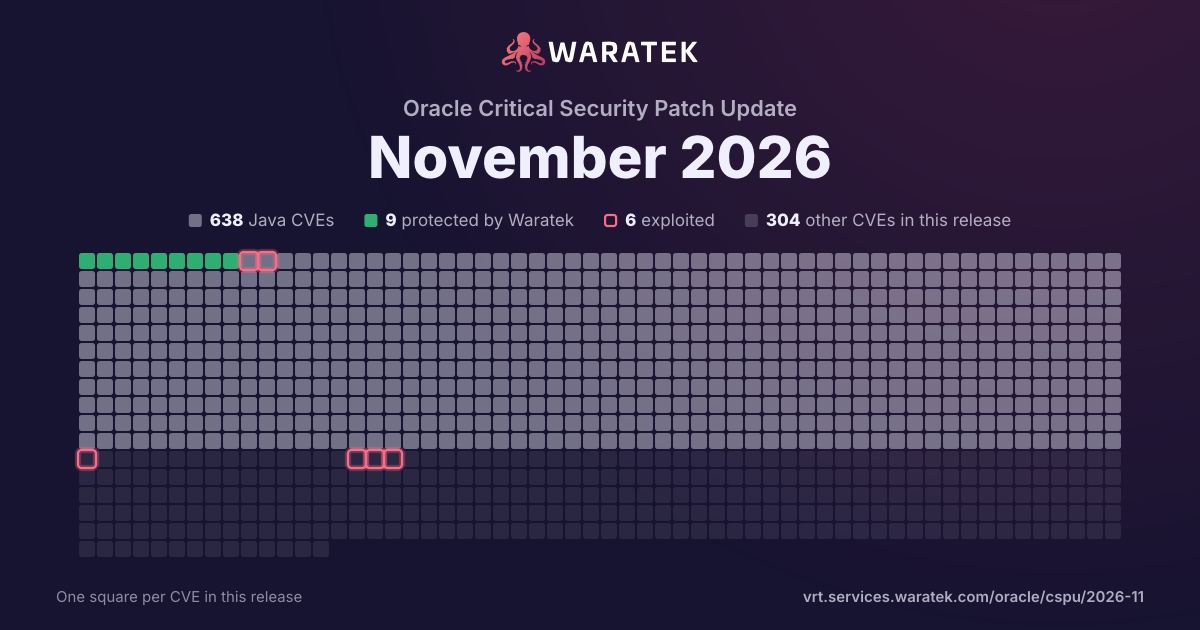
By status
8Protected by Waratek3Mitigation candidate626No exploit published16Outside Waratek scope289Not applicable
8Exploited, marked by the ring
No exploit published. For 554 of them, Oracle's security advisory is the source of public detail.
Protected by Waratek. Waratek RASP can block exploitation of these on systems that have not applied the patch yet.
Overview 10 matches · 0 protected · 0 exploited · 0 CISA KEV · 0 public PoC · 0 EPSS ≥ 0.5
10matches
0protected0.0%
0exploited0.0%
0CISA KEV0.0%
0public PoC0.0%
0EPSS ≥ 0.50.0%
Protected by Waratek
0
0.0%
Rule in development
0
0.0%
Mitigation candidate
0
0.0%
No exploit published
10
100.0%
blocked by ARMR today
0
0.0%
partly blocked
0
0.0%
not blocked
10
100.0%
not established
0
0.0%
unrecorded
0
0.0%
Exploited
0
0.0%
Working exploit published
0
0.0%
Proof of concept only
0
0.0%
Forecast only
0
0.0%
No public exploit
10
100.0%
split by
peak 9 / month
Apr 26May 26Jun 26Jul 26Aug 26
| CVE | Severity | Published▾ | Status | Exploitation | Description |
|---|---|---|---|---|---|
| CVE-2026-75595 | Critical | 2026-08-19 | No exploit published | No public exploit | Netty is an asynchronous, event-driven network application framework. Prior to 4.1.137.Fina and 4.2.17.Final, io.netty.handler.ssl.SslClientHelloHandler#decode checks the wrong offset before reading the four-byte TLS handshake header, so a ClientHello whose handshake header spans records can cause an IndexOutOfBoundsException and invoke select(ctx, null). This selects the default SslContext instead of the SNI-specific context. In deployments where per-SNI clientAuth=REQUIRE is the sole mutual TLS gate, the default SslContext uses clientAuth=NONE or clientAuth=OPTIONAL, and no application-layer certificate verification exists, an unauthenticated remote attacker can bypass the protected route's mutual TLS requirement. This issue is fixed in versions 4.1.137.Final and 4.2.17.Final. |
| CVE-2026-68079 | Critical | 2026-08-06 | No exploit published | No public exploit | In Apache CXF's DefaultEncryptingCodeDataProvider, a captured authorization code can be redeemed an unlimited number of times due to a flaw in the implementation of the removeCodeGrant functionality. This violates the RFC requirement that "The authorization code MUST NOT be used more than once." Users are recommended to upgrade to versions 4.2.3 or 4.1.8 or 3.6.12, which fix this issue. |
| CVE-2026-65583 | Critical | 2026-08-06 | No exploit published | No public exploit | Apache CXF’s OIDC relying-party token validation could accept self-issued ID tokens without enforcing required claim checks (issuer/subject/audience/time and sub_jwk binding), enabling authentication bypass with crafted tokens. However, note that self-issued ID tokens are not accepted by default in the validator. Users are recommended to upgrade to versions 4.2.3 or 4.1.8 or 3.6.12, which fixes this issue. |
| CVE-2026-63687 | Critical | 2026-08-06 | No exploit published | No public exploit | Apache CXF's JwtRequestCodeFilter copies all claims from a signed request JWT into the authorization parameter map without excluding security-sensitive parameters. A client that can produce a validly-signed request JWT (e.g., one whose client_secret is known or compromised) can thereby substitute the code_challenge, code_challenge_method, nonce, and state values that were set in the outer HTTP request, undermining PKCE integrity and OpenID Connect replay protection. Users are recommended to upgrade to versions 4.2.3 or 4.1.8 or 3.6.12, which fix this issue. |
| CVE-2026-61466 | Critical | 2026-08-06 | No exploit published | No public exploit | In Apache CXF's OAuth2 Dynamic Client Registration endpoint, the authorization server accepts and stores the `scope` value supplied in the client registration request verbatim, without validating it against an AS-defined allowlist. This could lead to a client self-assigning privileged scopes at registration time. Users are recommended to upgrade to versions 4.2.3 or 4.1.8 or 3.6.12, which fix this issue. |
| CVE-2026-8763 | Critical | 2026-08-03 | No exploit published | No public exploit | In Bouncy Castle for Java before 1.85, Name Constraints bypass via trailing dot in rfc822Name and URI. This issue also affects Bouncy Castle for Java LTS before 2.73.12, and Bouncy Castle for Java FIPS (BC-FJA) before bc-fips 1.0.2.7 (1.0.X series), 2.0.2 (2.0.X series) and 2.1.3 (2.1.X series). |
| CVE-2026-59650 | Critical | 2026-08-03 | No exploit published | No public exploit | In Bouncy Castle for Java before 1.85, MTI/A0 DH agreement exponentiates unvalidated peer value. This issue also affects Bouncy Castle for Java LTS before 2.73.12. |
| CVE-2026-59638 | Critical | 2026-08-03 | No exploit published | No public exploit | In Bouncy Castle for Java before 1.85, JSSE hostname verifier CN-fallback enabled by default despite documented opt-in. This issue also affects Bouncy Castle for Java LTS before 2.73.12, and Bouncy Castle for Java FIPS (BC-FJA) before bctls-fips 1.0.24 (1.0.X series), 2.0.24 (2.0.X series) and 2.1.24 (2.1.X series). |
| CVE-2026-58062 | Critical | 2026-08-03 | No exploit published | No public exploit | In Bouncy Castle for Java before 1.85, Stapled OCSP response accepted without binding to the checked certificate. This issue also affects Bouncy Castle for Java LTS before 2.73.12, and Bouncy Castle for Java FIPS (BC-FJA) before bc-fips 2.0.2 (2.0.X series) and 2.1.3 (2.1.X series). |
| CVE-2025-14813 | Critical | 2026-04-15 | No exploit published | No public exploit | : Use of a Broken or Risky Cryptographic Algorithm vulnerability in Legion of the Bouncy Castle Inc. BC-JAVA bcprov on all (core modules). This vulnerability is associated with program files G3413CTRBlockCipher. This issue affects BC-JAVA: from 1.59 before 1.80.2, from 1.81 before 1.81.1, from 1.82 before 1.84. |