
Oracle Critical Security Patch Update November 2026
Released November 2026 · Oracle's advisory ↗ · ← Critical Patch Update, October 2026
942 CVEs in this release, one square each
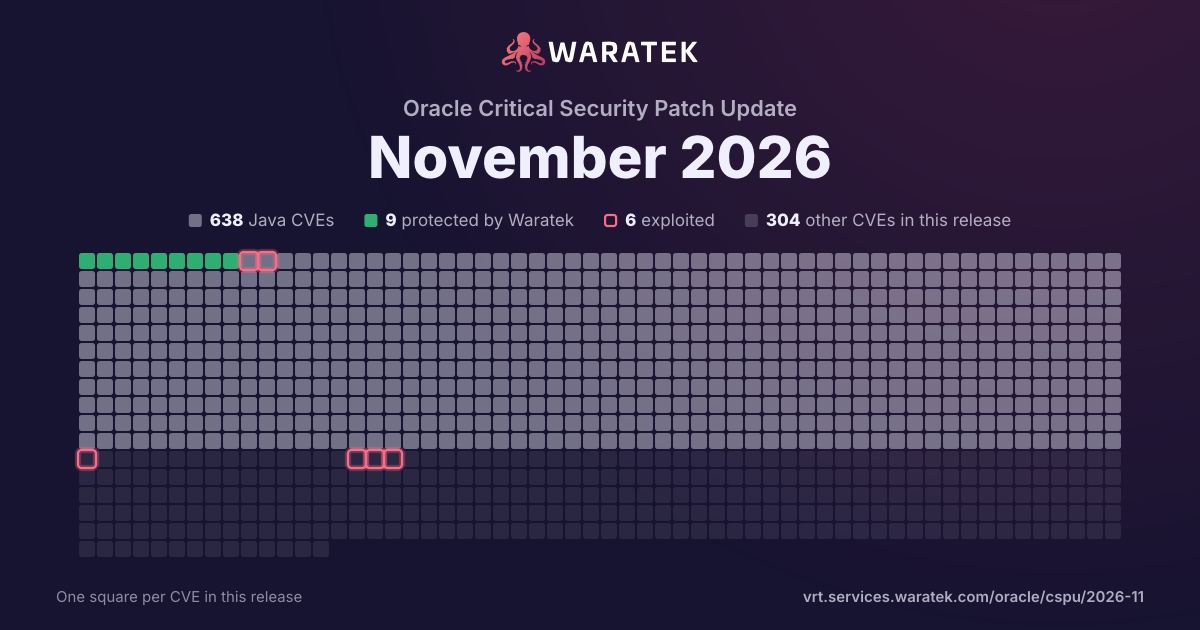
By status
8Protected by Waratek3Mitigation candidate626No exploit published16Outside Waratek scope289Not applicable
8Exploited, marked by the ring
No exploit published. For 554 of them, Oracle's security advisory is the source of public detail.
Protected by Waratek. Waratek RASP can block exploitation of these on systems that have not applied the patch yet.
Overview 16 matches · 4 protected · 1 exploited · 1 CISA KEV · 1 public PoC · 1 EPSS ≥ 0.5
Protected by Waratek
4
25.0%
Rule in development
0
0.0%
Mitigation candidate
2
12.5%
No exploit published
10
62.5%
blocked by ARMR today
4
25.0%
partly blocked
0
0.0%
not blocked
12
75.0%
not established
0
0.0%
unrecorded
0
0.0%
Exploited
1
6.2%
Working exploit published
0
0.0%
Proof of concept only
1
6.2%
Forecast only
0
0.0%
No public exploit
14
87.5%
split by
peak 8 / quarter
Q2 231
No exploit published1
High1
not blocked1
No public exploit1
Q3 230
Q4 231
Mitigation candidate1
High1
not blocked1
Exploited1
Q1 240
Q2 240
Q3 240
Q4 240
Q1 250
Q2 251
No exploit published1
High1
not blocked1
Proof of concept only1
Q3 250
Q4 250
Q1 260
Q2 265
Protected by Waratek1
Mitigation candidate1
No exploit published3
High5
blocked by ARMR today1
not blocked4
No public exploit5
Q3 268
Protected by Waratek3
No exploit published5
High8
blocked by ARMR today3
not blocked5
No public exploit8
Q3 23Q1 24Q3 24Q1 25Q3 25Q1 26Q3 26
| CVE | Severity | Published▾ | Status | Exploitation | Description |
|---|---|---|---|---|---|
| CVE-2026-66144 | High | 2026-07-24 | No exploit published | No public exploit | Although remote policy references are not retrieved during policy normalization, if they are manually retrieved via the API it can cause a denial of service attack if a huge policy is retrieved. Users are recommended to upgrade to version 3.2.3, which fixes this issue by imposing a default maximum size on data read from remote policy references. |
| CVE-2026-66143 | High | 2026-07-24 | No exploit published | No public exploit | It is possible to bypass the maximum number of normalized policy alternatives that was introduced in Apache Neethi 3.2.2 via certain crafted policies, which may lead to a denial of service attack via resource consumption. Users are recommended to upgrade to version 3.2.3, which fixes this issue. |
| CVE-2026-66142 | High | 2026-07-24 | No exploit published | No public exploit | Apache Neethi is vulnerable to uncontrolled recursion when parsing policies that lack policy Ids or with deeply nested structures, which may lead to a denial of service attack when parsing policies due to runtime memory exhaustion. Users are recommended to upgrade to version 3.2.3, which fixes this issue. |
| CVE-2026-47063 | High | 2026-07-21 | Protected by Waratek | No public exploit | Vulnerability in the Oracle Java SE, Oracle GraalVM for JDK, Oracle GraalVM Enterprise Edition product of Oracle Java SE (component: Libraries). Supported versions that are affected are Oracle Java SE: 8u491, 8u491-perf, 11.0.31, 17.0.19, 21.0.11, 25.0.3, 26.0.1; Oracle GraalVM for JDK: 17.0.19 and 21.0.11; Oracle GraalVM Enterprise Edition: 21.3.18. Easily exploitable vulnerability allows unauthenticated attacker with network access via multiple protocols to compromise Oracle Java SE, Oracle GraalVM for JDK, Oracle GraalVM Enterprise Edition. Successful attacks of this vulnerability can result in unauthorized creation, deletion or modification access to critical data or all Oracle Java SE, Oracle GraalVM for JDK, Oracle GraalVM Enterprise Edition accessible data. Note: This vulnerability can be exploited by using APIs in the specified Component, e.g., through a web service which supplies data to the APIs. This vulnerability also applies to Java deployments, typically in clients running sandboxed Java Web Start applications or sandboxed Java applets, that load and run untrusted code (e.g., code that comes from the internet) and rely on the Java sandbox for security. CVSS 3.1 Base Score 7.5 (Integrity impacts). CVSS Vector: (CVSS:3.1/AV:N/AC:L/PR:N/UI:N/S:U/C:N/I:H/A:N). |
| CVE-2026-47058 | High | 2026-07-21 | Protected by Waratek | No public exploit | Vulnerability in Oracle Java SE (component: Scripting). Supported versions that are affected are Oracle Java SE: 8u491, 8u491-perf and 11.0.31. Difficult to exploit vulnerability allows unauthenticated attacker with network access via multiple protocols to compromise Oracle Java SE. Successful attacks of this vulnerability can result in unauthorized creation, deletion or modification access to critical data or all Oracle Java SE accessible data as well as unauthorized access to critical data or complete access to all Oracle Java SE accessible data. Note: This vulnerability can be exploited by using APIs in the specified Component, e.g., through a web service which supplies data to the APIs. This vulnerability also applies to Java deployments, typically in clients running sandboxed Java Web Start applications or sandboxed Java applets, that load and run untrusted code (e.g., code that comes from the internet) and rely on the Java sandbox for security. CVSS 3.1 Base Score 7.4 (Confidentiality and Integrity impacts). CVSS Vector: (CVSS:3.1/AV:N/AC:H/PR:N/UI:N/S:U/C:H/I:H/A:N). |
| CVE-2026-47057 | High | 2026-07-21 | Protected by Waratek | No public exploit | Vulnerability in Oracle Java SE (component: Scripting). Supported versions that are affected are Oracle Java SE: 8u491, 8u491-perf and 11.0.31. Easily exploitable vulnerability allows unauthenticated attacker with network access via multiple protocols to compromise Oracle Java SE. Successful attacks of this vulnerability can result in unauthorized ability to cause a hang or frequently repeatable crash (complete DOS) of Oracle Java SE. Note: This vulnerability can be exploited by using APIs in the specified Component, e.g., through a web service which supplies data to the APIs. This vulnerability also applies to Java deployments, typically in clients running sandboxed Java Web Start applications or sandboxed Java applets, that load and run untrusted code (e.g., code that comes from the internet) and rely on the Java sandbox for security. CVSS 3.1 Base Score 7.5 (Availability impacts). CVSS Vector: (CVSS:3.1/AV:N/AC:L/PR:N/UI:N/S:U/C:N/I:N/A:H). |
| CVE-2026-54428 | High | 2026-07-01 | No exploit published | No public exploit | Allocation of resources without limits or throttling in the HTTP/2 HPACK decoder in Apache HttpComponents Core (5.4.2 and earlier, 5.5-beta1 and earlier) allows an remote attacker to cause a denial of service through memory exhaustion by sending oversized compressed header blocks before the HTTP/2 SETTINGS acknowledgement causes the configured header list size limit to be applied. |
| CVE-2026-54399 | High | 2026-07-01 | No exploit published | No public exploit | Uncontrolled Resource Consumption vulnerability in the HTTP/1.1 message parser in Apache HttpComponents Core (5.4.2 and earlier, 5.5-beta1 and earlier) allows an remote attacker to cause a denial of service through memory exhaustion by sending messages with excessive number of headers / excessive header length |
| CVE-2026-40984 | High | 2026-06-09 | No exploit published | No public exploit | In Micrometer, it is possible for a user to provide specially crafted HTTP requests that may cause a denial-of-service (DoS) condition. Affected versions: micrometer-core 1.16.0 through 1.16.5; 1.15.0 through 1.15.11; 1.14.0 through 1.14.15; 1.13.0 through 1.13.18; 1.9.0 through 1.9.17. micrometer-jetty11 1.16.0 through 1.16.5; 1.15.0 through 1.15.11; 1.14.0 through 1.14.15; 1.13.0 through 1.13.18. micrometer-jetty12 1.16.0 through 1.16.5; 1.15.0 through 1.15.11; 1.14.0 through 1.14.15; 1.13.0 through 1.13.18. |
| CVE-2026-40983 | High | 2026-06-09 | No exploit published | No public exploit | In Micrometer, it is possible for a user to provide specially crafted gRPC requests that may cause a denial-of-service (DoS) condition. Affected versions: Micrometer 1.16.0 through 1.16.5; 1.15.0 through 1.15.11. |
| CVE-2026-42402 | High | 2026-05-01 | No exploit published | No public exploit | Apache Neethi is vulnerable to a Denial of Service attack through algorithmic complexity in policy normalization. Specially crafted WS-Policy documents can trigger an exponential Cartesian cross-product expansion during the normalization process, causing unbounded memory allocation that exhausts the JVM heap. This occurs when the normalization process generates an excessive number of policy alternatives without bounds, leading to runtime memory exhaustion. Users should upgrade to 3.2.2 which limits the maximum number of normalized policy alternatives. |
| CVE-2026-34282 | High | 2026-04-21 | Mitigation candidate | No public exploit | Vulnerability in the Oracle Java SE, Oracle GraalVM for JDK, Oracle GraalVM Enterprise Edition product of Oracle Java SE (component: Networking). Supported versions that are affected are Oracle Java SE: 8u481-perf, 11.0.30, 17.0.18, 21.0.10, 25.0.2, 26; Oracle GraalVM for JDK: 17.0.18 and 21.0.10; Oracle GraalVM Enterprise Edition: 21.3.17. Easily exploitable vulnerability allows unauthenticated attacker with network access via multiple protocols to compromise Oracle Java SE, Oracle GraalVM for JDK, Oracle GraalVM Enterprise Edition. Successful attacks of this vulnerability can result in unauthorized ability to cause a hang or frequently repeatable crash (complete DOS) of Oracle Java SE, Oracle GraalVM for JDK, Oracle GraalVM Enterprise Edition. Note: This vulnerability can be exploited by using APIs in the specified Component, e.g., through a web service which supplies data to the APIs. This vulnerability also applies to Java deployments, typically in clients running sandboxed Java Web Start applications or sandboxed Java applets, that load and run untrusted code (e.g., code that comes from the internet) and rely on the Java sandbox for security. CVSS 3.1 Base Score 7.5 (Availability impacts). CVSS Vector: (CVSS:3.1/AV:N/AC:L/PR:N/UI:N/S:U/C:N/I:N/A:H). |
| CVE-2026-22016 | High | 2026-04-21 | Protected by Waratek | No public exploit | Vulnerability in the Oracle Java SE, Oracle GraalVM for JDK, Oracle GraalVM Enterprise Edition product of Oracle Java SE (component: JAXP). Supported versions that are affected are Oracle Java SE: 8u481, 8u481-b50, 8u481-perf, 11.0.30, 17.0.18, 21.0.10, 25.0.2, 26; Oracle GraalVM for JDK: 17.0.18 and 21.0.10; Oracle GraalVM Enterprise Edition: 21.3.17. Easily exploitable vulnerability allows unauthenticated attacker with network access via multiple protocols to compromise Oracle Java SE, Oracle GraalVM for JDK, Oracle GraalVM Enterprise Edition. Successful attacks of this vulnerability can result in unauthorized access to critical data or complete access to all Oracle Java SE, Oracle GraalVM for JDK, Oracle GraalVM Enterprise Edition accessible data. Note: This vulnerability can be exploited by using APIs in the specified Component, e.g., through a web service which supplies data to the APIs. This vulnerability also applies to Java deployments, typically in clients running sandboxed Java Web Start applications or sandboxed Java applets, that load and run untrusted code (e.g., code that comes from the internet) and rely on the Java sandbox for security. CVSS 3.1 Base Score 7.5 (Confidentiality impacts). CVSS Vector: (CVSS:3.1/AV:N/AC:L/PR:N/UI:N/S:U/C:H/I:N/A:N). |
| CVE-2025-48734 | High | 2025-05-28 | No exploit published | Proof of concept only | Improper Access Control vulnerability in Apache Commons. A special BeanIntrospector class was added in version 1.9.2. This can be used to stop attackers from using the declared class property of Java enum objects to get access to the classloader. However this protection was not enabled by default. PropertyUtilsBean (and consequently BeanUtilsBean) now disallows declared class level property access by default. Releases 1.11.0 and 2.0.0-M2 address a potential security issue when accessing enum properties in an uncontrolled way. If an application using Commons BeanUtils passes property paths from an external source directly to the getProperty() method of PropertyUtilsBean, an attacker can access the enum’s class loader via the “declaredClass” property available on all Java “enum” objects. Accessing the enum’s “declaredClass” allows remote attackers to access the ClassLoader and execute arbitrary code. The same issue exists with PropertyUtilsBean.getNestedProperty(). Starting in versions 1.11.0 and 2.0.0-M2 a special BeanIntrospector suppresses the “declaredClass” property. Note that this new BeanIntrospector is enabled by default, but you can disable it to regain the old behavior; see section 2.5 of the user's guide and the unit tests. This issue affects Apache Commons BeanUtils 1.x before 1.11.0, and 2.x before 2.0.0-M2.Users of the artifact commons-beanutils:commons-beanutils 1.x are recommended to upgrade to version 1.11.0, which fixes the issue. Users of the artifact org.apache.commons:commons-beanutils2 2.x are recommended to upgrade to version 2.0.0-M2, which fixes the issue. |
| CVE-2023-44487 | High | 2023-10-10 | Mitigation candidate | Exploited | The HTTP/2 protocol allows a denial of service (server resource consumption) because request cancellation can reset many streams quickly, as exploited in the wild in August through October 2023. |
| CVE-2023-2976 | High | 2023-06-14 | No exploit published | No public exploit | Use of Java's default temporary directory for file creation in `FileBackedOutputStream` in Google Guava versions 1.0 to 31.1 on Unix systems and Android Ice Cream Sandwich allows other users and apps on the machine with access to the default Java temporary directory to be able to access the files created by the class. Even though the security vulnerability is fixed in version 32.0.0, we recommend using version 32.0.1 as version 32.0.0 breaks some functionality under Windows. |