
Oracle Critical Security Patch Update November 2026
Released November 2026 · Oracle's advisory ↗ · ← Critical Patch Update, October 2026
942 CVEs in this release, one square each
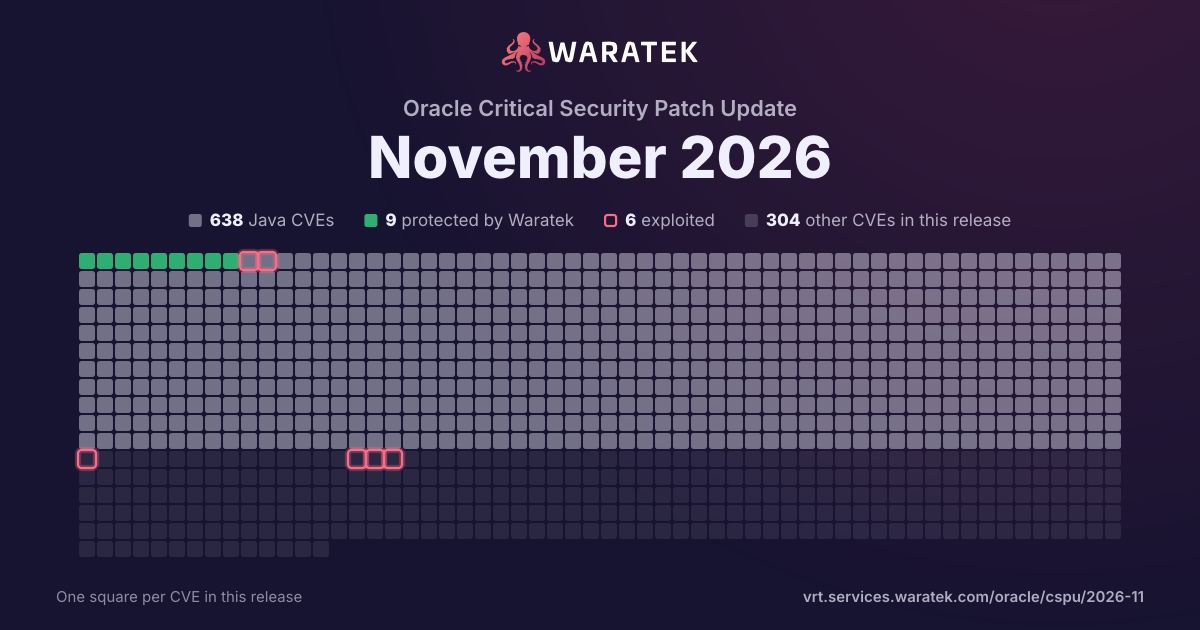
By status
9Protected by Waratek3Mitigation candidate626No exploit published15Outside Waratek scope289Not applicable
8Exploited, marked by the ring
No exploit published. For 547 of them, Oracle's security advisory is the source of public detail.
Protected by Waratek. Waratek RASP can block exploitation of these on systems that have not applied the patch yet.
Overview 31 matches · 8 in Waratek scope · 1 protected · 1 exploited · 1 CISA KEV · 1 public PoC · 1 EPSS ≥ 0.5
31matches
8in Waratek scope25.8%
1protected3.2%
1exploited3.2%
1CISA KEV3.2%
1public PoC3.2%
1EPSS ≥ 0.53.2%
Protected by Waratek
1
3.2%
Rule in development
0
0.0%
Mitigation candidate
2
6.5%
No exploit published
5
16.1%
Outside Waratek scope
1
3.2%
Not applicable
22
71.0%
Withdrawn CVE
0
0.0%
blocked by ARMR today
1
3.2%
partly blocked
0
0.0%
not blocked
30
96.8%
not established
0
0.0%
unrecorded
0
0.0%
Exploited
1
3.2%
Working exploit published
0
0.0%
Proof of concept only
7
22.6%
Forecast only
0
0.0%
No public exploit
23
74.2%
split by
peak 20 / quarter
Q3 221
Not applicable1
High1
not blocked1
No public exploit1
Q4 220
Q1 230
Q2 231
No exploit published1
High1
not blocked1
No public exploit1
Q3 231
Not applicable1
High1
not blocked1
Proof of concept only1
Q4 231
Mitigation candidate1
High1
not blocked1
Exploited1
Q1 240
Q2 240
Q3 240
Q4 241
Not applicable1
High1
not blocked1
Proof of concept only1
Q1 251
Not applicable1
High1
not blocked1
Proof of concept only1
Q2 251
No exploit published1
High1
not blocked1
Proof of concept only1
Q3 250
Q4 250
Q1 264
Not applicable4
High4
not blocked4
No public exploit4
Q2 2620
Protected by Waratek1
Mitigation candidate1
No exploit published3
Outside Waratek scope1
Not applicable14
High20
blocked by ARMR today1
not blocked19
Proof of concept only3
No public exploit17
Q4 22Q2 23Q4 23Q2 24Q4 24Q2 25Q4 25Q2 26
| CVE | Severity | Published▾ | Status | Exploitation | Description |
|---|---|---|---|---|---|
| CVE-2026-54297 | High | 2026-06-24 | Not applicable | Proof of concept only | Faraday is an HTTP client library abstraction layer that provides a common interface over many adapters. From 1.0.0 until 1.10.6 and 2.14.3, Faraday::NestedParamsEncoder, the default nested query parameter encoder/decoder in Faraday, decodes nested query strings without enforcing a maximum nesting depth. A crafted query string causes Faraday to build a deeply nested Ruby Hash structure. The internal dehash routine then recursively walks this attacker-controlled structure without a depth limit. At sufficient depth, Ruby raises an uncaught SystemStackError (stack level too deep), crashing the calling thread or worker. This can lead to denial of service in applications that pass attacker-controlled query strings to Faraday's nested query parsing or URL-building paths. This vulnerability is fixed in 1.10.6 and 2.14.3. |
| CVE-2026-11972 | High | 2026-06-23 | Not applicable | No public exploit | When using the "tarfile" module with a file opened in "streaming mode" (mode="r|") the tarfile module did not properly handle EOF, making archive parsing take exponentially longer. |
| CVE-2026-9076 | High | 2026-06-09 | Not applicable | No public exploit | Issue summary: When CMS password-based decryption (RFC 3211 / PWRI key unwrap) processes attacker-supplied CMS data, an attacker-chosen stream-mode KEK cipher can trigger a heap out-of-bounds read in kek_unwrap_key(). Impact summary: A heap buffer over-read may trigger a crash which leads to Denial of Service for an application if the input buffer ends at a memory page boundary and the following page is unmapped. There is no information disclosure as the over-read bytes are not revealed to the attacker. The key unwrapping function performs a check-byte test as specified in the RFC that reads 7 bytes from a heap allocation that is based on the wrapped key length from the message. There is a minimum length check based on the block length of the wrapping cipher. However the cipher is selected from an OID carried in the attacker's PWRI keyEncryptionAlgorithm with no requirement that the cipher be a block cipher. When an attacker selects a stream-mode cipher the guard will be ineffective and the allocated buffer containing the unwrapped key can be too small to fit the check-bytes specified in the RFC and a buffer over-read can happen. Applications calling CMS_decrypt() or CMS_decrypt_set1_password() (equivalently openssl cms -decrypt -pwri_password ...) on untrusted CMS data are vulnerable to this issue. No password knowledge is required: the over-read happens during the unwrap attempt before any authentication succeeds. The over-read is limited to a few bytes and is not written to output, so there is no information disclosure. Triggering a crash requires the allocation to border unmapped memory, which is unlikely with the normal allocator. The FIPS modules are not affected by this issue. |
| CVE-2026-45447 | High | 2026-06-09 | Not applicable | No public exploit | Issue summary: A specially crafted PKCS#7 or S/MIME signed message could trigger a use-after-free during PKCS#7 signature verification. Impact summary: A use-after-free may result in process crashes, heap corruption, or potentially remote code execution. When processing a PKCS#7 or S/MIME signed message, if the SignedData digestAlgorithms field is present as an empty ASN.1 SET, OpenSSL may incorrectly free a caller-owned BIO during PKCS7_verify(). A subsequent use of the BIO by the calling application results in a use-after-free condition. In the common case this occurs when the application later calls BIO_free() on the BIO originally passed to PKCS7_verify(). Depending on allocator behavior and application-specific BIO usage patterns, this may result in a crash or other memory corruption. In some application contexts this may potentially be exploitable for remote code execution. Applications that process PKCS#7 or S/MIME signed messages using OpenSSL PKCS#7 APIs may be affected. Applications using the CMS APIs for this processing are not affected. The FIPS modules in 4.0, 3.6, 3.5, 3.4, and 3.0 are not affected by this issue, as the affected code is outside the OpenSSL FIPS module boundary. |
| CVE-2026-40984 | High | 2026-06-09 | No exploit published | No public exploit | In Micrometer, it is possible for a user to provide specially crafted HTTP requests that may cause a denial-of-service (DoS) condition. Affected versions: micrometer-core 1.16.0 through 1.16.5; 1.15.0 through 1.15.11; 1.14.0 through 1.14.15; 1.13.0 through 1.13.18; 1.9.0 through 1.9.17. micrometer-jetty11 1.16.0 through 1.16.5; 1.15.0 through 1.15.11; 1.14.0 through 1.14.15; 1.13.0 through 1.13.18. micrometer-jetty12 1.16.0 through 1.16.5; 1.15.0 through 1.15.11; 1.14.0 through 1.14.15; 1.13.0 through 1.13.18. |
| CVE-2026-40983 | High | 2026-06-09 | No exploit published | No public exploit | In Micrometer, it is possible for a user to provide specially crafted gRPC requests that may cause a denial-of-service (DoS) condition. Affected versions: Micrometer 1.16.0 through 1.16.5; 1.15.0 through 1.15.11. |
| CVE-2026-34180 | High | 2026-06-09 | Not applicable | No public exploit | Issue summary: Parsing a crafted DER-encoded ASN.1 structure with a primitive element whose content exceeds 2 gigabytes in length may cause a heap buffer over-read on 64-bit Unix and Unix-like platforms. Impact summary: The heap buffer over-read may crash the application (Denial of Service) or to load into the decoded ASN.1 object contents of memory beyond the end of the input buffer. More typically such ASN.1 elements would instead be truncated. An integer truncation in OpenSSL's ASN.1 decoder causes the content length of an ASN.1 primitive element to be mishandled when it exceeds 2 gigabytes. In the worst case the truncated length is treated as a request to scan the binary content for a terminating zero byte, possibly causing OpenSSL to read either less than or beyond the end of the allocated buffer. Applications that pass attacker-supplied data to d2i_X509(), d2i_PKCS7(), or any other d2i_* decoding function are affected. OpenSSL's own command-line tools are not vulnerable, as data read through the BIO layer is checked before it reaches the affected code. The issue only affects 64-bit Unix and Unix-like platforms; 32-bit platforms and 64-bit Windows are not affected. The FIPS modules in 4.0, 3.6, 3.5, 3.4 and 3.0 are not affected by this issue, as the affected code is outside the OpenSSL FIPS module boundary. |
| CVE-2026-45022 | High | 2026-05-27 | Not applicable | No public exploit | go-git is an extensible git implementation library written in pure Go. Prior to 5.19.0 and 6.0.0-alpha.3, go-git may parse malformed Git objects in a way that differs from upstream Git. When commit or tag objects contain ambiguous or malformed headers, go-git’s decoded representation may expose values differently from how Git itself would interpret or reject the same object. Additionally, go-git’s commit signing and verification logic operates over commit data reconstructed from go-git’s parsed representation rather than the original raw object bytes. As a result, go-git may sign or verify a commit payload that is not byte-for-byte equivalent to the object stored in the repository. This can cause a signature to appear valid for a commit whose displayed or effective metadata differs from the object that was intended to be signed. This vulnerability is fixed in 5.19.0 and 6.0.0-alpha.3. |
| CVE-2026-6276 | High | 2026-05-13 | Not applicable | Proof of concept only | Using libcurl, when a custom `Host:` header is first set for an HTTP request and a second request is subsequently done using the same *easy handle* but without the custom `Host:` header set, the second request would use stale information and pass on cookies meant for the first host in the second request. Leak them. |
| CVE-2026-5773 | High | 2026-05-13 | Not applicable | Proof of concept only | libcurl might in some circumstances reuse the wrong connection for SMB(S) transfers. libcurl features a pool of recent connections so that subsequent requests can reuse an existing connection to avoid overhead. When reusing a connection a range of criteria must be met. Due to a logical error in the code, a network transfer operation that was requested by an application could wrongfully reuse an existing SMB connection to the same server that was using a different "share" than the new subsequent transfer should. This could in unlucky situations lead to the download of the wrong file or the upload of a file to the wrong place. When this happens, the same credentials are used and the server name is the same. |
| CVE-2026-45186 | High | 2026-05-10 | Not applicable | No public exploit | In libexpat before 2.8.1, the computational complexity of attribute name collision checks allows a denial of service via moderately sized crafted XML input. |
| CVE-2026-41506 | High | 2026-05-08 | Not applicable | No public exploit | go-git is an extensible git implementation library written in pure Go. Prior to versions 5.18.0 and 6.0.0-alpha.2, go-git may leak HTTP authentication credentials when following redirects during smart-HTTP clone and fetch operations. This issue has been patched in versions 5.18.0 and 6.0.0-alpha.2. |
| CVE-2026-42402 | High | 2026-05-01 | No exploit published | No public exploit | Apache Neethi is vulnerable to a Denial of Service attack through algorithmic complexity in policy normalization. Specially crafted WS-Policy documents can trigger an exponential Cartesian cross-product expansion during the normalization process, causing unbounded memory allocation that exhausts the JVM heap. This occurs when the normalization process generates an excessive number of policy alternatives without bounds, leading to runtime memory exhaustion. Users should upgrade to 3.2.2 which limits the maximum number of normalized policy alternatives. |
| CVE-2026-34282 | High | 2026-04-21 | Mitigation candidate | No public exploit | Vulnerability in the Oracle Java SE, Oracle GraalVM for JDK, Oracle GraalVM Enterprise Edition product of Oracle Java SE (component: Networking). Supported versions that are affected are Oracle Java SE: 8u481-perf, 11.0.30, 17.0.18, 21.0.10, 25.0.2, 26; Oracle GraalVM for JDK: 17.0.18 and 21.0.10; Oracle GraalVM Enterprise Edition: 21.3.17. Easily exploitable vulnerability allows unauthenticated attacker with network access via multiple protocols to compromise Oracle Java SE, Oracle GraalVM for JDK, Oracle GraalVM Enterprise Edition. Successful attacks of this vulnerability can result in unauthorized ability to cause a hang or frequently repeatable crash (complete DOS) of Oracle Java SE, Oracle GraalVM for JDK, Oracle GraalVM Enterprise Edition. Note: This vulnerability can be exploited by using APIs in the specified Component, e.g., through a web service which supplies data to the APIs. This vulnerability also applies to Java deployments, typically in clients running sandboxed Java Web Start applications or sandboxed Java applets, that load and run untrusted code (e.g., code that comes from the internet) and rely on the Java sandbox for security. CVSS 3.1 Base Score 7.5 (Availability impacts). CVSS Vector: (CVSS:3.1/AV:N/AC:L/PR:N/UI:N/S:U/C:N/I:N/A:H). |
| CVE-2026-22016 | High | 2026-04-21 | Protected by Waratek | No public exploit | Vulnerability in the Oracle Java SE, Oracle GraalVM for JDK, Oracle GraalVM Enterprise Edition product of Oracle Java SE (component: JAXP). Supported versions that are affected are Oracle Java SE: 8u481, 8u481-b50, 8u481-perf, 11.0.30, 17.0.18, 21.0.10, 25.0.2, 26; Oracle GraalVM for JDK: 17.0.18 and 21.0.10; Oracle GraalVM Enterprise Edition: 21.3.17. Easily exploitable vulnerability allows unauthenticated attacker with network access via multiple protocols to compromise Oracle Java SE, Oracle GraalVM for JDK, Oracle GraalVM Enterprise Edition. Successful attacks of this vulnerability can result in unauthorized access to critical data or complete access to all Oracle Java SE, Oracle GraalVM for JDK, Oracle GraalVM Enterprise Edition accessible data. Note: This vulnerability can be exploited by using APIs in the specified Component, e.g., through a web service which supplies data to the APIs. This vulnerability also applies to Java deployments, typically in clients running sandboxed Java Web Start applications or sandboxed Java applets, that load and run untrusted code (e.g., code that comes from the internet) and rely on the Java sandbox for security. CVSS 3.1 Base Score 7.5 (Confidentiality impacts). CVSS Vector: (CVSS:3.1/AV:N/AC:L/PR:N/UI:N/S:U/C:H/I:N/A:N). |
| CVE-2026-41254 | High | 2026-04-18 | Outside Waratek scope | No public exploit | Little CMS (lcms2) through 2.18 has an integer overflow in CubeSize in cmslut.c because the overflow check is performed after the multiplication. |
| CVE-2026-41080 | High | 2026-04-16 | Not applicable | No public exploit | libexpat before 2.8.0 uses insufficient entropy, and thus hash flooding can occur via a crafted XML document. |
| CVE-2026-28390 | High | 2026-04-07 | Not applicable | No public exploit | Issue summary: During processing of a crafted CMS EnvelopedData message with KeyTransportRecipientInfo a NULL pointer dereference can happen. Impact summary: Applications that process attacker-controlled CMS data may crash before authentication or cryptographic operations occur resulting in Denial of Service. When a CMS EnvelopedData message that uses KeyTransportRecipientInfo with RSA-OAEP encryption is processed, the optional parameters field of RSA-OAEP SourceFunc algorithm identifier is examined without checking for its presence. This results in a NULL pointer dereference if the field is missing. Applications and services that call CMS_decrypt() on untrusted input (e.g., S/MIME processing or CMS-based protocols) are vulnerable. The FIPS modules in 3.6, 3.5, 3.4, 3.3 and 3.0 are not affected by this issue, as the affected code is outside the OpenSSL FIPS module boundary. |
| CVE-2026-28388 | High | 2026-04-07 | Not applicable | No public exploit | Issue summary: When a delta CRL that contains a Delta CRL Indicator extension is processed a NULL pointer dereference might happen if the required CRL Number extension is missing. Impact summary: A NULL pointer dereference can trigger a crash which leads to a Denial of Service for an application. When CRL processing and delta CRL processing is enabled during X.509 certificate verification, the delta CRL processing does not check whether the CRL Number extension is NULL before dereferencing it. When a malformed delta CRL file is being processed, this parameter can be NULL, causing a NULL pointer dereference. Exploiting this issue requires the X509_V_FLAG_USE_DELTAS flag to be enabled in the verification context, the certificate being verified to contain a freshestCRL extension or the base CRL to have the EXFLAG_FRESHEST flag set, and an attacker to provide a malformed CRL to an application that processes it. The vulnerability is limited to Denial of Service and cannot be escalated to achieve code execution or memory disclosure. For that reason the issue was assessed as Low severity according to our Security Policy. The FIPS modules in 3.6, 3.5, 3.4, 3.3 and 3.0 are not affected by this issue, as the affected code is outside the OpenSSL FIPS module boundary. |
| CVE-2026-28387 | High | 2026-04-07 | Not applicable | No public exploit | Issue summary: An uncommon configuration of clients performing DANE TLSA-based server authentication, when paired with uncommon server DANE TLSA records, may result in a use-after-free and/or double-free on the client side. Impact summary: A use after free can have a range of potential consequences such as the corruption of valid data, crashes or execution of arbitrary code. However, the issue only affects clients that make use of TLSA records with both the PKIX-TA(0/PKIX-EE(1) certificate usages and the DANE-TA(2) certificate usage. By far the most common deployment of DANE is in SMTP MTAs for which RFC7672 recommends that clients treat as 'unusable' any TLSA records that have the PKIX certificate usages. These SMTP (or other similar) clients are not vulnerable to this issue. Conversely, any clients that support only the PKIX usages, and ignore the DANE-TA(2) usage are also not vulnerable. The client would also need to be communicating with a server that publishes a TLSA RRset with both types of TLSA records. No FIPS modules are affected by this issue, the problem code is outside the FIPS module boundary. |
| CVE-2026-27135 | High | 2026-03-18 | Not applicable | No public exploit | nghttp2 is an implementation of the Hypertext Transfer Protocol version 2 in C. Prior to version 1.68.1, the nghttp2 library stops reading the incoming data when user facing public API `nghttp2_session_terminate_session` or `nghttp2_session_terminate_session2` is called by the application. They might be called internally by the library when it detects the situation that is subject to connection error. Due to the missing internal state validation, the library keeps reading the rest of the data after one of those APIs is called. Then receiving a malformed frame that causes FRAME_SIZE_ERROR causes assertion failure. nghttp2 v1.68.1 adds missing state validation to avoid assertion failure. No known workarounds are available. |
| CVE-2025-69421 | High | 2026-01-27 | Not applicable | No public exploit | Issue summary: Processing a malformed PKCS#12 file can trigger a NULL pointer dereference in the PKCS12_item_decrypt_d2i_ex() function. Impact summary: A NULL pointer dereference can trigger a crash which leads to Denial of Service for an application processing PKCS#12 files. The PKCS12_item_decrypt_d2i_ex() function does not check whether the oct parameter is NULL before dereferencing it. When called from PKCS12_unpack_p7encdata() with a malformed PKCS#12 file, this parameter can be NULL, causing a crash. The vulnerability is limited to Denial of Service and cannot be escalated to achieve code execution or memory disclosure. Exploiting this issue requires an attacker to provide a malformed PKCS#12 file to an application that processes it. For that reason the issue was assessed as Low severity according to our Security Policy. The FIPS modules in 3.6, 3.5, 3.4, 3.3 and 3.0 are not affected by this issue, as the PKCS#12 implementation is outside the OpenSSL FIPS module boundary. OpenSSL 3.6, 3.5, 3.4, 3.3, 3.0, 1.1.1 and 1.0.2 are vulnerable to this issue. |
| CVE-2025-69420 | High | 2026-01-27 | Not applicable | No public exploit | Issue summary: A type confusion vulnerability exists in the TimeStamp Response verification code where an ASN1_TYPE union member is accessed without first validating the type, causing an invalid or NULL pointer dereference when processing a malformed TimeStamp Response file. Impact summary: An application calling TS_RESP_verify_response() with a malformed TimeStamp Response can be caused to dereference an invalid or NULL pointer when reading, resulting in a Denial of Service. The functions ossl_ess_get_signing_cert() and ossl_ess_get_signing_cert_v2() access the signing cert attribute value without validating its type. When the type is not V_ASN1_SEQUENCE, this results in accessing invalid memory through the ASN1_TYPE union, causing a crash. Exploiting this vulnerability requires an attacker to provide a malformed TimeStamp Response to an application that verifies timestamp responses. The TimeStamp protocol (RFC 3161) is not widely used and the impact of the exploit is just a Denial of Service. For these reasons the issue was assessed as Low severity. The FIPS modules in 3.5, 3.4, 3.3 and 3.0 are not affected by this issue, as the TimeStamp Response implementation is outside the OpenSSL FIPS module boundary. OpenSSL 3.6, 3.5, 3.4, 3.3, 3.0 and 1.1.1 are vulnerable to this issue. OpenSSL 1.0.2 is not affected by this issue. |
| CVE-2025-69419 | High | 2026-01-27 | Not applicable | No public exploit | Issue summary: Calling PKCS12_get_friendlyname() function on a maliciously crafted PKCS#12 file with a BMPString (UTF-16BE) friendly name containing non-ASCII BMP code point can trigger a one byte write before the allocated buffer. Impact summary: The out-of-bounds write can cause a memory corruption which can have various consequences including a Denial of Service. The OPENSSL_uni2utf8() function performs a two-pass conversion of a PKCS#12 BMPString (UTF-16BE) to UTF-8. In the second pass, when emitting UTF-8 bytes, the helper function bmp_to_utf8() incorrectly forwards the remaining UTF-16 source byte count as the destination buffer capacity to UTF8_putc(). For BMP code points above U+07FF, UTF-8 requires three bytes, but the forwarded capacity can be just two bytes. UTF8_putc() then returns -1, and this negative value is added to the output length without validation, causing the length to become negative. The subsequent trailing NUL byte is then written at a negative offset, causing write outside of heap allocated buffer. The vulnerability is reachable via the public PKCS12_get_friendlyname() API when parsing attacker-controlled PKCS#12 files. While PKCS12_parse() uses a different code path that avoids this issue, PKCS12_get_friendlyname() directly invokes the vulnerable function. Exploitation requires an attacker to provide a malicious PKCS#12 file to be parsed by the application and the attacker can just trigger a one zero byte write before the allocated buffer. For that reason the issue was assessed as Low severity according to our Security Policy. The FIPS modules in 3.6, 3.5, 3.4, 3.3 and 3.0 are not affected by this issue, as the PKCS#12 implementation is outside the OpenSSL FIPS module boundary. OpenSSL 3.6, 3.5, 3.4, 3.3, 3.0 and 1.1.1 are vulnerable to this issue. OpenSSL 1.0.2 is not affected by this issue. |
| CVE-2025-48734 | High | 2025-05-28 | No exploit published | Proof of concept only | Improper Access Control vulnerability in Apache Commons. A special BeanIntrospector class was added in version 1.9.2. This can be used to stop attackers from using the declared class property of Java enum objects to get access to the classloader. However this protection was not enabled by default. PropertyUtilsBean (and consequently BeanUtilsBean) now disallows declared class level property access by default. Releases 1.11.0 and 2.0.0-M2 address a potential security issue when accessing enum properties in an uncontrolled way. If an application using Commons BeanUtils passes property paths from an external source directly to the getProperty() method of PropertyUtilsBean, an attacker can access the enum’s class loader via the “declaredClass” property available on all Java “enum” objects. Accessing the enum’s “declaredClass” allows remote attackers to access the ClassLoader and execute arbitrary code. The same issue exists with PropertyUtilsBean.getNestedProperty(). Starting in versions 1.11.0 and 2.0.0-M2 a special BeanIntrospector suppresses the “declaredClass” property. Note that this new BeanIntrospector is enabled by default, but you can disable it to regain the old behavior; see section 2.5 of the user's guide and the unit tests. This issue affects Apache Commons BeanUtils 1.x before 1.11.0, and 2.x before 2.0.0-M2.Users of the artifact commons-beanutils:commons-beanutils 1.x are recommended to upgrade to version 1.11.0, which fixes the issue. Users of the artifact org.apache.commons:commons-beanutils2 2.x are recommended to upgrade to version 2.0.0-M2, which fixes the issue. |
| CVE-2025-0725 | High | 2025-02-05 | Not applicable | Proof of concept only | When libcurl is asked to perform automatic gzip decompression of content-encoded HTTP responses with the `CURLOPT_ACCEPT_ENCODING` option, **using zlib 1.2.0.3 or older**, an attacker-controlled integer overflow would make libcurl perform a buffer overflow. |
| CVE-2024-41311 | High | 2024-10-15 | Not applicable | Proof of concept only | In Libheif 1.17.6, insufficient checks in ImageOverlay::parse() decoding a heif file containing an overlay image with forged offsets can lead to an out-of-bounds read and write. |
| CVE-2023-44487 | High | 2023-10-10 | Mitigation candidate | Exploited | The HTTP/2 protocol allows a denial of service (server resource consumption) because request cancellation can reset many streams quickly, as exploited in the wild in August through October 2023. |
| CVE-2023-35945 | High | 2023-07-13 | Not applicable | Proof of concept only | Envoy is a cloud-native high-performance edge/middle/service proxy. Envoy’s HTTP/2 codec may leak a header map and bookkeeping structures upon receiving `RST_STREAM` immediately followed by the `GOAWAY` frames from an upstream server. In nghttp2, cleanup of pending requests due to receipt of the `GOAWAY` frame skips de-allocation of the bookkeeping structure and pending compressed header. The error return [code path] is taken if connection is already marked for not sending more requests due to `GOAWAY` frame. The clean-up code is right after the return statement, causing memory leak. Denial of service through memory exhaustion. This vulnerability was patched in versions(s) 1.26.3, 1.25.8, 1.24.9, 1.23.11. |
| CVE-2023-2976 | High | 2023-06-14 | No exploit published | No public exploit | Use of Java's default temporary directory for file creation in `FileBackedOutputStream` in Google Guava versions 1.0 to 31.1 on Unix systems and Android Ice Cream Sandwich allows other users and apps on the machine with access to the default Java temporary directory to be able to access the files created by the class. Even though the security vulnerability is fixed in version 32.0.0, we recommend using version 32.0.1 as version 32.0.0 breaks some functionality under Windows. |
| CVE-2022-38171 | High | 2022-08-22 | Not applicable | No public exploit | Xpdf prior to version 4.04 contains an integer overflow in the JBIG2 decoder (JBIG2Stream::readTextRegionSeg() in JBIG2Stream.cc). Processing a specially crafted PDF file or JBIG2 image could lead to a crash or the execution of arbitrary code. This is similar to the vulnerability described by CVE-2021-30860 (Apple CoreGraphics). |