
WaratekVRT Sign in

Oracle Critical Security Patch Update November 2026

Released November 2026 · Oracle's advisory ↗ · ← Critical Patch Update, October 2026

942 CVEs in this release, one square each
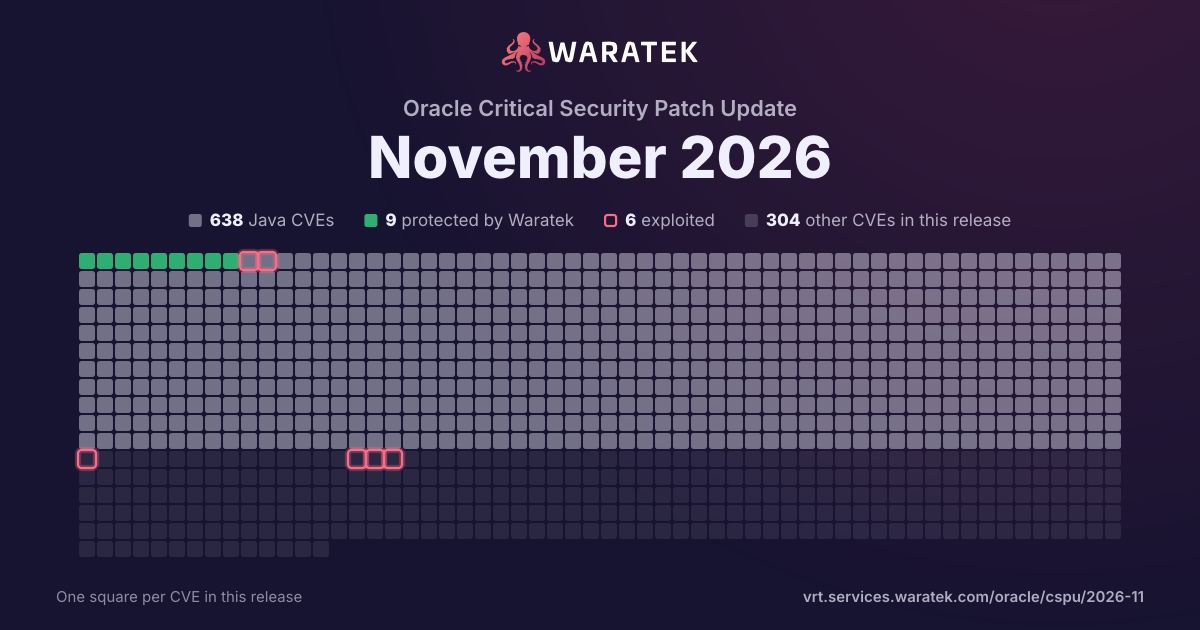
Protected by WaratekProtected by WaratekProtected by WaratekProtected by WaratekProtected by WaratekProtected by WaratekProtected by WaratekProtected by WaratekMitigation candidate, exploitedMitigation candidate, exploitedMitigation candidateNo exploit publishedNo exploit publishedNo exploit publishedNo exploit publishedNo exploit publishedNo exploit publishedNo exploit publishedNo exploit publishedNo exploit publishedNo exploit publishedNo exploit publishedNo exploit publishedNo exploit publishedNo exploit publishedNo exploit publishedNo exploit publishedNo exploit publishedNo exploit publishedNo exploit publishedNo exploit publishedNo exploit publishedNo exploit publishedNo exploit publishedNo exploit publishedNo exploit publishedNo exploit publishedNo exploit publishedNo exploit publishedNo exploit publishedNo exploit publishedNo exploit publishedNo exploit publishedNo exploit publishedNo exploit publishedNo exploit publishedNo exploit publishedNo exploit publishedNo exploit publishedNo exploit publishedNo exploit publishedNo exploit publishedNo exploit publishedNo exploit publishedNo exploit publishedNo exploit publishedNo exploit publishedNo exploit publishedNo exploit publishedNo exploit publishedNo exploit publishedNo exploit publishedNo exploit publishedNo exploit publishedNo exploit publishedNo exploit publishedNo exploit publishedNo exploit publishedNo exploit publishedNo exploit publishedNo exploit publishedNo exploit publishedNo exploit publishedNo exploit publishedNo exploit publishedNo exploit publishedNo exploit publishedNo exploit publishedNo exploit publishedNo exploit publishedNo exploit publishedNo exploit publishedNo exploit publishedNo exploit publishedNo exploit publishedNo exploit publishedNo exploit publishedNo exploit publishedNo exploit publishedNo exploit publishedNo exploit publishedNo exploit publishedNo exploit publishedNo exploit publishedNo exploit publishedNo exploit publishedNo exploit publishedNo exploit publishedNo exploit publishedNo exploit publishedNo exploit publishedNo exploit publishedNo exploit publishedNo exploit publishedNo exploit publishedNo exploit publishedNo exploit publishedNo exploit publishedNo exploit publishedNo exploit publishedNo exploit publishedNo exploit publishedNo exploit publishedNo exploit publishedNo exploit publishedNo exploit publishedNo exploit publishedNo exploit publishedNo exploit publishedNo exploit publishedNo exploit publishedNo exploit publishedNo exploit publishedNo exploit publishedNo exploit publishedNo exploit publishedNo exploit publishedNo exploit publishedNo exploit publishedNo exploit publishedNo exploit publishedNo exploit publishedNo exploit publishedNo exploit publishedNo exploit publishedNo exploit publishedNo exploit publishedNo exploit publishedNo exploit publishedNo exploit publishedNo exploit publishedNo exploit publishedNo exploit publishedNo exploit publishedNo exploit publishedNo exploit publishedNo exploit publishedNo exploit publishedNo exploit publishedNo exploit publishedNo exploit publishedNo exploit publishedNo exploit publishedNo exploit publishedNo exploit publishedNo exploit publishedNo exploit publishedNo exploit publishedNo exploit publishedNo exploit publishedNo exploit publishedNo exploit publishedNo exploit publishedNo exploit publishedNo exploit publishedNo exploit publishedNo exploit publishedNo exploit publishedNo exploit publishedNo exploit publishedNo exploit publishedNo exploit publishedNo exploit publishedNo exploit publishedNo exploit publishedNo exploit publishedNo exploit publishedNo exploit publishedNo exploit publishedNo exploit publishedNo exploit publishedNo exploit publishedNo exploit publishedNo exploit publishedNo exploit publishedNo exploit publishedNo exploit publishedNo exploit publishedNo exploit publishedNo exploit publishedNo exploit publishedNo exploit publishedNo exploit publishedNo exploit publishedNo exploit publishedNo exploit publishedNo exploit publishedNo exploit publishedNo exploit publishedNo exploit publishedNo exploit publishedNo exploit publishedNo exploit publishedNo exploit publishedNo exploit publishedNo exploit publishedNo exploit publishedNo exploit publishedNo exploit publishedNo exploit publishedNo exploit publishedNo exploit publishedNo exploit publishedNo exploit publishedNo exploit publishedNo exploit publishedNo exploit publishedNo exploit publishedNo exploit publishedNo exploit publishedNo exploit publishedNo exploit publishedNo exploit publishedNo exploit publishedNo exploit publishedNo exploit publishedNo exploit publishedNo exploit publishedNo exploit publishedNo exploit publishedNo exploit publishedNo exploit publishedNo exploit publishedNo exploit publishedNo exploit publishedNo exploit publishedNo exploit publishedNo exploit publishedNo exploit publishedNo exploit publishedNo exploit publishedNo exploit publishedNo exploit publishedNo exploit publishedNo exploit publishedNo exploit publishedNo exploit publishedNo exploit publishedNo exploit publishedNo exploit publishedNo exploit publishedNo exploit publishedNo exploit publishedNo exploit publishedNo exploit publishedNo exploit publishedNo exploit publishedNo exploit publishedNo exploit publishedNo exploit publishedNo exploit publishedNo exploit publishedNo exploit publishedNo exploit publishedNo exploit publishedNo exploit publishedNo exploit publishedNo exploit publishedNo exploit publishedNo exploit publishedNo exploit publishedNo exploit publishedNo exploit publishedNo exploit publishedNo exploit publishedNo exploit publishedNo exploit publishedNo exploit publishedNo exploit publishedNo exploit publishedNo exploit publishedNo exploit publishedNo exploit publishedNo exploit publishedNo exploit publishedNo exploit publishedNo exploit publishedNo exploit publishedNo exploit publishedNo exploit publishedNo exploit publishedNo exploit publishedNo exploit publishedNo exploit publishedNo exploit publishedNo exploit publishedNo exploit publishedNo exploit publishedNo exploit publishedNo exploit publishedNo exploit publishedNo exploit publishedNo exploit publishedNo exploit publishedNo exploit publishedNo exploit publishedNo exploit publishedNo exploit publishedNo exploit publishedNo exploit publishedNo exploit publishedNo exploit publishedNo exploit publishedNo exploit publishedNo exploit publishedNo exploit publishedNo exploit publishedNo exploit publishedNo exploit publishedNo exploit publishedNo exploit publishedNo exploit publishedNo exploit publishedNo exploit publishedNo exploit publishedNo exploit publishedNo exploit publishedNo exploit publishedNo exploit publishedNo exploit publishedNo exploit publishedNo exploit publishedNo exploit publishedNo exploit publishedNo exploit publishedNo exploit publishedNo exploit publishedNo exploit publishedNo exploit publishedNo exploit publishedNo exploit publishedNo exploit publishedNo exploit publishedNo exploit publishedNo exploit publishedNo exploit publishedNo exploit publishedNo exploit publishedNo exploit publishedNo exploit publishedNo exploit publishedNo exploit publishedNo exploit publishedNo exploit publishedNo exploit publishedNo exploit publishedNo exploit publishedNo exploit publishedNo exploit publishedNo exploit publishedNo exploit publishedNo exploit publishedNo exploit publishedNo exploit publishedNo exploit publishedNo exploit publishedNo exploit publishedNo exploit publishedNo exploit publishedNo exploit publishedNo exploit publishedNo exploit publishedNo exploit publishedNo exploit publishedNo exploit publishedNo exploit publishedNo exploit publishedNo exploit publishedNo exploit publishedNo exploit publishedNo exploit publishedNo exploit publishedNo exploit publishedNo exploit publishedNo exploit publishedNo exploit publishedNo exploit publishedNo exploit publishedNo exploit publishedNo exploit publishedNo exploit publishedNo exploit publishedNo exploit publishedNo exploit publishedNo exploit publishedNo exploit publishedNo exploit publishedNo exploit publishedNo exploit publishedNo exploit publishedNo exploit publishedNo exploit publishedNo exploit publishedNo exploit publishedNo exploit publishedNo exploit publishedNo exploit publishedNo exploit publishedNo exploit publishedNo exploit publishedNo exploit publishedNo exploit publishedNo exploit publishedNo exploit publishedNo exploit publishedNo exploit publishedNo exploit publishedNo exploit publishedNo exploit publishedNo exploit publishedNo exploit publishedNo exploit publishedNo exploit publishedNo exploit publishedNo exploit publishedNo exploit publishedNo exploit publishedNo exploit publishedNo exploit publishedNo exploit publishedNo exploit publishedNo exploit publishedNo exploit publishedNo exploit publishedNo exploit publishedNo exploit publishedNo exploit publishedNo exploit publishedNo exploit publishedNo exploit publishedNo exploit publishedNo exploit publishedNo exploit publishedNo exploit publishedNo exploit publishedNo exploit publishedNo exploit publishedNo exploit publishedNo exploit publishedNo exploit publishedNo exploit publishedNo exploit publishedNo exploit publishedNo exploit publishedNo exploit publishedNo exploit publishedNo exploit publishedNo exploit publishedNo exploit publishedNo exploit publishedNo exploit publishedNo exploit publishedNo exploit publishedNo exploit publishedNo exploit publishedNo exploit publishedNo exploit publishedNo exploit publishedNo exploit publishedNo exploit publishedNo exploit publishedNo exploit publishedNo exploit publishedNo exploit publishedNo exploit publishedNo exploit publishedNo exploit publishedNo exploit publishedNo exploit publishedNo exploit publishedNo exploit publishedNo exploit publishedNo exploit publishedNo exploit publishedNo exploit publishedNo exploit publishedNo exploit publishedNo exploit publishedNo exploit publishedNo exploit publishedNo exploit publishedNo exploit publishedNo exploit publishedNo exploit publishedNo exploit publishedNo exploit publishedNo exploit publishedNo exploit publishedNo exploit publishedNo exploit publishedNo exploit publishedNo exploit publishedNo exploit publishedNo exploit publishedNo exploit publishedNo exploit publishedNo exploit publishedNo exploit publishedNo exploit publishedNo exploit publishedNo exploit publishedNo exploit publishedNo exploit publishedNo exploit publishedNo exploit publishedNo exploit publishedNo exploit publishedNo exploit publishedNo exploit publishedNo exploit publishedNo exploit publishedNo exploit publishedNo exploit publishedNo exploit publishedNo exploit publishedNo exploit publishedNo exploit publishedNo exploit publishedNo exploit publishedNo exploit publishedNo exploit publishedNo exploit publishedNo exploit publishedNo exploit publishedNo exploit publishedNo exploit publishedNo exploit publishedNo exploit publishedNo exploit publishedNo exploit publishedNo exploit publishedNo exploit publishedNo exploit publishedNo exploit publishedNo exploit publishedNo exploit publishedNo exploit publishedNo exploit publishedNo exploit publishedNo exploit publishedNo exploit publishedNo exploit publishedNo exploit publishedNo exploit publishedNo exploit publishedNo exploit publishedNo exploit publishedNo exploit publishedNo exploit publishedNo exploit publishedNo exploit publishedNo exploit publishedNo exploit publishedNo exploit publishedNo exploit publishedNo exploit publishedNo exploit publishedNo exploit publishedNo exploit publishedNo exploit publishedNo exploit publishedNo exploit publishedNo exploit publishedNo exploit publishedNo exploit publishedNo exploit publishedNo exploit publishedNo exploit publishedNo exploit publishedNo exploit publishedNo exploit publishedNo exploit publishedNo exploit publishedNo exploit publishedNo exploit publishedNo exploit publishedNo exploit publishedNo exploit publishedNo exploit publishedNo exploit publishedNo exploit publishedNo exploit publishedNo exploit publishedNo exploit publishedNo exploit publishedNo exploit publishedNo exploit publishedNo exploit publishedNo exploit publishedNo exploit publishedNo exploit publishedNo exploit publishedNo exploit publishedNo exploit publishedNo exploit publishedNo exploit publishedNo exploit publishedNo exploit publishedNo exploit publishedNo exploit publishedNo exploit publishedNo exploit publishedNo exploit publishedNo exploit publishedNo exploit publishedNo exploit publishedNo exploit publishedNo exploit publishedNo exploit publishedNo exploit publishedNo exploit publishedNo exploit publishedNo exploit publishedNo exploit publishedNo exploit publishedNo exploit publishedNo exploit publishedNo exploit publishedNo exploit publishedNo exploit publishedNo exploit publishedNo exploit publishedNo exploit publishedNo exploit publishedNo exploit publishedNo exploit publishedNo exploit publishedOutside Waratek scope, exploitedOutside Waratek scope, exploitedOutside Waratek scopeOutside Waratek scopeOutside Waratek scopeOutside Waratek scopeOutside Waratek scopeOutside Waratek scopeOutside Waratek scopeOutside Waratek scopeOutside Waratek scopeOutside Waratek scopeOutside Waratek scopeOutside Waratek scopeOutside Waratek scopeOutside Waratek scopeNot applicable, exploitedNot applicable, exploitedNot applicable, exploitedNot applicable, exploitedNot applicableNot applicableNot applicableNot applicableNot applicableNot applicableNot applicableNot applicableNot applicableNot applicableNot applicableNot applicableNot applicableNot applicableNot applicableNot applicableNot applicableNot applicableNot applicableNot applicableNot applicableNot applicableNot applicableNot applicableNot applicableNot applicableNot applicableNot applicableNot applicableNot applicableNot applicableNot applicableNot applicableNot applicableNot applicableNot applicableNot applicableNot applicableNot applicableNot applicableNot applicableNot applicableNot applicableNot applicableNot applicableNot applicableNot applicableNot applicableNot applicableNot applicableNot applicableNot applicableNot applicableNot applicableNot applicableNot applicableNot applicableNot applicableNot applicableNot applicableNot applicableNot applicableNot applicableNot applicableNot applicableNot applicableNot applicableNot applicableNot applicableNot applicableNot applicableNot applicableNot applicableNot applicableNot applicableNot applicableNot applicableNot applicableNot applicableNot applicableNot applicableNot applicableNot applicableNot applicableNot applicableNot applicableNot applicableNot applicableNot applicableNot applicableNot applicableNot applicableNot applicableNot applicableNot applicableNot applicableNot applicableNot applicableNot applicableNot applicableNot applicableNot applicableNot applicableNot applicableNot applicableNot applicableNot applicableNot applicableNot applicableNot applicableNot applicableNot applicableNot applicableNot applicableNot applicableNot applicableNot applicableNot applicableNot applicableNot applicableNot applicableNot applicableNot applicableNot applicableNot applicableNot applicableNot applicableNot applicableNot applicableNot applicableNot applicableNot applicableNot applicableNot applicableNot applicableNot applicableNot applicableNot applicableNot applicableNot applicableNot applicableNot applicableNot applicableNot applicableNot applicableNot applicableNot applicableNot applicableNot applicableNot applicableNot applicableNot applicableNot applicableNot applicableNot applicableNot applicableNot applicableNot applicableNot applicableNot applicableNot applicableNot applicableNot applicableNot applicableNot applicableNot applicableNot applicableNot applicableNot applicableNot applicableNot applicableNot applicableNot applicableNot applicableNot applicableNot applicableNot applicableNot applicableNot applicableNot applicableNot applicableNot applicableNot applicableNot applicableNot applicableNot applicableNot applicableNot applicableNot applicableNot applicableNot applicableNot applicableNot applicableNot applicableNot applicableNot applicableNot applicableNot applicableNot applicableNot applicableNot applicableNot applicableNot applicableNot applicableNot applicableNot applicableNot applicableNot applicableNot applicableNot applicableNot applicableNot applicableNot applicableNot applicableNot applicableNot applicableNot applicableNot applicableNot applicableNot applicableNot applicableNot applicableNot applicableNot applicableNot applicableNot applicableNot applicableNot applicableNot applicableNot applicableNot applicableNot applicableNot applicableNot applicableNot applicableNot applicableNot applicableNot applicableNot applicableNot applicableNot applicableNot applicableNot applicableNot applicableNot applicableNot applicableNot applicableNot applicableNot applicableNot applicableNot applicableNot applicableNot applicableNot applicableNot applicableNot applicableNot applicableNot applicableNot applicableNot applicableNot applicableNot applicableNot applicableNot applicableNot applicableNot applicableNot applicableNot applicableNot applicableNot applicableNot applicableNot applicableNot applicableNot applicableNot applicableNot applicableNot applicableNot applicableNot applicableNot applicableNot applicableNot applicableNot applicableNot applicableNot applicable
Share this chart Oracle Critical Security Patch Update November 2026, one square per CVE: 637 Java CVEs, 8 protected by Waratek, 8 exploited, 305 other CVEs in this release.

Download the image

By status

No exploit published. For 554 of them, Oracle's security advisory is the source of public detail.

Protected by Waratek. Waratek RASP can block exploitation of these on systems that have not applied the patch yet.

Reset
More filters (2)
Columns
Published from 2026-10-01✕Published to 2026-10-31✕
Overview 19 matches · 0 protected · 0 exploited · 0 CISA KEV · 0 public PoC · 0 EPSS ≥ 0.5
19matches 0protected0.0% 0exploited0.0% 0CISA KEV0.0% 0public PoC0.0% 0EPSS ≥ 0.50.0%
Protected by Waratek 0 0.0% Rule in development 0 0.0% Mitigation candidate 0 0.0% No exploit published 19 100.0%
Critical 7 36.8% High 9 47.4% Medium 3 15.8% Low 0 0.0% None 0 0.0% Unknown 0 0.0%
blocked by ARMR today 0 0.0% partly blocked 0 0.0% not blocked 19 100.0% not established 0 0.0% unrecorded 0 0.0%
Exploited 0 0.0% Working exploit published 0 0.0% Proof of concept only 0 0.0% Forecast only 0 0.0% No public exploit 19 100.0%
split by peak 19 / month
No exploit published: 19 Medium: 3High: 9Critical: 7 not blocked: 19 No public exploit: 19
Oct 26
19 matches Sign in to download these CVEs as CSV or JSON, or to follow them in a feed.
CVE Severity Published▾ Status Exploitation Description
CVE-2026-114820 Critical 2026-10-24 No exploit published No public exploit Vulnerability in the Oracle Java SE, Oracle GraalVM for JDK, Oracle GraalVM Enterprise Edition product of Oracle Java SE (component: JSSE). Supported versions that are affected are Oracle Java SE: 8u511-b32, 8u511-perf-b32, 11.0.33.0.2, 17.0.21.0.2, 21.0.13.0.2, 25.0.5.0.2, 27.0.1.0.2; Oracle GraalVM for JDK: 17.0.21.0.2 and 21.0.13.0.2; Oracle GraalVM Enterprise Edition: 21.3.20.0.2. Easily exploitable vulnerability allows unauthenticated attacker with network access via multiple protocols to compromise Oracle Java SE, Oracle GraalVM for JDK, Oracle GraalVM Enterprise Edition. Successful attacks of this vulnerability can result in unauthorized creation, deletion or modification access to critical data or all Oracle Java SE, Oracle GraalVM for JDK, Oracle GraalVM Enterprise Edition accessible data as well as unauthorized access to critical data or complete access to all Oracle Java SE, Oracle GraalVM for JDK, Oracle GraalVM Enterprise Edition accessible data. Note: This vulnerability can be exploited by using APIs in the specified Component, e.g., through a web service which supplies data to the APIs. This vulnerability also applies to Java deployments, typically in clients running sandboxed Java Web Start applications or sandboxed Java applets, that load and run untrusted code (e.g., code that comes from the internet) and rely on the Java sandbox for security. CVSS 3.1 Base Score 9.1 (Confidentiality and Integrity impacts). CVSS Vector: (CVSS:3.1/AV:N/AC:L/PR:N/UI:N/S:U/C:H/I:H/A:N).
CVE-2026-91403 Critical 2026-10-21 No exploit published No public exploit Vulnerability in the Oracle Java SE, Oracle GraalVM for JDK, Oracle GraalVM Enterprise Edition product of Oracle Java SE (component: JSSE). Supported versions that are affected are Oracle Java SE: 8u511, 8u511-perf, 11.0.33, 17.0.21, 21.0.13, 25.0.5, 27.0.1; Oracle GraalVM for JDK: 17.0.21 and 21.0.13; Oracle GraalVM Enterprise Edition: 21.3.20. Easily exploitable vulnerability allows unauthenticated attacker with network access via multiple protocols to compromise Oracle Java SE, Oracle GraalVM for JDK, Oracle GraalVM Enterprise Edition. Successful attacks of this vulnerability can result in unauthorized creation, deletion or modification access to critical data or all Oracle Java SE, Oracle GraalVM for JDK, Oracle GraalVM Enterprise Edition accessible data as well as unauthorized access to critical data or complete access to all Oracle Java SE, Oracle GraalVM for JDK, Oracle GraalVM Enterprise Edition accessible data. Note: This vulnerability can be exploited by using APIs in the specified Component, e.g., through a web service which supplies data to the APIs. This vulnerability also applies to Java deployments, typically in clients running sandboxed Java Web Start applications or sandboxed Java applets, that load and run untrusted code (e.g., code that comes from the internet) and rely on the Java sandbox for security. CVSS 3.1 Base Score 9.1 (Confidentiality and Integrity impacts). CVSS Vector: (CVSS:3.1/AV:N/AC:L/PR:N/UI:N/S:U/C:H/I:H/A:N).
CVE-2026-93446 High 2026-10-20 No exploit published No public exploit Incomplete cleanup vulnerability in Apache Tomcat could cause TLS 1.3 connections to fail intermittently. This issue affects Apache Tomcat: from 11.0.0-M21 through 11.0.26, from 10.1.25 through 10.1.60, from 9.0.90 through 9.0.122. Users are recommended to upgrade to version 11.0.27, 10.1.61 or 9.0.123, which fix the issue.
CVE-2026-88041 High 2026-10-20 No exploit published No public exploit Incomplete cleanup vulnerability in Apache Tomcat allowed an trailer information from a previous request to leak into a subsequent request. This issue affects Apache Tomcat: from 11.0.0-M23 through 11.0.26, from 10.1.27 through 10.1.60, from 9.0.92 through 9.0.122. Users are recommended to upgrade to version 11.0.27, 10.1.61 or 9.0.123, which fix the issue.
CVE-2026-74049 Medium 2026-10-20 No exploit published No public exploit Execution After Redirect (EAR) vulnerability in Apache Tomcat. This issue affects Apache Tomcat: from 11.0.0-M1 through 11.0.26, from 10.1.0-M1 through 10.1.60, from 9.0.0.M1 through 9.0.122. The following versions were EOL at the time the CVE was created but are known to be affected: from 8.5.0 through 8.5.100, from 7.0.0 through 7.0.109. Other unsupported versions may also be affected. Users are recommended to upgrade to version 11.0.27, 10.1.61, 9.0.123, which fixes the issue.
CVE-2026-74048 Medium 2026-10-20 No exploit published No public exploit Not Failing Securely ('Failing Open') vulnerability in Apache Tomcat. If the OpenSSLLifecycleListener is configured to use FIPS mode but FIPS activation fails, Tomcat logs and error but continues to use JSSE in non-FIPS mode with the provided configuration. This issue affects Apache Tomcat: from 11.0.0-M14 through 11.0.26, from 10.1.22 through 10.1.60, from 9.0.92 through 9.0.122. Users are recommended to upgrade to version 11.0.27, 10.1.61 or 9.0.123, which fix the issue.
CVE-2026-101356 Critical 2026-10-20 No exploit published No public exploit Incorrect object recycling and re-use vulnerability in Apache Tomcat affecting HTTP/2 processing of asynchronous servlets can trigger request and/or response mix-up between users. This issue affects Apache Tomcat: from 11.0.22 through 11.0.26, from 10.1.55 through 10.1.60, from 9.0.118 through 9.0.122. Users are recommended to upgrade to version 11.0.27, 10.1.61 or 9.0.123, which fixes the issue.
CVE-2026-101296 Critical 2026-10-20 No exploit published No public exploit A missing critical step in authentication vulnerability in Apache Tomcat when the JNDI realm was configured with with a non GSSAPI SASL authentication mechanism allowed attackers to authenticate without providing the correct password. This issue affects Apache Tomcat: from 11.0.0-M1 through 11.0.26, from 10.1.0-M1 through 10.1.60, from 9.0.0.M1 through 9.0.122. The following versions were EOL at the time the CVE was created but are known to be affected: from 8.5.0 through 8.5.100, from 7.0.0 through 7.0.109. Other unsupported versions may also be affected. Users are recommended to upgrade to version 11.0.27, 10.1.61 or 9.0.123, which fix the issue.
CVE-2026-97791 High 2026-10-09 No exploit published No public exploit In Apache CXF, STSTokenValidator checks whether a SAML assertion is signed by a trusted certificate before deciding to send it to the STS. That result was stored in one object shared by all requests, so one request could read another's result. A remote, unauthenticated attacker could send a forged assertion signed with an untrusted certificate while legitimate requests were being processed, and it could be accepted as trusted without ever reaching the STS. Only services that use STSTokenValidator to validate SAML tokens without alwaysValidateToSts set are affected.  Users are recommended to upgrade to versions 4.2.4 or 4.1.9 or 3.6.13, which fix this issue.
CVE-2026-97468 Critical 2026-10-09 No exploit published No public exploit Apache CXF's STSTokenValidator and Security Token Service (STS) cached validated security tokens under a non-cryptographic 32-bit hash of the token (Java Arrays.hashCode/hashCode()), and treated a cache hit as proof that the presented token had already been validated. An attacker could craft a token (for example a UsernameToken or a self-signed SAML Assertion) whose hash collides with a cached entry. The token would then be accepted without password validation, signature trust verification or a call to the STS. This could let the attacker authenticate as another user and, through STS token validation or renewal, obtain STS-signed tokens for that identity. Users are recommended to upgrade to versions 4.2.4 or 4.1.9 or 3.6.13, which fix this issue.
CVE-2026-86463 High 2026-10-09 No exploit published No public exploit Apache CXF's FIQL query parser has a vulnerability in how it searches for operators in query expressions. The search pattern can get stuck trying many combinations when it encounters a long string without an operator, causing the parser to consume excessive CPU time. An attacker can send a crafted query to make the server use up CPU resources, potentially slowing down or stopping other requests. The fix was to limit FIQL expressions to 4 KiB by default, preventing attackers from sending extremely long inputs while still allowing normal queries. Users are recommended to upgrade to versions 4.2.4 or 4.1.9 or 3.6.13, which fix this issue.
CVE-2026-79650 Medium 2026-10-09 No exploit published No public exploit Apache CXF’s OIDC relying-party component could redirect users to an attacker-controlled URL after successful authentication. The issue occurs because attacker-controlled state parameters are preserved and later used as redirect targets without validating that the final decoded URI belongs to the RP’s origin. Both directly encoded and double-encoded external URLs can trigger the issue, depending on which validation path is used. Users are recommended to upgrade to versions 4.2.4 or 4.1.9 or 3.6.13, which fix this issue.
CVE-2026-78384 High 2026-10-09 No exploit published No public exploit CompressionUtils.inflate() decompressed attacker-controlled DEFLATE data with no output-size cap. A small (~KB) crafted payload could expand to gigabytes on the heap. Reachable via JWE decryption when zip=DEF (e.g. JoseSessionTokenProvider with RSA-OAEP key wrap) and via SAML redirect/POST binding token inflation — in both cases decompression happens before/independent of trust validation. Fix: Added a configurable maximum inflated-size cap (default 10 MiB, org.apache.cxf.compression-max-inflated-size system property) to CompressionUtils.inflate(); aborts with DataFormatException once exceeded. Users are recommended to upgrade to versions 4.2.4 or 4.1.9 or 3.6.13, which fix this issue.
CVE-2026-73179 High 2026-10-09 No exploit published No public exploit Improper enforcement of single-use authorization code semantics in the JPA OAuth2 authorization code grant provider in Apache CXFallows a remote attacker to obtain multiple valid access tokens from a single authorization code via concurrent token exchange requests that race the non-atomic find-then-delete operation against a shared relational database under READ_COMMITTED isolation. Users are recommended to upgrade to versions 4.2.4 or 4.1.9 or 3.6.13, which fixes this issue.
CVE-2026-71575 Critical 2026-10-09 No exploit published No public exploit The max_age authentication-freshness check in OidcClientCodeRequestFilter was inoperative due to a milliseconds/seconds unit mismatch and an inverted comparison polarity. Any relying party using setMaxAgeOffset to enforce re-authentication would silently accept sessions of any age, bypassing step-up authentication policies. Users are recommended to upgrade to versions 4.2.4 or 4.1.9 or 3.6.13, which fix this issue.
CVE-2026-108039 High 2026-10-09 No exploit published No public exploit By default, StaxUtils placed no limit on the total number of elements or the total number of characters in an XML document. A very large request could therefore use a lot of memory and CPU during parsing, especially where CXF builds a DOM from the input (for example SAAJ or WS-Security), and could cause a denial of service when no request size limit was configured. Both limits now have defaults: the maximum element count is 100 × maxChildElements (5,000,000 by default), and the maximum document size is 256M characters. Applications that process larger documents can raise the limits with the org.apache.cxf.stax.maxElementCount and org.apache.cxf.stax.maxXMLCharacters properties. Users are recommended to upgrade to versions 4.2.4 or 4.1.9 or 3.6.13, which fix this issue.
CVE-2026-107938 Critical 2026-10-09 No exploit published No public exploit In Apache CXF, the Netty-based HTTP client transport (cxf-rt-transports-http-netty-client) did not verify that the hostname in the server’s TLS certificate matched the host being called. This applied over both HTTP/1.1 and HTTP/2, even when disableCNCheck was left at its default value of false. The certificate chain was validated against the configured trust store, but the endpoint’s identity was not. A network attacker able to intercept traffic could present any certificate trusted by the client, such as a publicly issued certificate for a domain they control, and impersonate the target service. They could then read or modify the exchanged messages, including credentials.  Users are recommended to upgrade to versions 4.2.4 or 4.1.9 or 3.6.13, which fix this issue.
CVE-2026-107937 High 2026-10-09 No exploit published No public exploit In Apache CXF, the parser for multipart/MTOM attachment part headers did not fully enforce the configured attachment-max-header-size (default 300 characters) and attachment-headers-max-count (default 500) limits. The size limit was applied only to each physical line, not to a header value built from continuation lines or to the combined values of a repeated header. The count limit was checked against the number of distinct header names, not the total number of header lines. A remote, unauthenticated attacker could send a multipart request with very large folded or repeated part headers. The server would then allocate memory without bound, causing a denial of service.  Users are recommended to upgrade to versions 4.2.4 or 4.1.9 or 3.6.13, which fix this issue.
CVE-2026-100227 High 2026-10-09 No exploit published No public exploit Improper Verification of Cryptographic Signature vulnerability in Apache CXF's JAX-RS XML Security module. The JAX-RS XML Signature interceptors (XmlSigInHandler, XmlSigInInterceptor and the streaming XmlSecInInterceptor) did not ensure that the XML passed to the application was covered by the signature. An attacker with any document signed by a trusted key could wrap it in unsigned content, which the application would then treat as signed. Users are recommended to upgrade to versions 4.2.4 or 4.1.9 or 3.6.13, which fix this issue.