
Oracle Critical Security Patch Update November 2026
Released November 2026 · Oracle's advisory ↗ · ← Critical Patch Update, October 2026
942 CVEs in this release, one square each
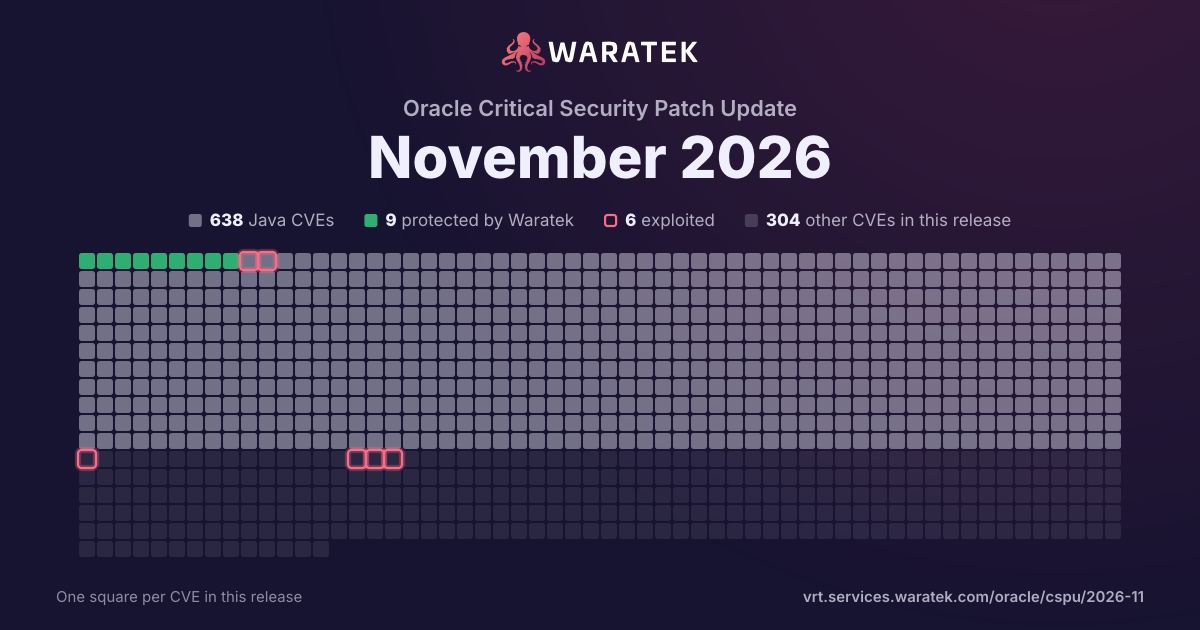
By status
9Protected by Waratek3Mitigation candidate626No exploit published15Outside Waratek scope289Not applicable
8Exploited, marked by the ring
No exploit published. For 547 of them, Oracle's security advisory is the source of public detail.
Protected by Waratek. Waratek RASP can block exploitation of these on systems that have not applied the patch yet.
Overview 12 matches · 1 in Waratek scope · 0 protected · 0 exploited · 0 CISA KEV · 0 public PoC · 0 EPSS ≥ 0.5
12matches
1in Waratek scope8.3%
0protected0.0%
0exploited0.0%
0CISA KEV0.0%
0public PoC0.0%
0EPSS ≥ 0.50.0%
Protected by Waratek
0
0.0%
Rule in development
0
0.0%
Mitigation candidate
0
0.0%
No exploit published
1
8.3%
Outside Waratek scope
0
0.0%
Not applicable
11
91.7%
Withdrawn CVE
0
0.0%
blocked by ARMR today
0
0.0%
partly blocked
0
0.0%
not blocked
12
100.0%
not established
0
0.0%
unrecorded
0
0.0%
Exploited
0
0.0%
Working exploit published
0
0.0%
Proof of concept only
4
33.3%
Forecast only
0
0.0%
No public exploit
8
66.7%
split by
peak 12 / month
May 26
| CVE | Severity | Published▾ | Status | Exploitation | Description |
|---|---|---|---|---|---|
| CVE-2026-45571 | Medium | 2026-05-27 | Not applicable | No public exploit | go-git is an extensible git implementation library written in pure Go. Prior to 5.19.1 and 6.0.0-alpha.4, a path validation issue in go-git could allow crafted repository data to affect files outside the intended checkout target, including the repository's .git directory. These validations were introduced in upstream Git years ago, so the vulnerability arose from go-git drifting from those checks. This vulnerability is fixed in 5.19.1 and 6.0.0-alpha.4. |
| CVE-2026-45570 | Low | 2026-05-27 | Not applicable | No public exploit | go-git is an extensible git implementation library written in pure Go. Prior to 5.19.1 and 6.0.0-alpha.4, go-git's SSH transport constructs the remote exec command by wrapping the repository path in single quotes without escaping single quotes embedded inside the path. A repository path containing a single quote can therefore break out of the quoted region in the exec command and be appended as additional shell tokens. This vulnerability is fixed in 5.19.1 and 6.0.0-alpha.4. |
| CVE-2026-45022 | High | 2026-05-27 | Not applicable | No public exploit | go-git is an extensible git implementation library written in pure Go. Prior to 5.19.0 and 6.0.0-alpha.3, go-git may parse malformed Git objects in a way that differs from upstream Git. When commit or tag objects contain ambiguous or malformed headers, go-git’s decoded representation may expose values differently from how Git itself would interpret or reject the same object. Additionally, go-git’s commit signing and verification logic operates over commit data reconstructed from go-git’s parsed representation rather than the original raw object bytes. As a result, go-git may sign or verify a commit payload that is not byte-for-byte equivalent to the object stored in the repository. This can cause a signature to appear valid for a commit whose displayed or effective metadata differs from the object that was intended to be signed. This vulnerability is fixed in 5.19.0 and 6.0.0-alpha.3. |
| CVE-2026-33637 | Medium | 2026-05-19 | Not applicable | Proof of concept only | Faraday is an HTTP client library abstraction layer that provides a common interface over many adapters. Versions 2.0.0 through 2.14.1 still allow protocol-relative host override when the request target is passed as a URI object (rather than a String) to Faraday::Connection#build_exclusive_url. This bypasses the February 2026 fix for GHSA-33mh-2634-fwr2 and enables off-host request forgery: a request built from a fixed-base Faraday::Connection can be redirected to an attacker-controlled host, forwarding connection-scoped values such as Authorization headers and default query parameters. This issue has been fixed in version 2.14.3. |
| CVE-2026-7168 | Medium | 2026-05-13 | Not applicable | Proof of concept only | Successfully using libcurl to do a transfer over a specific HTTP proxy (`proxyA`) with **Digest** authentication and then changing the proxy host to a second one (`proxyB`) for a second transfer, reusing the same handle, makes libcurl wrongly pass on the `Proxy-Authorization:` header field meant for `proxyA`, to `proxyB`. |
| CVE-2026-6429 | Medium | 2026-05-13 | Not applicable | No public exploit | When asked to both use a `.netrc` file for credentials and to follow HTTP redirects, libcurl could leak the password used for the first host to the followed-to host under certain circumstances. |
| CVE-2026-6276 | High | 2026-05-13 | Not applicable | Proof of concept only | Using libcurl, when a custom `Host:` header is first set for an HTTP request and a second request is subsequently done using the same *easy handle* but without the custom `Host:` header set, the second request would use stale information and pass on cookies meant for the first host in the second request. Leak them. |
| CVE-2026-5773 | High | 2026-05-13 | Not applicable | Proof of concept only | libcurl might in some circumstances reuse the wrong connection for SMB(S) transfers. libcurl features a pool of recent connections so that subsequent requests can reuse an existing connection to avoid overhead. When reusing a connection a range of criteria must be met. Due to a logical error in the code, a network transfer operation that was requested by an application could wrongfully reuse an existing SMB connection to the same server that was using a different "share" than the new subsequent transfer should. This could in unlucky situations lead to the download of the wrong file or the upload of a file to the wrong place. When this happens, the same credentials are used and the server name is the same. |
| CVE-2026-45186 | High | 2026-05-10 | Not applicable | No public exploit | In libexpat before 2.8.1, the computational complexity of attribute name collision checks allows a denial of service via moderately sized crafted XML input. |
| CVE-2026-41889 | Low | 2026-05-08 | Not applicable | No public exploit | pgx is a PostgreSQL driver and toolkit for Go. Prior to version 5.9.2, SQL injection can occur when the non-default simple protocol is used, a dollar quoted string literal is used in the SQL query, that string literal contains text that would be would be interpreted as a placeholder outside of a string literal, and the value of that placeholder is controllable by the attacker. This issue has been patched in version 5.9.2. |
| CVE-2026-41506 | High | 2026-05-08 | Not applicable | No public exploit | go-git is an extensible git implementation library written in pure Go. Prior to versions 5.18.0 and 6.0.0-alpha.2, go-git may leak HTTP authentication credentials when following redirects during smart-HTTP clone and fetch operations. This issue has been patched in versions 5.18.0 and 6.0.0-alpha.2. |
| CVE-2026-42402 | High | 2026-05-01 | No exploit published | No public exploit | Apache Neethi is vulnerable to a Denial of Service attack through algorithmic complexity in policy normalization. Specially crafted WS-Policy documents can trigger an exponential Cartesian cross-product expansion during the normalization process, causing unbounded memory allocation that exhausts the JVM heap. This occurs when the normalization process generates an excessive number of policy alternatives without bounds, leading to runtime memory exhaustion. Users should upgrade to 3.2.2 which limits the maximum number of normalized policy alternatives. |