
Oracle Critical Security Patch Update November 2026
Released November 2026 · Oracle's advisory ↗ · ← Critical Patch Update, October 2026
942 CVEs in this release, one square each
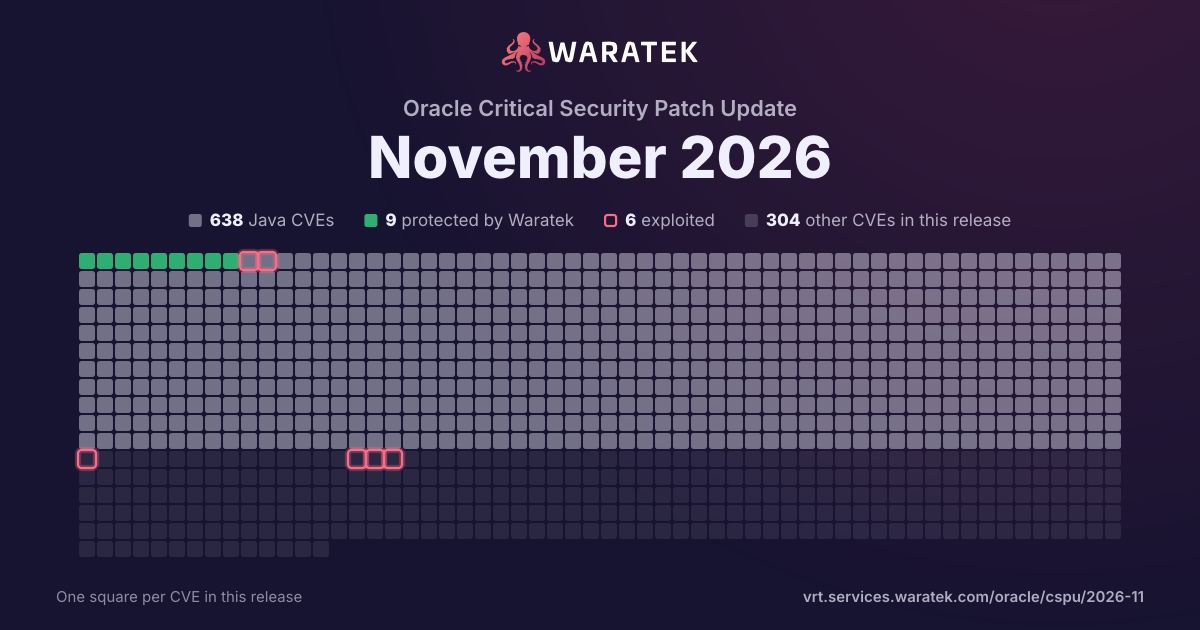
By status
9Protected by Waratek3Mitigation candidate626No exploit published15Outside Waratek scope289Not applicable
8Exploited, marked by the ring
No exploit published. For 547 of them, Oracle's security advisory is the source of public detail.
Protected by Waratek. Waratek RASP can block exploitation of these on systems that have not applied the patch yet.
Overview 53 matches · 15 in Waratek scope · 1 protected · 0 exploited · 0 CISA KEV · 0 public PoC · 0 EPSS ≥ 0.5
53matches
15in Waratek scope28.3%
1protected1.9%
0exploited0.0%
0CISA KEV0.0%
0public PoC0.0%
0EPSS ≥ 0.50.0%
Protected by Waratek
1
1.9%
Rule in development
0
0.0%
Mitigation candidate
1
1.9%
No exploit published
13
24.5%
Outside Waratek scope
3
5.7%
Not applicable
35
66.0%
Withdrawn CVE
0
0.0%
blocked by ARMR today
1
1.9%
partly blocked
0
0.0%
not blocked
52
98.1%
not established
0
0.0%
unrecorded
0
0.0%
Exploited
0
0.0%
Working exploit published
0
0.0%
Proof of concept only
7
13.2%
Forecast only
0
0.0%
No public exploit
46
86.8%
split by
peak 23 / month
Apr 2623
Protected by Waratek1
Mitigation candidate1
No exploit published10
Outside Waratek scope3
Not applicable8
Critical3
High7
Medium10
Low3
blocked by ARMR today1
not blocked22
No public exploit23
May 2612
No exploit published1
Not applicable11
High6
Medium4
Low2
not blocked12
Proof of concept only4
No public exploit8
Jun 2618
No exploit published2
Not applicable16
High7
Medium4
Low7
not blocked18
Proof of concept only3
No public exploit15
Apr 26May 26Jun 26
| CVE | Severity | Published▾ | Status | Exploitation | Description |
|---|---|---|---|---|---|
| CVE-2026-57438 | Low | 2026-06-25 | Not applicable | No public exploit | Nokogiri is an open source XML and HTML library for the Ruby programming language. Prior to 1.19.4, XInclude substitution performed by Nokogiri::XML::Node#do_xinclude replaced each <xi:include> in place, freeing the include node along with its children (such as <xi:fallback> and its descendants) and any namespaces declared on them. If an application had already exposed one of those nodes or namespaces to Ruby, the corresponding Ruby object was left pointing at freed memory. Using the object could result in invalid reads or writes to memory. This vulnerability is fixed in 1.19.4. |
| CVE-2026-57437 | Low | 2026-06-25 | Not applicable | No public exploit | Nokogiri is an open source XML and HTML library for the Ruby programming language. Prior to 1.19.4, Nokogiri::XML::XPathContext did not keep its source document alive for garbage collection. If an XPathContext outlived its document and the document was collected, evaluating an XPath expression could read invalid memory and potentially segfault. This is only reachable when application code constructs an XPathContext directly and lets the document become unreachable while continuing to use the context. The normal Document#xpath, #css, and related search methods are not affected, and it is not triggerable by malicious document input. This vulnerability is fixed in 1.19.4. |
| CVE-2026-57436 | Low | 2026-06-25 | Not applicable | No public exploit | Nokogiri is an open source XML and HTML library for the Ruby programming language. Prior to 1.19.4, Nokogiri::XML::Document#root= validated only that the new root was a Nokogiri::XML::Node, allowing a DTD node to be set as the document root. The result is a heap use-after-free during garbage collection or finalization, leading to an invalid memory read or potentially a segfault. This vulnerability is fixed in 1.19.4. |
| CVE-2026-57435 | Low | 2026-06-25 | Not applicable | No public exploit | Nokogiri is an open source XML and HTML library for the Ruby programming language. Prior to 1.19.4, Nokogiri’s CRuby native extension could leave a Ruby wrapper pointing to freed memory when replacing the value of an XML attribute. If Ruby code had already accessed an attribute child node, Nokogiri::XML::Attr#value= could free the underlying native child node while the wrapper remained reachable through the document node cache. A later use of the freed child node or a Ruby GC mark could dereference an invalid pointer, causing an invalid read and a possible segfault. This vulnerability is fixed in 1.19.4. |
| CVE-2026-57434 | Low | 2026-06-25 | Not applicable | No public exploit | Nokogiri is an open source XML and HTML library for the Ruby programming language. Prior to 1.19.4, Nokogiri contains a bug when calling certain methods on allocated-but-uninitialized native wrapper classes that inherit from Nokogiri::XML::Node. This caused a NULL pointer dereference that could crash the process. This vulnerability is fixed in 1.19.4. |
| CVE-2026-57236 | Low | 2026-06-25 | Not applicable | No public exploit | Nokogiri is an open source XML and HTML library for the Ruby programming language. Prior to 1.19.4, calling Document#encoding= with an invalid encoding (e.g., a non-string, or a string containing a null byte) raises an exception, but only after freeing the document's current encoding string without replacing it. The document is left referencing freed memory, so the next call to Document#encoding reads invalid memory, which can cause a segfault or leak freed bytes into a Ruby String. Affects the CRuby (libxml2) implementation only; JRuby is not affected. This vulnerability is fixed in 1.19.4. |
| CVE-2026-57235 | Medium | 2026-06-25 | Not applicable | No public exploit | Nokogiri is an open source XML and HTML library for the Ruby programming language. Prior to 1.19.4, Nokogiri::XML::NodeSet#[] (and its alias #slice) checked the requested index against the node set's bounds using a 32-bit-truncated copy of the index. A large negative index could pass the check and then be used at full width, reading outside the node set's storage. On CRuby this is an out-of-bounds read that typically crashes the process; on JRuby it is not memory-unsafe but returns an incorrect node. This vulnerability is fixed in 1.19.4. |
| CVE-2026-54297 | High | 2026-06-24 | Not applicable | Proof of concept only | Faraday is an HTTP client library abstraction layer that provides a common interface over many adapters. From 1.0.0 until 1.10.6 and 2.14.3, Faraday::NestedParamsEncoder, the default nested query parameter encoder/decoder in Faraday, decodes nested query strings without enforcing a maximum nesting depth. A crafted query string causes Faraday to build a deeply nested Ruby Hash structure. The internal dehash routine then recursively walks this attacker-controlled structure without a depth limit. At sufficient depth, Ruby raises an uncaught SystemStackError (stack level too deep), crashing the calling thread or worker. This can lead to denial of service in applications that pass attacker-controlled query strings to Faraday's nested query parsing or URL-building paths. This vulnerability is fixed in 1.10.6 and 2.14.3. |
| CVE-2026-11972 | High | 2026-06-23 | Not applicable | No public exploit | When using the "tarfile" module with a file opened in "streaming mode" (mode="r|") the tarfile module did not properly handle EOF, making archive parsing take exponentially longer. |
| CVE-2026-47242 | Medium | 2026-06-22 | Not applicable | No public exploit | Net::IMAP implements Internet Message Access Protocol (IMAP) client functionality in Ruby. Prior to 0.6.5 and 0.5.15, when Net::IMAP#id is called with a hash argument, although the ID field value strings are correctly quoted (escaping quoted specials), they were not validated to prohibit CRLF sequences. While Net::IMAP#enable does process its arguments for aliases, it does not validate them as valid atoms (or as a list of valid atoms). The #to_s value is sent verbatim. Arguments to either command could be used by an attacker to inject arbitrary IMAP commands. This vulnerability is fixed in 0.6.5 and 0.5.15. |
| CVE-2026-47240 | Medium | 2026-06-22 | Not applicable | No public exploit | Net::IMAP implements Internet Message Access Protocol (IMAP) client functionality in Ruby. Prior to 0.6.5 and 0.5.15, several Net::IMAP commands accept a "raw data" argument that is sent verbatim after validation to prevent command injection. However, if a server does not support non-synchronizing literals, it may still be possible to inject arbitrary IMAP commands inside non-synchronizing literals. A server without support for non-synchronizing literals may interpret the "+}\r\n" as the end of a malformed command line and respond with a tagged BAD. In that case, the contents of the literal will be interpreted as one or more new pipelined commands, allowing a CRLF command injection attack to succeed. This affects criteria for #search and #uid_search; search_keys for #sort, #thread, #uid_sort, and #uid_thread; and attr for #fetch and #uid_fetch. This vulnerability is fixed in 0.6.5 and 0.5.15. |
| CVE-2026-9076 | High | 2026-06-09 | Not applicable | No public exploit | Issue summary: When CMS password-based decryption (RFC 3211 / PWRI key unwrap) processes attacker-supplied CMS data, an attacker-chosen stream-mode KEK cipher can trigger a heap out-of-bounds read in kek_unwrap_key(). Impact summary: A heap buffer over-read may trigger a crash which leads to Denial of Service for an application if the input buffer ends at a memory page boundary and the following page is unmapped. There is no information disclosure as the over-read bytes are not revealed to the attacker. The key unwrapping function performs a check-byte test as specified in the RFC that reads 7 bytes from a heap allocation that is based on the wrapped key length from the message. There is a minimum length check based on the block length of the wrapping cipher. However the cipher is selected from an OID carried in the attacker's PWRI keyEncryptionAlgorithm with no requirement that the cipher be a block cipher. When an attacker selects a stream-mode cipher the guard will be ineffective and the allocated buffer containing the unwrapped key can be too small to fit the check-bytes specified in the RFC and a buffer over-read can happen. Applications calling CMS_decrypt() or CMS_decrypt_set1_password() (equivalently openssl cms -decrypt -pwri_password ...) on untrusted CMS data are vulnerable to this issue. No password knowledge is required: the over-read happens during the unwrap attempt before any authentication succeeds. The over-read is limited to a few bytes and is not written to output, so there is no information disclosure. Triggering a crash requires the allocation to border unmapped memory, which is unlikely with the normal allocator. The FIPS modules are not affected by this issue. |
| CVE-2026-45447 | High | 2026-06-09 | Not applicable | No public exploit | Issue summary: A specially crafted PKCS#7 or S/MIME signed message could trigger a use-after-free during PKCS#7 signature verification. Impact summary: A use-after-free may result in process crashes, heap corruption, or potentially remote code execution. When processing a PKCS#7 or S/MIME signed message, if the SignedData digestAlgorithms field is present as an empty ASN.1 SET, OpenSSL may incorrectly free a caller-owned BIO during PKCS7_verify(). A subsequent use of the BIO by the calling application results in a use-after-free condition. In the common case this occurs when the application later calls BIO_free() on the BIO originally passed to PKCS7_verify(). Depending on allocator behavior and application-specific BIO usage patterns, this may result in a crash or other memory corruption. In some application contexts this may potentially be exploitable for remote code execution. Applications that process PKCS#7 or S/MIME signed messages using OpenSSL PKCS#7 APIs may be affected. Applications using the CMS APIs for this processing are not affected. The FIPS modules in 4.0, 3.6, 3.5, 3.4, and 3.0 are not affected by this issue, as the affected code is outside the OpenSSL FIPS module boundary. |
| CVE-2026-40984 | High | 2026-06-09 | No exploit published | No public exploit | In Micrometer, it is possible for a user to provide specially crafted HTTP requests that may cause a denial-of-service (DoS) condition. Affected versions: micrometer-core 1.16.0 through 1.16.5; 1.15.0 through 1.15.11; 1.14.0 through 1.14.15; 1.13.0 through 1.13.18; 1.9.0 through 1.9.17. micrometer-jetty11 1.16.0 through 1.16.5; 1.15.0 through 1.15.11; 1.14.0 through 1.14.15; 1.13.0 through 1.13.18. micrometer-jetty12 1.16.0 through 1.16.5; 1.15.0 through 1.15.11; 1.14.0 through 1.14.15; 1.13.0 through 1.13.18. |
| CVE-2026-40983 | High | 2026-06-09 | No exploit published | No public exploit | In Micrometer, it is possible for a user to provide specially crafted gRPC requests that may cause a denial-of-service (DoS) condition. Affected versions: Micrometer 1.16.0 through 1.16.5; 1.15.0 through 1.15.11. |
| CVE-2026-34180 | High | 2026-06-09 | Not applicable | No public exploit | Issue summary: Parsing a crafted DER-encoded ASN.1 structure with a primitive element whose content exceeds 2 gigabytes in length may cause a heap buffer over-read on 64-bit Unix and Unix-like platforms. Impact summary: The heap buffer over-read may crash the application (Denial of Service) or to load into the decoded ASN.1 object contents of memory beyond the end of the input buffer. More typically such ASN.1 elements would instead be truncated. An integer truncation in OpenSSL's ASN.1 decoder causes the content length of an ASN.1 primitive element to be mishandled when it exceeds 2 gigabytes. In the worst case the truncated length is treated as a request to scan the binary content for a terminating zero byte, possibly causing OpenSSL to read either less than or beyond the end of the allocated buffer. Applications that pass attacker-supplied data to d2i_X509(), d2i_PKCS7(), or any other d2i_* decoding function are affected. OpenSSL's own command-line tools are not vulnerable, as data read through the BIO layer is checked before it reaches the affected code. The issue only affects 64-bit Unix and Unix-like platforms; 32-bit platforms and 64-bit Windows are not affected. The FIPS modules in 4.0, 3.6, 3.5, 3.4 and 3.0 are not affected by this issue, as the affected code is outside the OpenSSL FIPS module boundary. |
| CVE-2026-10803 | Low | 2026-06-04 | Not applicable | Proof of concept only | A flaw has been found in MLflow up to 3.10.0. This issue affects the function mlflow.data.digest_utils of the file mlflow/data/digest_utils.py of the component Dataset Digest Computation. This manipulation causes use of weak hash. It is possible to launch the attack on the local host. The attack is considered to have high complexity. The exploitability is assessed as difficult. The exploit has been published and may be used. The project was informed of the problem early through a pull request but has not reacted yet. |
| CVE-2026-3198 | Medium | 2026-06-02 | Not applicable | Proof of concept only | MLflow 3.9.0 with basic-auth (`--app-name basic-auth`) fails to enforce authorization checks for multiple Gateway API 'list' endpoints. Specifically, the `BEFORE_REQUEST_HANDLERS` dictionary in `mlflow/server/auth/__init__.py` does not include entries for `ListGatewaySecretInfos`, `ListGatewayEndpoints`, and `ListGatewayModelDefinitions`. This allows any authenticated user, regardless of their assigned permissions, to enumerate all gateway secrets, endpoints, and model definitions. This vulnerability exposes sensitive information, such as API keys, endpoint configurations, and proprietary model definitions, to unauthorized users. |
| CVE-2026-45571 | Medium | 2026-05-27 | Not applicable | No public exploit | go-git is an extensible git implementation library written in pure Go. Prior to 5.19.1 and 6.0.0-alpha.4, a path validation issue in go-git could allow crafted repository data to affect files outside the intended checkout target, including the repository's .git directory. These validations were introduced in upstream Git years ago, so the vulnerability arose from go-git drifting from those checks. This vulnerability is fixed in 5.19.1 and 6.0.0-alpha.4. |
| CVE-2026-45570 | Low | 2026-05-27 | Not applicable | No public exploit | go-git is an extensible git implementation library written in pure Go. Prior to 5.19.1 and 6.0.0-alpha.4, go-git's SSH transport constructs the remote exec command by wrapping the repository path in single quotes without escaping single quotes embedded inside the path. A repository path containing a single quote can therefore break out of the quoted region in the exec command and be appended as additional shell tokens. This vulnerability is fixed in 5.19.1 and 6.0.0-alpha.4. |
| CVE-2026-45022 | High | 2026-05-27 | Not applicable | No public exploit | go-git is an extensible git implementation library written in pure Go. Prior to 5.19.0 and 6.0.0-alpha.3, go-git may parse malformed Git objects in a way that differs from upstream Git. When commit or tag objects contain ambiguous or malformed headers, go-git’s decoded representation may expose values differently from how Git itself would interpret or reject the same object. Additionally, go-git’s commit signing and verification logic operates over commit data reconstructed from go-git’s parsed representation rather than the original raw object bytes. As a result, go-git may sign or verify a commit payload that is not byte-for-byte equivalent to the object stored in the repository. This can cause a signature to appear valid for a commit whose displayed or effective metadata differs from the object that was intended to be signed. This vulnerability is fixed in 5.19.0 and 6.0.0-alpha.3. |
| CVE-2026-33637 | Medium | 2026-05-19 | Not applicable | Proof of concept only | Faraday is an HTTP client library abstraction layer that provides a common interface over many adapters. Versions 2.0.0 through 2.14.1 still allow protocol-relative host override when the request target is passed as a URI object (rather than a String) to Faraday::Connection#build_exclusive_url. This bypasses the February 2026 fix for GHSA-33mh-2634-fwr2 and enables off-host request forgery: a request built from a fixed-base Faraday::Connection can be redirected to an attacker-controlled host, forwarding connection-scoped values such as Authorization headers and default query parameters. This issue has been fixed in version 2.14.3. |
| CVE-2026-7168 | Medium | 2026-05-13 | Not applicable | Proof of concept only | Successfully using libcurl to do a transfer over a specific HTTP proxy (`proxyA`) with **Digest** authentication and then changing the proxy host to a second one (`proxyB`) for a second transfer, reusing the same handle, makes libcurl wrongly pass on the `Proxy-Authorization:` header field meant for `proxyA`, to `proxyB`. |
| CVE-2026-6429 | Medium | 2026-05-13 | Not applicable | No public exploit | When asked to both use a `.netrc` file for credentials and to follow HTTP redirects, libcurl could leak the password used for the first host to the followed-to host under certain circumstances. |
| CVE-2026-6276 | High | 2026-05-13 | Not applicable | Proof of concept only | Using libcurl, when a custom `Host:` header is first set for an HTTP request and a second request is subsequently done using the same *easy handle* but without the custom `Host:` header set, the second request would use stale information and pass on cookies meant for the first host in the second request. Leak them. |
| CVE-2026-5773 | High | 2026-05-13 | Not applicable | Proof of concept only | libcurl might in some circumstances reuse the wrong connection for SMB(S) transfers. libcurl features a pool of recent connections so that subsequent requests can reuse an existing connection to avoid overhead. When reusing a connection a range of criteria must be met. Due to a logical error in the code, a network transfer operation that was requested by an application could wrongfully reuse an existing SMB connection to the same server that was using a different "share" than the new subsequent transfer should. This could in unlucky situations lead to the download of the wrong file or the upload of a file to the wrong place. When this happens, the same credentials are used and the server name is the same. |
| CVE-2026-45186 | High | 2026-05-10 | Not applicable | No public exploit | In libexpat before 2.8.1, the computational complexity of attribute name collision checks allows a denial of service via moderately sized crafted XML input. |
| CVE-2026-41889 | Low | 2026-05-08 | Not applicable | No public exploit | pgx is a PostgreSQL driver and toolkit for Go. Prior to version 5.9.2, SQL injection can occur when the non-default simple protocol is used, a dollar quoted string literal is used in the SQL query, that string literal contains text that would be would be interpreted as a placeholder outside of a string literal, and the value of that placeholder is controllable by the attacker. This issue has been patched in version 5.9.2. |
| CVE-2026-41506 | High | 2026-05-08 | Not applicable | No public exploit | go-git is an extensible git implementation library written in pure Go. Prior to versions 5.18.0 and 6.0.0-alpha.2, go-git may leak HTTP authentication credentials when following redirects during smart-HTTP clone and fetch operations. This issue has been patched in versions 5.18.0 and 6.0.0-alpha.2. |
| CVE-2026-42402 | High | 2026-05-01 | No exploit published | No public exploit | Apache Neethi is vulnerable to a Denial of Service attack through algorithmic complexity in policy normalization. Specially crafted WS-Policy documents can trigger an exponential Cartesian cross-product expansion during the normalization process, causing unbounded memory allocation that exhausts the JVM heap. This occurs when the normalization process generates an excessive number of policy alternatives without bounds, leading to runtime memory exhaustion. Users should upgrade to 3.2.2 which limits the maximum number of normalized policy alternatives. |
| CVE-2026-41990 | Medium | 2026-04-23 | Not applicable | No public exploit | Libgcrypt before 1.12.2 mishandles Dilithium signing. Writes to a static array lack a bounds check but do not use attacker-controlled data. |
| CVE-2026-41989 | Medium | 2026-04-23 | Not applicable | No public exploit | Libgcrypt before 1.12.2 sometimes allows a heap-based buffer overflow and denial of service via crafted ECDH ciphertext to gcry_pk_decrypt. |
| CVE-2026-34282 | High | 2026-04-21 | Mitigation candidate | No public exploit | Vulnerability in the Oracle Java SE, Oracle GraalVM for JDK, Oracle GraalVM Enterprise Edition product of Oracle Java SE (component: Networking). Supported versions that are affected are Oracle Java SE: 8u481-perf, 11.0.30, 17.0.18, 21.0.10, 25.0.2, 26; Oracle GraalVM for JDK: 17.0.18 and 21.0.10; Oracle GraalVM Enterprise Edition: 21.3.17. Easily exploitable vulnerability allows unauthenticated attacker with network access via multiple protocols to compromise Oracle Java SE, Oracle GraalVM for JDK, Oracle GraalVM Enterprise Edition. Successful attacks of this vulnerability can result in unauthorized ability to cause a hang or frequently repeatable crash (complete DOS) of Oracle Java SE, Oracle GraalVM for JDK, Oracle GraalVM Enterprise Edition. Note: This vulnerability can be exploited by using APIs in the specified Component, e.g., through a web service which supplies data to the APIs. This vulnerability also applies to Java deployments, typically in clients running sandboxed Java Web Start applications or sandboxed Java applets, that load and run untrusted code (e.g., code that comes from the internet) and rely on the Java sandbox for security. CVSS 3.1 Base Score 7.5 (Availability impacts). CVSS Vector: (CVSS:3.1/AV:N/AC:L/PR:N/UI:N/S:U/C:N/I:N/A:H). |
| CVE-2026-34268 | Low | 2026-04-21 | No exploit published | No public exploit | Vulnerability in the Oracle Java SE, Oracle GraalVM for JDK, Oracle GraalVM Enterprise Edition product of Oracle Java SE (component: Security). Supported versions that are affected are Oracle Java SE: 8u481, 8u481-b50, 8u481-perf, 11.0.30, 17.0.18, 21.0.10, 25.0.2, 26; Oracle GraalVM for JDK: 17.0.18 and 21.0.10; Oracle GraalVM Enterprise Edition: 21.3.17. Difficult to exploit vulnerability allows unauthenticated attacker with logon to the infrastructure where Oracle Java SE, Oracle GraalVM for JDK, Oracle GraalVM Enterprise Edition executes to compromise Oracle Java SE, Oracle GraalVM for JDK, Oracle GraalVM Enterprise Edition. Successful attacks of this vulnerability can result in unauthorized read access to a subset of Oracle Java SE, Oracle GraalVM for JDK, Oracle GraalVM Enterprise Edition accessible data. Note: This vulnerability can be exploited by using APIs in the specified Component, e.g., through a web service which supplies data to the APIs. This vulnerability also applies to Java deployments, typically in clients running sandboxed Java Web Start applications or sandboxed Java applets, that load and run untrusted code (e.g., code that comes from the internet) and rely on the Java sandbox for security. CVSS 3.1 Base Score 2.9 (Confidentiality impacts). CVSS Vector: (CVSS:3.1/AV:L/AC:H/PR:N/UI:N/S:U/C:L/I:N/A:N). |
| CVE-2026-22021 | Medium | 2026-04-21 | No exploit published | No public exploit | Vulnerability in the Oracle Java SE, Oracle GraalVM for JDK, Oracle GraalVM Enterprise Edition product of Oracle Java SE (component: JSSE). Supported versions that are affected are Oracle Java SE: 8u481, 8u481-b50, 8u481-perf, 11.0.30, 17.0.18, 21.0.10, 25.0.2, 26; Oracle GraalVM for JDK: 17.0.18 and 21.0.10; Oracle GraalVM Enterprise Edition: 21.3.17. Easily exploitable vulnerability allows unauthenticated attacker with network access via HTTPS to compromise Oracle Java SE, Oracle GraalVM for JDK, Oracle GraalVM Enterprise Edition. Successful attacks of this vulnerability can result in unauthorized ability to cause a partial denial of service (partial DOS) of Oracle Java SE, Oracle GraalVM for JDK, Oracle GraalVM Enterprise Edition. Note: This vulnerability can be exploited by using APIs in the specified Component, e.g., through a web service which supplies data to the APIs. This vulnerability also applies to Java deployments, typically in clients running sandboxed Java Web Start applications or sandboxed Java applets, that load and run untrusted code (e.g., code that comes from the internet) and rely on the Java sandbox for security. CVSS 3.1 Base Score 5.3 (Availability impacts). CVSS Vector: (CVSS:3.1/AV:N/AC:L/PR:N/UI:N/S:U/C:N/I:N/A:L). |
| CVE-2026-22018 | Low | 2026-04-21 | No exploit published | No public exploit | Vulnerability in the Oracle Java SE, Oracle GraalVM for JDK, Oracle GraalVM Enterprise Edition product of Oracle Java SE (component: Libraries). Supported versions that are affected are Oracle Java SE: 8u481, 8u481-b50, 8u481-perf, 11.0.30, 17.0.18, 21.0.10, 25.0.2, 26; Oracle GraalVM for JDK: 17.0.18 and 21.0.10; Oracle GraalVM Enterprise Edition: 21.3.17. Difficult to exploit vulnerability allows unauthenticated attacker with network access via multiple protocols to compromise Oracle Java SE, Oracle GraalVM for JDK, Oracle GraalVM Enterprise Edition. Successful attacks of this vulnerability can result in unauthorized ability to cause a partial denial of service (partial DOS) of Oracle Java SE, Oracle GraalVM for JDK, Oracle GraalVM Enterprise Edition. Note: This vulnerability can be exploited by using APIs in the specified Component, e.g., through a web service which supplies data to the APIs. This vulnerability also applies to Java deployments, typically in clients running sandboxed Java Web Start applications or sandboxed Java applets, that load and run untrusted code (e.g., code that comes from the internet) and rely on the Java sandbox for security. CVSS 3.1 Base Score 3.7 (Availability impacts). CVSS Vector: (CVSS:3.1/AV:N/AC:H/PR:N/UI:N/S:U/C:N/I:N/A:L). |
| CVE-2026-22016 | High | 2026-04-21 | Protected by Waratek | No public exploit | Vulnerability in the Oracle Java SE, Oracle GraalVM for JDK, Oracle GraalVM Enterprise Edition product of Oracle Java SE (component: JAXP). Supported versions that are affected are Oracle Java SE: 8u481, 8u481-b50, 8u481-perf, 11.0.30, 17.0.18, 21.0.10, 25.0.2, 26; Oracle GraalVM for JDK: 17.0.18 and 21.0.10; Oracle GraalVM Enterprise Edition: 21.3.17. Easily exploitable vulnerability allows unauthenticated attacker with network access via multiple protocols to compromise Oracle Java SE, Oracle GraalVM for JDK, Oracle GraalVM Enterprise Edition. Successful attacks of this vulnerability can result in unauthorized access to critical data or complete access to all Oracle Java SE, Oracle GraalVM for JDK, Oracle GraalVM Enterprise Edition accessible data. Note: This vulnerability can be exploited by using APIs in the specified Component, e.g., through a web service which supplies data to the APIs. This vulnerability also applies to Java deployments, typically in clients running sandboxed Java Web Start applications or sandboxed Java applets, that load and run untrusted code (e.g., code that comes from the internet) and rely on the Java sandbox for security. CVSS 3.1 Base Score 7.5 (Confidentiality impacts). CVSS Vector: (CVSS:3.1/AV:N/AC:L/PR:N/UI:N/S:U/C:H/I:N/A:N). |
| CVE-2026-22013 | Medium | 2026-04-21 | Outside Waratek scope | No public exploit | Vulnerability in the Oracle Java SE, Oracle GraalVM for JDK, Oracle GraalVM Enterprise Edition product of Oracle Java SE (component: JGSS). Supported versions that are affected are Oracle Java SE: 8u481, 8u481-b50, 8u481-perf, 11.0.30, 17.0.18, 21.0.10, 25.0.2, 26; Oracle GraalVM for JDK: 17.0.18 and 21.0.10; Oracle GraalVM Enterprise Edition: 21.3.17. Difficult to exploit vulnerability allows unauthenticated attacker with network access via multiple protocols to compromise Oracle Java SE, Oracle GraalVM for JDK, Oracle GraalVM Enterprise Edition. Successful attacks require human interaction from a person other than the attacker. Successful attacks of this vulnerability can result in unauthorized access to critical data or complete access to all Oracle Java SE, Oracle GraalVM for JDK, Oracle GraalVM Enterprise Edition accessible data. Note: This vulnerability applies to Java deployments, typically in clients running sandboxed Java Web Start applications or sandboxed Java applets, that load and run untrusted code (e.g., code that comes from the internet) and rely on the Java sandbox for security. This vulnerability does not apply to Java deployments, typically in servers, that load and run only trusted code (e.g., code installed by an administrator). CVSS 3.1 Base Score 5.3 (Confidentiality impacts). CVSS Vector: (CVSS:3.1/AV:N/AC:H/PR:N/UI:R/S:U/C:H/I:N/A:N). |
| CVE-2026-22007 | Low | 2026-04-21 | No exploit published | No public exploit | Vulnerability in the Oracle Java SE, Oracle GraalVM for JDK, Oracle GraalVM Enterprise Edition product of Oracle Java SE (component: Security). Supported versions that are affected are Oracle Java SE: 8u481, 8u481-b50, 8u481-perf, 11.0.30, 17.0.18, 21.0.10, 25.0.2, 26; Oracle GraalVM for JDK: 17.0.18 and 21.0.10; Oracle GraalVM Enterprise Edition: 21.3.17. Difficult to exploit vulnerability allows unauthenticated attacker with logon to the infrastructure where Oracle Java SE, Oracle GraalVM for JDK, Oracle GraalVM Enterprise Edition executes to compromise Oracle Java SE, Oracle GraalVM for JDK, Oracle GraalVM Enterprise Edition. Successful attacks of this vulnerability can result in unauthorized read access to a subset of Oracle Java SE, Oracle GraalVM for JDK, Oracle GraalVM Enterprise Edition accessible data. Note: This vulnerability can be exploited by using APIs in the specified Component, e.g., through a web service which supplies data to the APIs. This vulnerability also applies to Java deployments, typically in clients running sandboxed Java Web Start applications or sandboxed Java applets, that load and run untrusted code (e.g., code that comes from the internet) and rely on the Java sandbox for security. CVSS 3.1 Base Score 2.9 (Confidentiality impacts). CVSS Vector: (CVSS:3.1/AV:L/AC:H/PR:N/UI:N/S:U/C:L/I:N/A:N). |
| CVE-2026-22003 | Medium | 2026-04-21 | Outside Waratek scope | No public exploit | Vulnerability in the Oracle Java SE, Oracle GraalVM Enterprise Edition product of Oracle Java SE (component: Hotspot). Supported versions that are affected are Oracle Java SE: 8u481 and 8u481-b50; Oracle GraalVM Enterprise Edition: 21.3.17. Difficult to exploit vulnerability allows low privileged attacker with logon to the infrastructure where Oracle Java SE, Oracle GraalVM Enterprise Edition executes to compromise Oracle Java SE, Oracle GraalVM Enterprise Edition. Successful attacks require human interaction from a person other than the attacker. Successful attacks of this vulnerability can result in unauthorized creation, deletion or modification access to critical data or all Oracle Java SE, Oracle GraalVM Enterprise Edition accessible data and unauthorized ability to cause a hang or frequently repeatable crash (complete DOS) of Oracle Java SE, Oracle GraalVM Enterprise Edition. Note: This vulnerability applies to Java deployments, typically in clients running sandboxed Java Web Start applications or sandboxed Java applets, that load and run untrusted code (e.g., code that comes from the internet) and rely on the Java sandbox for security. This vulnerability does not apply to Java deployments, typically in servers, that load and run only trusted code (e.g., code installed by an administrator). CVSS 3.1 Base Score 6.0 (Integrity and Availability impacts). CVSS Vector: (CVSS:3.1/AV:L/AC:H/PR:L/UI:R/S:U/C:N/I:H/A:H). |
| CVE-2026-41254 | High | 2026-04-18 | Outside Waratek scope | No public exploit | Little CMS (lcms2) through 2.18 has an integer overflow in CubeSize in cmslut.c because the overflow check is performed after the multiplication. |
| CVE-2026-41080 | High | 2026-04-16 | Not applicable | No public exploit | libexpat before 2.8.0 uses insufficient entropy, and thus hash flooding can occur via a crafted XML document. |
| CVE-2025-14813 | Critical | 2026-04-15 | No exploit published | No public exploit | : Use of a Broken or Risky Cryptographic Algorithm vulnerability in Legion of the Bouncy Castle Inc. BC-JAVA bcprov on all (core modules). This vulnerability is associated with program files G3413CTRBlockCipher. This issue affects BC-JAVA: from 1.59 before 1.80.2, from 1.81 before 1.81.1, from 1.82 before 1.84. |
| CVE-2026-34481 | Medium | 2026-04-10 | No exploit published | No public exploit | Apache Log4j's JsonTemplateLayout https://logging.apache.org/log4j/2.x/manual/json-template-layout.html , in versions up to and including 2.25.3, produces invalid JSON output when log events contain non-finite floating-point values (NaN, Infinity, or -Infinity), which are prohibited by RFC 8259. This may cause downstream log processing systems to reject or fail to index affected records. An attacker can exploit this issue only if both of the following conditions are met: * The application uses JsonTemplateLayout. * The application logs a MapMessage, or logs an object directly (e.g., via Logger.info(Object), which wraps it in an ObjectMessage), where the message contains an attacker-controlled floating-point value. Users are advised to upgrade to Apache Log4j JSON Template Layout 2.25.4, which corrects this issue. Note: The fix released in version 2.25.4 did not cover all affected code paths. CVE-2026-49844 was assigned to the remaining issue, which concerns the MapMessage.asJson() serialization in Apache Log4j API and is fixed in versions 2.25.5 and 2.26.1. |
| CVE-2026-34480 | Medium | 2026-04-10 | No exploit published | No public exploit | Apache Log4j Core's XmlLayout https://logging.apache.org/log4j/2.x/manual/layouts.html#XmlLayout , in versions up to and including 2.25.3, fails to sanitize characters forbidden by the XML 1.0 specification https://www.w3.org/TR/xml/#charsets producing invalid XML output whenever a log message or MDC value contains such characters. The impact depends on the StAX implementation in use: * JRE built-in StAX: Forbidden characters are silently written to the output, producing malformed XML. Conforming parsers must reject such documents with a fatal error, which may cause downstream log-processing systems to drop the affected records. * Alternative StAX implementations (e.g., Woodstox https://github.com/FasterXML/woodstox , a transitive dependency of the Jackson XML Dataformat module): An exception is thrown during the logging call, and the log event is never delivered to its intended appender, only to Log4j's internal status logger. Users are advised to upgrade to Apache Log4j Core 2.25.4, which corrects this issue by sanitizing forbidden characters before XML output. |
| CVE-2026-34479 | Medium | 2026-04-10 | No exploit published | No public exploit | The Log4j1XmlLayout from the Apache Log4j 1-to-Log4j 2 bridge fails to escape characters forbidden by the XML 1.0 standard, producing malformed XML output. Conforming XML parsers are required to reject documents containing such characters with a fatal error, which may cause downstream log processing systems to drop or fail to index affected records. Two groups of users are affected: * Those using Log4j1XmlLayout directly in a Log4j Core 2 configuration file. * Those using the Log4j 1 configuration compatibility layer with org.apache.log4j.xml.XMLLayout specified as the layout class. Users are advised to upgrade to Apache Log4j 1-to-Log4j 2 bridge version 2.25.4, which corrects this issue. Note: The Apache Log4j 1-to-Log4j 2 bridge is deprecated and will not be present in Log4j 3. Users are encouraged to consult the Log4j 1 to Log4j 2 migration guide https://logging.apache.org/log4j/2.x/migrate-from-log4j1.html , and specifically the section on eliminating reliance on the bridge. |
| CVE-2026-34478 | Medium | 2026-04-10 | No exploit published | No public exploit | Apache Log4j Core's Rfc5424Layout https://logging.apache.org/log4j/2.x/manual/layouts.html#RFC5424Layout , in versions 2.21.0 through 2.25.3, is vulnerable to log injection via CRLF sequences due to undocumented renames of security-relevant configuration attributes. Two distinct issues affect users of stream-based syslog services who configure Rfc5424Layout directly: * The newLineEscape attribute was silently renamed, causing newline escaping to stop working for users of TCP framing (RFC 6587), exposing them to CRLF injection in log output. * The useTlsMessageFormat attribute was silently renamed, causing users of TLS framing (RFC 5425) to be silently downgraded to unframed TCP (RFC 6587), without newline escaping. Users of the SyslogAppender are not affected, as its configuration attributes were not modified. Users are advised to upgrade to Apache Log4j Core 2.25.4, which corrects this issue. |
| CVE-2026-34477 | Medium | 2026-04-10 | No exploit published | No public exploit | The fix for CVE-2025-68161 https://logging.apache.org/security.html#CVE-2025-68161 was incomplete: it addressed hostname verification only when enabled via the log4j2.sslVerifyHostName https://logging.apache.org/log4j/2.x/manual/systemproperties.html#log4j2.sslVerifyHostName system property, but not when configured through the verifyHostName https://logging.apache.org/log4j/2.x/manual/appenders/network.html#SslConfiguration-attr-verifyHostName attribute of the <Ssl> element. Although the verifyHostName configuration attribute was introduced in Log4j Core 2.12.0, it was silently ignored in all versions through 2.25.3, leaving TLS connections vulnerable to interception regardless of the configured value. A network-based attacker may be able to perform a man-in-the-middle attack when all of the following conditions are met: * An SMTP, Socket, or Syslog appender is in use. * TLS is configured via a nested <Ssl> element. * The attacker can present a certificate issued by a CA trusted by the appender's configured trust store, or by the default Java trust store if none is configured. This issue does not affect users of the HTTP appender, which uses a separate verifyHostname https://logging.apache.org/log4j/2.x/manual/appenders/network.html#HttpAppender-attr-verifyHostName attribute that was not subject to this bug and verifies host names by default. Users are advised to upgrade to Apache Log4j Core 2.25.4, which corrects this issue. |
| CVE-2026-33816 | Critical | 2026-04-07 | Not applicable | No public exploit | Memory-safety vulnerability in github.com/jackc/pgx/v5. |
| CVE-2026-33815 | Critical | 2026-04-07 | Not applicable | No public exploit | Memory-safety vulnerability in github.com/jackc/pgx/v5. |
| CVE-2026-28390 | High | 2026-04-07 | Not applicable | No public exploit | Issue summary: During processing of a crafted CMS EnvelopedData message with KeyTransportRecipientInfo a NULL pointer dereference can happen. Impact summary: Applications that process attacker-controlled CMS data may crash before authentication or cryptographic operations occur resulting in Denial of Service. When a CMS EnvelopedData message that uses KeyTransportRecipientInfo with RSA-OAEP encryption is processed, the optional parameters field of RSA-OAEP SourceFunc algorithm identifier is examined without checking for its presence. This results in a NULL pointer dereference if the field is missing. Applications and services that call CMS_decrypt() on untrusted input (e.g., S/MIME processing or CMS-based protocols) are vulnerable. The FIPS modules in 3.6, 3.5, 3.4, 3.3 and 3.0 are not affected by this issue, as the affected code is outside the OpenSSL FIPS module boundary. |
| CVE-2026-28388 | High | 2026-04-07 | Not applicable | No public exploit | Issue summary: When a delta CRL that contains a Delta CRL Indicator extension is processed a NULL pointer dereference might happen if the required CRL Number extension is missing. Impact summary: A NULL pointer dereference can trigger a crash which leads to a Denial of Service for an application. When CRL processing and delta CRL processing is enabled during X.509 certificate verification, the delta CRL processing does not check whether the CRL Number extension is NULL before dereferencing it. When a malformed delta CRL file is being processed, this parameter can be NULL, causing a NULL pointer dereference. Exploiting this issue requires the X509_V_FLAG_USE_DELTAS flag to be enabled in the verification context, the certificate being verified to contain a freshestCRL extension or the base CRL to have the EXFLAG_FRESHEST flag set, and an attacker to provide a malformed CRL to an application that processes it. The vulnerability is limited to Denial of Service and cannot be escalated to achieve code execution or memory disclosure. For that reason the issue was assessed as Low severity according to our Security Policy. The FIPS modules in 3.6, 3.5, 3.4, 3.3 and 3.0 are not affected by this issue, as the affected code is outside the OpenSSL FIPS module boundary. |
| CVE-2026-28387 | High | 2026-04-07 | Not applicable | No public exploit | Issue summary: An uncommon configuration of clients performing DANE TLSA-based server authentication, when paired with uncommon server DANE TLSA records, may result in a use-after-free and/or double-free on the client side. Impact summary: A use after free can have a range of potential consequences such as the corruption of valid data, crashes or execution of arbitrary code. However, the issue only affects clients that make use of TLSA records with both the PKIX-TA(0/PKIX-EE(1) certificate usages and the DANE-TA(2) certificate usage. By far the most common deployment of DANE is in SMTP MTAs for which RFC7672 recommends that clients treat as 'unusable' any TLSA records that have the PKIX certificate usages. These SMTP (or other similar) clients are not vulnerable to this issue. Conversely, any clients that support only the PKIX usages, and ignore the DANE-TA(2) usage are also not vulnerable. The client would also need to be communicating with a server that publishes a TLSA RRset with both types of TLSA records. No FIPS modules are affected by this issue, the problem code is outside the FIPS module boundary. |