
Oracle Critical Security Patch Update November 2026
Released November 2026 · Oracle's advisory ↗ · ← Critical Patch Update, October 2026
942 CVEs in this release, one square each
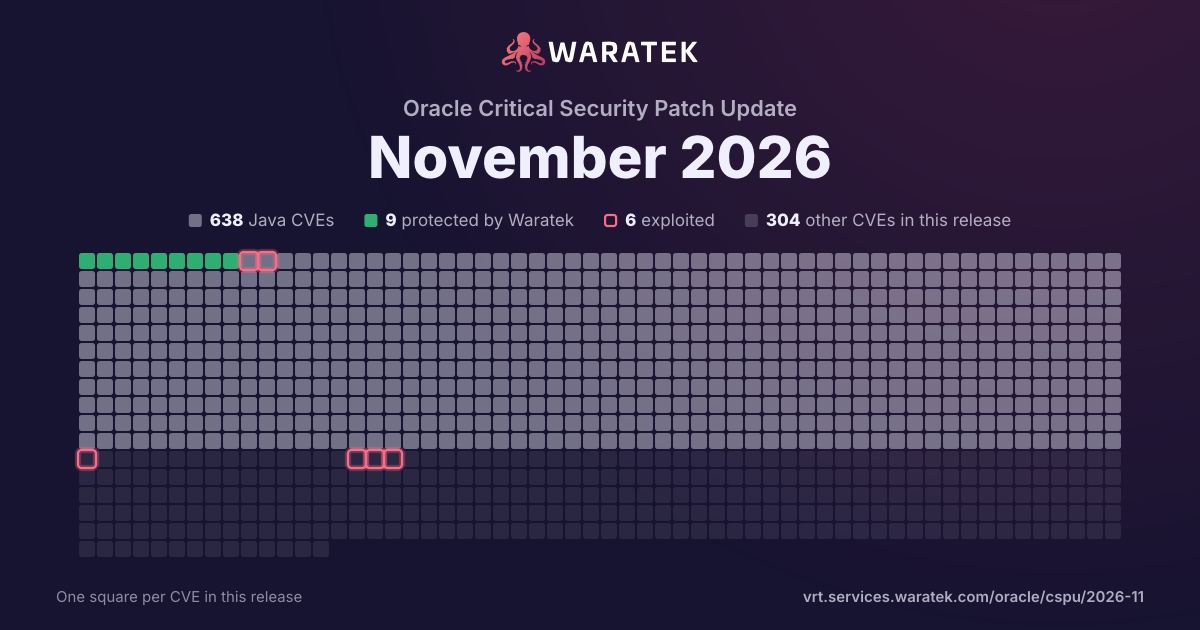
By status
9Protected by Waratek4Mitigation candidate625No exploit published15Outside Waratek scope289Not applicable
6Exploited, marked by the ring
No exploit published. For 554 of them, Oracle's security advisory is the source of public detail.
Protected by Waratek. Waratek RASP can block exploitation of these on systems that have not applied the patch yet.
Overview 106 matches · 63 in Waratek scope · 0 protected · 0 exploited · 0 CISA KEV · 0 public PoC · 0 EPSS ≥ 0.5
106matches
63in Waratek scope59.4%
0protected0.0%
0exploited0.0%
0CISA KEV0.0%
0public PoC0.0%
0EPSS ≥ 0.50.0%
Protected by Waratek
0
0.0%
Rule in development
0
0.0%
Mitigation candidate
0
0.0%
No exploit published
63
59.4%
Outside Waratek scope
7
6.6%
Not applicable
36
34.0%
Withdrawn CVE
0
0.0%
blocked by ARMR today
0
0.0%
partly blocked
0
0.0%
not blocked
106
100.0%
not established
0
0.0%
unrecorded
0
0.0%
Exploited
0
0.0%
Working exploit published
0
0.0%
Proof of concept only
4
3.8%
Forecast only
0
0.0%
No public exploit
102
96.2%
split by
peak 72 / quarter
Q1 251
Not applicable1
Low1
not blocked1
No public exploit1
Q2 250
Q3 250
Q4 250
Q1 262
Not applicable2
Low2
not blocked2
No public exploit2
Q2 2612
No exploit published3
Not applicable9
Low12
not blocked12
Proof of concept only1
No public exploit11
Q3 2619
No exploit published3
Outside Waratek scope6
Not applicable10
Low19
not blocked19
Proof of concept only3
No public exploit16
Q4 2672
No exploit published57
Outside Waratek scope1
Not applicable14
Low72
not blocked72
No public exploit72
Q1 25Q2 25Q3 25Q4 25Q1 26Q2 26Q3 26Q4 26
| CVE | Severity | Published▾ | Status | Exploitation | Description |
|---|---|---|---|---|---|
| CVE-2026-91679 | Low | 2026-11-17 | No exploit published | No public exploit | Vulnerability in the Oracle WebCenter Content product of Oracle Fusion Middleware (component: Content Portal Suite). Supported versions that are affected are 12.2.1.4.0 and 14.1.2.0.0. Difficult to exploit vulnerability allows unauthenticated attacker with network access via HTTP to compromise Oracle WebCenter Content. Successful attacks require human interaction from a person other than the attacker. Successful attacks of this vulnerability can result in unauthorized read access to a subset of Oracle WebCenter Content accessible data. CVSS 3.1 Base Score 3.1 (Confidentiality impacts). CVSS Vector: (CVSS:3.1/AV:N/AC:H/PR:N/UI:R/S:U/C:L/I:N/A:N). |
| CVE-2026-91678 | Low | 2026-11-17 | No exploit published | No public exploit | Vulnerability in the Service Delivery Platform product of Oracle Fusion Middleware (component: Installer). The supported version that is affected is 14.1.2.0.0. Easily exploitable vulnerability allows low privileged attacker with logon to the infrastructure where Service Delivery Platform executes to compromise Service Delivery Platform. Successful attacks of this vulnerability can result in unauthorized read access to a subset of Service Delivery Platform accessible data. CVSS 3.1 Base Score 3.3 (Confidentiality impacts). CVSS Vector: (CVSS:3.1/AV:L/AC:L/PR:L/UI:N/S:U/C:L/I:N/A:N). |
| CVE-2026-91676 | Low | 2026-11-17 | No exploit published | No public exploit | Vulnerability in the Oracle Identity Manager Connector product of Oracle Fusion Middleware (component: Millennium). Supported versions that are affected are 12.2.1.4.0 and 14.1.2.1.0. Easily exploitable vulnerability allows low privileged attacker with logon to the infrastructure where Oracle Identity Manager Connector executes to compromise Oracle Identity Manager Connector. Successful attacks of this vulnerability can result in unauthorized read access to a subset of Oracle Identity Manager Connector accessible data. CVSS 3.1 Base Score 3.3 (Confidentiality impacts). CVSS Vector: (CVSS:3.1/AV:L/AC:L/PR:L/UI:N/S:U/C:L/I:N/A:N). |
| CVE-2026-91674 | Low | 2026-11-17 | No exploit published | No public exploit | Vulnerability in the Oracle Identity Manager Connector product of Oracle Fusion Middleware (component: Generic REST). Supported versions that are affected are 12.2.1.4.0 and 14.1.2.1.0. Easily exploitable vulnerability allows low privileged attacker with logon to the infrastructure where Oracle Identity Manager Connector executes to compromise Oracle Identity Manager Connector. Successful attacks of this vulnerability can result in unauthorized read access to a subset of Oracle Identity Manager Connector accessible data. CVSS 3.1 Base Score 3.3 (Confidentiality impacts). CVSS Vector: (CVSS:3.1/AV:L/AC:L/PR:L/UI:N/S:U/C:L/I:N/A:N). |
| CVE-2026-91670 | Low | 2026-11-17 | No exploit published | No public exploit | Vulnerability in the Oracle Application Development Framework (ADF) product of Oracle Fusion Middleware (component: ADF Faces). Supported versions that are affected are 12.2.1.4.0 and 14.1.2.0.0. Difficult to exploit vulnerability allows unauthenticated attacker with network access via HTTP to compromise Oracle Application Development Framework (ADF). Successful attacks of this vulnerability can result in unauthorized read access to a subset of Oracle Application Development Framework (ADF) accessible data. CVSS 3.1 Base Score 3.7 (Confidentiality impacts). CVSS Vector: (CVSS:3.1/AV:N/AC:H/PR:N/UI:N/S:U/C:L/I:N/A:N). |
| CVE-2026-91619 | Low | 2026-11-17 | No exploit published | No public exploit | Vulnerability in the Oracle Application Development Framework (ADF) product of Oracle Fusion Middleware (component: ADF Faces). Supported versions that are affected are 12.2.1.4.0 and 14.1.2.0.0. Difficult to exploit vulnerability allows unauthenticated attacker with network access via HTTP to compromise Oracle Application Development Framework (ADF). Successful attacks of this vulnerability can result in unauthorized update, insert or delete access to some of Oracle Application Development Framework (ADF) accessible data. CVSS 3.1 Base Score 3.7 (Integrity impacts). CVSS Vector: (CVSS:3.1/AV:N/AC:H/PR:N/UI:N/S:U/C:N/I:L/A:N). |
| CVE-2026-127417 | Low | 2026-11-17 | No exploit published | No public exploit | Vulnerability in the Oracle Hyperion Infrastructure Technology product of Oracle Hyperion (component: Lifecycle Management). The supported version that is affected is 11.2.26.0.000. Easily exploitable vulnerability allows high privileged attacker with network access via HTTP to compromise Oracle Hyperion Infrastructure Technology. Successful attacks of this vulnerability can result in unauthorized read access to a subset of Oracle Hyperion Infrastructure Technology accessible data. CVSS 3.1 Base Score 2.7 (Confidentiality impacts). CVSS Vector: (CVSS:3.1/AV:N/AC:L/PR:H/UI:N/S:U/C:L/I:N/A:N). |
| CVE-2026-127407 | Low | 2026-11-17 | No exploit published | No public exploit | Vulnerability in the Oracle Agile Engineering Data Management product of Oracle Supply Chain (component: Engineering Communication Interface). The supported version that is affected is 6.2.1. Easily exploitable vulnerability allows low privileged attacker with logon to the infrastructure where Oracle Agile Engineering Data Management executes to compromise Oracle Agile Engineering Data Management. Successful attacks of this vulnerability can result in unauthorized read access to a subset of Oracle Agile Engineering Data Management accessible data. CVSS 3.1 Base Score 3.3 (Confidentiality impacts). CVSS Vector: (CVSS:3.1/AV:L/AC:L/PR:L/UI:N/S:U/C:L/I:N/A:N). |
| CVE-2026-127378 | Low | 2026-11-17 | No exploit published | No public exploit | Vulnerability in the Oracle Hyperion Financial Close Management product of Oracle Hyperion (component: Reconciliation Manage). The supported version that is affected is 11.2.26.0.000. Difficult to exploit vulnerability allows unauthenticated attacker with network access via HTTP to compromise Oracle Hyperion Financial Close Management. Successful attacks of this vulnerability can result in unauthorized read access to a subset of Oracle Hyperion Financial Close Management accessible data. CVSS 3.1 Base Score 3.7 (Confidentiality impacts). CVSS Vector: (CVSS:3.1/AV:N/AC:H/PR:N/UI:N/S:U/C:L/I:N/A:N). |
| CVE-2026-127366 | Low | 2026-11-17 | No exploit published | No public exploit | Vulnerability in the Oracle Hyperion Financial Close Management product of Oracle Hyperion (component: Reconciliation Manage). The supported version that is affected is 11.2.26.0.000. Easily exploitable vulnerability allows low privileged attacker with logon to the infrastructure where Oracle Hyperion Financial Close Management executes to compromise Oracle Hyperion Financial Close Management. Successful attacks of this vulnerability can result in unauthorized read access to a subset of Oracle Hyperion Financial Close Management accessible data. CVSS 3.1 Base Score 3.3 (Confidentiality impacts). CVSS Vector: (CVSS:3.1/AV:L/AC:L/PR:L/UI:N/S:U/C:L/I:N/A:N). |
| CVE-2026-127364 | Low | 2026-11-17 | No exploit published | No public exploit | Vulnerability in the Oracle Hyperion Financial Close Management product of Oracle Hyperion (component: Reconciliation Manage). The supported version that is affected is 11.2.26.0.000. Difficult to exploit vulnerability allows unauthenticated attacker with network access via HTTP to compromise Oracle Hyperion Financial Close Management. Successful attacks of this vulnerability can result in unauthorized read access to a subset of Oracle Hyperion Financial Close Management accessible data. CVSS 3.1 Base Score 3.7 (Confidentiality impacts). CVSS Vector: (CVSS:3.1/AV:N/AC:H/PR:N/UI:N/S:U/C:L/I:N/A:N). |
| CVE-2026-127361 | Low | 2026-11-17 | No exploit published | No public exploit | Vulnerability in the Oracle Hyperion Financial Close Management product of Oracle Hyperion (component: Reconciliation Manage). The supported version that is affected is 11.2.26.0.000. Difficult to exploit vulnerability allows high privileged attacker with network access via HTTP to compromise Oracle Hyperion Financial Close Management. Successful attacks require human interaction from a person other than the attacker. Successful attacks of this vulnerability can result in unauthorized update, insert or delete access to some of Oracle Hyperion Financial Close Management accessible data. CVSS 3.1 Base Score 2.0 (Integrity impacts). CVSS Vector: (CVSS:3.1/AV:N/AC:H/PR:H/UI:R/S:U/C:N/I:L/A:N). |
| CVE-2026-127354 | Low | 2026-11-17 | No exploit published | No public exploit | Vulnerability in the Oracle Hyperion Financial Close Management product of Oracle Hyperion (component: Reconciliation Manage). The supported version that is affected is 11.2.26.0.000. Difficult to exploit vulnerability allows low privileged attacker with network access via HTTP to compromise Oracle Hyperion Financial Close Management. Successful attacks of this vulnerability can result in unauthorized read access to a subset of Oracle Hyperion Financial Close Management accessible data. CVSS 3.1 Base Score 3.1 (Confidentiality impacts). CVSS Vector: (CVSS:3.1/AV:N/AC:H/PR:L/UI:N/S:U/C:L/I:N/A:N). |
| CVE-2026-127353 | Low | 2026-11-17 | No exploit published | No public exploit | Vulnerability in the Oracle Hyperion Financial Close Management product of Oracle Hyperion (component: Reconciliation Manage). The supported version that is affected is 11.2.26.0.000. Difficult to exploit vulnerability allows unauthenticated attacker with network access via HTTP to compromise Oracle Hyperion Financial Close Management. Successful attacks of this vulnerability can result in unauthorized update, insert or delete access to some of Oracle Hyperion Financial Close Management accessible data. CVSS 3.1 Base Score 3.7 (Integrity impacts). CVSS Vector: (CVSS:3.1/AV:N/AC:H/PR:N/UI:N/S:U/C:N/I:L/A:N). |
| CVE-2026-127348 | Low | 2026-11-17 | No exploit published | No public exploit | Vulnerability in the Oracle Hyperion Financial Close Management product of Oracle Hyperion (component: Reconciliation Manage). The supported version that is affected is 11.2.26.0.000. Difficult to exploit vulnerability allows unauthenticated attacker with logon to the infrastructure where Oracle Hyperion Financial Close Management executes to compromise Oracle Hyperion Financial Close Management. Successful attacks require human interaction from a person other than the attacker. Successful attacks of this vulnerability can result in unauthorized update, insert or delete access to some of Oracle Hyperion Financial Close Management accessible data as well as unauthorized read access to a subset of Oracle Hyperion Financial Close Management accessible data. CVSS 3.1 Base Score 3.6 (Confidentiality and Integrity impacts). CVSS Vector: (CVSS:3.1/AV:L/AC:H/PR:N/UI:R/S:U/C:L/I:L/A:N). |
| CVE-2026-127345 | Low | 2026-11-17 | No exploit published | No public exploit | Vulnerability in the Oracle Hyperion Financial Close Management product of Oracle Hyperion (component: Reconciliation Manage). The supported version that is affected is 11.2.26.0.000. Difficult to exploit vulnerability allows low privileged attacker with network access via HTTP to compromise Oracle Hyperion Financial Close Management. Successful attacks of this vulnerability can result in unauthorized update, insert or delete access to some of Oracle Hyperion Financial Close Management accessible data. CVSS 3.1 Base Score 3.1 (Integrity impacts). CVSS Vector: (CVSS:3.1/AV:N/AC:H/PR:L/UI:N/S:U/C:N/I:L/A:N). |
| CVE-2026-127323 | Low | 2026-11-17 | Not applicable | No public exploit | Vulnerability in the Oracle AutoVue product of Oracle Supply Chain (component: Security). The supported version that is affected is 21.1.0. Difficult to exploit vulnerability allows unauthenticated attacker with network access via HTTP to compromise Oracle AutoVue. Successful attacks of this vulnerability can result in unauthorized read access to a subset of Oracle AutoVue accessible data. CVSS 3.1 Base Score 3.7 (Confidentiality impacts). CVSS Vector: (CVSS:3.1/AV:N/AC:H/PR:N/UI:N/S:U/C:L/I:N/A:N). |
| CVE-2026-127318 | Low | 2026-11-17 | Not applicable | No public exploit | Vulnerability in the Oracle AutoVue product of Oracle Supply Chain (component: Security). The supported version that is affected is 21.1.0.7. Difficult to exploit vulnerability allows unauthenticated attacker with access to the physical communication segment attached to the hardware where the Oracle AutoVue executes to compromise Oracle AutoVue. Successful attacks of this vulnerability can result in unauthorized read access to a subset of Oracle AutoVue accessible data. CVSS 3.1 Base Score 3.1 (Confidentiality impacts). CVSS Vector: (CVSS:3.1/AV:A/AC:H/PR:N/UI:N/S:U/C:L/I:N/A:N). |
| CVE-2026-127314 | Low | 2026-11-17 | Not applicable | No public exploit | Vulnerability in the Oracle AutoVue product of Oracle Supply Chain (component: Security). The supported version that is affected is 21.1.0.7. Easily exploitable vulnerability allows low privileged attacker with logon to the infrastructure where Oracle AutoVue executes to compromise Oracle AutoVue. Successful attacks of this vulnerability can result in unauthorized read access to a subset of Oracle AutoVue accessible data. CVSS 3.1 Base Score 3.3 (Confidentiality impacts). CVSS Vector: (CVSS:3.1/AV:L/AC:L/PR:L/UI:N/S:U/C:L/I:N/A:N). |
| CVE-2026-127305 | Low | 2026-11-17 | No exploit published | No public exploit | Vulnerability in the Oracle Hyperion Financial Close Management product of Oracle Hyperion (component: Reconciliation Manage). The supported version that is affected is 11.2.26.0.000. Difficult to exploit vulnerability allows high privileged attacker with network access via HTTP to compromise Oracle Hyperion Financial Close Management. Successful attacks of this vulnerability can result in unauthorized update, insert or delete access to some of Oracle Hyperion Financial Close Management accessible data as well as unauthorized read access to a subset of Oracle Hyperion Financial Close Management accessible data. CVSS 3.1 Base Score 3.3 (Confidentiality and Integrity impacts). CVSS Vector: (CVSS:3.1/AV:N/AC:H/PR:H/UI:N/S:U/C:L/I:L/A:N). |
| CVE-2026-115180 | Low | 2026-11-17 | No exploit published | No public exploit | Vulnerability in the Oracle Hyperion Financial Close Management product of Oracle Hyperion (component: Reconciliation Manage). The supported version that is affected is 11.2.26.0.000. Difficult to exploit vulnerability allows unauthenticated attacker with access to the physical communication segment attached to the hardware where the Oracle Hyperion Financial Close Management executes to compromise Oracle Hyperion Financial Close Management. Successful attacks of this vulnerability can result in unauthorized read access to a subset of Oracle Hyperion Financial Close Management accessible data. CVSS 3.1 Base Score 3.1 (Confidentiality impacts). CVSS Vector: (CVSS:3.1/AV:A/AC:H/PR:N/UI:N/S:U/C:L/I:N/A:N). |
| CVE-2026-115174 | Low | 2026-11-17 | No exploit published | No public exploit | Vulnerability in the Oracle Hyperion Financial Close Management product of Oracle Hyperion (component: Reconciliation Manage). The supported version that is affected is 11.2.26.0.000. Difficult to exploit vulnerability allows high privileged attacker with logon to the infrastructure where Oracle Hyperion Financial Close Management executes to compromise Oracle Hyperion Financial Close Management. Successful attacks of this vulnerability can result in unauthorized read access to a subset of Oracle Hyperion Financial Close Management accessible data. CVSS 3.1 Base Score 1.9 (Confidentiality impacts). CVSS Vector: (CVSS:3.1/AV:L/AC:H/PR:H/UI:N/S:U/C:L/I:N/A:N). |
| CVE-2026-115171 | Low | 2026-11-17 | No exploit published | No public exploit | Vulnerability in the Oracle Hyperion Financial Close Management product of Oracle Hyperion (component: Reconciliation Manage). The supported version that is affected is 11.2.26.0.000. Difficult to exploit vulnerability allows high privileged attacker with logon to the infrastructure where Oracle Hyperion Financial Close Management executes to compromise Oracle Hyperion Financial Close Management. Successful attacks of this vulnerability can result in unauthorized update, insert or delete access to some of Oracle Hyperion Financial Close Management accessible data. CVSS 3.1 Base Score 1.9 (Integrity impacts). CVSS Vector: (CVSS:3.1/AV:L/AC:H/PR:H/UI:N/S:U/C:N/I:L/A:N). |
| CVE-2026-115152 | Low | 2026-11-17 | No exploit published | No public exploit | Vulnerability in the Oracle Hyperion Planning product of Oracle Hyperion (component: Security). The supported version that is affected is 11.2.26.0.000. Difficult to exploit vulnerability allows high privileged attacker with logon to the infrastructure where Oracle Hyperion Planning executes to compromise Oracle Hyperion Planning. Successful attacks of this vulnerability can result in unauthorized read access to a subset of Oracle Hyperion Planning accessible data. CVSS 3.1 Base Score 1.9 (Confidentiality impacts). CVSS Vector: (CVSS:3.1/AV:L/AC:H/PR:H/UI:N/S:U/C:L/I:N/A:N). |
| CVE-2026-115123 | Low | 2026-11-17 | No exploit published | No public exploit | Vulnerability in the Oracle Hyperion Planning product of Oracle Hyperion (component: Application Development Framework). The supported version that is affected is 11.2.26.0.000. Difficult to exploit vulnerability allows low privileged attacker with logon to the infrastructure where Oracle Hyperion Planning executes to compromise Oracle Hyperion Planning. Successful attacks of this vulnerability can result in unauthorized read access to a subset of Oracle Hyperion Planning accessible data. CVSS 3.1 Base Score 2.5 (Confidentiality impacts). CVSS Vector: (CVSS:3.1/AV:L/AC:H/PR:L/UI:N/S:U/C:L/I:N/A:N). |
| CVE-2026-115118 | Low | 2026-11-17 | No exploit published | No public exploit | Vulnerability in the Oracle Hyperion Financial Close Management product of Oracle Hyperion (component: Reconciliation Manage). The supported version that is affected is 11.2.26.0.000. Difficult to exploit vulnerability allows unauthenticated attacker with network access via HTTP to compromise Oracle Hyperion Financial Close Management. Successful attacks of this vulnerability can result in unauthorized read access to a subset of Oracle Hyperion Financial Close Management accessible data. CVSS 3.1 Base Score 3.7 (Confidentiality impacts). CVSS Vector: (CVSS:3.1/AV:N/AC:H/PR:N/UI:N/S:U/C:L/I:N/A:N). |
| CVE-2026-115115 | Low | 2026-11-17 | No exploit published | No public exploit | Vulnerability in the Oracle Hyperion Financial Close Management product of Oracle Hyperion (component: Reconciliation Manage). The supported version that is affected is 11.2.26.0.000. Difficult to exploit vulnerability allows high privileged attacker with logon to the infrastructure where Oracle Hyperion Financial Close Management executes to compromise Oracle Hyperion Financial Close Management. Successful attacks of this vulnerability can result in unauthorized update, insert or delete access to some of Oracle Hyperion Financial Close Management accessible data as well as unauthorized read access to a subset of Oracle Hyperion Financial Close Management accessible data. CVSS 3.1 Base Score 3.0 (Confidentiality and Integrity impacts). CVSS Vector: (CVSS:3.1/AV:L/AC:H/PR:H/UI:N/S:U/C:L/I:L/A:N). |
| CVE-2026-115114 | Low | 2026-11-17 | No exploit published | No public exploit | Vulnerability in the Oracle Hyperion Planning product of Oracle Hyperion (component: Security). The supported version that is affected is 11.2.26.0.000. Difficult to exploit vulnerability allows high privileged attacker with logon to the infrastructure where Oracle Hyperion Planning executes to compromise Oracle Hyperion Planning. Successful attacks of this vulnerability can result in unauthorized read access to a subset of Oracle Hyperion Planning accessible data. CVSS 3.1 Base Score 1.9 (Confidentiality impacts). CVSS Vector: (CVSS:3.1/AV:L/AC:H/PR:H/UI:N/S:U/C:L/I:N/A:N). |
| CVE-2026-115108 | Low | 2026-11-17 | No exploit published | No public exploit | Vulnerability in the Oracle Hyperion Planning product of Oracle Hyperion (component: Security). The supported version that is affected is 11.2.26.0.000. Difficult to exploit vulnerability allows unauthenticated attacker with network access via HTTP to compromise Oracle Hyperion Planning. Successful attacks of this vulnerability can result in unauthorized read access to a subset of Oracle Hyperion Planning accessible data. CVSS 3.1 Base Score 3.7 (Confidentiality impacts). CVSS Vector: (CVSS:3.1/AV:N/AC:H/PR:N/UI:N/S:U/C:L/I:N/A:N). |
| CVE-2026-115104 | Low | 2026-11-17 | No exploit published | No public exploit | Vulnerability in the Oracle Hyperion Financial Close Management product of Oracle Hyperion (component: Reconciliation Manage). The supported version that is affected is 11.2.26.0.000. Difficult to exploit vulnerability allows low privileged attacker with logon to the infrastructure where Oracle Hyperion Financial Close Management executes to compromise Oracle Hyperion Financial Close Management. Successful attacks of this vulnerability can result in unauthorized read access to a subset of Oracle Hyperion Financial Close Management accessible data. CVSS 3.1 Base Score 2.5 (Confidentiality impacts). CVSS Vector: (CVSS:3.1/AV:L/AC:H/PR:L/UI:N/S:U/C:L/I:N/A:N). |
| CVE-2026-115098 | Low | 2026-11-17 | No exploit published | No public exploit | Vulnerability in the Oracle Hyperion Financial Close Management product of Oracle Hyperion (component: Reconciliation Manage). The supported version that is affected is 11.2.26.0.000. Difficult to exploit vulnerability allows unauthenticated attacker with network access via HTTP to compromise Oracle Hyperion Financial Close Management. Successful attacks of this vulnerability can result in unauthorized update, insert or delete access to some of Oracle Hyperion Financial Close Management accessible data. CVSS 3.1 Base Score 3.7 (Integrity impacts). CVSS Vector: (CVSS:3.1/AV:N/AC:H/PR:N/UI:N/S:U/C:N/I:L/A:N). |
| CVE-2026-115084 | Low | 2026-11-17 | No exploit published | No public exploit | Vulnerability in the Oracle Hyperion Infrastructure Technology product of Oracle Hyperion (component: Installation and Configuration). The supported version that is affected is 11.2.26.0.000. Difficult to exploit vulnerability allows unauthenticated attacker with network access via HTTP to compromise Oracle Hyperion Infrastructure Technology. Successful attacks require human interaction from a person other than the attacker. Successful attacks of this vulnerability can result in unauthorized update, insert or delete access to some of Oracle Hyperion Infrastructure Technology accessible data. CVSS 3.1 Base Score 3.1 (Integrity impacts). CVSS Vector: (CVSS:3.1/AV:N/AC:H/PR:N/UI:R/S:U/C:N/I:L/A:N). |
| CVE-2026-115075 | Low | 2026-11-17 | No exploit published | No public exploit | Vulnerability in the Oracle Hyperion Infrastructure Technology product of Oracle Hyperion (component: Common Security). The supported version that is affected is 11.2.26.0.000. Easily exploitable vulnerability allows low privileged attacker with logon to the infrastructure where Oracle Hyperion Infrastructure Technology executes to compromise Oracle Hyperion Infrastructure Technology. Successful attacks of this vulnerability can result in unauthorized read access to a subset of Oracle Hyperion Infrastructure Technology accessible data. CVSS 3.1 Base Score 3.3 (Confidentiality impacts). CVSS Vector: (CVSS:3.1/AV:L/AC:L/PR:L/UI:N/S:U/C:L/I:N/A:N). |
| CVE-2026-115073 | Low | 2026-11-17 | No exploit published | No public exploit | Vulnerability in the Oracle Hyperion Infrastructure Technology product of Oracle Hyperion (component: Common Security). The supported version that is affected is 11.2.26.0.000. Difficult to exploit vulnerability allows low privileged attacker with network access via HTTP to compromise Oracle Hyperion Infrastructure Technology. Successful attacks of this vulnerability can result in unauthorized read access to a subset of Oracle Hyperion Infrastructure Technology accessible data. CVSS 3.1 Base Score 3.1 (Confidentiality impacts). CVSS Vector: (CVSS:3.1/AV:N/AC:H/PR:L/UI:N/S:U/C:L/I:N/A:N). |
| CVE-2026-115041 | Low | 2026-11-17 | No exploit published | No public exploit | Vulnerability in the Siebel CRM Deployment product of Oracle Siebel CRM (component: Server Infrastructure). Supported versions that are affected are 17.0-26.9. Easily exploitable vulnerability allows low privileged attacker with logon to the infrastructure where Siebel CRM Deployment executes to compromise Siebel CRM Deployment. Successful attacks of this vulnerability can result in unauthorized ability to cause a partial denial of service (partial DOS) of Siebel CRM Deployment. CVSS 3.1 Base Score 3.3 (Availability impacts). CVSS Vector: (CVSS:3.1/AV:L/AC:L/PR:L/UI:N/S:U/C:N/I:N/A:L). |
| CVE-2026-115040 | Low | 2026-11-17 | No exploit published | No public exploit | Vulnerability in the Siebel CRM Deployment product of Oracle Siebel CRM (component: Server Infrastructure). Supported versions that are affected are 17.0-26.9. Difficult to exploit vulnerability allows high privileged attacker with logon to the infrastructure where Siebel CRM Deployment executes to compromise Siebel CRM Deployment. Successful attacks of this vulnerability can result in unauthorized read access to a subset of Siebel CRM Deployment accessible data. CVSS 3.1 Base Score 1.9 (Confidentiality impacts). CVSS Vector: (CVSS:3.1/AV:L/AC:H/PR:H/UI:N/S:U/C:L/I:N/A:N). |
| CVE-2026-115033 | Low | 2026-11-17 | No exploit published | No public exploit | Vulnerability in the Oracle Hyperion Data Relationship Management product of Oracle Hyperion (component: Access and security). The supported version that is affected is 11.2.26.0.000. Easily exploitable vulnerability allows low privileged attacker with logon to the infrastructure where Oracle Hyperion Data Relationship Management executes to compromise Oracle Hyperion Data Relationship Management. Successful attacks of this vulnerability can result in unauthorized read access to a subset of Oracle Hyperion Data Relationship Management accessible data. CVSS 3.1 Base Score 3.3 (Confidentiality impacts). CVSS Vector: (CVSS:3.1/AV:L/AC:L/PR:L/UI:N/S:U/C:L/I:N/A:N). |
| CVE-2026-115030 | Low | 2026-11-17 | No exploit published | No public exploit | Vulnerability in the Oracle Hyperion Data Relationship Management product of Oracle Hyperion (component: Access and security). The supported version that is affected is 11.2.26.0.000. Difficult to exploit vulnerability allows low privileged attacker with network access via HTTP to compromise Oracle Hyperion Data Relationship Management. Successful attacks of this vulnerability can result in unauthorized read access to a subset of Oracle Hyperion Data Relationship Management accessible data. CVSS 3.1 Base Score 3.1 (Confidentiality impacts). CVSS Vector: (CVSS:3.1/AV:N/AC:H/PR:L/UI:N/S:U/C:L/I:N/A:N). |
| CVE-2026-115029 | Low | 2026-11-17 | No exploit published | No public exploit | Vulnerability in the Oracle Hyperion Data Relationship Management product of Oracle Hyperion (component: Access and security). The supported version that is affected is 11.2.26.0.000. Difficult to exploit vulnerability allows unauthenticated attacker with network access via HTTP to compromise Oracle Hyperion Data Relationship Management. Successful attacks require human interaction from a person other than the attacker and while the vulnerability is in Oracle Hyperion Data Relationship Management, attacks may significantly impact additional products (scope change). Successful attacks of this vulnerability can result in unauthorized update, insert or delete access to some of Oracle Hyperion Data Relationship Management accessible data. CVSS 3.1 Base Score 3.4 (Integrity impacts). CVSS Vector: (CVSS:3.1/AV:N/AC:H/PR:N/UI:R/S:C/C:N/I:L/A:N). |
| CVE-2026-115028 | Low | 2026-11-17 | No exploit published | No public exploit | Vulnerability in the Oracle Hyperion Data Relationship Management product of Oracle Hyperion (component: Access and security). The supported version that is affected is 11.2.26.0.000. Difficult to exploit vulnerability allows unauthenticated attacker with network access via HTTP to compromise Oracle Hyperion Data Relationship Management. Successful attacks of this vulnerability can result in unauthorized read access to a subset of Oracle Hyperion Data Relationship Management accessible data. CVSS 3.1 Base Score 3.7 (Confidentiality impacts). CVSS Vector: (CVSS:3.1/AV:N/AC:H/PR:N/UI:N/S:U/C:L/I:N/A:N). |
| CVE-2026-115026 | Low | 2026-11-17 | No exploit published | No public exploit | Vulnerability in the Oracle Hyperion Data Relationship Management product of Oracle Hyperion (component: Access and security). The supported version that is affected is 11.2.26.0.000. Easily exploitable vulnerability allows low privileged attacker with network access via HTTP to compromise Oracle Hyperion Data Relationship Management. Successful attacks require human interaction from a person other than the attacker. Successful attacks of this vulnerability can result in unauthorized update, insert or delete access to some of Oracle Hyperion Data Relationship Management accessible data. CVSS 3.1 Base Score 3.5 (Integrity impacts). CVSS Vector: (CVSS:3.1/AV:N/AC:L/PR:L/UI:R/S:U/C:N/I:L/A:N). |
| CVE-2026-115025 | Low | 2026-11-17 | No exploit published | No public exploit | Vulnerability in the Oracle Hyperion Data Relationship Management product of Oracle Hyperion (component: Access and security). The supported version that is affected is 11.2.26.0.000. Difficult to exploit vulnerability allows low privileged attacker with network access via HTTP to compromise Oracle Hyperion Data Relationship Management. Successful attacks of this vulnerability can result in unauthorized read access to a subset of Oracle Hyperion Data Relationship Management accessible data. CVSS 3.1 Base Score 3.1 (Confidentiality impacts). CVSS Vector: (CVSS:3.1/AV:N/AC:H/PR:L/UI:N/S:U/C:L/I:N/A:N). |
| CVE-2026-115020 | Low | 2026-11-17 | No exploit published | No public exploit | Vulnerability in the Oracle Hyperion Data Relationship Management product of Oracle Hyperion (component: Access and security). The supported version that is affected is 11.2.26.0.000. Difficult to exploit vulnerability allows unauthenticated attacker with network access via HTTP to compromise Oracle Hyperion Data Relationship Management. Successful attacks of this vulnerability can result in unauthorized ability to cause a partial denial of service (partial DOS) of Oracle Hyperion Data Relationship Management. CVSS 3.1 Base Score 3.7 (Availability impacts). CVSS Vector: (CVSS:3.1/AV:N/AC:H/PR:N/UI:N/S:U/C:N/I:N/A:L). |
| CVE-2026-115019 | Low | 2026-11-17 | No exploit published | No public exploit | Vulnerability in the Oracle Hyperion Data Relationship Management product of Oracle Hyperion (component: Access and security). The supported version that is affected is 11.2.26.0.000. Difficult to exploit vulnerability allows unauthenticated attacker with network access via HTTP to compromise Oracle Hyperion Data Relationship Management. Successful attacks of this vulnerability can result in unauthorized ability to cause a partial denial of service (partial DOS) of Oracle Hyperion Data Relationship Management. CVSS 3.1 Base Score 3.7 (Availability impacts). CVSS Vector: (CVSS:3.1/AV:N/AC:H/PR:N/UI:N/S:U/C:N/I:N/A:L). |
| CVE-2026-115015 | Low | 2026-11-17 | No exploit published | No public exploit | Vulnerability in the Oracle Hyperion Data Relationship Management product of Oracle Hyperion (component: Access and security). The supported version that is affected is 11.2.26.0.000. Difficult to exploit vulnerability allows unauthenticated attacker with network access via HTTP to compromise Oracle Hyperion Data Relationship Management. Successful attacks of this vulnerability can result in unauthorized read access to a subset of Oracle Hyperion Data Relationship Management accessible data. CVSS 3.1 Base Score 3.7 (Confidentiality impacts). CVSS Vector: (CVSS:3.1/AV:N/AC:H/PR:N/UI:N/S:U/C:L/I:N/A:N). |
| CVE-2026-115012 | Low | 2026-11-17 | No exploit published | No public exploit | Vulnerability in the Oracle Hyperion Data Relationship Management product of Oracle Hyperion (component: Access and security). The supported version that is affected is 11.2.26.0.000. Easily exploitable vulnerability allows low privileged attacker with logon to the infrastructure where Oracle Hyperion Data Relationship Management executes to compromise Oracle Hyperion Data Relationship Management. Successful attacks of this vulnerability can result in unauthorized read access to a subset of Oracle Hyperion Data Relationship Management accessible data. CVSS 3.1 Base Score 3.3 (Confidentiality impacts). CVSS Vector: (CVSS:3.1/AV:L/AC:L/PR:L/UI:N/S:U/C:L/I:N/A:N). |
| CVE-2026-115010 | Low | 2026-11-17 | No exploit published | No public exploit | Vulnerability in the Oracle Hyperion Data Relationship Management product of Oracle Hyperion (component: Access and security). The supported version that is affected is 11.2.26.0.000. Difficult to exploit vulnerability allows high privileged attacker with logon to the infrastructure where Oracle Hyperion Data Relationship Management executes to compromise Oracle Hyperion Data Relationship Management. Successful attacks of this vulnerability can result in unauthorized ability to cause a partial denial of service (partial DOS) of Oracle Hyperion Data Relationship Management. CVSS 3.1 Base Score 1.9 (Availability impacts). CVSS Vector: (CVSS:3.1/AV:L/AC:H/PR:H/UI:N/S:U/C:N/I:N/A:L). |
| CVE-2026-115009 | Low | 2026-11-17 | No exploit published | No public exploit | Vulnerability in the Oracle Hyperion Data Relationship Management product of Oracle Hyperion (component: Access and security). The supported version that is affected is 11.2.26.0.000. Difficult to exploit vulnerability allows low privileged attacker with network access via HTTP to compromise Oracle Hyperion Data Relationship Management. Successful attacks of this vulnerability can result in unauthorized read access to a subset of Oracle Hyperion Data Relationship Management accessible data. CVSS 3.1 Base Score 3.1 (Confidentiality impacts). CVSS Vector: (CVSS:3.1/AV:N/AC:H/PR:L/UI:N/S:U/C:L/I:N/A:N). |
| CVE-2026-115007 | Low | 2026-11-17 | No exploit published | No public exploit | Vulnerability in the Oracle Hyperion Data Relationship Management product of Oracle Hyperion (component: Access and security). The supported version that is affected is 11.2.26.0.000. Difficult to exploit vulnerability allows unauthenticated attacker with network access via HTTP to compromise Oracle Hyperion Data Relationship Management. Successful attacks require human interaction from a person other than the attacker. Successful attacks of this vulnerability can result in unauthorized read access to a subset of Oracle Hyperion Data Relationship Management accessible data. CVSS 3.1 Base Score 3.1 (Confidentiality impacts). CVSS Vector: (CVSS:3.1/AV:N/AC:H/PR:N/UI:R/S:U/C:L/I:N/A:N). |
| CVE-2026-114988 | Low | 2026-11-17 | Not applicable | No public exploit | Vulnerability in the Oracle AutoVue product of Oracle Supply Chain (component: Security Related Issues). The supported version that is affected is 21.1.0. Difficult to exploit vulnerability allows low privileged attacker with logon to the infrastructure where Oracle AutoVue executes to compromise Oracle AutoVue. Successful attacks of this vulnerability can result in unauthorized update, insert or delete access to some of Oracle AutoVue accessible data as well as unauthorized read access to a subset of Oracle AutoVue accessible data. CVSS 3.1 Base Score 3.6 (Confidentiality and Integrity impacts). CVSS Vector: (CVSS:3.1/AV:L/AC:H/PR:L/UI:N/S:U/C:L/I:L/A:N). |
| CVE-2026-114987 | Low | 2026-11-17 | Not applicable | No public exploit | Vulnerability in the Oracle AutoVue product of Oracle Supply Chain (component: Security Related Issues). The supported version that is affected is 21.1.0. Easily exploitable vulnerability allows high privileged attacker with logon to the infrastructure where Oracle AutoVue executes to compromise Oracle AutoVue. Successful attacks of this vulnerability can result in unauthorized read access to a subset of Oracle AutoVue accessible data and unauthorized ability to cause a partial denial of service (partial DOS) of Oracle AutoVue. CVSS 3.1 Base Score 3.4 (Confidentiality and Availability impacts). CVSS Vector: (CVSS:3.1/AV:L/AC:L/PR:H/UI:N/S:U/C:L/I:N/A:L). |
| CVE-2026-114986 | Low | 2026-11-17 | Not applicable | No public exploit | Vulnerability in the Oracle AutoVue product of Oracle Supply Chain (component: Security Related Issues). The supported version that is affected is 21.1.0.7. Difficult to exploit vulnerability allows high privileged attacker with logon to the infrastructure where Oracle AutoVue executes to compromise Oracle AutoVue. Successful attacks of this vulnerability can result in unauthorized update, insert or delete access to some of Oracle AutoVue accessible data and unauthorized ability to cause a partial denial of service (partial DOS) of Oracle AutoVue. CVSS 3.1 Base Score 3.0 (Integrity and Availability impacts). CVSS Vector: (CVSS:3.1/AV:L/AC:H/PR:H/UI:N/S:U/C:N/I:L/A:L). |
| CVE-2026-114985 | Low | 2026-11-17 | Not applicable | No public exploit | Vulnerability in the Oracle AutoVue product of Oracle Supply Chain (component: Security Related Issues). The supported version that is affected is 21.1.0.7. Difficult to exploit vulnerability allows high privileged attacker with logon to the infrastructure where Oracle AutoVue executes to compromise Oracle AutoVue. Successful attacks of this vulnerability can result in unauthorized update, insert or delete access to some of Oracle AutoVue accessible data and unauthorized ability to cause a partial denial of service (partial DOS) of Oracle AutoVue. CVSS 3.1 Base Score 3.0 (Integrity and Availability impacts). CVSS Vector: (CVSS:3.1/AV:L/AC:H/PR:H/UI:N/S:U/C:N/I:L/A:L). |
| CVE-2026-114973 | Low | 2026-11-17 | No exploit published | No public exploit | Vulnerability in the Oracle Hyperion Profitability and Cost Management product of Oracle Hyperion (component: Deployment). The supported version that is affected is 11.2.26.0.000. Easily exploitable vulnerability allows low privileged attacker with logon to the infrastructure where Oracle Hyperion Profitability and Cost Management executes to compromise Oracle Hyperion Profitability and Cost Management. Successful attacks of this vulnerability can result in unauthorized read access to a subset of Oracle Hyperion Profitability and Cost Management accessible data. CVSS 3.1 Base Score 3.3 (Confidentiality impacts). CVSS Vector: (CVSS:3.1/AV:L/AC:L/PR:L/UI:N/S:U/C:L/I:N/A:N). |
| CVE-2026-114970 | Low | 2026-11-17 | No exploit published | No public exploit | Vulnerability in the Oracle Hyperion Profitability and Cost Management product of Oracle Hyperion (component: Deployment). The supported version that is affected is 11.2.26.0.000. Difficult to exploit vulnerability allows unauthenticated attacker with network access via HTTP to compromise Oracle Hyperion Profitability and Cost Management. Successful attacks of this vulnerability can result in unauthorized read access to a subset of Oracle Hyperion Profitability and Cost Management accessible data. CVSS 3.1 Base Score 3.7 (Confidentiality impacts). CVSS Vector: (CVSS:3.1/AV:N/AC:H/PR:N/UI:N/S:U/C:L/I:N/A:N). |
| CVE-2026-114968 | Low | 2026-11-17 | No exploit published | No public exploit | Vulnerability in the Oracle Hyperion Profitability and Cost Management product of Oracle Hyperion (component: Deployment). The supported version that is affected is 11.2.26.0.000. Difficult to exploit vulnerability allows low privileged attacker with network access via HTTP to compromise Oracle Hyperion Profitability and Cost Management. Successful attacks of this vulnerability can result in unauthorized update, insert or delete access to some of Oracle Hyperion Profitability and Cost Management accessible data. CVSS 3.1 Base Score 3.1 (Integrity impacts). CVSS Vector: (CVSS:3.1/AV:N/AC:H/PR:L/UI:N/S:U/C:N/I:L/A:N). |
| CVE-2026-114967 | Low | 2026-11-17 | No exploit published | No public exploit | Vulnerability in the Oracle Hyperion Profitability and Cost Management product of Oracle Hyperion (component: Deployment). The supported version that is affected is 11.2.26.0.000. Easily exploitable vulnerability allows high privileged attacker with logon to the infrastructure where Oracle Hyperion Profitability and Cost Management executes to compromise Oracle Hyperion Profitability and Cost Management. Successful attacks of this vulnerability can result in unauthorized update, insert or delete access to some of Oracle Hyperion Profitability and Cost Management accessible data and unauthorized ability to cause a partial denial of service (partial DOS) of Oracle Hyperion Profitability and Cost Management. CVSS 3.1 Base Score 3.4 (Integrity and Availability impacts). CVSS Vector: (CVSS:3.1/AV:L/AC:L/PR:H/UI:N/S:U/C:N/I:L/A:L). |
| CVE-2026-114966 | Low | 2026-11-17 | No exploit published | No public exploit | Vulnerability in the Oracle Hyperion Profitability and Cost Management product of Oracle Hyperion (component: Deployment). The supported version that is affected is 11.2.26.0.000. Easily exploitable vulnerability allows low privileged attacker with logon to the infrastructure where Oracle Hyperion Profitability and Cost Management executes to compromise Oracle Hyperion Profitability and Cost Management. Successful attacks of this vulnerability can result in unauthorized read access to a subset of Oracle Hyperion Profitability and Cost Management accessible data. CVSS 3.1 Base Score 3.3 (Confidentiality impacts). CVSS Vector: (CVSS:3.1/AV:L/AC:L/PR:L/UI:N/S:U/C:L/I:N/A:N). |
| CVE-2026-114961 | Low | 2026-11-17 | No exploit published | No public exploit | Vulnerability in the Oracle Hyperion Infrastructure Technology product of Oracle Hyperion (component: Installation and Configuration). The supported version that is affected is 11.2.26.0.000. Difficult to exploit vulnerability allows high privileged attacker with logon to the infrastructure where Oracle Hyperion Infrastructure Technology executes to compromise Oracle Hyperion Infrastructure Technology. Successful attacks of this vulnerability can result in unauthorized update, insert or delete access to some of Oracle Hyperion Infrastructure Technology accessible data and unauthorized ability to cause a partial denial of service (partial DOS) of Oracle Hyperion Infrastructure Technology. CVSS 3.1 Base Score 3.0 (Integrity and Availability impacts). CVSS Vector: (CVSS:3.1/AV:L/AC:H/PR:H/UI:N/S:U/C:N/I:L/A:L). |
| CVE-2026-114957 | Low | 2026-11-17 | No exploit published | No public exploit | Vulnerability in the Oracle Hyperion Planning product of Oracle Hyperion (component: Security). The supported version that is affected is 11.2.26.0.000. Difficult to exploit vulnerability allows low privileged attacker with logon to the infrastructure where Oracle Hyperion Planning executes to compromise Oracle Hyperion Planning. Successful attacks of this vulnerability can result in unauthorized update, insert or delete access to some of Oracle Hyperion Planning accessible data. CVSS 3.1 Base Score 2.5 (Integrity impacts). CVSS Vector: (CVSS:3.1/AV:L/AC:H/PR:L/UI:N/S:U/C:N/I:L/A:N). |
| CVE-2026-114948 | Low | 2026-11-17 | Not applicable | No public exploit | Vulnerability in the MySQL Cluster product of Oracle MySQL (component: Cluster: JS module). Supported versions that are affected are 8.0.0-8.0.50, 8.4.0-8.4.13, 9.7.0-9.7.4 and 26.10. Difficult to exploit vulnerability allows low privileged attacker with logon to the infrastructure where MySQL Cluster executes to compromise MySQL Cluster. Successful attacks of this vulnerability can result in unauthorized read access to a subset of MySQL Cluster accessible data. CVSS 3.1 Base Score 2.5 (Confidentiality impacts). CVSS Vector: (CVSS:3.1/AV:L/AC:H/PR:L/UI:N/S:U/C:L/I:N/A:N). |
| CVE-2026-114947 | Low | 2026-11-17 | Outside Waratek scope | No public exploit | Vulnerability in Oracle Java SE (component: JSSE). Supported versions that are affected are Oracle Java SE: 25.0.5.0.3 and 27.0.1.0.3. Difficult to exploit vulnerability allows unauthenticated attacker with network access via TLS to compromise Oracle Java SE. Successful attacks of this vulnerability can result in unauthorized update, insert or delete access to some of Oracle Java SE accessible data. Note: This vulnerability applies to Java deployments, typically in clients running sandboxed Java Web Start applications or sandboxed Java applets, that load and run untrusted code (e.g., code that comes from the internet) and rely on the Java sandbox for security. This vulnerability does not apply to Java deployments, typically in servers, that load and run only trusted code (e.g., code installed by an administrator). CVSS 3.1 Base Score 3.7 (Integrity impacts). CVSS Vector: (CVSS:3.1/AV:N/AC:H/PR:N/UI:N/S:U/C:N/I:L/A:N). |
| CVE-2026-114834 | Low | 2026-11-17 | No exploit published | No public exploit | Vulnerability in the Helidon product of Oracle Fusion Middleware (component: helidon-data-jakarta-persistence). Supported versions that are affected are 4.0.0-4.5.6 and 27.0.0-27.0.1. Easily exploitable vulnerability allows low privileged attacker with logon to the infrastructure where Helidon executes to compromise Helidon. Successful attacks of this vulnerability can result in unauthorized read access to a subset of Helidon accessible data. CVSS 3.1 Base Score 3.3 (Confidentiality impacts). CVSS Vector: (CVSS:3.1/AV:L/AC:L/PR:L/UI:N/S:U/C:L/I:N/A:N). |
| CVE-2026-114831 | Low | 2026-11-17 | No exploit published | No public exploit | Vulnerability in the Helidon product of Oracle Fusion Middleware (component: helidon-webserver-static-content). Supported versions that are affected are 3.0.0-3.2.22, 4.0.0-4.5.6 and 27.0.0-27.0.1. Difficult to exploit vulnerability allows unauthenticated attacker with network access via HTTP to compromise Helidon. Successful attacks of this vulnerability can result in unauthorized ability to cause a partial denial of service (partial DOS) of Helidon. CVSS 3.1 Base Score 3.7 (Availability impacts). CVSS Vector: (CVSS:3.1/AV:N/AC:H/PR:N/UI:N/S:U/C:N/I:N/A:L). |
| CVE-2026-114807 | Low | 2026-11-17 | No exploit published | No public exploit | Vulnerability in the Oracle Business Intelligence Enterprise Edition product of Oracle Analytics (component: Platform Security). The supported version that is affected is 26.01.0.0.0. Difficult to exploit vulnerability allows high privileged attacker with logon to the infrastructure where Oracle Business Intelligence Enterprise Edition executes to compromise Oracle Business Intelligence Enterprise Edition. Successful attacks of this vulnerability can result in unauthorized update, insert or delete access to some of Oracle Business Intelligence Enterprise Edition accessible data as well as unauthorized read access to a subset of Oracle Business Intelligence Enterprise Edition accessible data and unauthorized ability to cause a partial denial of service (partial DOS) of Oracle Business Intelligence Enterprise Edition. CVSS 3.1 Base Score 3.9 (Confidentiality, Integrity and Availability impacts). CVSS Vector: (CVSS:3.1/AV:L/AC:H/PR:H/UI:N/S:U/C:L/I:L/A:L). |
| CVE-2026-114806 | Low | 2026-11-17 | No exploit published | No public exploit | Vulnerability in the Oracle Business Intelligence Enterprise Edition product of Oracle Analytics (component: Platform Security). The supported version that is affected is 26.01.0.0.0. Difficult to exploit vulnerability allows low privileged attacker with logon to the infrastructure where Oracle Business Intelligence Enterprise Edition executes to compromise Oracle Business Intelligence Enterprise Edition. Successful attacks of this vulnerability can result in unauthorized update, insert or delete access to some of Oracle Business Intelligence Enterprise Edition accessible data as well as unauthorized read access to a subset of Oracle Business Intelligence Enterprise Edition accessible data. CVSS 3.1 Base Score 3.6 (Confidentiality and Integrity impacts). CVSS Vector: (CVSS:3.1/AV:L/AC:H/PR:L/UI:N/S:U/C:L/I:L/A:N). |
| CVE-2026-106073 | Low | 2026-10-23 | Not applicable | No public exploit | A flaw in Node.js Permission Model filesystem enforcement leaves `fs.realpathSync()` without the required read permission checks. This is an incomplete fix of CVE-2026-21715, which only covered `fs.realpathSync.native()`. As a result, code running under `--permission` with restricted `--allow-fs-read` can still use `fs.realpathSync()` to check file existence, resolve symlink targets, and enumerate filesystem paths outside of permitted directories. This vulnerability affects Node.js **26.x**, **24.x**, and **22.x**. |
| CVE-2026-106071 | Low | 2026-10-23 | Not applicable | No public exploit | A flaw in Node.js Permission Model filesystem enforcement can grant access to paths that do not match a wildcard `--allow-fs-read` or `--allow-fs-write` rule. When the requested path is shorter than the prefix of a wildcard grant, the radix tree lookup stops comparing early and treats the path as a match. For example, `--allow-fs-read=/etc/passwd.*` also allows reading `/etc/passwd`. This requires the wildcard grant to sit directly under the root of the permission tree, for example when it is the only grant for that scope. This is a different root cause from CVE-2026-58043. This vulnerability affects Node.js **26.x**. |
| CVE-2026-106070 | Low | 2026-10-23 | Not applicable | No public exploit | A flaw in the Node.js `zlib.ZipFile` API can cause it to return bytes that do not belong to the requested entry after the local and central header validation fails. When `zipEntry.modified` is read on an archive whose local header does not match its central directory, either directly or while compacting the archive, the validation error is caught but the parsed local header is left cached without a content offset. A later content read then returns attacker-controlled bytes from the start of the file instead of rejecting the archive, and CRC-32 verification still passes because the attacker controls the central directory CRC. A Node.js-based scanner can therefore approve different content from what another ZIP implementation extracts from the same archive. This vulnerability affects Node.js **26.x**. |
| CVE-2026-114124 | Low | 2026-10-21 | Not applicable | No public exploit | Electron is a framework for writing cross-platform desktop applications using JavaScript, HTML and CSS. Prior to versions 42.11.6, 43.7.3, 44.4.3, and 45.0.0-alpha.9, frame data received from the GPU process for macOS offscreen rendering was not fully validated by the main process. An attacker who had separately gained code execution in the GPU process could provide inconsistent frame geometry and cause the main process to read out-of-bounds memory while producing paint event images, disclosing memory or crashing the application. This issue is fixed in versions 42.11.6, 43.7.3, 44.4.3, and 45.0.0-alpha.9. |
| CVE-2026-114122 | Low | 2026-10-21 | Not applicable | No public exploit | Electron is a framework for writing cross-platform desktop applications using JavaScript, HTML and CSS. Prior to versions 42.11.6, 43.7.3, 44.4.3, and 45.0.0-alpha.9, frame data received from the GPU process for webContents.beginFrameSubscription was not fully validated by the main process. An attacker who had separately gained code execution in the GPU process could supply inconsistent frame geometry and cause the main process to read out-of-bounds memory while producing captured frame images, disclosing memory or crashing the application. This issue is fixed in versions 42.11.6, 43.7.3, 44.4.3, and 45.0.0-alpha.9. |
| CVE-2026-42356 | Low | 2026-10-01 | Not applicable | No public exploit | Deployment of wrong handler vulnerability in Apache HTTP Server allows the target of some internal redirects from CGI programs to also be treated as CGI and executed. The target must already be in a directory enabled for CGI and have no other extension understood by mod_mime. This issue affects Apache HTTP Server: from 2.4.60 through 2.4.68. |
| CVE-2026-77696 | Low | 2026-09-29 | Not applicable | No public exploit | Issue summary: SM2 signature generation uses non-constant-time arithmetic on secret values, forming a timing side-channel. Impact summary: An attacker able to measure SM2 signing times may learn information about the per-signature secret nonce, which over many signatures can, via a lattice / Hidden Number Problem attack, lead to recovery of the private key. CWE: CWE-208: Observable Timing Discrepancy Description: SM2 signature generation computes the signature value using variable-time BIGNUM operations on the secret nonce and the private key, so the time taken to produce an SM2 signature depends on these secret values, forming a timing side-channel. Applications performing SM2 signature generation are affected on all platforms. FIPS Impact: no SM2 is not a FIPS algorithm. |
| CVE-2026-54875 | Low | 2026-09-29 | Not applicable | No public exploit | Issue summary: A non-constant-time optimized implementation of scalar point multiplication is used for SM2 private key operations on ARM64 and RISC-V platforms. Impact summary: An attacker able to measure the time taken by, or to observe the cache-line access pattern of SM2 signing or decryption on an affected platform can learn information about the secret scalar. CWE: CWE-208: Observable Timing Discrepancy Description: On ARM64 and RISC-V processors, the SM2 curve uses an optimized scalar multiplication implementation whose conditional branches and table look ups are chosen according to the bits of the secret scalar. The execution time and the cache-access pattern therefore depend on the long-term private key (during SM2 decryption) or the per-signature nonce (during SM2 signature generation), forming a timing and cache side-channel. FIPS Impact: no SM2 is not a FIPS algorithm and the optimized SM2 implementation is not part of the FIPS module. OpenSSL 4.0, 3.6, 3.5 and 3.4 are vulnerable to this issue on AArch64 and RISC-V. OpenSSL 3.0, 1.1.1 and 1.0.2 are not affected by this issue. OpenSSL 4.0 users should upgrade to OpenSSL 4.0.3. OpenSSL 3.6 users should upgrade to OpenSSL 3.6.5. OpenSSL 3.5 users should upgrade to OpenSSL 3.5.9. OpenSSL 3.4 users should upgrade to OpenSSL 3.4.8. This issue was reported on 2 May 2026 by Abhinav Agarwal. It was independently reported on 6 June 2026 by Feng Xue. The fix was developed by Igor Ustinov. -- cut (non-publishing metadata for internal use) -- Reported by: Abhinav Agarwal, Feng Xue Fixed by: Igor Ustinov |
| CVE-2026-54872 | Low | 2026-09-29 | Not applicable | No public exploit | Issue summary: The generic elliptic-curve scalar multiplication used for ECDSA and SM2 signature operations with curves that do not have a dedicated implementation leaks information about the secret nonce through timing. Impact summary: An attacker able to measure signing times may learn information about the per-signature secret nonce, which over many signatures can, via a lattice / Hidden Number Problem attack, lead to recovery of the private key. CWE: CWE-208: Observable Timing Discrepancy Description: The generic elliptic-curve scalar multiplication used for curves that do not have a dedicated constant-time implementation pads the secret scalar with non-constant-time BIGNUM operations, so the time taken depends on the value of the secret scalar derived from the ECDSA and SM2 nonce. The leak is very small; observing it requires a large number of measurements. The effect is largest for curves whose group order lies on a machine-word boundary, such as brainpoolP384r1. Applications using ECDSA signing over the Brainpool and other generic prime curves, and SM2 signing on platforms that use the generic implementation, are vulnerable to this issue. The NIST curves P-256, P-384 and P-521 use dedicated constant-time implementations and are not affected. FIPS Impact: no The FIPS modules are not affected: the approved NIST curves used in the FIPS provider have dedicated constant-time implementations and do not use the affected code path. |
| CVE-2026-35191 | Low | 2026-09-29 | Not applicable | No public exploit | Issue summary: The OpenSSL QUIC server, when configured to not preform address validation, can be forced to count incoming packets multiple times in its unvalidated credit computation, leading to a violation of the RFC 9000 unvalidated connection amplification limit of 3 times the amount of data received. Impact summary: A remote attacker able to spoof packets to a server using the OpenSSL QUIC implementation might use the server for an amplification of a DDoS attack. CWE: CWE-440: Expected Behavior Violation Description: OpenSSL's QUIC stack, when operating as a server, enforces client address validation (RFC 9000, Section 8), to confirm the peer address is not used for a traffic amplification attack. If this feature is disabled on the server, the QUIC stack limits the amount of server data that can be sent to 3 times the amount of data received from the peer address, until such time as the TLS handshake is completed. The OpenSSL QUIC server, when operating in non-validation mode, adds the length of the whole datagram received to the unvalidated credit limit when processing each QUIC packet in the datagram. A remote peer may, after establishing a connection with an initial client hello frame, send a subsequent datagram containing multiple QUIC packets, leading the server to account the entire datagram length for each packet in the datagram, resulting in the server believing that the peer has sent more data than it actually has, thereby violating the 3x amplification limit mandated by the RFC. FIPS impact: no As the QUIC stack lives outside the FIPS module boundary, no FIPS modules are affected by this CVE. |
| CVE-2026-67420 | Low | 2026-09-25 | Not applicable | Proof of concept only | RabbitMQ is a messaging and streaming broker. From 3.13.0 until 3.13.19, 4.0.24, 4.1.15, 4.2.10, and 4.3.5, RabbitMQ OAuth credential refresh retains revoked runtime tags. when an existing AMQP connection refreshes from an OAuth token that grants the impersonator tag to a valid same-username token that no longer grants that tag, RabbitMQ updates the OAuth backend implementation (token/scopes/expiry) but leaves the connection's runtime #user.tags unchanged. rabbitaccesscontrol:checkuserid/2 then still honors the stale impersonator tag, so the connection (including newly opened channels) can continue publishing messages with a foreign AMQP userid after that privilege should have been revoked. A fresh connection using the downgraded token correctly refuses the same publish, proving the defect is stale session state rather than the token Limited to connections that once held impersonator and successfully refresh to a downgraded same-username rabbitauthbackendoauth2 (or an equivalent refresh-capable backend that returns tags) is enabled for This issue is fixed in versions 3.13.19, 4.0.24, 4.1.15, 4.2.10, and 4.3.5. |
| CVE-2026-67234 | Low | 2026-09-25 | Not applicable | No public exploit | RabbitMQ is a messaging and streaming broker. From 4.2.0 until 4.2.8 and 4.3.2, get_auth_mechanism/1 used term_to_binary/1 on the strict_auth_mechanism or preferred_auth_mechanism atom when clearing the corresponding cookie, producing a non-ASCII cookie name that violates RFC 6265 and can prevent the browser from deleting the preference. The issue is not directly exploitable for code execution or data exfiltration; its security relevance is limited to stale authentication-mechanism preferences persisting across logout and login cycles. This issue is fixed in versions 4.2.8 and 4.3.2. |
| CVE-2026-77756 | Low | 2026-09-23 | No exploit published | No public exploit | Inconsistent Interpretation of HTTP Requests ('HTTP Request/Response Smuggling') vulnerability in Apache Tomcat caused by processing the transfer-encoding header for an HTTP/1.0 request may allow an attacker to cause one request from another user to fail when Tomcat is located behind a reverse proxy. This issue affects Apache Tomcat: from 11.0.0-M1 through 11.0.25, from 10.1.0-M1 through 10.1.59, from 9.0.47 through 9.0.121. The following versions were EOL at the time the CVE was created but are known to be affected: from 8.5.67 through 8.5.100. Other unsupported versions may also be affected. Users are recommended to upgrade to version 11.0.26, 10.1.60 or 9.0.122, which fix the issue. |
| CVE-2026-67240 | Low | 2026-09-23 | Not applicable | Proof of concept only | RabbitMQ is a messaging and streaming broker. Prior to versions 4.2.7 and 4.3.1, pattern_to_regex maps % -> .*? and _ -> ., then compiles ^...$ with only [unicode]; re:run is called with only [{capture, none}] - no explicit match_limit. A pattern like %_%_..._%X becomes ^.*?..*?.....*?.X$ with overlapping lazy quantifiers. The whole-expression cap is ?MAX_EXPRESSION_LENGTH=4096 chars / ?MAX_TOKENS=200; a LIKE string literal is one token, so ~2000 %_ pairs fit. SQL filters are accepted unconditionally at rabbit_amqp_session.erl:3264 (no feature flag). Evaluated per-message at rabbit_stream_queue.erl:1439. OTP's default 10M match_limit caps each match at ~100-200 ms (not seconds), and the re NIF yields to the scheduler. An authenticated AMQP 1.0 consumer with read+write on a stream queue can cause ~100-200 ms of CPU per delivered message via a crafted LIKE filter, multiplied across thousands of messages and parallel sessions - a substantial backtracking-driven CPU amplification. Preconditions include AMQP 1.0 with stream queues in use Attacker can attach a receiver with a filter (read permission) and publish messages with long property values (write permission). This issue is fixed in versions 4.2.7 and 4.3.1. |
| CVE-2026-66069 | Low | 2026-09-23 | Not applicable | No public exploit | RabbitMQ is a messaging and streaming broker. Prior to versions 4.1.13, 4.2.7, and 4.3.0, is_authorized/2 uses is_authorized_monitor for all methods. DELETE resets rabbit_core_metrics:reset_auth_attempt_metrics(). Impact is cosmetic (counters only, no log erasure), but inconsistent with rabbit_mgmt_wm_reset.erl which requires admin for the analogous operation. A monitoring-tagged user can reset the per-node authentication-attempt counters via DELETE /api/auth/attempts/:node, erasing evidence of brute-force activity. The sibling endpoint wm_reset requires administrator. Preconditions include Management plugin enabled monitoring tag. This issue is fixed in versions 4.1.13, 4.2.7, and 4.3.0. |
| CVE-2026-86141 | Low | 2026-09-05 | Not applicable | No public exploit | xmlregexp in libxml2 before 2.15.4 has a NULL pointer dereference in xmlRegNewParserCtxt after a strdup failure, i.e., it does not calculate a string length after NULL checking. |
| CVE-2026-60589 | Low | 2026-08-18 | No exploit published | No public exploit | Vulnerability in the Oracle Java SE, Oracle GraalVM for JDK, Oracle GraalVM Enterprise Edition product of Oracle Java SE (component: Security). Supported versions that are affected are Oracle Java SE: 8u501, 11.0.32, 17.0.20, 21.0.12, 25.0.4, 26.0.2; Oracle GraalVM for JDK: 17.0.20 and 21.0.12; Oracle GraalVM Enterprise Edition: 21.3.19. Difficult to exploit vulnerability allows unauthenticated attacker with network access via multiple protocols to compromise Oracle Java SE, Oracle GraalVM for JDK, Oracle GraalVM Enterprise Edition. Successful attacks of this vulnerability can result in unauthorized read access to a subset of Oracle Java SE, Oracle GraalVM for JDK, Oracle GraalVM Enterprise Edition accessible data. Note: This vulnerability can only be exploited by supplying data to APIs in the specified Component without using Untrusted Java Web Start applications or Untrusted Java applets, such as through a web service. CVSS 3.1 Base Score 3.7 (Confidentiality impacts). CVSS Vector: (CVSS:3.1/AV:N/AC:H/PR:N/UI:N/S:U/C:L/I:N/A:N). |
| CVE-2026-54522 | Low | 2026-07-30 | Not applicable | Proof of concept only | MessagePack for Ruby is an implementation of the MessagePack binary serialization format. Prior to 1.8.2, MessagePack::Buffer#clear in ext/msgpack/buffer.c leaves rmem_last, rmem_end, and rmem_owner stale after _msgpack_buffer_shift_chunk returns an rmem page to the shared pool, allowing a subsequent Buffer#write and a second MessagePack::Buffer to alias the page and disclose or corrupt cross-buffer data. This issue is fixed in version 1.8.2. |
| CVE-2026-60166 | Low | 2026-07-21 | Outside Waratek scope | No public exploit | Vulnerability in Oracle Java SE (component: JavaFX). The supported version that is affected is Oracle Java SE: 8u491. Difficult to exploit vulnerability allows unauthenticated attacker with network access via multiple protocols to compromise Oracle Java SE. Successful attacks require human interaction from a person other than the attacker. Successful attacks of this vulnerability can result in unauthorized read access to a subset of Oracle Java SE accessible data. Note: This vulnerability applies to Java deployments, typically in clients running sandboxed Java Web Start applications or sandboxed Java applets, that load and run untrusted code (e.g., code that comes from the internet) and rely on the Java sandbox for security. This vulnerability does not apply to Java deployments, typically in servers, that load and run only trusted code (e.g., code installed by an administrator). CVSS 3.1 Base Score 3.1 (Confidentiality impacts). CVSS Vector: (CVSS:3.1/AV:N/AC:H/PR:N/UI:R/S:U/C:L/I:N/A:N). |
| CVE-2026-60164 | Low | 2026-07-21 | Outside Waratek scope | No public exploit | Vulnerability in Oracle Java SE (component: JavaFX). The supported version that is affected is Oracle Java SE: 8u491. Difficult to exploit vulnerability allows unauthenticated attacker with network access via multiple protocols to compromise Oracle Java SE. Successful attacks require human interaction from a person other than the attacker. Successful attacks of this vulnerability can result in unauthorized read access to a subset of Oracle Java SE accessible data. Note: This vulnerability applies to Java deployments, typically in clients running sandboxed Java Web Start applications or sandboxed Java applets, that load and run untrusted code (e.g., code that comes from the internet) and rely on the Java sandbox for security. This vulnerability does not apply to Java deployments, typically in servers, that load and run only trusted code (e.g., code installed by an administrator). CVSS 3.1 Base Score 3.1 (Confidentiality impacts). CVSS Vector: (CVSS:3.1/AV:N/AC:H/PR:N/UI:R/S:U/C:L/I:N/A:N). |
| CVE-2026-47059 | Low | 2026-07-21 | Outside Waratek scope | No public exploit | Vulnerability in the Oracle Java SE, Oracle GraalVM for JDK, Oracle GraalVM Enterprise Edition product of Oracle Java SE (component: 2D). Supported versions that are affected are Oracle Java SE: 8u491, 8u491-perf, 11.0.31, 17.0.19, 21.0.11, 25.0.3, 26.0.1; Oracle GraalVM for JDK: 17.0.19 and 21.0.11; Oracle GraalVM Enterprise Edition: 21.3.18. Difficult to exploit vulnerability allows unauthenticated attacker with network access via multiple protocols to compromise Oracle Java SE, Oracle GraalVM for JDK, Oracle GraalVM Enterprise Edition. Successful attacks of this vulnerability can result in unauthorized ability to cause a partial denial of service (partial DOS) of Oracle Java SE, Oracle GraalVM for JDK, Oracle GraalVM Enterprise Edition. Note: This vulnerability applies to Java deployments, typically in clients running sandboxed Java Web Start applications or sandboxed Java applets, that load and run untrusted code (e.g., code that comes from the internet) and rely on the Java sandbox for security. This vulnerability does not apply to Java deployments, typically in servers, that load and run only trusted code (e.g., code installed by an administrator). CVSS 3.1 Base Score 3.7 (Availability impacts). CVSS Vector: (CVSS:3.1/AV:N/AC:H/PR:N/UI:N/S:U/C:N/I:N/A:L). |
| CVE-2026-47035 | Low | 2026-07-21 | Outside Waratek scope | No public exploit | Vulnerability in Oracle Java SE (component: JavaFX). The supported version that is affected is Oracle Java SE: 8u491. Difficult to exploit vulnerability allows unauthenticated attacker with network access via multiple protocols to compromise Oracle Java SE. Successful attacks require human interaction from a person other than the attacker. Successful attacks of this vulnerability can result in unauthorized update, insert or delete access to some of Oracle Java SE accessible data. Note: This vulnerability applies to Java deployments, typically in clients running sandboxed Java Web Start applications or sandboxed Java applets, that load and run untrusted code (e.g., code that comes from the internet) and rely on the Java sandbox for security. This vulnerability does not apply to Java deployments, typically in servers, that load and run only trusted code (e.g., code installed by an administrator). CVSS 3.1 Base Score 3.1 (Integrity impacts). CVSS Vector: (CVSS:3.1/AV:N/AC:H/PR:N/UI:R/S:U/C:N/I:L/A:N). |
| CVE-2026-47034 | Low | 2026-07-21 | Outside Waratek scope | No public exploit | Vulnerability in Oracle Java SE (component: JavaFX). The supported version that is affected is Oracle Java SE: 8u491. Difficult to exploit vulnerability allows unauthenticated attacker with network access via multiple protocols to compromise Oracle Java SE. Successful attacks require human interaction from a person other than the attacker. Successful attacks of this vulnerability can result in unauthorized update, insert or delete access to some of Oracle Java SE accessible data. Note: This vulnerability applies to Java deployments, typically in clients running sandboxed Java Web Start applications or sandboxed Java applets, that load and run untrusted code (e.g., code that comes from the internet) and rely on the Java sandbox for security. This vulnerability does not apply to Java deployments, typically in servers, that load and run only trusted code (e.g., code installed by an administrator). CVSS 3.1 Base Score 3.1 (Integrity impacts). CVSS Vector: (CVSS:3.1/AV:N/AC:H/PR:N/UI:R/S:U/C:N/I:L/A:N). |
| CVE-2026-47030 | Low | 2026-07-21 | Outside Waratek scope | No public exploit | Vulnerability in Oracle Java SE (component: JavaFX). The supported version that is affected is Oracle Java SE: 8u491. Difficult to exploit vulnerability allows unauthenticated attacker with network access via multiple protocols to compromise Oracle Java SE. Successful attacks require human interaction from a person other than the attacker. Successful attacks of this vulnerability can result in unauthorized update, insert or delete access to some of Oracle Java SE accessible data. Note: This vulnerability applies to Java deployments, typically in clients running sandboxed Java Web Start applications or sandboxed Java applets, that load and run untrusted code (e.g., code that comes from the internet) and rely on the Java sandbox for security. This vulnerability does not apply to Java deployments, typically in servers, that load and run only trusted code (e.g., code installed by an administrator). CVSS 3.1 Base Score 3.1 (Integrity impacts). CVSS Vector: (CVSS:3.1/AV:N/AC:H/PR:N/UI:R/S:U/C:N/I:L/A:N). |
| CVE-2026-47010 | Low | 2026-07-21 | No exploit published | No public exploit | Vulnerability in the Oracle Java SE, Oracle GraalVM for JDK, Oracle GraalVM Enterprise Edition product of Oracle Java SE (component: ImageIO). Supported versions that are affected are Oracle Java SE: 8u491, 8u491-perf, 11.0.31, 17.0.19, 21.0.11, 25.0.3, 26.0.1; Oracle GraalVM for JDK: 17.0.19 and 21.0.11; Oracle GraalVM Enterprise Edition: 21.3.18. Difficult to exploit vulnerability allows unauthenticated attacker with network access via multiple protocols to compromise Oracle Java SE, Oracle GraalVM for JDK, Oracle GraalVM Enterprise Edition. Successful attacks of this vulnerability can result in unauthorized update, insert or delete access to some of Oracle Java SE, Oracle GraalVM for JDK, Oracle GraalVM Enterprise Edition accessible data. Note: This vulnerability can be exploited by using APIs in the specified Component, e.g., through a web service which supplies data to the APIs. This vulnerability also applies to Java deployments, typically in clients running sandboxed Java Web Start applications or sandboxed Java applets, that load and run untrusted code (e.g., code that comes from the internet) and rely on the Java sandbox for security. CVSS 3.1 Base Score 3.7 (Integrity impacts). CVSS Vector: (CVSS:3.1/AV:N/AC:H/PR:N/UI:N/S:U/C:N/I:L/A:N). |
| CVE-2026-57438 | Low | 2026-06-25 | Not applicable | No public exploit | Nokogiri is an open source XML and HTML library for the Ruby programming language. Prior to 1.19.4, XInclude substitution performed by Nokogiri::XML::Node#do_xinclude replaced each <xi:include> in place, freeing the include node along with its children (such as <xi:fallback> and its descendants) and any namespaces declared on them. If an application had already exposed one of those nodes or namespaces to Ruby, the corresponding Ruby object was left pointing at freed memory. Using the object could result in invalid reads or writes to memory. This vulnerability is fixed in 1.19.4. |
| CVE-2026-57437 | Low | 2026-06-25 | Not applicable | No public exploit | Nokogiri is an open source XML and HTML library for the Ruby programming language. Prior to 1.19.4, Nokogiri::XML::XPathContext did not keep its source document alive for garbage collection. If an XPathContext outlived its document and the document was collected, evaluating an XPath expression could read invalid memory and potentially segfault. This is only reachable when application code constructs an XPathContext directly and lets the document become unreachable while continuing to use the context. The normal Document#xpath, #css, and related search methods are not affected, and it is not triggerable by malicious document input. This vulnerability is fixed in 1.19.4. |
| CVE-2026-57436 | Low | 2026-06-25 | Not applicable | No public exploit | Nokogiri is an open source XML and HTML library for the Ruby programming language. Prior to 1.19.4, Nokogiri::XML::Document#root= validated only that the new root was a Nokogiri::XML::Node, allowing a DTD node to be set as the document root. The result is a heap use-after-free during garbage collection or finalization, leading to an invalid memory read or potentially a segfault. This vulnerability is fixed in 1.19.4. |
| CVE-2026-57435 | Low | 2026-06-25 | Not applicable | No public exploit | Nokogiri is an open source XML and HTML library for the Ruby programming language. Prior to 1.19.4, Nokogiri’s CRuby native extension could leave a Ruby wrapper pointing to freed memory when replacing the value of an XML attribute. If Ruby code had already accessed an attribute child node, Nokogiri::XML::Attr#value= could free the underlying native child node while the wrapper remained reachable through the document node cache. A later use of the freed child node or a Ruby GC mark could dereference an invalid pointer, causing an invalid read and a possible segfault. This vulnerability is fixed in 1.19.4. |
| CVE-2026-57434 | Low | 2026-06-25 | Not applicable | No public exploit | Nokogiri is an open source XML and HTML library for the Ruby programming language. Prior to 1.19.4, Nokogiri contains a bug when calling certain methods on allocated-but-uninitialized native wrapper classes that inherit from Nokogiri::XML::Node. This caused a NULL pointer dereference that could crash the process. This vulnerability is fixed in 1.19.4. |
| CVE-2026-57236 | Low | 2026-06-25 | Not applicable | No public exploit | Nokogiri is an open source XML and HTML library for the Ruby programming language. Prior to 1.19.4, calling Document#encoding= with an invalid encoding (e.g., a non-string, or a string containing a null byte) raises an exception, but only after freeing the document's current encoding string without replacing it. The document is left referencing freed memory, so the next call to Document#encoding reads invalid memory, which can cause a segfault or leak freed bytes into a Ruby String. Affects the CRuby (libxml2) implementation only; JRuby is not affected. This vulnerability is fixed in 1.19.4. |
| CVE-2026-10803 | Low | 2026-06-04 | Not applicable | Proof of concept only | A flaw has been found in MLflow up to 3.10.0. This issue affects the function mlflow.data.digest_utils of the file mlflow/data/digest_utils.py of the component Dataset Digest Computation. This manipulation causes use of weak hash. It is possible to launch the attack on the local host. The attack is considered to have high complexity. The exploitability is assessed as difficult. The exploit has been published and may be used. The project was informed of the problem early through a pull request but has not reacted yet. |
| CVE-2026-45570 | Low | 2026-05-27 | Not applicable | No public exploit | go-git is an extensible git implementation library written in pure Go. Prior to 5.19.1 and 6.0.0-alpha.4, go-git's SSH transport constructs the remote exec command by wrapping the repository path in single quotes without escaping single quotes embedded inside the path. A repository path containing a single quote can therefore break out of the quoted region in the exec command and be appended as additional shell tokens. This vulnerability is fixed in 5.19.1 and 6.0.0-alpha.4. |
| CVE-2026-41889 | Low | 2026-05-08 | Not applicable | No public exploit | pgx is a PostgreSQL driver and toolkit for Go. Prior to version 5.9.2, SQL injection can occur when the non-default simple protocol is used, a dollar quoted string literal is used in the SQL query, that string literal contains text that would be would be interpreted as a placeholder outside of a string literal, and the value of that placeholder is controllable by the attacker. This issue has been patched in version 5.9.2. |