
Oracle Critical Security Patch Update November 2026
Released November 2026 · Oracle's advisory ↗ · ← Critical Patch Update, October 2026
942 CVEs in this release, one square each
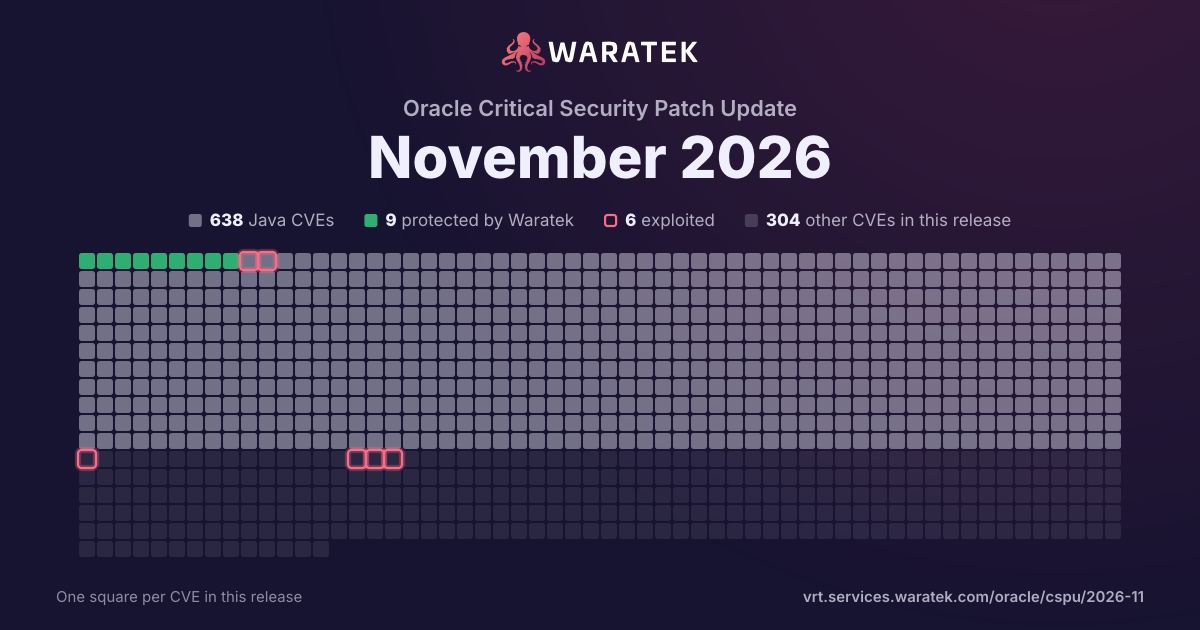
By status
9Protected by Waratek3Mitigation candidate626No exploit published15Outside Waratek scope289Not applicable
8Exploited, marked by the ring
No exploit published. For 547 of them, Oracle's security advisory is the source of public detail.
Protected by Waratek. Waratek RASP can block exploitation of these on systems that have not applied the patch yet.
Overview 350 matches · 118 in Waratek scope · 0 protected · 6 exploited · 3 CISA KEV · 7 public PoC · 1 EPSS ≥ 0.5
350matches
118in Waratek scope33.7%
0protected0.0%
6exploited1.7%
3CISA KEV0.9%
7public PoC2.0%
1EPSS ≥ 0.50.3%
Protected by Waratek
0
0.0%
Rule in development
0
0.0%
Mitigation candidate
3
0.9%
No exploit published
115
32.9%
Outside Waratek scope
13
3.7%
Not applicable
219
62.6%
Withdrawn CVE
0
0.0%
blocked by ARMR today
0
0.0%
partly blocked
0
0.0%
not blocked
350
100.0%
not established
0
0.0%
unrecorded
0
0.0%
Exploited
6
1.7%
Working exploit published
0
0.0%
Proof of concept only
92
26.3%
Forecast only
0
0.0%
No public exploit
252
72.0%
split by
peak 193 / quarter
Q3 211
No exploit published1
Medium1
not blocked1
No public exploit1
Q4 210
Q1 220
Q2 220
Q3 221
Not applicable1
High1
not blocked1
No public exploit1
Q4 220
Q1 230
Q2 231
No exploit published1
High1
not blocked1
No public exploit1
Q3 231
Not applicable1
High1
not blocked1
Proof of concept only1
Q4 231
Mitigation candidate1
High1
not blocked1
Exploited1
Q1 240
Q2 241
Not applicable1
Medium1
not blocked1
Proof of concept only1
Q3 240
Q4 241
Not applicable1
High1
not blocked1
Proof of concept only1
Q1 252
Not applicable2
High1
Low1
not blocked2
Proof of concept only1
No public exploit1
Q2 251
No exploit published1
High1
not blocked1
Proof of concept only1
Q3 250
Q4 251
Mitigation candidate1
Critical1
not blocked1
Exploited1
Q1 268
Not applicable8
High4
Medium2
Low2
not blocked8
No public exploit8
Q2 2652
Mitigation candidate1
No exploit published13
Outside Waratek scope3
Not applicable35
Critical3
High19
Medium18
Low12
not blocked52
Proof of concept only7
No public exploit45
Q3 26193
No exploit published80
Outside Waratek scope9
Not applicable104
Critical25
High103
Medium46
Low19
not blocked193
Proof of concept only53
No public exploit140
Q4 2686
No exploit published19
Outside Waratek scope1
Not applicable66
Critical20
High44
Medium16
Low6
not blocked86
Exploited4
Proof of concept only27
No public exploit55
Q4 21Q2 22Q4 22Q2 23Q4 23Q2 24Q4 24Q2 25Q4 25Q2 26Q4 26
| CVE | Severity | Published▾ | Status | Exploitation | Description |
|---|---|---|---|---|---|
| CVE-2026-116692 | Critical | 2026-10-27 | Not applicable | Exploited | MLflow is an open source AI engineering platform for agents, large language models, and machine learning models. From 3.12.0rc0 until 3.17.0, third-party scorer deserialization in mlflow/genai/scorers/base.py accepts request-selected descendants of THIRD_PARTY_SCORER_ALLOWED_MODULES rather than requiring an exact allowed module. A caller can use MLflow artifact endpoints to place a Python module beneath a writable allowed package and submit its module and class through /ajax-api/3.0/mlflow/scorer/invoke. Scorer.model_validate_json() imports the module and constructs the class before trace processing. Authentication-disabled deployments permit this code execution without credentials, while basic-auth deployments require a principal capable of creating an experiment and run and uploading artifacts. In either configuration, the allowed scorer package must be writable by the server process. This issue is fixed in version 3.17.0. |
| CVE-2026-116691 | Medium | 2026-10-27 | Not applicable | Proof of concept only | MLflow is an open source AI engineering platform for agents, large language models, and machine learning models. From 2.19.0 until 3.17.0, mlflow.crewai.autolog() records CrewAI Agent objects without consistently sanitizing nested credential-bearing values. mlflow/crewai/autolog.py::_get_agent_attributes() converts the Agent llm field to a string that includes the provider API key, while mlflow/crewai/autolog.py::_construct_full_inputs() expands the Agent object into mlflow.spanInputs. Applications can therefore send plaintext provider credentials to the MLflow trace backend or a configured OTLP destination, where trace readers can obtain them. This issue is fixed in version 3.17.0. |
| CVE-2026-116690 | High | 2026-10-27 | Not applicable | Exploited | MLflow is an open source AI engineering platform for agents, large language models, and machine learning models. From 3.10.0 until 3.17.0, the prompt branch in _create_model_version() accepts schemeless relative sources because path validation runs only when a source has a URL scheme, and mlflow.prompt.is_prompt is interpreted by tag presence rather than a true value. A remote caller can store a server-local path as the model version artifact location and use /api/2.0/mlflow/model-versions/get-artifact to read files accessible to the MLflow server process. Default unauthenticated servers require no privileges, while basic-auth deployments are exposed to authenticated users who can create registered models. This issue is fixed in version 3.17.0. |
| CVE-2026-115557 | Critical | 2026-10-24 | Not applicable | No public exploit | Python has added a denylist for known compromised certificates to the "ssl" module to ensure user safety even without certificate revocation configured. Known compromised certificates will automatically be rejected regardless of the SSLContext policy configuration. |
| CVE-2026-114820 | Critical | 2026-10-24 | No exploit published | No public exploit | Vulnerability in the Oracle Java SE, Oracle GraalVM for JDK, Oracle GraalVM Enterprise Edition product of Oracle Java SE (component: JSSE). Supported versions that are affected are Oracle Java SE: 8u511-b32, 8u511-perf-b32, 11.0.33.0.2, 17.0.21.0.2, 21.0.13.0.2, 25.0.5.0.2, 27.0.1.0.2; Oracle GraalVM for JDK: 17.0.21.0.2 and 21.0.13.0.2; Oracle GraalVM Enterprise Edition: 21.3.20.0.2. Easily exploitable vulnerability allows unauthenticated attacker with network access via multiple protocols to compromise Oracle Java SE, Oracle GraalVM for JDK, Oracle GraalVM Enterprise Edition. Successful attacks of this vulnerability can result in unauthorized creation, deletion or modification access to critical data or all Oracle Java SE, Oracle GraalVM for JDK, Oracle GraalVM Enterprise Edition accessible data as well as unauthorized access to critical data or complete access to all Oracle Java SE, Oracle GraalVM for JDK, Oracle GraalVM Enterprise Edition accessible data. Note: This vulnerability can be exploited by using APIs in the specified Component, e.g., through a web service which supplies data to the APIs. This vulnerability also applies to Java deployments, typically in clients running sandboxed Java Web Start applications or sandboxed Java applets, that load and run untrusted code (e.g., code that comes from the internet) and rely on the Java sandbox for security. CVSS 3.1 Base Score 9.1 (Confidentiality and Integrity impacts). CVSS Vector: (CVSS:3.1/AV:N/AC:L/PR:N/UI:N/S:U/C:H/I:H/A:N). |
| CVE-2026-115886 | Medium | 2026-10-23 | Not applicable | Exploited | MLflow is an open source AI engineering platform for agents, large language models, and machine learning models. From 3.12.0rc0 until 3.17.0, the scorer invoke, register, and GenAI evaluate endpoints, including unauthenticated POST /ajax-api/3.0/mlflow/scorer/invoke, accept serialized third-party scorer data that Scorer.model_validate_json resolves using a module-path allowlist without constraining the selected class or its constructor arguments. When optional trulens and trulens-providers-litellm packages are installed, an attacker can select mlflow.genai.scorers.trulens, choose a model URI outside MLflow's native provider registry so execution uses the LiteLLM fallback, and supply api_base and api_key values that cause the server to send an outbound request to an attacker-chosen or internal host with attacker-controlled headers and body. The vulnerable deserialization occurs before a tracking-store lookup or job submission. This issue is fixed in version 3.17.0. |
| CVE-2026-106074 | Medium | 2026-10-23 | Not applicable | No public exploit | A flaw in Node.js `crypto` causes the internal entropy caches used by `crypto.randomUUID()`, `crypto.randomUUIDv7()`, and `crypto.randomInt()` to be saved into user-land startup snapshots (`--build-snapshot`) and single executable applications built with `useSnapshot`. If any of these functions, or an API that relies on them such as `URL.createObjectURL()`, is called while the snapshot is built, every process started from that snapshot returns the same values until the cache is refilled: up to 127 UUIDs and about 1,000 `randomInt()` values. Identifiers expected to be unique can collide across processes, and values issued by one process can be predicted by observing another. This vulnerability affects Node.js **26.x**, **24.x**, and **22.x**. |
| CVE-2026-106073 | Low | 2026-10-23 | Not applicable | No public exploit | A flaw in Node.js Permission Model filesystem enforcement leaves `fs.realpathSync()` without the required read permission checks. This is an incomplete fix of CVE-2026-21715, which only covered `fs.realpathSync.native()`. As a result, code running under `--permission` with restricted `--allow-fs-read` can still use `fs.realpathSync()` to check file existence, resolve symlink targets, and enumerate filesystem paths outside of permitted directories. This vulnerability affects Node.js **26.x**, **24.x**, and **22.x**. |
| CVE-2026-106072 | Medium | 2026-10-23 | Not applicable | No public exploit | A flaw in Node.js TLS hostname verification allows a certificate with only a DNS SAN to authenticate an IP endpoint when the client connects using a non-canonical IPv4 spelling, such as `0177.0.0.1`, `0x7f.0.0.1`, `2130706433` or `127.1`. `tls.checkServerIdentity()` did not classify these hosts as IP addresses, but normalized them to their canonical form and matched the result against the certificate DNS names. A certificate containing `DNS:127.0.0.1` and no `IP Address:127.0.0.1` SAN was therefore accepted, while the same certificate is correctly rejected for `127.0.0.1`. Exploitation requires a certificate with a numeric DNS SAN issued by a CA trusted by the client, and a platform resolver that accepts these spellings, such as glibc. This vulnerability affects Node.js **26.x**, **24.x**, and **22.x**. |
| CVE-2026-106071 | Low | 2026-10-23 | Not applicable | No public exploit | A flaw in Node.js Permission Model filesystem enforcement can grant access to paths that do not match a wildcard `--allow-fs-read` or `--allow-fs-write` rule. When the requested path is shorter than the prefix of a wildcard grant, the radix tree lookup stops comparing early and treats the path as a match. For example, `--allow-fs-read=/etc/passwd.*` also allows reading `/etc/passwd`. This requires the wildcard grant to sit directly under the root of the permission tree, for example when it is the only grant for that scope. This is a different root cause from CVE-2026-58043. This vulnerability affects Node.js **26.x**. |
| CVE-2026-106070 | Low | 2026-10-23 | Not applicable | No public exploit | A flaw in the Node.js `zlib.ZipFile` API can cause it to return bytes that do not belong to the requested entry after the local and central header validation fails. When `zipEntry.modified` is read on an archive whose local header does not match its central directory, either directly or while compacting the archive, the validation error is caught but the parsed local header is left cached without a content offset. A later content read then returns attacker-controlled bytes from the start of the file instead of rejecting the archive, and CRC-32 verification still passes because the attacker controls the central directory CRC. A Node.js-based scanner can therefore approve different content from what another ZIP implementation extracts from the same archive. This vulnerability affects Node.js **26.x**. |
| CVE-2026-106069 | High | 2026-10-23 | Not applicable | No public exploit | A flaw in Node.js TLS hostname verification can cause a server certificate to be validated against a different IP address than the one the client connected to, when the host is a non-canonical IPv4 literal with a leading zero, such as `0127.0.0.1`. `tls.checkServerIdentity()` normalizes the host following the WHATWG URL rules, which read a leading-zero octet as octal (`0127.0.0.1` becomes `87.0.0.1`), while the connection is made through the operating system resolver, which on some platforms such as macOS reads it as decimal (`127.0.0.1`). A server at the connected address can then be authenticated with a certificate issued for another IP address. This vulnerability affects Node.js **26.x**, **24.x**, and **22.x**. |
| CVE-2026-105483 | High | 2026-10-23 | Not applicable | No public exploit | A flaw in Node.js TLS hostname verification allows a certificate without a matching IP address SAN to authenticate a connection to an IPv4 address when the host is written with non-ASCII characters, such as fullwidth digits (`127.0.0.1`). `tls.checkServerIdentity()` did not recognize such hosts as IP addresses, even though they normalize and resolve to a regular IPv4 address, and matched them against the certificate DNS names and Common Name instead. A certificate containing `DNS:127.0.0.1` or `DNS:*.0.0.1` could therefore be accepted for an IP endpoint it was not issued for. This is a regression introduced after the fix for CVE-2026-48618. This vulnerability affects Node.js **26.x** and **24.x**. |
| CVE-2026-105482 | High | 2026-10-23 | Not applicable | Proof of concept only | A flaw in Node.js DNS resolution allows hostnames containing a NUL byte to be silently truncated by the dns.resolve*() functions and dns.reverse(). This is an incomplete fix of CVE-2026-48930, which only covered dns.lookup() and the net/tls host options. Because the name is passed to c-ares as a C string, resolving attacker.example\0.trusted.example queries attacker.example and returns its records without any error. Applications that validate a hostname, for example against a domain allowlist, and then resolve it with dns.resolve*() can act on records for a different name than the one they validated. This vulnerability affects Node.js 26.x, 24.x, and 22.x. |
| CVE-2026-105481 | Medium | 2026-10-23 | Not applicable | No public exploit | A flaw in Node.js HTTP Agent connection reuse can cause a client to accept as valid a response that was sent before the client has sent the request. This is an incomplete fix of CVE-2026-48931. The guard that destroys idle keep-alive sockets when unexpected data arrives only runs when the event loop polls for I/O. If an unsolicited response has already reached the socket but has not been read yet when the socket is handed to a new request, for example because the event loop was busy with synchronous work, the guard is removed without seeing it and the data is parsed as the response to the new request. This vulnerability affects Node.js **26.x**, **24.x**, and **22.x**. |
| CVE-2026-114583 | Medium | 2026-10-22 | Not applicable | No public exploit | tarfile.tar_filter could be bypassed using crafted link entries, including symlinks with empty or directory-like names, to redirect later archive members outside the intended extraction directory. This allowed a malicious tar archive to cause tarfile.extractall() with filter="tar" to write files outside the destination directory, subject to the permissions of the extracting process. This is the tarfile.tar_filter counterpart of CVE-2026-7774, which covered tarfile.data_filter. |
| CVE-2026-111497 | Critical | 2026-10-22 | Outside Waratek scope | Exploited | A buffer overflow vulnerability in the Brotli decoder (c/dec/decode.c) in Google Brotli versions 1.0.3 through 1.2.0 on all platforms allows a remote unauthenticated attacker to corrupt adjacent decoder state memory, disclose sensitive memory contents, cause a denial of service, or potentially execute arbitrary code using a crafted Brotli-compressed stream. Users need to update any Brotli libraries or binaries between 1.0.3 through 1.2.0 to the latest available version: 1.0.10 or 1.1.1 or 1.2.1. |
| CVE-2026-91403 | Critical | 2026-10-21 | No exploit published | No public exploit | Vulnerability in the Oracle Java SE, Oracle GraalVM for JDK, Oracle GraalVM Enterprise Edition product of Oracle Java SE (component: JSSE). Supported versions that are affected are Oracle Java SE: 8u511, 8u511-perf, 11.0.33, 17.0.21, 21.0.13, 25.0.5, 27.0.1; Oracle GraalVM for JDK: 17.0.21 and 21.0.13; Oracle GraalVM Enterprise Edition: 21.3.20. Easily exploitable vulnerability allows unauthenticated attacker with network access via multiple protocols to compromise Oracle Java SE, Oracle GraalVM for JDK, Oracle GraalVM Enterprise Edition. Successful attacks of this vulnerability can result in unauthorized creation, deletion or modification access to critical data or all Oracle Java SE, Oracle GraalVM for JDK, Oracle GraalVM Enterprise Edition accessible data as well as unauthorized access to critical data or complete access to all Oracle Java SE, Oracle GraalVM for JDK, Oracle GraalVM Enterprise Edition accessible data. Note: This vulnerability can be exploited by using APIs in the specified Component, e.g., through a web service which supplies data to the APIs. This vulnerability also applies to Java deployments, typically in clients running sandboxed Java Web Start applications or sandboxed Java applets, that load and run untrusted code (e.g., code that comes from the internet) and rely on the Java sandbox for security. CVSS 3.1 Base Score 9.1 (Confidentiality and Integrity impacts). CVSS Vector: (CVSS:3.1/AV:N/AC:L/PR:N/UI:N/S:U/C:H/I:H/A:N). |
| CVE-2026-114124 | Low | 2026-10-21 | Not applicable | No public exploit | Electron is a framework for writing cross-platform desktop applications using JavaScript, HTML and CSS. Prior to versions 42.11.6, 43.7.3, 44.4.3, and 45.0.0-alpha.9, frame data received from the GPU process for macOS offscreen rendering was not fully validated by the main process. An attacker who had separately gained code execution in the GPU process could provide inconsistent frame geometry and cause the main process to read out-of-bounds memory while producing paint event images, disclosing memory or crashing the application. This issue is fixed in versions 42.11.6, 43.7.3, 44.4.3, and 45.0.0-alpha.9. |
| CVE-2026-114122 | Low | 2026-10-21 | Not applicable | No public exploit | Electron is a framework for writing cross-platform desktop applications using JavaScript, HTML and CSS. Prior to versions 42.11.6, 43.7.3, 44.4.3, and 45.0.0-alpha.9, frame data received from the GPU process for webContents.beginFrameSubscription was not fully validated by the main process. An attacker who had separately gained code execution in the GPU process could supply inconsistent frame geometry and cause the main process to read out-of-bounds memory while producing captured frame images, disclosing memory or crashing the application. This issue is fixed in versions 42.11.6, 43.7.3, 44.4.3, and 45.0.0-alpha.9. |
| CVE-2026-113800 | Medium | 2026-10-21 | Not applicable | No public exploit | Electron is a framework for writing cross-platform desktop applications using JavaScript, HTML and CSS. Prior to versions 42.11.3, 43.7.0, 44.3.0, and 45.0.0-alpha.5, hid and usb permission checks made from an iframe caused setPermissionCheckHandler to receive the top-level frame's origin and details instead of the requesting frame's. An application that delegated hid or usb to a cross-origin untrusted iframe and allowed device access with origin-based logic could therefore grant that embedded frame access intended for the top-level page. This issue is fixed in versions 42.11.3, 43.7.0, 44.3.0, and 45.0.0-alpha.5. |
| CVE-2026-94266 | High | 2026-10-20 | Not applicable | Proof of concept only | libcurl could accidentally return a URL for `curl_easy_getinfo()`'s `CURLINFO_EFFECTIVE_URL` option containing credentials, even though neither the URL provided to libcurl nor the redirected URL did. |
| CVE-2026-94265 | Critical | 2026-10-20 | Not applicable | Proof of concept only | When processing an HTTP redirect to a URL containing userinfo (a `username:password` component), curl might erroneously retain and re-transmit the original host's HTTP Negotiate authentication state. Consequently, a malicious server can trigger a redirect containing arbitrary userinfo to force curl to send a freshly minted Kerberos ticket—generated using the ambient identity of the client process to an untrusted third-party host, effectively bypassing the domain-scoping restrictions normally enforced by the absence of `--location-trusted`. |
| CVE-2026-93446 | High | 2026-10-20 | No exploit published | No public exploit | Incomplete cleanup vulnerability in Apache Tomcat could cause TLS 1.3 connections to fail intermittently. This issue affects Apache Tomcat: from 11.0.0-M21 through 11.0.26, from 10.1.25 through 10.1.60, from 9.0.90 through 9.0.122. Users are recommended to upgrade to version 11.0.27, 10.1.61 or 9.0.123, which fix the issue. |
| CVE-2026-92391 | High | 2026-10-20 | Not applicable | Proof of concept only | A deeply nested multipart MIME structure constructed via the public API causes a stack overflow in libcurl during normal cleanup operations. An excessive recursion depth within `curl_mime_free` leads to unbounded stack frame allocation during structure traversal, ultimately crashing the host process. |
| CVE-2026-92390 | High | 2026-10-20 | Not applicable | Proof of concept only | When invoked with `--remote-header-name` (`-J`), curl fails to preserve its documented anti-clobbering protection if an intermediate 103 Early Hints response precedes the final HTTP response, or if an `ETag` header is processed before `Content-Disposition` under `--etag-save`. This flaw allows an HTTP(S) server to overwrite an existing local file specified in the `Content-Disposition` header despite the presence of the `-J` non-overwrite constraint. |
| CVE-2026-92389 | High | 2026-10-20 | Not applicable | Proof of concept only | libcurl's TFTP state machine fails to validate state transitions against the requested transfer direction, accepting opening server responses for both reads and writes interchangeably. A malicious TFTP server can respond to a download request in a way that forces the client into transmit mode, prompting libcurl to consume and transmit data from the handle's persistent `CURLOPT_READDATA` pointer - including data remaining from unrelated prior operations, such as an HTTP POST request executed on a reused handle. |
| CVE-2026-92388 | Critical | 2026-10-20 | Not applicable | Proof of concept only | When an FTP wildcard `LIST` operation fails, libcurl omits the restoration path meant for successful listings, leaving the write callback set to the internal listing parser and the write callback data pointing directly to the easy handle. Subsequent reuse of this handle triggers an immediate crash, and cloning it via `curl_easy_duphandle()` copies this corrupted state into the duplicate. If the original handle is subsequently freed, executing a transfer on the cloned handle causes a heap use-after-free read against the dangling handle reference; alternatively, reusing the original or cloned handle while changing only `CURLOPT_WRITEDATA` (and omitting `CURLOPT_WRITEFUNCTION`) results in type confusion, forcing the internal parser to interpret incoming server response bytes into memory at the application-supplied write data pointer. |
| CVE-2026-92387 | High | 2026-10-20 | Not applicable | Proof of concept only | By permanently omitting the final control-response line, a malicious FTP, IMAP, POP3, or SMTP server can exploit libcurl and completely bypass its configured transfer timeout mechanism, indefinitely blocking all concurrent transfers bound to the same multi-handle. |
| CVE-2026-92386 | High | 2026-10-20 | Not applicable | Proof of concept only | When writing a long cookie name and value to a Netscape cookie jar, a remote HTTP server can make `curl` write a record that exceeds its line-length parsing limit. Consequently, any subsequent `curl` invocation reading from that same cookie jar using `--cookie` silently aborts parsing prematurely upon encountering the too long line, ignoring all subsequent valid cookies in the file. |
| CVE-2026-88041 | High | 2026-10-20 | No exploit published | No public exploit | Incomplete cleanup vulnerability in Apache Tomcat allowed an trailer information from a previous request to leak into a subsequent request. This issue affects Apache Tomcat: from 11.0.0-M23 through 11.0.26, from 10.1.27 through 10.1.60, from 9.0.92 through 9.0.122. Users are recommended to upgrade to version 11.0.27, 10.1.61 or 9.0.123, which fix the issue. |
| CVE-2026-87866 | Critical | 2026-10-20 | Not applicable | Proof of concept only | When built with wolfSSL, curl can successfully validate a pinned public key hash against a key the TLS peer does not possess. During the TLS handshake, wolfSSL validates the connection, but curl's subsequent re-parsing of the same certificate - tricked by a manipulated validity length field - extracts and matches a different embedded key, incorrectly authorizing the pinned public key. |
| CVE-2026-87865 | High | 2026-10-20 | Not applicable | Proof of concept only | When libcurl uses libssh2 with a hashed `known_hosts` file, an unrelated initial entry can cause host key validation to report a key *mismatch* as a *missing* key to the `CURLOPT_SSH_KEYFUNCTION` callback. |
| CVE-2026-87864 | High | 2026-10-20 | Not applicable | Proof of concept only | Enabling `CURLOPT_CRLF` causes curl to advertise the raw input byte count in the `IMAP APPEND {N}` literal while transmitting line-ending expanded data. The server reads only $N$ bytes for the payload, causing the remaining overflow bytes to be interpreted and executed as pipelined IMAP commands within the authenticated session. |
| CVE-2026-87863 | High | 2026-10-20 | Not applicable | Proof of concept only | An authenticated HTTPS origin can supply an HSTS `max-age` value that the parser accepts, but time serialization later fails to process. On 64-bit systems, extreme max-age values compute an absolute expiry within standard time integer limits that exceeds calendar time structure bounds. During cache saves, the original HSTS file is truncated before writing a temporary replacement; when serialization fails, the temporary file is deleted, leaving an empty or partial cache. Because the save error is silently ignored during cleanup, curl exits successfully despite the data loss. |
| CVE-2026-87862 | High | 2026-10-20 | Not applicable | Proof of concept only | Importing a `includeSubDomains` parent HSTS entry before a longer-lived child entry, silently drops the child. Consequently, when the parent expires, the child's valid HSTS policy is lost, causing curl to issue unencrypted HTTP requests rather than upgrading to HTTPS. |
| CVE-2026-87861 | Critical | 2026-10-20 | Not applicable | Proof of concept only | When using ambient user credentials, an HTTP request directed to one origin may be dispatched over a connection previously authenticated via Negotiate for a different origin, leaving the request's intended credentials unused. |
| CVE-2026-86415 | High | 2026-10-20 | Not applicable | No public exploit | libcurl's connection cache match function never considers the automatic client certificate option, so a cached, already authenticated Schannel connection can be handed to a transfer that got redirected to a different origin, even though the code explicitly switched off the auto client cert option for that transfer to prevent exactly this. |
| CVE-2026-86414 | Critical | 2026-10-20 | Not applicable | Proof of concept only | An HTTP proxy can trick libcurl into sending the origin's credentials (Basic password, or a Negotiate/Kerberos ticket) to the proxy itself, by answering the `CONNECT` tunnel request with 401 `WWW-Authenticate:` instead of the expected 407 `Proxy-Authenticate:`. |
| CVE-2026-86413 | Critical | 2026-10-20 | Not applicable | Proof of concept only | When using an *ambient user* in a first transfer doing Negotiate authentication and asked to follow redirects, curl could pass on its credential details to an unrelated second origin when asked to redirect there. |
| CVE-2026-86412 | High | 2026-10-20 | Not applicable | Proof of concept only | A remote HTTP server can set a cookie that curl accepts and writes to a Netscape cookie jar but cannot reload. On the next invocation using the same path for `--cookie` and `--cookie-jar`, curl fails before connecting, then the cleanup procedure replaces the jar with an empty file, deleting cookies for unrelated domains. |
| CVE-2026-86411 | Critical | 2026-10-20 | Not applicable | Proof of concept only | An `ftp://` transfer configured with `CURLUSESSL_NONE` can reuse a pooled FTP control connection that a previous easy handle upgraded with `STARTTLS` and authenticated using a client certificate. The second handle performs neither a new TLS handshake nor a new FTP login, so the server continues to authorize it under the first handle's certificate identity. |
| CVE-2026-86410 | High | 2026-10-20 | Not applicable | Proof of concept only | A flaw in the curl command line tool's logic makes it only set SSH host verification options when interacting directly using SFTP or SCP, and not as a result of following a redirect. |
| CVE-2026-86409 | High | 2026-10-20 | Not applicable | Proof of concept only | Setting `CURLOPT_AWS_SIGV4` to NULL but does not disable SigV4 authentication, contrary to expectations and documentation. A subsequent transfer on the same handle still sends an `Authorization: AWS4-HMAC-SHA256` header to whatever URL isset next, leaking state information. |
| CVE-2026-74049 | Medium | 2026-10-20 | No exploit published | No public exploit | Execution After Redirect (EAR) vulnerability in Apache Tomcat. This issue affects Apache Tomcat: from 11.0.0-M1 through 11.0.26, from 10.1.0-M1 through 10.1.60, from 9.0.0.M1 through 9.0.122. The following versions were EOL at the time the CVE was created but are known to be affected: from 8.5.0 through 8.5.100, from 7.0.0 through 7.0.109. Other unsupported versions may also be affected. Users are recommended to upgrade to version 11.0.27, 10.1.61, 9.0.123, which fixes the issue. |
| CVE-2026-74048 | Medium | 2026-10-20 | No exploit published | No public exploit | Not Failing Securely ('Failing Open') vulnerability in Apache Tomcat. If the OpenSSLLifecycleListener is configured to use FIPS mode but FIPS activation fails, Tomcat logs and error but continues to use JSSE in non-FIPS mode with the provided configuration. This issue affects Apache Tomcat: from 11.0.0-M14 through 11.0.26, from 10.1.22 through 10.1.60, from 9.0.92 through 9.0.122. Users are recommended to upgrade to version 11.0.27, 10.1.61 or 9.0.123, which fix the issue. |
| CVE-2026-107929 | High | 2026-10-20 | Not applicable | Proof of concept only | When `CURLOPT_INTERFACE` (or the command line tool's `--interface` option) is set with one of the documented prefixes (`if!`, `host!`, `ifhost!`), that binding is not part of the connection reuse key, so a later transfer asking for a different source can silently reuse an existing connection and go out from the earlier transfer's source address |
| CVE-2026-107928 | High | 2026-10-20 | Not applicable | Proof of concept only | When curl is built with GnuTLS, a malicious WebSocket server can make curl send memory past its send buffer. This is due to an out of bounds read following when `gnutls_record_send()` returns a number of bytes sent **greater than the number of bytes it was given to send**. GnuTLS does that after a blocked send. |
| CVE-2026-101356 | Critical | 2026-10-20 | No exploit published | No public exploit | Incorrect object recycling and re-use vulnerability in Apache Tomcat affecting HTTP/2 processing of asynchronous servlets can trigger request and/or response mix-up between users. This issue affects Apache Tomcat: from 11.0.22 through 11.0.26, from 10.1.55 through 10.1.60, from 9.0.118 through 9.0.122. Users are recommended to upgrade to version 11.0.27, 10.1.61 or 9.0.123, which fixes the issue. |
| CVE-2026-101296 | Critical | 2026-10-20 | No exploit published | No public exploit | A missing critical step in authentication vulnerability in Apache Tomcat when the JNDI realm was configured with with a non GSSAPI SASL authentication mechanism allowed attackers to authenticate without providing the correct password. This issue affects Apache Tomcat: from 11.0.0-M1 through 11.0.26, from 10.1.0-M1 through 10.1.60, from 9.0.0.M1 through 9.0.122. The following versions were EOL at the time the CVE was created but are known to be affected: from 8.5.0 through 8.5.100, from 7.0.0 through 7.0.109. Other unsupported versions may also be affected. Users are recommended to upgrade to version 11.0.27, 10.1.61 or 9.0.123, which fix the issue. |
| CVE-2026-92392 | High | 2026-10-14 | Not applicable | Proof of concept only | During an upload, curl mishandles HTTP/2 `RST_STREAM` received from the server (with reason `HTTP_1_1_REQUIRED` or `REFUSED_STREAM`) leading to a use after free of a `struct Curl_easy` object. |
| CVE-2026-67418 | Medium | 2026-10-14 | Not applicable | No public exploit | RabbitMQ is a messaging and streaming broker. From 3.13.0 until 3.13.19, 4.0.24, 4.1.15, 4.2.10, and 4.3.5, the MQTT 5 parser in deps/rabbitmq_mqtt/src/rabbit_mqtt_packet.erl accepts Request-Problem-Information on PUBLISH packets even though the property is valid only for CONNECT. An authenticated publisher with topic write permission can cause the broker to store and route that inapplicable property to a separately authenticated matching subscriber. When the subscriber path serializes the outbound PUBLISH, serialise_prop/2 has no matching clause, and the uncontained function_clause exception closes the victim MQTT or Web MQTT connection. The publisher connection and broker remain available, and queued replay, retained-message persistence, and broker-wide denial of service were not established. This issue is fixed in versions 3.13.19, 4.0.24, 4.1.15, 4.2.10, and 4.3.5. |
| CVE-2026-67416 | Medium | 2026-10-14 | Not applicable | Proof of concept only | RabbitMQ is a messaging and streaming broker. From 4.0.0 until 4.0.24, 4.1.15, 4.2.10, and 4.3.4, the optimized AMQP 1.0 server_mode parser in deps/amqp10_common/src/amqp10_binary_parser.erl matches the textual prefixes of symbolic data, sequence, and value body descriptors without verifying their encoded symbol lengths. An authenticated AMQP 1.0 publisher with write permission can submit a well-formed unknown descriptor that begins with a registered body descriptor, and RabbitMQ misclassifies and stores the bytes as a standard body section. Strict AMQP 1.0 consumers can terminate while decoding the stored entry. For bodies misclassified as data, AMQP 0-9-1 or other cross-protocol conversion performs full body decoding and can terminate the consumer protocol process, with acknowledgement-required delivery permitting repeated failures. Sequence and value classifications are normally transported as opaque encoded payloads on that conversion path. The broker remains alive, and the issue does not bypass routing or authorization. This issue is fixed in versions 4.0.24, 4.1.15, 4.2.10, and 4.3.4. |
| CVE-2026-67414 | Medium | 2026-10-14 | Not applicable | Proof of concept only | RabbitMQ is a messaging and streaming broker. From 4.0.0 until 4.0.24, 4.1.15, 4.2.10, and 4.3.4, deps/amqp10_common/src/amqp10_binary_parser.erl materializes each element of AMQP 1.0 arrays whose shared constructor has zero width, while limiting only the number of elements in each array and not the aggregate arrays in a frame. After completing SASL authentication, a low-privilege client can send an ordinary frame containing many individually permitted arrays, causing a small frame to expand into a very large reader-process heap before later frame validation or authorization. Because deps/rabbit/src/rabbit_amqp_reader.erl clears the pre-authentication max_heap_size guard after login, repeated or concurrent frames can trigger the node-wide memory alarm, block publishers, or exhaust broker memory. This issue is fixed in versions 4.0.24, 4.1.15, 4.2.10, and 4.3.4. |
| CVE-2026-97791 | High | 2026-10-09 | No exploit published | No public exploit | In Apache CXF, STSTokenValidator checks whether a SAML assertion is signed by a trusted certificate before deciding to send it to the STS. That result was stored in one object shared by all requests, so one request could read another's result. A remote, unauthenticated attacker could send a forged assertion signed with an untrusted certificate while legitimate requests were being processed, and it could be accepted as trusted without ever reaching the STS. Only services that use STSTokenValidator to validate SAML tokens without alwaysValidateToSts set are affected. Users are recommended to upgrade to versions 4.2.4 or 4.1.9 or 3.6.13, which fix this issue. |
| CVE-2026-97468 | Critical | 2026-10-09 | No exploit published | No public exploit | Apache CXF's STSTokenValidator and Security Token Service (STS) cached validated security tokens under a non-cryptographic 32-bit hash of the token (Java Arrays.hashCode/hashCode()), and treated a cache hit as proof that the presented token had already been validated. An attacker could craft a token (for example a UsernameToken or a self-signed SAML Assertion) whose hash collides with a cached entry. The token would then be accepted without password validation, signature trust verification or a call to the STS. This could let the attacker authenticate as another user and, through STS token validation or renewal, obtain STS-signed tokens for that identity. Users are recommended to upgrade to versions 4.2.4 or 4.1.9 or 3.6.13, which fix this issue. |
| CVE-2026-86463 | High | 2026-10-09 | No exploit published | No public exploit | Apache CXF's FIQL query parser has a vulnerability in how it searches for operators in query expressions. The search pattern can get stuck trying many combinations when it encounters a long string without an operator, causing the parser to consume excessive CPU time. An attacker can send a crafted query to make the server use up CPU resources, potentially slowing down or stopping other requests. The fix was to limit FIQL expressions to 4 KiB by default, preventing attackers from sending extremely long inputs while still allowing normal queries. Users are recommended to upgrade to versions 4.2.4 or 4.1.9 or 3.6.13, which fix this issue. |
| CVE-2026-79650 | Medium | 2026-10-09 | No exploit published | No public exploit | Apache CXF’s OIDC relying-party component could redirect users to an attacker-controlled URL after successful authentication. The issue occurs because attacker-controlled state parameters are preserved and later used as redirect targets without validating that the final decoded URI belongs to the RP’s origin. Both directly encoded and double-encoded external URLs can trigger the issue, depending on which validation path is used. Users are recommended to upgrade to versions 4.2.4 or 4.1.9 or 3.6.13, which fix this issue. |
| CVE-2026-78384 | High | 2026-10-09 | No exploit published | No public exploit | CompressionUtils.inflate() decompressed attacker-controlled DEFLATE data with no output-size cap. A small (~KB) crafted payload could expand to gigabytes on the heap. Reachable via JWE decryption when zip=DEF (e.g. JoseSessionTokenProvider with RSA-OAEP key wrap) and via SAML redirect/POST binding token inflation — in both cases decompression happens before/independent of trust validation. Fix: Added a configurable maximum inflated-size cap (default 10 MiB, org.apache.cxf.compression-max-inflated-size system property) to CompressionUtils.inflate(); aborts with DataFormatException once exceeded. Users are recommended to upgrade to versions 4.2.4 or 4.1.9 or 3.6.13, which fix this issue. |
| CVE-2026-73179 | High | 2026-10-09 | No exploit published | No public exploit | Improper enforcement of single-use authorization code semantics in the JPA OAuth2 authorization code grant provider in Apache CXFallows a remote attacker to obtain multiple valid access tokens from a single authorization code via concurrent token exchange requests that race the non-atomic find-then-delete operation against a shared relational database under READ_COMMITTED isolation. Users are recommended to upgrade to versions 4.2.4 or 4.1.9 or 3.6.13, which fixes this issue. |
| CVE-2026-71575 | Critical | 2026-10-09 | No exploit published | No public exploit | The max_age authentication-freshness check in OidcClientCodeRequestFilter was inoperative due to a milliseconds/seconds unit mismatch and an inverted comparison polarity. Any relying party using setMaxAgeOffset to enforce re-authentication would silently accept sessions of any age, bypassing step-up authentication policies. Users are recommended to upgrade to versions 4.2.4 or 4.1.9 or 3.6.13, which fix this issue. |
| CVE-2026-108039 | High | 2026-10-09 | No exploit published | No public exploit | By default, StaxUtils placed no limit on the total number of elements or the total number of characters in an XML document. A very large request could therefore use a lot of memory and CPU during parsing, especially where CXF builds a DOM from the input (for example SAAJ or WS-Security), and could cause a denial of service when no request size limit was configured. Both limits now have defaults: the maximum element count is 100 × maxChildElements (5,000,000 by default), and the maximum document size is 256M characters. Applications that process larger documents can raise the limits with the org.apache.cxf.stax.maxElementCount and org.apache.cxf.stax.maxXMLCharacters properties. Users are recommended to upgrade to versions 4.2.4 or 4.1.9 or 3.6.13, which fix this issue. |
| CVE-2026-107938 | Critical | 2026-10-09 | No exploit published | No public exploit | In Apache CXF, the Netty-based HTTP client transport (cxf-rt-transports-http-netty-client) did not verify that the hostname in the server’s TLS certificate matched the host being called. This applied over both HTTP/1.1 and HTTP/2, even when disableCNCheck was left at its default value of false. The certificate chain was validated against the configured trust store, but the endpoint’s identity was not. A network attacker able to intercept traffic could present any certificate trusted by the client, such as a publicly issued certificate for a domain they control, and impersonate the target service. They could then read or modify the exchanged messages, including credentials. Users are recommended to upgrade to versions 4.2.4 or 4.1.9 or 3.6.13, which fix this issue. |
| CVE-2026-107937 | High | 2026-10-09 | No exploit published | No public exploit | In Apache CXF, the parser for multipart/MTOM attachment part headers did not fully enforce the configured attachment-max-header-size (default 300 characters) and attachment-headers-max-count (default 500) limits. The size limit was applied only to each physical line, not to a header value built from continuation lines or to the combined values of a repeated header. The count limit was checked against the number of distinct header names, not the total number of header lines. A remote, unauthenticated attacker could send a multipart request with very large folded or repeated part headers. The server would then allocate memory without bound, causing a denial of service. Users are recommended to upgrade to versions 4.2.4 or 4.1.9 or 3.6.13, which fix this issue. |
| CVE-2026-100227 | High | 2026-10-09 | No exploit published | No public exploit | Improper Verification of Cryptographic Signature vulnerability in Apache CXF's JAX-RS XML Security module. The JAX-RS XML Signature interceptors (XmlSigInHandler, XmlSigInInterceptor and the streaming XmlSecInInterceptor) did not ensure that the XML passed to the application was covered by the signature. An attacker with any document signed by a trusted key could wrap it in unsigned content, which the application would then treat as signed. Users are recommended to upgrade to versions 4.2.4 or 4.1.9 or 3.6.13, which fix this issue. |
| CVE-2026-77214 | High | 2026-10-07 | Not applicable | No public exploit | libexpat before commit 13c5f63 contains a heap buffer over-read vulnerability in xmlparse.c. XML_ParseBuffer advances the parse buffer end with parser->m_bufferEnd += len using a caller-supplied length that is not validated against the allocated buffer size, so repeated XML_ParseBuffer calls move m_bufferEnd past the end of the heap allocation and subsequent parsing reads out of bounds. Reaching this path requires a parse buffer to already be present; otherwise XML_ParseBuffer returns XML_ERROR_NO_BUFFER. A buffer is present after a prior call to XML_GetBuffer, either directly (the common case) or indirectly through a prior XML_Parse call that allocates the buffer internally. The over-read discloses adjacent heap memory to the calling application, recovering heap pointers, libc function pointers, and code pointers sufficient to defeat ASLR and build further exploitation primitives. |
| CVE-2026-93546 | High | 2026-10-01 | Not applicable | No public exploit | Integer overflow in mod_dav_fs in Apache HTTP Server through 2.4.68 allows an authenticated WebDAV client with write access to crash worker processes and persistently corrupt a directory's property database via PROPPATCH requests declaring many XML namespaces. |
| CVE-2026-79768 | Medium | 2026-10-01 | Not applicable | No public exploit | Path equivalence: '/./' (single dot directory) vulnerability in Apache HTTP Server's mod_userdir module when configured with absolute non-wildcard UserDir directive (the 2nd form in https://httpd.apache.org/docs/2.4/mod/mod_userdir.html#userdir) This issue affects Apache HTTP Server: from 2.4.0 through 2.4.68. |
| CVE-2026-73637 | High | 2026-10-01 | Not applicable | No public exploit | Use after free in mod_auth_digest in Apache Software Foundation Apache HTTP Server before 2.4.69 on all platforms allows an unauthenticated remote client to cause authentication state corruption via concurrent Digest authentication requests when AuthDigestNcCheck is enabled or AuthDigestNonceLifetime is set to 0. Users are recommended to upgrade to version 2.4.69, which fixes this issue. |
| CVE-2026-73636 | High | 2026-10-01 | Not applicable | No public exploit | Authentication bypass by capture-replay in mod_auth_digest in Apache Software Foundation Apache HTTP Server 2.4.x on all platforms allows a man-in-the-middle (MITM) attacker to replay captured digest authentication credentials via crafted requests that trigger garbage collection of the client's shared memory entry when AuthDigestNonceLifetime is set to 0. Users are recommended to upgrade to version 2.4.69, which fixes this issue. |
| CVE-2026-63718 | High | 2026-10-01 | Not applicable | No public exploit | Inconsistent Interpretation of HTTP Requests ('HTTP Request/Response Smuggling') response smuggling vulnerability in Apache HTTP Server via mod_proxy_uwsgi and a crafted uwsgi response with Transfer-Encoding. This issue affects Apache HTTP Server: from 2.4.30 through 2.4.68. |
| CVE-2026-63686 | High | 2026-10-01 | Not applicable | No public exploit | A NULL pointer dereference in mod_xml2enc in Apache Software Foundation Apache HTTP Server before 2.4.69 on all platforms allows an untrusted backend server to cause a denial of service via a proxied response with a charset whose conversion partially succeeds then fails. Users are recommended to upgrade to version 2.4.69, which fixes this issue. |
| CVE-2026-63292 | High | 2026-10-01 | Not applicable | No public exploit | Stack-based buffer overflow in mod_vhost_alias in Apache Software Foundation Apache HTTP Server through 2.4.68 on all platforms allows a remote client to cause a denial of service or potentially execute arbitrary code via an HTTP request with a Host header exceeding 8192 bytes when VirtualDocumentRoot uses a hostname format specifier and LimitRequestFieldSize is raised above the default. Users are recommended to upgrade to version 2.4.69, which fixes this issue. |
| CVE-2026-63045 | High | 2026-10-01 | Not applicable | No public exploit | Improper validation of FTP PASV reply address in mod_proxy_ftp in Apache Software Foundation Apache HTTP Server through 2.4.68 on all platforms allows, in forward proxy configurations, an untrusted FTP server to cause the proxy to open a data connection to an arbitrary third-party host via a crafted PASV response. Users are recommended to upgrade to version 2.4.69, which fixes this issue. |
| CVE-2026-59797 | Critical | 2026-10-01 | Not applicable | No public exploit | Improper Privilege Management vulnerability in Apache HTTP Server's mod_ssl via SSLRequire and file-related expressions. This issue affects Apache HTTP Server: from 2.4.0 through 2.4.68. |
| CVE-2026-59685 | High | 2026-10-01 | Not applicable | No public exploit | Out-of-bounds Write vulnerability in Apache HTTP Server on Windows while processing paths with 8.3 names that may grow when expanded. This issue affects Apache HTTP Server: from 2.4.0 through 2.4.68. |
| CVE-2026-58415 | Medium | 2026-10-01 | Not applicable | No public exploit | Internal state files accessible to external parties in mod_dav_fs in Apache Software Foundation Apache HTTP Server before 2.4.69 on all platforms allows a remote client to read WebDAV dead properties of resources it cannot author via a GET request for the .DAV state directory This issue affects Apache HTTP Server: from 2.4.0 through 2.4.68. |
| CVE-2026-57941 | Critical | 2026-10-01 | Not applicable | No public exploit | Use After Free vulnerability in Apache HTTP Server's mod_http2 via shared session->bbtmp re-entrancy This issue affects Apache HTTP Server: from 2.4.0 through 2.4.68. |
| CVE-2026-56449 | High | 2026-10-01 | Not applicable | No public exploit | Out-of-bounds Write vulnerability in Apache HTTP Server's mod_proxy_html with crafted HTTP response bodies. This issue affects Apache HTTP Server version 2.4.68. |
| CVE-2026-56154 | Critical | 2026-10-01 | Not applicable | No public exploit | Use After Free vulnerability in Apache HTTP Server's mod_rewrite when using lookahead (%{LA-U:HTTP:...}) This issue affects Apache HTTP Server: from 2.4.0 through 2.4.68. |
| CVE-2026-56153 | High | 2026-10-01 | Not applicable | No public exploit | Out-of-bounds Write vulnerability in Apache HTTP Server's mod_charset_lite. This issue affects Apache HTTP Server: from 2.4.0 through 2.4.68. |
| CVE-2026-48005 | High | 2026-10-01 | Not applicable | No public exploit | Missing authentication checks in mod_auth_digest in Apache Software Foundation Apache HTTP Server before 2.4.69 on all platforms allows an unauthenticated remote client to cause a denial of service (forced re-authentication) via forged Authorization headers when Digest authentication is enabled with AuthDigestNcCheck . Users are recommended to upgrade to version 2.4.69, which fixes this issue. |
| CVE-2026-47360 | High | 2026-10-01 | Not applicable | No public exploit | Exposure of Sensitive Information to an Unauthorized Actor vulnerability in Apache HTTP Server's mod_session_cookie module. When SessionCookieRemove changes across internal redirects, the session cookie may still be passed to a backend server. This issue affects Apache HTTP Server: from 2.4.0 through 2.4.68. |
| CVE-2026-46729 | High | 2026-10-01 | Not applicable | No public exploit | NULL Pointer Dereference vulnerability in Apache HTTP Servers mod_heartmonitor over unicast listener. This issue affects Apache HTTP Server: from 2.4.0 through 2.4.68. |
| CVE-2026-42528 | Medium | 2026-10-01 | Not applicable | No public exploit | A memory calculation bug in mod_dav in Apache httpd 2.4.67 and earlier allows an attacker with permission to create WebDAV locks to crash server child processes. Users are recommended to upgrade to version 2.4.69, which fixes this issue |
| CVE-2026-42356 | Low | 2026-10-01 | Not applicable | No public exploit | Deployment of wrong handler vulnerability in Apache HTTP Server allows the target of some internal redirects from CGI programs to also be treated as CGI and executed. The target must already be in a directory enabled for CGI and have no other extension understood by mod_mime. This issue affects Apache HTTP Server: from 2.4.60 through 2.4.68. |
| CVE-2026-19553 | High | 2026-09-30 | Not applicable | No public exploit | ssl.SSLContext.wrap_bio() didn't require the server_hostname argument to not be None if ssl.SSLContext.check_hostname was set. Due to a missing parameter check in SSLObject, if the server_hostname argument isn't supplied then hostname verification would be silently skipped. This defect could lead to programs where certificate hostname verification *appeared* to be succeeding with SSLContext.check_hostname = True and no ValueError being raised due to misconfiguration. If the program passes a server_hostname value that isn't an empty string or None to any of these APIs then certificate hostname verification proceeds as expected and the program is not affected by this vulnerability. Mitigating this vulnerability doesn't require updating Python or applying the patch. To mitigate, pass a valid non-None and non-empty server_hostname value to SSLContext.wrap_bio(), asyncio.create_connection(), or asyncio.loop.start_tls() and certificate hostname verification will proceed as expected. Upgrading to the latest version of Python or applying the patch only changes the behavior from silently skipping hostname verification to raising a ValueError, similar to SSLContext.wrap_socket(), when server_hostname isn't supplied. |
| CVE-2026-19445 | Critical | 2026-09-30 | Not applicable | No public exploit | A remote, unauthenticated TLS client can make a server crash or call through a freed pointer if its sni_callback assigns a different context to SSLSocket.context (the documented way to select a certificate per server name) and nothing else keeps the original ssl.SSLContext alive. Typical cases are servers that create an SSLContext per connection or replace it while connections are open; servers that wrap their listening socket with it are not affected. Mitigation: keep a reference to every SSLContext that sets sni_callback for the lifetime of the server. TLS clients are not affected. |
| CVE-2026-84784 | High | 2026-09-29 | Not applicable | No public exploit | Issue summary: A malicious remote peer may flood the local QUIC stack with NEW_CONNECTION_ID frames by avoiding a limit check on how many connection IDs the remote QUIC stack can use. Impact summary: The local QUIC stack sends a RETIRE_CONN_ID frame for every NEW_CONNECTION_ID frame it receives. The RETIRE_CONN_ID frame is dispatched via the Control Frame Queue (CFQ). If the remote peer also withholds ACKs, then it can force the local stack to allocate ~400MB (depending on ACK delay). CWE: CWE-770: Allocation of Resources Without Limits or Throttling Description: RFC 9000 sections 5.1.1 and 5.1.2 [1] describe the mechanism by which a remote peer can notify the local QUIC stack to change the destination connection ID (a.k.a. CID) the local stack uses to identify the connection at the remote peer. Each CID is associated with a sequence number. The sequence number is transmitted in NEW_CONNECTION_ID and RETIRE_CONNECTION_ID frames to identify the CID which is being either associated with a connection or retired. The remote peer sends a NEW_CONNECTION_ID frame to let the local stack know a new CID is being associated with an existing connection. The NEW_CONNECTION_ID frame carries the new CID, its sequence number, and the retire-prior-to number. The retire-prior-to identifies existing CIDs that are to be retired. The local QUIC stack must send a RETIRE_CONNECTION_ID for every destination CID whose sequence number is less than retire-prior-to. The CID becomes retired after the local stack receives an ACK for its RETIRE_CONNECTION_ID frame. Although the OpenSSL QUIC stack supports at most one destination CID for every connection, it can be tricked into processing more than one RETIRE_CONNECTION_ID frame per connection. The OpenSSL QUIC stack currently retires the destination CID as soon as it receives the NEW_CONNECTION_ID, while in fact the destination CID must be retired after an ACK for the RETIRE_CONNECTION_ID frame is received. Correcting the flawed logic also fixes the backlog growth. [1] https://datatracker.ietf.org/doc/html/rfc9000#name-issuing-connection-ids FIPS impact: no The FIPS module is not affected as the QUIC implementation is outside of the OpenSSL FIPS module boundary. |
| CVE-2026-84782 | High | 2026-09-29 | Not applicable | No public exploit | Issue summary: The DTLS retransmission logic does not correctly handle a handshake message write that is suspended part-way through. The retransmitted message can be read past the message buffer and the retransmission overwrites the internal state the suspended write needs to resume correctly. Impact summary: The retransmitted message can disclose a heap memory to the peer as plaintext handshake data or cause a crash and a Denial of Service when the read reaches an unmapped memory region. CWE: CWE-125: Out-of-bounds Read Description: DTLS handshake messages can be written out in multiple fragments, and a write can suspend mid-message (returning WANT_WRITE) if the underlying transport temporarily cannot accept more data. While such a write is suspended, the DTLS retransmission timer may independently fire and ask the retransmission logic to resend an earlier, already-acknowledged-as-sent message from its retransmit queue. The retransmission logic reused the same internal buffer and position tracking as the message that was still being written, without resetting the position back to the start of the message being retransmitted. As a result the retransmission was read starting from wherever the suspended write had left off, producing a mislabelled message whose body was leftover bytes from the other, larger message still in flight - content that was never meant to be sent at that point, and which could run past the end of the allocated buffer. Separately, even when the retransmission is positioned correctly, allowing it to run to completion while another write is suspended overwrites the same shared bookkeeping that the suspended write depends on to resume. When the application later resumes the suspended write (via a subsequent SSL_read(), SSL_write(), SSL_accept(), or SSL_connect() call), it finds that bookkeeping in a state inconsistent with the message and aborts the process in a debugging build. The fix resets the retransmission's read position to the start of the message before resending, and skips retransmission entirely whenever a handshake write is still suspended, deferring to the next call that resumes it instead. FIPS impact: no The affected code is outside the FIPS module boundary. |
| CVE-2026-77696 | Low | 2026-09-29 | Not applicable | No public exploit | Issue summary: SM2 signature generation uses non-constant-time arithmetic on secret values, forming a timing side-channel. Impact summary: An attacker able to measure SM2 signing times may learn information about the per-signature secret nonce, which over many signatures can, via a lattice / Hidden Number Problem attack, lead to recovery of the private key. CWE: CWE-208: Observable Timing Discrepancy Description: SM2 signature generation computes the signature value using variable-time BIGNUM operations on the secret nonce and the private key, so the time taken to produce an SM2 signature depends on these secret values, forming a timing side-channel. Applications performing SM2 signature generation are affected on all platforms. FIPS Impact: no SM2 is not a FIPS algorithm. |
| CVE-2026-75806 | Medium | 2026-09-29 | Not applicable | No public exploit | Issue summary: An established DTLS 1.2 association using an AEAD cipher suite can be terminated by a single unauthenticated datagram whose encrypted fragment is shorter than the mandatory explicit IV and authentication tag overhead. Impact summary: An attacker who can send a datagram that is routed to an existing DTLS 1.2 association can tear that association down without knowing any key material. This is a Denial of Service limited to the targeted association. There is no memory safety or confidentiality impact. CWE: CWE-1284: Improper Validation of Specified Quantity in Input Description: In TLS 1.2 and DTLS 1.2 every record protected by an AEAD cipher suite carries an explicit IV followed by the ciphertext and an authentication tag. When decrypting such a record the record layer passed the record length to the cipher implementation before checking that the record was long enough to contain the explicit IV and the tag. For a record shorter than that overhead the cipher implementation rejected the impossible length, and the record layer treated this as an internal failure and raised a fatal internal_error alert instead of treating the record as one that failed authentication. In TLS 1.2 the same record causes a fatal internal_error alert instead of the expected bad_record_mac alert. Since any undecryptable record already terminates a TLS connection, this is a protocol conformance issue rather than a security issue in TLS. The fix validates the record length against the explicit IV and tag length before any AEAD processing, so that TLS reports bad_record_mac and DTLS silently discards the record. FIPS impact: no The affected code is outside the FIPS module boundary. |
| CVE-2026-75805 | Medium | 2026-09-29 | Not applicable | No public exploit | Issue summary: A CMP client that requests certificate revocation on the basis of a PKCS#10 CSR may dereference a NULL pointer and terminate abnormally when processing a crafted revocation response. Impact summary: The NULL pointer dereference happens on a read which leads to a crash and a Denial of Service for the affected client application. CWE: CWE-476: NULL-pointer dereference Description: A CMP client revoking a certificate has to tell the server which certificate to revoke, and may do so by supplying a PKCS#10 CSR instead of the certificate itself or its issuer name and serial number. This is 'openssl cmp -cmd rr -csr <file>' on the command line, or OSSL_CMP_exec_RR_ses() with the certificate supplied via OSSL_CMP_CTX_set1_p10CSR() through the API. A CSR does not contain the issuer name and serial number of the certificate, so the client does not send them. A server may optionally name the certificate it revoked in its response, and the client then compares that name against what it sent. Having sent neither an issuer name nor a serial number, it has nothing to compare against, and a server returning a specially crafted name causes the client to read from a NULL pointer and crash. The revocation response is checked for valid message protection before the affected code is reached, so an attacker must be a malicious or compromised CMP server, or a man-in-the-middle in possession of the secret used for message protection. Clients that identify the certificate to be revoked by a certificate or by issuer and serial number rather than by a PKCS#10 CSR are not affected. FIPS impact: no No FIPS modules are affected by this issue, as the CMP protocol implementation is outside the OpenSSL FIPS module boundary. |
| CVE-2026-75804 | Medium | 2026-09-29 | Not applicable | No public exploit | Issue summary: OpenSSL QUIC stack does not enforce connection level flow control for streams. Remote peers may send more bytes as long as they fit within the stream flow control limits. Impact summary: A malicious remote peer may exploit the lack of connection flow control for streams to make the QUIC stack receive ~100MB of memory instead of 768 KiB (default flow control window size). CWE: CWE-770: Allocation of Resources Without Limits or Throttling Description: The local QUIC stack advertises two flow control limits to its remote peer: stream flow control limit and connection flow control limit. The remote peer must follow both limits when transmitting stream data. Whenever the local QUIC stack receives a stream frame, it validates that the size of the received stream frame stays within flow control limits. If either limit is exceeded (stream level or connection level), then the QUIC stack must close the connection with a flow control error. The vulnerable OpenSSL QUIC stack enforces the stream-level but not the connection-level limit. To exploit the issue, three conditions must be met: - the remote peer opens several streams - each stream must stay within the stream-level flow control limit - there must be no zero-offset byte sent on any of the streams (to prevent the vulnerable QUIC stack from consuming data). By meeting the conditions above, the remote peer may make the local stack allocate 2 x MAX_STREAMS x (stream flow control limit) bytes of memory. MAX_STREAMS defaults to 100, and the limit applies to both bidirectional and unidirectional streams, making it 200 in total. The default flow control window for a stream is 512kB. The remote peer may force the vulnerable QUIC stack to allocate 100MB of heap per connection. FIPS impact: no The FIPS module is not affected as the QUIC implementation is outside of the OpenSSL FIPS module boundary. |
| CVE-2026-72897 | High | 2026-09-29 | Not applicable | No public exploit | Issue summary: A TLS server that calls SSL_set_SSL_CTX() to switch a connection to a different SSL_CTX part way through a handshake may access memory beyond the end of an internal array if the replacement context knows about more provider signature algorithms than the context the connection was created from. Applications which never call SSL_set_SSL_CTX() are not affected. Impact summary: A remote peer may be able to cause a small out-of-bounds read, and in some circumstances a fixed-value out-of-bounds write, on the server heap. This may lead to a Denial of Service. CWE: CWE-787: Out-of-bounds Write Description: A TLS connection records how many certificate slots it has when it is created, taken from the SSL_CTX that created it: the built-in certificate types plus one slot for each provider TLS-SIGALG entry that context was aware of. That count sizes an internal array of per-slot certificate validity flags. An application may replace a connection's SSL_CTX part way through the handshake by calling SSL_set_SSL_CTX(), most commonly from a servername callback in order to serve a different virtual host. Doing so did not refresh the recorded count. A provider signature algorithm's slot index is its position in the list of whichever context resolves it, so if the replacement context is aware of more of them than the original, an algorithm offered by the peer can resolve to an index beyond the end of the array. Processing the peer's signature algorithms then reads one four byte word past the end for each such algorithm and, where the word read is zero, writes a fixed value over it. A peer offering many of them can corrupt heap metadata and abort the process. Only provider signature algorithms which occupy one of the excess slots, and which the server also has configured, have this effect. Codepoints the replacement context does not recognise are discarded without being resolved to a slot, and provider signature algorithms are usable only from TLS 1.3. The two contexts must therefore be aware of different numbers of provider signature algorithms, which requires separate library contexts, a provider loaded between the two being created, or providers which differ in what they advertise - in 4.0, for example, the default provider advertises SM2 where the FIPS provider does not. A deployment meeting the condition is also unable to negotiate the affected algorithms with legitimate clients, since the same stale count hides the corresponding certificates, so the misconfiguration is likely to be noticed. For that reason, and because the configuration is not the default, this issue has been assessed as Low severity. FIPS impact: no No FIPS modules are affected by this issue as the affected code is outside the OpenSSL FIPS module boundary. |
| CVE-2026-54875 | Low | 2026-09-29 | Not applicable | No public exploit | Issue summary: A non-constant-time optimized implementation of scalar point multiplication is used for SM2 private key operations on ARM64 and RISC-V platforms. Impact summary: An attacker able to measure the time taken by, or to observe the cache-line access pattern of SM2 signing or decryption on an affected platform can learn information about the secret scalar. CWE: CWE-208: Observable Timing Discrepancy Description: On ARM64 and RISC-V processors, the SM2 curve uses an optimized scalar multiplication implementation whose conditional branches and table look ups are chosen according to the bits of the secret scalar. The execution time and the cache-access pattern therefore depend on the long-term private key (during SM2 decryption) or the per-signature nonce (during SM2 signature generation), forming a timing and cache side-channel. FIPS Impact: no SM2 is not a FIPS algorithm and the optimized SM2 implementation is not part of the FIPS module. OpenSSL 4.0, 3.6, 3.5 and 3.4 are vulnerable to this issue on AArch64 and RISC-V. OpenSSL 3.0, 1.1.1 and 1.0.2 are not affected by this issue. OpenSSL 4.0 users should upgrade to OpenSSL 4.0.3. OpenSSL 3.6 users should upgrade to OpenSSL 3.6.5. OpenSSL 3.5 users should upgrade to OpenSSL 3.5.9. OpenSSL 3.4 users should upgrade to OpenSSL 3.4.8. This issue was reported on 2 May 2026 by Abhinav Agarwal. It was independently reported on 6 June 2026 by Feng Xue. The fix was developed by Igor Ustinov. -- cut (non-publishing metadata for internal use) -- Reported by: Abhinav Agarwal, Feng Xue Fixed by: Igor Ustinov |
| CVE-2026-54873 | High | 2026-09-29 | Not applicable | No public exploit | Issue summary: QUIC process may keep memory for QUIC packet buffer for much longer period than necessary. Impact summary: Remote peer can exploit this vulnerability by sending maliciously crafted packets, making the local QUIC stack to keep the memory for packet buffers allocated. The time for which the memory remains allocated is entirely under the control of the potentially malicious remote peer. CWE: CWE-770: Allocation of Resources Without Limits or Throttling Description: To save copy operation from the packet buffer to the stream reassemble buffer the QUIC stack leaves the stream data on the packet buffer waiting to be copied to a buffer provided by the local receiving application. The QUIC stack releases a reference to the packet buffer only after the data are copied to the application buffer. This design is more efficient for legitimate data transfers but enables an attacker to allocate a lot more memory than actually required by the data kept in the receiving stream buffer. To mitigate the vulnerability, the QUIC stack now calculates and monitors memory overhead for every stream. The memory overhead for a single stream frame is calculated as a difference between the size of the whole packet that carries the stream frame and the size of the stream frame itself. The memory overhead for a single stream frame is added to the total (cumulative) memory overhead QUIC stack keeps for each stream. Once the cumulative memory overhead exceeds 64kB, the QUIC stack moves the stream frame data from the packet buffer to the stream buffer, starting with the next packet received. FIPS impact: no The FIPS module is not affected as the QUIC implementation is outside of the OpenSSL FIPS module boundary. |
| CVE-2026-54872 | Low | 2026-09-29 | Not applicable | No public exploit | Issue summary: The generic elliptic-curve scalar multiplication used for ECDSA and SM2 signature operations with curves that do not have a dedicated implementation leaks information about the secret nonce through timing. Impact summary: An attacker able to measure signing times may learn information about the per-signature secret nonce, which over many signatures can, via a lattice / Hidden Number Problem attack, lead to recovery of the private key. CWE: CWE-208: Observable Timing Discrepancy Description: The generic elliptic-curve scalar multiplication used for curves that do not have a dedicated constant-time implementation pads the secret scalar with non-constant-time BIGNUM operations, so the time taken depends on the value of the secret scalar derived from the ECDSA and SM2 nonce. The leak is very small; observing it requires a large number of measurements. The effect is largest for curves whose group order lies on a machine-word boundary, such as brainpoolP384r1. Applications using ECDSA signing over the Brainpool and other generic prime curves, and SM2 signing on platforms that use the generic implementation, are vulnerable to this issue. The NIST curves P-256, P-384 and P-521 use dedicated constant-time implementations and are not affected. FIPS Impact: no The FIPS modules are not affected: the approved NIST curves used in the FIPS provider have dedicated constant-time implementations and do not use the affected code path. |
| CVE-2026-42772 | Medium | 2026-09-29 | Not applicable | No public exploit | Issue summary: The QUIC stream reassembly algorithm performance deteriorates progressively as packets are arriving out of order. The worst case has a quadratic complexity proportional to the number of stream frames kept in the buffer for the received stream data. Impact summary: A remote QUIC peer that completes the handshake can create a connection-scoped CPU pressure and potentially a Denial of Service using compliant STREAM frames inside the advertised receive window, with low attacker bandwidth. CWE: CWE-407: Inefficient Algorithmic Complexity Description: OpenSSL manages received QUIC stream fragments using a doubly-linked list. While it optimizes for append operations (at the end of the list), it falls back to a head-to-tail linear search for any fragment that does not immediately follow the current `tail`. By manipulating the sequence of offsets, an attacker can force the server to perform O(n^2) operations, consuming excessive CPU time for the QUIC process. FIPS impact: no The FIPS module is not affected as the QUIC implementation is outside of the OpenSSL FIPS module boundary. |
| CVE-2026-35191 | Low | 2026-09-29 | Not applicable | No public exploit | Issue summary: The OpenSSL QUIC server, when configured to not preform address validation, can be forced to count incoming packets multiple times in its unvalidated credit computation, leading to a violation of the RFC 9000 unvalidated connection amplification limit of 3 times the amount of data received. Impact summary: A remote attacker able to spoof packets to a server using the OpenSSL QUIC implementation might use the server for an amplification of a DDoS attack. CWE: CWE-440: Expected Behavior Violation Description: OpenSSL's QUIC stack, when operating as a server, enforces client address validation (RFC 9000, Section 8), to confirm the peer address is not used for a traffic amplification attack. If this feature is disabled on the server, the QUIC stack limits the amount of server data that can be sent to 3 times the amount of data received from the peer address, until such time as the TLS handshake is completed. The OpenSSL QUIC server, when operating in non-validation mode, adds the length of the whole datagram received to the unvalidated credit limit when processing each QUIC packet in the datagram. A remote peer may, after establishing a connection with an initial client hello frame, send a subsequent datagram containing multiple QUIC packets, leading the server to account the entire datagram length for each packet in the datagram, resulting in the server believing that the peer has sent more data than it actually has, thereby violating the 3x amplification limit mandated by the RFC. FIPS impact: no As the QUIC stack lives outside the FIPS module boundary, no FIPS modules are affected by this CVE. |