
Oracle Critical Security Patch Update November 2026
Released November 2026 · Oracle's advisory ↗ · ← Critical Patch Update, October 2026
942 CVEs in this release, one square each
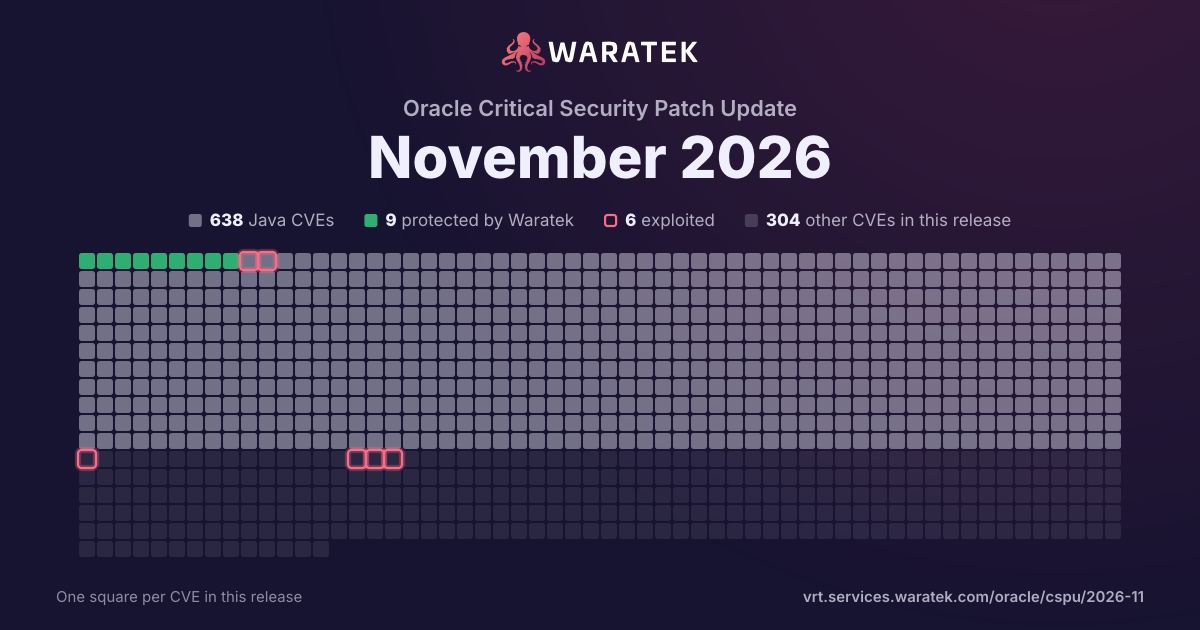
By status
9Protected by Waratek3Mitigation candidate626No exploit published15Outside Waratek scope289Not applicable
8Exploited, marked by the ring
No exploit published. For 547 of them, Oracle's security advisory is the source of public detail.
Protected by Waratek. Waratek RASP can block exploitation of these on systems that have not applied the patch yet.
Overview 6 matches · 3 in Waratek scope · 0 protected · 1 exploited · 1 CISA KEV · 1 public PoC · 1 EPSS ≥ 0.5
6matches
3in Waratek scope50.0%
0protected0.0%
1exploited16.7%
1CISA KEV16.7%
1public PoC16.7%
1EPSS ≥ 0.516.7%
Protected by Waratek
0
0.0%
Rule in development
0
0.0%
Mitigation candidate
1
16.7%
No exploit published
2
33.3%
Outside Waratek scope
0
0.0%
Not applicable
3
50.0%
Withdrawn CVE
0
0.0%
blocked by ARMR today
0
0.0%
partly blocked
0
0.0%
not blocked
6
100.0%
not established
0
0.0%
unrecorded
0
0.0%
Exploited
1
16.7%
Working exploit published
0
0.0%
Proof of concept only
2
33.3%
Forecast only
0
0.0%
No public exploit
3
50.0%
split by
peak 1 / quarter
Q3 211
No exploit published1
Medium1
not blocked1
No public exploit1
Q4 210
Q1 220
Q2 220
Q3 221
Not applicable1
High1
not blocked1
No public exploit1
Q4 220
Q1 230
Q2 231
No exploit published1
High1
not blocked1
No public exploit1
Q3 231
Not applicable1
High1
not blocked1
Proof of concept only1
Q4 231
Mitigation candidate1
High1
not blocked1
Exploited1
Q1 240
Q2 241
Not applicable1
Medium1
not blocked1
Proof of concept only1
Q3 21Q4 21Q1 22Q2 22Q3 22Q4 22Q1 23Q2 23Q3 23Q4 23Q1 24Q2 24
| CVE | Severity | Published▾ | Status | Exploitation | Description |
|---|---|---|---|---|---|
| CVE-2024-38949 | Medium | 2024-06-26 | Not applicable | Proof of concept only | Heap Buffer Overflow vulnerability in Libde265 v1.0.15 allows attackers to crash the application via crafted payload to display444as420 function at sdl.cc |
| CVE-2023-44487 | High | 2023-10-10 | Mitigation candidate | Exploited | The HTTP/2 protocol allows a denial of service (server resource consumption) because request cancellation can reset many streams quickly, as exploited in the wild in August through October 2023. |
| CVE-2023-35945 | High | 2023-07-13 | Not applicable | Proof of concept only | Envoy is a cloud-native high-performance edge/middle/service proxy. Envoy’s HTTP/2 codec may leak a header map and bookkeeping structures upon receiving `RST_STREAM` immediately followed by the `GOAWAY` frames from an upstream server. In nghttp2, cleanup of pending requests due to receipt of the `GOAWAY` frame skips de-allocation of the bookkeeping structure and pending compressed header. The error return [code path] is taken if connection is already marked for not sending more requests due to `GOAWAY` frame. The clean-up code is right after the return statement, causing memory leak. Denial of service through memory exhaustion. This vulnerability was patched in versions(s) 1.26.3, 1.25.8, 1.24.9, 1.23.11. |
| CVE-2023-2976 | High | 2023-06-14 | No exploit published | No public exploit | Use of Java's default temporary directory for file creation in `FileBackedOutputStream` in Google Guava versions 1.0 to 31.1 on Unix systems and Android Ice Cream Sandwich allows other users and apps on the machine with access to the default Java temporary directory to be able to access the files created by the class. Even though the security vulnerability is fixed in version 32.0.0, we recommend using version 32.0.1 as version 32.0.0 breaks some functionality under Windows. |
| CVE-2022-38171 | High | 2022-08-22 | Not applicable | No public exploit | Xpdf prior to version 4.04 contains an integer overflow in the JBIG2 decoder (JBIG2Stream::readTextRegionSeg() in JBIG2Stream.cc). Processing a specially crafted PDF file or JBIG2 image could lead to a crash or the execution of arbitrary code. This is similar to the vulnerability described by CVE-2021-30860 (Apple CoreGraphics). |
| CVE-2021-35043 | Medium | 2021-07-19 | No exploit published | No public exploit | OWASP AntiSamy before 1.6.4 allows XSS via HTML attributes when using the HTML output serializer (XHTML is not affected). This was demonstrated by a javascript: URL with : as the replacement for the : character. |