
Oracle Critical Security Patch Update November 2026
Released November 2026 · Oracle's advisory ↗ · ← Critical Patch Update, October 2026
942 CVEs in this release, one square each
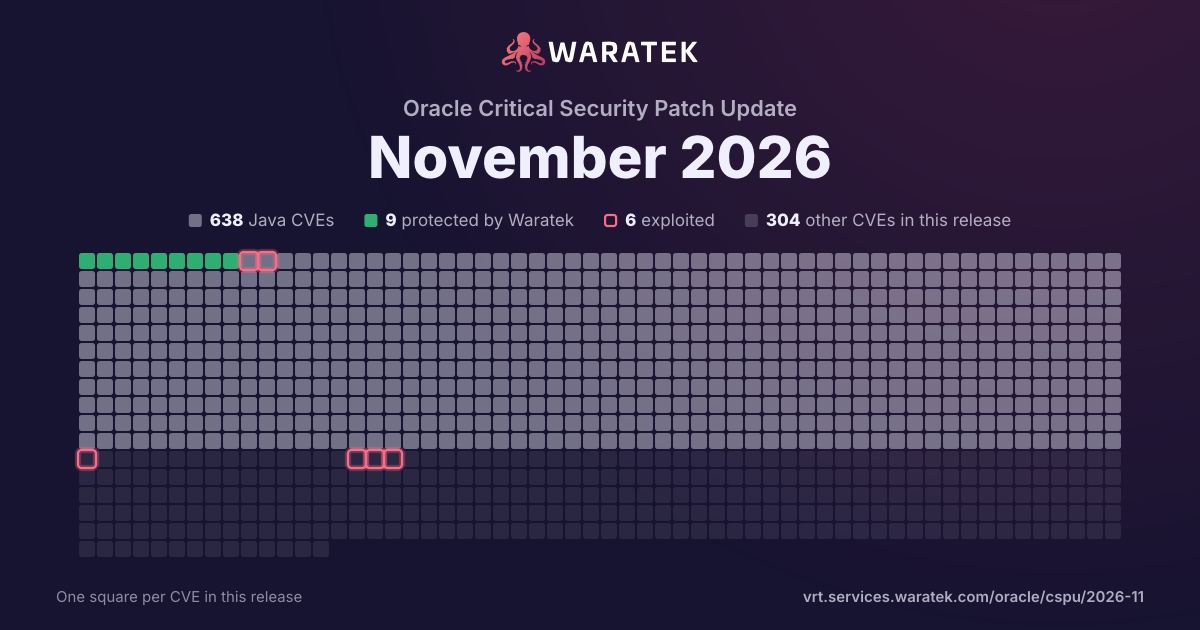
By status
9Protected by Waratek4Mitigation candidate625No exploit published15Outside Waratek scope289Not applicable
6Exploited, marked by the ring
No exploit published. For 554 of them, Oracle's security advisory is the source of public detail.
Protected by Waratek. Waratek RASP can block exploitation of these on systems that have not applied the patch yet.
Overview 257 matches · 1 protected · 0 exploited · 0 CISA KEV · 0 public PoC · 0 EPSS ≥ 0.5
Protected by Waratek
1
0.4%
Rule in development
0
0.0%
Mitigation candidate
0
0.0%
No exploit published
256
99.6%
blocked by ARMR today
1
0.4%
partly blocked
0
0.0%
not blocked
256
99.6%
not established
0
0.0%
unrecorded
0
0.0%
Exploited
0
0.0%
Working exploit published
0
0.0%
Proof of concept only
3
1.2%
Forecast only
0
0.0%
No public exploit
254
98.8%
split by
peak 236 / quarter
Q3 211
No exploit published1
Medium1
not blocked1
No public exploit1
Q4 210
Q1 220
Q2 220
Q3 220
Q4 220
Q1 230
Q2 230
Q3 230
Q4 230
Q1 240
Q2 240
Q3 240
Q4 240
Q1 250
Q2 250
Q3 250
Q4 250
Q1 260
Q2 266
No exploit published6
Medium6
not blocked6
No public exploit6
Q3 2614
Protected by Waratek1
No exploit published13
Medium14
blocked by ARMR today1
not blocked13
Proof of concept only3
No public exploit11
Q4 26236
No exploit published236
Medium236
not blocked236
No public exploit236
Q4 21Q2 22Q4 22Q2 23Q4 23Q2 24Q4 24Q2 25Q4 25Q2 26Q4 26
| CVE | Severity | Published▾ | Status | Exploitation | Description |
|---|---|---|---|---|---|
| CVE-2026-114840 | Medium | 2026-11-17 | No exploit published | No public exploit | Vulnerability in the Oracle Financial Services Regulatory Reporting product of Oracle Financial Services Applications (component: Internal Operations). The supported version that is affected is 8.1.2.10. Easily exploitable vulnerability allows high privileged attacker with logon to the infrastructure where Oracle Financial Services Regulatory Reporting executes to compromise Oracle Financial Services Regulatory Reporting. Successful attacks of this vulnerability can result in unauthorized access to critical data or complete access to all Oracle Financial Services Regulatory Reporting accessible data. CVSS 3.1 Base Score 4.4 (Confidentiality impacts). CVSS Vector: (CVSS:3.1/AV:L/AC:L/PR:H/UI:N/S:U/C:H/I:N/A:N). |
| CVE-2026-114839 | Medium | 2026-11-17 | No exploit published | No public exploit | Vulnerability in the Oracle Financial Services Enterprise Case Management product of Oracle Financial Services Applications (component: Installer). The supported version that is affected is 8.1.2.10. Easily exploitable vulnerability allows high privileged attacker with logon to the infrastructure where Oracle Financial Services Enterprise Case Management executes to compromise Oracle Financial Services Enterprise Case Management. Successful attacks of this vulnerability can result in unauthorized access to critical data or complete access to all Oracle Financial Services Enterprise Case Management accessible data. CVSS 3.1 Base Score 4.4 (Confidentiality impacts). CVSS Vector: (CVSS:3.1/AV:L/AC:L/PR:H/UI:N/S:U/C:H/I:N/A:N). |
| CVE-2026-114838 | Medium | 2026-11-17 | No exploit published | No public exploit | Vulnerability in the Oracle Financial Services Enterprise Case Management product of Oracle Financial Services Applications (component: Web UI). The supported version that is affected is 8.1.2.10. Difficult to exploit vulnerability allows low privileged attacker with network access via HTTP to compromise Oracle Financial Services Enterprise Case Management. Successful attacks of this vulnerability can result in unauthorized creation, deletion or modification access to critical data or all Oracle Financial Services Enterprise Case Management accessible data as well as unauthorized access to critical data or complete access to all Oracle Financial Services Enterprise Case Management accessible data. CVSS 3.1 Base Score 6.8 (Confidentiality and Integrity impacts). CVSS Vector: (CVSS:3.1/AV:N/AC:H/PR:L/UI:N/S:U/C:H/I:H/A:N). |
| CVE-2026-114837 | Medium | 2026-11-17 | No exploit published | No public exploit | Vulnerability in the Oracle Financial Services Enterprise Case Management product of Oracle Financial Services Applications (component: Web UI). The supported version that is affected is 8.1.2.10. Difficult to exploit vulnerability allows low privileged attacker with network access via HTTP to compromise Oracle Financial Services Enterprise Case Management. Successful attacks of this vulnerability can result in unauthorized creation, deletion or modification access to critical data or all Oracle Financial Services Enterprise Case Management accessible data as well as unauthorized access to critical data or complete access to all Oracle Financial Services Enterprise Case Management accessible data. CVSS 3.1 Base Score 6.8 (Confidentiality and Integrity impacts). CVSS Vector: (CVSS:3.1/AV:N/AC:H/PR:L/UI:N/S:U/C:H/I:H/A:N). |
| CVE-2026-114836 | Medium | 2026-11-17 | No exploit published | No public exploit | Vulnerability in the Oracle Financial Services Enterprise Case Management product of Oracle Financial Services Applications (component: Web UI). The supported version that is affected is 8.1.2.10. Difficult to exploit vulnerability allows low privileged attacker with network access via HTTP to compromise Oracle Financial Services Enterprise Case Management. Successful attacks of this vulnerability can result in unauthorized creation, deletion or modification access to critical data or all Oracle Financial Services Enterprise Case Management accessible data as well as unauthorized access to critical data or complete access to all Oracle Financial Services Enterprise Case Management accessible data. CVSS 3.1 Base Score 6.8 (Confidentiality and Integrity impacts). CVSS Vector: (CVSS:3.1/AV:N/AC:H/PR:L/UI:N/S:U/C:H/I:H/A:N). |
| CVE-2026-114833 | Medium | 2026-11-17 | No exploit published | No public exploit | Vulnerability in the Helidon product of Oracle Fusion Middleware (component: helidon-security). Supported versions that are affected are 3.0.0-3.2.22 and 4.0.0-4.5.6. Easily exploitable vulnerability allows unauthenticated attacker with network access via HTTP to compromise Helidon. Successful attacks of this vulnerability can result in unauthorized read access to a subset of Helidon accessible data. CVSS 3.1 Base Score 5.3 (Confidentiality impacts). CVSS Vector: (CVSS:3.1/AV:N/AC:L/PR:N/UI:N/S:U/C:L/I:N/A:N). |
| CVE-2026-114832 | Medium | 2026-11-17 | No exploit published | No public exploit | Vulnerability in the Helidon product of Oracle Fusion Middleware (component: helidon-security-jwt). Supported versions that are affected are 3.0.0-3.2.22. Difficult to exploit vulnerability allows low privileged attacker with network access via HTTP to compromise Helidon. Successful attacks of this vulnerability can result in unauthorized creation, deletion or modification access to critical data or all Helidon accessible data as well as unauthorized read access to a subset of Helidon accessible data. CVSS 3.1 Base Score 5.9 (Confidentiality and Integrity impacts). CVSS Vector: (CVSS:3.1/AV:N/AC:H/PR:L/UI:N/S:U/C:L/I:H/A:N). |
| CVE-2026-114830 | Medium | 2026-11-17 | No exploit published | No public exploit | Vulnerability in the Oracle Enterprise Manager Base Platform product of Oracle Enterprise Manager (component: Agent Next Gen). Supported versions that are affected are 13.5 and 24.1. Easily exploitable vulnerability allows low privileged attacker with logon to the infrastructure where Oracle Enterprise Manager Base Platform executes to compromise Oracle Enterprise Manager Base Platform. Successful attacks of this vulnerability can result in unauthorized access to critical data or complete access to all Oracle Enterprise Manager Base Platform accessible data as well as unauthorized update, insert or delete access to some of Oracle Enterprise Manager Base Platform accessible data. CVSS 3.1 Base Score 6.1 (Confidentiality and Integrity impacts). CVSS Vector: (CVSS:3.1/AV:L/AC:L/PR:L/UI:N/S:U/C:H/I:L/A:N). |
| CVE-2026-114823 | Medium | 2026-11-17 | No exploit published | No public exploit | Vulnerability in the Oracle Business Process Management Suite product of Oracle Fusion Middleware (component: Human workflow 11g+). Supported versions that are affected are 12.2.1.4.0 and 14.1.2.0.0. Easily exploitable vulnerability allows low privileged attacker with network access via HTTP to compromise Oracle Business Process Management Suite. Successful attacks require human interaction from a person other than the attacker and while the vulnerability is in Oracle Business Process Management Suite, attacks may significantly impact additional products (scope change). Successful attacks of this vulnerability can result in unauthorized update, insert or delete access to some of Oracle Business Process Management Suite accessible data as well as unauthorized read access to a subset of Oracle Business Process Management Suite accessible data. CVSS 3.1 Base Score 5.4 (Confidentiality and Integrity impacts). CVSS Vector: (CVSS:3.1/AV:N/AC:L/PR:L/UI:R/S:C/C:L/I:L/A:N). |
| CVE-2026-114816 | Medium | 2026-11-17 | No exploit published | No public exploit | Vulnerability in the Oracle Hyperion Planning product of Oracle Hyperion (component: Security). The supported version that is affected is 11.2.26.0.000. Difficult to exploit vulnerability allows low privileged attacker with network access via HTTP to compromise Oracle Hyperion Planning. Successful attacks of this vulnerability can result in unauthorized access to critical data or complete access to all Oracle Hyperion Planning accessible data as well as unauthorized update, insert or delete access to some of Oracle Hyperion Planning accessible data. CVSS 3.1 Base Score 5.9 (Confidentiality and Integrity impacts). CVSS Vector: (CVSS:3.1/AV:N/AC:H/PR:L/UI:N/S:U/C:H/I:L/A:N). |
| CVE-2026-114812 | Medium | 2026-11-17 | No exploit published | No public exploit | Vulnerability in the Oracle Hyperion Infrastructure Technology product of Oracle Hyperion (component: Common Security). The supported version that is affected is 11.2.26.0.000. Easily exploitable vulnerability allows unauthenticated attacker with network access via HTTP to compromise Oracle Hyperion Infrastructure Technology. Successful attacks of this vulnerability can result in unauthorized read access to a subset of Oracle Hyperion Infrastructure Technology accessible data. CVSS 3.1 Base Score 5.3 (Confidentiality impacts). CVSS Vector: (CVSS:3.1/AV:N/AC:L/PR:N/UI:N/S:U/C:L/I:N/A:N). |
| CVE-2026-114811 | Medium | 2026-11-17 | No exploit published | No public exploit | Vulnerability in the Oracle BI Publisher product of Oracle Analytics (component: Web Service API). Supported versions that are affected are 8.2.0.0.0, 12.2.1.4.0 and 26.01.0.0.0. Easily exploitable vulnerability allows low privileged attacker with network access via HTTP to compromise Oracle BI Publisher. Successful attacks of this vulnerability can result in unauthorized read access to a subset of Oracle BI Publisher accessible data. CVSS 3.1 Base Score 4.3 (Confidentiality impacts). CVSS Vector: (CVSS:3.1/AV:N/AC:L/PR:L/UI:N/S:U/C:L/I:N/A:N). |
| CVE-2026-114810 | Medium | 2026-11-17 | No exploit published | No public exploit | Vulnerability in the Oracle BI Publisher product of Oracle Analytics (component: E-Business Suite - XDO). The supported version that is affected is 12.2.1.4.0. Easily exploitable vulnerability allows low privileged attacker with logon to the infrastructure where Oracle BI Publisher executes to compromise Oracle BI Publisher. Successful attacks of this vulnerability can result in unauthorized access to critical data or complete access to all Oracle BI Publisher accessible data. CVSS 3.1 Base Score 5.5 (Confidentiality impacts). CVSS Vector: (CVSS:3.1/AV:L/AC:L/PR:L/UI:N/S:U/C:H/I:N/A:N). |
| CVE-2026-114808 | Medium | 2026-11-17 | No exploit published | No public exploit | Vulnerability in the Oracle Business Intelligence Enterprise Edition product of Oracle Analytics (component: Platform Security). The supported version that is affected is 12.2.1.4.0. Easily exploitable vulnerability allows unauthenticated attacker with logon to the infrastructure where Oracle Business Intelligence Enterprise Edition executes to compromise Oracle Business Intelligence Enterprise Edition. Successful attacks require human interaction from a person other than the attacker. Successful attacks of this vulnerability can result in unauthorized ability to cause a hang or frequently repeatable crash (complete DOS) of Oracle Business Intelligence Enterprise Edition. CVSS 3.1 Base Score 5.5 (Availability impacts). CVSS Vector: (CVSS:3.1/AV:L/AC:L/PR:N/UI:R/S:U/C:N/I:N/A:H). |
| CVE-2026-114805 | Medium | 2026-11-17 | No exploit published | No public exploit | Vulnerability in the Oracle Business Intelligence Enterprise Edition product of Oracle Analytics (component: Analytics Web General). Supported versions that are affected are 8.2.0.0.0, 12.2.1.4.0 and 26.01.0.0.0. Difficult to exploit vulnerability allows low privileged attacker with network access via HTTP to compromise Oracle Business Intelligence Enterprise Edition. Successful attacks of this vulnerability can result in unauthorized ability to cause a hang or frequently repeatable crash (complete DOS) of Oracle Business Intelligence Enterprise Edition. CVSS 3.1 Base Score 5.3 (Availability impacts). CVSS Vector: (CVSS:3.1/AV:N/AC:H/PR:L/UI:N/S:U/C:N/I:N/A:H). |
| CVE-2026-114804 | Medium | 2026-11-17 | No exploit published | No public exploit | Vulnerability in the Oracle Business Intelligence Enterprise Edition product of Oracle Analytics (component: Platform Security). The supported version that is affected is 26.01.0.0.0. Easily exploitable vulnerability allows low privileged attacker with network access via HTTP to compromise Oracle Business Intelligence Enterprise Edition. Successful attacks of this vulnerability can result in unauthorized ability to cause a hang or frequently repeatable crash (complete DOS) of Oracle Business Intelligence Enterprise Edition. CVSS 3.1 Base Score 6.5 (Availability impacts). CVSS Vector: (CVSS:3.1/AV:N/AC:L/PR:L/UI:N/S:U/C:N/I:N/A:H). |
| CVE-2026-114803 | Medium | 2026-11-17 | No exploit published | No public exploit | Vulnerability in the Oracle Business Intelligence Enterprise Edition product of Oracle Analytics (component: BI Search). Supported versions that are affected are 8.2.0.0.0, 12.2.1.4.0 and 26.01.0.0.0. Difficult to exploit vulnerability allows low privileged attacker with network access via HTTP to compromise Oracle Business Intelligence Enterprise Edition. Successful attacks of this vulnerability can result in unauthorized ability to cause a hang or frequently repeatable crash (complete DOS) of Oracle Business Intelligence Enterprise Edition as well as unauthorized update, insert or delete access to some of Oracle Business Intelligence Enterprise Edition accessible data and unauthorized read access to a subset of Oracle Business Intelligence Enterprise Edition accessible data. CVSS 3.1 Base Score 6.4 (Confidentiality, Integrity and Availability impacts). CVSS Vector: (CVSS:3.1/AV:N/AC:H/PR:L/UI:N/S:U/C:L/I:L/A:H). |
| CVE-2026-114802 | Medium | 2026-11-17 | No exploit published | No public exploit | Vulnerability in the Oracle Business Intelligence Enterprise Edition product of Oracle Analytics (component: Platform Security). Supported versions that are affected are 8.2.0.0.0, 12.2.1.4.0 and 26.01.0.0.0. Easily exploitable vulnerability allows high privileged attacker with logon to the infrastructure where Oracle Business Intelligence Enterprise Edition executes to compromise Oracle Business Intelligence Enterprise Edition. Successful attacks of this vulnerability can result in takeover of Oracle Business Intelligence Enterprise Edition. CVSS 3.1 Base Score 6.7 (Confidentiality, Integrity and Availability impacts). CVSS Vector: (CVSS:3.1/AV:L/AC:L/PR:H/UI:N/S:U/C:H/I:H/A:H). |
| CVE-2026-114801 | Medium | 2026-11-17 | No exploit published | No public exploit | Vulnerability in the Oracle Business Intelligence Enterprise Edition product of Oracle Analytics (component: Platform Security). The supported version that is affected is 26.01.0.0.0. Easily exploitable vulnerability allows high privileged attacker with logon to the infrastructure where Oracle Business Intelligence Enterprise Edition executes to compromise Oracle Business Intelligence Enterprise Edition. Successful attacks of this vulnerability can result in takeover of Oracle Business Intelligence Enterprise Edition. CVSS 3.1 Base Score 6.7 (Confidentiality, Integrity and Availability impacts). CVSS Vector: (CVSS:3.1/AV:L/AC:L/PR:H/UI:N/S:U/C:H/I:H/A:H). |
| CVE-2026-114800 | Medium | 2026-11-17 | No exploit published | No public exploit | Vulnerability in the Oracle Business Intelligence Enterprise Edition product of Oracle Analytics (component: Visual Analyzer). Supported versions that are affected are 8.2.0.0.0, 12.2.1.4.0 and 26.01.0.0.0. Easily exploitable vulnerability allows unauthenticated attacker with network access via HTTP to compromise Oracle Business Intelligence Enterprise Edition. Successful attacks require human interaction from a person other than the attacker and while the vulnerability is in Oracle Business Intelligence Enterprise Edition, attacks may significantly impact additional products (scope change). Successful attacks of this vulnerability can result in unauthorized update, insert or delete access to some of Oracle Business Intelligence Enterprise Edition accessible data as well as unauthorized read access to a subset of Oracle Business Intelligence Enterprise Edition accessible data. CVSS 3.1 Base Score 6.1 (Confidentiality and Integrity impacts). CVSS Vector: (CVSS:3.1/AV:N/AC:L/PR:N/UI:R/S:C/C:L/I:L/A:N). |
| CVE-2026-114798 | Medium | 2026-11-17 | No exploit published | No public exploit | Vulnerability in the Oracle Business Intelligence Enterprise Edition product of Oracle Analytics (component: Platform Security). The supported version that is affected is 26.01.0.0.0. Easily exploitable vulnerability allows high privileged attacker with logon to the infrastructure where Oracle Business Intelligence Enterprise Edition executes to compromise Oracle Business Intelligence Enterprise Edition. Successful attacks of this vulnerability can result in takeover of Oracle Business Intelligence Enterprise Edition. CVSS 3.1 Base Score 6.7 (Confidentiality, Integrity and Availability impacts). CVSS Vector: (CVSS:3.1/AV:L/AC:L/PR:H/UI:N/S:U/C:H/I:H/A:H). |
| CVE-2026-114797 | Medium | 2026-11-17 | No exploit published | No public exploit | Vulnerability in the Oracle BI Publisher product of Oracle Analytics (component: BI Publisher Security). The supported version that is affected is 12.2.1.4.0. Easily exploitable vulnerability allows unauthenticated attacker with network access via HTTP to compromise Oracle BI Publisher. Successful attacks require human interaction from a person other than the attacker and while the vulnerability is in Oracle BI Publisher, attacks may significantly impact additional products (scope change). Successful attacks of this vulnerability can result in unauthorized update, insert or delete access to some of Oracle BI Publisher accessible data as well as unauthorized read access to a subset of Oracle BI Publisher accessible data. CVSS 3.1 Base Score 6.1 (Confidentiality and Integrity impacts). CVSS Vector: (CVSS:3.1/AV:N/AC:L/PR:N/UI:R/S:C/C:L/I:L/A:N). |
| CVE-2026-114796 | Medium | 2026-11-17 | No exploit published | No public exploit | Vulnerability in the Oracle Business Intelligence Enterprise Edition product of Oracle Analytics (component: Analytics Web General). Supported versions that are affected are 8.2.0.0.0, 12.2.1.4.0 and 26.01.0.0.0. Easily exploitable vulnerability allows low privileged attacker with network access via HTTP to compromise Oracle Business Intelligence Enterprise Edition. While the vulnerability is in Oracle Business Intelligence Enterprise Edition, attacks may significantly impact additional products (scope change). Successful attacks of this vulnerability can result in unauthorized update, insert or delete access to some of Oracle Business Intelligence Enterprise Edition accessible data as well as unauthorized read access to a subset of Oracle Business Intelligence Enterprise Edition accessible data. CVSS 3.1 Base Score 6.4 (Confidentiality and Integrity impacts). CVSS Vector: (CVSS:3.1/AV:N/AC:L/PR:L/UI:N/S:C/C:L/I:L/A:N). |
| CVE-2026-114795 | Medium | 2026-11-17 | No exploit published | No public exploit | Vulnerability in the Oracle Hyperion Infrastructure Technology product of Oracle Hyperion (component: Common Security). The supported version that is affected is 11.2.26.0.000. Easily exploitable vulnerability allows low privileged attacker with network access via SSH to compromise Oracle Hyperion Infrastructure Technology. Successful attacks of this vulnerability can result in unauthorized access to critical data or complete access to all Oracle Hyperion Infrastructure Technology accessible data. CVSS 3.1 Base Score 6.5 (Confidentiality impacts). CVSS Vector: (CVSS:3.1/AV:N/AC:L/PR:L/UI:N/S:U/C:H/I:N/A:N). |
| CVE-2026-114791 | Medium | 2026-11-17 | No exploit published | No public exploit | Vulnerability in the Oracle Hyperion Planning product of Oracle Hyperion (component: Security). The supported version that is affected is 11.2.26.0.000. Easily exploitable vulnerability allows unauthenticated attacker with network access via HTTP to compromise Oracle Hyperion Planning. Successful attacks require human interaction from a person other than the attacker and while the vulnerability is in Oracle Hyperion Planning, attacks may significantly impact additional products (scope change). Successful attacks of this vulnerability can result in unauthorized update, insert or delete access to some of Oracle Hyperion Planning accessible data as well as unauthorized read access to a subset of Oracle Hyperion Planning accessible data. CVSS 3.1 Base Score 6.1 (Confidentiality and Integrity impacts). CVSS Vector: (CVSS:3.1/AV:N/AC:L/PR:N/UI:R/S:C/C:L/I:L/A:N). |
| CVE-2026-114790 | Medium | 2026-11-17 | No exploit published | No public exploit | Vulnerability in the Oracle Business Intelligence Enterprise Edition product of Oracle Analytics (component: Platform Security). Supported versions that are affected are 8.2.0.0.0, 12.2.1.4.0 and 26.01.0.0.0. Easily exploitable vulnerability allows high privileged attacker with network access via HTTP to compromise Oracle Business Intelligence Enterprise Edition. While the vulnerability is in Oracle Business Intelligence Enterprise Edition, attacks may significantly impact additional products (scope change). Successful attacks of this vulnerability can result in unauthorized access to critical data or complete access to all Oracle Business Intelligence Enterprise Edition accessible data. CVSS 3.1 Base Score 6.8 (Confidentiality impacts). CVSS Vector: (CVSS:3.1/AV:N/AC:L/PR:H/UI:N/S:C/C:H/I:N/A:N). |
| CVE-2026-114789 | Medium | 2026-11-17 | No exploit published | No public exploit | Vulnerability in the Oracle BI Publisher product of Oracle Analytics (component: Web Server). The supported version that is affected is 12.2.1.4.0. Easily exploitable vulnerability allows unauthenticated attacker with network access via HTTP to compromise Oracle BI Publisher. Successful attacks require human interaction from a person other than the attacker and while the vulnerability is in Oracle BI Publisher, attacks may significantly impact additional products (scope change). Successful attacks of this vulnerability can result in unauthorized update, insert or delete access to some of Oracle BI Publisher accessible data as well as unauthorized read access to a subset of Oracle BI Publisher accessible data. CVSS 3.1 Base Score 6.1 (Confidentiality and Integrity impacts). CVSS Vector: (CVSS:3.1/AV:N/AC:L/PR:N/UI:R/S:C/C:L/I:L/A:N). |
| CVE-2026-114787 | Medium | 2026-11-17 | No exploit published | No public exploit | Vulnerability in the Oracle Business Intelligence Enterprise Edition product of Oracle Analytics (component: BI Platform Security). Supported versions that are affected are 8.2.0.0.0 and 26.01.0.0.0. Easily exploitable vulnerability allows low privileged attacker with network access via HTTP to compromise Oracle Business Intelligence Enterprise Edition. Successful attacks of this vulnerability can result in unauthorized update, insert or delete access to some of Oracle Business Intelligence Enterprise Edition accessible data as well as unauthorized read access to a subset of Oracle Business Intelligence Enterprise Edition accessible data. CVSS 3.1 Base Score 5.4 (Confidentiality and Integrity impacts). CVSS Vector: (CVSS:3.1/AV:N/AC:L/PR:L/UI:N/S:U/C:L/I:L/A:N). |
| CVE-2026-114786 | Medium | 2026-11-17 | No exploit published | No public exploit | Vulnerability in the Oracle Business Intelligence Enterprise Edition product of Oracle Analytics (component: ICAP Client API). Supported versions that are affected are 8.2.0.0.0 and 26.01.0.0.0. Easily exploitable vulnerability allows low privileged attacker with network access via HTTP to compromise Oracle Business Intelligence Enterprise Edition. While the vulnerability is in Oracle Business Intelligence Enterprise Edition, attacks may significantly impact additional products (scope change). Successful attacks of this vulnerability can result in unauthorized update, insert or delete access to some of Oracle Business Intelligence Enterprise Edition accessible data as well as unauthorized read access to a subset of Oracle Business Intelligence Enterprise Edition accessible data. CVSS 3.1 Base Score 6.4 (Confidentiality and Integrity impacts). CVSS Vector: (CVSS:3.1/AV:N/AC:L/PR:L/UI:N/S:C/C:L/I:L/A:N). |
| CVE-2026-114782 | Medium | 2026-11-17 | No exploit published | No public exploit | Vulnerability in the Oracle Hyperion Infrastructure Technology product of Oracle Hyperion (component: Common Events). The supported version that is affected is 11.2.26.0.000. Easily exploitable vulnerability allows unauthenticated attacker with network access via HTTP to compromise Oracle Hyperion Infrastructure Technology. Successful attacks require human interaction from a person other than the attacker and while the vulnerability is in Oracle Hyperion Infrastructure Technology, attacks may significantly impact additional products (scope change). Successful attacks of this vulnerability can result in unauthorized update, insert or delete access to some of Oracle Hyperion Infrastructure Technology accessible data as well as unauthorized read access to a subset of Oracle Hyperion Infrastructure Technology accessible data. CVSS 3.1 Base Score 6.1 (Confidentiality and Integrity impacts). CVSS Vector: (CVSS:3.1/AV:N/AC:L/PR:N/UI:R/S:C/C:L/I:L/A:N). |
| CVE-2026-101702 | Medium | 2026-11-17 | No exploit published | No public exploit | Vulnerability in the Oracle Hyperion Financial Data Quality Management, Enterprise Edition product of Oracle Hyperion (component: Security). The supported version that is affected is 11.2.26.0.000. Easily exploitable vulnerability allows low privileged attacker with logon to the infrastructure where Oracle Hyperion Financial Data Quality Management, Enterprise Edition executes to compromise Oracle Hyperion Financial Data Quality Management, Enterprise Edition. Successful attacks of this vulnerability can result in unauthorized access to critical data or complete access to all Oracle Hyperion Financial Data Quality Management, Enterprise Edition accessible data. CVSS 3.1 Base Score 5.5 (Confidentiality impacts). CVSS Vector: (CVSS:3.1/AV:L/AC:L/PR:L/UI:N/S:U/C:H/I:N/A:N). |
| CVE-2026-101563 | Medium | 2026-11-17 | No exploit published | No public exploit | Vulnerability in the Oracle Agile PLM product of Oracle Supply Chain (component: Security). The supported version that is affected is 9.3.6. Difficult to exploit vulnerability allows low privileged attacker with network access via HTTP to compromise Oracle Agile PLM. Successful attacks of this vulnerability can result in unauthorized creation, deletion or modification access to critical data or all Oracle Agile PLM accessible data as well as unauthorized access to critical data or complete access to all Oracle Agile PLM accessible data. CVSS 3.1 Base Score 6.8 (Confidentiality and Integrity impacts). CVSS Vector: (CVSS:3.1/AV:N/AC:H/PR:L/UI:N/S:U/C:H/I:H/A:N). |
| CVE-2026-101550 | Medium | 2026-11-17 | No exploit published | No public exploit | Vulnerability in the Oracle Hyperion Financial Management product of Oracle Hyperion (component: Security). The supported version that is affected is 11.2.26.0.000. Difficult to exploit vulnerability allows high privileged attacker with network access via HTTP to compromise Oracle Hyperion Financial Management. Successful attacks require human interaction from a person other than the attacker. Successful attacks of this vulnerability can result in unauthorized access to critical data or complete access to all Oracle Hyperion Financial Management accessible data. CVSS 3.1 Base Score 4.2 (Confidentiality impacts). CVSS Vector: (CVSS:3.1/AV:N/AC:H/PR:H/UI:R/S:U/C:H/I:N/A:N). |
| CVE-2026-74049 | Medium | 2026-10-20 | No exploit published | No public exploit | Execution After Redirect (EAR) vulnerability in Apache Tomcat. This issue affects Apache Tomcat: from 11.0.0-M1 through 11.0.26, from 10.1.0-M1 through 10.1.60, from 9.0.0.M1 through 9.0.122. The following versions were EOL at the time the CVE was created but are known to be affected: from 8.5.0 through 8.5.100, from 7.0.0 through 7.0.109. Other unsupported versions may also be affected. Users are recommended to upgrade to version 11.0.27, 10.1.61, 9.0.123, which fixes the issue. |
| CVE-2026-74048 | Medium | 2026-10-20 | No exploit published | No public exploit | Not Failing Securely ('Failing Open') vulnerability in Apache Tomcat. If the OpenSSLLifecycleListener is configured to use FIPS mode but FIPS activation fails, Tomcat logs and error but continues to use JSSE in non-FIPS mode with the provided configuration. This issue affects Apache Tomcat: from 11.0.0-M14 through 11.0.26, from 10.1.22 through 10.1.60, from 9.0.92 through 9.0.122. Users are recommended to upgrade to version 11.0.27, 10.1.61 or 9.0.123, which fix the issue. |
| CVE-2026-79650 | Medium | 2026-10-09 | No exploit published | No public exploit | Apache CXF’s OIDC relying-party component could redirect users to an attacker-controlled URL after successful authentication. The issue occurs because attacker-controlled state parameters are preserved and later used as redirect targets without validating that the final decoded URI belongs to the RP’s origin. Both directly encoded and double-encoded external URLs can trigger the issue, depending on which validation path is used. Users are recommended to upgrade to versions 4.2.4 or 4.1.9 or 3.6.13, which fix this issue. |
| CVE-2026-73581 | Medium | 2026-09-23 | No exploit published | No public exploit | Improper Check for Certificate Revocation vulnerability in Apache Tomcat. Both the OpenSSL and OpenSSL-FFM TLS implementations ignore CRLs when certificate uses a keystore. This issue affects Apache Tomcat: from 11.0.0-M1 through 11.0.25, from 10.1.0-M1 through 10.1.59, from 9.0.0-M1 through 9.0.121. The following versions were EOL at the time the CVE was created but are known to be affected: from 8.5.0 through 8.5.100. Other unsupported versions may also be affected. Users are recommended to upgrade to version 11.0.26, 10.1.59, 9.0.122, which fixes the issue. |
| CVE-2026-83557 | Medium | 2026-09-01 | No exploit published | Proof of concept only | DefaultBaseTypeLimitingValidator is the PolymorphicTypeValidator applied automatically whenever @JsonTypeInfo is used without an explicitly configured custom validator. It denies polymorphic resolution only for a fixed set of "unsafe base types", and its isSafeSubType method returns true unconditionally for every base type outside that set. java.lang.Comparable was absent from the list despite being implemented by a very large fraction of JDK and application classes, comparable in breadth to java.io.Serializable, which is on the list for that reason. An application declaring an @JsonTypeInfo-annotated property or class with Comparable as its base type, and no custom PolymorphicTypeValidator, will accept a type identifier for essentially any class implementing Comparable. This yields an attacker-controlled object instantiation primitive; a demonstrated case constructs a java.io.File for an arbitrary attacker-chosen path, which becomes path-traversal-adjacent if the application subsequently calls path-sensitive methods on the value. No class implementing Comparable has been identified that yields code execution through deserialization alone. Global Default Typing via activateDefaultTyping is not affected, because that method structurally requires an explicit PolymorphicTypeValidator argument. This affects com.fasterxml.jackson.core:jackson-databind from 2.11.0 before 2.18.10, from 2.19.0 before 2.21.6, and from 2.22.0 before 2.22.2, and tools.jackson.core:jackson-databind from 3.0.0 before 3.1.6 and from 3.2.0 before 3.2.2. Users should upgrade to 2.18.10, 2.21.6, 2.22.2, 3.1.6, or 3.2.2. |
| CVE-2026-19032 | Medium | 2026-09-01 | Protected by Waratek | Proof of concept only | jackson-databind's deserializer for java.nio.file.Path resolves an attacker-supplied URI without restricting the URI scheme. In JDKFromStringDeserializer.NioPathHelper.deserialize, a string bound from untrusted JSON is passed to new URI(value) and then to Path.of(uri). When that throws FileSystemNotFoundException, the code enumerates ServiceLoader<FileSystemProvider> and calls provider.getPath(uri) on the first provider whose scheme matches the attacker-chosen scheme. Untrusted JSON can therefore select and drive an arbitrary registered FileSystemProvider during readValue under a default JsonMapper, and forces provider class loading at the same time. With only the JDK built-in providers (file, jar/zipfs) present, the resolved path is inert and no mount or network I/O occurs; further impact requires a side-effecting third-party FileSystemProvider on the classpath. This affects com.fasterxml.jackson.core:jackson-databind from 2.8.0 before 2.18.10, from 2.19.0 before 2.21.6, and from 2.22.0 before 2.22.2, and tools.jackson.core:jackson-databind from 3.0.0 before 3.1.6 and from 3.2.0 before 3.2.2. Users should upgrade to 2.18.10, 2.21.6, 2.22.2, 3.1.6, or 3.2.2. Binding java.nio.file.Path from untrusted JSON should be avoided regardless of version. |
| CVE-2026-70907 | Medium | 2026-08-18 | No exploit published | No public exploit | Vulnerability in the Oracle Java SE, Oracle GraalVM for JDK, Oracle GraalVM Enterprise Edition product of Oracle Java SE (component: JSSE). Supported versions that are affected are Oracle Java SE: 8u501, 11.0.32, 17.0.20, 21.0.12, 25.0.4, 26.0.2; Oracle GraalVM for JDK: 17.0.20 and 21.0.12; Oracle GraalVM Enterprise Edition: 21.3.19. Easily exploitable vulnerability allows unauthenticated attacker with network access via TLS to compromise Oracle Java SE, Oracle GraalVM for JDK, Oracle GraalVM Enterprise Edition. Successful attacks of this vulnerability can result in unauthorized ability to cause a partial denial of service (partial DOS) of Oracle Java SE, Oracle GraalVM for JDK, Oracle GraalVM Enterprise Edition. Note: This vulnerability can only be exploited by supplying data to APIs in the specified Component without using Untrusted Java Web Start applications or Untrusted Java applets, such as through a web service. CVSS 3.1 Base Score 5.3 (Availability impacts). CVSS Vector: (CVSS:3.1/AV:N/AC:L/PR:N/UI:N/S:U/C:N/I:N/A:L). |
| CVE-2026-61308 | Medium | 2026-08-18 | No exploit published | No public exploit | Vulnerability in the Oracle Java SE, Oracle GraalVM for JDK, Oracle GraalVM Enterprise Edition product of Oracle Java SE (component: Networking). Supported versions that are affected are Oracle Java SE: 8u501, 11.0.32, 17.0.20, 21.0.12, 25.0.4, 26.0.2; Oracle GraalVM for JDK: 17.0.20 and 21.0.12; Oracle GraalVM Enterprise Edition: 21.3.19. Difficult to exploit vulnerability allows unauthenticated attacker with network access via HTTP to compromise Oracle Java SE, Oracle GraalVM for JDK, Oracle GraalVM Enterprise Edition. While the vulnerability is in Oracle Java SE, Oracle GraalVM for JDK, Oracle GraalVM Enterprise Edition, attacks may significantly impact additional products (scope change). Successful attacks of this vulnerability can result in unauthorized access to critical data or complete access to all Oracle Java SE, Oracle GraalVM for JDK, Oracle GraalVM Enterprise Edition accessible data. Note: This vulnerability can be exploited by using APIs in the specified Component, e.g., through a web service which supplies data to the APIs. This vulnerability also applies to Java deployments, typically in clients running sandboxed Java Web Start applications or sandboxed Java applets, that load and run untrusted code (e.g., code that comes from the internet) and rely on the Java sandbox for security. CVSS 3.1 Base Score 6.8 (Confidentiality impacts). CVSS Vector: (CVSS:3.1/AV:N/AC:H/PR:N/UI:N/S:C/C:H/I:N/A:N). |
| CVE-2026-59949 | Medium | 2026-08-18 | No exploit published | No public exploit | yawkat LZ4 Java provides LZ4 compression for Java. Prior to 1.11.1, JNI-backed XXHash implementations fail to validate the byte array object and the off and len arguments in XXHashFactory.nativeInstance().hash32().hash(), XXHashFactory.nativeInstance().hash64().hash(), XXHashFactory.nativeInstance().newStreamingHash32().update(), and XXHashFactory.nativeInstance().newStreamingHash64().update(), allowing null arrays or oversized ranges to reach native code, read outside the Java array, and fatally terminate the JVM. This issue is fixed in version 1.11.1. |
| CVE-2026-71497 | Medium | 2026-08-06 | No exploit published | No public exploit | jsoup is a Java library for working with real-world HTML. From 1.14.3 until 1.23.1, jsoup's HTML parser could incorrectly handle a malformed tag name ending in a control character, causing the tag to acquire the parsing behavior of a different element. When a custom Safelist permits certain raw-text elements, this misparsing can cause content that should remain inert text to be emitted as active markup after serialization, potentially resulting in cross-site scripting. jsoup's built-in Safelists are not affected. This issue is fixed in version 1.23.1. |
| CVE-2026-18401 | Medium | 2026-08-04 | No exploit published | Proof of concept only | The non-blocking (asynchronous) JSON parser in jackson-core does not enforce the maxNumberLength constraint defined in StreamReadConstraints (default: 1000 characters). An attacker able to submit JSON to an application that uses the async parser API can supply a number token of arbitrary length, leading to excessive memory allocation and potential CPU exhaustion, resulting in a denial of service. The synchronous parser enforces this limit correctly, so the constraint is applied inconsistently depending on which parsing API the application uses. Root cause: the async parsing path in NonBlockingUtf8JsonParserBase and related classes never invokes the number length validation methods. Number parsing methods such as _finishNumberIntegralPart() accumulate digits into the TextBuffer without any length check, then call _valueComplete() to finalize the token. _valueComplete() does not call resetInt() or resetFloat(), which are the methods in ParserBase where validateIntegerLength() and validateFPLength() are performed. Because that validation step is skipped, maxNumberLength is never enforced on the async code path. Impact: an attacker sending a JSON document containing an arbitrarily long number to an application using the async parser (for example a Spring WebFlux or other reactive application) can cause unbounded allocation in the TextBuffer and an OutOfMemoryError. If the application subsequently calls getBigIntegerValue() or getDecimalValue(), the JVM may additionally be tied up in O(n^2) BigInteger parsing, causing CPU-based denial of service. No privileges or user interaction beyond the ability to submit data for parsing are required. This issue affects com.fasterxml.jackson.core:jackson-core from version 2.15.0 through 2.18.5 and from 2.19.0 through 2.21.0, and tools.jackson.core:jackson-core from 3.0.0 through 3.0.x. Versions prior to 2.15.0 are not affected, because StreamReadConstraints -- which defines the maxNumberLength setting -- was first introduced in jackson-core 2.15.0, so no such constraint exists to be bypassed in earlier releases. Note that GHSA-72hv-8253-57qq records the lower bound of the affected 2.x range as 2.0.0. |
| CVE-2026-64607 | Medium | 2026-07-31 | No exploit published | No public exploit | HttpClient based on the classic i/o model fails to correctly release the underlying connection back to the connection manager if it encounters an invalid or unsupported `Content-Encoding` header value in the response message. Please note this defect does not affect HttpClient based on the async i/o model. This issue affects Apache HttpComponents Client: from 5.0-alpha1 through 5.6.2. |
| CVE-2026-60147 | Medium | 2026-07-21 | No exploit published | No public exploit | Vulnerability in the Oracle Java SE, Oracle GraalVM for JDK, Oracle GraalVM Enterprise Edition product of Oracle Java SE (component: Security). Supported versions that are affected are Oracle Java SE: 8u491, 8u491-perf, 11.0.31, 17.0.19, 21.0.11, 25.0.3, 26.0.1; Oracle GraalVM for JDK: 17.0.19 and 21.0.11; Oracle GraalVM Enterprise Edition: 21.3.18. Easily exploitable vulnerability allows unauthenticated attacker with network access via multiple protocols to compromise Oracle Java SE, Oracle GraalVM for JDK, Oracle GraalVM Enterprise Edition. Successful attacks of this vulnerability can result in unauthorized update, insert or delete access to some of Oracle Java SE, Oracle GraalVM for JDK, Oracle GraalVM Enterprise Edition accessible data as well as unauthorized read access to a subset of Oracle Java SE, Oracle GraalVM for JDK, Oracle GraalVM Enterprise Edition accessible data. Note: This vulnerability can be exploited by using APIs in the specified Component, e.g., through a web service which supplies data to the APIs. This vulnerability also applies to Java deployments, typically in clients running sandboxed Java Web Start applications or sandboxed Java applets, that load and run untrusted code (e.g., code that comes from the internet) and rely on the Java sandbox for security. CVSS 3.1 Base Score 6.5 (Confidentiality and Integrity impacts). CVSS Vector: (CVSS:3.1/AV:N/AC:L/PR:N/UI:N/S:U/C:L/I:L/A:N). |
| CVE-2026-47027 | Medium | 2026-07-21 | No exploit published | No public exploit | Vulnerability in Oracle Java SE (component: Libraries). Supported versions that are affected are Oracle Java SE: 8u491, 8u491-perf, 11.0.31, 17.0.19, 21.0.11, 25.0.3, 26.0.1; Oracle GraalVM for JDK: 17.0.19 and 21.0.11; Oracle GraalVM Enterprise Edition: 21.3.18. Easily exploitable vulnerability allows unauthenticated attacker with network access via multiple protocols to compromise Oracle Java SE. Successful attacks of this vulnerability can result in unauthorized ability to cause a partial denial of service (partial DOS) of Oracle Java SE. Note: This vulnerability can be exploited by using APIs in the specified Component, e.g., through a web service which supplies data to the APIs. This vulnerability also applies to Java deployments, typically in clients running sandboxed Java Web Start applications or sandboxed Java applets, that load and run untrusted code (e.g., code that comes from the internet) and rely on the Java sandbox for security. CVSS 3.1 Base Score 5.3 (Availability impacts). CVSS Vector: (CVSS:3.1/AV:N/AC:L/PR:N/UI:N/S:U/C:N/I:N/A:L). |
| CVE-2026-47021 | Medium | 2026-07-21 | No exploit published | No public exploit | Vulnerability in the Oracle Java SE, Oracle GraalVM for JDK, Oracle GraalVM Enterprise Edition product of Oracle Java SE (component: 2D). Supported versions that are affected are Oracle Java SE: 8u491, 8u491-perf, 11.0.31, 17.0.19, 21.0.11, 25.0.3, 26.0.1; Oracle GraalVM for JDK: 17.0.19 and 21.0.11; Oracle GraalVM Enterprise Edition: 21.3.18. Easily exploitable vulnerability allows unauthenticated attacker with network access via multiple protocols to compromise Oracle Java SE, Oracle GraalVM for JDK, Oracle GraalVM Enterprise Edition. Successful attacks of this vulnerability can result in unauthorized ability to cause a partial denial of service (partial DOS) of Oracle Java SE, Oracle GraalVM for JDK, Oracle GraalVM Enterprise Edition. Note: This vulnerability can be exploited by using APIs in the specified Component, e.g., through a web service which supplies data to the APIs. This vulnerability also applies to Java deployments, typically in clients running sandboxed Java Web Start applications or sandboxed Java applets, that load and run untrusted code (e.g., code that comes from the internet) and rely on the Java sandbox for security. CVSS 3.1 Base Score 5.3 (Availability impacts). CVSS Vector: (CVSS:3.1/AV:N/AC:L/PR:N/UI:N/S:U/C:N/I:N/A:L). |
| CVE-2026-46968 | Medium | 2026-07-21 | No exploit published | No public exploit | Vulnerability in Oracle Java SE (component: JSSE). Supported versions that are affected are Oracle Java SE: 8u491, 8u491-perf, 11.0.31, 17.0.19, 21.0.11, 25.0.3, 26.0.1; Oracle GraalVM for JDK: 17.0.19 and 21.0.11; Oracle GraalVM Enterprise Edition: 21.3.18. Difficult to exploit vulnerability allows unauthenticated attacker with network access via TLS to compromise Oracle Java SE. Successful attacks of this vulnerability can result in unauthorized creation, deletion or modification access to critical data or all Oracle Java SE accessible data. Note: This vulnerability can only be exploited by supplying data to APIs in the specified Component without using Untrusted Java Web Start applications or Untrusted Java applets, such as through a web service. CVSS 3.1 Base Score 5.9 (Integrity impacts). CVSS Vector: (CVSS:3.1/AV:N/AC:H/PR:N/UI:N/S:U/C:N/I:H/A:N). |
| CVE-2026-49844 | Medium | 2026-07-10 | No exploit published | No public exploit | Improper encoding of non-finite floating-point values during MapMessage JSON serialization in Apache Log4j API produces output that is not valid JSON. This issue affects Apache Log4j API versions 2.13.1 through 2.25.4 and version 2.26.0. The fix for CVE-2026-34481 did not cover all code paths: when a MapMessage contains a non-finite IEEE 754 value (NaN, Infinity, or -Infinity), MapMessage.asJson() emits the corresponding bare token. RFC 8259 does not permit these tokens, so a conformant parser rejects the resulting document. The defect is reachable only when both of the following conditions hold: * The application uses the message resolver https://logging.apache.org/log4j/2.x/manual/json-template-layout.html#event-template-resolver-message of JsonTemplateLayout or any other layout that relies on MapMessage.asJson() or MapMessage.getFormattedMessage(new String[]{"JSON"}). * The application logs a MapMessage that contains an attacker-controlled floating-point value. An attacker who can supply a non-finite value can cause the affected layout to emit malformed JSON, which may corrupt the enclosing log record or disrupt downstream log ingestion and parsing. Users are advised to upgrade to Apache Log4j API 2.25.5 or 2.26.1, both of which emit RFC 8259-compliant JSON for non-finite values. |
| CVE-2026-22021 | Medium | 2026-04-21 | No exploit published | No public exploit | Vulnerability in the Oracle Java SE, Oracle GraalVM for JDK, Oracle GraalVM Enterprise Edition product of Oracle Java SE (component: JSSE). Supported versions that are affected are Oracle Java SE: 8u481, 8u481-b50, 8u481-perf, 11.0.30, 17.0.18, 21.0.10, 25.0.2, 26; Oracle GraalVM for JDK: 17.0.18 and 21.0.10; Oracle GraalVM Enterprise Edition: 21.3.17. Easily exploitable vulnerability allows unauthenticated attacker with network access via HTTPS to compromise Oracle Java SE, Oracle GraalVM for JDK, Oracle GraalVM Enterprise Edition. Successful attacks of this vulnerability can result in unauthorized ability to cause a partial denial of service (partial DOS) of Oracle Java SE, Oracle GraalVM for JDK, Oracle GraalVM Enterprise Edition. Note: This vulnerability can be exploited by using APIs in the specified Component, e.g., through a web service which supplies data to the APIs. This vulnerability also applies to Java deployments, typically in clients running sandboxed Java Web Start applications or sandboxed Java applets, that load and run untrusted code (e.g., code that comes from the internet) and rely on the Java sandbox for security. CVSS 3.1 Base Score 5.3 (Availability impacts). CVSS Vector: (CVSS:3.1/AV:N/AC:L/PR:N/UI:N/S:U/C:N/I:N/A:L). |
| CVE-2026-34481 | Medium | 2026-04-10 | No exploit published | No public exploit | Apache Log4j's JsonTemplateLayout https://logging.apache.org/log4j/2.x/manual/json-template-layout.html , in versions up to and including 2.25.3, produces invalid JSON output when log events contain non-finite floating-point values (NaN, Infinity, or -Infinity), which are prohibited by RFC 8259. This may cause downstream log processing systems to reject or fail to index affected records. An attacker can exploit this issue only if both of the following conditions are met: * The application uses JsonTemplateLayout. * The application logs a MapMessage, or logs an object directly (e.g., via Logger.info(Object), which wraps it in an ObjectMessage), where the message contains an attacker-controlled floating-point value. Users are advised to upgrade to Apache Log4j JSON Template Layout 2.25.4, which corrects this issue. Note: The fix released in version 2.25.4 did not cover all affected code paths. CVE-2026-49844 was assigned to the remaining issue, which concerns the MapMessage.asJson() serialization in Apache Log4j API and is fixed in versions 2.25.5 and 2.26.1. |
| CVE-2026-34480 | Medium | 2026-04-10 | No exploit published | No public exploit | Apache Log4j Core's XmlLayout https://logging.apache.org/log4j/2.x/manual/layouts.html#XmlLayout , in versions up to and including 2.25.3, fails to sanitize characters forbidden by the XML 1.0 specification https://www.w3.org/TR/xml/#charsets producing invalid XML output whenever a log message or MDC value contains such characters. The impact depends on the StAX implementation in use: * JRE built-in StAX: Forbidden characters are silently written to the output, producing malformed XML. Conforming parsers must reject such documents with a fatal error, which may cause downstream log-processing systems to drop the affected records. * Alternative StAX implementations (e.g., Woodstox https://github.com/FasterXML/woodstox , a transitive dependency of the Jackson XML Dataformat module): An exception is thrown during the logging call, and the log event is never delivered to its intended appender, only to Log4j's internal status logger. Users are advised to upgrade to Apache Log4j Core 2.25.4, which corrects this issue by sanitizing forbidden characters before XML output. |
| CVE-2026-34479 | Medium | 2026-04-10 | No exploit published | No public exploit | The Log4j1XmlLayout from the Apache Log4j 1-to-Log4j 2 bridge fails to escape characters forbidden by the XML 1.0 standard, producing malformed XML output. Conforming XML parsers are required to reject documents containing such characters with a fatal error, which may cause downstream log processing systems to drop or fail to index affected records. Two groups of users are affected: * Those using Log4j1XmlLayout directly in a Log4j Core 2 configuration file. * Those using the Log4j 1 configuration compatibility layer with org.apache.log4j.xml.XMLLayout specified as the layout class. Users are advised to upgrade to Apache Log4j 1-to-Log4j 2 bridge version 2.25.4, which corrects this issue. Note: The Apache Log4j 1-to-Log4j 2 bridge is deprecated and will not be present in Log4j 3. Users are encouraged to consult the Log4j 1 to Log4j 2 migration guide https://logging.apache.org/log4j/2.x/migrate-from-log4j1.html , and specifically the section on eliminating reliance on the bridge. |
| CVE-2026-34478 | Medium | 2026-04-10 | No exploit published | No public exploit | Apache Log4j Core's Rfc5424Layout https://logging.apache.org/log4j/2.x/manual/layouts.html#RFC5424Layout , in versions 2.21.0 through 2.25.3, is vulnerable to log injection via CRLF sequences due to undocumented renames of security-relevant configuration attributes. Two distinct issues affect users of stream-based syslog services who configure Rfc5424Layout directly: * The newLineEscape attribute was silently renamed, causing newline escaping to stop working for users of TCP framing (RFC 6587), exposing them to CRLF injection in log output. * The useTlsMessageFormat attribute was silently renamed, causing users of TLS framing (RFC 5425) to be silently downgraded to unframed TCP (RFC 6587), without newline escaping. Users of the SyslogAppender are not affected, as its configuration attributes were not modified. Users are advised to upgrade to Apache Log4j Core 2.25.4, which corrects this issue. |
| CVE-2026-34477 | Medium | 2026-04-10 | No exploit published | No public exploit | The fix for CVE-2025-68161 https://logging.apache.org/security.html#CVE-2025-68161 was incomplete: it addressed hostname verification only when enabled via the log4j2.sslVerifyHostName https://logging.apache.org/log4j/2.x/manual/systemproperties.html#log4j2.sslVerifyHostName system property, but not when configured through the verifyHostName https://logging.apache.org/log4j/2.x/manual/appenders/network.html#SslConfiguration-attr-verifyHostName attribute of the <Ssl> element. Although the verifyHostName configuration attribute was introduced in Log4j Core 2.12.0, it was silently ignored in all versions through 2.25.3, leaving TLS connections vulnerable to interception regardless of the configured value. A network-based attacker may be able to perform a man-in-the-middle attack when all of the following conditions are met: * An SMTP, Socket, or Syslog appender is in use. * TLS is configured via a nested <Ssl> element. * The attacker can present a certificate issued by a CA trusted by the appender's configured trust store, or by the default Java trust store if none is configured. This issue does not affect users of the HTTP appender, which uses a separate verifyHostname https://logging.apache.org/log4j/2.x/manual/appenders/network.html#HttpAppender-attr-verifyHostName attribute that was not subject to this bug and verifies host names by default. Users are advised to upgrade to Apache Log4j Core 2.25.4, which corrects this issue. |
| CVE-2021-35043 | Medium | 2021-07-19 | No exploit published | No public exploit | OWASP AntiSamy before 1.6.4 allows XSS via HTML attributes when using the HTML output serializer (XHTML is not affected). This was demonstrated by a javascript: URL with : as the replacement for the : character. |