
Oracle Critical Security Patch Update November 2026
Released November 2026 · Oracle's advisory ↗ · ← Critical Patch Update, October 2026
942 CVEs in this release, one square each
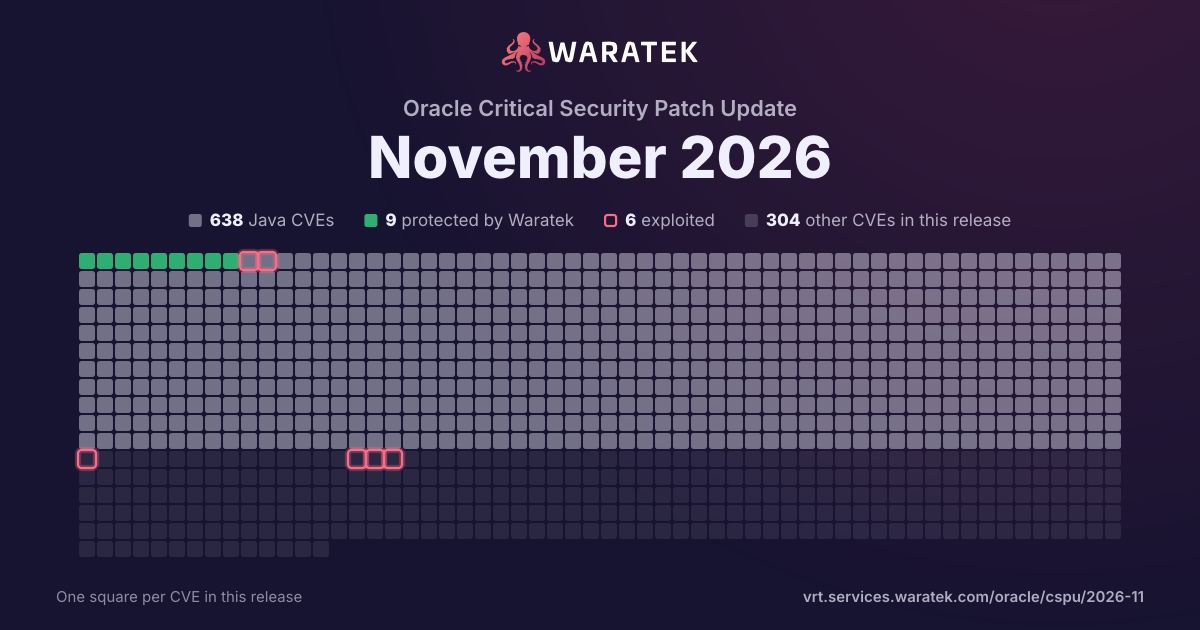
By status
9Protected by Waratek4Mitigation candidate625No exploit published15Outside Waratek scope289Not applicable
6Exploited, marked by the ring
No exploit published. For 554 of them, Oracle's security advisory is the source of public detail.
Protected by Waratek. Waratek RASP can block exploitation of these on systems that have not applied the patch yet.
Overview 289 matches · 0 in Waratek scope · 0 protected · 3 exploited · 0 CISA KEV · 3 public PoC · 0 EPSS ≥ 0.5
289matches
0in Waratek scope0.0%
0protected0.0%
3exploited1.0%
0CISA KEV0.0%
3public PoC1.0%
0EPSS ≥ 0.50.0%
Protected by Waratek
0
0.0%
Rule in development
0
0.0%
Mitigation candidate
0
0.0%
No exploit published
0
0.0%
Outside Waratek scope
0
0.0%
Not applicable
289
100.0%
Withdrawn CVE
0
0.0%
blocked by ARMR today
0
0.0%
partly blocked
0
0.0%
not blocked
289
100.0%
not established
0
0.0%
unrecorded
0
0.0%
Exploited
3
1.0%
Working exploit published
0
0.0%
Proof of concept only
81
28.0%
Forecast only
0
0.0%
No public exploit
205
70.9%
split by
peak 136 / quarter
Q3 221
Not applicable1
High1
not blocked1
No public exploit1
Q4 220
Q1 230
Q2 230
Q3 231
Not applicable1
High1
not blocked1
Proof of concept only1
Q4 230
Q1 240
Q2 241
Not applicable1
Medium1
not blocked1
Proof of concept only1
Q3 240
Q4 241
Not applicable1
High1
not blocked1
Proof of concept only1
Q1 252
Not applicable2
High1
Low1
not blocked2
Proof of concept only1
No public exploit1
Q2 250
Q3 250
Q4 250
Q1 268
Not applicable8
High4
Medium2
Low2
not blocked8
No public exploit8
Q2 2635
Not applicable35
Critical2
High14
Medium10
Low9
not blocked35
Proof of concept only7
No public exploit28
Q3 26104
Not applicable104
Critical13
High51
Medium30
Low10
not blocked104
Proof of concept only43
No public exploit61
Q4 26136
Not applicable136
Critical22
High63
Medium37
Low14
not blocked136
Exploited3
Proof of concept only27
No public exploit106
Q4 22Q2 23Q4 23Q2 24Q4 24Q2 25Q4 25Q2 26Q4 26
| CVE | Severity | Published▾ | Status | Exploitation | Description |
|---|---|---|---|---|---|
| CVE-2026-80230 | High | 2026-09-06 | Not applicable | Proof of concept only | When `CURLOPT_PINNEDPUBLICKEY` is configured alongside options that disable standard peer verification (`CURLOPT_SSL_VERIFYPEER = 0` and `CURLOPT_SSL_VERIFYHOST = 0`), libcurl fails to enforce public key pinning on connections established without a presented server certificate. Bypassing the pinning check under these disabled-verification conditions allows unauthenticated connections to succeed when they should be rejected. |
| CVE-2026-19931 | Critical | 2026-09-06 | Not applicable | Proof of concept only | A flaw in libcurl makes it wrongly reuse an HTTP connection setup for a given hostname using Negotiate authentication, when the initial request is done using empty credentials. This can make user B's request get sent over user A's previously authenticated connection. |
| CVE-2026-18924 | Critical | 2026-09-06 | Not applicable | Proof of concept only | A flaw in libcurl's handling of HTTP/2 Server Push streams, when the parent handle is set to share connections with other handles, can lead to use-after-free in the cleanup process. |
| CVE-2026-13608 | High | 2026-09-06 | Not applicable | Proof of concept only | A flaw in the libcurl SASL negotiation for LDAP authentication allows an incomplete handshake sequence to be misinterpreted as a successful cryptographic verification. An attacker executing a Man-in-the-Middle (MITM) attack can inject a premature or shortcut response that bypasses complete peer validation. |
| CVE-2026-86144 | High | 2026-09-05 | Not applicable | No public exploit | In xinclude in libxml2 before 2.15.4, xmlXIncludeProcess and xmlXIncludeProcessTree do not propagate parseFlags. This has security relevance for, for example, the XML_PARSE_NONET flag, if (without it) a custom resource loader accesses the internet and triggers XML external entity injection, SSRF, or a denial of service (e.g., for an attacker-controlled internet resource that is intentionally slow). |
| CVE-2026-86143 | High | 2026-09-05 | Not applicable | No public exploit | In xmlIO in libxml2 before 2.15.4, an inconsistency in xmlOutputWriteCallback and xmlBufUse causes negative lengths to reach write callbacks, aka a lack of a check for integer overflow before calling writecallback. This has security relevance for many types of uses of that length value within a callback. |
| CVE-2026-86142 | High | 2026-09-05 | Not applicable | No public exploit | In libxml2 before 2.15.4, there is a heap-based buffer overflow in xmlXPtrEvalXPtrPart because of xmlXPtrEval xpointer length saturation. |
| CVE-2026-86141 | Low | 2026-09-05 | Not applicable | No public exploit | xmlregexp in libxml2 before 2.15.4 has a NULL pointer dereference in xmlRegNewParserCtxt after a strdup failure, i.e., it does not calculate a string length after NULL checking. |
| CVE-2026-86140 | High | 2026-09-05 | Not applicable | No public exploit | In libxml2 before 2.15.4, xmlSnprintfElements in valid.c has a strcat stack-based buffer overflow. |
| CVE-2026-86139 | High | 2026-09-05 | Not applicable | No public exploit | In libxml2 before 2.15.4, xmlURIEscapeStr in uri.c has an integer overflow. |
| CVE-2026-86138 | High | 2026-09-05 | Not applicable | No public exploit | In libxml2 before 2.15.4, xmlDictAddQString in dict.c has an integer overflow and resultant heap-based buffer overflow. |
| CVE-2026-86137 | Medium | 2026-09-05 | Not applicable | No public exploit | In libxml2 before 2.15.4, xmlFAParsePosCharGroup has an out-of-bounds read, aka an out-of-bounds read in the NXT macro in xmlregexp. |
| CVE-2026-85396 | High | 2026-09-03 | Not applicable | No public exploit | rubyzip versions before 3.4.0 contain a path traversal vulnerability in Zip::Entry#extract that fails to properly validate extraction paths using prefix comparison without trailing separators. Attackers can craft archive entries with names like ../upload_backup/owned.sh to write files outside the intended extraction directory into sibling paths sharing the destination prefix. |
| CVE-2026-63435 | Medium | 2026-09-01 | Not applicable | No public exploit | Mail is an internet library for Ruby designed to handle email generation, parsing, and sending. Prior to 2.9.1, Mail::Utilities.q_value_decode and Mail::Utilities.b_value_decode used a single String#match and an overly greedy charset capture to decode only the first RFC 2047 encoded-word and mishandle surrounding or subsequent text. A crafted malformed encoded-word in an address display name or local part could cross ? delimiters and make decoded From, To, or Reply-To header values differ from the raw values inspected by a human reviewer or downstream parser, enabling apparent sender or recipient spoofing, phishing, or authorization-check bypass. This issue is fixed in version 2.9.1. |
| CVE-2026-54874 | High | 2026-08-25 | Not applicable | No public exploit | Issue summary: Receiving a DTLS record for a future epoch while a handshake is in progress causes OpenSSL to buffer far more memory than the record itself requires. Impact summary: A peer can use a small amount of network traffic to make an OpenSSL DTLS endpoint retain a disproportionately large amount of memory, which may lead to a Denial of Service. CWE: CWE-405: Asymmetric Resource Consumption (Amplification) Description: While a DTLS handshake is in progress, a peer may legitimately have already moved on to the next epoch (for example, having sent its ChangeCipherSpec and Finished messages) before the local endpoint has processed the same transition, typically because of reordering on the underlying UDP transport. OpenSSL buffers such early records so that they can be processed once the local endpoint catches up. Buffering a record currently retains the entire read buffer it arrived in, which is sized to hold the largest possible DTLS record (around 16 kilobytes), rather than just the bytes that make up the record itself. Up to 100 such records may be buffered per connection. As a result, a peer that sends a stream of small forged records claiming to belong to the next epoch can cause an OpenSSL DTLS endpoint to retain around 1.7 megabytes of memory, despite sending only a small fraction of that amount of data over the network. An attacker therefore gains a memory amplification factor of around 1200, and can multiply the effect across as many associations as it is able to open, making this a remote memory exhaustion Denial of Service risk for DTLS servers. Since the memory retained per connection remains bounded, and any limit an application already places on the number of concurrent associations also bounds the total exposure, this issue has been assessed as Low severity. FIPS impact: no No FIPS modules are affected by this issue as the affected code is outside the OpenSSL FIPS module boundary. OpenSSL 4.0, 3.6, 3.5, 3.4, 3.0, 1.1.1 and 1.0.2 are vulnerable to this issue. OpenSSL 4.0 users should upgrade to OpenSSL 4.0.2. OpenSSL 3.6 users should upgrade to OpenSSL 3.6.4. OpenSSL 3.5 users should upgrade to OpenSSL 3.5.8. OpenSSL 3.4 users should upgrade to OpenSSL 3.4.7. OpenSSL 3.0 users should upgrade to OpenSSL 3.0.22. Premium support customers only: OpenSSL 1.1.1 users should upgrade to OpenSSL 1.1.1zi OpenSSL 1.0.2 users should upgrade to OpenSSL 1.0.2zr This issue was reported on 18 May 2026 by Amazon Web Services. The fix has been developed by Matt Caswell. -- cut (non-publishing metadata for internal use) -- Reported by: Amazon Web Services Fixed by: Matt Caswell |
| CVE-2026-76957 | High | 2026-08-20 | Not applicable | No public exploit | libexpat before 2.8.4 lacks handler call depth tracking with custom encoding callbacks. Thus, a use-after-free can occur. NOTE: this is similar to CVE-2026-50219, CVE-2026-56131 and CVE-2026-56412. |
| CVE-2026-66046 | High | 2026-08-18 | Not applicable | No public exploit | Expat through 2.8.3 contains a denial of service vulnerability caused by quadratic algorithmic complexity in the storeAtts() function in xmlparse.c, where processing N specified attributes with non-normalized values triggers an O(N^2) linear scan of elementType->defaultAtts to determine CDATA status. A remote unauthenticated attacker can supply a single well-formed XML document of a few megabytes to an application parsing untrusted XML to cause excessive CPU consumption, resulting in denial of service without requiring authentication, external entity resolution, or non-default parser options. |
| CVE-2026-71557 | Medium | 2026-08-07 | Not applicable | No public exploit | go-git is an extensible git implementation library written in pure Go. Prior to 5.19.2 and 6.0.0-alpha.5, reference names are not sanitized before being used to construct on-disk paths under the reference storage directory, so a maliciously crafted reference name (for example containing directory-traversal sequences) can cause go-git to write files outside the intended reference storage directory. Versions 5.19.2 and 6.0.0-alpha.5 fix the issue. |
| CVE-2026-71556 | High | 2026-08-07 | Not applicable | No public exploit | go-git is an extensible git implementation library written in pure Go. Prior to 5.19.2 and 6.0.0-alpha.5, worktree operations (including checkout, status, and add) resolve symbolic links inside the working tree without confining resolution to the worktree boundary, so a maliciously crafted repository containing a symlink can cause go-git to read from or write to files outside the intended working directory when the repository is cloned and its worktree operations are used. Versions 5.19.2 and 6.0.0-alpha.5. |
| CVE-2026-71211 | High | 2026-08-05 | Not applicable | No public exploit | MLflow's AI Gateway accepts an auth_config.api_base value when creating a gateway secret (mlflow/server/handlers.py, _create_gateway_secret) with no validation of scheme, host, or IP range; the value is stored verbatim. The gateway proxy endpoint (mlflow/server/gateway_api.py, raw_proxy) subsequently issues an HTTP request to that stored api_base plus a caller-supplied path and returns the full response body. |
| CVE-2026-54522 | Low | 2026-07-30 | Not applicable | Proof of concept only | MessagePack for Ruby is an implementation of the MessagePack binary serialization format. Prior to 1.8.2, MessagePack::Buffer#clear in ext/msgpack/buffer.c leaves rmem_last, rmem_end, and rmem_owner stale after _msgpack_buffer_shift_chunk returns an rmem page to the shared pool, allowing a subsequent Buffer#write and a second MessagePack::Buffer to alias the page and disclose or corrupt cross-buffer data. This issue is fixed in version 1.8.2. |
| CVE-2026-47737 | High | 2026-07-14 | Not applicable | No public exploit | Puma is a Ruby/Rack web server built for parallelism. From 5.5.0 until 7.2.1 and 8.0.2, Puma is vulnerable to source IP spoofing when set_remote_address proxy_protocol: :v1 is enabled and persistent connections are used because Puma incorrectly re-parses PROXY protocol headers after each keep-alive request on the same connection, allowing an attacker to inject a second PROXY header and overwrite REMOTE_ADDR. This issue is fixed in versions 7.2.1 and 8.0.2. |
| CVE-2026-47736 | High | 2026-07-14 | Not applicable | No public exploit | Puma is a Ruby/Rack web server built for parallelism. From 5.5.0 until 7.2.1 and 8.0.2, when PROXY protocol v1 support is enabled, Puma reads incoming bytes into an internal buffer while waiting for CRLF to determine whether a PROXY v1 line is present, allowing an attacker that continuously sends bytes without CRLF to cause unbounded in-process memory growth and additional CPU cost from repeatedly scanning the growing buffer. This issue is fixed in versions 7.2.1 and 8.0.2. |
| CVE-2026-13221 | Critical | 2026-07-13 | Not applicable | No public exploit | Perl versions before 5.40.5-RC1, from 5.41.0 before 5.42.3-RC1, from 5.43.0 before 5.43.10 produce silently incorrect regular expression matches when an alternation of more than 65535 fixed string branches is compiled into a trie in Perl_study_chunk. When such branches are combined into a trie, the delta between the first branch and the shared tail is stored in a 16-bit field. A branch count above 65535 overflows the field, and the trie's match decision table is truncated with no warning or error. A pattern of this shape produces false positive matches (matching strings it should not) and false negative matches (failing to match strings it should). When such a pattern gates an access or filtering decision, the result is wrong. |
| CVE-2026-9547 | High | 2026-07-03 | Not applicable | Proof of concept only | When a libcurl-based application performs transfers via `SCP://` or `SFTP://` and utilizes the `CURLOPT_SSH_KEYFUNCTION` callback, it may silently accept an untrusted server. This vulnerability occurs when a server presents a host key type that does not match the specific key type already recorded for that host in the `known_hosts` file. Instead of rejecting the mismatch, the callback mechanism fails to properly enforce the restriction, allowing the connection to succeed without warning and risking a potential man-in-the-middle attack. |
| CVE-2026-9545 | High | 2026-07-03 | Not applicable | Proof of concept only | In this scenario, libcurl first uses a proper HTTP/3 server for the initial transfers, and when it makes a second transfer to the same site it has been replaced by the attacker's impostor machine - without a valid certificate. When libcurl returns to the hostname the second time with a cached SSL session (`CURLOPT_SSL_SESSIONID_CACHE` is not disabled) and early data enabled (the `CURLSSLOPT_EARLYDATA` bit is set in `CURLOPT_SSL_OPTIONS`), libcurl might send off the second request's bytes on that new connection *before* enforcing the certificate verification failure. Potentially leaking sensitive information. |
| CVE-2026-9079 | Critical | 2026-07-03 | Not applicable | Proof of concept only | libcurl had a flaw that when instructed to clear proxy authentication credentials which made it not do so, leaving the old credentials around to get used for subsequent transfers that should not know nor use them. |
| CVE-2026-8932 | High | 2026-07-03 | Not applicable | Proof of concept only | libcurl would reuse a previously created connection even when some mTLS config related option had been changed that should have prohibited reuse. libcurl keeps previously used connections in a connection pool for subsequent transfers to reuse if one of them matches the setup. However, some TLS settings related to client certificates were left out from the configuration match checks, making them match too easily. In particular options related to the private key. |
| CVE-2026-8927 | Critical | 2026-07-03 | Not applicable | Proof of concept only | When reusing a libcurl handle for sequential transfers driven by environment-variable proxy configuration, libcurl fails to clear the proxy authentication state between requests. Specifically, if the initial transfer authenticates against `proxyA` using Digest auth, a subsequent transfer routed through `proxyB` erroneously leaks the `Proxy-Authorization:` header intended solely for `proxyA`. |
| CVE-2026-8924 | Critical | 2026-07-03 | Not applicable | Proof of concept only | A flaw in curl’s cookie parsing logic allows a malicious HTTP server to set "super cookies" that bypass the Public Suffix List check. This enables an attacker-controlled origin to inject cookies that curl subsequently scopes and transmits to unrelated third-party domains. |
| CVE-2026-8286 | High | 2026-07-03 | Not applicable | Proof of concept only | A vulnerability exists where a new transfer that uses STARTTLS to upgrade the connection might reuse an existing live connection even though the TLS configuration mismatches so it should not. |
| CVE-2026-12064 | High | 2026-07-03 | Not applicable | Proof of concept only | When a user invokes curl using a schemeless URL combined with `--proto-default` sftp (or scp), a disconnect occurs between the tool layer and libcurl. The tool layer incorrectly infers the URL scheme, which erroneously bypasses the initialization of critical SSH security options like CURLOPT_SSH_HOST_PUBLIC_KEY_SHA256 and CURLOPT_SSH_KNOWNHOSTS. Conversely, the libcurl runtime successfully honors CURLOPT_DEFAULT_PROTOCOL and establishes the connection via SFTP/SCP as specified. Because the tool layer skipped the security configuration, these SSH host verification options are silently omitted, causing curl to connect to an unverified SSH remote host without throwing an error. |
| CVE-2026-11856 | Critical | 2026-07-03 | Not applicable | Proof of concept only | Successfully using libcurl to do a transfer to a specific HTTP origin (`hostA`) with **Digest** authentication and then changing the origin to a different one (`hostB`) for a second transfer, reusing the same handle, makes libcurl wrongly pass on the `Authorization:` header field meant for `hostA`, to `hostB`. |
| CVE-2026-10536 | Critical | 2026-07-03 | Not applicable | Proof of concept only | A use-after-free vulnerability exists in libcurl when an application configures an HTTP/2 stream-dependency tree via `CURLOPT_STREAM_DEPENDS` or `CURLOPT_STREAM_DEPENDS_E`, subsequently invokes `curl_easy_reset()`, and finally terminates the handle with `curl_easy_cleanup()`. During this final cleanup phase, libcurl attempts to access and modify an internal structure that was already freed during the reset operation. |
| CVE-2026-53492 | High | 2026-07-01 | Not applicable | No public exploit | containerd is an open-source container runtime. In Versions prior to 2.3.2, 2.2.5 and 2.1.9, the CRI implementation improperly trusts Container Device Interface (CDI) annotations found within untrusted checkpoint image metadata during container restoration. When restoring a container from a checkpoint, containerd preserves CDI-related annotations from the checkpoint archive rather than relying solely on the pod's create-time specification. This allows a user with pod creation permissions to bypass standard Kubernetes resource allocation and device plugin enforcement, injecting arbitrary CDI edits (such as device nodes and host mounts) into the restored container. Successful exploitation requires that the node has CDI enabled and contains a matching host CDI specification for the requested device; environments where CDI is disabled or lacking sensitive device specifications are not affected. This issue has been fixed in versions 2.3.2, 2.2.5 and 2.1.9. |
| CVE-2026-53489 | High | 2026-07-01 | Not applicable | No public exploit | containerd is an open-source container runtime. Versions prior to 2.3.2, 2.2.5 and 2.1.9 contain a bug where the CRI plugin restores container.log from a checkpoint image without validating a symlinked path. This could result in reading an arbitrary file on the host via kubectl logs. This issue has been fixed in versions 2.3.2, 2.2.5 and 2.1.9. |
| CVE-2026-53488 | Critical | 2026-07-01 | Not applicable | No public exploit | containerd is an open-source container runtime. In versions prior to 1.7.33, 2.3.2, 2.2.5, 2.1.9, and 2.0.10 the CRI plugin propagates labels from an image config (LABEL instruction in Dockerfile) to a container without validation. This may result in executing an arbitrary command on the host, via a plugin that consumes container labels for some operations. This issue has been fixed in versions 1.7.33, 2.3.2, 2.2.5, 2.1.9, and 2.0.10. |
| CVE-2026-50195 | Medium | 2026-07-01 | Not applicable | No public exploit | containerd is an open-source container runtime. Versions prior to 2.3.2, 2.2.5 and 2.1.9 contain a vulnerability in the CRI checkpoint import process where it fails to validate the image references specified within a checkpoint image's configuration. An attacker with permissions to create pods can use a crafted checkpoint image to force containerd to pull a malicious image and assign it an arbitrary local tag, thereby poisoning the node's local image cache. Subsequently, if other pods on the same node attempt to use the poisoned tag with an IfNotPresent (or Never) pull policy, they will unknowingly execute the attacker's malicious image instead of the legitimate one. This can lead to a compromise of the affected pods, allowing the attacker to execute arbitrary code under the victim pod's identity. This issue has been fixed in versions 2.3.2, 2.2.5 and 2.1.9. |
| CVE-2026-47262 | Medium | 2026-07-01 | Not applicable | No public exploit | containerd is an open-source container runtime. Versions prior to 1.7.33, 2.0.10, 2.1.9, 2.2.5 and 2.3.2, contain a vulnerability that allows a maliciously crafted image to cause a Denial of Service (DoS) condition. When creating a container from this image, memory exhaustion occurs, leading to an Out Of Memory (OOM) kill of the containerd process. This renders the container runtime API unavailable and can disrupt clients such as the Docker Engine or Kubernetes control-plane components. This issue has been fixed in versions 1.7.33, 2.0.10, 2.1.9, 2.2.5 and 2.3.2. |
| CVE-2026-46680 | High | 2026-07-01 | Not applicable | No public exploit | containerd is an open-source container runtime. In versions prior to 1.7.32, 2.0.9, 2.2.4 and 2.3.1, containers launched with a numeric User directive that cannot be parsed as a 32-bit integer are incorrectly treated as a username, leading to runAsNonRoot evasion. If a crafted image provides an /etc/passwd file mapping this large numeric string to root, the container ultimately runs as root (UID 0). This allows the Kubernetes runAsNonRoot restriction to be bypassed, causing unexpected behavior for environments that require containers to run as a non-root user. This issue has been fixed in versions 1.7.32, 2.0.9, 2.2.4 and 2.3.1. |
| CVE-2026-57438 | Low | 2026-06-25 | Not applicable | No public exploit | Nokogiri is an open source XML and HTML library for the Ruby programming language. Prior to 1.19.4, XInclude substitution performed by Nokogiri::XML::Node#do_xinclude replaced each <xi:include> in place, freeing the include node along with its children (such as <xi:fallback> and its descendants) and any namespaces declared on them. If an application had already exposed one of those nodes or namespaces to Ruby, the corresponding Ruby object was left pointing at freed memory. Using the object could result in invalid reads or writes to memory. This vulnerability is fixed in 1.19.4. |
| CVE-2026-57437 | Low | 2026-06-25 | Not applicable | No public exploit | Nokogiri is an open source XML and HTML library for the Ruby programming language. Prior to 1.19.4, Nokogiri::XML::XPathContext did not keep its source document alive for garbage collection. If an XPathContext outlived its document and the document was collected, evaluating an XPath expression could read invalid memory and potentially segfault. This is only reachable when application code constructs an XPathContext directly and lets the document become unreachable while continuing to use the context. The normal Document#xpath, #css, and related search methods are not affected, and it is not triggerable by malicious document input. This vulnerability is fixed in 1.19.4. |
| CVE-2026-57436 | Low | 2026-06-25 | Not applicable | No public exploit | Nokogiri is an open source XML and HTML library for the Ruby programming language. Prior to 1.19.4, Nokogiri::XML::Document#root= validated only that the new root was a Nokogiri::XML::Node, allowing a DTD node to be set as the document root. The result is a heap use-after-free during garbage collection or finalization, leading to an invalid memory read or potentially a segfault. This vulnerability is fixed in 1.19.4. |
| CVE-2026-57435 | Low | 2026-06-25 | Not applicable | No public exploit | Nokogiri is an open source XML and HTML library for the Ruby programming language. Prior to 1.19.4, Nokogiri’s CRuby native extension could leave a Ruby wrapper pointing to freed memory when replacing the value of an XML attribute. If Ruby code had already accessed an attribute child node, Nokogiri::XML::Attr#value= could free the underlying native child node while the wrapper remained reachable through the document node cache. A later use of the freed child node or a Ruby GC mark could dereference an invalid pointer, causing an invalid read and a possible segfault. This vulnerability is fixed in 1.19.4. |
| CVE-2026-57434 | Low | 2026-06-25 | Not applicable | No public exploit | Nokogiri is an open source XML and HTML library for the Ruby programming language. Prior to 1.19.4, Nokogiri contains a bug when calling certain methods on allocated-but-uninitialized native wrapper classes that inherit from Nokogiri::XML::Node. This caused a NULL pointer dereference that could crash the process. This vulnerability is fixed in 1.19.4. |
| CVE-2026-57236 | Low | 2026-06-25 | Not applicable | No public exploit | Nokogiri is an open source XML and HTML library for the Ruby programming language. Prior to 1.19.4, calling Document#encoding= with an invalid encoding (e.g., a non-string, or a string containing a null byte) raises an exception, but only after freeing the document's current encoding string without replacing it. The document is left referencing freed memory, so the next call to Document#encoding reads invalid memory, which can cause a segfault or leak freed bytes into a Ruby String. Affects the CRuby (libxml2) implementation only; JRuby is not affected. This vulnerability is fixed in 1.19.4. |
| CVE-2026-57235 | Medium | 2026-06-25 | Not applicable | No public exploit | Nokogiri is an open source XML and HTML library for the Ruby programming language. Prior to 1.19.4, Nokogiri::XML::NodeSet#[] (and its alias #slice) checked the requested index against the node set's bounds using a 32-bit-truncated copy of the index. A large negative index could pass the check and then be used at full width, reading outside the node set's storage. On CRuby this is an out-of-bounds read that typically crashes the process; on JRuby it is not memory-unsafe but returns an incorrect node. This vulnerability is fixed in 1.19.4. |
| CVE-2026-54297 | High | 2026-06-24 | Not applicable | Proof of concept only | Faraday is an HTTP client library abstraction layer that provides a common interface over many adapters. From 1.0.0 until 1.10.6 and 2.14.3, Faraday::NestedParamsEncoder, the default nested query parameter encoder/decoder in Faraday, decodes nested query strings without enforcing a maximum nesting depth. A crafted query string causes Faraday to build a deeply nested Ruby Hash structure. The internal dehash routine then recursively walks this attacker-controlled structure without a depth limit. At sufficient depth, Ruby raises an uncaught SystemStackError (stack level too deep), crashing the calling thread or worker. This can lead to denial of service in applications that pass attacker-controlled query strings to Faraday's nested query parsing or URL-building paths. This vulnerability is fixed in 1.10.6 and 2.14.3. |
| CVE-2026-11972 | High | 2026-06-23 | Not applicable | No public exploit | When using the "tarfile" module with a file opened in "streaming mode" (mode="r|") the tarfile module did not properly handle EOF, making archive parsing take exponentially longer. |
| CVE-2026-47242 | Medium | 2026-06-22 | Not applicable | No public exploit | Net::IMAP implements Internet Message Access Protocol (IMAP) client functionality in Ruby. Prior to 0.6.5 and 0.5.15, when Net::IMAP#id is called with a hash argument, although the ID field value strings are correctly quoted (escaping quoted specials), they were not validated to prohibit CRLF sequences. While Net::IMAP#enable does process its arguments for aliases, it does not validate them as valid atoms (or as a list of valid atoms). The #to_s value is sent verbatim. Arguments to either command could be used by an attacker to inject arbitrary IMAP commands. This vulnerability is fixed in 0.6.5 and 0.5.15. |
| CVE-2026-47240 | Medium | 2026-06-22 | Not applicable | No public exploit | Net::IMAP implements Internet Message Access Protocol (IMAP) client functionality in Ruby. Prior to 0.6.5 and 0.5.15, several Net::IMAP commands accept a "raw data" argument that is sent verbatim after validation to prevent command injection. However, if a server does not support non-synchronizing literals, it may still be possible to inject arbitrary IMAP commands inside non-synchronizing literals. A server without support for non-synchronizing literals may interpret the "+}\r\n" as the end of a malformed command line and respond with a tagged BAD. In that case, the contents of the literal will be interpreted as one or more new pipelined commands, allowing a CRLF command injection attack to succeed. This affects criteria for #search and #uid_search; search_keys for #sort, #thread, #uid_sort, and #uid_thread; and attr for #fetch and #uid_fetch. This vulnerability is fixed in 0.6.5 and 0.5.15. |
| CVE-2026-9076 | High | 2026-06-09 | Not applicable | No public exploit | Issue summary: When CMS password-based decryption (RFC 3211 / PWRI key unwrap) processes attacker-supplied CMS data, an attacker-chosen stream-mode KEK cipher can trigger a heap out-of-bounds read in kek_unwrap_key(). Impact summary: A heap buffer over-read may trigger a crash which leads to Denial of Service for an application if the input buffer ends at a memory page boundary and the following page is unmapped. There is no information disclosure as the over-read bytes are not revealed to the attacker. The key unwrapping function performs a check-byte test as specified in the RFC that reads 7 bytes from a heap allocation that is based on the wrapped key length from the message. There is a minimum length check based on the block length of the wrapping cipher. However the cipher is selected from an OID carried in the attacker's PWRI keyEncryptionAlgorithm with no requirement that the cipher be a block cipher. When an attacker selects a stream-mode cipher the guard will be ineffective and the allocated buffer containing the unwrapped key can be too small to fit the check-bytes specified in the RFC and a buffer over-read can happen. Applications calling CMS_decrypt() or CMS_decrypt_set1_password() (equivalently openssl cms -decrypt -pwri_password ...) on untrusted CMS data are vulnerable to this issue. No password knowledge is required: the over-read happens during the unwrap attempt before any authentication succeeds. The over-read is limited to a few bytes and is not written to output, so there is no information disclosure. Triggering a crash requires the allocation to border unmapped memory, which is unlikely with the normal allocator. The FIPS modules are not affected by this issue. |
| CVE-2026-45447 | High | 2026-06-09 | Not applicable | No public exploit | Issue summary: A specially crafted PKCS#7 or S/MIME signed message could trigger a use-after-free during PKCS#7 signature verification. Impact summary: A use-after-free may result in process crashes, heap corruption, or potentially remote code execution. When processing a PKCS#7 or S/MIME signed message, if the SignedData digestAlgorithms field is present as an empty ASN.1 SET, OpenSSL may incorrectly free a caller-owned BIO during PKCS7_verify(). A subsequent use of the BIO by the calling application results in a use-after-free condition. In the common case this occurs when the application later calls BIO_free() on the BIO originally passed to PKCS7_verify(). Depending on allocator behavior and application-specific BIO usage patterns, this may result in a crash or other memory corruption. In some application contexts this may potentially be exploitable for remote code execution. Applications that process PKCS#7 or S/MIME signed messages using OpenSSL PKCS#7 APIs may be affected. Applications using the CMS APIs for this processing are not affected. The FIPS modules in 4.0, 3.6, 3.5, 3.4, and 3.0 are not affected by this issue, as the affected code is outside the OpenSSL FIPS module boundary. |
| CVE-2026-34180 | High | 2026-06-09 | Not applicable | No public exploit | Issue summary: Parsing a crafted DER-encoded ASN.1 structure with a primitive element whose content exceeds 2 gigabytes in length may cause a heap buffer over-read on 64-bit Unix and Unix-like platforms. Impact summary: The heap buffer over-read may crash the application (Denial of Service) or to load into the decoded ASN.1 object contents of memory beyond the end of the input buffer. More typically such ASN.1 elements would instead be truncated. An integer truncation in OpenSSL's ASN.1 decoder causes the content length of an ASN.1 primitive element to be mishandled when it exceeds 2 gigabytes. In the worst case the truncated length is treated as a request to scan the binary content for a terminating zero byte, possibly causing OpenSSL to read either less than or beyond the end of the allocated buffer. Applications that pass attacker-supplied data to d2i_X509(), d2i_PKCS7(), or any other d2i_* decoding function are affected. OpenSSL's own command-line tools are not vulnerable, as data read through the BIO layer is checked before it reaches the affected code. The issue only affects 64-bit Unix and Unix-like platforms; 32-bit platforms and 64-bit Windows are not affected. The FIPS modules in 4.0, 3.6, 3.5, 3.4 and 3.0 are not affected by this issue, as the affected code is outside the OpenSSL FIPS module boundary. |
| CVE-2026-10803 | Low | 2026-06-04 | Not applicable | Proof of concept only | A flaw has been found in MLflow up to 3.10.0. This issue affects the function mlflow.data.digest_utils of the file mlflow/data/digest_utils.py of the component Dataset Digest Computation. This manipulation causes use of weak hash. It is possible to launch the attack on the local host. The attack is considered to have high complexity. The exploitability is assessed as difficult. The exploit has been published and may be used. The project was informed of the problem early through a pull request but has not reacted yet. |
| CVE-2026-3198 | Medium | 2026-06-02 | Not applicable | Proof of concept only | MLflow 3.9.0 with basic-auth (`--app-name basic-auth`) fails to enforce authorization checks for multiple Gateway API 'list' endpoints. Specifically, the `BEFORE_REQUEST_HANDLERS` dictionary in `mlflow/server/auth/__init__.py` does not include entries for `ListGatewaySecretInfos`, `ListGatewayEndpoints`, and `ListGatewayModelDefinitions`. This allows any authenticated user, regardless of their assigned permissions, to enumerate all gateway secrets, endpoints, and model definitions. This vulnerability exposes sensitive information, such as API keys, endpoint configurations, and proprietary model definitions, to unauthorized users. |
| CVE-2026-45571 | Medium | 2026-05-27 | Not applicable | No public exploit | go-git is an extensible git implementation library written in pure Go. Prior to 5.19.1 and 6.0.0-alpha.4, a path validation issue in go-git could allow crafted repository data to affect files outside the intended checkout target, including the repository's .git directory. These validations were introduced in upstream Git years ago, so the vulnerability arose from go-git drifting from those checks. This vulnerability is fixed in 5.19.1 and 6.0.0-alpha.4. |
| CVE-2026-45570 | Low | 2026-05-27 | Not applicable | No public exploit | go-git is an extensible git implementation library written in pure Go. Prior to 5.19.1 and 6.0.0-alpha.4, go-git's SSH transport constructs the remote exec command by wrapping the repository path in single quotes without escaping single quotes embedded inside the path. A repository path containing a single quote can therefore break out of the quoted region in the exec command and be appended as additional shell tokens. This vulnerability is fixed in 5.19.1 and 6.0.0-alpha.4. |
| CVE-2026-45022 | High | 2026-05-27 | Not applicable | No public exploit | go-git is an extensible git implementation library written in pure Go. Prior to 5.19.0 and 6.0.0-alpha.3, go-git may parse malformed Git objects in a way that differs from upstream Git. When commit or tag objects contain ambiguous or malformed headers, go-git’s decoded representation may expose values differently from how Git itself would interpret or reject the same object. Additionally, go-git’s commit signing and verification logic operates over commit data reconstructed from go-git’s parsed representation rather than the original raw object bytes. As a result, go-git may sign or verify a commit payload that is not byte-for-byte equivalent to the object stored in the repository. This can cause a signature to appear valid for a commit whose displayed or effective metadata differs from the object that was intended to be signed. This vulnerability is fixed in 5.19.0 and 6.0.0-alpha.3. |
| CVE-2026-33637 | Medium | 2026-05-19 | Not applicable | Proof of concept only | Faraday is an HTTP client library abstraction layer that provides a common interface over many adapters. Versions 2.0.0 through 2.14.1 still allow protocol-relative host override when the request target is passed as a URI object (rather than a String) to Faraday::Connection#build_exclusive_url. This bypasses the February 2026 fix for GHSA-33mh-2634-fwr2 and enables off-host request forgery: a request built from a fixed-base Faraday::Connection can be redirected to an attacker-controlled host, forwarding connection-scoped values such as Authorization headers and default query parameters. This issue has been fixed in version 2.14.3. |
| CVE-2026-7168 | Medium | 2026-05-13 | Not applicable | Proof of concept only | Successfully using libcurl to do a transfer over a specific HTTP proxy (`proxyA`) with **Digest** authentication and then changing the proxy host to a second one (`proxyB`) for a second transfer, reusing the same handle, makes libcurl wrongly pass on the `Proxy-Authorization:` header field meant for `proxyA`, to `proxyB`. |
| CVE-2026-6429 | Medium | 2026-05-13 | Not applicable | No public exploit | When asked to both use a `.netrc` file for credentials and to follow HTTP redirects, libcurl could leak the password used for the first host to the followed-to host under certain circumstances. |
| CVE-2026-6276 | High | 2026-05-13 | Not applicable | Proof of concept only | Using libcurl, when a custom `Host:` header is first set for an HTTP request and a second request is subsequently done using the same *easy handle* but without the custom `Host:` header set, the second request would use stale information and pass on cookies meant for the first host in the second request. Leak them. |
| CVE-2026-5773 | High | 2026-05-13 | Not applicable | Proof of concept only | libcurl might in some circumstances reuse the wrong connection for SMB(S) transfers. libcurl features a pool of recent connections so that subsequent requests can reuse an existing connection to avoid overhead. When reusing a connection a range of criteria must be met. Due to a logical error in the code, a network transfer operation that was requested by an application could wrongfully reuse an existing SMB connection to the same server that was using a different "share" than the new subsequent transfer should. This could in unlucky situations lead to the download of the wrong file or the upload of a file to the wrong place. When this happens, the same credentials are used and the server name is the same. |
| CVE-2026-45186 | High | 2026-05-10 | Not applicable | No public exploit | In libexpat before 2.8.1, the computational complexity of attribute name collision checks allows a denial of service via moderately sized crafted XML input. |
| CVE-2026-41889 | Low | 2026-05-08 | Not applicable | No public exploit | pgx is a PostgreSQL driver and toolkit for Go. Prior to version 5.9.2, SQL injection can occur when the non-default simple protocol is used, a dollar quoted string literal is used in the SQL query, that string literal contains text that would be would be interpreted as a placeholder outside of a string literal, and the value of that placeholder is controllable by the attacker. This issue has been patched in version 5.9.2. |
| CVE-2026-41506 | High | 2026-05-08 | Not applicable | No public exploit | go-git is an extensible git implementation library written in pure Go. Prior to versions 5.18.0 and 6.0.0-alpha.2, go-git may leak HTTP authentication credentials when following redirects during smart-HTTP clone and fetch operations. This issue has been patched in versions 5.18.0 and 6.0.0-alpha.2. |
| CVE-2026-41990 | Medium | 2026-04-23 | Not applicable | No public exploit | Libgcrypt before 1.12.2 mishandles Dilithium signing. Writes to a static array lack a bounds check but do not use attacker-controlled data. |
| CVE-2026-41989 | Medium | 2026-04-23 | Not applicable | No public exploit | Libgcrypt before 1.12.2 sometimes allows a heap-based buffer overflow and denial of service via crafted ECDH ciphertext to gcry_pk_decrypt. |
| CVE-2026-41080 | High | 2026-04-16 | Not applicable | No public exploit | libexpat before 2.8.0 uses insufficient entropy, and thus hash flooding can occur via a crafted XML document. |
| CVE-2026-33816 | Critical | 2026-04-07 | Not applicable | No public exploit | Memory-safety vulnerability in github.com/jackc/pgx/v5. |
| CVE-2026-33815 | Critical | 2026-04-07 | Not applicable | No public exploit | Memory-safety vulnerability in github.com/jackc/pgx/v5. |
| CVE-2026-28390 | High | 2026-04-07 | Not applicable | No public exploit | Issue summary: During processing of a crafted CMS EnvelopedData message with KeyTransportRecipientInfo a NULL pointer dereference can happen. Impact summary: Applications that process attacker-controlled CMS data may crash before authentication or cryptographic operations occur resulting in Denial of Service. When a CMS EnvelopedData message that uses KeyTransportRecipientInfo with RSA-OAEP encryption is processed, the optional parameters field of RSA-OAEP SourceFunc algorithm identifier is examined without checking for its presence. This results in a NULL pointer dereference if the field is missing. Applications and services that call CMS_decrypt() on untrusted input (e.g., S/MIME processing or CMS-based protocols) are vulnerable. The FIPS modules in 3.6, 3.5, 3.4, 3.3 and 3.0 are not affected by this issue, as the affected code is outside the OpenSSL FIPS module boundary. |
| CVE-2026-28388 | High | 2026-04-07 | Not applicable | No public exploit | Issue summary: When a delta CRL that contains a Delta CRL Indicator extension is processed a NULL pointer dereference might happen if the required CRL Number extension is missing. Impact summary: A NULL pointer dereference can trigger a crash which leads to a Denial of Service for an application. When CRL processing and delta CRL processing is enabled during X.509 certificate verification, the delta CRL processing does not check whether the CRL Number extension is NULL before dereferencing it. When a malformed delta CRL file is being processed, this parameter can be NULL, causing a NULL pointer dereference. Exploiting this issue requires the X509_V_FLAG_USE_DELTAS flag to be enabled in the verification context, the certificate being verified to contain a freshestCRL extension or the base CRL to have the EXFLAG_FRESHEST flag set, and an attacker to provide a malformed CRL to an application that processes it. The vulnerability is limited to Denial of Service and cannot be escalated to achieve code execution or memory disclosure. For that reason the issue was assessed as Low severity according to our Security Policy. The FIPS modules in 3.6, 3.5, 3.4, 3.3 and 3.0 are not affected by this issue, as the affected code is outside the OpenSSL FIPS module boundary. |
| CVE-2026-28387 | High | 2026-04-07 | Not applicable | No public exploit | Issue summary: An uncommon configuration of clients performing DANE TLSA-based server authentication, when paired with uncommon server DANE TLSA records, may result in a use-after-free and/or double-free on the client side. Impact summary: A use after free can have a range of potential consequences such as the corruption of valid data, crashes or execution of arbitrary code. However, the issue only affects clients that make use of TLSA records with both the PKIX-TA(0/PKIX-EE(1) certificate usages and the DANE-TA(2) certificate usage. By far the most common deployment of DANE is in SMTP MTAs for which RFC7672 recommends that clients treat as 'unusable' any TLSA records that have the PKIX certificate usages. These SMTP (or other similar) clients are not vulnerable to this issue. Conversely, any clients that support only the PKIX usages, and ignore the DANE-TA(2) usage are also not vulnerable. The client would also need to be communicating with a server that publishes a TLSA RRset with both types of TLSA records. No FIPS modules are affected by this issue, the problem code is outside the FIPS module boundary. |
| CVE-2026-34165 | Medium | 2026-03-31 | Not applicable | No public exploit | go-git is an extensible git implementation library written in pure Go. From version 5.0.0 to before version 5.17.1, a vulnerability has been identified in which a maliciously crafted .idx file can cause asymmetric memory consumption, potentially exhausting available memory and resulting in a denial-of-service (DoS) condition. Exploitation requires write access to the local repository's .git directory, it order to create or alter existing .idx files. This issue has been patched in version 5.17.1. |
| CVE-2026-33762 | Low | 2026-03-31 | Not applicable | No public exploit | go-git is an extensible git implementation library written in pure Go. Prior to version 5.17.1, go-git’s index decoder for format version 4 fails to validate the path name prefix length before applying it to the previously decoded path name. A maliciously crafted index file can trigger an out-of-bounds slice operation, resulting in a runtime panic during normal index parsing. This issue only affects Git index format version 4. Earlier formats (go-git supports only v2 and v3) are not vulnerable to this issue. This issue has been patched in version 5.17.1. |
| CVE-2026-27135 | High | 2026-03-18 | Not applicable | No public exploit | nghttp2 is an implementation of the Hypertext Transfer Protocol version 2 in C. Prior to version 1.68.1, the nghttp2 library stops reading the incoming data when user facing public API `nghttp2_session_terminate_session` or `nghttp2_session_terminate_session2` is called by the application. They might be called internally by the library when it detects the situation that is subject to connection error. Due to the missing internal state validation, the library keeps reading the rest of the data after one of those APIs is called. Then receiving a malformed frame that causes FRAME_SIZE_ERROR causes assertion failure. nghttp2 v1.68.1 adds missing state validation to avoid assertion failure. No known workarounds are available. |
| CVE-2026-1229 | Low | 2026-02-24 | Not applicable | No public exploit | The CombinedMult function in the CIRCL ecc/p384 package (secp384r1 curve) produces an incorrect value for specific inputs. The issue is fixed by using complete addition formulas. ECDH and ECDSA signing relying on this curve are not affected. The bug was fixed in v1.6.3 https://github.com/cloudflare/circl/releases/tag/v1.6.3 . |
| CVE-2026-25934 | Medium | 2026-02-09 | Not applicable | No public exploit | go-git is a highly extensible git implementation library written in pure Go. Prior to 5.16.5, a vulnerability was discovered in go-git whereby data integrity values for .pack and .idx files were not properly verified. This resulted in go-git potentially consuming corrupted files, which would likely result in unexpected errors such as object not found. For context, clients fetch packfiles from upstream Git servers. Those files contain a checksum of their contents, so that clients can perform integrity checks before consuming it. The pack indexes (.idx) are generated locally by go-git, or the git cli, when new .pack files are received and processed. The integrity checks for both files were not being verified correctly. This vulnerability is fixed in 5.16.5. |
| CVE-2025-69421 | High | 2026-01-27 | Not applicable | No public exploit | Issue summary: Processing a malformed PKCS#12 file can trigger a NULL pointer dereference in the PKCS12_item_decrypt_d2i_ex() function. Impact summary: A NULL pointer dereference can trigger a crash which leads to Denial of Service for an application processing PKCS#12 files. The PKCS12_item_decrypt_d2i_ex() function does not check whether the oct parameter is NULL before dereferencing it. When called from PKCS12_unpack_p7encdata() with a malformed PKCS#12 file, this parameter can be NULL, causing a crash. The vulnerability is limited to Denial of Service and cannot be escalated to achieve code execution or memory disclosure. Exploiting this issue requires an attacker to provide a malformed PKCS#12 file to an application that processes it. For that reason the issue was assessed as Low severity according to our Security Policy. The FIPS modules in 3.6, 3.5, 3.4, 3.3 and 3.0 are not affected by this issue, as the PKCS#12 implementation is outside the OpenSSL FIPS module boundary. OpenSSL 3.6, 3.5, 3.4, 3.3, 3.0, 1.1.1 and 1.0.2 are vulnerable to this issue. |
| CVE-2025-69420 | High | 2026-01-27 | Not applicable | No public exploit | Issue summary: A type confusion vulnerability exists in the TimeStamp Response verification code where an ASN1_TYPE union member is accessed without first validating the type, causing an invalid or NULL pointer dereference when processing a malformed TimeStamp Response file. Impact summary: An application calling TS_RESP_verify_response() with a malformed TimeStamp Response can be caused to dereference an invalid or NULL pointer when reading, resulting in a Denial of Service. The functions ossl_ess_get_signing_cert() and ossl_ess_get_signing_cert_v2() access the signing cert attribute value without validating its type. When the type is not V_ASN1_SEQUENCE, this results in accessing invalid memory through the ASN1_TYPE union, causing a crash. Exploiting this vulnerability requires an attacker to provide a malformed TimeStamp Response to an application that verifies timestamp responses. The TimeStamp protocol (RFC 3161) is not widely used and the impact of the exploit is just a Denial of Service. For these reasons the issue was assessed as Low severity. The FIPS modules in 3.5, 3.4, 3.3 and 3.0 are not affected by this issue, as the TimeStamp Response implementation is outside the OpenSSL FIPS module boundary. OpenSSL 3.6, 3.5, 3.4, 3.3, 3.0 and 1.1.1 are vulnerable to this issue. OpenSSL 1.0.2 is not affected by this issue. |
| CVE-2025-69419 | High | 2026-01-27 | Not applicable | No public exploit | Issue summary: Calling PKCS12_get_friendlyname() function on a maliciously crafted PKCS#12 file with a BMPString (UTF-16BE) friendly name containing non-ASCII BMP code point can trigger a one byte write before the allocated buffer. Impact summary: The out-of-bounds write can cause a memory corruption which can have various consequences including a Denial of Service. The OPENSSL_uni2utf8() function performs a two-pass conversion of a PKCS#12 BMPString (UTF-16BE) to UTF-8. In the second pass, when emitting UTF-8 bytes, the helper function bmp_to_utf8() incorrectly forwards the remaining UTF-16 source byte count as the destination buffer capacity to UTF8_putc(). For BMP code points above U+07FF, UTF-8 requires three bytes, but the forwarded capacity can be just two bytes. UTF8_putc() then returns -1, and this negative value is added to the output length without validation, causing the length to become negative. The subsequent trailing NUL byte is then written at a negative offset, causing write outside of heap allocated buffer. The vulnerability is reachable via the public PKCS12_get_friendlyname() API when parsing attacker-controlled PKCS#12 files. While PKCS12_parse() uses a different code path that avoids this issue, PKCS12_get_friendlyname() directly invokes the vulnerable function. Exploitation requires an attacker to provide a malicious PKCS#12 file to be parsed by the application and the attacker can just trigger a one zero byte write before the allocated buffer. For that reason the issue was assessed as Low severity according to our Security Policy. The FIPS modules in 3.6, 3.5, 3.4, 3.3 and 3.0 are not affected by this issue, as the PKCS#12 implementation is outside the OpenSSL FIPS module boundary. OpenSSL 3.6, 3.5, 3.4, 3.3, 3.0 and 1.1.1 are vulnerable to this issue. OpenSSL 1.0.2 is not affected by this issue. |
| CVE-2024-3220 | Low | 2025-02-14 | Not applicable | No public exploit | There is a defect in the CPython standard library module “mimetypes” where on Windows the default list of known file locations are writable meaning other users can create invalid files to cause MemoryError to be raised on Python runtime startup or have file extensions be interpreted as the incorrect file type. This defect is caused by the default locations of Linux and macOS platforms (such as “/etc/mime.types”) also being used on Windows, where they are user-writable locations (“C:\etc\mime.types”). To work-around this issue a user can call mimetypes.init() with an empty list (“[]”) on Windows platforms to avoid using the default list of known file locations. |
| CVE-2025-0725 | High | 2025-02-05 | Not applicable | Proof of concept only | When libcurl is asked to perform automatic gzip decompression of content-encoded HTTP responses with the `CURLOPT_ACCEPT_ENCODING` option, **using zlib 1.2.0.3 or older**, an attacker-controlled integer overflow would make libcurl perform a buffer overflow. |
| CVE-2024-41311 | High | 2024-10-15 | Not applicable | Proof of concept only | In Libheif 1.17.6, insufficient checks in ImageOverlay::parse() decoding a heif file containing an overlay image with forged offsets can lead to an out-of-bounds read and write. |
| CVE-2024-38949 | Medium | 2024-06-26 | Not applicable | Proof of concept only | Heap Buffer Overflow vulnerability in Libde265 v1.0.15 allows attackers to crash the application via crafted payload to display444as420 function at sdl.cc |
| CVE-2023-35945 | High | 2023-07-13 | Not applicable | Proof of concept only | Envoy is a cloud-native high-performance edge/middle/service proxy. Envoy’s HTTP/2 codec may leak a header map and bookkeeping structures upon receiving `RST_STREAM` immediately followed by the `GOAWAY` frames from an upstream server. In nghttp2, cleanup of pending requests due to receipt of the `GOAWAY` frame skips de-allocation of the bookkeeping structure and pending compressed header. The error return [code path] is taken if connection is already marked for not sending more requests due to `GOAWAY` frame. The clean-up code is right after the return statement, causing memory leak. Denial of service through memory exhaustion. This vulnerability was patched in versions(s) 1.26.3, 1.25.8, 1.24.9, 1.23.11. |
| CVE-2022-38171 | High | 2022-08-22 | Not applicable | No public exploit | Xpdf prior to version 4.04 contains an integer overflow in the JBIG2 decoder (JBIG2Stream::readTextRegionSeg() in JBIG2Stream.cc). Processing a specially crafted PDF file or JBIG2 image could lead to a crash or the execution of arbitrary code. This is similar to the vulnerability described by CVE-2021-30860 (Apple CoreGraphics). |