
Oracle Critical Security Patch Update November 2026
Released November 2026 · Oracle's advisory ↗ · ← Critical Patch Update, October 2026
942 CVEs in this release, one square each
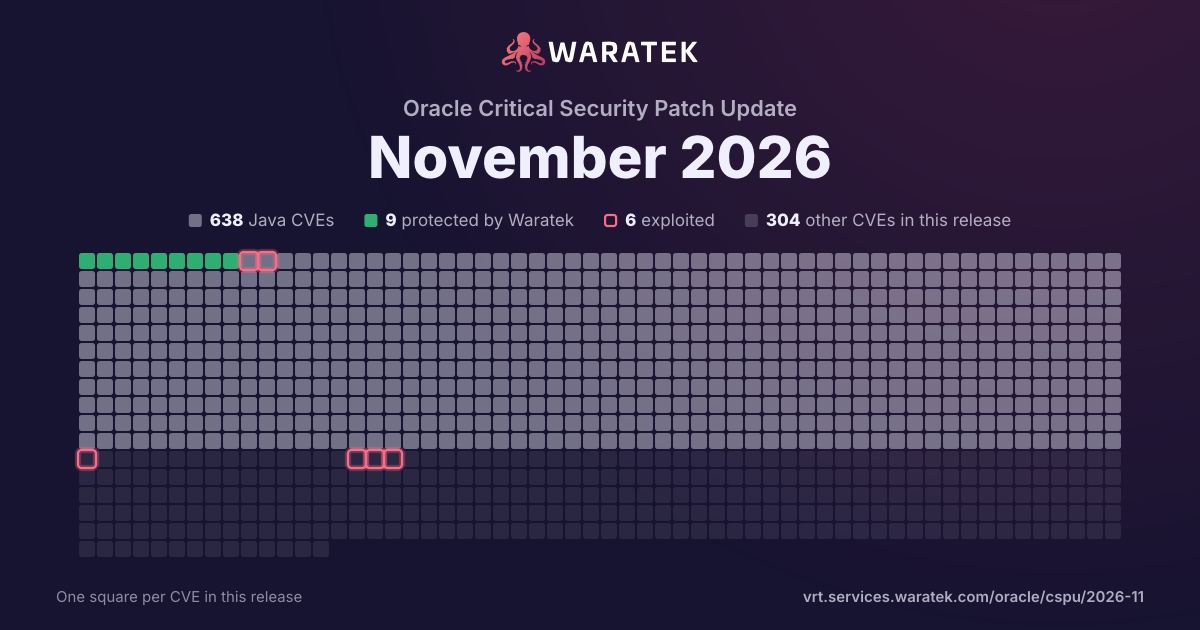
By status
9Protected by Waratek4Mitigation candidate625No exploit published15Outside Waratek scope289Not applicable
6Exploited, marked by the ring
No exploit published. For 554 of them, Oracle's security advisory is the source of public detail.
Protected by Waratek. Waratek RASP can block exploitation of these on systems that have not applied the patch yet.
Overview 289 matches · 0 in Waratek scope · 0 protected · 3 exploited · 0 CISA KEV · 3 public PoC · 0 EPSS ≥ 0.5
289matches
0in Waratek scope0.0%
0protected0.0%
3exploited1.0%
0CISA KEV0.0%
3public PoC1.0%
0EPSS ≥ 0.50.0%
Protected by Waratek
0
0.0%
Rule in development
0
0.0%
Mitigation candidate
0
0.0%
No exploit published
0
0.0%
Outside Waratek scope
0
0.0%
Not applicable
289
100.0%
Withdrawn CVE
0
0.0%
blocked by ARMR today
0
0.0%
partly blocked
0
0.0%
not blocked
289
100.0%
not established
0
0.0%
unrecorded
0
0.0%
Exploited
3
1.0%
Working exploit published
0
0.0%
Proof of concept only
81
28.0%
Forecast only
0
0.0%
No public exploit
205
70.9%
split by
peak 136 / quarter
Q3 221
Not applicable1
High1
not blocked1
No public exploit1
Q4 220
Q1 230
Q2 230
Q3 231
Not applicable1
High1
not blocked1
Proof of concept only1
Q4 230
Q1 240
Q2 241
Not applicable1
Medium1
not blocked1
Proof of concept only1
Q3 240
Q4 241
Not applicable1
High1
not blocked1
Proof of concept only1
Q1 252
Not applicable2
High1
Low1
not blocked2
Proof of concept only1
No public exploit1
Q2 250
Q3 250
Q4 250
Q1 268
Not applicable8
High4
Medium2
Low2
not blocked8
No public exploit8
Q2 2635
Not applicable35
Critical2
High14
Medium10
Low9
not blocked35
Proof of concept only7
No public exploit28
Q3 26104
Not applicable104
Critical13
High51
Medium30
Low10
not blocked104
Proof of concept only43
No public exploit61
Q4 26136
Not applicable136
Critical22
High63
Medium37
Low14
not blocked136
Exploited3
Proof of concept only27
No public exploit106
Q4 22Q2 23Q4 23Q2 24Q4 24Q2 25Q4 25Q2 26Q4 26
| CVE | Severity | Published▾ | Status | Exploitation | Description |
|---|---|---|---|---|---|
| CVE-2026-87862 | High | 2026-10-20 | Not applicable | Proof of concept only | Importing a `includeSubDomains` parent HSTS entry before a longer-lived child entry, silently drops the child. Consequently, when the parent expires, the child's valid HSTS policy is lost, causing curl to issue unencrypted HTTP requests rather than upgrading to HTTPS. |
| CVE-2026-87861 | Critical | 2026-10-20 | Not applicable | Proof of concept only | When using ambient user credentials, an HTTP request directed to one origin may be dispatched over a connection previously authenticated via Negotiate for a different origin, leaving the request's intended credentials unused. |
| CVE-2026-86415 | High | 2026-10-20 | Not applicable | No public exploit | libcurl's connection cache match function never considers the automatic client certificate option, so a cached, already authenticated Schannel connection can be handed to a transfer that got redirected to a different origin, even though the code explicitly switched off the auto client cert option for that transfer to prevent exactly this. |
| CVE-2026-86414 | Critical | 2026-10-20 | Not applicable | Proof of concept only | An HTTP proxy can trick libcurl into sending the origin's credentials (Basic password, or a Negotiate/Kerberos ticket) to the proxy itself, by answering the `CONNECT` tunnel request with 401 `WWW-Authenticate:` instead of the expected 407 `Proxy-Authenticate:`. |
| CVE-2026-86413 | Critical | 2026-10-20 | Not applicable | Proof of concept only | When using an *ambient user* in a first transfer doing Negotiate authentication and asked to follow redirects, curl could pass on its credential details to an unrelated second origin when asked to redirect there. |
| CVE-2026-86412 | High | 2026-10-20 | Not applicable | Proof of concept only | A remote HTTP server can set a cookie that curl accepts and writes to a Netscape cookie jar but cannot reload. On the next invocation using the same path for `--cookie` and `--cookie-jar`, curl fails before connecting, then the cleanup procedure replaces the jar with an empty file, deleting cookies for unrelated domains. |
| CVE-2026-86411 | Critical | 2026-10-20 | Not applicable | Proof of concept only | An `ftp://` transfer configured with `CURLUSESSL_NONE` can reuse a pooled FTP control connection that a previous easy handle upgraded with `STARTTLS` and authenticated using a client certificate. The second handle performs neither a new TLS handshake nor a new FTP login, so the server continues to authorize it under the first handle's certificate identity. |
| CVE-2026-86410 | High | 2026-10-20 | Not applicable | Proof of concept only | A flaw in the curl command line tool's logic makes it only set SSH host verification options when interacting directly using SFTP or SCP, and not as a result of following a redirect. |
| CVE-2026-86409 | High | 2026-10-20 | Not applicable | Proof of concept only | Setting `CURLOPT_AWS_SIGV4` to NULL but does not disable SigV4 authentication, contrary to expectations and documentation. A subsequent transfer on the same handle still sends an `Authorization: AWS4-HMAC-SHA256` header to whatever URL isset next, leaking state information. |
| CVE-2026-107929 | High | 2026-10-20 | Not applicable | Proof of concept only | When `CURLOPT_INTERFACE` (or the command line tool's `--interface` option) is set with one of the documented prefixes (`if!`, `host!`, `ifhost!`), that binding is not part of the connection reuse key, so a later transfer asking for a different source can silently reuse an existing connection and go out from the earlier transfer's source address |
| CVE-2026-107928 | High | 2026-10-20 | Not applicable | Proof of concept only | When curl is built with GnuTLS, a malicious WebSocket server can make curl send memory past its send buffer. This is due to an out of bounds read following when `gnutls_record_send()` returns a number of bytes sent **greater than the number of bytes it was given to send**. GnuTLS does that after a blocked send. |
| CVE-2026-92392 | High | 2026-10-14 | Not applicable | Proof of concept only | During an upload, curl mishandles HTTP/2 `RST_STREAM` received from the server (with reason `HTTP_1_1_REQUIRED` or `REFUSED_STREAM`) leading to a use after free of a `struct Curl_easy` object. |
| CVE-2026-67418 | Medium | 2026-10-14 | Not applicable | No public exploit | RabbitMQ is a messaging and streaming broker. From 3.13.0 until 3.13.19, 4.0.24, 4.1.15, 4.2.10, and 4.3.5, the MQTT 5 parser in deps/rabbitmq_mqtt/src/rabbit_mqtt_packet.erl accepts Request-Problem-Information on PUBLISH packets even though the property is valid only for CONNECT. An authenticated publisher with topic write permission can cause the broker to store and route that inapplicable property to a separately authenticated matching subscriber. When the subscriber path serializes the outbound PUBLISH, serialise_prop/2 has no matching clause, and the uncontained function_clause exception closes the victim MQTT or Web MQTT connection. The publisher connection and broker remain available, and queued replay, retained-message persistence, and broker-wide denial of service were not established. This issue is fixed in versions 3.13.19, 4.0.24, 4.1.15, 4.2.10, and 4.3.5. |
| CVE-2026-67416 | Medium | 2026-10-14 | Not applicable | Proof of concept only | RabbitMQ is a messaging and streaming broker. From 4.0.0 until 4.0.24, 4.1.15, 4.2.10, and 4.3.4, the optimized AMQP 1.0 server_mode parser in deps/amqp10_common/src/amqp10_binary_parser.erl matches the textual prefixes of symbolic data, sequence, and value body descriptors without verifying their encoded symbol lengths. An authenticated AMQP 1.0 publisher with write permission can submit a well-formed unknown descriptor that begins with a registered body descriptor, and RabbitMQ misclassifies and stores the bytes as a standard body section. Strict AMQP 1.0 consumers can terminate while decoding the stored entry. For bodies misclassified as data, AMQP 0-9-1 or other cross-protocol conversion performs full body decoding and can terminate the consumer protocol process, with acknowledgement-required delivery permitting repeated failures. Sequence and value classifications are normally transported as opaque encoded payloads on that conversion path. The broker remains alive, and the issue does not bypass routing or authorization. This issue is fixed in versions 4.0.24, 4.1.15, 4.2.10, and 4.3.4. |
| CVE-2026-67414 | Medium | 2026-10-14 | Not applicable | Proof of concept only | RabbitMQ is a messaging and streaming broker. From 4.0.0 until 4.0.24, 4.1.15, 4.2.10, and 4.3.4, deps/amqp10_common/src/amqp10_binary_parser.erl materializes each element of AMQP 1.0 arrays whose shared constructor has zero width, while limiting only the number of elements in each array and not the aggregate arrays in a frame. After completing SASL authentication, a low-privilege client can send an ordinary frame containing many individually permitted arrays, causing a small frame to expand into a very large reader-process heap before later frame validation or authorization. Because deps/rabbit/src/rabbit_amqp_reader.erl clears the pre-authentication max_heap_size guard after login, repeated or concurrent frames can trigger the node-wide memory alarm, block publishers, or exhaust broker memory. This issue is fixed in versions 4.0.24, 4.1.15, 4.2.10, and 4.3.4. |
| CVE-2026-77214 | High | 2026-10-07 | Not applicable | No public exploit | libexpat before commit 13c5f63 contains a heap buffer over-read vulnerability in xmlparse.c. XML_ParseBuffer advances the parse buffer end with parser->m_bufferEnd += len using a caller-supplied length that is not validated against the allocated buffer size, so repeated XML_ParseBuffer calls move m_bufferEnd past the end of the heap allocation and subsequent parsing reads out of bounds. Reaching this path requires a parse buffer to already be present; otherwise XML_ParseBuffer returns XML_ERROR_NO_BUFFER. A buffer is present after a prior call to XML_GetBuffer, either directly (the common case) or indirectly through a prior XML_Parse call that allocates the buffer internally. The over-read discloses adjacent heap memory to the calling application, recovering heap pointers, libc function pointers, and code pointers sufficient to defeat ASLR and build further exploitation primitives. |
| CVE-2026-93546 | High | 2026-10-01 | Not applicable | No public exploit | Integer overflow in mod_dav_fs in Apache HTTP Server through 2.4.68 allows an authenticated WebDAV client with write access to crash worker processes and persistently corrupt a directory's property database via PROPPATCH requests declaring many XML namespaces. |
| CVE-2026-79768 | Medium | 2026-10-01 | Not applicable | No public exploit | Path equivalence: '/./' (single dot directory) vulnerability in Apache HTTP Server's mod_userdir module when configured with absolute non-wildcard UserDir directive (the 2nd form in https://httpd.apache.org/docs/2.4/mod/mod_userdir.html#userdir) This issue affects Apache HTTP Server: from 2.4.0 through 2.4.68. |
| CVE-2026-73637 | High | 2026-10-01 | Not applicable | No public exploit | Use after free in mod_auth_digest in Apache Software Foundation Apache HTTP Server before 2.4.69 on all platforms allows an unauthenticated remote client to cause authentication state corruption via concurrent Digest authentication requests when AuthDigestNcCheck is enabled or AuthDigestNonceLifetime is set to 0. Users are recommended to upgrade to version 2.4.69, which fixes this issue. |
| CVE-2026-73636 | High | 2026-10-01 | Not applicable | No public exploit | Authentication bypass by capture-replay in mod_auth_digest in Apache Software Foundation Apache HTTP Server 2.4.x on all platforms allows a man-in-the-middle (MITM) attacker to replay captured digest authentication credentials via crafted requests that trigger garbage collection of the client's shared memory entry when AuthDigestNonceLifetime is set to 0. Users are recommended to upgrade to version 2.4.69, which fixes this issue. |
| CVE-2026-63718 | High | 2026-10-01 | Not applicable | No public exploit | Inconsistent Interpretation of HTTP Requests ('HTTP Request/Response Smuggling') response smuggling vulnerability in Apache HTTP Server via mod_proxy_uwsgi and a crafted uwsgi response with Transfer-Encoding. This issue affects Apache HTTP Server: from 2.4.30 through 2.4.68. |
| CVE-2026-63686 | High | 2026-10-01 | Not applicable | No public exploit | A NULL pointer dereference in mod_xml2enc in Apache Software Foundation Apache HTTP Server before 2.4.69 on all platforms allows an untrusted backend server to cause a denial of service via a proxied response with a charset whose conversion partially succeeds then fails. Users are recommended to upgrade to version 2.4.69, which fixes this issue. |
| CVE-2026-63292 | High | 2026-10-01 | Not applicable | No public exploit | Stack-based buffer overflow in mod_vhost_alias in Apache Software Foundation Apache HTTP Server through 2.4.68 on all platforms allows a remote client to cause a denial of service or potentially execute arbitrary code via an HTTP request with a Host header exceeding 8192 bytes when VirtualDocumentRoot uses a hostname format specifier and LimitRequestFieldSize is raised above the default. Users are recommended to upgrade to version 2.4.69, which fixes this issue. |
| CVE-2026-63045 | High | 2026-10-01 | Not applicable | No public exploit | Improper validation of FTP PASV reply address in mod_proxy_ftp in Apache Software Foundation Apache HTTP Server through 2.4.68 on all platforms allows, in forward proxy configurations, an untrusted FTP server to cause the proxy to open a data connection to an arbitrary third-party host via a crafted PASV response. Users are recommended to upgrade to version 2.4.69, which fixes this issue. |
| CVE-2026-59797 | Critical | 2026-10-01 | Not applicable | No public exploit | Improper Privilege Management vulnerability in Apache HTTP Server's mod_ssl via SSLRequire and file-related expressions. This issue affects Apache HTTP Server: from 2.4.0 through 2.4.68. |
| CVE-2026-59685 | High | 2026-10-01 | Not applicable | No public exploit | Out-of-bounds Write vulnerability in Apache HTTP Server on Windows while processing paths with 8.3 names that may grow when expanded. This issue affects Apache HTTP Server: from 2.4.0 through 2.4.68. |
| CVE-2026-58415 | Medium | 2026-10-01 | Not applicable | No public exploit | Internal state files accessible to external parties in mod_dav_fs in Apache Software Foundation Apache HTTP Server before 2.4.69 on all platforms allows a remote client to read WebDAV dead properties of resources it cannot author via a GET request for the .DAV state directory This issue affects Apache HTTP Server: from 2.4.0 through 2.4.68. |
| CVE-2026-57941 | Critical | 2026-10-01 | Not applicable | No public exploit | Use After Free vulnerability in Apache HTTP Server's mod_http2 via shared session->bbtmp re-entrancy This issue affects Apache HTTP Server: from 2.4.0 through 2.4.68. |
| CVE-2026-56449 | High | 2026-10-01 | Not applicable | No public exploit | Out-of-bounds Write vulnerability in Apache HTTP Server's mod_proxy_html with crafted HTTP response bodies. This issue affects Apache HTTP Server version 2.4.68. |
| CVE-2026-56154 | Critical | 2026-10-01 | Not applicable | No public exploit | Use After Free vulnerability in Apache HTTP Server's mod_rewrite when using lookahead (%{LA-U:HTTP:...}) This issue affects Apache HTTP Server: from 2.4.0 through 2.4.68. |
| CVE-2026-56153 | High | 2026-10-01 | Not applicable | No public exploit | Out-of-bounds Write vulnerability in Apache HTTP Server's mod_charset_lite. This issue affects Apache HTTP Server: from 2.4.0 through 2.4.68. |
| CVE-2026-48005 | High | 2026-10-01 | Not applicable | No public exploit | Missing authentication checks in mod_auth_digest in Apache Software Foundation Apache HTTP Server before 2.4.69 on all platforms allows an unauthenticated remote client to cause a denial of service (forced re-authentication) via forged Authorization headers when Digest authentication is enabled with AuthDigestNcCheck . Users are recommended to upgrade to version 2.4.69, which fixes this issue. |
| CVE-2026-47360 | High | 2026-10-01 | Not applicable | No public exploit | Exposure of Sensitive Information to an Unauthorized Actor vulnerability in Apache HTTP Server's mod_session_cookie module. When SessionCookieRemove changes across internal redirects, the session cookie may still be passed to a backend server. This issue affects Apache HTTP Server: from 2.4.0 through 2.4.68. |
| CVE-2026-46729 | High | 2026-10-01 | Not applicable | No public exploit | NULL Pointer Dereference vulnerability in Apache HTTP Servers mod_heartmonitor over unicast listener. This issue affects Apache HTTP Server: from 2.4.0 through 2.4.68. |
| CVE-2026-42528 | Medium | 2026-10-01 | Not applicable | No public exploit | A memory calculation bug in mod_dav in Apache httpd 2.4.67 and earlier allows an attacker with permission to create WebDAV locks to crash server child processes. Users are recommended to upgrade to version 2.4.69, which fixes this issue |
| CVE-2026-42356 | Low | 2026-10-01 | Not applicable | No public exploit | Deployment of wrong handler vulnerability in Apache HTTP Server allows the target of some internal redirects from CGI programs to also be treated as CGI and executed. The target must already be in a directory enabled for CGI and have no other extension understood by mod_mime. This issue affects Apache HTTP Server: from 2.4.60 through 2.4.68. |
| CVE-2026-19553 | High | 2026-09-30 | Not applicable | No public exploit | ssl.SSLContext.wrap_bio() didn't require the server_hostname argument to not be None if ssl.SSLContext.check_hostname was set. Due to a missing parameter check in SSLObject, if the server_hostname argument isn't supplied then hostname verification would be silently skipped. This defect could lead to programs where certificate hostname verification *appeared* to be succeeding with SSLContext.check_hostname = True and no ValueError being raised due to misconfiguration. If the program passes a server_hostname value that isn't an empty string or None to any of these APIs then certificate hostname verification proceeds as expected and the program is not affected by this vulnerability. Mitigating this vulnerability doesn't require updating Python or applying the patch. To mitigate, pass a valid non-None and non-empty server_hostname value to SSLContext.wrap_bio(), asyncio.create_connection(), or asyncio.loop.start_tls() and certificate hostname verification will proceed as expected. Upgrading to the latest version of Python or applying the patch only changes the behavior from silently skipping hostname verification to raising a ValueError, similar to SSLContext.wrap_socket(), when server_hostname isn't supplied. |
| CVE-2026-19445 | Critical | 2026-09-30 | Not applicable | No public exploit | A remote, unauthenticated TLS client can make a server crash or call through a freed pointer if its sni_callback assigns a different context to SSLSocket.context (the documented way to select a certificate per server name) and nothing else keeps the original ssl.SSLContext alive. Typical cases are servers that create an SSLContext per connection or replace it while connections are open; servers that wrap their listening socket with it are not affected. Mitigation: keep a reference to every SSLContext that sets sni_callback for the lifetime of the server. TLS clients are not affected. |
| CVE-2026-84784 | High | 2026-09-29 | Not applicable | No public exploit | Issue summary: A malicious remote peer may flood the local QUIC stack with NEW_CONNECTION_ID frames by avoiding a limit check on how many connection IDs the remote QUIC stack can use. Impact summary: The local QUIC stack sends a RETIRE_CONN_ID frame for every NEW_CONNECTION_ID frame it receives. The RETIRE_CONN_ID frame is dispatched via the Control Frame Queue (CFQ). If the remote peer also withholds ACKs, then it can force the local stack to allocate ~400MB (depending on ACK delay). CWE: CWE-770: Allocation of Resources Without Limits or Throttling Description: RFC 9000 sections 5.1.1 and 5.1.2 [1] describe the mechanism by which a remote peer can notify the local QUIC stack to change the destination connection ID (a.k.a. CID) the local stack uses to identify the connection at the remote peer. Each CID is associated with a sequence number. The sequence number is transmitted in NEW_CONNECTION_ID and RETIRE_CONNECTION_ID frames to identify the CID which is being either associated with a connection or retired. The remote peer sends a NEW_CONNECTION_ID frame to let the local stack know a new CID is being associated with an existing connection. The NEW_CONNECTION_ID frame carries the new CID, its sequence number, and the retire-prior-to number. The retire-prior-to identifies existing CIDs that are to be retired. The local QUIC stack must send a RETIRE_CONNECTION_ID for every destination CID whose sequence number is less than retire-prior-to. The CID becomes retired after the local stack receives an ACK for its RETIRE_CONNECTION_ID frame. Although the OpenSSL QUIC stack supports at most one destination CID for every connection, it can be tricked into processing more than one RETIRE_CONNECTION_ID frame per connection. The OpenSSL QUIC stack currently retires the destination CID as soon as it receives the NEW_CONNECTION_ID, while in fact the destination CID must be retired after an ACK for the RETIRE_CONNECTION_ID frame is received. Correcting the flawed logic also fixes the backlog growth. [1] https://datatracker.ietf.org/doc/html/rfc9000#name-issuing-connection-ids FIPS impact: no The FIPS module is not affected as the QUIC implementation is outside of the OpenSSL FIPS module boundary. |
| CVE-2026-84782 | High | 2026-09-29 | Not applicable | No public exploit | Issue summary: The DTLS retransmission logic does not correctly handle a handshake message write that is suspended part-way through. The retransmitted message can be read past the message buffer and the retransmission overwrites the internal state the suspended write needs to resume correctly. Impact summary: The retransmitted message can disclose a heap memory to the peer as plaintext handshake data or cause a crash and a Denial of Service when the read reaches an unmapped memory region. CWE: CWE-125: Out-of-bounds Read Description: DTLS handshake messages can be written out in multiple fragments, and a write can suspend mid-message (returning WANT_WRITE) if the underlying transport temporarily cannot accept more data. While such a write is suspended, the DTLS retransmission timer may independently fire and ask the retransmission logic to resend an earlier, already-acknowledged-as-sent message from its retransmit queue. The retransmission logic reused the same internal buffer and position tracking as the message that was still being written, without resetting the position back to the start of the message being retransmitted. As a result the retransmission was read starting from wherever the suspended write had left off, producing a mislabelled message whose body was leftover bytes from the other, larger message still in flight - content that was never meant to be sent at that point, and which could run past the end of the allocated buffer. Separately, even when the retransmission is positioned correctly, allowing it to run to completion while another write is suspended overwrites the same shared bookkeeping that the suspended write depends on to resume. When the application later resumes the suspended write (via a subsequent SSL_read(), SSL_write(), SSL_accept(), or SSL_connect() call), it finds that bookkeeping in a state inconsistent with the message and aborts the process in a debugging build. The fix resets the retransmission's read position to the start of the message before resending, and skips retransmission entirely whenever a handshake write is still suspended, deferring to the next call that resumes it instead. FIPS impact: no The affected code is outside the FIPS module boundary. |
| CVE-2026-77696 | Low | 2026-09-29 | Not applicable | No public exploit | Issue summary: SM2 signature generation uses non-constant-time arithmetic on secret values, forming a timing side-channel. Impact summary: An attacker able to measure SM2 signing times may learn information about the per-signature secret nonce, which over many signatures can, via a lattice / Hidden Number Problem attack, lead to recovery of the private key. CWE: CWE-208: Observable Timing Discrepancy Description: SM2 signature generation computes the signature value using variable-time BIGNUM operations on the secret nonce and the private key, so the time taken to produce an SM2 signature depends on these secret values, forming a timing side-channel. Applications performing SM2 signature generation are affected on all platforms. FIPS Impact: no SM2 is not a FIPS algorithm. |
| CVE-2026-75806 | Medium | 2026-09-29 | Not applicable | No public exploit | Issue summary: An established DTLS 1.2 association using an AEAD cipher suite can be terminated by a single unauthenticated datagram whose encrypted fragment is shorter than the mandatory explicit IV and authentication tag overhead. Impact summary: An attacker who can send a datagram that is routed to an existing DTLS 1.2 association can tear that association down without knowing any key material. This is a Denial of Service limited to the targeted association. There is no memory safety or confidentiality impact. CWE: CWE-1284: Improper Validation of Specified Quantity in Input Description: In TLS 1.2 and DTLS 1.2 every record protected by an AEAD cipher suite carries an explicit IV followed by the ciphertext and an authentication tag. When decrypting such a record the record layer passed the record length to the cipher implementation before checking that the record was long enough to contain the explicit IV and the tag. For a record shorter than that overhead the cipher implementation rejected the impossible length, and the record layer treated this as an internal failure and raised a fatal internal_error alert instead of treating the record as one that failed authentication. In TLS 1.2 the same record causes a fatal internal_error alert instead of the expected bad_record_mac alert. Since any undecryptable record already terminates a TLS connection, this is a protocol conformance issue rather than a security issue in TLS. The fix validates the record length against the explicit IV and tag length before any AEAD processing, so that TLS reports bad_record_mac and DTLS silently discards the record. FIPS impact: no The affected code is outside the FIPS module boundary. |
| CVE-2026-75805 | Medium | 2026-09-29 | Not applicable | No public exploit | Issue summary: A CMP client that requests certificate revocation on the basis of a PKCS#10 CSR may dereference a NULL pointer and terminate abnormally when processing a crafted revocation response. Impact summary: The NULL pointer dereference happens on a read which leads to a crash and a Denial of Service for the affected client application. CWE: CWE-476: NULL-pointer dereference Description: A CMP client revoking a certificate has to tell the server which certificate to revoke, and may do so by supplying a PKCS#10 CSR instead of the certificate itself or its issuer name and serial number. This is 'openssl cmp -cmd rr -csr <file>' on the command line, or OSSL_CMP_exec_RR_ses() with the certificate supplied via OSSL_CMP_CTX_set1_p10CSR() through the API. A CSR does not contain the issuer name and serial number of the certificate, so the client does not send them. A server may optionally name the certificate it revoked in its response, and the client then compares that name against what it sent. Having sent neither an issuer name nor a serial number, it has nothing to compare against, and a server returning a specially crafted name causes the client to read from a NULL pointer and crash. The revocation response is checked for valid message protection before the affected code is reached, so an attacker must be a malicious or compromised CMP server, or a man-in-the-middle in possession of the secret used for message protection. Clients that identify the certificate to be revoked by a certificate or by issuer and serial number rather than by a PKCS#10 CSR are not affected. FIPS impact: no No FIPS modules are affected by this issue, as the CMP protocol implementation is outside the OpenSSL FIPS module boundary. |
| CVE-2026-75804 | Medium | 2026-09-29 | Not applicable | No public exploit | Issue summary: OpenSSL QUIC stack does not enforce connection level flow control for streams. Remote peers may send more bytes as long as they fit within the stream flow control limits. Impact summary: A malicious remote peer may exploit the lack of connection flow control for streams to make the QUIC stack receive ~100MB of memory instead of 768 KiB (default flow control window size). CWE: CWE-770: Allocation of Resources Without Limits or Throttling Description: The local QUIC stack advertises two flow control limits to its remote peer: stream flow control limit and connection flow control limit. The remote peer must follow both limits when transmitting stream data. Whenever the local QUIC stack receives a stream frame, it validates that the size of the received stream frame stays within flow control limits. If either limit is exceeded (stream level or connection level), then the QUIC stack must close the connection with a flow control error. The vulnerable OpenSSL QUIC stack enforces the stream-level but not the connection-level limit. To exploit the issue, three conditions must be met: - the remote peer opens several streams - each stream must stay within the stream-level flow control limit - there must be no zero-offset byte sent on any of the streams (to prevent the vulnerable QUIC stack from consuming data). By meeting the conditions above, the remote peer may make the local stack allocate 2 x MAX_STREAMS x (stream flow control limit) bytes of memory. MAX_STREAMS defaults to 100, and the limit applies to both bidirectional and unidirectional streams, making it 200 in total. The default flow control window for a stream is 512kB. The remote peer may force the vulnerable QUIC stack to allocate 100MB of heap per connection. FIPS impact: no The FIPS module is not affected as the QUIC implementation is outside of the OpenSSL FIPS module boundary. |
| CVE-2026-72897 | High | 2026-09-29 | Not applicable | No public exploit | Issue summary: A TLS server that calls SSL_set_SSL_CTX() to switch a connection to a different SSL_CTX part way through a handshake may access memory beyond the end of an internal array if the replacement context knows about more provider signature algorithms than the context the connection was created from. Applications which never call SSL_set_SSL_CTX() are not affected. Impact summary: A remote peer may be able to cause a small out-of-bounds read, and in some circumstances a fixed-value out-of-bounds write, on the server heap. This may lead to a Denial of Service. CWE: CWE-787: Out-of-bounds Write Description: A TLS connection records how many certificate slots it has when it is created, taken from the SSL_CTX that created it: the built-in certificate types plus one slot for each provider TLS-SIGALG entry that context was aware of. That count sizes an internal array of per-slot certificate validity flags. An application may replace a connection's SSL_CTX part way through the handshake by calling SSL_set_SSL_CTX(), most commonly from a servername callback in order to serve a different virtual host. Doing so did not refresh the recorded count. A provider signature algorithm's slot index is its position in the list of whichever context resolves it, so if the replacement context is aware of more of them than the original, an algorithm offered by the peer can resolve to an index beyond the end of the array. Processing the peer's signature algorithms then reads one four byte word past the end for each such algorithm and, where the word read is zero, writes a fixed value over it. A peer offering many of them can corrupt heap metadata and abort the process. Only provider signature algorithms which occupy one of the excess slots, and which the server also has configured, have this effect. Codepoints the replacement context does not recognise are discarded without being resolved to a slot, and provider signature algorithms are usable only from TLS 1.3. The two contexts must therefore be aware of different numbers of provider signature algorithms, which requires separate library contexts, a provider loaded between the two being created, or providers which differ in what they advertise - in 4.0, for example, the default provider advertises SM2 where the FIPS provider does not. A deployment meeting the condition is also unable to negotiate the affected algorithms with legitimate clients, since the same stale count hides the corresponding certificates, so the misconfiguration is likely to be noticed. For that reason, and because the configuration is not the default, this issue has been assessed as Low severity. FIPS impact: no No FIPS modules are affected by this issue as the affected code is outside the OpenSSL FIPS module boundary. |
| CVE-2026-54875 | Low | 2026-09-29 | Not applicable | No public exploit | Issue summary: A non-constant-time optimized implementation of scalar point multiplication is used for SM2 private key operations on ARM64 and RISC-V platforms. Impact summary: An attacker able to measure the time taken by, or to observe the cache-line access pattern of SM2 signing or decryption on an affected platform can learn information about the secret scalar. CWE: CWE-208: Observable Timing Discrepancy Description: On ARM64 and RISC-V processors, the SM2 curve uses an optimized scalar multiplication implementation whose conditional branches and table look ups are chosen according to the bits of the secret scalar. The execution time and the cache-access pattern therefore depend on the long-term private key (during SM2 decryption) or the per-signature nonce (during SM2 signature generation), forming a timing and cache side-channel. FIPS Impact: no SM2 is not a FIPS algorithm and the optimized SM2 implementation is not part of the FIPS module. OpenSSL 4.0, 3.6, 3.5 and 3.4 are vulnerable to this issue on AArch64 and RISC-V. OpenSSL 3.0, 1.1.1 and 1.0.2 are not affected by this issue. OpenSSL 4.0 users should upgrade to OpenSSL 4.0.3. OpenSSL 3.6 users should upgrade to OpenSSL 3.6.5. OpenSSL 3.5 users should upgrade to OpenSSL 3.5.9. OpenSSL 3.4 users should upgrade to OpenSSL 3.4.8. This issue was reported on 2 May 2026 by Abhinav Agarwal. It was independently reported on 6 June 2026 by Feng Xue. The fix was developed by Igor Ustinov. -- cut (non-publishing metadata for internal use) -- Reported by: Abhinav Agarwal, Feng Xue Fixed by: Igor Ustinov |
| CVE-2026-54873 | High | 2026-09-29 | Not applicable | No public exploit | Issue summary: QUIC process may keep memory for QUIC packet buffer for much longer period than necessary. Impact summary: Remote peer can exploit this vulnerability by sending maliciously crafted packets, making the local QUIC stack to keep the memory for packet buffers allocated. The time for which the memory remains allocated is entirely under the control of the potentially malicious remote peer. CWE: CWE-770: Allocation of Resources Without Limits or Throttling Description: To save copy operation from the packet buffer to the stream reassemble buffer the QUIC stack leaves the stream data on the packet buffer waiting to be copied to a buffer provided by the local receiving application. The QUIC stack releases a reference to the packet buffer only after the data are copied to the application buffer. This design is more efficient for legitimate data transfers but enables an attacker to allocate a lot more memory than actually required by the data kept in the receiving stream buffer. To mitigate the vulnerability, the QUIC stack now calculates and monitors memory overhead for every stream. The memory overhead for a single stream frame is calculated as a difference between the size of the whole packet that carries the stream frame and the size of the stream frame itself. The memory overhead for a single stream frame is added to the total (cumulative) memory overhead QUIC stack keeps for each stream. Once the cumulative memory overhead exceeds 64kB, the QUIC stack moves the stream frame data from the packet buffer to the stream buffer, starting with the next packet received. FIPS impact: no The FIPS module is not affected as the QUIC implementation is outside of the OpenSSL FIPS module boundary. |
| CVE-2026-54872 | Low | 2026-09-29 | Not applicable | No public exploit | Issue summary: The generic elliptic-curve scalar multiplication used for ECDSA and SM2 signature operations with curves that do not have a dedicated implementation leaks information about the secret nonce through timing. Impact summary: An attacker able to measure signing times may learn information about the per-signature secret nonce, which over many signatures can, via a lattice / Hidden Number Problem attack, lead to recovery of the private key. CWE: CWE-208: Observable Timing Discrepancy Description: The generic elliptic-curve scalar multiplication used for curves that do not have a dedicated constant-time implementation pads the secret scalar with non-constant-time BIGNUM operations, so the time taken depends on the value of the secret scalar derived from the ECDSA and SM2 nonce. The leak is very small; observing it requires a large number of measurements. The effect is largest for curves whose group order lies on a machine-word boundary, such as brainpoolP384r1. Applications using ECDSA signing over the Brainpool and other generic prime curves, and SM2 signing on platforms that use the generic implementation, are vulnerable to this issue. The NIST curves P-256, P-384 and P-521 use dedicated constant-time implementations and are not affected. FIPS Impact: no The FIPS modules are not affected: the approved NIST curves used in the FIPS provider have dedicated constant-time implementations and do not use the affected code path. |
| CVE-2026-42772 | Medium | 2026-09-29 | Not applicable | No public exploit | Issue summary: The QUIC stream reassembly algorithm performance deteriorates progressively as packets are arriving out of order. The worst case has a quadratic complexity proportional to the number of stream frames kept in the buffer for the received stream data. Impact summary: A remote QUIC peer that completes the handshake can create a connection-scoped CPU pressure and potentially a Denial of Service using compliant STREAM frames inside the advertised receive window, with low attacker bandwidth. CWE: CWE-407: Inefficient Algorithmic Complexity Description: OpenSSL manages received QUIC stream fragments using a doubly-linked list. While it optimizes for append operations (at the end of the list), it falls back to a head-to-tail linear search for any fragment that does not immediately follow the current `tail`. By manipulating the sequence of offsets, an attacker can force the server to perform O(n^2) operations, consuming excessive CPU time for the QUIC process. FIPS impact: no The FIPS module is not affected as the QUIC implementation is outside of the OpenSSL FIPS module boundary. |
| CVE-2026-35191 | Low | 2026-09-29 | Not applicable | No public exploit | Issue summary: The OpenSSL QUIC server, when configured to not preform address validation, can be forced to count incoming packets multiple times in its unvalidated credit computation, leading to a violation of the RFC 9000 unvalidated connection amplification limit of 3 times the amount of data received. Impact summary: A remote attacker able to spoof packets to a server using the OpenSSL QUIC implementation might use the server for an amplification of a DDoS attack. CWE: CWE-440: Expected Behavior Violation Description: OpenSSL's QUIC stack, when operating as a server, enforces client address validation (RFC 9000, Section 8), to confirm the peer address is not used for a traffic amplification attack. If this feature is disabled on the server, the QUIC stack limits the amount of server data that can be sent to 3 times the amount of data received from the peer address, until such time as the TLS handshake is completed. The OpenSSL QUIC server, when operating in non-validation mode, adds the length of the whole datagram received to the unvalidated credit limit when processing each QUIC packet in the datagram. A remote peer may, after establishing a connection with an initial client hello frame, send a subsequent datagram containing multiple QUIC packets, leading the server to account the entire datagram length for each packet in the datagram, resulting in the server believing that the peer has sent more data than it actually has, thereby violating the 3x amplification limit mandated by the RFC. FIPS impact: no As the QUIC stack lives outside the FIPS module boundary, no FIPS modules are affected by this CVE. |
| CVE-2026-35189 | Medium | 2026-09-29 | Not applicable | No public exploit | Issue summary: A certificate with many nameRelativeToCRLIssuer CRL distribution points causes disproportionate heap growth when OpenSSL caches X.509 extensions. Impact summary: Receiving a crafted certificate from a malicious peer can lead to significant memory pressure and possible Denial of Service in clients or in servers that solicit client certificates. CWE: CWE-770: Allocation of Resources Without Limits or Throttling Description: A certificate or a set of certificates that fits under the limit for size of certificates accepted from the peer (~100 KiB) can result in allocation of several hundred MiB of resident memory on the receiving side during a normal TLS handshake. This may be enough to crash the client or server, if multiple concurrent connections lead to similarly large memory allocations. The fix postpones processing of the CRL distribution points extensions in certificates to the time when the processed value is required for CRL processing. This avoids keeping large memory allocations for a long time when such certificates are received. FIPS impact: no The affected code is outside the FIPS module boundary. |
| CVE-2026-102633 | High | 2026-09-29 | Not applicable | No public exploit | libexpat versions 2.7.2 through 2.8.5 contain an integer overflow vulnerability in expat_realloc() function on 32-bit platforms when computing allocation sizes. Attackers supplying malicious XML to applications parsing with vulnerable libexpat can cause heap buffer overflow, memory corruption, or denial of service. |
| CVE-2026-88816 | High | 2026-09-28 | Not applicable | No public exploit | DBI versions before 1.654 for Perl incorrectly treat numeric values as strings in FetchHashKeyName. fetchrow_hashref uses the string pointer of the FetchHashKeyName attribute as the key name without stringifying it first. When FetchHashKeyName has been set to an integer (IV) or floating-point (NV) value, that pointer is invalid, so reading the key name triggers a segmentation fault. This can be triggered with the following code: my $dbh = DBI->connect( "dbi:ExampleP:", "", "", { RaiseError => 0, PrintError => 0 } ); $dbh->{FetchHashKeyName} = 42; my $sth = $dbh->prepare("select mode, size, name from ."); $sth->execute; $sth->fetchrow_hashref; |
| CVE-2026-88815 | Medium | 2026-09-28 | Not applicable | Proof of concept only | DBI versions before 1.654 for Perl incorrectly treat numeric values as strings in sql_type_cast_svpv. When casting to SQL_NUMERIC, sql_type_cast_svpv passes the string pointer and length of the SV to grok_number without stringifying it first. An integer (IV) or floating-point (NV) value has no valid string pointer, so grok_number reads from an invalid address, triggering a segmentation fault. This is reachable in Perl using the sql_type_cast function: my $num = 42; DBI::sql_type_cast( $num, DBI::SQL_NUMERIC, 0 ); |
| CVE-2026-102278 | High | 2026-09-28 | Not applicable | No public exploit | The brace-expansion library generates arbitrary strings containing a common prefix and suffix. Prior to 1.1.20, 2.1.6, 3.0.8, and 5.0.11, deeply nested brace groups cause expand_() to recurse once per nesting level at comma-member and single-set expansion sites, exhausting the native stack before output limits can apply and potentially terminating the Node.js process. expand_ performs uncontrolled recursion for nested brace alternatives and single-part sets. deeply nested brace groups supplied as an untrusted pattern. expand_ is affected. expand is affected. Comma members is affected. Single set is affected. native stack exhaustion during nested sub-expansion. process-terminating denial of service. This issue is fixed in versions 1.1.20, 2.1.6, 3.0.8, and 5.0.11. |
| CVE-2026-102277 | Medium | 2026-09-28 | Not applicable | No public exploit | The brace-expansion library generates arbitrary strings containing a common prefix and suffix. Prior to 1.1.21, 2.1.7, 3.0.9, and 5.0.12, the expand function handles untrusted {a},b}-shaped patterns with many trailing closing braces by restarting its scan once for each trailing closing brace. The successive full-input rescans with linear working-string growth cause quadratic CPU time and memory pressure that can block the Node.js event loop. The process eventually recovers, making the impact a recoverable CPU denial of service. This issue is fixed in versions 1.1.21, 2.1.7, 3.0.9, and 5.0.12. |
| CVE-2026-102276 | High | 2026-09-28 | Not applicable | No public exploit | The brace-expansion library generates arbitrary strings containing a common prefix and suffix. Prior to 1.1.19, 2.1.5, 3.0.7, and 5.0.10, crafted brace patterns can exhaust the native stack in parseCommaParts because parseCommaParts recursively processes the remainder once per brace group and uses push.apply to pass every element of a very large comma-part array as a function argument. Patterns containing many comma-separated brace groups trigger the recursive path, while the large array triggers the argument-array path without deep recursion. These paths cause recursive and argument-array native stack exhaustion before max or maxLength can limit output, potentially terminating the Node.js process in a process-terminating denial of service. This issue is fixed in versions 1.1.19, 2.1.5, 3.0.7, and 5.0.10. |
| CVE-2026-102274 | High | 2026-09-28 | Not applicable | Proof of concept only | PyJWT is a Python implementation of JSON Web Token standards. From 2.9.0 until 2.14.0, PyJWKSet does not catch the plain ValueError raised for malformed RSA JWK components by RSAAlgorithm.from_jwk in jwt/api_jwk.py. This occurs when a JWK Set contains a malformed RSA key alongside otherwise usable keys. As a result, one malformed member aborts construction of the entire PyJWKSet. Consequently, applications can experience authentication failures or request-level denial of service. This issue is fixed in version 2.14.0. |
| CVE-2026-102273 | High | 2026-09-28 | Not applicable | No public exploit | PyJWT is a Python implementation of JSON Web Token standards. From 2.13.0 until 2.14.0, PyJWT HMACAlgorithm.prepare_key is affected because HMAC key guard only recognizes top-level public JWK forms and misses container representations. This occurs when an application allows HMAC and asymmetric algorithms and passes a public JWK container as the raw key. As a result, public asymmetric key material is accepted as the HMAC secret. Consequently, an attacker who knows the public key can forge a token with arbitrary authenticated claims. This issue is fixed in version 2.14.0. |
| CVE-2026-102272 | High | 2026-09-28 | Not applicable | Proof of concept only | PyJWT is a Python implementation of JSON Web Token standards. From 2.13.0 until 2.14.0, HMACAlgorithm.prepare_key in jwt/algorithms.py is affected because raw-JWK detector does not normalize accepted Unicode byte-order marks before checking for JSON. This occurs when a public JWK is prefixed with a UTF-8 BOM and used in a mixed-algorithm verification path. As a result, public JWK bypasses asymmetric-key detection and becomes the HMAC secret. Consequently, an attacker who knows the public key can forge authenticated tokens. This issue is fixed in version 2.14.0. |
| CVE-2026-102271 | High | 2026-09-28 | Not applicable | Proof of concept only | PyJWT is a Python implementation of JSON Web Token standards. From 2.4.0 until 2.14.0, PyJWT HMACAlgorithm.prepare_key is affected because asymmetric-key guard relies on textual markers that are absent from DER encoding. This occurs when an application mixes HMAC and asymmetric algorithms and supplies a DER public key as the shared verification key. As a result, PyJWT uses public DER bytes as an HMAC secret. Consequently, an attacker who knows the public key can forge authenticated HMAC tokens. This issue is fixed in version 2.14.0. |
| CVE-2026-102270 | Medium | 2026-09-28 | Not applicable | Proof of concept only | PyJWT is a Python implementation of JSON Web Token standards. Prior to 2.14.0, PyJWT is_pem_format is affected because lazy PEM regular expression backtracks extensively. This occurs when a certificate-like input contains repeated BEGIN markers without a matching END marker. As a result, is_pem_format performs unbounded backtracking while searching for a PEM end marker. Consequently, an attacker can cause intensive CPU consumption. This issue is fixed in version 2.14.0. |
| CVE-2026-102269 | Medium | 2026-09-28 | Not applicable | Proof of concept only | PyJWT is a Python implementation of JSON Web Token standards. Prior to 2.14.0, PyJWT signature segment is affected because signature segment decoding accepts characters outside the canonical Base64URL representation. This occurs when non-Base64URL characters are appended to a valid compact JWS signature segment. As a result, base64url_decode produces the same signature bytes for different serialized segments. Consequently, raw-token revocation checks can fail to recognize an equivalent modified token. This issue is fixed in version 2.14.0. |
| CVE-2026-102268 | Critical | 2026-09-28 | Not applicable | Proof of concept only | PyJWT is a Python implementation of JSON Web Token standards. Prior to 2.14.0, is_pem_format in jwt/utils.py is affected because is_pem_format does not recognize every PEM representation accepted by the cryptography loader. This occurs when an application mixes HMAC and asymmetric algorithms and supplies a mutated public-key PEM as raw key bytes. As a result, HMACAlgorithm.prepare_key treats the unrecognized asymmetric public key as an HMAC secret. Consequently, an attacker who knows the public key can forge authenticated HMAC tokens. This issue is fixed in version 2.14.0. |
| CVE-2026-102267 | Critical | 2026-09-28 | Not applicable | No public exploit | PyJWT is a Python implementation of JSON Web Token standards. Prior to 2.14.0, PyJWT PyJWKClient is affected because redirect destinations are not revalidated against the JWKS trust boundary. This occurs when a configured trusted JWKS endpoint returns an attacker-influenced redirect. As a result, PyJWKClient follows the redirect and consumes the redirected response as key material. Consequently, forwarded credentials may be disclosed or verification keys may be substituted. This issue is fixed in version 2.14.0. |
| CVE-2026-102266 | Critical | 2026-09-28 | Not applicable | Proof of concept only | PyJWT is a Python implementation of JSON Web Token standards. From 2.13.0 until 2.14.0, HMACAlgorithm.from_jwk is affected because PyJWK verification path used the decoded key without applying prepare_key validation. This occurs when a trusted JWK Set contains an oct entry with an empty k value. As a result, an attacker signs an HMAC token with the same zero-length key accepted by PyJWT. Consequently, forged token can carry arbitrary authenticated claims. This issue is fixed in version 2.14.0. |
| CVE-2026-102265 | Medium | 2026-09-28 | Not applicable | Proof of concept only | PyJWT is a Python implementation of JSON Web Token standards. From 2.13.0 until 2.14.0, PyJWS._load in jwt/api_jws.py is affected because parser catches ValueError but not RecursionError. This occurs when a deeply nested token header reaches json.loads. As a result, RecursionError escapes the documented PyJWT error hierarchy. Consequently, an unauthenticated malformed token can cause a request-level failure and HTTP 500. This issue is fixed in version 2.14.0. |
| CVE-2026-101918 | High | 2026-09-28 | Not applicable | Proof of concept only | PyJWT is a Python implementation of JSON Web Token standards. From 2.0.0a1 until 2.15.0, PyJWT PyJWKClient.get_signing_key_from_jwt is affected because payload parser catches ValueError but not RecursionError. This occurs when an attacker-controlled recursively nested payload reaches json.loads. As a result, documented PyJWT exception handling does not contain the failure. Consequently, an unauthenticated request can raise an exception that may produce an HTTP 500 response. The advisory-defined affected implementation also includes jwt/api_jwt.py, verify_signature=False. This issue is fixed in version 2.15.0. |
| CVE-2026-101917 | High | 2026-09-28 | Not applicable | Proof of concept only | PyJWT is a Python implementation of JSON Web Token standards. Prior to 2.14.0, PyJWT get_signing_key_from_jwt is affected because unknown kid misses force refreshes without a negative cache or minimum refresh interval. This occurs when unauthenticated tokens repeatedly use the same unknown kid or varying kid values absent from the cached JWKS. As a result, each cache miss causes PyJWKClient to refresh the JWKS. Consequently, attacker traffic can amplify outbound requests to the configured JWKS endpoint. This issue is fixed in version 2.14.0. |
| CVE-2026-67420 | Low | 2026-09-25 | Not applicable | Proof of concept only | RabbitMQ is a messaging and streaming broker. From 3.13.0 until 3.13.19, 4.0.24, 4.1.15, 4.2.10, and 4.3.5, RabbitMQ OAuth credential refresh retains revoked runtime tags. when an existing AMQP connection refreshes from an OAuth token that grants the impersonator tag to a valid same-username token that no longer grants that tag, RabbitMQ updates the OAuth backend implementation (token/scopes/expiry) but leaves the connection's runtime #user.tags unchanged. rabbitaccesscontrol:checkuserid/2 then still honors the stale impersonator tag, so the connection (including newly opened channels) can continue publishing messages with a foreign AMQP userid after that privilege should have been revoked. A fresh connection using the downgraded token correctly refuses the same publish, proving the defect is stale session state rather than the token Limited to connections that once held impersonator and successfully refresh to a downgraded same-username rabbitauthbackendoauth2 (or an equivalent refresh-capable backend that returns tags) is enabled for This issue is fixed in versions 3.13.19, 4.0.24, 4.1.15, 4.2.10, and 4.3.5. |
| CVE-2026-67419 | High | 2026-09-25 | Not applicable | Proof of concept only | RabbitMQ is a messaging and streaming broker. Prior to 4.3.5, an authenticated user who can bind a queue to a topic exchange and publish to it can use consecutive # segments in a binding key to make both topic matchers revisit the same trie-node and routing-key-suffix states without memoization. The matcher materializes duplicate destinations before deduplication, causing combinatorial CPU work and memory pressure that can disrupt routing for all tenants. This vulnerability is fixed in 4.3.5. |
| CVE-2026-67415 | Medium | 2026-09-25 | Not applicable | Proof of concept only | RabbitMQ is a messaging and streaming broker. From 4.2.0 until 4.2.9 and 4.3.3, the Shovel parameter parser converted attacker-controlled runtime parameter values into non-garbage-collected Erlang atoms before bounding them or checking a fixed allowlist. Exploitation requires network access to the Management HTTP API, valid credentials with both the management and policymaker tags, permission to set Shovel runtime parameters on a vhost, and the rabbitmq_shovel and rabbitmq_shovel_management plugins to be enabled. The attacker can exhaust the node-wide atom table and deny service, and malicious parameters are stored durably and reparsed when workers start, so atom pressure can recur after restart without a live attacker connection. This issue is fixed in versions 4.2.9 and 4.3.3. |
| CVE-2026-67413 | Medium | 2026-09-25 | Not applicable | Proof of concept only | RabbitMQ is a messaging and streaming broker. From 4.0.0 until 4.0.23, 4.1.14, 4.2.9, and 4.3.3, the optional rabbitmq_jms_topic_exchange plugin's x-jms-topic exchange accepted a client-controlled rjms_erlang_selector binding expression whose LIKE evaluator expanded percent and underscore wildcards into overlapping PCRE fragments. It executed those fragments with raw re:run/3 without match or recursion limits, allowing an authenticated tenant that can bind and publish to consume broker scheduler CPU and deny service with pathological selectors. This issue is fixed in versions 4.0.23, 4.1.14, 4.2.9, and 4.3.3. |
| CVE-2026-67412 | Medium | 2026-09-25 | Not applicable | Proof of concept only | RabbitMQ is a messaging and streaming broker. From 3.13.0 until 4.3.3, 4.2.9 , 4.1.14, 4.0.24, and 3.13.18, Federation upstream in RabbitMQ skips vhost authorization allowing cross-vhost message access. what the bug lets you do. A policymaker on one vhost reads and drains messages out of another vhost it has no permission on. With the default ack-mode the source messages are consumed (deleted), not copied. Why that should not 1. Federation validates the upstream URI without any vhost-access Cross-vhost message read/drain from a per-vhost policymaker, breaking vhost tenancy This issue is fixed in versions 4.3.3, 4.2.9 , 4.1.14, 4.0.24, and 3.13.18. |
| CVE-2026-67411 | Medium | 2026-09-25 | Not applicable | Proof of concept only | RabbitMQ is a messaging and streaming broker. From 3.13.0 until 3.13.18, 4.0.23, 4.1.14, 4.2.9, and 4.3.3, native MQTT and MQTT over WebSocket behind a trusted PROXY Protocol frontend could lose the proxy-derived client address before the MQTT authentication path checked loopback_users, causing the frontend-to-broker address to be treated as loopback. An attacker who can reach the trusted frontend and has valid credentials for a loopback-restricted account can therefore bypass the source-address restriction; the issue does not bypass password authentication. This issue is fixed in versions 3.13.18, 4.0.23, 4.1.14, 4.2.9, and 4.3.3. |
| CVE-2026-67410 | High | 2026-09-25 | Not applicable | Proof of concept only | RabbitMQ is a messaging and streaming broker. From 4.2.0 until 4.3.3 and 4.2.9, OAuth2 Client Secret Exposed via Unauthenticated JavaScript Endpoint (CWE-200). when OAuth2 authentication is enabled for the RabbitMQ Management UI and the configured flow, IDP use a client secret, the oauthclientsecret configuration value is included in the JavaScript served by the unauthenticated endpoint /js/oidc-oauth/bootstrap.js. Any user who can reach the management UI port can retrieve the OAuth2 client secret without Files: deps/rabbitmqmanagement/src/rabbitmgmtwmauth.erl, line 186 deps/rabbitmqmanagement/src/rabbitmgmtoauthbootstrap.erl, lines 35-50 deps/rabbitmqmanagement/src/rabbitmgmtdispatcher.erl, lines 45-49 (route registration) Code Path: 1. The route /js/oidc-oauth/bootstrap.js is registered as a plain Cowboy handler (rabbitmgmtdispatcher.erl:46): Credential exposure for the affected configuration: OAuth2 client secret is accessible without any authentication Token theft: Attacker can complete the authorization code flow using stolen authorization codes Client impersonation: Attacker can make requests. Any RabbitMQ deployment with: This issue is fixed in versions 4.3.3 and 4.2.9. |
| CVE-2026-67409 | High | 2026-09-25 | Not applicable | Proof of concept only | RabbitMQ is a messaging and streaming broker. From 3.13.0 until 4.3.3, 4.2.9, 4.1.14, 4.0.23, and 3.13.18, JWKS Fetch Ignores HTTP Response Status Code - Signing Key Destruction Causes Authentication DoS (CWE-252). the JWKS key fetching mechanism in uaajwt.erl does not validate the HTTP response status code when downloading signing keys from the OAuth2 provider's JWKS endpoint. Non-200 responses (including 4xx and 5xx errors) are processed identically to successful responses. When the JWKS endpoint returns an error response with a valid-JSON body that lacks a keys field, all previously cached signing keys are destroyed, causing a persistent authentication denial of Files: deps/rabbitmqauthbackendoauth2/src/uaajwt.erl, lines 50-63 deps/rabbitmqauthbackendoauth2/src/uaajwks.erl, lines 5-7 deps/rabbitmqauthbackendoauth2/src/rabbitoauth2provider.erl, lines 98-107 Bug 1: HTTP status code ignored (uaajwt.erl:50-63): The Erlang httpc module returns {ok, {{HttpVersion, StatusCode, ReasonPhrase}, Headers, Body}}. The pattern {ok, {, , JwksBody}} matches ANY successful HTTP transaction Persistent authentication DoS: Once keys are destroyed, ALL OAuth2/JWT authentication fails for all users until a new successful JWKS refresh occurs Amplification: A single attacker can deny access to all legitimate OAuth2 users across the entire RabbitMQ. This issue is fixed in versions 4.3.3, 4.2.9, 4.1.14, 4.0.23, and 3.13.18. |
| CVE-2026-67408 | High | 2026-09-25 | Not applicable | Proof of concept only | RabbitMQ is a messaging and streaming broker. From 4.1.0 until 4.3.3, 4.2.9, and 4.1.11, Stream Management Super-Stream Binding Keys Allocation Allows Low-Privilege Node Denial of Service. rabbitMQ 4.3.1 with rabbitmqstreammanagement enabled accepts PUT /api/stream/super-streams/{vhost}/{name} requests from an authenticated management user that can access the target vhost. When the request body contains the binding-keys field, the handler parses the attacker-controlled comma-separated string and builds the full stream-name list before checking whether the user has permission to configure the resulting streams. A low-privileged management user with vhost access but no configure, write, or read permission can therefore force large transient allocations before the resource permission check. In a 768 MB memory-limited container, one HTTP PUT with about 4.5 MB of JSON body killed the RabbitMQ container with Docker state exited true An authenticated low-privileged management user can kill a memory-limited RabbitMQ node with one HTTP This issue is fixed in versions 4.3.3, 4.2.9, and 4.1.11. |
| CVE-2026-67407 | Medium | 2026-09-25 | Not applicable | No public exploit | RabbitMQ is a messaging and streaming broker. From 4.0.0 until 4.3.3 and 4.2.9 and 4.1.14 and 4.0.23, Incomplete fix for CVE-2026-44838: escaperegexchar/1 does not escape -, leaving room for an MQTT topic permission bypass. the CVE-2026-44838 fix made expandtopicpermission/2 escape regex metacharacters in expanded topic-permission variables (escaperegex(V)), but escaperegexchar/1 escapes \ ^ $ . | ? + ( ) [ ] { } and omits -. When a topic permission template places {clientid} inside a [...] character class A low-privileged authenticated MQTT user controlling its clientid can broaden topic authorization (read and write) when templates embed {clientid} in a [...] This issue is fixed in versions 4.3.3 and 4.2.9 and 4.1.14 and 4.0.23. |
| CVE-2026-67406 | Medium | 2026-09-25 | Not applicable | No public exploit | RabbitMQ is a messaging and streaming broker. From 4.0.0 until 4.3.3, 4.2.9, 4.1.14, and 4.0.23, Shovel does not format state logged by the crash reporter and can leave unencrypted credentials in a crash dump file. the shovel worker genserver processes does not implement the formatstatus/2 callback. When these processes crash (e.g., due to network partitions, connection failures), the OTP SASL error handler writes the full process state , including plaintext AMQP passwords and URIs , to the error log. This is particularly severe for the shovel worker, which stores deobfuscated plaintext URIs (including amqp://user:password@host format) in its genserver state for the entire process Automatic Credential Exposure: Shovel worker crashes (common during network partitions) automatically write plaintext upstream/downstream passwords to error logs No Special Configuration Needed: Unlike DEBUG logging, SASL error reports are always active Broad. This issue is fixed in versions 4.3.3, 4.2.9, 4.1.14, and 4.0.23. |
| CVE-2026-67242 | Medium | 2026-09-25 | Not applicable | Proof of concept only | RabbitMQ is a messaging and streaming broker. From 4.2.0 until 4.2.9 and 4.3.3, OAuth2 isinteger(Exp) guard skips token-expiry checks for float exp. validatetokenexpiry/1 (lines 208-214) and expirytimestamp/1 (138-144) both guard with 'when isinteger(Exp)' and fall through to ok/never for float values. josejwt:verify validates only the signature, not exp. With float exp, no expiry validation occurs anywhere in the If the IdP emits exp as a JSON float (RFC 7519 permits fractional NumericDate), both the login-time expiry check and the mid-connection disconnect timer are silently skipped , an already-expired token is accepted, and connections never time OAuth2 backend enabled IdP emits float exp (uncommon; mainstream IdPs emit integers) Attacker possesses a previously-valid signed. This issue is fixed in versions 4.2.9 and 4.3.3. |
| CVE-2026-67241 | Medium | 2026-09-25 | Not applicable | Proof of concept only | RabbitMQ is a messaging and streaming broker. From 4.2.0 until 4.2.9 and 4.3.3, AMQP 1.0 management exchange.declare skips alternate-exchange permission check. pUT /exchanges/:name (lines 192-240) checks only configure on the declared exchange and passes XArgs straight to rabbitexchange:declare/7. It omits the checkreadpermitted(X) + checkwritepermitted(AE) that rabbitchannel.erl:2540-2548 enforces for the alternate-exchange argument on the AMQP 0-9-1 path. The same file already implements the analogous DLX check for queues (lines 708-719), confirming this is a missing-check bug rather than intentional A user with only configure on exchange X can route X's unroutable messages into an alternate exchange they have no write permission AMQP 1.0 enabled (default in RabbitMQ 4.x) Attacker has configure on at least one exchange but lacks write on the target. This issue is fixed in versions 4.2.9 and 4.3.3. |
| CVE-2026-67239 | High | 2026-09-25 | Not applicable | No public exploit | RabbitMQ is a messaging and streaming broker. From 3.13.0 until 3.13.18 and 4.0.23 and 4.1.14 and 4.2.9 and 4.3.3, Stored XSS via TLS peer-certificate DN in stream-management UI (sibling of V-11). lines 102/106/110 render peercertsubject / peercertissuer with raw <%= %> and no fmtstring(). RFC4514 backslash-escaping of </> is HTML-inert and bypassable (<img ... //>). Requires non-default config: a stream TLS listener with verifypeer and an attacker-obtainable trusted cert with a malicious Same as the connection.ejs finding, against operators viewing the stream-connection detail rabbitmqstream + rabbitmqstreammanagement enabled with a TLS listener using verifypeer Attacker can obtain a certificate signed by a CA the listener trusts, with attacker-chosen DN An operator views the. This issue is fixed in versions 3.13.18 and 4.0.23 and 4.1.14 and 4.2.9 and 4.3.3. |
| CVE-2026-67237 | High | 2026-09-25 | Not applicable | No public exploit | RabbitMQ is a messaging and streaming broker. From 4.2.0 until 4.2.8 and 4.3.2, set_token_auth/2 inserted a bearer token from the Authorization header or access_token cookie into OAuth bootstrap JavaScript without escaping, allowing attacker-controlled token content to execute JavaScript in the management UI origin. The endpoint is exposed before authentication only when management.oauth_enabled is true, and exploitation through the cookie path additionally requires the attacker to plant an access_token cookie on the management host. This issue is fixed in versions 4.2.8 and 4.3.2. |
| CVE-2026-67236 | High | 2026-09-25 | Not applicable | No public exploit | RabbitMQ is a messaging and streaming broker. From 4.2.0 until 4.2.8 and 4.3.2, a successful POST /login caused is_authorized/2 to set an auth cookie containing base64-encoded username:password credentials without HttpOnly, Secure, SameSite, or expiration protections. Because base64 is encoding rather than encryption, an attacker with same-origin cross-site scripting, an HTTP-readable network position, or local access to the browser cookie store could recover the actual login credentials; older browsers that treated an absent SameSite attribute as None also sent the cookie cross-site. This issue is fixed in versions 4.2.8 and 4.3.2. |
| CVE-2026-67234 | Low | 2026-09-25 | Not applicable | No public exploit | RabbitMQ is a messaging and streaming broker. From 4.2.0 until 4.2.8 and 4.3.2, get_auth_mechanism/1 used term_to_binary/1 on the strict_auth_mechanism or preferred_auth_mechanism atom when clearing the corresponding cookie, producing a non-ASCII cookie name that violates RFC 6265 and can prevent the browser from deleting the preference. The issue is not directly exploitable for code execution or data exfiltration; its security relevance is limited to stale authentication-mechanism preferences persisting across logout and login cycles. This issue is fixed in versions 4.2.8 and 4.3.2. |
| CVE-2026-67227 | Medium | 2026-09-25 | Not applicable | No public exploit | RabbitMQ is a messaging and streaming broker. From 4.0.0 until 4.0.22 and 4.1.14 and 4.2.7 and 4.3.1, Atom exhaustion: toatom on global-parameter :name. resourceexists/2 (and the PUT/DELETE handlers) call rabbitdatacoercion:toatom/1 on the :name URL path segment. toatom/1 uses binarytoatom/2 (unsafe). The endpoint requires policymaker (not management, but below A user with the policymaker tag can crash the node by exhausting the atom table via repeated requests to /api/global-parameters/:name with unique :name Management plugin enabled policymaker tag ~1M HTTP. This issue is fixed in versions 4.0.22 and 4.1.14 and 4.2.7 and 4.3.1. |
| CVE-2026-67226 | Medium | 2026-09-25 | Not applicable | Proof of concept only | RabbitMQ is a messaging and streaming broker. From 4.0.0 until 4.0.22 and 4.1.14 and 4.2.7, Admin-only atom exhaustion: PUT /api/users tags list. settags/2 maps rabbitdatacoercion:toatom/1 over the user's tags list. The 20 MB management body limit fits ~3-4M short tag strings. An administrator can crash the node in a single request by creating a user (or importing definitions) with ~1M unique tag administrator. This issue is fixed in versions 4.0.22 and 4.1.14 and 4.2.7. |
| CVE-2026-67223 | Medium | 2026-09-25 | Not applicable | No public exploit | RabbitMQ is a messaging and streaming broker. The advisory establishes affected 3.13, 4.0, 4.1, 4.2, and 4.3 maintenance lines but contains conflicting first-fixed versions for the 3.13, 4.0, and 4.1 lines. fill/2 substitutes ${username} into user_dn_pattern without RFC 4514 DN escaping, allowing a crafted username to alter the LDAP bind DN and potentially select a different directory entry. Exploitation requires rabbitmq_auth_backend_ldap with a user_dn_pattern containing ${username}, a directory layout in which the injected suffix resolves usefully, and a password valid for the resulting DN. The advisory body identifies 3.13.15, 4.0.20, 4.1.11, 4.2.9, and 4.3.3 as fixed, while structured metadata identifies 3.13.18, 4.0.23, 4.1.14, 4.2.9, and 4.3.3. No fixed-version assertion is certifiable until a curator resolves this conflict. |
| CVE-2026-61837 | Medium | 2026-09-25 | Not applicable | Proof of concept only | RabbitMQ is a messaging and streaming broker. From 4.0.0 until 4.3.3, 4.2.9, 4.1.14, and 4.0.23, AMQP 1.0 management GET /bindings exposes full binding topology to any authenticated AMQP user without resource/management permission checks. the AMQP 1.0 HTTP-over-AMQP management endpoint GET /bindings (the rabbitamqpmanagement handler) enumerates bindings between an arbitrary source exchange and destination queue/exchange in the caller's virtual host without performing any resource-level permission check. Unlike every sibling operation in the same module (which call checkresourceaccess / bindingchecks), the GET handler ignores the authenticated User and returns the binding list unchanged. As a result, any authenticated AMQP 1.0 client that can open a management link pair , including users with no management/monitoring/policymaker/administrator tag , can enumerate the complete binding topology (source exchanges, destination queues/exchanges, routing keys, and binding arguments) of the virtual host they can access. The equivalent HTTP management API (GET /api/bindings) Confidentiality impact: a non-management AMQP 1.0 user can enumerate the complete routing topology of any virtual host it can connect to , every (source exchange, destination queue/exchange, routing key, binding arguments) This issue is fixed in versions 4.3.3, 4.2.9, 4.1.14, and 4.0.23. |
| CVE-2026-67240 | Low | 2026-09-23 | Not applicable | Proof of concept only | RabbitMQ is a messaging and streaming broker. Prior to versions 4.2.7 and 4.3.1, pattern_to_regex maps % -> .*? and _ -> ., then compiles ^...$ with only [unicode]; re:run is called with only [{capture, none}] - no explicit match_limit. A pattern like %_%_..._%X becomes ^.*?..*?.....*?.X$ with overlapping lazy quantifiers. The whole-expression cap is ?MAX_EXPRESSION_LENGTH=4096 chars / ?MAX_TOKENS=200; a LIKE string literal is one token, so ~2000 %_ pairs fit. SQL filters are accepted unconditionally at rabbit_amqp_session.erl:3264 (no feature flag). Evaluated per-message at rabbit_stream_queue.erl:1439. OTP's default 10M match_limit caps each match at ~100-200 ms (not seconds), and the re NIF yields to the scheduler. An authenticated AMQP 1.0 consumer with read+write on a stream queue can cause ~100-200 ms of CPU per delivered message via a crafted LIKE filter, multiplied across thousands of messages and parallel sessions - a substantial backtracking-driven CPU amplification. Preconditions include AMQP 1.0 with stream queues in use Attacker can attach a receiver with a filter (read permission) and publish messages with long property values (write permission). This issue is fixed in versions 4.2.7 and 4.3.1. |
| CVE-2026-67238 | High | 2026-09-23 | Not applicable | No public exploit | RabbitMQ is a messaging and streaming broker. Prior to versions 4.2.7 and 4.3.1, rabbit_pid_codec:decompose_from_binary/1 parses a caller-supplied ETF-encoded binary and calls binary_to_atom(Node, utf8) on the node-name field. It is reached from rabbit_volatile_queue:pid_from_name/2, which is invoked for any queue name / routing key beginning amq.rabbitmq.reply-to.. The CandidateNodes membership check happens after the atom is created, and the surrounding try/catch cannot reclaim atoms (they are never GC'd). binary_to_existing_atom is not used. Any authenticated AMQP client can crash the entire Erlang VM (all vhosts, all connections) with ~1M cheap requests. Preconditions include Authenticated AMQP 0-9-1 connection to any vhost No per-connection rate limit low enough to make ~1M operations infeasible. This issue is fixed in versions 4.2.7 and 4.3.1. |
| CVE-2026-67228 | Medium | 2026-09-23 | Not applicable | No public exploit | RabbitMQ is a messaging and streaming broker. Prior to versions 4.2.7 and 4.3.1, The runtime-parameters lookup path coerces the URL :component segment to an atom with rabbit_data_coercion:to_atom/1 in lookup_component/1 (deps/rabbit/src/rabbit_runtime_parameters.erl), creating a new atom for any previously unseen value. A safe helper, rabbit_registry:binary_to_type/1, which uses binary_to_existing_atom with a catch, already exists but is not used at this call site. lookup_component/1 calls rabbit_data_coercion:to_atom(Component) on the :component segment of the request URL, converting an attacker-supplied string into a new atom. Because the Erlang atom table is bounded and atoms are never garbage collected, an authorized policymaker issuing roughly one million requests with distinct component values can exhaust the atom table and crash the node, resulting in a denial of service. Preconditions include Exploitation requires policymaker privileges and roughly one million requests.. This issue is fixed in versions 4.2.7 and 4.3.1. |
| CVE-2026-66069 | Low | 2026-09-23 | Not applicable | No public exploit | RabbitMQ is a messaging and streaming broker. Prior to versions 4.1.13, 4.2.7, and 4.3.0, is_authorized/2 uses is_authorized_monitor for all methods. DELETE resets rabbit_core_metrics:reset_auth_attempt_metrics(). Impact is cosmetic (counters only, no log erasure), but inconsistent with rabbit_mgmt_wm_reset.erl which requires admin for the analogous operation. A monitoring-tagged user can reset the per-node authentication-attempt counters via DELETE /api/auth/attempts/:node, erasing evidence of brute-force activity. The sibling endpoint wm_reset requires administrator. Preconditions include Management plugin enabled monitoring tag. This issue is fixed in versions 4.1.13, 4.2.7, and 4.3.0. |
| CVE-2026-66067 | Medium | 2026-09-23 | Not applicable | No public exploit | RabbitMQ is a messaging and streaming broker. Prior to versions 4.2.7 and 4.3.1, The stream open handler calls only check_vhost_access; it omits the node/vhost/user connection-limit checks that rabbit_reader performs for AMQP. A developer %% FIXME comment at the cited line explicitly acknowledges the gap. No compensating enforcement exists in connection tracking or elsewhere in rabbitmq_stream. An authenticated tenant can fully bypass operator-configured per-user and per-vhost connection caps by connecting via port 5552 instead of 5672. Preconditions include rabbitmq_stream plugin enabled Authenticated stream-protocol credentials Operator relies on per-user/per-vhost connection limits for tenant isolation. This issue is fixed in versions 4.2.7 and 4.3.1. |
| CVE-2026-53495 | Medium | 2026-09-14 | Not applicable | No public exploit | containerd is an open-source container runtime. Prior to 1.7.35, 2.0.12, 2.2.8, and 2.3.5, containerd on Linux with the CRI plugin enabled can indefinitely block the drainExecSyncIO goroutine in internal/cri/server/container_execsync.go when CRI ExecSync is used by exec probes or lifecycle hooks that launch long-lived background child processes retaining standard input and output pipes. The input and output drain phase has no default timeout and did not stop when the request context was canceled, so repeated ExecSync invocations can accumulate blocked goroutines and host memory. The resulting resource exhaustion can cause the OOM killer to terminate containerd, leaving the container runtime unavailable until restart. Deployments not using containerd's CRI implementation and containers not running on Linux are not affected. This issue is fixed in versions 1.7.35, 2.0.12, 2.2.8, and 2.3.5. |
| CVE-2026-89161 | High | 2026-09-11 | Not applicable | No public exploit | In PCRE2 before 10.48, pcre2_jit_match mishandles a previously copied subject being passed in as a context. An incorrect free operation can occur. |
| CVE-2026-82209 | High | 2026-09-06 | Not applicable | Proof of concept only | When libpsl support is enabled, libcurl fails to enforce the Public Suffix List boundary check when processing a `Set-Cookie` header where the `Domain` attribute explicitly matches an origin host that is itself a public suffix (e.g., `Domain=co.uk` set by `co.uk`). Instead of coercing it into a strict host-only cookie, libcurl saves the cookie with wildcard domain scope (`.co.uk`). Consequently, the cookie is inappropriately included in subsequent outbound requests or HTTP redirects to arbitrary sibling subdomains under the same public suffix (e.g., `attacker.co.uk`). |
| CVE-2026-82208 | High | 2026-09-06 | Not applicable | Proof of concept only | With the wolfSSL backend, when CA caching is enabled and an `CURLOPT_SSL_CTX_FUNCTION` callback replaces the trust store, libcurl can silently reinstall the cached store after the callback returns. A certificate trusted by the cached store but rejected by the callback-selected store is then incorrectly accepted. |
| CVE-2026-80231 | High | 2026-09-06 | Not applicable | Proof of concept only | A flaw in libcurl makes it wrongly reuse an existing HTTPS connection setup for a given hostname even when using a different Native CA Store setting (`CURLSSLOPT_NATIVE_CA`) than when the connection was created. |