
Oracle Critical Security Patch Update November 2026
Released November 2026 · Oracle's advisory ↗ · ← Critical Patch Update, October 2026
942 CVEs in this release, one square each
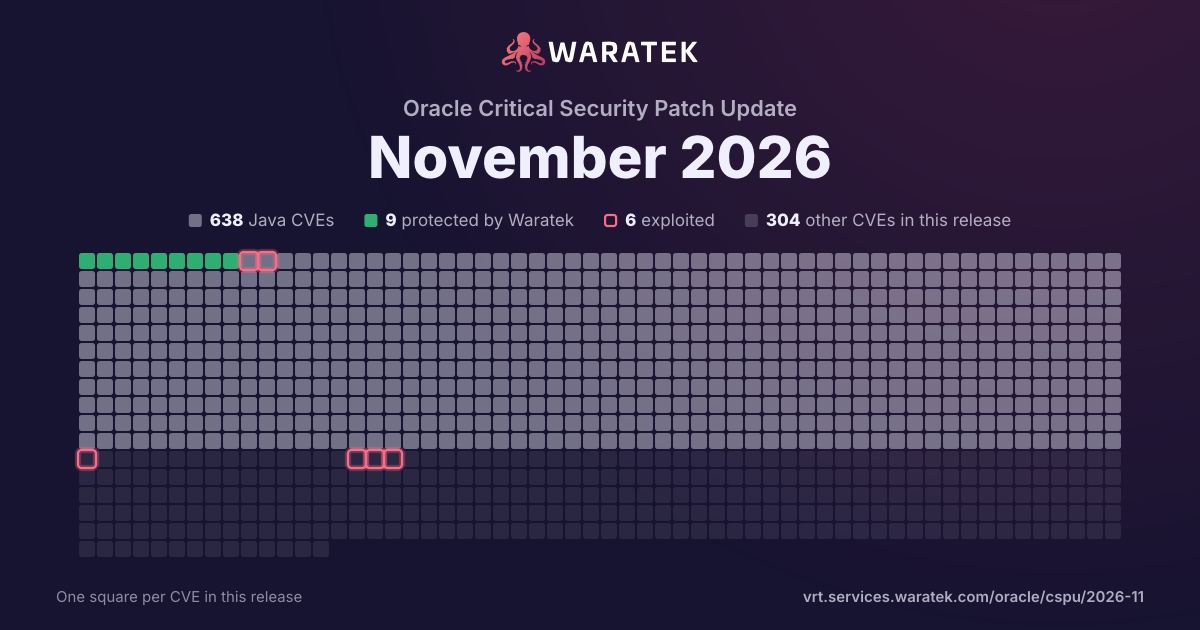
By status
9Protected by Waratek3Mitigation candidate625No exploit published16Outside Waratek scope289Not applicable
7Exploited, marked by the ring
No exploit published. For 554 of them, Oracle's security advisory is the source of public detail.
Protected by Waratek. Waratek RASP can block exploitation of these on systems that have not applied the patch yet.
Overview 204 matches · 0 in Waratek scope · 0 protected · 0 exploited · 0 CISA KEV · 0 public PoC · 0 EPSS ≥ 0.5
204matches
0in Waratek scope0.0%
0protected0.0%
0exploited0.0%
0CISA KEV0.0%
0public PoC0.0%
0EPSS ≥ 0.50.0%
Protected by Waratek
0
0.0%
Rule in development
0
0.0%
Mitigation candidate
0
0.0%
No exploit published
0
0.0%
Outside Waratek scope
0
0.0%
Not applicable
204
100.0%
Withdrawn CVE
0
0.0%
blocked by ARMR today
0
0.0%
partly blocked
0
0.0%
not blocked
204
100.0%
not established
0
0.0%
unrecorded
0
0.0%
Exploited
0
0.0%
Working exploit published
0
0.0%
Proof of concept only
0
0.0%
Forecast only
0
0.0%
No public exploit
204
100.0%
split by
peak 105 / quarter
Q3 221
Not applicable1
High1
not blocked1
No public exploit1
Q4 220
Q1 230
Q2 230
Q3 230
Q4 230
Q1 240
Q2 240
Q3 240
Q4 240
Q1 251
Not applicable1
Low1
not blocked1
No public exploit1
Q2 250
Q3 250
Q4 250
Q1 268
Not applicable8
High4
Medium2
Low2
not blocked8
No public exploit8
Q2 2628
Not applicable28
Critical2
High11
Medium7
Low8
not blocked28
No public exploit28
Q3 2661
Not applicable61
Critical4
High32
Medium18
Low7
not blocked61
No public exploit61
Q4 26105
Not applicable105
Critical14
High44
Medium33
Low14
not blocked105
No public exploit105
Q4 22Q2 23Q4 23Q2 24Q4 24Q2 25Q4 25Q2 26Q4 26
| CVE | Severity | Published▾ | Status | Exploitation | Description |
|---|---|---|---|---|---|
| CVE-2026-127428 | High | 2026-11-17 | Not applicable | No public exploit | Vulnerability in the MySQL Server, MySQL Cluster product of Oracle MySQL (component: Server: GIS). Supported versions that are affected are MySQL Server: 8.4.0-8.4.13, 9.7.0-9.7.4, 26.10; MySQL Cluster: 8.0.0-8.0.50, 8.4.0-8.4.13, 9.7.0-9.7.4 and 26.10. Easily exploitable vulnerability allows low privileged attacker with network access via multiple protocols to compromise MySQL Server, MySQL Cluster. Successful attacks of this vulnerability can result in unauthorized ability to cause a hang or frequently repeatable crash (complete DOS) of MySQL Server, MySQL Cluster and unauthorized read access to a subset of MySQL Server, MySQL Cluster accessible data. CVSS 3.1 Base Score 7.1 (Confidentiality and Availability impacts). CVSS Vector: (CVSS:3.1/AV:N/AC:L/PR:L/UI:N/S:U/C:L/I:N/A:H). |
| CVE-2026-127427 | High | 2026-11-17 | Not applicable | No public exploit | Vulnerability in the Oracle VM VirtualBox product of Oracle Virtualization (component: Core). The supported version that is affected is 7.2.22. Easily exploitable vulnerability allows unauthenticated attacker with network access via RDP to compromise Oracle VM VirtualBox. Successful attacks of this vulnerability can result in unauthorized ability to cause a hang or frequently repeatable crash (complete DOS) of Oracle VM VirtualBox. CVSS 3.1 Base Score 7.5 (Availability impacts). CVSS Vector: (CVSS:3.1/AV:N/AC:L/PR:N/UI:N/S:U/C:N/I:N/A:H). |
| CVE-2026-127426 | High | 2026-11-17 | Not applicable | No public exploit | Vulnerability in the Oracle VM VirtualBox product of Oracle Virtualization (component: Core). The supported version that is affected is 7.2.22. Easily exploitable vulnerability allows unauthenticated attacker with access to the physical communication segment attached to the hardware where the Oracle VM VirtualBox executes to compromise Oracle VM VirtualBox. While the vulnerability is in Oracle VM VirtualBox, attacks may significantly impact additional products (scope change). Successful attacks of this vulnerability can result in unauthorized access to critical data or complete access to all Oracle VM VirtualBox accessible data. CVSS 3.1 Base Score 7.4 (Confidentiality impacts). CVSS Vector: (CVSS:3.1/AV:A/AC:L/PR:N/UI:N/S:C/C:H/I:N/A:N). |
| CVE-2026-127425 | High | 2026-11-17 | Not applicable | No public exploit | Vulnerability in the Oracle VM VirtualBox product of Oracle Virtualization (component: Core). The supported version that is affected is 7.2.22. Easily exploitable vulnerability allows high privileged attacker with logon to the infrastructure where Oracle VM VirtualBox executes to compromise Oracle VM VirtualBox. While the vulnerability is in Oracle VM VirtualBox, attacks may significantly impact additional products (scope change). Successful attacks of this vulnerability can result in unauthorized creation, deletion or modification access to critical data or all Oracle VM VirtualBox accessible data as well as unauthorized read access to a subset of Oracle VM VirtualBox accessible data and unauthorized ability to cause a hang or frequently repeatable crash (complete DOS) of Oracle VM VirtualBox. CVSS 3.1 Base Score 8.1 (Confidentiality, Integrity and Availability impacts). CVSS Vector: (CVSS:3.1/AV:L/AC:L/PR:H/UI:N/S:C/C:L/I:H/A:H). |
| CVE-2026-127423 | High | 2026-11-17 | Not applicable | No public exploit | Vulnerability in the Oracle VM VirtualBox product of Oracle Virtualization (component: Core). The supported version that is affected is 7.2.22. Easily exploitable vulnerability allows unauthenticated attacker with logon to the infrastructure where Oracle VM VirtualBox executes to compromise Oracle VM VirtualBox. Successful attacks require human interaction from a person other than the attacker. Successful attacks of this vulnerability can result in unauthorized creation, deletion or modification access to critical data or all Oracle VM VirtualBox accessible data and unauthorized ability to cause a hang or frequently repeatable crash (complete DOS) of Oracle VM VirtualBox. CVSS 3.1 Base Score 7.1 (Integrity and Availability impacts). CVSS Vector: (CVSS:3.1/AV:L/AC:L/PR:N/UI:R/S:U/C:N/I:H/A:H). |
| CVE-2026-127422 | High | 2026-11-17 | Not applicable | No public exploit | Vulnerability in the Oracle VM VirtualBox product of Oracle Virtualization (component: Core). The supported version that is affected is 7.2.22. Easily exploitable vulnerability allows unauthenticated attacker with logon to the infrastructure where Oracle VM VirtualBox executes to compromise Oracle VM VirtualBox. Successful attacks require human interaction from a person other than the attacker. Successful attacks of this vulnerability can result in unauthorized creation, deletion or modification access to critical data or all Oracle VM VirtualBox accessible data and unauthorized ability to cause a hang or frequently repeatable crash (complete DOS) of Oracle VM VirtualBox. CVSS 3.1 Base Score 7.1 (Integrity and Availability impacts). CVSS Vector: (CVSS:3.1/AV:L/AC:L/PR:N/UI:R/S:U/C:N/I:H/A:H). |
| CVE-2026-127421 | High | 2026-11-17 | Not applicable | No public exploit | Vulnerability in the Oracle VM VirtualBox product of Oracle Virtualization (component: Core). The supported version that is affected is 7.2.22. Easily exploitable vulnerability allows unauthenticated attacker with logon to the infrastructure where Oracle VM VirtualBox executes to compromise Oracle VM VirtualBox. Successful attacks require human interaction from a person other than the attacker and while the vulnerability is in Oracle VM VirtualBox, attacks may significantly impact additional products (scope change). Successful attacks of this vulnerability can result in takeover of Oracle VM VirtualBox. CVSS 3.1 Base Score 8.6 (Confidentiality, Integrity and Availability impacts). CVSS Vector: (CVSS:3.1/AV:L/AC:L/PR:N/UI:R/S:C/C:H/I:H/A:H). |
| CVE-2026-127420 | Medium | 2026-11-17 | Not applicable | No public exploit | Vulnerability in the Oracle VM VirtualBox product of Oracle Virtualization (component: Core). The supported version that is affected is 7.2.22. Easily exploitable vulnerability allows unauthenticated attacker with logon to the infrastructure where Oracle VM VirtualBox executes to compromise Oracle VM VirtualBox. Successful attacks require human interaction from a person other than the attacker. Successful attacks of this vulnerability can result in unauthorized update, insert or delete access to some of Oracle VM VirtualBox accessible data as well as unauthorized read access to a subset of Oracle VM VirtualBox accessible data. CVSS 3.1 Base Score 4.4 (Confidentiality and Integrity impacts). CVSS Vector: (CVSS:3.1/AV:L/AC:L/PR:N/UI:R/S:U/C:L/I:L/A:N). |
| CVE-2026-127414 | High | 2026-11-17 | Not applicable | No public exploit | Vulnerability in the Oracle VM VirtualBox product of Oracle Virtualization (component: Core). The supported version that is affected is 7.2.22. Easily exploitable vulnerability allows unauthenticated attacker with logon to the infrastructure where Oracle VM VirtualBox executes to compromise Oracle VM VirtualBox. Successful attacks require human interaction from a person other than the attacker. Successful attacks of this vulnerability can result in unauthorized creation, deletion or modification access to critical data or all Oracle VM VirtualBox accessible data and unauthorized ability to cause a hang or frequently repeatable crash (complete DOS) of Oracle VM VirtualBox. CVSS 3.1 Base Score 7.1 (Integrity and Availability impacts). CVSS Vector: (CVSS:3.1/AV:L/AC:L/PR:N/UI:R/S:U/C:N/I:H/A:H). |
| CVE-2026-127413 | High | 2026-11-17 | Not applicable | No public exploit | Vulnerability in the Oracle VM VirtualBox product of Oracle Virtualization (component: Core). The supported version that is affected is 7.2.22. Easily exploitable vulnerability allows unauthenticated attacker with network access via RDP to compromise Oracle VM VirtualBox. Successful attacks of this vulnerability can result in unauthorized ability to cause a hang or frequently repeatable crash (complete DOS) of Oracle VM VirtualBox. CVSS 3.1 Base Score 7.5 (Availability impacts). CVSS Vector: (CVSS:3.1/AV:N/AC:L/PR:N/UI:N/S:U/C:N/I:N/A:H). |
| CVE-2026-127412 | Medium | 2026-11-17 | Not applicable | No public exploit | Vulnerability in the Oracle VM VirtualBox product of Oracle Virtualization (component: Core). The supported version that is affected is 7.2.22. Easily exploitable vulnerability allows high privileged attacker with logon to the infrastructure where Oracle VM VirtualBox executes to compromise Oracle VM VirtualBox. While the vulnerability is in Oracle VM VirtualBox, attacks may significantly impact additional products (scope change). Successful attacks of this vulnerability can result in unauthorized ability to cause a hang or frequently repeatable crash (complete DOS) of Oracle VM VirtualBox and unauthorized read access to a subset of Oracle VM VirtualBox accessible data. CVSS 3.1 Base Score 6.7 (Confidentiality and Availability impacts). CVSS Vector: (CVSS:3.1/AV:L/AC:L/PR:H/UI:N/S:C/C:L/I:N/A:H). |
| CVE-2026-127411 | Medium | 2026-11-17 | Not applicable | No public exploit | Vulnerability in the Oracle VM VirtualBox product of Oracle Virtualization (component: Core). The supported version that is affected is 7.2.22. Easily exploitable vulnerability allows high privileged attacker with logon to the infrastructure where Oracle VM VirtualBox executes to compromise Oracle VM VirtualBox. While the vulnerability is in Oracle VM VirtualBox, attacks may significantly impact additional products (scope change). Successful attacks of this vulnerability can result in unauthorized ability to cause a hang or frequently repeatable crash (complete DOS) of Oracle VM VirtualBox and unauthorized read access to a subset of Oracle VM VirtualBox accessible data. CVSS 3.1 Base Score 6.7 (Confidentiality and Availability impacts). CVSS Vector: (CVSS:3.1/AV:L/AC:L/PR:H/UI:N/S:C/C:L/I:N/A:H). |
| CVE-2026-127402 | High | 2026-11-17 | Not applicable | No public exploit | Vulnerability in the Oracle AutoVue product of Oracle Supply Chain (component: Security). The supported version that is affected is 21.1.0. Difficult to exploit vulnerability allows unauthenticated attacker with network access via HTTP to compromise Oracle AutoVue. Successful attacks of this vulnerability can result in takeover of Oracle AutoVue. CVSS 3.1 Base Score 8.1 (Confidentiality, Integrity and Availability impacts). CVSS Vector: (CVSS:3.1/AV:N/AC:H/PR:N/UI:N/S:U/C:H/I:H/A:H). |
| CVE-2026-127339 | High | 2026-11-17 | Not applicable | No public exploit | Vulnerability in the Oracle AutoVue product of Oracle Supply Chain (component: Security). The supported version that is affected is 21.1.0. Easily exploitable vulnerability allows unauthenticated attacker with logon to the infrastructure where Oracle AutoVue executes to compromise Oracle AutoVue. While the vulnerability is in Oracle AutoVue, attacks may significantly impact additional products (scope change). Successful attacks of this vulnerability can result in unauthorized creation, deletion or modification access to critical data or all Oracle AutoVue accessible data. CVSS 3.1 Base Score 7.1 (Integrity impacts). CVSS Vector: (CVSS:3.1/AV:L/AC:L/PR:N/UI:N/S:C/C:N/I:H/A:N). |
| CVE-2026-127337 | High | 2026-11-17 | Not applicable | No public exploit | Vulnerability in the Oracle AutoVue product of Oracle Supply Chain (component: Security). The supported version that is affected is 21.1.0. Easily exploitable vulnerability allows unauthenticated attacker with logon to the infrastructure where Oracle AutoVue executes to compromise Oracle AutoVue. While the vulnerability is in Oracle AutoVue, attacks may significantly impact additional products (scope change). Successful attacks of this vulnerability can result in unauthorized access to critical data or complete access to all Oracle AutoVue accessible data as well as unauthorized update, insert or delete access to some of Oracle AutoVue accessible data. CVSS 3.1 Base Score 7.9 (Confidentiality and Integrity impacts). CVSS Vector: (CVSS:3.1/AV:L/AC:L/PR:N/UI:N/S:C/C:H/I:L/A:N). |
| CVE-2026-127336 | Medium | 2026-11-17 | Not applicable | No public exploit | Vulnerability in the Oracle AutoVue product of Oracle Supply Chain (component: Security). The supported version that is affected is 21.1.0. Difficult to exploit vulnerability allows unauthenticated attacker with network access via HTTP to compromise Oracle AutoVue. Successful attacks require human interaction from a person other than the attacker. Successful attacks of this vulnerability can result in unauthorized access to critical data or complete access to all Oracle AutoVue accessible data as well as unauthorized update, insert or delete access to some of Oracle AutoVue accessible data. CVSS 3.1 Base Score 5.9 (Confidentiality and Integrity impacts). CVSS Vector: (CVSS:3.1/AV:N/AC:H/PR:N/UI:R/S:U/C:H/I:L/A:N). |
| CVE-2026-127334 | High | 2026-11-17 | Not applicable | No public exploit | Vulnerability in the Oracle AutoVue product of Oracle Supply Chain (component: Security). The supported version that is affected is 21.1.0. Easily exploitable vulnerability allows low privileged attacker with network access via HTTP to compromise Oracle AutoVue. Successful attacks of this vulnerability can result in takeover of Oracle AutoVue. CVSS 3.1 Base Score 8.8 (Confidentiality, Integrity and Availability impacts). CVSS Vector: (CVSS:3.1/AV:N/AC:L/PR:L/UI:N/S:U/C:H/I:H/A:H). |
| CVE-2026-127333 | Medium | 2026-11-17 | Not applicable | No public exploit | Vulnerability in the Oracle AutoVue product of Oracle Supply Chain (component: Security). The supported version that is affected is 21.1.0. Easily exploitable vulnerability allows unauthenticated attacker with access to the physical communication segment attached to the hardware where the Oracle AutoVue executes to compromise Oracle AutoVue. Successful attacks of this vulnerability can result in unauthorized read access to a subset of Oracle AutoVue accessible data. CVSS 3.1 Base Score 4.3 (Confidentiality impacts). CVSS Vector: (CVSS:3.1/AV:A/AC:L/PR:N/UI:N/S:U/C:L/I:N/A:N). |
| CVE-2026-127332 | Medium | 2026-11-17 | Not applicable | No public exploit | Vulnerability in the Oracle AutoVue product of Oracle Supply Chain (component: Security). The supported version that is affected is 21.1.0. Difficult to exploit vulnerability allows unauthenticated attacker with logon to the infrastructure where Oracle AutoVue executes to compromise Oracle AutoVue. Successful attacks of this vulnerability can result in unauthorized update, insert or delete access to some of Oracle AutoVue accessible data and unauthorized ability to cause a partial denial of service (partial DOS) of Oracle AutoVue. CVSS 3.1 Base Score 4.0 (Integrity and Availability impacts). CVSS Vector: (CVSS:3.1/AV:L/AC:H/PR:N/UI:N/S:U/C:N/I:L/A:L). |
| CVE-2026-127331 | High | 2026-11-17 | Not applicable | No public exploit | Vulnerability in the Oracle AutoVue product of Oracle Supply Chain (component: Security). The supported version that is affected is 21.1.0. Easily exploitable vulnerability allows unauthenticated attacker with network access via HTTP to compromise Oracle AutoVue. Successful attacks of this vulnerability can result in unauthorized ability to cause a hang or frequently repeatable crash (complete DOS) of Oracle AutoVue. CVSS 3.1 Base Score 7.5 (Availability impacts). CVSS Vector: (CVSS:3.1/AV:N/AC:L/PR:N/UI:N/S:U/C:N/I:N/A:H). |
| CVE-2026-127330 | High | 2026-11-17 | Not applicable | No public exploit | Vulnerability in the Oracle AutoVue product of Oracle Supply Chain (component: Security). The supported version that is affected is 21.1.0. Difficult to exploit vulnerability allows unauthenticated attacker with network access via HTTP to compromise Oracle AutoVue. Successful attacks of this vulnerability can result in takeover of Oracle AutoVue. CVSS 3.1 Base Score 8.1 (Confidentiality, Integrity and Availability impacts). CVSS Vector: (CVSS:3.1/AV:N/AC:H/PR:N/UI:N/S:U/C:H/I:H/A:H). |
| CVE-2026-127329 | High | 2026-11-17 | Not applicable | No public exploit | Vulnerability in the Oracle AutoVue product of Oracle Supply Chain (component: Security). The supported version that is affected is 21.1.0. Difficult to exploit vulnerability allows unauthenticated attacker with network access via HTTP to compromise Oracle AutoVue. Successful attacks of this vulnerability can result in takeover of Oracle AutoVue. CVSS 3.1 Base Score 8.1 (Confidentiality, Integrity and Availability impacts). CVSS Vector: (CVSS:3.1/AV:N/AC:H/PR:N/UI:N/S:U/C:H/I:H/A:H). |
| CVE-2026-127328 | High | 2026-11-17 | Not applicable | No public exploit | Vulnerability in the Oracle AutoVue product of Oracle Supply Chain (component: Security). The supported version that is affected is 21.1.0. Difficult to exploit vulnerability allows unauthenticated attacker with network access via HTTP to compromise Oracle AutoVue. Successful attacks of this vulnerability can result in takeover of Oracle AutoVue. CVSS 3.1 Base Score 8.1 (Confidentiality, Integrity and Availability impacts). CVSS Vector: (CVSS:3.1/AV:N/AC:H/PR:N/UI:N/S:U/C:H/I:H/A:H). |
| CVE-2026-127327 | Critical | 2026-11-17 | Not applicable | No public exploit | Vulnerability in the Oracle AutoVue product of Oracle Supply Chain (component: Security). The supported version that is affected is 21.1.0. Easily exploitable vulnerability allows unauthenticated attacker with network access via HTTP to compromise Oracle AutoVue. Successful attacks of this vulnerability can result in takeover of Oracle AutoVue. CVSS 3.1 Base Score 9.8 (Confidentiality, Integrity and Availability impacts). CVSS Vector: (CVSS:3.1/AV:N/AC:L/PR:N/UI:N/S:U/C:H/I:H/A:H). |
| CVE-2026-127326 | Critical | 2026-11-17 | Not applicable | No public exploit | Vulnerability in the Oracle AutoVue product of Oracle Supply Chain (component: Security). The supported version that is affected is 21.1.0. Easily exploitable vulnerability allows unauthenticated attacker with network access via HTTP to compromise Oracle AutoVue. Successful attacks of this vulnerability can result in takeover of Oracle AutoVue. CVSS 3.1 Base Score 9.8 (Confidentiality, Integrity and Availability impacts). CVSS Vector: (CVSS:3.1/AV:N/AC:L/PR:N/UI:N/S:U/C:H/I:H/A:H). |
| CVE-2026-127325 | Critical | 2026-11-17 | Not applicable | No public exploit | Vulnerability in the Oracle AutoVue product of Oracle Supply Chain (component: Security). The supported version that is affected is 21.1.0. Easily exploitable vulnerability allows unauthenticated attacker with network access via HTTP to compromise Oracle AutoVue. Successful attacks of this vulnerability can result in takeover of Oracle AutoVue. CVSS 3.1 Base Score 9.8 (Confidentiality, Integrity and Availability impacts). CVSS Vector: (CVSS:3.1/AV:N/AC:L/PR:N/UI:N/S:U/C:H/I:H/A:H). |
| CVE-2026-127324 | Critical | 2026-11-17 | Not applicable | No public exploit | Vulnerability in the Oracle AutoVue product of Oracle Supply Chain (component: Security). The supported version that is affected is 21.1.0. Easily exploitable vulnerability allows unauthenticated attacker with network access via HTTP to compromise Oracle AutoVue. Successful attacks of this vulnerability can result in takeover of Oracle AutoVue. CVSS 3.1 Base Score 9.8 (Confidentiality, Integrity and Availability impacts). CVSS Vector: (CVSS:3.1/AV:N/AC:L/PR:N/UI:N/S:U/C:H/I:H/A:H). |
| CVE-2026-127323 | Low | 2026-11-17 | Not applicable | No public exploit | Vulnerability in the Oracle AutoVue product of Oracle Supply Chain (component: Security). The supported version that is affected is 21.1.0. Difficult to exploit vulnerability allows unauthenticated attacker with network access via HTTP to compromise Oracle AutoVue. Successful attacks of this vulnerability can result in unauthorized read access to a subset of Oracle AutoVue accessible data. CVSS 3.1 Base Score 3.7 (Confidentiality impacts). CVSS Vector: (CVSS:3.1/AV:N/AC:H/PR:N/UI:N/S:U/C:L/I:N/A:N). |
| CVE-2026-127322 | Medium | 2026-11-17 | Not applicable | No public exploit | Vulnerability in the Oracle AutoVue product of Oracle Supply Chain (component: Security). The supported version that is affected is 21.1.0. Difficult to exploit vulnerability allows unauthenticated attacker with network access via HTTP to compromise Oracle AutoVue. Successful attacks require human interaction from a person other than the attacker. Successful attacks of this vulnerability can result in unauthorized access to critical data or complete access to all Oracle AutoVue accessible data. CVSS 3.1 Base Score 5.3 (Confidentiality impacts). CVSS Vector: (CVSS:3.1/AV:N/AC:H/PR:N/UI:R/S:U/C:H/I:N/A:N). |
| CVE-2026-127321 | Medium | 2026-11-17 | Not applicable | No public exploit | Vulnerability in the Oracle AutoVue product of Oracle Supply Chain (component: Security). The supported version that is affected is 21.1.0. Difficult to exploit vulnerability allows unauthenticated attacker with network access via HTTP to compromise Oracle AutoVue. Successful attacks of this vulnerability can result in unauthorized access to critical data or complete access to all Oracle AutoVue accessible data. CVSS 3.1 Base Score 5.9 (Confidentiality impacts). CVSS Vector: (CVSS:3.1/AV:N/AC:H/PR:N/UI:N/S:U/C:H/I:N/A:N). |
| CVE-2026-127320 | Medium | 2026-11-17 | Not applicable | No public exploit | Vulnerability in the Oracle AutoVue product of Oracle Supply Chain (component: Security). The supported version that is affected is 21.1.0. Difficult to exploit vulnerability allows unauthenticated attacker with access to the physical communication segment attached to the hardware where the Oracle AutoVue executes to compromise Oracle AutoVue. Successful attacks of this vulnerability can result in unauthorized creation, deletion or modification access to critical data or all Oracle AutoVue accessible data as well as unauthorized access to critical data or complete access to all Oracle AutoVue accessible data. CVSS 3.1 Base Score 6.8 (Confidentiality and Integrity impacts). CVSS Vector: (CVSS:3.1/AV:A/AC:H/PR:N/UI:N/S:U/C:H/I:H/A:N). |
| CVE-2026-127319 | High | 2026-11-17 | Not applicable | No public exploit | Vulnerability in the Oracle AutoVue product of Oracle Supply Chain (component: Security). The supported version that is affected is 21.1.0. Easily exploitable vulnerability allows low privileged attacker with network access via HTTP to compromise Oracle AutoVue. Successful attacks of this vulnerability can result in unauthorized access to critical data or complete access to all Oracle AutoVue accessible data as well as unauthorized update, insert or delete access to some of Oracle AutoVue accessible data. CVSS 3.1 Base Score 7.1 (Confidentiality and Integrity impacts). CVSS Vector: (CVSS:3.1/AV:N/AC:L/PR:L/UI:N/S:U/C:H/I:L/A:N). |
| CVE-2026-127318 | Low | 2026-11-17 | Not applicable | No public exploit | Vulnerability in the Oracle AutoVue product of Oracle Supply Chain (component: Security). The supported version that is affected is 21.1.0.7. Difficult to exploit vulnerability allows unauthenticated attacker with access to the physical communication segment attached to the hardware where the Oracle AutoVue executes to compromise Oracle AutoVue. Successful attacks of this vulnerability can result in unauthorized read access to a subset of Oracle AutoVue accessible data. CVSS 3.1 Base Score 3.1 (Confidentiality impacts). CVSS Vector: (CVSS:3.1/AV:A/AC:H/PR:N/UI:N/S:U/C:L/I:N/A:N). |
| CVE-2026-127314 | Low | 2026-11-17 | Not applicable | No public exploit | Vulnerability in the Oracle AutoVue product of Oracle Supply Chain (component: Security). The supported version that is affected is 21.1.0.7. Easily exploitable vulnerability allows low privileged attacker with logon to the infrastructure where Oracle AutoVue executes to compromise Oracle AutoVue. Successful attacks of this vulnerability can result in unauthorized read access to a subset of Oracle AutoVue accessible data. CVSS 3.1 Base Score 3.3 (Confidentiality impacts). CVSS Vector: (CVSS:3.1/AV:L/AC:L/PR:L/UI:N/S:U/C:L/I:N/A:N). |
| CVE-2026-127313 | Medium | 2026-11-17 | Not applicable | No public exploit | Vulnerability in the Oracle AutoVue product of Oracle Supply Chain (component: Security). The supported version that is affected is 21.1.0. Difficult to exploit vulnerability allows unauthenticated attacker with access to the physical communication segment attached to the hardware where the Oracle AutoVue executes to compromise Oracle AutoVue. Successful attacks of this vulnerability can result in unauthorized creation, deletion or modification access to critical data or all Oracle AutoVue accessible data as well as unauthorized access to critical data or complete access to all Oracle AutoVue accessible data. CVSS 3.1 Base Score 6.8 (Confidentiality and Integrity impacts). CVSS Vector: (CVSS:3.1/AV:A/AC:H/PR:N/UI:N/S:U/C:H/I:H/A:N). |
| CVE-2026-127312 | Medium | 2026-11-17 | Not applicable | No public exploit | Vulnerability in the Oracle AutoVue product of Oracle Supply Chain (component: Security). The supported version that is affected is 21.1.0. Easily exploitable vulnerability allows unauthenticated attacker with network access via HTTP to compromise Oracle AutoVue. Successful attacks require human interaction from a person other than the attacker. Successful attacks of this vulnerability can result in unauthorized update, insert or delete access to some of Oracle AutoVue accessible data as well as unauthorized read access to a subset of Oracle AutoVue accessible data. CVSS 3.1 Base Score 5.4 (Confidentiality and Integrity impacts). CVSS Vector: (CVSS:3.1/AV:N/AC:L/PR:N/UI:R/S:U/C:L/I:L/A:N). |
| CVE-2026-127311 | Medium | 2026-11-17 | Not applicable | No public exploit | Vulnerability in the Oracle AutoVue product of Oracle Supply Chain (component: Security). The supported version that is affected is 21.1.0. Easily exploitable vulnerability allows unauthenticated attacker with network access via HTTP to compromise Oracle AutoVue. Successful attacks require human interaction from a person other than the attacker and while the vulnerability is in Oracle AutoVue, attacks may significantly impact additional products (scope change). Successful attacks of this vulnerability can result in unauthorized update, insert or delete access to some of Oracle AutoVue accessible data as well as unauthorized read access to a subset of Oracle AutoVue accessible data. CVSS 3.1 Base Score 6.1 (Confidentiality and Integrity impacts). CVSS Vector: (CVSS:3.1/AV:N/AC:L/PR:N/UI:R/S:C/C:L/I:L/A:N). |
| CVE-2026-127310 | Medium | 2026-11-17 | Not applicable | No public exploit | Vulnerability in the Oracle AutoVue product of Oracle Supply Chain (component: Security). The supported version that is affected is 21.1.0. Easily exploitable vulnerability allows low privileged attacker with network access via HTTP to compromise Oracle AutoVue. Successful attacks of this vulnerability can result in unauthorized access to critical data or complete access to all Oracle AutoVue accessible data. CVSS 3.1 Base Score 6.5 (Confidentiality impacts). CVSS Vector: (CVSS:3.1/AV:N/AC:L/PR:L/UI:N/S:U/C:H/I:N/A:N). |
| CVE-2026-127309 | Medium | 2026-11-17 | Not applicable | No public exploit | Vulnerability in the Oracle AutoVue product of Oracle Supply Chain (component: Security). The supported version that is affected is 21.1.0. Easily exploitable vulnerability allows unauthenticated attacker with network access via HTTP to compromise Oracle AutoVue. Successful attacks of this vulnerability can result in unauthorized read access to a subset of Oracle AutoVue accessible data. CVSS 3.1 Base Score 5.3 (Confidentiality impacts). CVSS Vector: (CVSS:3.1/AV:N/AC:L/PR:N/UI:N/S:U/C:L/I:N/A:N). |
| CVE-2026-127308 | High | 2026-11-17 | Not applicable | No public exploit | Vulnerability in the Oracle AutoVue product of Oracle Supply Chain (component: Security). The supported version that is affected is 21.1.0. Easily exploitable vulnerability allows unauthenticated attacker with network access via HTTP to compromise Oracle AutoVue. Successful attacks require human interaction from a person other than the attacker. Successful attacks of this vulnerability can result in unauthorized creation, deletion or modification access to critical data or all Oracle AutoVue accessible data as well as unauthorized access to critical data or complete access to all Oracle AutoVue accessible data. CVSS 3.1 Base Score 8.1 (Confidentiality and Integrity impacts). CVSS Vector: (CVSS:3.1/AV:N/AC:L/PR:N/UI:R/S:U/C:H/I:H/A:N). |
| CVE-2026-127307 | High | 2026-11-17 | Not applicable | No public exploit | Vulnerability in the Oracle AutoVue product of Oracle Supply Chain (component: Security). The supported version that is affected is 21.1.0. Easily exploitable vulnerability allows low privileged attacker with network access via HTTP to compromise Oracle AutoVue. Successful attacks of this vulnerability can result in takeover of Oracle AutoVue. CVSS 3.1 Base Score 8.8 (Confidentiality, Integrity and Availability impacts). CVSS Vector: (CVSS:3.1/AV:N/AC:L/PR:L/UI:N/S:U/C:H/I:H/A:H). |
| CVE-2026-127306 | High | 2026-11-17 | Not applicable | No public exploit | Vulnerability in the Oracle AutoVue product of Oracle Supply Chain (component: Security Related Issues). The supported version that is affected is 21.1.0. Easily exploitable vulnerability allows unauthenticated attacker with network access via HTTP to compromise Oracle AutoVue. While the vulnerability is in Oracle AutoVue, attacks may significantly impact additional products (scope change). Successful attacks of this vulnerability can result in unauthorized access to critical data or complete access to all Oracle AutoVue accessible data. CVSS 3.1 Base Score 8.6 (Confidentiality impacts). CVSS Vector: (CVSS:3.1/AV:N/AC:L/PR:N/UI:N/S:C/C:H/I:N/A:N). |
| CVE-2026-114991 | Medium | 2026-11-17 | Not applicable | No public exploit | Vulnerability in the Oracle AutoVue product of Oracle Supply Chain (component: Security Related Issues). The supported version that is affected is 21.1.0. Easily exploitable vulnerability allows low privileged attacker with network access via HTTP to compromise Oracle AutoVue. Successful attacks of this vulnerability can result in unauthorized ability to cause a partial denial of service (partial DOS) of Oracle AutoVue. CVSS 3.1 Base Score 4.3 (Availability impacts). CVSS Vector: (CVSS:3.1/AV:N/AC:L/PR:L/UI:N/S:U/C:N/I:N/A:L). |
| CVE-2026-114990 | Medium | 2026-11-17 | Not applicable | No public exploit | Vulnerability in the Oracle AutoVue product of Oracle Supply Chain (component: Core). The supported version that is affected is 21.1.0. Easily exploitable vulnerability allows low privileged attacker with network access via HTTP to compromise Oracle AutoVue. Successful attacks of this vulnerability can result in unauthorized ability to cause a partial denial of service (partial DOS) of Oracle AutoVue. CVSS 3.1 Base Score 4.3 (Availability impacts). CVSS Vector: (CVSS:3.1/AV:N/AC:L/PR:L/UI:N/S:U/C:N/I:N/A:L). |
| CVE-2026-114989 | Medium | 2026-11-17 | Not applicable | No public exploit | Vulnerability in the Oracle AutoVue product of Oracle Supply Chain (component: Security Related Issues). The supported version that is affected is 21.1.0. Easily exploitable vulnerability allows low privileged attacker with network access via HTTP to compromise Oracle AutoVue. Successful attacks of this vulnerability can result in unauthorized update, insert or delete access to some of Oracle AutoVue accessible data as well as unauthorized read access to a subset of Oracle AutoVue accessible data and unauthorized ability to cause a partial denial of service (partial DOS) of Oracle AutoVue. CVSS 3.1 Base Score 6.3 (Confidentiality, Integrity and Availability impacts). CVSS Vector: (CVSS:3.1/AV:N/AC:L/PR:L/UI:N/S:U/C:L/I:L/A:L). |
| CVE-2026-114988 | Low | 2026-11-17 | Not applicable | No public exploit | Vulnerability in the Oracle AutoVue product of Oracle Supply Chain (component: Security Related Issues). The supported version that is affected is 21.1.0. Difficult to exploit vulnerability allows low privileged attacker with logon to the infrastructure where Oracle AutoVue executes to compromise Oracle AutoVue. Successful attacks of this vulnerability can result in unauthorized update, insert or delete access to some of Oracle AutoVue accessible data as well as unauthorized read access to a subset of Oracle AutoVue accessible data. CVSS 3.1 Base Score 3.6 (Confidentiality and Integrity impacts). CVSS Vector: (CVSS:3.1/AV:L/AC:H/PR:L/UI:N/S:U/C:L/I:L/A:N). |
| CVE-2026-114987 | Low | 2026-11-17 | Not applicable | No public exploit | Vulnerability in the Oracle AutoVue product of Oracle Supply Chain (component: Security Related Issues). The supported version that is affected is 21.1.0. Easily exploitable vulnerability allows high privileged attacker with logon to the infrastructure where Oracle AutoVue executes to compromise Oracle AutoVue. Successful attacks of this vulnerability can result in unauthorized read access to a subset of Oracle AutoVue accessible data and unauthorized ability to cause a partial denial of service (partial DOS) of Oracle AutoVue. CVSS 3.1 Base Score 3.4 (Confidentiality and Availability impacts). CVSS Vector: (CVSS:3.1/AV:L/AC:L/PR:H/UI:N/S:U/C:L/I:N/A:L). |
| CVE-2026-114986 | Low | 2026-11-17 | Not applicable | No public exploit | Vulnerability in the Oracle AutoVue product of Oracle Supply Chain (component: Security Related Issues). The supported version that is affected is 21.1.0.7. Difficult to exploit vulnerability allows high privileged attacker with logon to the infrastructure where Oracle AutoVue executes to compromise Oracle AutoVue. Successful attacks of this vulnerability can result in unauthorized update, insert or delete access to some of Oracle AutoVue accessible data and unauthorized ability to cause a partial denial of service (partial DOS) of Oracle AutoVue. CVSS 3.1 Base Score 3.0 (Integrity and Availability impacts). CVSS Vector: (CVSS:3.1/AV:L/AC:H/PR:H/UI:N/S:U/C:N/I:L/A:L). |
| CVE-2026-114985 | Low | 2026-11-17 | Not applicable | No public exploit | Vulnerability in the Oracle AutoVue product of Oracle Supply Chain (component: Security Related Issues). The supported version that is affected is 21.1.0.7. Difficult to exploit vulnerability allows high privileged attacker with logon to the infrastructure where Oracle AutoVue executes to compromise Oracle AutoVue. Successful attacks of this vulnerability can result in unauthorized update, insert or delete access to some of Oracle AutoVue accessible data and unauthorized ability to cause a partial denial of service (partial DOS) of Oracle AutoVue. CVSS 3.1 Base Score 3.0 (Integrity and Availability impacts). CVSS Vector: (CVSS:3.1/AV:L/AC:H/PR:H/UI:N/S:U/C:N/I:L/A:L). |
| CVE-2026-114984 | Medium | 2026-11-17 | Not applicable | No public exploit | Vulnerability in the Oracle AutoVue product of Oracle Supply Chain (component: Security Related Issues). The supported version that is affected is 21.1.0. Difficult to exploit vulnerability allows low privileged attacker with network access via HTTP to compromise Oracle AutoVue. Successful attacks of this vulnerability can result in unauthorized creation, deletion or modification access to critical data or all Oracle AutoVue accessible data and unauthorized ability to cause a hang or frequently repeatable crash (complete DOS) of Oracle AutoVue. CVSS 3.1 Base Score 6.8 (Integrity and Availability impacts). CVSS Vector: (CVSS:3.1/AV:N/AC:H/PR:L/UI:N/S:U/C:N/I:H/A:H). |
| CVE-2026-114983 | Medium | 2026-11-17 | Not applicable | No public exploit | Vulnerability in the Oracle AutoVue product of Oracle Supply Chain (component: Security Related Issues). The supported version that is affected is 21.1.0. Difficult to exploit vulnerability allows unauthenticated attacker with network access via HTTP to compromise Oracle AutoVue. Successful attacks of this vulnerability can result in unauthorized update, insert or delete access to some of Oracle AutoVue accessible data as well as unauthorized read access to a subset of Oracle AutoVue accessible data and unauthorized ability to cause a partial denial of service (partial DOS) of Oracle AutoVue. CVSS 3.1 Base Score 5.6 (Confidentiality, Integrity and Availability impacts). CVSS Vector: (CVSS:3.1/AV:N/AC:H/PR:N/UI:N/S:U/C:L/I:L/A:L). |
| CVE-2026-114982 | Medium | 2026-11-17 | Not applicable | No public exploit | Vulnerability in the Oracle AutoVue product of Oracle Supply Chain (component: Security Related Issues). The supported version that is affected is 21.1.0. Easily exploitable vulnerability allows high privileged attacker with logon to the infrastructure where Oracle AutoVue executes to compromise Oracle AutoVue. Successful attacks of this vulnerability can result in unauthorized creation, deletion or modification access to critical data or all Oracle AutoVue accessible data and unauthorized ability to cause a hang or frequently repeatable crash (complete DOS) of Oracle AutoVue. CVSS 3.1 Base Score 6.0 (Integrity and Availability impacts). CVSS Vector: (CVSS:3.1/AV:L/AC:L/PR:H/UI:N/S:U/C:N/I:H/A:H). |
| CVE-2026-114981 | High | 2026-11-17 | Not applicable | No public exploit | Vulnerability in the Oracle AutoVue product of Oracle Supply Chain (component: Security Related Issues). The supported version that is affected is 21.1.0. Difficult to exploit vulnerability allows low privileged attacker with network access via HTTP to compromise Oracle AutoVue. Successful attacks of this vulnerability can result in takeover of Oracle AutoVue. CVSS 3.1 Base Score 7.5 (Confidentiality, Integrity and Availability impacts). CVSS Vector: (CVSS:3.1/AV:N/AC:H/PR:L/UI:N/S:U/C:H/I:H/A:H). |
| CVE-2026-114980 | Critical | 2026-11-17 | Not applicable | No public exploit | Vulnerability in the Oracle AutoVue product of Oracle Supply Chain (component: Security Related Issues). The supported version that is affected is 21.1.0. Easily exploitable vulnerability allows low privileged attacker with network access via HTTP to compromise Oracle AutoVue. While the vulnerability is in Oracle AutoVue, attacks may significantly impact additional products (scope change). Successful attacks of this vulnerability can result in takeover of Oracle AutoVue. CVSS 3.1 Base Score 9.9 (Confidentiality, Integrity and Availability impacts). CVSS Vector: (CVSS:3.1/AV:N/AC:L/PR:L/UI:N/S:C/C:H/I:H/A:H). |
| CVE-2026-114953 | Medium | 2026-11-17 | Not applicable | No public exploit | Vulnerability in the MySQL Server, MySQL Cluster product of Oracle MySQL (component: Server: Replication). Supported versions that are affected are MySQL Server: 8.4.0-8.4.13, 9.7.0-9.7.4, 26.10; MySQL Cluster: 8.0.0-8.0.50, 8.4.0-8.4.13, 9.7.0-9.7.4 and 26.10. Easily exploitable vulnerability allows low privileged attacker with network access via multiple protocols to compromise MySQL Server, MySQL Cluster. Successful attacks of this vulnerability can result in unauthorized ability to cause a hang or frequently repeatable crash (complete DOS) of MySQL Server, MySQL Cluster. CVSS 3.1 Base Score 6.5 (Availability impacts). CVSS Vector: (CVSS:3.1/AV:N/AC:L/PR:L/UI:N/S:U/C:N/I:N/A:H). |
| CVE-2026-114952 | Critical | 2026-11-17 | Not applicable | No public exploit | Vulnerability in the MySQL Server, MySQL Cluster product of Oracle MySQL (component: Client programs). Supported versions that are affected are MySQL Server: 8.4.0-8.4.13, 9.7.0-9.7.4, 26.10; MySQL Cluster: 8.0.0-8.0.50, 8.4.0-8.4.13, 9.7.0-9.7.4 and 26.10. Easily exploitable vulnerability allows unauthenticated attacker with network access via multiple protocols to compromise MySQL Server, MySQL Cluster. Successful attacks of this vulnerability can result in unauthorized creation, deletion or modification access to critical data or all MySQL Server, MySQL Cluster accessible data as well as unauthorized access to critical data or complete access to all MySQL Server, MySQL Cluster accessible data. CVSS 3.1 Base Score 9.1 (Confidentiality and Integrity impacts). CVSS Vector: (CVSS:3.1/AV:N/AC:L/PR:N/UI:N/S:U/C:H/I:H/A:N). |
| CVE-2026-114951 | High | 2026-11-17 | Not applicable | No public exploit | Vulnerability in the MySQL Server, MySQL Cluster product of Oracle MySQL (component: Server: Logging). Supported versions that are affected are MySQL Server: 8.4.0-8.4.13, 9.7.0-9.7.4, 26.10; MySQL Cluster: 8.0.0-8.0.50, 8.4.0-8.4.13, 9.7.0-9.7.4 and 26.10. Easily exploitable vulnerability allows high privileged attacker with network access via multiple protocols to compromise MySQL Server, MySQL Cluster. Successful attacks of this vulnerability can result in takeover of MySQL Server, MySQL Cluster. CVSS 3.1 Base Score 7.2 (Confidentiality, Integrity and Availability impacts). CVSS Vector: (CVSS:3.1/AV:N/AC:L/PR:H/UI:N/S:U/C:H/I:H/A:H). |
| CVE-2026-114950 | High | 2026-11-17 | Not applicable | No public exploit | Vulnerability in the MySQL Server, MySQL Cluster product of Oracle MySQL (component: Server: Optimizer). Supported versions that are affected are MySQL Server: 8.4.0-8.4.13, 9.7.0-9.7.4, 26.10; MySQL Cluster: 8.0.0-8.0.50, 8.4.0-8.4.13, 9.7.0-9.7.4 and 26.10. Easily exploitable vulnerability allows high privileged attacker with network access via multiple protocols to compromise MySQL Server, MySQL Cluster. Successful attacks of this vulnerability can result in takeover of MySQL Server, MySQL Cluster. CVSS 3.1 Base Score 7.2 (Confidentiality, Integrity and Availability impacts). CVSS Vector: (CVSS:3.1/AV:N/AC:L/PR:H/UI:N/S:U/C:H/I:H/A:H). |
| CVE-2026-114949 | High | 2026-11-17 | Not applicable | No public exploit | Vulnerability in the MySQL Server, MySQL Cluster product of Oracle MySQL (component: Server: Replication). Supported versions that are affected are MySQL Server: 8.4.0-8.4.13, 9.7.0-9.7.4, 26.10; MySQL Cluster: 8.0.0-8.0.50, 8.4.0-8.4.13, 9.7.0-9.7.4 and 26.10. Easily exploitable vulnerability allows high privileged attacker with network access via multiple protocols to compromise MySQL Server, MySQL Cluster. Successful attacks of this vulnerability can result in takeover of MySQL Server, MySQL Cluster. CVSS 3.1 Base Score 7.2 (Confidentiality, Integrity and Availability impacts). CVSS Vector: (CVSS:3.1/AV:N/AC:L/PR:H/UI:N/S:U/C:H/I:H/A:H). |
| CVE-2026-114948 | Low | 2026-11-17 | Not applicable | No public exploit | Vulnerability in the MySQL Cluster product of Oracle MySQL (component: Cluster: JS module). Supported versions that are affected are 8.0.0-8.0.50, 8.4.0-8.4.13, 9.7.0-9.7.4 and 26.10. Difficult to exploit vulnerability allows low privileged attacker with logon to the infrastructure where MySQL Cluster executes to compromise MySQL Cluster. Successful attacks of this vulnerability can result in unauthorized read access to a subset of MySQL Cluster accessible data. CVSS 3.1 Base Score 2.5 (Confidentiality impacts). CVSS Vector: (CVSS:3.1/AV:L/AC:H/PR:L/UI:N/S:U/C:L/I:N/A:N). |
| CVE-2026-114850 | Critical | 2026-11-17 | Not applicable | No public exploit | Vulnerability in Oracle APEX (component: General). Supported versions that are affected are 24.1.22, 24.2.21, 26.1.5 and 26.2.0. Easily exploitable vulnerability allows unauthenticated attacker with network access via HTTPS to compromise Oracle APEX. Successful attacks of this vulnerability can result in takeover of Oracle APEX. CVSS 3.1 Base Score 9.8 (Confidentiality, Integrity and Availability impacts). CVSS Vector: (CVSS:3.1/AV:N/AC:L/PR:N/UI:N/S:U/C:H/I:H/A:H). |
| CVE-2026-114848 | Critical | 2026-11-17 | Not applicable | No public exploit | Vulnerability in the Oracle Text component of Oracle Database Server. Supported versions that are affected are 19.3-19.33, 21.3-21.24 and 23.4.0-23.26.3. Easily exploitable vulnerability allows low privileged attacker having Create Session privilege with network access via Oracle Net to compromise Oracle Text. While the vulnerability is in Oracle Text, attacks may significantly impact additional products (scope change). Successful attacks of this vulnerability can result in takeover of Oracle Text. CVSS 3.1 Base Score 9.9 (Confidentiality, Integrity and Availability impacts). CVSS Vector: (CVSS:3.1/AV:N/AC:L/PR:L/UI:N/S:C/C:H/I:H/A:H). |
| CVE-2026-114822 | Critical | 2026-11-17 | Not applicable | No public exploit | Vulnerability in the RDBMS component of Oracle Database Server. Supported versions that are affected are 23.4.0-23.26.4. Easily exploitable vulnerability allows low privileged attacker having Create Session privilege with network access via Oracle Net to compromise RDBMS. While the vulnerability is in RDBMS, attacks may significantly impact additional products (scope change). Successful attacks of this vulnerability can result in takeover of RDBMS. CVSS 3.1 Base Score 9.9 (Confidentiality, Integrity and Availability impacts). CVSS Vector: (CVSS:3.1/AV:N/AC:L/PR:L/UI:N/S:C/C:H/I:H/A:H). |
| CVE-2026-114819 | Critical | 2026-11-17 | Not applicable | No public exploit | Vulnerability in the Oracle Text component of Oracle Database Server. Supported versions that are affected are 19.3-19.32, 21.3-21.24 and 23.4.0-23.26.3. Easily exploitable vulnerability allows low privileged attacker having Create Session privilege with network access via Oracle Net to compromise Oracle Text. While the vulnerability is in Oracle Text, attacks may significantly impact additional products (scope change). Successful attacks of this vulnerability can result in takeover of Oracle Text. CVSS 3.1 Base Score 9.9 (Confidentiality, Integrity and Availability impacts). CVSS Vector: (CVSS:3.1/AV:N/AC:L/PR:L/UI:N/S:C/C:H/I:H/A:H). |
| CVE-2026-118627 | High | 2026-11-04 | Not applicable | No public exploit | MLflow SHAP load_explainer Deserialization of Untrusted Data Remote Code Execution Vulnerability. This vulnerability allows remote attackers to execute arbitrary code on affected installations of MLflow. User interaction is required to exploit this vulnerability in that the target must visit a malicious page or open a malicious file. The specific flaw exists within the loading of SHAP explainer models. The issue results from the lack of proper validation of user-supplied data, which can result in deserialization of untrusted data. An attacker can leverage this vulnerability to execute code in the context of the current user. Was ZDI-CAN-30301. |
| CVE-2026-118626 | Medium | 2026-11-04 | Not applicable | No public exploit | MLflow Tracking Server Issues Missing Authorization Privilege Escalation Vulnerability. This vulnerability allows remote attackers to escalate privileges on affected installations of MLflow. Authentication is required to exploit this vulnerability. The specific flaw exists within the configuration of the BEFORE_REQUEST_HANDLERS. The issue results from the lack of authorization prior to allowing access to functionality. An attacker can leverage this vulnerability to escalate privileges to resources normally protected from the user. Was ZDI-CAN-32108. |
| CVE-2026-118625 | Medium | 2026-11-04 | Not applicable | No public exploit | MLflow Tracking Server Missing Authorization Privilege Escalation Vulnerability. This vulnerability allows remote attackers to escalate privileges on affected installations of MLflow. Authentication is required to exploit this vulnerability. The specific flaw exists within the get_endpoints function. The issue results from the lack of authorization prior to allowing access to functionality. An attacker can leverage this vulnerability to escalate privileges to resources normally protected from the user. Was ZDI-CAN-32107. |
| CVE-2026-118624 | Medium | 2026-11-04 | Not applicable | No public exploit | MLflow Tracking Server Jobs Missing Authorization Information Disclosure Vulnerability. This vulnerability allows remote attackers to disclose sensitive information on affected installations of MLflow. Authentication is required to exploit this vulnerability. The specific flaw exists within the _find_validator function. The issue results from the lack of authorization prior to allowing access to functionality. An attacker can leverage this vulnerability to disclose information in the context of the service account. Was ZDI-CAN-31894. |
| CVE-2026-118623 | High | 2026-11-04 | Not applicable | No public exploit | MLflow PickleEvaluationArtifact Deserialization of Untrusted Data Remote Code Execution Vulnerability. This vulnerability allows remote attackers to execute arbitrary code on affected installations of MLflow. User interaction is required to exploit this vulnerability in that the target must visit a malicious page or open a malicious file. The specific flaw exists within the parsing of pickle files. The issue results from the lack of proper validation of user-supplied data, which can result in deserialization of untrusted data. An attacker can leverage this vulnerability to execute code in the context of the current process. Was ZDI-CAN-29513. |
| CVE-2026-115557 | Critical | 2026-10-24 | Not applicable | No public exploit | Python has added a denylist for known compromised certificates to the "ssl" module to ensure user safety even without certificate revocation configured. Known compromised certificates will automatically be rejected regardless of the SSLContext policy configuration. |
| CVE-2026-106074 | Medium | 2026-10-23 | Not applicable | No public exploit | A flaw in Node.js `crypto` causes the internal entropy caches used by `crypto.randomUUID()`, `crypto.randomUUIDv7()`, and `crypto.randomInt()` to be saved into user-land startup snapshots (`--build-snapshot`) and single executable applications built with `useSnapshot`. If any of these functions, or an API that relies on them such as `URL.createObjectURL()`, is called while the snapshot is built, every process started from that snapshot returns the same values until the cache is refilled: up to 127 UUIDs and about 1,000 `randomInt()` values. Identifiers expected to be unique can collide across processes, and values issued by one process can be predicted by observing another. This vulnerability affects Node.js **26.x**, **24.x**, and **22.x**. |
| CVE-2026-106073 | Low | 2026-10-23 | Not applicable | No public exploit | A flaw in Node.js Permission Model filesystem enforcement leaves `fs.realpathSync()` without the required read permission checks. This is an incomplete fix of CVE-2026-21715, which only covered `fs.realpathSync.native()`. As a result, code running under `--permission` with restricted `--allow-fs-read` can still use `fs.realpathSync()` to check file existence, resolve symlink targets, and enumerate filesystem paths outside of permitted directories. This vulnerability affects Node.js **26.x**, **24.x**, and **22.x**. |
| CVE-2026-106072 | Medium | 2026-10-23 | Not applicable | No public exploit | A flaw in Node.js TLS hostname verification allows a certificate with only a DNS SAN to authenticate an IP endpoint when the client connects using a non-canonical IPv4 spelling, such as `0177.0.0.1`, `0x7f.0.0.1`, `2130706433` or `127.1`. `tls.checkServerIdentity()` did not classify these hosts as IP addresses, but normalized them to their canonical form and matched the result against the certificate DNS names. A certificate containing `DNS:127.0.0.1` and no `IP Address:127.0.0.1` SAN was therefore accepted, while the same certificate is correctly rejected for `127.0.0.1`. Exploitation requires a certificate with a numeric DNS SAN issued by a CA trusted by the client, and a platform resolver that accepts these spellings, such as glibc. This vulnerability affects Node.js **26.x**, **24.x**, and **22.x**. |
| CVE-2026-106071 | Low | 2026-10-23 | Not applicable | No public exploit | A flaw in Node.js Permission Model filesystem enforcement can grant access to paths that do not match a wildcard `--allow-fs-read` or `--allow-fs-write` rule. When the requested path is shorter than the prefix of a wildcard grant, the radix tree lookup stops comparing early and treats the path as a match. For example, `--allow-fs-read=/etc/passwd.*` also allows reading `/etc/passwd`. This requires the wildcard grant to sit directly under the root of the permission tree, for example when it is the only grant for that scope. This is a different root cause from CVE-2026-58043. This vulnerability affects Node.js **26.x**. |
| CVE-2026-106070 | Low | 2026-10-23 | Not applicable | No public exploit | A flaw in the Node.js `zlib.ZipFile` API can cause it to return bytes that do not belong to the requested entry after the local and central header validation fails. When `zipEntry.modified` is read on an archive whose local header does not match its central directory, either directly or while compacting the archive, the validation error is caught but the parsed local header is left cached without a content offset. A later content read then returns attacker-controlled bytes from the start of the file instead of rejecting the archive, and CRC-32 verification still passes because the attacker controls the central directory CRC. A Node.js-based scanner can therefore approve different content from what another ZIP implementation extracts from the same archive. This vulnerability affects Node.js **26.x**. |
| CVE-2026-106069 | High | 2026-10-23 | Not applicable | No public exploit | A flaw in Node.js TLS hostname verification can cause a server certificate to be validated against a different IP address than the one the client connected to, when the host is a non-canonical IPv4 literal with a leading zero, such as `0127.0.0.1`. `tls.checkServerIdentity()` normalizes the host following the WHATWG URL rules, which read a leading-zero octet as octal (`0127.0.0.1` becomes `87.0.0.1`), while the connection is made through the operating system resolver, which on some platforms such as macOS reads it as decimal (`127.0.0.1`). A server at the connected address can then be authenticated with a certificate issued for another IP address. This vulnerability affects Node.js **26.x**, **24.x**, and **22.x**. |
| CVE-2026-105483 | High | 2026-10-23 | Not applicable | No public exploit | A flaw in Node.js TLS hostname verification allows a certificate without a matching IP address SAN to authenticate a connection to an IPv4 address when the host is written with non-ASCII characters, such as fullwidth digits (`127.0.0.1`). `tls.checkServerIdentity()` did not recognize such hosts as IP addresses, even though they normalize and resolve to a regular IPv4 address, and matched them against the certificate DNS names and Common Name instead. A certificate containing `DNS:127.0.0.1` or `DNS:*.0.0.1` could therefore be accepted for an IP endpoint it was not issued for. This is a regression introduced after the fix for CVE-2026-48618. This vulnerability affects Node.js **26.x** and **24.x**. |
| CVE-2026-105481 | Medium | 2026-10-23 | Not applicable | No public exploit | A flaw in Node.js HTTP Agent connection reuse can cause a client to accept as valid a response that was sent before the client has sent the request. This is an incomplete fix of CVE-2026-48931. The guard that destroys idle keep-alive sockets when unexpected data arrives only runs when the event loop polls for I/O. If an unsolicited response has already reached the socket but has not been read yet when the socket is handed to a new request, for example because the event loop was busy with synchronous work, the guard is removed without seeing it and the data is parsed as the response to the new request. This vulnerability affects Node.js **26.x**, **24.x**, and **22.x**. |
| CVE-2026-114583 | Medium | 2026-10-22 | Not applicable | No public exploit | tarfile.tar_filter could be bypassed using crafted link entries, including symlinks with empty or directory-like names, to redirect later archive members outside the intended extraction directory. This allowed a malicious tar archive to cause tarfile.extractall() with filter="tar" to write files outside the destination directory, subject to the permissions of the extracting process. This is the tarfile.tar_filter counterpart of CVE-2026-7774, which covered tarfile.data_filter. |
| CVE-2026-114124 | Low | 2026-10-21 | Not applicable | No public exploit | Electron is a framework for writing cross-platform desktop applications using JavaScript, HTML and CSS. Prior to versions 42.11.6, 43.7.3, 44.4.3, and 45.0.0-alpha.9, frame data received from the GPU process for macOS offscreen rendering was not fully validated by the main process. An attacker who had separately gained code execution in the GPU process could provide inconsistent frame geometry and cause the main process to read out-of-bounds memory while producing paint event images, disclosing memory or crashing the application. This issue is fixed in versions 42.11.6, 43.7.3, 44.4.3, and 45.0.0-alpha.9. |
| CVE-2026-114122 | Low | 2026-10-21 | Not applicable | No public exploit | Electron is a framework for writing cross-platform desktop applications using JavaScript, HTML and CSS. Prior to versions 42.11.6, 43.7.3, 44.4.3, and 45.0.0-alpha.9, frame data received from the GPU process for webContents.beginFrameSubscription was not fully validated by the main process. An attacker who had separately gained code execution in the GPU process could supply inconsistent frame geometry and cause the main process to read out-of-bounds memory while producing captured frame images, disclosing memory or crashing the application. This issue is fixed in versions 42.11.6, 43.7.3, 44.4.3, and 45.0.0-alpha.9. |
| CVE-2026-113800 | Medium | 2026-10-21 | Not applicable | No public exploit | Electron is a framework for writing cross-platform desktop applications using JavaScript, HTML and CSS. Prior to versions 42.11.3, 43.7.0, 44.3.0, and 45.0.0-alpha.5, hid and usb permission checks made from an iframe caused setPermissionCheckHandler to receive the top-level frame's origin and details instead of the requesting frame's. An application that delegated hid or usb to a cross-origin untrusted iframe and allowed device access with origin-based logic could therefore grant that embedded frame access intended for the top-level page. This issue is fixed in versions 42.11.3, 43.7.0, 44.3.0, and 45.0.0-alpha.5. |
| CVE-2026-86415 | High | 2026-10-20 | Not applicable | No public exploit | libcurl's connection cache match function never considers the automatic client certificate option, so a cached, already authenticated Schannel connection can be handed to a transfer that got redirected to a different origin, even though the code explicitly switched off the auto client cert option for that transfer to prevent exactly this. |
| CVE-2026-67418 | Medium | 2026-10-14 | Not applicable | No public exploit | RabbitMQ is a messaging and streaming broker. From 3.13.0 until 3.13.19, 4.0.24, 4.1.15, 4.2.10, and 4.3.5, the MQTT 5 parser in deps/rabbitmq_mqtt/src/rabbit_mqtt_packet.erl accepts Request-Problem-Information on PUBLISH packets even though the property is valid only for CONNECT. An authenticated publisher with topic write permission can cause the broker to store and route that inapplicable property to a separately authenticated matching subscriber. When the subscriber path serializes the outbound PUBLISH, serialise_prop/2 has no matching clause, and the uncontained function_clause exception closes the victim MQTT or Web MQTT connection. The publisher connection and broker remain available, and queued replay, retained-message persistence, and broker-wide denial of service were not established. This issue is fixed in versions 3.13.19, 4.0.24, 4.1.15, 4.2.10, and 4.3.5. |
| CVE-2026-77214 | High | 2026-10-07 | Not applicable | No public exploit | libexpat before commit 13c5f63 contains a heap buffer over-read vulnerability in xmlparse.c. XML_ParseBuffer advances the parse buffer end with parser->m_bufferEnd += len using a caller-supplied length that is not validated against the allocated buffer size, so repeated XML_ParseBuffer calls move m_bufferEnd past the end of the heap allocation and subsequent parsing reads out of bounds. Reaching this path requires a parse buffer to already be present; otherwise XML_ParseBuffer returns XML_ERROR_NO_BUFFER. A buffer is present after a prior call to XML_GetBuffer, either directly (the common case) or indirectly through a prior XML_Parse call that allocates the buffer internally. The over-read discloses adjacent heap memory to the calling application, recovering heap pointers, libc function pointers, and code pointers sufficient to defeat ASLR and build further exploitation primitives. |
| CVE-2026-93546 | High | 2026-10-01 | Not applicable | No public exploit | Integer overflow in mod_dav_fs in Apache HTTP Server through 2.4.68 allows an authenticated WebDAV client with write access to crash worker processes and persistently corrupt a directory's property database via PROPPATCH requests declaring many XML namespaces. |
| CVE-2026-79768 | Medium | 2026-10-01 | Not applicable | No public exploit | Path equivalence: '/./' (single dot directory) vulnerability in Apache HTTP Server's mod_userdir module when configured with absolute non-wildcard UserDir directive (the 2nd form in https://httpd.apache.org/docs/2.4/mod/mod_userdir.html#userdir) This issue affects Apache HTTP Server: from 2.4.0 through 2.4.68. |
| CVE-2026-73637 | High | 2026-10-01 | Not applicable | No public exploit | Use after free in mod_auth_digest in Apache Software Foundation Apache HTTP Server before 2.4.69 on all platforms allows an unauthenticated remote client to cause authentication state corruption via concurrent Digest authentication requests when AuthDigestNcCheck is enabled or AuthDigestNonceLifetime is set to 0. Users are recommended to upgrade to version 2.4.69, which fixes this issue. |
| CVE-2026-73636 | High | 2026-10-01 | Not applicable | No public exploit | Authentication bypass by capture-replay in mod_auth_digest in Apache Software Foundation Apache HTTP Server 2.4.x on all platforms allows a man-in-the-middle (MITM) attacker to replay captured digest authentication credentials via crafted requests that trigger garbage collection of the client's shared memory entry when AuthDigestNonceLifetime is set to 0. Users are recommended to upgrade to version 2.4.69, which fixes this issue. |
| CVE-2026-63718 | High | 2026-10-01 | Not applicable | No public exploit | Inconsistent Interpretation of HTTP Requests ('HTTP Request/Response Smuggling') response smuggling vulnerability in Apache HTTP Server via mod_proxy_uwsgi and a crafted uwsgi response with Transfer-Encoding. This issue affects Apache HTTP Server: from 2.4.30 through 2.4.68. |
| CVE-2026-63686 | High | 2026-10-01 | Not applicable | No public exploit | A NULL pointer dereference in mod_xml2enc in Apache Software Foundation Apache HTTP Server before 2.4.69 on all platforms allows an untrusted backend server to cause a denial of service via a proxied response with a charset whose conversion partially succeeds then fails. Users are recommended to upgrade to version 2.4.69, which fixes this issue. |
| CVE-2026-63292 | High | 2026-10-01 | Not applicable | No public exploit | Stack-based buffer overflow in mod_vhost_alias in Apache Software Foundation Apache HTTP Server through 2.4.68 on all platforms allows a remote client to cause a denial of service or potentially execute arbitrary code via an HTTP request with a Host header exceeding 8192 bytes when VirtualDocumentRoot uses a hostname format specifier and LimitRequestFieldSize is raised above the default. Users are recommended to upgrade to version 2.4.69, which fixes this issue. |
| CVE-2026-63045 | High | 2026-10-01 | Not applicable | No public exploit | Improper validation of FTP PASV reply address in mod_proxy_ftp in Apache Software Foundation Apache HTTP Server through 2.4.68 on all platforms allows, in forward proxy configurations, an untrusted FTP server to cause the proxy to open a data connection to an arbitrary third-party host via a crafted PASV response. Users are recommended to upgrade to version 2.4.69, which fixes this issue. |
| CVE-2026-59797 | Critical | 2026-10-01 | Not applicable | No public exploit | Improper Privilege Management vulnerability in Apache HTTP Server's mod_ssl via SSLRequire and file-related expressions. This issue affects Apache HTTP Server: from 2.4.0 through 2.4.68. |
| CVE-2026-59685 | High | 2026-10-01 | Not applicable | No public exploit | Out-of-bounds Write vulnerability in Apache HTTP Server on Windows while processing paths with 8.3 names that may grow when expanded. This issue affects Apache HTTP Server: from 2.4.0 through 2.4.68. |
| CVE-2026-58415 | Medium | 2026-10-01 | Not applicable | No public exploit | Internal state files accessible to external parties in mod_dav_fs in Apache Software Foundation Apache HTTP Server before 2.4.69 on all platforms allows a remote client to read WebDAV dead properties of resources it cannot author via a GET request for the .DAV state directory This issue affects Apache HTTP Server: from 2.4.0 through 2.4.68. |
| CVE-2026-57941 | Critical | 2026-10-01 | Not applicable | No public exploit | Use After Free vulnerability in Apache HTTP Server's mod_http2 via shared session->bbtmp re-entrancy This issue affects Apache HTTP Server: from 2.4.0 through 2.4.68. |
| CVE-2026-56449 | High | 2026-10-01 | Not applicable | No public exploit | Out-of-bounds Write vulnerability in Apache HTTP Server's mod_proxy_html with crafted HTTP response bodies. This issue affects Apache HTTP Server version 2.4.68. |
| CVE-2026-56154 | Critical | 2026-10-01 | Not applicable | No public exploit | Use After Free vulnerability in Apache HTTP Server's mod_rewrite when using lookahead (%{LA-U:HTTP:...}) This issue affects Apache HTTP Server: from 2.4.0 through 2.4.68. |
| CVE-2026-56153 | High | 2026-10-01 | Not applicable | No public exploit | Out-of-bounds Write vulnerability in Apache HTTP Server's mod_charset_lite. This issue affects Apache HTTP Server: from 2.4.0 through 2.4.68. |