
Oracle Critical Security Patch Update November 2026
Released November 2026 · Oracle's advisory ↗ · ← Critical Patch Update, October 2026
942 CVEs in this release, one square each
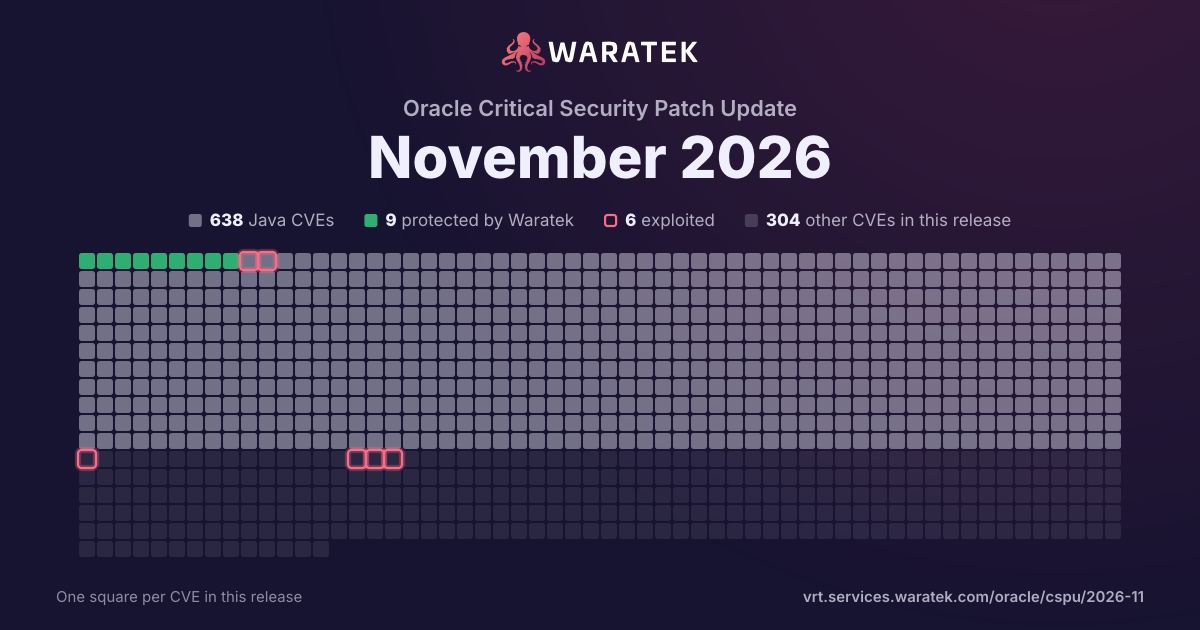
By status
8Protected by Waratek3Mitigation candidate626No exploit published16Outside Waratek scope289Not applicable
8Exploited, marked by the ring
No exploit published. For 554 of them, Oracle's security advisory is the source of public detail.
Protected by Waratek. Waratek RASP can block exploitation of these on systems that have not applied the patch yet.
Overview 73 matches · 0 protected · 0 exploited · 0 CISA KEV · 0 public PoC · 0 EPSS ≥ 0.5
73matches
0protected0.0%
0exploited0.0%
0CISA KEV0.0%
0public PoC0.0%
0EPSS ≥ 0.50.0%
Protected by Waratek
0
0.0%
Rule in development
0
0.0%
Mitigation candidate
0
0.0%
No exploit published
73
100.0%
blocked by ARMR today
0
0.0%
partly blocked
0
0.0%
not blocked
73
100.0%
not established
0
0.0%
unrecorded
0
0.0%
Exploited
0
0.0%
Working exploit published
0
0.0%
Proof of concept only
0
0.0%
Forecast only
0
0.0%
No public exploit
73
100.0%
split by
peak 58 / quarter
Q3 211
No exploit published1
Medium1
not blocked1
No public exploit1
Q4 210
Q1 220
Q2 220
Q3 220
Q4 220
Q1 230
Q2 231
No exploit published1
High1
not blocked1
No public exploit1
Q3 230
Q4 230
Q1 240
Q2 240
Q3 240
Q4 240
Q1 250
Q2 250
Q3 250
Q4 250
Q1 260
Q2 2613
No exploit published13
Critical1
High3
Medium6
Low3
not blocked13
No public exploit13
Q3 2658
No exploit published58
Critical9
High37
Medium10
Low2
not blocked58
No public exploit58
Q3 21Q1 22Q3 22Q1 23Q3 23Q1 24Q3 24Q1 25Q3 25Q1 26Q3 26
| CVE | Severity | Published▾ | Status | Exploitation | Description |
|---|---|---|---|---|---|
| CVE-2026-68569 | High | 2026-08-25 | No exploit published | No public exploit | Improper Authentication vulnerability in Apache Tomcat meant that in some circumstances (e.g. CLIENT-CERT, SPNEGO) that a user would be authenticated even if the user did not exist in the DataSourceRealm. This issue affects Apache Tomcat: from 11.0.0-M1 through 11.0.24, from 10.1.0-M1 through 10.1.57, from 9.0.0.M1 through 9.0.120. The following versions were EOL at the time the CVE was created but are known to be affected: from 8.5.0 through 8.5.100, from 7.0.0 through 7.0.109. Other unsupported versions may also be affected. Users are recommended to upgrade to version 11.0.25, 10.1.58 or 9.0.121, which fix the issue. |
| CVE-2026-75140 | High | 2026-08-20 | No exploit published | No public exploit | jsoup through 1.23.2, fixed in commit 862ba2f, contains an uncontrolled resource consumption vulnerability in XmlTreeBuilder that allows remote attackers to exhaust JVM heap memory by supplying a deeply nested XML document with uniquely-namespaced elements. The builder copies the entire inherited namespace map on every start element, causing quadratic time and memory complexity, which attackers can exploit to trigger an OutOfMemoryError and terminate the application. |
| CVE-2026-75596 | High | 2026-08-19 | No exploit published | No public exploit | Netty is an asynchronous, event-driven network application framework. Prior to 4.1.137.Final and 4.2.17.Final, the default io.netty.handler.ssl.SniHandler constructors use the pre-handshake ClientHello aggregation path in handler/src/main/java/io/netty/handler/ssl/SslClientHelloHandler.java at io.netty.handler.ssl.SslClientHelloHandler#decode, where handshakeBuffer.clear() and writeBytes() recopy all previously received body bytes for every additional TLS record. An unauthenticated remote peer can advertise a large ClientHello and deliver its body in thousands of tiny records, causing quadratic CPU work on the event loop before the TLS handshake completes and degrading TLS handling for other clients. This issue is fixed in versions 4.1.137.Final and 4.2.17.Final. |
| CVE-2026-75595 | Critical | 2026-08-19 | No exploit published | No public exploit | Netty is an asynchronous, event-driven network application framework. Prior to 4.1.137.Fina and 4.2.17.Final, io.netty.handler.ssl.SslClientHelloHandler#decode checks the wrong offset before reading the four-byte TLS handshake header, so a ClientHello whose handshake header spans records can cause an IndexOutOfBoundsException and invoke select(ctx, null). This selects the default SslContext instead of the SNI-specific context. In deployments where per-SNI clientAuth=REQUIRE is the sole mutual TLS gate, the default SslContext uses clientAuth=NONE or clientAuth=OPTIONAL, and no application-layer certificate verification exists, an unauthenticated remote attacker can bypass the protected route's mutual TLS requirement. This issue is fixed in versions 4.1.137.Final and 4.2.17.Final. |
| CVE-2026-70907 | Medium | 2026-08-18 | No exploit published | No public exploit | Vulnerability in the Oracle Java SE, Oracle GraalVM for JDK, Oracle GraalVM Enterprise Edition product of Oracle Java SE (component: JSSE). Supported versions that are affected are Oracle Java SE: 8u501, 11.0.32, 17.0.20, 21.0.12, 25.0.4, 26.0.2; Oracle GraalVM for JDK: 17.0.20 and 21.0.12; Oracle GraalVM Enterprise Edition: 21.3.19. Easily exploitable vulnerability allows unauthenticated attacker with network access via TLS to compromise Oracle Java SE, Oracle GraalVM for JDK, Oracle GraalVM Enterprise Edition. Successful attacks of this vulnerability can result in unauthorized ability to cause a partial denial of service (partial DOS) of Oracle Java SE, Oracle GraalVM for JDK, Oracle GraalVM Enterprise Edition. Note: This vulnerability can only be exploited by supplying data to APIs in the specified Component without using Untrusted Java Web Start applications or Untrusted Java applets, such as through a web service. CVSS 3.1 Base Score 5.3 (Availability impacts). CVSS Vector: (CVSS:3.1/AV:N/AC:L/PR:N/UI:N/S:U/C:N/I:N/A:L). |
| CVE-2026-61308 | Medium | 2026-08-18 | No exploit published | No public exploit | Vulnerability in the Oracle Java SE, Oracle GraalVM for JDK, Oracle GraalVM Enterprise Edition product of Oracle Java SE (component: Networking). Supported versions that are affected are Oracle Java SE: 8u501, 11.0.32, 17.0.20, 21.0.12, 25.0.4, 26.0.2; Oracle GraalVM for JDK: 17.0.20 and 21.0.12; Oracle GraalVM Enterprise Edition: 21.3.19. Difficult to exploit vulnerability allows unauthenticated attacker with network access via HTTP to compromise Oracle Java SE, Oracle GraalVM for JDK, Oracle GraalVM Enterprise Edition. While the vulnerability is in Oracle Java SE, Oracle GraalVM for JDK, Oracle GraalVM Enterprise Edition, attacks may significantly impact additional products (scope change). Successful attacks of this vulnerability can result in unauthorized access to critical data or complete access to all Oracle Java SE, Oracle GraalVM for JDK, Oracle GraalVM Enterprise Edition accessible data. Note: This vulnerability can be exploited by using APIs in the specified Component, e.g., through a web service which supplies data to the APIs. This vulnerability also applies to Java deployments, typically in clients running sandboxed Java Web Start applications or sandboxed Java applets, that load and run untrusted code (e.g., code that comes from the internet) and rely on the Java sandbox for security. CVSS 3.1 Base Score 6.8 (Confidentiality impacts). CVSS Vector: (CVSS:3.1/AV:N/AC:H/PR:N/UI:N/S:C/C:H/I:N/A:N). |
| CVE-2026-60589 | Low | 2026-08-18 | No exploit published | No public exploit | Vulnerability in the Oracle Java SE, Oracle GraalVM for JDK, Oracle GraalVM Enterprise Edition product of Oracle Java SE (component: Security). Supported versions that are affected are Oracle Java SE: 8u501, 11.0.32, 17.0.20, 21.0.12, 25.0.4, 26.0.2; Oracle GraalVM for JDK: 17.0.20 and 21.0.12; Oracle GraalVM Enterprise Edition: 21.3.19. Difficult to exploit vulnerability allows unauthenticated attacker with network access via multiple protocols to compromise Oracle Java SE, Oracle GraalVM for JDK, Oracle GraalVM Enterprise Edition. Successful attacks of this vulnerability can result in unauthorized read access to a subset of Oracle Java SE, Oracle GraalVM for JDK, Oracle GraalVM Enterprise Edition accessible data. Note: This vulnerability can only be exploited by supplying data to APIs in the specified Component without using Untrusted Java Web Start applications or Untrusted Java applets, such as through a web service. CVSS 3.1 Base Score 3.7 (Confidentiality impacts). CVSS Vector: (CVSS:3.1/AV:N/AC:H/PR:N/UI:N/S:U/C:L/I:N/A:N). |
| CVE-2026-59949 | Medium | 2026-08-18 | No exploit published | No public exploit | yawkat LZ4 Java provides LZ4 compression for Java. Prior to 1.11.1, JNI-backed XXHash implementations fail to validate the byte array object and the off and len arguments in XXHashFactory.nativeInstance().hash32().hash(), XXHashFactory.nativeInstance().hash64().hash(), XXHashFactory.nativeInstance().newStreamingHash32().update(), and XXHashFactory.nativeInstance().newStreamingHash64().update(), allowing null arrays or oversized ranges to reach native code, read outside the Java array, and fatally terminate the JVM. This issue is fixed in version 1.11.1. |
| CVE-2026-59903 | High | 2026-08-17 | No exploit published | No public exploit | Netty is an asynchronous, event-driven network application framework. Prior to 4.1.137.Final and 4.2.17.Final, io.netty.handler.codec.http.cors.CorsHandler setVaryHeader replaces application Vary headers such as Authorization or Cookie with Origin, allowing a caching proxy or CDN to reuse authenticated responses across users and disclose sensitive information. This issue is fixed in versions 4.1.137.Final and 4.2.17.Final. |
| CVE-2026-71497 | Medium | 2026-08-06 | No exploit published | No public exploit | jsoup is a Java library for working with real-world HTML. From 1.14.3 until 1.23.1, jsoup's HTML parser could incorrectly handle a malformed tag name ending in a control character, causing the tag to acquire the parsing behavior of a different element. When a custom Safelist permits certain raw-text elements, this misparsing can cause content that should remain inert text to be emitted as active markup after serialization, potentially resulting in cross-site scripting. jsoup's built-in Safelists are not affected. This issue is fixed in version 1.23.1. |
| CVE-2026-68481 | High | 2026-08-06 | No exploit published | No public exploit | In Apache CXF's DefaultEncryptingOAuthDataProvider, revoked access tokens still decrypt successfully, and TokenIntrospectionService reports active:true. The same applies to refresh tokens. This violates the RFC stipulations that 'The authorization server MUST invalidate the token.' and 'introspection of a revoked token MUST return {"active":false}'. Users are recommended to upgrade to versions 4.2.3 or 4.1.8 or 3.6.12, which fix this issue. |
| CVE-2026-68079 | Critical | 2026-08-06 | No exploit published | No public exploit | In Apache CXF's DefaultEncryptingCodeDataProvider, a captured authorization code can be redeemed an unlimited number of times due to a flaw in the implementation of the removeCodeGrant functionality. This violates the RFC requirement that "The authorization code MUST NOT be used more than once." Users are recommended to upgrade to versions 4.2.3 or 4.1.8 or 3.6.12, which fix this issue. |
| CVE-2026-65583 | Critical | 2026-08-06 | No exploit published | No public exploit | Apache CXF’s OIDC relying-party token validation could accept self-issued ID tokens without enforcing required claim checks (issuer/subject/audience/time and sub_jwk binding), enabling authentication bypass with crafted tokens. However, note that self-issued ID tokens are not accepted by default in the validator. Users are recommended to upgrade to versions 4.2.3 or 4.1.8 or 3.6.12, which fixes this issue. |
| CVE-2026-64958 | High | 2026-08-06 | No exploit published | No public exploit | An incomplete fix for CVE-2026-50645 means that it is still possible to perform a denial of service attack on Apache CXF by sending a message with many attachment headers. Users are recommended to upgrade to versions 4.2.3 or 4.1.8 or 3.6.12, which fix this issue. |
| CVE-2026-63687 | Critical | 2026-08-06 | No exploit published | No public exploit | Apache CXF's JwtRequestCodeFilter copies all claims from a signed request JWT into the authorization parameter map without excluding security-sensitive parameters. A client that can produce a validly-signed request JWT (e.g., one whose client_secret is known or compromised) can thereby substitute the code_challenge, code_challenge_method, nonce, and state values that were set in the outer HTTP request, undermining PKCE integrity and OpenID Connect replay protection. Users are recommended to upgrade to versions 4.2.3 or 4.1.8 or 3.6.12, which fix this issue. |
| CVE-2026-61466 | Critical | 2026-08-06 | No exploit published | No public exploit | In Apache CXF's OAuth2 Dynamic Client Registration endpoint, the authorization server accepts and stores the `scope` value supplied in the client registration request verbatim, without validating it against an AS-defined allowlist. This could lead to a client self-assigning privileged scopes at registration time. Users are recommended to upgrade to versions 4.2.3 or 4.1.8 or 3.6.12, which fix this issue. |
| CVE-2026-57819 | High | 2026-08-06 | No exploit published | No public exploit | Apache CXF allows to set a limit on the number of form parameters in a JAX-RS message via the "maxFormParameterCount" configuration option. However, no default limit is set which may lead to denial of service attacks when processing requests with very large numbers of form parameters. Users are recommended to upgrade to versions 4.2.3 or 4.1.8 or 3.6.12, which fix this issue by using a default limit of 500 parameters. |
| CVE-2026-57818 | High | 2026-08-06 | No exploit published | No public exploit | A race condition in JCacheCodeDataProvider allows an attacker to redeem a single authorization code multiple times via concurrent requests, resulting in the issuance of multiple distinct, valid access tokens. Users are recommended to upgrade to versions 4.2.3, 4.1.8 or 3.6.12, which fix this issue. |
| CVE-2026-57817 | High | 2026-08-06 | No exploit published | No public exploit | The OpenID Connect Core 1.0 specification mandates that the RP MUST validate the `c_hash` parameter when operating in the Hybrid Flow. If an Apache CXF RP is integrated with a non-compliant or misconfigured Identity Provider (IdP) that omits the `c_hash`, the RP becomes vulnerable to Authorization Code Substitution/Injection attacks. Users are recommended to upgrade to versions 4.2.3 or 4.1.8 or 3.6.12, which fix this issue. |
| CVE-2026-54225 | High | 2026-08-06 | No exploit published | No public exploit | Apache CXF allows to control the maximum attachment size via the "attachment-max-size". Prior to Apache CXF 4.2.3 and 4.1.8 and 3.6.12, there was no default placed on this size, meaning that a denial of service attack is possible if the user doesn't explicitly set the limit. Users should update to Apache CXF 4.2.3 or 4.1.8 or 3.6.12 which fixes this problem by imposing a default attachment size limit of 50mb. |
| CVE-2026-8763 | Critical | 2026-08-03 | No exploit published | No public exploit | In Bouncy Castle for Java before 1.85, Name Constraints bypass via trailing dot in rfc822Name and URI. This issue also affects Bouncy Castle for Java LTS before 2.73.12, and Bouncy Castle for Java FIPS (BC-FJA) before bc-fips 1.0.2.7 (1.0.X series), 2.0.2 (2.0.X series) and 2.1.3 (2.1.X series). |
| CVE-2026-59651 | High | 2026-08-03 | No exploit published | No public exploit | In Bouncy Castle for Java before 1.85, BKS keystore accepts legacy version with 16-bit integrity MAC key. This issue also affects Bouncy Castle for Java LTS before 2.73.12. |
| CVE-2026-59650 | Critical | 2026-08-03 | No exploit published | No public exploit | In Bouncy Castle for Java before 1.85, MTI/A0 DH agreement exponentiates unvalidated peer value. This issue also affects Bouncy Castle for Java LTS before 2.73.12. |
| CVE-2026-59649 | High | 2026-08-03 | No exploit published | No public exploit | In Bouncy Castle for Java before 1.85, OpenPGP user-attribute subpacket length bounded only by JVM max memory. This issue also affects Bouncy Castle for Java LTS before 2.73.12, and Bouncy Castle for Java FIPS (BC-FJA) before bcpg-fips 1.0.13 (1.0.X series), 2.0.13 (2.0.X series) and 2.1.13 (2.1.X series). |
| CVE-2026-59646 | High | 2026-08-03 | No exploit published | No public exploit | In Bouncy Castle for Java before 1.85, DTLS handshake reassembler allocates buffer from unchecked 24-bit length. This issue also affects Bouncy Castle for Java LTS before 2.73.12, and Bouncy Castle for Java FIPS (BC-FJA) before bctls-fips 1.0.24 (1.0.X series), 2.0.24 (2.0.X series) and 2.1.24 (2.1.X series). |
| CVE-2026-59645 | High | 2026-08-03 | No exploit published | No public exploit | In Bouncy Castle for Java before 1.85, OER parser recurses without depth limit on self-referential IEEE 1609.2 schema. This issue also affects Bouncy Castle for Java LTS before 2.73.12, and Bouncy Castle for Java FIPS (BC-FJA) before bcutil-fips 2.0.7 (2.0.X series) and 2.1.7 (2.1.X series). |
| CVE-2026-59644 | High | 2026-08-03 | No exploit published | No public exploit | In Bouncy Castle for Java before 1.85, MLS hash-ratchet honours arbitrary 32-bit generation counter from sender. |
| CVE-2026-59643 | High | 2026-08-03 | No exploit published | No public exploit | In Bouncy Castle for Java before 1.85, OpenPGP inline-signature policy failures silently ignored. This issue also affects Bouncy Castle for Java FIPS (BC-FJA) before bcpg-fips 2.0.13. |
| CVE-2026-59642 | High | 2026-08-03 | No exploit published | No public exploit | In Bouncy Castle for Java before 1.85, CMS AuthenticatedData content not bound to MAC when authAttrs present. This issue also affects Bouncy Castle for Java LTS before 2.73.12, and Bouncy Castle for Java FIPS (BC-FJA) before bcpkix-fips 1.0.12 (1.0.X series), 2.0.12 (2.0.X series) and 2.1.12 (2.1.X series). |
| CVE-2026-59641 | High | 2026-08-03 | No exploit published | No public exploit | In Bouncy Castle for Java before 1.85, S/MIME validator trusts signer-asserted signingTime for path validation. This issue also affects Bouncy Castle for Java LTS before 2.73.12, and Bouncy Castle for Java FIPS (BC-FJA) before bcmail-fips and bcjmail-fips 1.0.7 (1.0.X series), 2.0.7 (2.0.X series) and 2.1.7 (2.1.X series). |
| CVE-2026-59640 | High | 2026-08-03 | No exploit published | No public exploit | In Bouncy Castle for Java before 1.85, OpenPGP CFB quick-check oracle active on symmetric/session-key paths. This issue also affects Bouncy Castle for Java LTS before 2.73.12, and Bouncy Castle for Java FIPS (BC-FJA) before bcpg-fips 1.0.13 (1.0.X series), 2.0.13 (2.0.X series) and 2.1.13 (2.1.X series). |
| CVE-2026-59639 | High | 2026-08-03 | No exploit published | No public exploit | In Bouncy Castle for Java before 1.85, CMS verifySignatures returns true for SignedData with zero signers. This issue also affects Bouncy Castle for Java LTS before 2.73.12, and Bouncy Castle for Java FIPS (BC-FJA) before bcpkix-fips 1.0.12 (1.0.X series), 2.0.12 (2.0.X series) and 2.1.12 (2.1.X series). |
| CVE-2026-59638 | Critical | 2026-08-03 | No exploit published | No public exploit | In Bouncy Castle for Java before 1.85, JSSE hostname verifier CN-fallback enabled by default despite documented opt-in. This issue also affects Bouncy Castle for Java LTS before 2.73.12, and Bouncy Castle for Java FIPS (BC-FJA) before bctls-fips 1.0.24 (1.0.X series), 2.0.24 (2.0.X series) and 2.1.24 (2.1.X series). |
| CVE-2026-58062 | Critical | 2026-08-03 | No exploit published | No public exploit | In Bouncy Castle for Java before 1.85, Stapled OCSP response accepted without binding to the checked certificate. This issue also affects Bouncy Castle for Java LTS before 2.73.12, and Bouncy Castle for Java FIPS (BC-FJA) before bc-fips 2.0.2 (2.0.X series) and 2.1.3 (2.1.X series). |
| CVE-2026-58061 | High | 2026-08-03 | No exploit published | No public exploit | In Bouncy Castle for Java before 1.85, CCM-family modes write plaintext to caller buffer before tag check. This issue also affects Bouncy Castle for Java LTS before 2.73.12, and Bouncy Castle for Java FIPS (BC-FJA) before bc-fips 1.0.2.7 (1.0.X series), 2.0.2 (2.0.X series) and 2.1.3 (2.1.X series). |
| CVE-2026-58060 | High | 2026-08-03 | No exploit published | No public exploit | In Bouncy Castle for Java before 1.85, HSS public-key level count unbounded, enabling huge allocation on verify. This issue also affects Bouncy Castle for Java LTS before 2.73.12, and Bouncy Castle for Java FIPS (BC-FJA) before bc-fips 2.0.2 (2.0.X series) and 2.1.3 (2.1.X series). |
| CVE-2026-58059 | High | 2026-08-03 | No exploit published | No public exploit | In Bouncy Castle for Java before 1.85, Quadratic-time escaping when stringifying X.500 distinguished names. This issue also affects Bouncy Castle for Java LTS before 2.73.12, and Bouncy Castle for Java FIPS (BC-FJA) before bc-fips 1.0.2.7 (1.0.X series), 2.0.2 (2.0.X series) and 2.1.3 (2.1.X series). |
| CVE-2026-14682 | High | 2026-08-03 | No exploit published | No public exploit | In Bouncy Castle for Java before 1.85, Possible OOM from unbounded up-front allocation on a definite-length read. This issue also affects Bouncy Castle for Java LTS before 2.73.12, and Bouncy Castle for Java FIPS (BC-FJA) before bc-fips 1.0.2.7 (1.0.X series), 2.0.2 (2.0.X series) and 2.1.3 (2.1.X series), and before bctls-fips 1.0.24. |
| CVE-2026-13506 | High | 2026-08-03 | No exploit published | No public exploit | In Bouncy Castle for Java before 1.85, Lazy ASN.1 sequence forcing resets nesting-depth guard. This issue also affects Bouncy Castle for Java LTS before 2.73.12, and Bouncy Castle for Java FIPS (BC-FJA) before bc-fips 1.0.2.7 (1.0.X series), 2.0.2 (2.0.X series) and 2.1.3 (2.1.X series). |
| CVE-2026-12860 | High | 2026-08-03 | No exploit published | No public exploit | In Bouncy Castle for Java before 1.85, RSA PKCS#1 verification skips last two hash bytes in NULL-omitted path. This issue also affects Bouncy Castle for Java LTS before 2.73.12. |
| CVE-2026-12852 | High | 2026-08-03 | No exploit published | No public exploit | In Bouncy Castle for Java before 1.85, MLS wire decoder allocates attacker-declared opaque length before bounds check. |
| CVE-2026-12817 | High | 2026-08-03 | No exploit published | No public exploit | In Bouncy Castle for Java before 1.85, OpenPGP AEAD decryption skips final tag on chunk-aligned data. This issue also affects Bouncy Castle for Java LTS before 2.73.12, and Bouncy Castle for Java FIPS (BC-FJA) before bcpg-fips 1.0.13 (1.0.X series), 2.0.13 (2.0.X series) and 2.1.13 (2.1.X series). |
| CVE-2026-12816 | High | 2026-08-03 | No exploit published | No public exploit | In Bouncy Castle for Java before 1.85, IESEngine stream-mode MAC forgery via length-dependent KDF split. This issue also affects Bouncy Castle for Java LTS before 2.73.12. |
| CVE-2026-12803 | High | 2026-08-03 | No exploit published | No public exploit | In Bouncy Castle for Java before 1.85, KCCMBlockCipher MAC does not bind nonce when AAD is absent (cross-nonce AEAD forgery). This issue also affects Bouncy Castle for Java LTS before 2.73.12. |
| CVE-2026-12802 | High | 2026-08-03 | No exploit published | No public exploit | In Bouncy Castle for Java before 1.85, CMS AuthEnvelopedData fails to enforce tag-length on decryption. This issue also affects Bouncy Castle for Java LTS before 2.73.12, and Bouncy Castle for Java FIPS (BC-FJA) before bcpkix-fips 1.0.12 (1.0.X series), 2.0.12 (2.0.X series) and 2.1.12 (2.1.X series). |
| CVE-2026-12185 | High | 2026-08-03 | No exploit published | No public exploit | In Bouncy Castle for Java before 1.85, BKS/UBER keystore allocates from untrusted lengths before integrity check. This issue also affects Bouncy Castle for Java LTS before 2.73.12. |
| CVE-2026-64607 | Medium | 2026-07-31 | No exploit published | No public exploit | HttpClient based on the classic i/o model fails to correctly release the underlying connection back to the connection manager if it encounters an invalid or unsupported `Content-Encoding` header value in the response message. Please note this defect does not affect HttpClient based on the async i/o model. This issue affects Apache HttpComponents Client: from 5.0-alpha1 through 5.6.2. |
| CVE-2026-66144 | High | 2026-07-24 | No exploit published | No public exploit | Although remote policy references are not retrieved during policy normalization, if they are manually retrieved via the API it can cause a denial of service attack if a huge policy is retrieved. Users are recommended to upgrade to version 3.2.3, which fixes this issue by imposing a default maximum size on data read from remote policy references. |
| CVE-2026-66143 | High | 2026-07-24 | No exploit published | No public exploit | It is possible to bypass the maximum number of normalized policy alternatives that was introduced in Apache Neethi 3.2.2 via certain crafted policies, which may lead to a denial of service attack via resource consumption. Users are recommended to upgrade to version 3.2.3, which fixes this issue. |
| CVE-2026-66142 | High | 2026-07-24 | No exploit published | No public exploit | Apache Neethi is vulnerable to uncontrolled recursion when parsing policies that lack policy Ids or with deeply nested structures, which may lead to a denial of service attack when parsing policies due to runtime memory exhaustion. Users are recommended to upgrade to version 3.2.3, which fixes this issue. |
| CVE-2026-60147 | Medium | 2026-07-21 | No exploit published | No public exploit | Vulnerability in the Oracle Java SE, Oracle GraalVM for JDK, Oracle GraalVM Enterprise Edition product of Oracle Java SE (component: Security). Supported versions that are affected are Oracle Java SE: 8u491, 8u491-perf, 11.0.31, 17.0.19, 21.0.11, 25.0.3, 26.0.1; Oracle GraalVM for JDK: 17.0.19 and 21.0.11; Oracle GraalVM Enterprise Edition: 21.3.18. Easily exploitable vulnerability allows unauthenticated attacker with network access via multiple protocols to compromise Oracle Java SE, Oracle GraalVM for JDK, Oracle GraalVM Enterprise Edition. Successful attacks of this vulnerability can result in unauthorized update, insert or delete access to some of Oracle Java SE, Oracle GraalVM for JDK, Oracle GraalVM Enterprise Edition accessible data as well as unauthorized read access to a subset of Oracle Java SE, Oracle GraalVM for JDK, Oracle GraalVM Enterprise Edition accessible data. Note: This vulnerability can be exploited by using APIs in the specified Component, e.g., through a web service which supplies data to the APIs. This vulnerability also applies to Java deployments, typically in clients running sandboxed Java Web Start applications or sandboxed Java applets, that load and run untrusted code (e.g., code that comes from the internet) and rely on the Java sandbox for security. CVSS 3.1 Base Score 6.5 (Confidentiality and Integrity impacts). CVSS Vector: (CVSS:3.1/AV:N/AC:L/PR:N/UI:N/S:U/C:L/I:L/A:N). |
| CVE-2026-47027 | Medium | 2026-07-21 | No exploit published | No public exploit | Vulnerability in Oracle Java SE (component: Libraries). Supported versions that are affected are Oracle Java SE: 8u491, 8u491-perf, 11.0.31, 17.0.19, 21.0.11, 25.0.3, 26.0.1; Oracle GraalVM for JDK: 17.0.19 and 21.0.11; Oracle GraalVM Enterprise Edition: 21.3.18. Easily exploitable vulnerability allows unauthenticated attacker with network access via multiple protocols to compromise Oracle Java SE. Successful attacks of this vulnerability can result in unauthorized ability to cause a partial denial of service (partial DOS) of Oracle Java SE. Note: This vulnerability can be exploited by using APIs in the specified Component, e.g., through a web service which supplies data to the APIs. This vulnerability also applies to Java deployments, typically in clients running sandboxed Java Web Start applications or sandboxed Java applets, that load and run untrusted code (e.g., code that comes from the internet) and rely on the Java sandbox for security. CVSS 3.1 Base Score 5.3 (Availability impacts). CVSS Vector: (CVSS:3.1/AV:N/AC:L/PR:N/UI:N/S:U/C:N/I:N/A:L). |
| CVE-2026-47021 | Medium | 2026-07-21 | No exploit published | No public exploit | Vulnerability in the Oracle Java SE, Oracle GraalVM for JDK, Oracle GraalVM Enterprise Edition product of Oracle Java SE (component: 2D). Supported versions that are affected are Oracle Java SE: 8u491, 8u491-perf, 11.0.31, 17.0.19, 21.0.11, 25.0.3, 26.0.1; Oracle GraalVM for JDK: 17.0.19 and 21.0.11; Oracle GraalVM Enterprise Edition: 21.3.18. Easily exploitable vulnerability allows unauthenticated attacker with network access via multiple protocols to compromise Oracle Java SE, Oracle GraalVM for JDK, Oracle GraalVM Enterprise Edition. Successful attacks of this vulnerability can result in unauthorized ability to cause a partial denial of service (partial DOS) of Oracle Java SE, Oracle GraalVM for JDK, Oracle GraalVM Enterprise Edition. Note: This vulnerability can be exploited by using APIs in the specified Component, e.g., through a web service which supplies data to the APIs. This vulnerability also applies to Java deployments, typically in clients running sandboxed Java Web Start applications or sandboxed Java applets, that load and run untrusted code (e.g., code that comes from the internet) and rely on the Java sandbox for security. CVSS 3.1 Base Score 5.3 (Availability impacts). CVSS Vector: (CVSS:3.1/AV:N/AC:L/PR:N/UI:N/S:U/C:N/I:N/A:L). |
| CVE-2026-47010 | Low | 2026-07-21 | No exploit published | No public exploit | Vulnerability in the Oracle Java SE, Oracle GraalVM for JDK, Oracle GraalVM Enterprise Edition product of Oracle Java SE (component: ImageIO). Supported versions that are affected are Oracle Java SE: 8u491, 8u491-perf, 11.0.31, 17.0.19, 21.0.11, 25.0.3, 26.0.1; Oracle GraalVM for JDK: 17.0.19 and 21.0.11; Oracle GraalVM Enterprise Edition: 21.3.18. Difficult to exploit vulnerability allows unauthenticated attacker with network access via multiple protocols to compromise Oracle Java SE, Oracle GraalVM for JDK, Oracle GraalVM Enterprise Edition. Successful attacks of this vulnerability can result in unauthorized update, insert or delete access to some of Oracle Java SE, Oracle GraalVM for JDK, Oracle GraalVM Enterprise Edition accessible data. Note: This vulnerability can be exploited by using APIs in the specified Component, e.g., through a web service which supplies data to the APIs. This vulnerability also applies to Java deployments, typically in clients running sandboxed Java Web Start applications or sandboxed Java applets, that load and run untrusted code (e.g., code that comes from the internet) and rely on the Java sandbox for security. CVSS 3.1 Base Score 3.7 (Integrity impacts). CVSS Vector: (CVSS:3.1/AV:N/AC:H/PR:N/UI:N/S:U/C:N/I:L/A:N). |
| CVE-2026-46968 | Medium | 2026-07-21 | No exploit published | No public exploit | Vulnerability in Oracle Java SE (component: JSSE). Supported versions that are affected are Oracle Java SE: 8u491, 8u491-perf, 11.0.31, 17.0.19, 21.0.11, 25.0.3, 26.0.1; Oracle GraalVM for JDK: 17.0.19 and 21.0.11; Oracle GraalVM Enterprise Edition: 21.3.18. Difficult to exploit vulnerability allows unauthenticated attacker with network access via TLS to compromise Oracle Java SE. Successful attacks of this vulnerability can result in unauthorized creation, deletion or modification access to critical data or all Oracle Java SE accessible data. Note: This vulnerability can only be exploited by supplying data to APIs in the specified Component without using Untrusted Java Web Start applications or Untrusted Java applets, such as through a web service. CVSS 3.1 Base Score 5.9 (Integrity impacts). CVSS Vector: (CVSS:3.1/AV:N/AC:H/PR:N/UI:N/S:U/C:N/I:H/A:N). |
| CVE-2026-49844 | Medium | 2026-07-10 | No exploit published | No public exploit | Improper encoding of non-finite floating-point values during MapMessage JSON serialization in Apache Log4j API produces output that is not valid JSON. This issue affects Apache Log4j API versions 2.13.1 through 2.25.4 and version 2.26.0. The fix for CVE-2026-34481 did not cover all code paths: when a MapMessage contains a non-finite IEEE 754 value (NaN, Infinity, or -Infinity), MapMessage.asJson() emits the corresponding bare token. RFC 8259 does not permit these tokens, so a conformant parser rejects the resulting document. The defect is reachable only when both of the following conditions hold: * The application uses the message resolver https://logging.apache.org/log4j/2.x/manual/json-template-layout.html#event-template-resolver-message of JsonTemplateLayout or any other layout that relies on MapMessage.asJson() or MapMessage.getFormattedMessage(new String[]{"JSON"}). * The application logs a MapMessage that contains an attacker-controlled floating-point value. An attacker who can supply a non-finite value can cause the affected layout to emit malformed JSON, which may corrupt the enclosing log record or disrupt downstream log ingestion and parsing. Users are advised to upgrade to Apache Log4j API 2.25.5 or 2.26.1, both of which emit RFC 8259-compliant JSON for non-finite values. |
| CVE-2026-54428 | High | 2026-07-01 | No exploit published | No public exploit | Allocation of resources without limits or throttling in the HTTP/2 HPACK decoder in Apache HttpComponents Core (5.4.2 and earlier, 5.5-beta1 and earlier) allows an remote attacker to cause a denial of service through memory exhaustion by sending oversized compressed header blocks before the HTTP/2 SETTINGS acknowledgement causes the configured header list size limit to be applied. |
| CVE-2026-54399 | High | 2026-07-01 | No exploit published | No public exploit | Uncontrolled Resource Consumption vulnerability in the HTTP/1.1 message parser in Apache HttpComponents Core (5.4.2 and earlier, 5.5-beta1 and earlier) allows an remote attacker to cause a denial of service through memory exhaustion by sending messages with excessive number of headers / excessive header length |
| CVE-2026-40984 | High | 2026-06-09 | No exploit published | No public exploit | In Micrometer, it is possible for a user to provide specially crafted HTTP requests that may cause a denial-of-service (DoS) condition. Affected versions: micrometer-core 1.16.0 through 1.16.5; 1.15.0 through 1.15.11; 1.14.0 through 1.14.15; 1.13.0 through 1.13.18; 1.9.0 through 1.9.17. micrometer-jetty11 1.16.0 through 1.16.5; 1.15.0 through 1.15.11; 1.14.0 through 1.14.15; 1.13.0 through 1.13.18. micrometer-jetty12 1.16.0 through 1.16.5; 1.15.0 through 1.15.11; 1.14.0 through 1.14.15; 1.13.0 through 1.13.18. |
| CVE-2026-40983 | High | 2026-06-09 | No exploit published | No public exploit | In Micrometer, it is possible for a user to provide specially crafted gRPC requests that may cause a denial-of-service (DoS) condition. Affected versions: Micrometer 1.16.0 through 1.16.5; 1.15.0 through 1.15.11. |
| CVE-2026-42402 | High | 2026-05-01 | No exploit published | No public exploit | Apache Neethi is vulnerable to a Denial of Service attack through algorithmic complexity in policy normalization. Specially crafted WS-Policy documents can trigger an exponential Cartesian cross-product expansion during the normalization process, causing unbounded memory allocation that exhausts the JVM heap. This occurs when the normalization process generates an excessive number of policy alternatives without bounds, leading to runtime memory exhaustion. Users should upgrade to 3.2.2 which limits the maximum number of normalized policy alternatives. |
| CVE-2026-34268 | Low | 2026-04-21 | No exploit published | No public exploit | Vulnerability in the Oracle Java SE, Oracle GraalVM for JDK, Oracle GraalVM Enterprise Edition product of Oracle Java SE (component: Security). Supported versions that are affected are Oracle Java SE: 8u481, 8u481-b50, 8u481-perf, 11.0.30, 17.0.18, 21.0.10, 25.0.2, 26; Oracle GraalVM for JDK: 17.0.18 and 21.0.10; Oracle GraalVM Enterprise Edition: 21.3.17. Difficult to exploit vulnerability allows unauthenticated attacker with logon to the infrastructure where Oracle Java SE, Oracle GraalVM for JDK, Oracle GraalVM Enterprise Edition executes to compromise Oracle Java SE, Oracle GraalVM for JDK, Oracle GraalVM Enterprise Edition. Successful attacks of this vulnerability can result in unauthorized read access to a subset of Oracle Java SE, Oracle GraalVM for JDK, Oracle GraalVM Enterprise Edition accessible data. Note: This vulnerability can be exploited by using APIs in the specified Component, e.g., through a web service which supplies data to the APIs. This vulnerability also applies to Java deployments, typically in clients running sandboxed Java Web Start applications or sandboxed Java applets, that load and run untrusted code (e.g., code that comes from the internet) and rely on the Java sandbox for security. CVSS 3.1 Base Score 2.9 (Confidentiality impacts). CVSS Vector: (CVSS:3.1/AV:L/AC:H/PR:N/UI:N/S:U/C:L/I:N/A:N). |
| CVE-2026-22021 | Medium | 2026-04-21 | No exploit published | No public exploit | Vulnerability in the Oracle Java SE, Oracle GraalVM for JDK, Oracle GraalVM Enterprise Edition product of Oracle Java SE (component: JSSE). Supported versions that are affected are Oracle Java SE: 8u481, 8u481-b50, 8u481-perf, 11.0.30, 17.0.18, 21.0.10, 25.0.2, 26; Oracle GraalVM for JDK: 17.0.18 and 21.0.10; Oracle GraalVM Enterprise Edition: 21.3.17. Easily exploitable vulnerability allows unauthenticated attacker with network access via HTTPS to compromise Oracle Java SE, Oracle GraalVM for JDK, Oracle GraalVM Enterprise Edition. Successful attacks of this vulnerability can result in unauthorized ability to cause a partial denial of service (partial DOS) of Oracle Java SE, Oracle GraalVM for JDK, Oracle GraalVM Enterprise Edition. Note: This vulnerability can be exploited by using APIs in the specified Component, e.g., through a web service which supplies data to the APIs. This vulnerability also applies to Java deployments, typically in clients running sandboxed Java Web Start applications or sandboxed Java applets, that load and run untrusted code (e.g., code that comes from the internet) and rely on the Java sandbox for security. CVSS 3.1 Base Score 5.3 (Availability impacts). CVSS Vector: (CVSS:3.1/AV:N/AC:L/PR:N/UI:N/S:U/C:N/I:N/A:L). |
| CVE-2026-22018 | Low | 2026-04-21 | No exploit published | No public exploit | Vulnerability in the Oracle Java SE, Oracle GraalVM for JDK, Oracle GraalVM Enterprise Edition product of Oracle Java SE (component: Libraries). Supported versions that are affected are Oracle Java SE: 8u481, 8u481-b50, 8u481-perf, 11.0.30, 17.0.18, 21.0.10, 25.0.2, 26; Oracle GraalVM for JDK: 17.0.18 and 21.0.10; Oracle GraalVM Enterprise Edition: 21.3.17. Difficult to exploit vulnerability allows unauthenticated attacker with network access via multiple protocols to compromise Oracle Java SE, Oracle GraalVM for JDK, Oracle GraalVM Enterprise Edition. Successful attacks of this vulnerability can result in unauthorized ability to cause a partial denial of service (partial DOS) of Oracle Java SE, Oracle GraalVM for JDK, Oracle GraalVM Enterprise Edition. Note: This vulnerability can be exploited by using APIs in the specified Component, e.g., through a web service which supplies data to the APIs. This vulnerability also applies to Java deployments, typically in clients running sandboxed Java Web Start applications or sandboxed Java applets, that load and run untrusted code (e.g., code that comes from the internet) and rely on the Java sandbox for security. CVSS 3.1 Base Score 3.7 (Availability impacts). CVSS Vector: (CVSS:3.1/AV:N/AC:H/PR:N/UI:N/S:U/C:N/I:N/A:L). |
| CVE-2026-22007 | Low | 2026-04-21 | No exploit published | No public exploit | Vulnerability in the Oracle Java SE, Oracle GraalVM for JDK, Oracle GraalVM Enterprise Edition product of Oracle Java SE (component: Security). Supported versions that are affected are Oracle Java SE: 8u481, 8u481-b50, 8u481-perf, 11.0.30, 17.0.18, 21.0.10, 25.0.2, 26; Oracle GraalVM for JDK: 17.0.18 and 21.0.10; Oracle GraalVM Enterprise Edition: 21.3.17. Difficult to exploit vulnerability allows unauthenticated attacker with logon to the infrastructure where Oracle Java SE, Oracle GraalVM for JDK, Oracle GraalVM Enterprise Edition executes to compromise Oracle Java SE, Oracle GraalVM for JDK, Oracle GraalVM Enterprise Edition. Successful attacks of this vulnerability can result in unauthorized read access to a subset of Oracle Java SE, Oracle GraalVM for JDK, Oracle GraalVM Enterprise Edition accessible data. Note: This vulnerability can be exploited by using APIs in the specified Component, e.g., through a web service which supplies data to the APIs. This vulnerability also applies to Java deployments, typically in clients running sandboxed Java Web Start applications or sandboxed Java applets, that load and run untrusted code (e.g., code that comes from the internet) and rely on the Java sandbox for security. CVSS 3.1 Base Score 2.9 (Confidentiality impacts). CVSS Vector: (CVSS:3.1/AV:L/AC:H/PR:N/UI:N/S:U/C:L/I:N/A:N). |
| CVE-2025-14813 | Critical | 2026-04-15 | No exploit published | No public exploit | : Use of a Broken or Risky Cryptographic Algorithm vulnerability in Legion of the Bouncy Castle Inc. BC-JAVA bcprov on all (core modules). This vulnerability is associated with program files G3413CTRBlockCipher. This issue affects BC-JAVA: from 1.59 before 1.80.2, from 1.81 before 1.81.1, from 1.82 before 1.84. |
| CVE-2026-34481 | Medium | 2026-04-10 | No exploit published | No public exploit | Apache Log4j's JsonTemplateLayout https://logging.apache.org/log4j/2.x/manual/json-template-layout.html , in versions up to and including 2.25.3, produces invalid JSON output when log events contain non-finite floating-point values (NaN, Infinity, or -Infinity), which are prohibited by RFC 8259. This may cause downstream log processing systems to reject or fail to index affected records. An attacker can exploit this issue only if both of the following conditions are met: * The application uses JsonTemplateLayout. * The application logs a MapMessage, or logs an object directly (e.g., via Logger.info(Object), which wraps it in an ObjectMessage), where the message contains an attacker-controlled floating-point value. Users are advised to upgrade to Apache Log4j JSON Template Layout 2.25.4, which corrects this issue. Note: The fix released in version 2.25.4 did not cover all affected code paths. CVE-2026-49844 was assigned to the remaining issue, which concerns the MapMessage.asJson() serialization in Apache Log4j API and is fixed in versions 2.25.5 and 2.26.1. |
| CVE-2026-34480 | Medium | 2026-04-10 | No exploit published | No public exploit | Apache Log4j Core's XmlLayout https://logging.apache.org/log4j/2.x/manual/layouts.html#XmlLayout , in versions up to and including 2.25.3, fails to sanitize characters forbidden by the XML 1.0 specification https://www.w3.org/TR/xml/#charsets producing invalid XML output whenever a log message or MDC value contains such characters. The impact depends on the StAX implementation in use: * JRE built-in StAX: Forbidden characters are silently written to the output, producing malformed XML. Conforming parsers must reject such documents with a fatal error, which may cause downstream log-processing systems to drop the affected records. * Alternative StAX implementations (e.g., Woodstox https://github.com/FasterXML/woodstox , a transitive dependency of the Jackson XML Dataformat module): An exception is thrown during the logging call, and the log event is never delivered to its intended appender, only to Log4j's internal status logger. Users are advised to upgrade to Apache Log4j Core 2.25.4, which corrects this issue by sanitizing forbidden characters before XML output. |
| CVE-2026-34479 | Medium | 2026-04-10 | No exploit published | No public exploit | The Log4j1XmlLayout from the Apache Log4j 1-to-Log4j 2 bridge fails to escape characters forbidden by the XML 1.0 standard, producing malformed XML output. Conforming XML parsers are required to reject documents containing such characters with a fatal error, which may cause downstream log processing systems to drop or fail to index affected records. Two groups of users are affected: * Those using Log4j1XmlLayout directly in a Log4j Core 2 configuration file. * Those using the Log4j 1 configuration compatibility layer with org.apache.log4j.xml.XMLLayout specified as the layout class. Users are advised to upgrade to Apache Log4j 1-to-Log4j 2 bridge version 2.25.4, which corrects this issue. Note: The Apache Log4j 1-to-Log4j 2 bridge is deprecated and will not be present in Log4j 3. Users are encouraged to consult the Log4j 1 to Log4j 2 migration guide https://logging.apache.org/log4j/2.x/migrate-from-log4j1.html , and specifically the section on eliminating reliance on the bridge. |
| CVE-2026-34478 | Medium | 2026-04-10 | No exploit published | No public exploit | Apache Log4j Core's Rfc5424Layout https://logging.apache.org/log4j/2.x/manual/layouts.html#RFC5424Layout , in versions 2.21.0 through 2.25.3, is vulnerable to log injection via CRLF sequences due to undocumented renames of security-relevant configuration attributes. Two distinct issues affect users of stream-based syslog services who configure Rfc5424Layout directly: * The newLineEscape attribute was silently renamed, causing newline escaping to stop working for users of TCP framing (RFC 6587), exposing them to CRLF injection in log output. * The useTlsMessageFormat attribute was silently renamed, causing users of TLS framing (RFC 5425) to be silently downgraded to unframed TCP (RFC 6587), without newline escaping. Users of the SyslogAppender are not affected, as its configuration attributes were not modified. Users are advised to upgrade to Apache Log4j Core 2.25.4, which corrects this issue. |
| CVE-2026-34477 | Medium | 2026-04-10 | No exploit published | No public exploit | The fix for CVE-2025-68161 https://logging.apache.org/security.html#CVE-2025-68161 was incomplete: it addressed hostname verification only when enabled via the log4j2.sslVerifyHostName https://logging.apache.org/log4j/2.x/manual/systemproperties.html#log4j2.sslVerifyHostName system property, but not when configured through the verifyHostName https://logging.apache.org/log4j/2.x/manual/appenders/network.html#SslConfiguration-attr-verifyHostName attribute of the <Ssl> element. Although the verifyHostName configuration attribute was introduced in Log4j Core 2.12.0, it was silently ignored in all versions through 2.25.3, leaving TLS connections vulnerable to interception regardless of the configured value. A network-based attacker may be able to perform a man-in-the-middle attack when all of the following conditions are met: * An SMTP, Socket, or Syslog appender is in use. * TLS is configured via a nested <Ssl> element. * The attacker can present a certificate issued by a CA trusted by the appender's configured trust store, or by the default Java trust store if none is configured. This issue does not affect users of the HTTP appender, which uses a separate verifyHostname https://logging.apache.org/log4j/2.x/manual/appenders/network.html#HttpAppender-attr-verifyHostName attribute that was not subject to this bug and verifies host names by default. Users are advised to upgrade to Apache Log4j Core 2.25.4, which corrects this issue. |
| CVE-2023-2976 | High | 2023-06-14 | No exploit published | No public exploit | Use of Java's default temporary directory for file creation in `FileBackedOutputStream` in Google Guava versions 1.0 to 31.1 on Unix systems and Android Ice Cream Sandwich allows other users and apps on the machine with access to the default Java temporary directory to be able to access the files created by the class. Even though the security vulnerability is fixed in version 32.0.0, we recommend using version 32.0.1 as version 32.0.0 breaks some functionality under Windows. |
| CVE-2021-35043 | Medium | 2021-07-19 | No exploit published | No public exploit | OWASP AntiSamy before 1.6.4 allows XSS via HTML attributes when using the HTML output serializer (XHTML is not affected). This was demonstrated by a javascript: URL with : as the replacement for the : character. |