
Oracle Critical Security Patch Update November 2026
Released November 2026 · Oracle's advisory ↗ · ← Critical Patch Update, October 2026
942 CVEs in this release, one square each
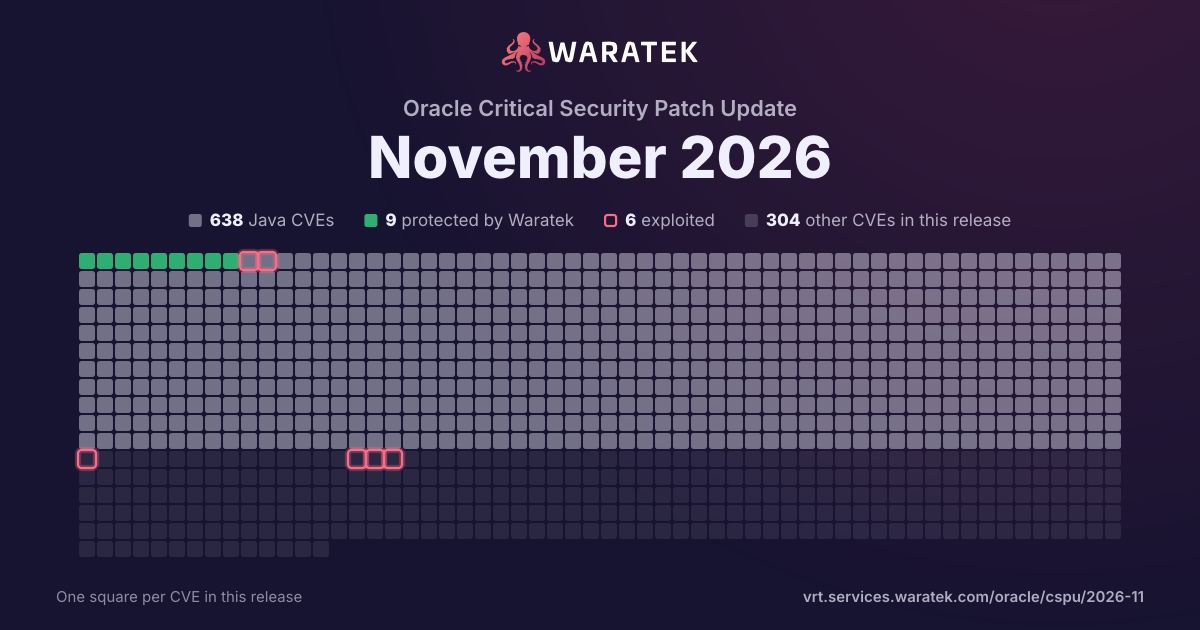
By status
9Protected by Waratek3Mitigation candidate626No exploit published15Outside Waratek scope289Not applicable
8Exploited, marked by the ring
No exploit published. For 547 of them, Oracle's security advisory is the source of public detail.
Protected by Waratek. Waratek RASP can block exploitation of these on systems that have not applied the patch yet.
Overview 48 matches · 2 protected · 0 exploited · 0 CISA KEV · 0 public PoC · 0 EPSS ≥ 0.5
Protected by Waratek
2
4.2%
Rule in development
0
0.0%
Mitigation candidate
0
0.0%
No exploit published
46
95.8%
blocked by ARMR today
2
4.2%
partly blocked
0
0.0%
not blocked
46
95.8%
not established
0
0.0%
unrecorded
0
0.0%
Exploited
0
0.0%
Working exploit published
0
0.0%
Proof of concept only
0
0.0%
Forecast only
0
0.0%
No public exploit
48
100.0%
| CVE | Severity | Published▾ | Status | Exploitation | Description |
|---|---|---|---|---|---|
| CVE-2026-68569 | High | 2026-08-25 | No exploit published | No public exploit | Improper Authentication vulnerability in Apache Tomcat meant that in some circumstances (e.g. CLIENT-CERT, SPNEGO) that a user would be authenticated even if the user did not exist in the DataSourceRealm. This issue affects Apache Tomcat: from 11.0.0-M1 through 11.0.24, from 10.1.0-M1 through 10.1.57, from 9.0.0.M1 through 9.0.120. The following versions were EOL at the time the CVE was created but are known to be affected: from 8.5.0 through 8.5.100, from 7.0.0 through 7.0.109. Other unsupported versions may also be affected. Users are recommended to upgrade to version 11.0.25, 10.1.58 or 9.0.121, which fix the issue. |
| CVE-2026-75140 | High | 2026-08-20 | No exploit published | No public exploit | jsoup through 1.23.2, fixed in commit 862ba2f, contains an uncontrolled resource consumption vulnerability in XmlTreeBuilder that allows remote attackers to exhaust JVM heap memory by supplying a deeply nested XML document with uniquely-namespaced elements. The builder copies the entire inherited namespace map on every start element, causing quadratic time and memory complexity, which attackers can exploit to trigger an OutOfMemoryError and terminate the application. |
| CVE-2026-75596 | High | 2026-08-19 | No exploit published | No public exploit | Netty is an asynchronous, event-driven network application framework. Prior to 4.1.137.Final and 4.2.17.Final, the default io.netty.handler.ssl.SniHandler constructors use the pre-handshake ClientHello aggregation path in handler/src/main/java/io/netty/handler/ssl/SslClientHelloHandler.java at io.netty.handler.ssl.SslClientHelloHandler#decode, where handshakeBuffer.clear() and writeBytes() recopy all previously received body bytes for every additional TLS record. An unauthenticated remote peer can advertise a large ClientHello and deliver its body in thousands of tiny records, causing quadratic CPU work on the event loop before the TLS handshake completes and degrading TLS handling for other clients. This issue is fixed in versions 4.1.137.Final and 4.2.17.Final. |
| CVE-2026-75595 | Critical | 2026-08-19 | No exploit published | No public exploit | Netty is an asynchronous, event-driven network application framework. Prior to 4.1.137.Fina and 4.2.17.Final, io.netty.handler.ssl.SslClientHelloHandler#decode checks the wrong offset before reading the four-byte TLS handshake header, so a ClientHello whose handshake header spans records can cause an IndexOutOfBoundsException and invoke select(ctx, null). This selects the default SslContext instead of the SNI-specific context. In deployments where per-SNI clientAuth=REQUIRE is the sole mutual TLS gate, the default SslContext uses clientAuth=NONE or clientAuth=OPTIONAL, and no application-layer certificate verification exists, an unauthenticated remote attacker can bypass the protected route's mutual TLS requirement. This issue is fixed in versions 4.1.137.Final and 4.2.17.Final. |
| CVE-2026-70907 | Medium | 2026-08-18 | No exploit published | No public exploit | Vulnerability in the Oracle Java SE, Oracle GraalVM for JDK, Oracle GraalVM Enterprise Edition product of Oracle Java SE (component: JSSE). Supported versions that are affected are Oracle Java SE: 8u501, 11.0.32, 17.0.20, 21.0.12, 25.0.4, 26.0.2; Oracle GraalVM for JDK: 17.0.20 and 21.0.12; Oracle GraalVM Enterprise Edition: 21.3.19. Easily exploitable vulnerability allows unauthenticated attacker with network access via TLS to compromise Oracle Java SE, Oracle GraalVM for JDK, Oracle GraalVM Enterprise Edition. Successful attacks of this vulnerability can result in unauthorized ability to cause a partial denial of service (partial DOS) of Oracle Java SE, Oracle GraalVM for JDK, Oracle GraalVM Enterprise Edition. Note: This vulnerability can only be exploited by supplying data to APIs in the specified Component without using Untrusted Java Web Start applications or Untrusted Java applets, such as through a web service. CVSS 3.1 Base Score 5.3 (Availability impacts). CVSS Vector: (CVSS:3.1/AV:N/AC:L/PR:N/UI:N/S:U/C:N/I:N/A:L). |
| CVE-2026-61308 | Medium | 2026-08-18 | No exploit published | No public exploit | Vulnerability in the Oracle Java SE, Oracle GraalVM for JDK, Oracle GraalVM Enterprise Edition product of Oracle Java SE (component: Networking). Supported versions that are affected are Oracle Java SE: 8u501, 11.0.32, 17.0.20, 21.0.12, 25.0.4, 26.0.2; Oracle GraalVM for JDK: 17.0.20 and 21.0.12; Oracle GraalVM Enterprise Edition: 21.3.19. Difficult to exploit vulnerability allows unauthenticated attacker with network access via HTTP to compromise Oracle Java SE, Oracle GraalVM for JDK, Oracle GraalVM Enterprise Edition. While the vulnerability is in Oracle Java SE, Oracle GraalVM for JDK, Oracle GraalVM Enterprise Edition, attacks may significantly impact additional products (scope change). Successful attacks of this vulnerability can result in unauthorized access to critical data or complete access to all Oracle Java SE, Oracle GraalVM for JDK, Oracle GraalVM Enterprise Edition accessible data. Note: This vulnerability can be exploited by using APIs in the specified Component, e.g., through a web service which supplies data to the APIs. This vulnerability also applies to Java deployments, typically in clients running sandboxed Java Web Start applications or sandboxed Java applets, that load and run untrusted code (e.g., code that comes from the internet) and rely on the Java sandbox for security. CVSS 3.1 Base Score 6.8 (Confidentiality impacts). CVSS Vector: (CVSS:3.1/AV:N/AC:H/PR:N/UI:N/S:C/C:H/I:N/A:N). |
| CVE-2026-60589 | Low | 2026-08-18 | No exploit published | No public exploit | Vulnerability in the Oracle Java SE, Oracle GraalVM for JDK, Oracle GraalVM Enterprise Edition product of Oracle Java SE (component: Security). Supported versions that are affected are Oracle Java SE: 8u501, 11.0.32, 17.0.20, 21.0.12, 25.0.4, 26.0.2; Oracle GraalVM for JDK: 17.0.20 and 21.0.12; Oracle GraalVM Enterprise Edition: 21.3.19. Difficult to exploit vulnerability allows unauthenticated attacker with network access via multiple protocols to compromise Oracle Java SE, Oracle GraalVM for JDK, Oracle GraalVM Enterprise Edition. Successful attacks of this vulnerability can result in unauthorized read access to a subset of Oracle Java SE, Oracle GraalVM for JDK, Oracle GraalVM Enterprise Edition accessible data. Note: This vulnerability can only be exploited by supplying data to APIs in the specified Component without using Untrusted Java Web Start applications or Untrusted Java applets, such as through a web service. CVSS 3.1 Base Score 3.7 (Confidentiality impacts). CVSS Vector: (CVSS:3.1/AV:N/AC:H/PR:N/UI:N/S:U/C:L/I:N/A:N). |
| CVE-2026-59949 | Medium | 2026-08-18 | No exploit published | No public exploit | yawkat LZ4 Java provides LZ4 compression for Java. Prior to 1.11.1, JNI-backed XXHash implementations fail to validate the byte array object and the off and len arguments in XXHashFactory.nativeInstance().hash32().hash(), XXHashFactory.nativeInstance().hash64().hash(), XXHashFactory.nativeInstance().newStreamingHash32().update(), and XXHashFactory.nativeInstance().newStreamingHash64().update(), allowing null arrays or oversized ranges to reach native code, read outside the Java array, and fatally terminate the JVM. This issue is fixed in version 1.11.1. |
| CVE-2026-59903 | High | 2026-08-17 | No exploit published | No public exploit | Netty is an asynchronous, event-driven network application framework. Prior to 4.1.137.Final and 4.2.17.Final, io.netty.handler.codec.http.cors.CorsHandler setVaryHeader replaces application Vary headers such as Authorization or Cookie with Origin, allowing a caching proxy or CDN to reuse authenticated responses across users and disclose sensitive information. This issue is fixed in versions 4.1.137.Final and 4.2.17.Final. |
| CVE-2026-71497 | Medium | 2026-08-06 | No exploit published | No public exploit | jsoup is a Java library for working with real-world HTML. From 1.14.3 until 1.23.1, jsoup's HTML parser could incorrectly handle a malformed tag name ending in a control character, causing the tag to acquire the parsing behavior of a different element. When a custom Safelist permits certain raw-text elements, this misparsing can cause content that should remain inert text to be emitted as active markup after serialization, potentially resulting in cross-site scripting. jsoup's built-in Safelists are not affected. This issue is fixed in version 1.23.1. |
| CVE-2026-68481 | High | 2026-08-06 | No exploit published | No public exploit | In Apache CXF's DefaultEncryptingOAuthDataProvider, revoked access tokens still decrypt successfully, and TokenIntrospectionService reports active:true. The same applies to refresh tokens. This violates the RFC stipulations that 'The authorization server MUST invalidate the token.' and 'introspection of a revoked token MUST return {"active":false}'. Users are recommended to upgrade to versions 4.2.3 or 4.1.8 or 3.6.12, which fix this issue. |
| CVE-2026-68079 | Critical | 2026-08-06 | No exploit published | No public exploit | In Apache CXF's DefaultEncryptingCodeDataProvider, a captured authorization code can be redeemed an unlimited number of times due to a flaw in the implementation of the removeCodeGrant functionality. This violates the RFC requirement that "The authorization code MUST NOT be used more than once." Users are recommended to upgrade to versions 4.2.3 or 4.1.8 or 3.6.12, which fix this issue. |
| CVE-2026-66909 | Critical | 2026-08-06 | Protected by Waratek | No public exploit | Apache CXF's JMS transport deserializes the body of any inbound JMS ObjectMessage using native Java deserialization, with no type restrictions in place. Any attacker able to place a message on the service's JMS destination can submit a malicious serialized object, leading to denial of service or, if a suitable gadget class is on the classpath, remote code execution. The fix disables ObjectMessage deserialization by default, with a configuration switch to re-enable it if needed. Users are recommended to upgrade to versions 4.2.3 or 4.1.8 or 3.6.12, which fix this issue. |
| CVE-2026-65583 | Critical | 2026-08-06 | No exploit published | No public exploit | Apache CXF’s OIDC relying-party token validation could accept self-issued ID tokens without enforcing required claim checks (issuer/subject/audience/time and sub_jwk binding), enabling authentication bypass with crafted tokens. However, note that self-issued ID tokens are not accepted by default in the validator. Users are recommended to upgrade to versions 4.2.3 or 4.1.8 or 3.6.12, which fixes this issue. |
| CVE-2026-65432 | High | 2026-08-06 | Protected by Waratek | No public exploit | Apache CXF reads a top-level WSDL through its hardened StaxUtils path, which disables XML DTDs and external entities. However, any <wsdl:import> or <xsd:import> referenced from that top-level WSDL is handed off to WSDL4J, which does not disable DOCTYPE declarations or external entities. As a result, the protections applied to the top-level document do not extend to imported documents, leaving imported WSDL/XSD content vulnerable to XML External Entity (XXE) attacks. Users are recommended to upgrade to versions 4.2.3 or 4.1.8 or 3.6.12, which fix this issue. |
| CVE-2026-64958 | High | 2026-08-06 | No exploit published | No public exploit | An incomplete fix for CVE-2026-50645 means that it is still possible to perform a denial of service attack on Apache CXF by sending a message with many attachment headers. Users are recommended to upgrade to versions 4.2.3 or 4.1.8 or 3.6.12, which fix this issue. |
| CVE-2026-63687 | Critical | 2026-08-06 | No exploit published | No public exploit | Apache CXF's JwtRequestCodeFilter copies all claims from a signed request JWT into the authorization parameter map without excluding security-sensitive parameters. A client that can produce a validly-signed request JWT (e.g., one whose client_secret is known or compromised) can thereby substitute the code_challenge, code_challenge_method, nonce, and state values that were set in the outer HTTP request, undermining PKCE integrity and OpenID Connect replay protection. Users are recommended to upgrade to versions 4.2.3 or 4.1.8 or 3.6.12, which fix this issue. |
| CVE-2026-61466 | Critical | 2026-08-06 | No exploit published | No public exploit | In Apache CXF's OAuth2 Dynamic Client Registration endpoint, the authorization server accepts and stores the `scope` value supplied in the client registration request verbatim, without validating it against an AS-defined allowlist. This could lead to a client self-assigning privileged scopes at registration time. Users are recommended to upgrade to versions 4.2.3 or 4.1.8 or 3.6.12, which fix this issue. |
| CVE-2026-57819 | High | 2026-08-06 | No exploit published | No public exploit | Apache CXF allows to set a limit on the number of form parameters in a JAX-RS message via the "maxFormParameterCount" configuration option. However, no default limit is set which may lead to denial of service attacks when processing requests with very large numbers of form parameters. Users are recommended to upgrade to versions 4.2.3 or 4.1.8 or 3.6.12, which fix this issue by using a default limit of 500 parameters. |
| CVE-2026-57818 | High | 2026-08-06 | No exploit published | No public exploit | A race condition in JCacheCodeDataProvider allows an attacker to redeem a single authorization code multiple times via concurrent requests, resulting in the issuance of multiple distinct, valid access tokens. Users are recommended to upgrade to versions 4.2.3, 4.1.8 or 3.6.12, which fix this issue. |
| CVE-2026-57817 | High | 2026-08-06 | No exploit published | No public exploit | The OpenID Connect Core 1.0 specification mandates that the RP MUST validate the `c_hash` parameter when operating in the Hybrid Flow. If an Apache CXF RP is integrated with a non-compliant or misconfigured Identity Provider (IdP) that omits the `c_hash`, the RP becomes vulnerable to Authorization Code Substitution/Injection attacks. Users are recommended to upgrade to versions 4.2.3 or 4.1.8 or 3.6.12, which fix this issue. |
| CVE-2026-54225 | High | 2026-08-06 | No exploit published | No public exploit | Apache CXF allows to control the maximum attachment size via the "attachment-max-size". Prior to Apache CXF 4.2.3 and 4.1.8 and 3.6.12, there was no default placed on this size, meaning that a denial of service attack is possible if the user doesn't explicitly set the limit. Users should update to Apache CXF 4.2.3 or 4.1.8 or 3.6.12 which fixes this problem by imposing a default attachment size limit of 50mb. |
| CVE-2026-8763 | Critical | 2026-08-03 | No exploit published | No public exploit | In Bouncy Castle for Java before 1.85, Name Constraints bypass via trailing dot in rfc822Name and URI. This issue also affects Bouncy Castle for Java LTS before 2.73.12, and Bouncy Castle for Java FIPS (BC-FJA) before bc-fips 1.0.2.7 (1.0.X series), 2.0.2 (2.0.X series) and 2.1.3 (2.1.X series). |
| CVE-2026-59651 | High | 2026-08-03 | No exploit published | No public exploit | In Bouncy Castle for Java before 1.85, BKS keystore accepts legacy version with 16-bit integrity MAC key. This issue also affects Bouncy Castle for Java LTS before 2.73.12. |
| CVE-2026-59650 | Critical | 2026-08-03 | No exploit published | No public exploit | In Bouncy Castle for Java before 1.85, MTI/A0 DH agreement exponentiates unvalidated peer value. This issue also affects Bouncy Castle for Java LTS before 2.73.12. |
| CVE-2026-59649 | High | 2026-08-03 | No exploit published | No public exploit | In Bouncy Castle for Java before 1.85, OpenPGP user-attribute subpacket length bounded only by JVM max memory. This issue also affects Bouncy Castle for Java LTS before 2.73.12, and Bouncy Castle for Java FIPS (BC-FJA) before bcpg-fips 1.0.13 (1.0.X series), 2.0.13 (2.0.X series) and 2.1.13 (2.1.X series). |
| CVE-2026-59646 | High | 2026-08-03 | No exploit published | No public exploit | In Bouncy Castle for Java before 1.85, DTLS handshake reassembler allocates buffer from unchecked 24-bit length. This issue also affects Bouncy Castle for Java LTS before 2.73.12, and Bouncy Castle for Java FIPS (BC-FJA) before bctls-fips 1.0.24 (1.0.X series), 2.0.24 (2.0.X series) and 2.1.24 (2.1.X series). |
| CVE-2026-59645 | High | 2026-08-03 | No exploit published | No public exploit | In Bouncy Castle for Java before 1.85, OER parser recurses without depth limit on self-referential IEEE 1609.2 schema. This issue also affects Bouncy Castle for Java LTS before 2.73.12, and Bouncy Castle for Java FIPS (BC-FJA) before bcutil-fips 2.0.7 (2.0.X series) and 2.1.7 (2.1.X series). |
| CVE-2026-59644 | High | 2026-08-03 | No exploit published | No public exploit | In Bouncy Castle for Java before 1.85, MLS hash-ratchet honours arbitrary 32-bit generation counter from sender. |
| CVE-2026-59643 | High | 2026-08-03 | No exploit published | No public exploit | In Bouncy Castle for Java before 1.85, OpenPGP inline-signature policy failures silently ignored. This issue also affects Bouncy Castle for Java FIPS (BC-FJA) before bcpg-fips 2.0.13. |
| CVE-2026-59642 | High | 2026-08-03 | No exploit published | No public exploit | In Bouncy Castle for Java before 1.85, CMS AuthenticatedData content not bound to MAC when authAttrs present. This issue also affects Bouncy Castle for Java LTS before 2.73.12, and Bouncy Castle for Java FIPS (BC-FJA) before bcpkix-fips 1.0.12 (1.0.X series), 2.0.12 (2.0.X series) and 2.1.12 (2.1.X series). |
| CVE-2026-59641 | High | 2026-08-03 | No exploit published | No public exploit | In Bouncy Castle for Java before 1.85, S/MIME validator trusts signer-asserted signingTime for path validation. This issue also affects Bouncy Castle for Java LTS before 2.73.12, and Bouncy Castle for Java FIPS (BC-FJA) before bcmail-fips and bcjmail-fips 1.0.7 (1.0.X series), 2.0.7 (2.0.X series) and 2.1.7 (2.1.X series). |
| CVE-2026-59640 | High | 2026-08-03 | No exploit published | No public exploit | In Bouncy Castle for Java before 1.85, OpenPGP CFB quick-check oracle active on symmetric/session-key paths. This issue also affects Bouncy Castle for Java LTS before 2.73.12, and Bouncy Castle for Java FIPS (BC-FJA) before bcpg-fips 1.0.13 (1.0.X series), 2.0.13 (2.0.X series) and 2.1.13 (2.1.X series). |
| CVE-2026-59639 | High | 2026-08-03 | No exploit published | No public exploit | In Bouncy Castle for Java before 1.85, CMS verifySignatures returns true for SignedData with zero signers. This issue also affects Bouncy Castle for Java LTS before 2.73.12, and Bouncy Castle for Java FIPS (BC-FJA) before bcpkix-fips 1.0.12 (1.0.X series), 2.0.12 (2.0.X series) and 2.1.12 (2.1.X series). |
| CVE-2026-59638 | Critical | 2026-08-03 | No exploit published | No public exploit | In Bouncy Castle for Java before 1.85, JSSE hostname verifier CN-fallback enabled by default despite documented opt-in. This issue also affects Bouncy Castle for Java LTS before 2.73.12, and Bouncy Castle for Java FIPS (BC-FJA) before bctls-fips 1.0.24 (1.0.X series), 2.0.24 (2.0.X series) and 2.1.24 (2.1.X series). |
| CVE-2026-58062 | Critical | 2026-08-03 | No exploit published | No public exploit | In Bouncy Castle for Java before 1.85, Stapled OCSP response accepted without binding to the checked certificate. This issue also affects Bouncy Castle for Java LTS before 2.73.12, and Bouncy Castle for Java FIPS (BC-FJA) before bc-fips 2.0.2 (2.0.X series) and 2.1.3 (2.1.X series). |
| CVE-2026-58061 | High | 2026-08-03 | No exploit published | No public exploit | In Bouncy Castle for Java before 1.85, CCM-family modes write plaintext to caller buffer before tag check. This issue also affects Bouncy Castle for Java LTS before 2.73.12, and Bouncy Castle for Java FIPS (BC-FJA) before bc-fips 1.0.2.7 (1.0.X series), 2.0.2 (2.0.X series) and 2.1.3 (2.1.X series). |
| CVE-2026-58060 | High | 2026-08-03 | No exploit published | No public exploit | In Bouncy Castle for Java before 1.85, HSS public-key level count unbounded, enabling huge allocation on verify. This issue also affects Bouncy Castle for Java LTS before 2.73.12, and Bouncy Castle for Java FIPS (BC-FJA) before bc-fips 2.0.2 (2.0.X series) and 2.1.3 (2.1.X series). |
| CVE-2026-58059 | High | 2026-08-03 | No exploit published | No public exploit | In Bouncy Castle for Java before 1.85, Quadratic-time escaping when stringifying X.500 distinguished names. This issue also affects Bouncy Castle for Java LTS before 2.73.12, and Bouncy Castle for Java FIPS (BC-FJA) before bc-fips 1.0.2.7 (1.0.X series), 2.0.2 (2.0.X series) and 2.1.3 (2.1.X series). |
| CVE-2026-14682 | High | 2026-08-03 | No exploit published | No public exploit | In Bouncy Castle for Java before 1.85, Possible OOM from unbounded up-front allocation on a definite-length read. This issue also affects Bouncy Castle for Java LTS before 2.73.12, and Bouncy Castle for Java FIPS (BC-FJA) before bc-fips 1.0.2.7 (1.0.X series), 2.0.2 (2.0.X series) and 2.1.3 (2.1.X series), and before bctls-fips 1.0.24. |
| CVE-2026-13506 | High | 2026-08-03 | No exploit published | No public exploit | In Bouncy Castle for Java before 1.85, Lazy ASN.1 sequence forcing resets nesting-depth guard. This issue also affects Bouncy Castle for Java LTS before 2.73.12, and Bouncy Castle for Java FIPS (BC-FJA) before bc-fips 1.0.2.7 (1.0.X series), 2.0.2 (2.0.X series) and 2.1.3 (2.1.X series). |
| CVE-2026-12860 | High | 2026-08-03 | No exploit published | No public exploit | In Bouncy Castle for Java before 1.85, RSA PKCS#1 verification skips last two hash bytes in NULL-omitted path. This issue also affects Bouncy Castle for Java LTS before 2.73.12. |
| CVE-2026-12852 | High | 2026-08-03 | No exploit published | No public exploit | In Bouncy Castle for Java before 1.85, MLS wire decoder allocates attacker-declared opaque length before bounds check. |
| CVE-2026-12817 | High | 2026-08-03 | No exploit published | No public exploit | In Bouncy Castle for Java before 1.85, OpenPGP AEAD decryption skips final tag on chunk-aligned data. This issue also affects Bouncy Castle for Java LTS before 2.73.12, and Bouncy Castle for Java FIPS (BC-FJA) before bcpg-fips 1.0.13 (1.0.X series), 2.0.13 (2.0.X series) and 2.1.13 (2.1.X series). |
| CVE-2026-12816 | High | 2026-08-03 | No exploit published | No public exploit | In Bouncy Castle for Java before 1.85, IESEngine stream-mode MAC forgery via length-dependent KDF split. This issue also affects Bouncy Castle for Java LTS before 2.73.12. |
| CVE-2026-12803 | High | 2026-08-03 | No exploit published | No public exploit | In Bouncy Castle for Java before 1.85, KCCMBlockCipher MAC does not bind nonce when AAD is absent (cross-nonce AEAD forgery). This issue also affects Bouncy Castle for Java LTS before 2.73.12. |
| CVE-2026-12802 | High | 2026-08-03 | No exploit published | No public exploit | In Bouncy Castle for Java before 1.85, CMS AuthEnvelopedData fails to enforce tag-length on decryption. This issue also affects Bouncy Castle for Java LTS before 2.73.12, and Bouncy Castle for Java FIPS (BC-FJA) before bcpkix-fips 1.0.12 (1.0.X series), 2.0.12 (2.0.X series) and 2.1.12 (2.1.X series). |
| CVE-2026-12185 | High | 2026-08-03 | No exploit published | No public exploit | In Bouncy Castle for Java before 1.85, BKS/UBER keystore allocates from untrusted lengths before integrity check. This issue also affects Bouncy Castle for Java LTS before 2.73.12. |