
Oracle Critical Security Patch Update November 2026
Released November 2026 · Oracle's advisory ↗ · ← Critical Patch Update, October 2026
942 CVEs in this release, one square each
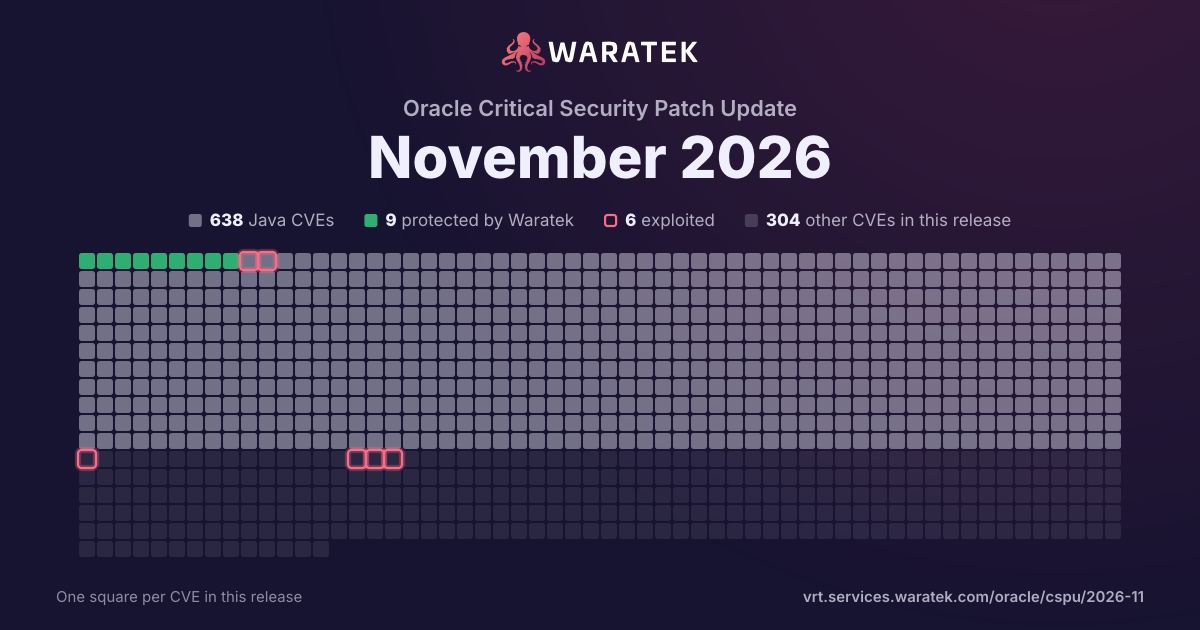
By status
8Protected by Waratek3Mitigation candidate626No exploit published16Outside Waratek scope289Not applicable
8Exploited, marked by the ring
No exploit published. For 554 of them, Oracle's security advisory is the source of public detail.
Protected by Waratek. Waratek RASP can block exploitation of these on systems that have not applied the patch yet.
Overview 22 matches · 3 in Waratek scope · 0 protected · 0 exploited · 0 CISA KEV · 0 public PoC · 0 EPSS ≥ 0.5
22matches
3in Waratek scope13.6%
0protected0.0%
0exploited0.0%
0CISA KEV0.0%
0public PoC0.0%
0EPSS ≥ 0.50.0%
Protected by Waratek
0
0.0%
Rule in development
0
0.0%
Mitigation candidate
0
0.0%
No exploit published
3
13.6%
Outside Waratek scope
0
0.0%
Not applicable
19
86.4%
Withdrawn CVE
0
0.0%
blocked by ARMR today
0
0.0%
partly blocked
0
0.0%
not blocked
22
100.0%
not established
0
0.0%
unrecorded
0
0.0%
Exploited
0
0.0%
Working exploit published
0
0.0%
Proof of concept only
22
100.0%
Forecast only
0
0.0%
No public exploit
0
0.0%
split by
peak 15 / quarter
Q2 241
Not applicable1
Medium1
not blocked1
Proof of concept only1
Q3 240
Q4 240
Q1 250
Q2 250
Q3 250
Q4 250
Q1 260
Q2 263
Not applicable3
Medium3
not blocked3
Proof of concept only3
Q3 2615
No exploit published3
Not applicable12
Medium15
not blocked15
Proof of concept only15
Q4 263
Not applicable3
Medium3
not blocked3
Proof of concept only3
Q2 24Q3 24Q4 24Q1 25Q2 25Q3 25Q4 25Q1 26Q2 26Q3 26Q4 26
| CVE | Severity | Published▾ | Status | Exploitation | Description |
|---|---|---|---|---|---|
| CVE-2026-116691 | Medium | 2026-10-27 | Not applicable | Proof of concept only | MLflow is an open source AI engineering platform for agents, large language models, and machine learning models. From 2.19.0 until 3.17.0, mlflow.crewai.autolog() records CrewAI Agent objects without consistently sanitizing nested credential-bearing values. mlflow/crewai/autolog.py::_get_agent_attributes() converts the Agent llm field to a string that includes the provider API key, while mlflow/crewai/autolog.py::_construct_full_inputs() expands the Agent object into mlflow.spanInputs. Applications can therefore send plaintext provider credentials to the MLflow trace backend or a configured OTLP destination, where trace readers can obtain them. This issue is fixed in version 3.17.0. |
| CVE-2026-67416 | Medium | 2026-10-14 | Not applicable | Proof of concept only | RabbitMQ is a messaging and streaming broker. From 4.0.0 until 4.0.24, 4.1.15, 4.2.10, and 4.3.4, the optimized AMQP 1.0 server_mode parser in deps/amqp10_common/src/amqp10_binary_parser.erl matches the textual prefixes of symbolic data, sequence, and value body descriptors without verifying their encoded symbol lengths. An authenticated AMQP 1.0 publisher with write permission can submit a well-formed unknown descriptor that begins with a registered body descriptor, and RabbitMQ misclassifies and stores the bytes as a standard body section. Strict AMQP 1.0 consumers can terminate while decoding the stored entry. For bodies misclassified as data, AMQP 0-9-1 or other cross-protocol conversion performs full body decoding and can terminate the consumer protocol process, with acknowledgement-required delivery permitting repeated failures. Sequence and value classifications are normally transported as opaque encoded payloads on that conversion path. The broker remains alive, and the issue does not bypass routing or authorization. This issue is fixed in versions 4.0.24, 4.1.15, 4.2.10, and 4.3.4. |
| CVE-2026-67414 | Medium | 2026-10-14 | Not applicable | Proof of concept only | RabbitMQ is a messaging and streaming broker. From 4.0.0 until 4.0.24, 4.1.15, 4.2.10, and 4.3.4, deps/amqp10_common/src/amqp10_binary_parser.erl materializes each element of AMQP 1.0 arrays whose shared constructor has zero width, while limiting only the number of elements in each array and not the aggregate arrays in a frame. After completing SASL authentication, a low-privilege client can send an ordinary frame containing many individually permitted arrays, causing a small frame to expand into a very large reader-process heap before later frame validation or authorization. Because deps/rabbit/src/rabbit_amqp_reader.erl clears the pre-authentication max_heap_size guard after login, repeated or concurrent frames can trigger the node-wide memory alarm, block publishers, or exhaust broker memory. This issue is fixed in versions 4.0.24, 4.1.15, 4.2.10, and 4.3.4. |
| CVE-2026-88815 | Medium | 2026-09-28 | Not applicable | Proof of concept only | DBI versions before 1.654 for Perl incorrectly treat numeric values as strings in sql_type_cast_svpv. When casting to SQL_NUMERIC, sql_type_cast_svpv passes the string pointer and length of the SV to grok_number without stringifying it first. An integer (IV) or floating-point (NV) value has no valid string pointer, so grok_number reads from an invalid address, triggering a segmentation fault. This is reachable in Perl using the sql_type_cast function: my $num = 42; DBI::sql_type_cast( $num, DBI::SQL_NUMERIC, 0 ); |
| CVE-2026-102270 | Medium | 2026-09-28 | Not applicable | Proof of concept only | PyJWT is a Python implementation of JSON Web Token standards. Prior to 2.14.0, PyJWT is_pem_format is affected because lazy PEM regular expression backtracks extensively. This occurs when a certificate-like input contains repeated BEGIN markers without a matching END marker. As a result, is_pem_format performs unbounded backtracking while searching for a PEM end marker. Consequently, an attacker can cause intensive CPU consumption. This issue is fixed in version 2.14.0. |
| CVE-2026-102269 | Medium | 2026-09-28 | Not applicable | Proof of concept only | PyJWT is a Python implementation of JSON Web Token standards. Prior to 2.14.0, PyJWT signature segment is affected because signature segment decoding accepts characters outside the canonical Base64URL representation. This occurs when non-Base64URL characters are appended to a valid compact JWS signature segment. As a result, base64url_decode produces the same signature bytes for different serialized segments. Consequently, raw-token revocation checks can fail to recognize an equivalent modified token. This issue is fixed in version 2.14.0. |
| CVE-2026-102265 | Medium | 2026-09-28 | Not applicable | Proof of concept only | PyJWT is a Python implementation of JSON Web Token standards. From 2.13.0 until 2.14.0, PyJWS._load in jwt/api_jws.py is affected because parser catches ValueError but not RecursionError. This occurs when a deeply nested token header reaches json.loads. As a result, RecursionError escapes the documented PyJWT error hierarchy. Consequently, an unauthenticated malformed token can cause a request-level failure and HTTP 500. This issue is fixed in version 2.14.0. |
| CVE-2026-67415 | Medium | 2026-09-25 | Not applicable | Proof of concept only | RabbitMQ is a messaging and streaming broker. From 4.2.0 until 4.2.9 and 4.3.3, the Shovel parameter parser converted attacker-controlled runtime parameter values into non-garbage-collected Erlang atoms before bounding them or checking a fixed allowlist. Exploitation requires network access to the Management HTTP API, valid credentials with both the management and policymaker tags, permission to set Shovel runtime parameters on a vhost, and the rabbitmq_shovel and rabbitmq_shovel_management plugins to be enabled. The attacker can exhaust the node-wide atom table and deny service, and malicious parameters are stored durably and reparsed when workers start, so atom pressure can recur after restart without a live attacker connection. This issue is fixed in versions 4.2.9 and 4.3.3. |
| CVE-2026-67413 | Medium | 2026-09-25 | Not applicable | Proof of concept only | RabbitMQ is a messaging and streaming broker. From 4.0.0 until 4.0.23, 4.1.14, 4.2.9, and 4.3.3, the optional rabbitmq_jms_topic_exchange plugin's x-jms-topic exchange accepted a client-controlled rjms_erlang_selector binding expression whose LIKE evaluator expanded percent and underscore wildcards into overlapping PCRE fragments. It executed those fragments with raw re:run/3 without match or recursion limits, allowing an authenticated tenant that can bind and publish to consume broker scheduler CPU and deny service with pathological selectors. This issue is fixed in versions 4.0.23, 4.1.14, 4.2.9, and 4.3.3. |
| CVE-2026-67412 | Medium | 2026-09-25 | Not applicable | Proof of concept only | RabbitMQ is a messaging and streaming broker. From 3.13.0 until 4.3.3, 4.2.9 , 4.1.14, 4.0.24, and 3.13.18, Federation upstream in RabbitMQ skips vhost authorization allowing cross-vhost message access. what the bug lets you do. A policymaker on one vhost reads and drains messages out of another vhost it has no permission on. With the default ack-mode the source messages are consumed (deleted), not copied. Why that should not 1. Federation validates the upstream URI without any vhost-access Cross-vhost message read/drain from a per-vhost policymaker, breaking vhost tenancy This issue is fixed in versions 4.3.3, 4.2.9 , 4.1.14, 4.0.24, and 3.13.18. |
| CVE-2026-67411 | Medium | 2026-09-25 | Not applicable | Proof of concept only | RabbitMQ is a messaging and streaming broker. From 3.13.0 until 3.13.18, 4.0.23, 4.1.14, 4.2.9, and 4.3.3, native MQTT and MQTT over WebSocket behind a trusted PROXY Protocol frontend could lose the proxy-derived client address before the MQTT authentication path checked loopback_users, causing the frontend-to-broker address to be treated as loopback. An attacker who can reach the trusted frontend and has valid credentials for a loopback-restricted account can therefore bypass the source-address restriction; the issue does not bypass password authentication. This issue is fixed in versions 3.13.18, 4.0.23, 4.1.14, 4.2.9, and 4.3.3. |
| CVE-2026-67242 | Medium | 2026-09-25 | Not applicable | Proof of concept only | RabbitMQ is a messaging and streaming broker. From 4.2.0 until 4.2.9 and 4.3.3, OAuth2 isinteger(Exp) guard skips token-expiry checks for float exp. validatetokenexpiry/1 (lines 208-214) and expirytimestamp/1 (138-144) both guard with 'when isinteger(Exp)' and fall through to ok/never for float values. josejwt:verify validates only the signature, not exp. With float exp, no expiry validation occurs anywhere in the If the IdP emits exp as a JSON float (RFC 7519 permits fractional NumericDate), both the login-time expiry check and the mid-connection disconnect timer are silently skipped , an already-expired token is accepted, and connections never time OAuth2 backend enabled IdP emits float exp (uncommon; mainstream IdPs emit integers) Attacker possesses a previously-valid signed. This issue is fixed in versions 4.2.9 and 4.3.3. |
| CVE-2026-67241 | Medium | 2026-09-25 | Not applicable | Proof of concept only | RabbitMQ is a messaging and streaming broker. From 4.2.0 until 4.2.9 and 4.3.3, AMQP 1.0 management exchange.declare skips alternate-exchange permission check. pUT /exchanges/:name (lines 192-240) checks only configure on the declared exchange and passes XArgs straight to rabbitexchange:declare/7. It omits the checkreadpermitted(X) + checkwritepermitted(AE) that rabbitchannel.erl:2540-2548 enforces for the alternate-exchange argument on the AMQP 0-9-1 path. The same file already implements the analogous DLX check for queues (lines 708-719), confirming this is a missing-check bug rather than intentional A user with only configure on exchange X can route X's unroutable messages into an alternate exchange they have no write permission AMQP 1.0 enabled (default in RabbitMQ 4.x) Attacker has configure on at least one exchange but lacks write on the target. This issue is fixed in versions 4.2.9 and 4.3.3. |
| CVE-2026-67226 | Medium | 2026-09-25 | Not applicable | Proof of concept only | RabbitMQ is a messaging and streaming broker. From 4.0.0 until 4.0.22 and 4.1.14 and 4.2.7, Admin-only atom exhaustion: PUT /api/users tags list. settags/2 maps rabbitdatacoercion:toatom/1 over the user's tags list. The 20 MB management body limit fits ~3-4M short tag strings. An administrator can crash the node in a single request by creating a user (or importing definitions) with ~1M unique tag administrator. This issue is fixed in versions 4.0.22 and 4.1.14 and 4.2.7. |
| CVE-2026-61837 | Medium | 2026-09-25 | Not applicable | Proof of concept only | RabbitMQ is a messaging and streaming broker. From 4.0.0 until 4.3.3, 4.2.9, 4.1.14, and 4.0.23, AMQP 1.0 management GET /bindings exposes full binding topology to any authenticated AMQP user without resource/management permission checks. the AMQP 1.0 HTTP-over-AMQP management endpoint GET /bindings (the rabbitamqpmanagement handler) enumerates bindings between an arbitrary source exchange and destination queue/exchange in the caller's virtual host without performing any resource-level permission check. Unlike every sibling operation in the same module (which call checkresourceaccess / bindingchecks), the GET handler ignores the authenticated User and returns the binding list unchanged. As a result, any authenticated AMQP 1.0 client that can open a management link pair , including users with no management/monitoring/policymaker/administrator tag , can enumerate the complete binding topology (source exchanges, destination queues/exchanges, routing keys, and binding arguments) of the virtual host they can access. The equivalent HTTP management API (GET /api/bindings) Confidentiality impact: a non-management AMQP 1.0 user can enumerate the complete routing topology of any virtual host it can connect to , every (source exchange, destination queue/exchange, routing key, binding arguments) This issue is fixed in versions 4.3.3, 4.2.9, 4.1.14, and 4.0.23. |
| CVE-2026-83557 | Medium | 2026-09-01 | No exploit published | Proof of concept only | DefaultBaseTypeLimitingValidator is the PolymorphicTypeValidator applied automatically whenever @JsonTypeInfo is used without an explicitly configured custom validator. It denies polymorphic resolution only for a fixed set of "unsafe base types", and its isSafeSubType method returns true unconditionally for every base type outside that set. java.lang.Comparable was absent from the list despite being implemented by a very large fraction of JDK and application classes, comparable in breadth to java.io.Serializable, which is on the list for that reason. An application declaring an @JsonTypeInfo-annotated property or class with Comparable as its base type, and no custom PolymorphicTypeValidator, will accept a type identifier for essentially any class implementing Comparable. This yields an attacker-controlled object instantiation primitive; a demonstrated case constructs a java.io.File for an arbitrary attacker-chosen path, which becomes path-traversal-adjacent if the application subsequently calls path-sensitive methods on the value. No class implementing Comparable has been identified that yields code execution through deserialization alone. Global Default Typing via activateDefaultTyping is not affected, because that method structurally requires an explicit PolymorphicTypeValidator argument. This affects com.fasterxml.jackson.core:jackson-databind from 2.11.0 before 2.18.10, from 2.19.0 before 2.21.6, and from 2.22.0 before 2.22.2, and tools.jackson.core:jackson-databind from 3.0.0 before 3.1.6 and from 3.2.0 before 3.2.2. Users should upgrade to 2.18.10, 2.21.6, 2.22.2, 3.1.6, or 3.2.2. |
| CVE-2026-19032 | Medium | 2026-09-01 | No exploit published | Proof of concept only | jackson-databind's deserializer for java.nio.file.Path resolves an attacker-supplied URI without restricting the URI scheme. In JDKFromStringDeserializer.NioPathHelper.deserialize, a string bound from untrusted JSON is passed to new URI(value) and then to Path.of(uri). When that throws FileSystemNotFoundException, the code enumerates ServiceLoader<FileSystemProvider> and calls provider.getPath(uri) on the first provider whose scheme matches the attacker-chosen scheme. Untrusted JSON can therefore select and drive an arbitrary registered FileSystemProvider during readValue under a default JsonMapper, and forces provider class loading at the same time. With only the JDK built-in providers (file, jar/zipfs) present, the resolved path is inert and no mount or network I/O occurs; further impact requires a side-effecting third-party FileSystemProvider on the classpath. This affects com.fasterxml.jackson.core:jackson-databind from 2.8.0 before 2.18.10, from 2.19.0 before 2.21.6, and from 2.22.0 before 2.22.2, and tools.jackson.core:jackson-databind from 3.0.0 before 3.1.6 and from 3.2.0 before 3.2.2. Users should upgrade to 2.18.10, 2.21.6, 2.22.2, 3.1.6, or 3.2.2. Binding java.nio.file.Path from untrusted JSON should be avoided regardless of version. |
| CVE-2026-18401 | Medium | 2026-08-04 | No exploit published | Proof of concept only | The non-blocking (asynchronous) JSON parser in jackson-core does not enforce the maxNumberLength constraint defined in StreamReadConstraints (default: 1000 characters). An attacker able to submit JSON to an application that uses the async parser API can supply a number token of arbitrary length, leading to excessive memory allocation and potential CPU exhaustion, resulting in a denial of service. The synchronous parser enforces this limit correctly, so the constraint is applied inconsistently depending on which parsing API the application uses. Root cause: the async parsing path in NonBlockingUtf8JsonParserBase and related classes never invokes the number length validation methods. Number parsing methods such as _finishNumberIntegralPart() accumulate digits into the TextBuffer without any length check, then call _valueComplete() to finalize the token. _valueComplete() does not call resetInt() or resetFloat(), which are the methods in ParserBase where validateIntegerLength() and validateFPLength() are performed. Because that validation step is skipped, maxNumberLength is never enforced on the async code path. Impact: an attacker sending a JSON document containing an arbitrarily long number to an application using the async parser (for example a Spring WebFlux or other reactive application) can cause unbounded allocation in the TextBuffer and an OutOfMemoryError. If the application subsequently calls getBigIntegerValue() or getDecimalValue(), the JVM may additionally be tied up in O(n^2) BigInteger parsing, causing CPU-based denial of service. No privileges or user interaction beyond the ability to submit data for parsing are required. This issue affects com.fasterxml.jackson.core:jackson-core from version 2.15.0 through 2.18.5 and from 2.19.0 through 2.21.0, and tools.jackson.core:jackson-core from 3.0.0 through 3.0.x. Versions prior to 2.15.0 are not affected, because StreamReadConstraints -- which defines the maxNumberLength setting -- was first introduced in jackson-core 2.15.0, so no such constraint exists to be bypassed in earlier releases. Note that GHSA-72hv-8253-57qq records the lower bound of the affected 2.x range as 2.0.0. |
| CVE-2026-3198 | Medium | 2026-06-02 | Not applicable | Proof of concept only | MLflow 3.9.0 with basic-auth (`--app-name basic-auth`) fails to enforce authorization checks for multiple Gateway API 'list' endpoints. Specifically, the `BEFORE_REQUEST_HANDLERS` dictionary in `mlflow/server/auth/__init__.py` does not include entries for `ListGatewaySecretInfos`, `ListGatewayEndpoints`, and `ListGatewayModelDefinitions`. This allows any authenticated user, regardless of their assigned permissions, to enumerate all gateway secrets, endpoints, and model definitions. This vulnerability exposes sensitive information, such as API keys, endpoint configurations, and proprietary model definitions, to unauthorized users. |
| CVE-2026-33637 | Medium | 2026-05-19 | Not applicable | Proof of concept only | Faraday is an HTTP client library abstraction layer that provides a common interface over many adapters. Versions 2.0.0 through 2.14.1 still allow protocol-relative host override when the request target is passed as a URI object (rather than a String) to Faraday::Connection#build_exclusive_url. This bypasses the February 2026 fix for GHSA-33mh-2634-fwr2 and enables off-host request forgery: a request built from a fixed-base Faraday::Connection can be redirected to an attacker-controlled host, forwarding connection-scoped values such as Authorization headers and default query parameters. This issue has been fixed in version 2.14.3. |
| CVE-2026-7168 | Medium | 2026-05-13 | Not applicable | Proof of concept only | Successfully using libcurl to do a transfer over a specific HTTP proxy (`proxyA`) with **Digest** authentication and then changing the proxy host to a second one (`proxyB`) for a second transfer, reusing the same handle, makes libcurl wrongly pass on the `Proxy-Authorization:` header field meant for `proxyA`, to `proxyB`. |
| CVE-2024-38949 | Medium | 2024-06-26 | Not applicable | Proof of concept only | Heap Buffer Overflow vulnerability in Libde265 v1.0.15 allows attackers to crash the application via crafted payload to display444as420 function at sdl.cc |