
Oracle Critical Security Patch Update November 2026
Released November 2026 · Oracle's advisory ↗ · ← Critical Patch Update, October 2026
942 CVEs in this release, one square each
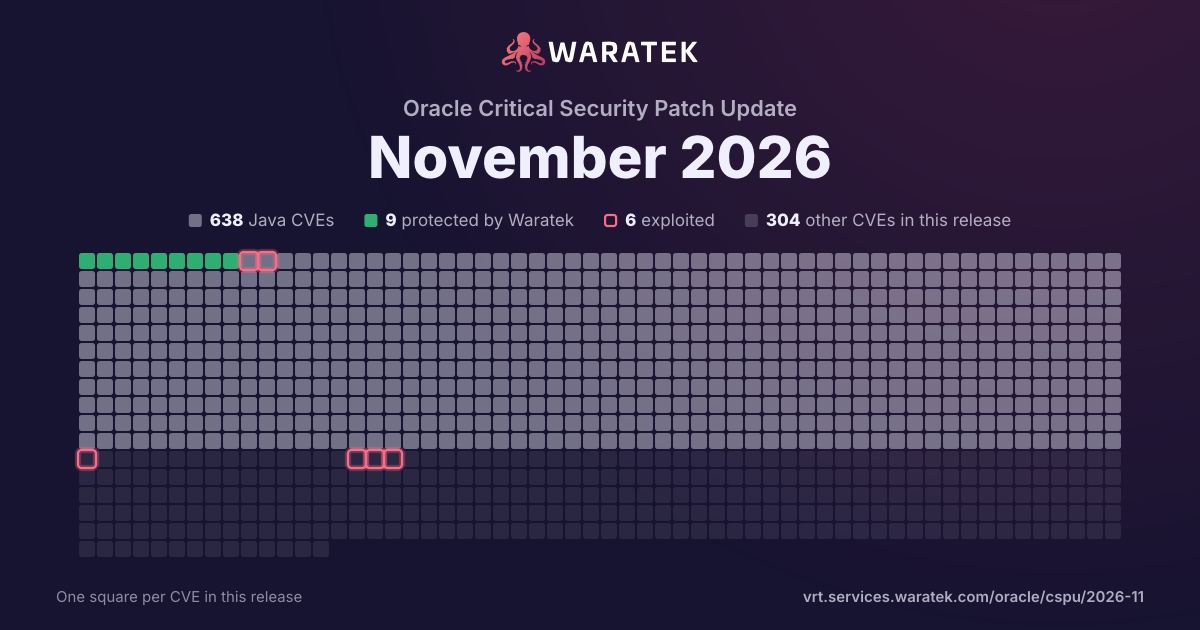
By status
9Protected by Waratek3Mitigation candidate626No exploit published15Outside Waratek scope289Not applicable
8Exploited, marked by the ring
No exploit published. For 547 of them, Oracle's security advisory is the source of public detail.
Protected by Waratek. Waratek RASP can block exploitation of these on systems that have not applied the patch yet.
Overview 7 matches · 3 in Waratek scope · 2 protected · 0 exploited · 0 CISA KEV · 1 public PoC · 1 EPSS ≥ 0.5
7matches
3in Waratek scope42.9%
2protected28.6%
0exploited0.0%
0CISA KEV0.0%
1public PoC14.3%
1EPSS ≥ 0.514.3%
Protected by Waratek
2
28.6%
Rule in development
0
0.0%
Mitigation candidate
0
0.0%
No exploit published
1
14.3%
Outside Waratek scope
0
0.0%
Not applicable
4
57.1%
Withdrawn CVE
0
0.0%
blocked by ARMR today
2
28.6%
partly blocked
0
0.0%
not blocked
5
71.4%
not established
0
0.0%
unrecorded
0
0.0%
Exploited
0
0.0%
Working exploit published
0
0.0%
Proof of concept only
7
100.0%
Forecast only
0
0.0%
No public exploit
0
0.0%
split by
peak 1 / quarter
Q1 221
Protected by Waratek1
Critical1
blocked by ARMR today1
Proof of concept only1
Q2 221
Protected by Waratek1
Critical1
blocked by ARMR today1
Proof of concept only1
Q3 220
Q4 220
Q1 230
Q2 230
Q3 231
Not applicable1
High1
not blocked1
Proof of concept only1
Q4 230
Q1 240
Q2 241
Not applicable1
Medium1
not blocked1
Proof of concept only1
Q3 240
Q4 241
Not applicable1
High1
not blocked1
Proof of concept only1
Q1 251
Not applicable1
High1
not blocked1
Proof of concept only1
Q2 251
No exploit published1
High1
not blocked1
Proof of concept only1
Q2 22Q4 22Q2 23Q4 23Q2 24Q4 24Q2 25
| CVE | Severity | Published▾ | Status | Exploitation | Description |
|---|---|---|---|---|---|
| CVE-2025-48734 | High | 2025-05-28 | No exploit published | Proof of concept only | Improper Access Control vulnerability in Apache Commons. A special BeanIntrospector class was added in version 1.9.2. This can be used to stop attackers from using the declared class property of Java enum objects to get access to the classloader. However this protection was not enabled by default. PropertyUtilsBean (and consequently BeanUtilsBean) now disallows declared class level property access by default. Releases 1.11.0 and 2.0.0-M2 address a potential security issue when accessing enum properties in an uncontrolled way. If an application using Commons BeanUtils passes property paths from an external source directly to the getProperty() method of PropertyUtilsBean, an attacker can access the enum’s class loader via the “declaredClass” property available on all Java “enum” objects. Accessing the enum’s “declaredClass” allows remote attackers to access the ClassLoader and execute arbitrary code. The same issue exists with PropertyUtilsBean.getNestedProperty(). Starting in versions 1.11.0 and 2.0.0-M2 a special BeanIntrospector suppresses the “declaredClass” property. Note that this new BeanIntrospector is enabled by default, but you can disable it to regain the old behavior; see section 2.5 of the user's guide and the unit tests. This issue affects Apache Commons BeanUtils 1.x before 1.11.0, and 2.x before 2.0.0-M2.Users of the artifact commons-beanutils:commons-beanutils 1.x are recommended to upgrade to version 1.11.0, which fixes the issue. Users of the artifact org.apache.commons:commons-beanutils2 2.x are recommended to upgrade to version 2.0.0-M2, which fixes the issue. |
| CVE-2025-0725 | High | 2025-02-05 | Not applicable | Proof of concept only | When libcurl is asked to perform automatic gzip decompression of content-encoded HTTP responses with the `CURLOPT_ACCEPT_ENCODING` option, **using zlib 1.2.0.3 or older**, an attacker-controlled integer overflow would make libcurl perform a buffer overflow. |
| CVE-2024-41311 | High | 2024-10-15 | Not applicable | Proof of concept only | In Libheif 1.17.6, insufficient checks in ImageOverlay::parse() decoding a heif file containing an overlay image with forged offsets can lead to an out-of-bounds read and write. |
| CVE-2024-38949 | Medium | 2024-06-26 | Not applicable | Proof of concept only | Heap Buffer Overflow vulnerability in Libde265 v1.0.15 allows attackers to crash the application via crafted payload to display444as420 function at sdl.cc |
| CVE-2023-35945 | High | 2023-07-13 | Not applicable | Proof of concept only | Envoy is a cloud-native high-performance edge/middle/service proxy. Envoy’s HTTP/2 codec may leak a header map and bookkeeping structures upon receiving `RST_STREAM` immediately followed by the `GOAWAY` frames from an upstream server. In nghttp2, cleanup of pending requests due to receipt of the `GOAWAY` frame skips de-allocation of the bookkeeping structure and pending compressed header. The error return [code path] is taken if connection is already marked for not sending more requests due to `GOAWAY` frame. The clean-up code is right after the return statement, causing memory leak. Denial of service through memory exhaustion. This vulnerability was patched in versions(s) 1.26.3, 1.25.8, 1.24.9, 1.23.11. |
| CVE-2022-23457 | Critical | 2022-04-25 | Protected by Waratek | Proof of concept only | ESAPI (The OWASP Enterprise Security API) is a free, open source, web application security control library. Prior to version 2.3.0.0, the default implementation of `Validator.getValidDirectoryPath(String, String, File, boolean)` may incorrectly treat the tested input string as a child of the specified parent directory. This potentially could allow control-flow bypass checks to be defeated if an attack can specify the entire string representing the 'input' path. This vulnerability is patched in release 2.3.0.0 of ESAPI. As a workaround, it is possible to write one's own implementation of the Validator interface. However, maintainers do not recommend this. |
| CVE-2022-23305 | Critical | 2022-01-18 | Protected by Waratek | Proof of concept only | By design, the JDBCAppender in Log4j 1.2.x accepts an SQL statement as a configuration parameter where the values to be inserted are converters from PatternLayout. The message converter, %m, is likely to always be included. This allows attackers to manipulate the SQL by entering crafted strings into input fields or headers of an application that are logged allowing unintended SQL queries to be executed. Note this issue only affects Log4j 1.x when specifically configured to use the JDBCAppender, which is not the default. Beginning in version 2.0-beta8, the JDBCAppender was re-introduced with proper support for parameterized SQL queries and further customization over the columns written to in logs. Apache Log4j 1.2 reached end of life in August 2015. Users should upgrade to Log4j 2 as it addresses numerous other issues from the previous versions. |