
Oracle Critical Security Patch Update November 2026
Released November 2026 · Oracle's advisory ↗ · ← Critical Patch Update, October 2026
942 CVEs in this release, one square each
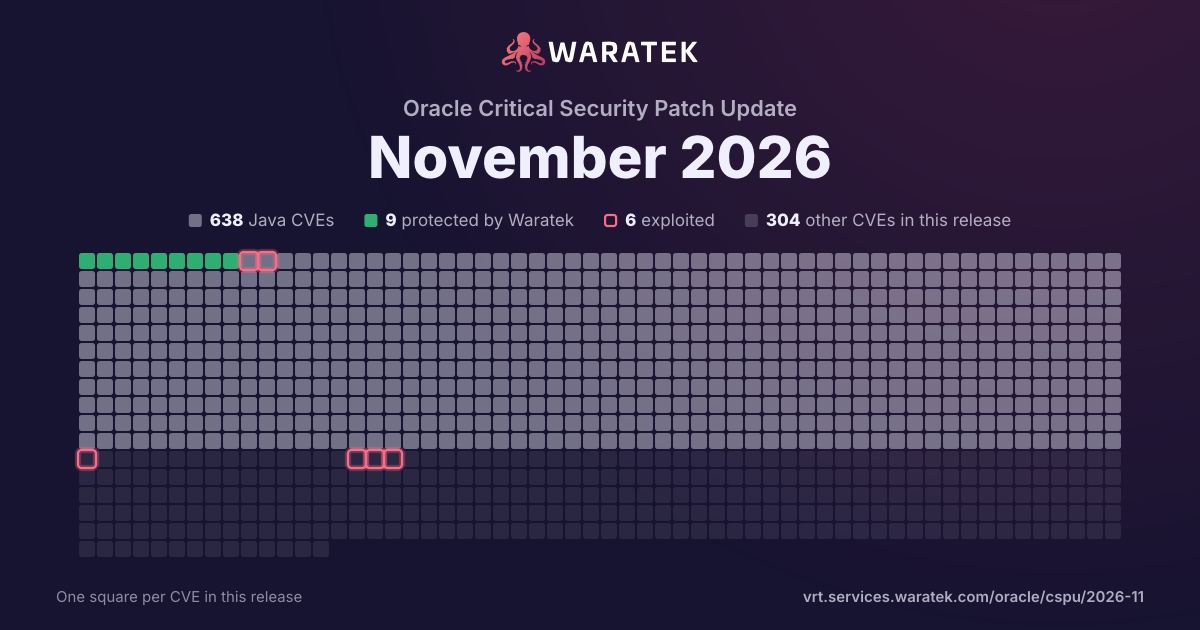
By status
9Protected by Waratek3Mitigation candidate626No exploit published15Outside Waratek scope289Not applicable
8Exploited, marked by the ring
No exploit published. For 547 of them, Oracle's security advisory is the source of public detail.
Protected by Waratek. Waratek RASP can block exploitation of these on systems that have not applied the patch yet.
Overview 27 matches · 0 in Waratek scope · 0 protected · 0 exploited · 0 CISA KEV · 1 public PoC · 0 EPSS ≥ 0.5
27matches
0in Waratek scope0.0%
0protected0.0%
0exploited0.0%
0CISA KEV0.0%
1public PoC3.7%
0EPSS ≥ 0.50.0%
Protected by Waratek
0
0.0%
Rule in development
0
0.0%
Mitigation candidate
0
0.0%
No exploit published
0
0.0%
Outside Waratek scope
0
0.0%
Not applicable
27
100.0%
Withdrawn CVE
0
0.0%
blocked by ARMR today
0
0.0%
partly blocked
0
0.0%
not blocked
27
100.0%
not established
0
0.0%
unrecorded
0
0.0%
Exploited
0
0.0%
Working exploit published
0
0.0%
Proof of concept only
27
100.0%
Forecast only
0
0.0%
No public exploit
0
0.0%
split by
peak 27 / month
Oct 26
| CVE | Severity | Published▾ | Status | Exploitation | Description |
|---|---|---|---|---|---|
| CVE-2026-116691 | Medium | 2026-10-27 | Not applicable | Proof of concept only | MLflow is an open source AI engineering platform for agents, large language models, and machine learning models. From 2.19.0 until 3.17.0, mlflow.crewai.autolog() records CrewAI Agent objects without consistently sanitizing nested credential-bearing values. mlflow/crewai/autolog.py::_get_agent_attributes() converts the Agent llm field to a string that includes the provider API key, while mlflow/crewai/autolog.py::_construct_full_inputs() expands the Agent object into mlflow.spanInputs. Applications can therefore send plaintext provider credentials to the MLflow trace backend or a configured OTLP destination, where trace readers can obtain them. This issue is fixed in version 3.17.0. |
| CVE-2026-105482 | High | 2026-10-23 | Not applicable | Proof of concept only | A flaw in Node.js DNS resolution allows hostnames containing a NUL byte to be silently truncated by the dns.resolve*() functions and dns.reverse(). This is an incomplete fix of CVE-2026-48930, which only covered dns.lookup() and the net/tls host options. Because the name is passed to c-ares as a C string, resolving attacker.example\0.trusted.example queries attacker.example and returns its records without any error. Applications that validate a hostname, for example against a domain allowlist, and then resolve it with dns.resolve*() can act on records for a different name than the one they validated. This vulnerability affects Node.js 26.x, 24.x, and 22.x. |
| CVE-2026-94266 | High | 2026-10-20 | Not applicable | Proof of concept only | libcurl could accidentally return a URL for `curl_easy_getinfo()`'s `CURLINFO_EFFECTIVE_URL` option containing credentials, even though neither the URL provided to libcurl nor the redirected URL did. |
| CVE-2026-94265 | Critical | 2026-10-20 | Not applicable | Proof of concept only | When processing an HTTP redirect to a URL containing userinfo (a `username:password` component), curl might erroneously retain and re-transmit the original host's HTTP Negotiate authentication state. Consequently, a malicious server can trigger a redirect containing arbitrary userinfo to force curl to send a freshly minted Kerberos ticket—generated using the ambient identity of the client process to an untrusted third-party host, effectively bypassing the domain-scoping restrictions normally enforced by the absence of `--location-trusted`. |
| CVE-2026-92391 | High | 2026-10-20 | Not applicable | Proof of concept only | A deeply nested multipart MIME structure constructed via the public API causes a stack overflow in libcurl during normal cleanup operations. An excessive recursion depth within `curl_mime_free` leads to unbounded stack frame allocation during structure traversal, ultimately crashing the host process. |
| CVE-2026-92390 | High | 2026-10-20 | Not applicable | Proof of concept only | When invoked with `--remote-header-name` (`-J`), curl fails to preserve its documented anti-clobbering protection if an intermediate 103 Early Hints response precedes the final HTTP response, or if an `ETag` header is processed before `Content-Disposition` under `--etag-save`. This flaw allows an HTTP(S) server to overwrite an existing local file specified in the `Content-Disposition` header despite the presence of the `-J` non-overwrite constraint. |
| CVE-2026-92389 | High | 2026-10-20 | Not applicable | Proof of concept only | libcurl's TFTP state machine fails to validate state transitions against the requested transfer direction, accepting opening server responses for both reads and writes interchangeably. A malicious TFTP server can respond to a download request in a way that forces the client into transmit mode, prompting libcurl to consume and transmit data from the handle's persistent `CURLOPT_READDATA` pointer - including data remaining from unrelated prior operations, such as an HTTP POST request executed on a reused handle. |
| CVE-2026-92388 | Critical | 2026-10-20 | Not applicable | Proof of concept only | When an FTP wildcard `LIST` operation fails, libcurl omits the restoration path meant for successful listings, leaving the write callback set to the internal listing parser and the write callback data pointing directly to the easy handle. Subsequent reuse of this handle triggers an immediate crash, and cloning it via `curl_easy_duphandle()` copies this corrupted state into the duplicate. If the original handle is subsequently freed, executing a transfer on the cloned handle causes a heap use-after-free read against the dangling handle reference; alternatively, reusing the original or cloned handle while changing only `CURLOPT_WRITEDATA` (and omitting `CURLOPT_WRITEFUNCTION`) results in type confusion, forcing the internal parser to interpret incoming server response bytes into memory at the application-supplied write data pointer. |
| CVE-2026-92387 | High | 2026-10-20 | Not applicable | Proof of concept only | By permanently omitting the final control-response line, a malicious FTP, IMAP, POP3, or SMTP server can exploit libcurl and completely bypass its configured transfer timeout mechanism, indefinitely blocking all concurrent transfers bound to the same multi-handle. |
| CVE-2026-92386 | High | 2026-10-20 | Not applicable | Proof of concept only | When writing a long cookie name and value to a Netscape cookie jar, a remote HTTP server can make `curl` write a record that exceeds its line-length parsing limit. Consequently, any subsequent `curl` invocation reading from that same cookie jar using `--cookie` silently aborts parsing prematurely upon encountering the too long line, ignoring all subsequent valid cookies in the file. |
| CVE-2026-87866 | Critical | 2026-10-20 | Not applicable | Proof of concept only | When built with wolfSSL, curl can successfully validate a pinned public key hash against a key the TLS peer does not possess. During the TLS handshake, wolfSSL validates the connection, but curl's subsequent re-parsing of the same certificate - tricked by a manipulated validity length field - extracts and matches a different embedded key, incorrectly authorizing the pinned public key. |
| CVE-2026-87865 | High | 2026-10-20 | Not applicable | Proof of concept only | When libcurl uses libssh2 with a hashed `known_hosts` file, an unrelated initial entry can cause host key validation to report a key *mismatch* as a *missing* key to the `CURLOPT_SSH_KEYFUNCTION` callback. |
| CVE-2026-87864 | High | 2026-10-20 | Not applicable | Proof of concept only | Enabling `CURLOPT_CRLF` causes curl to advertise the raw input byte count in the `IMAP APPEND {N}` literal while transmitting line-ending expanded data. The server reads only $N$ bytes for the payload, causing the remaining overflow bytes to be interpreted and executed as pipelined IMAP commands within the authenticated session. |
| CVE-2026-87863 | High | 2026-10-20 | Not applicable | Proof of concept only | An authenticated HTTPS origin can supply an HSTS `max-age` value that the parser accepts, but time serialization later fails to process. On 64-bit systems, extreme max-age values compute an absolute expiry within standard time integer limits that exceeds calendar time structure bounds. During cache saves, the original HSTS file is truncated before writing a temporary replacement; when serialization fails, the temporary file is deleted, leaving an empty or partial cache. Because the save error is silently ignored during cleanup, curl exits successfully despite the data loss. |
| CVE-2026-87862 | High | 2026-10-20 | Not applicable | Proof of concept only | Importing a `includeSubDomains` parent HSTS entry before a longer-lived child entry, silently drops the child. Consequently, when the parent expires, the child's valid HSTS policy is lost, causing curl to issue unencrypted HTTP requests rather than upgrading to HTTPS. |
| CVE-2026-87861 | Critical | 2026-10-20 | Not applicable | Proof of concept only | When using ambient user credentials, an HTTP request directed to one origin may be dispatched over a connection previously authenticated via Negotiate for a different origin, leaving the request's intended credentials unused. |
| CVE-2026-86414 | Critical | 2026-10-20 | Not applicable | Proof of concept only | An HTTP proxy can trick libcurl into sending the origin's credentials (Basic password, or a Negotiate/Kerberos ticket) to the proxy itself, by answering the `CONNECT` tunnel request with 401 `WWW-Authenticate:` instead of the expected 407 `Proxy-Authenticate:`. |
| CVE-2026-86413 | Critical | 2026-10-20 | Not applicable | Proof of concept only | When using an *ambient user* in a first transfer doing Negotiate authentication and asked to follow redirects, curl could pass on its credential details to an unrelated second origin when asked to redirect there. |
| CVE-2026-86412 | High | 2026-10-20 | Not applicable | Proof of concept only | A remote HTTP server can set a cookie that curl accepts and writes to a Netscape cookie jar but cannot reload. On the next invocation using the same path for `--cookie` and `--cookie-jar`, curl fails before connecting, then the cleanup procedure replaces the jar with an empty file, deleting cookies for unrelated domains. |
| CVE-2026-86411 | Critical | 2026-10-20 | Not applicable | Proof of concept only | An `ftp://` transfer configured with `CURLUSESSL_NONE` can reuse a pooled FTP control connection that a previous easy handle upgraded with `STARTTLS` and authenticated using a client certificate. The second handle performs neither a new TLS handshake nor a new FTP login, so the server continues to authorize it under the first handle's certificate identity. |
| CVE-2026-86410 | High | 2026-10-20 | Not applicable | Proof of concept only | A flaw in the curl command line tool's logic makes it only set SSH host verification options when interacting directly using SFTP or SCP, and not as a result of following a redirect. |
| CVE-2026-86409 | High | 2026-10-20 | Not applicable | Proof of concept only | Setting `CURLOPT_AWS_SIGV4` to NULL but does not disable SigV4 authentication, contrary to expectations and documentation. A subsequent transfer on the same handle still sends an `Authorization: AWS4-HMAC-SHA256` header to whatever URL isset next, leaking state information. |
| CVE-2026-107929 | High | 2026-10-20 | Not applicable | Proof of concept only | When `CURLOPT_INTERFACE` (or the command line tool's `--interface` option) is set with one of the documented prefixes (`if!`, `host!`, `ifhost!`), that binding is not part of the connection reuse key, so a later transfer asking for a different source can silently reuse an existing connection and go out from the earlier transfer's source address |
| CVE-2026-107928 | High | 2026-10-20 | Not applicable | Proof of concept only | When curl is built with GnuTLS, a malicious WebSocket server can make curl send memory past its send buffer. This is due to an out of bounds read following when `gnutls_record_send()` returns a number of bytes sent **greater than the number of bytes it was given to send**. GnuTLS does that after a blocked send. |
| CVE-2026-92392 | High | 2026-10-14 | Not applicable | Proof of concept only | During an upload, curl mishandles HTTP/2 `RST_STREAM` received from the server (with reason `HTTP_1_1_REQUIRED` or `REFUSED_STREAM`) leading to a use after free of a `struct Curl_easy` object. |
| CVE-2026-67416 | Medium | 2026-10-14 | Not applicable | Proof of concept only | RabbitMQ is a messaging and streaming broker. From 4.0.0 until 4.0.24, 4.1.15, 4.2.10, and 4.3.4, the optimized AMQP 1.0 server_mode parser in deps/amqp10_common/src/amqp10_binary_parser.erl matches the textual prefixes of symbolic data, sequence, and value body descriptors without verifying their encoded symbol lengths. An authenticated AMQP 1.0 publisher with write permission can submit a well-formed unknown descriptor that begins with a registered body descriptor, and RabbitMQ misclassifies and stores the bytes as a standard body section. Strict AMQP 1.0 consumers can terminate while decoding the stored entry. For bodies misclassified as data, AMQP 0-9-1 or other cross-protocol conversion performs full body decoding and can terminate the consumer protocol process, with acknowledgement-required delivery permitting repeated failures. Sequence and value classifications are normally transported as opaque encoded payloads on that conversion path. The broker remains alive, and the issue does not bypass routing or authorization. This issue is fixed in versions 4.0.24, 4.1.15, 4.2.10, and 4.3.4. |
| CVE-2026-67414 | Medium | 2026-10-14 | Not applicable | Proof of concept only | RabbitMQ is a messaging and streaming broker. From 4.0.0 until 4.0.24, 4.1.15, 4.2.10, and 4.3.4, deps/amqp10_common/src/amqp10_binary_parser.erl materializes each element of AMQP 1.0 arrays whose shared constructor has zero width, while limiting only the number of elements in each array and not the aggregate arrays in a frame. After completing SASL authentication, a low-privilege client can send an ordinary frame containing many individually permitted arrays, causing a small frame to expand into a very large reader-process heap before later frame validation or authorization. Because deps/rabbit/src/rabbit_amqp_reader.erl clears the pre-authentication max_heap_size guard after login, repeated or concurrent frames can trigger the node-wide memory alarm, block publishers, or exhaust broker memory. This issue is fixed in versions 4.0.24, 4.1.15, 4.2.10, and 4.3.4. |