
Oracle Critical Security Patch Update November 2026
Released November 2026 · Oracle's advisory ↗ · ← Critical Patch Update, October 2026
942 CVEs in this release, one square each
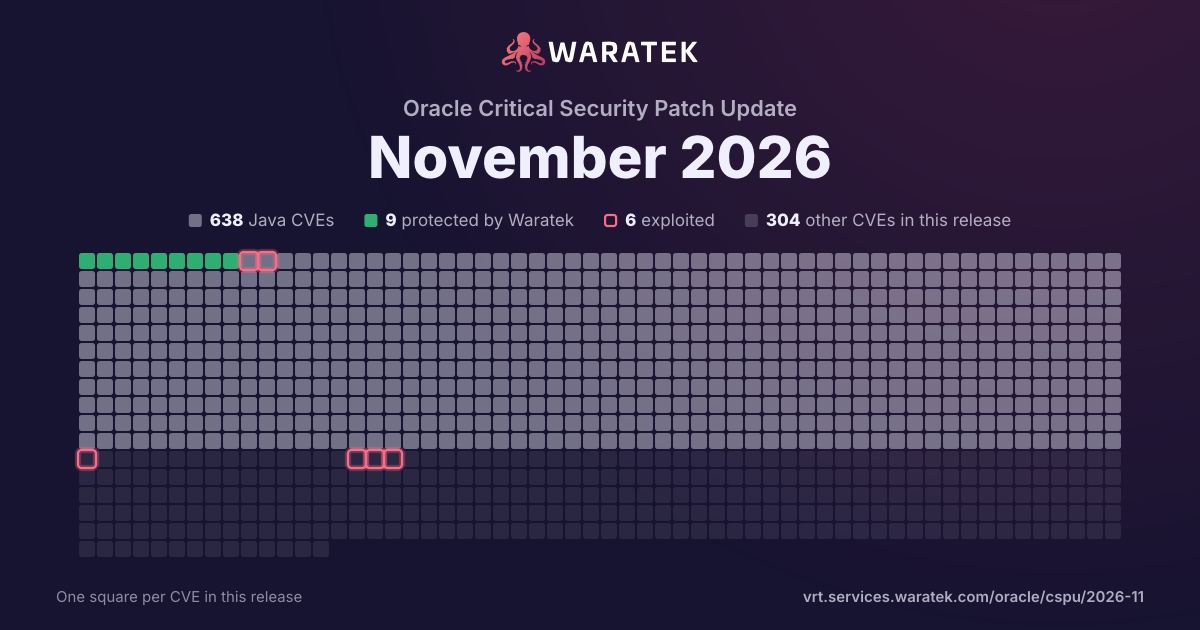
By status
9Protected by Waratek4Mitigation candidate625No exploit published15Outside Waratek scope289Not applicable
6Exploited, marked by the ring
No exploit published. For 554 of them, Oracle's security advisory is the source of public detail.
Protected by Waratek. Waratek RASP can block exploitation of these on systems that have not applied the patch yet.
Overview 289 matches · 0 in Waratek scope · 0 protected · 3 exploited · 0 CISA KEV · 3 public PoC · 0 EPSS ≥ 0.5
289matches
0in Waratek scope0.0%
0protected0.0%
3exploited1.0%
0CISA KEV0.0%
3public PoC1.0%
0EPSS ≥ 0.50.0%
Protected by Waratek
0
0.0%
Rule in development
0
0.0%
Mitigation candidate
0
0.0%
No exploit published
0
0.0%
Outside Waratek scope
0
0.0%
Not applicable
289
100.0%
Withdrawn CVE
0
0.0%
blocked by ARMR today
0
0.0%
partly blocked
0
0.0%
not blocked
289
100.0%
not established
0
0.0%
unrecorded
0
0.0%
Exploited
3
1.0%
Working exploit published
0
0.0%
Proof of concept only
81
28.0%
Forecast only
0
0.0%
No public exploit
205
70.9%
split by
peak 136 / quarter
Q3 221
Not applicable1
High1
not blocked1
No public exploit1
Q4 220
Q1 230
Q2 230
Q3 231
Not applicable1
High1
not blocked1
Proof of concept only1
Q4 230
Q1 240
Q2 241
Not applicable1
Medium1
not blocked1
Proof of concept only1
Q3 240
Q4 241
Not applicable1
High1
not blocked1
Proof of concept only1
Q1 252
Not applicable2
High1
Low1
not blocked2
Proof of concept only1
No public exploit1
Q2 250
Q3 250
Q4 250
Q1 268
Not applicable8
High4
Medium2
Low2
not blocked8
No public exploit8
Q2 2635
Not applicable35
Critical2
High14
Medium10
Low9
not blocked35
Proof of concept only7
No public exploit28
Q3 26104
Not applicable104
Critical13
High51
Medium30
Low10
not blocked104
Proof of concept only43
No public exploit61
Q4 26136
Not applicable136
Critical22
High63
Medium37
Low14
not blocked136
Exploited3
Proof of concept only27
No public exploit106
Q4 22Q2 23Q4 23Q2 24Q4 24Q2 25Q4 25Q2 26Q4 26
| CVE | Severity | Published▾ | Status | Exploitation | Description |
|---|---|---|---|---|---|
| CVE-2026-127428 | High | 2026-11-17 | Not applicable | No public exploit | Vulnerability in the MySQL Server, MySQL Cluster product of Oracle MySQL (component: Server: GIS). Supported versions that are affected are MySQL Server: 8.4.0-8.4.13, 9.7.0-9.7.4, 26.10; MySQL Cluster: 8.0.0-8.0.50, 8.4.0-8.4.13, 9.7.0-9.7.4 and 26.10. Easily exploitable vulnerability allows low privileged attacker with network access via multiple protocols to compromise MySQL Server, MySQL Cluster. Successful attacks of this vulnerability can result in unauthorized ability to cause a hang or frequently repeatable crash (complete DOS) of MySQL Server, MySQL Cluster and unauthorized read access to a subset of MySQL Server, MySQL Cluster accessible data. CVSS 3.1 Base Score 7.1 (Confidentiality and Availability impacts). CVSS Vector: (CVSS:3.1/AV:N/AC:L/PR:L/UI:N/S:U/C:L/I:N/A:H). |
| CVE-2026-127427 | High | 2026-11-17 | Not applicable | No public exploit | Vulnerability in the Oracle VM VirtualBox product of Oracle Virtualization (component: Core). The supported version that is affected is 7.2.22. Easily exploitable vulnerability allows unauthenticated attacker with network access via RDP to compromise Oracle VM VirtualBox. Successful attacks of this vulnerability can result in unauthorized ability to cause a hang or frequently repeatable crash (complete DOS) of Oracle VM VirtualBox. CVSS 3.1 Base Score 7.5 (Availability impacts). CVSS Vector: (CVSS:3.1/AV:N/AC:L/PR:N/UI:N/S:U/C:N/I:N/A:H). |
| CVE-2026-127426 | High | 2026-11-17 | Not applicable | No public exploit | Vulnerability in the Oracle VM VirtualBox product of Oracle Virtualization (component: Core). The supported version that is affected is 7.2.22. Easily exploitable vulnerability allows unauthenticated attacker with access to the physical communication segment attached to the hardware where the Oracle VM VirtualBox executes to compromise Oracle VM VirtualBox. While the vulnerability is in Oracle VM VirtualBox, attacks may significantly impact additional products (scope change). Successful attacks of this vulnerability can result in unauthorized access to critical data or complete access to all Oracle VM VirtualBox accessible data. CVSS 3.1 Base Score 7.4 (Confidentiality impacts). CVSS Vector: (CVSS:3.1/AV:A/AC:L/PR:N/UI:N/S:C/C:H/I:N/A:N). |
| CVE-2026-127425 | High | 2026-11-17 | Not applicable | No public exploit | Vulnerability in the Oracle VM VirtualBox product of Oracle Virtualization (component: Core). The supported version that is affected is 7.2.22. Easily exploitable vulnerability allows high privileged attacker with logon to the infrastructure where Oracle VM VirtualBox executes to compromise Oracle VM VirtualBox. While the vulnerability is in Oracle VM VirtualBox, attacks may significantly impact additional products (scope change). Successful attacks of this vulnerability can result in unauthorized creation, deletion or modification access to critical data or all Oracle VM VirtualBox accessible data as well as unauthorized read access to a subset of Oracle VM VirtualBox accessible data and unauthorized ability to cause a hang or frequently repeatable crash (complete DOS) of Oracle VM VirtualBox. CVSS 3.1 Base Score 8.1 (Confidentiality, Integrity and Availability impacts). CVSS Vector: (CVSS:3.1/AV:L/AC:L/PR:H/UI:N/S:C/C:L/I:H/A:H). |
| CVE-2026-127423 | High | 2026-11-17 | Not applicable | No public exploit | Vulnerability in the Oracle VM VirtualBox product of Oracle Virtualization (component: Core). The supported version that is affected is 7.2.22. Easily exploitable vulnerability allows unauthenticated attacker with logon to the infrastructure where Oracle VM VirtualBox executes to compromise Oracle VM VirtualBox. Successful attacks require human interaction from a person other than the attacker. Successful attacks of this vulnerability can result in unauthorized creation, deletion or modification access to critical data or all Oracle VM VirtualBox accessible data and unauthorized ability to cause a hang or frequently repeatable crash (complete DOS) of Oracle VM VirtualBox. CVSS 3.1 Base Score 7.1 (Integrity and Availability impacts). CVSS Vector: (CVSS:3.1/AV:L/AC:L/PR:N/UI:R/S:U/C:N/I:H/A:H). |
| CVE-2026-127422 | High | 2026-11-17 | Not applicable | No public exploit | Vulnerability in the Oracle VM VirtualBox product of Oracle Virtualization (component: Core). The supported version that is affected is 7.2.22. Easily exploitable vulnerability allows unauthenticated attacker with logon to the infrastructure where Oracle VM VirtualBox executes to compromise Oracle VM VirtualBox. Successful attacks require human interaction from a person other than the attacker. Successful attacks of this vulnerability can result in unauthorized creation, deletion or modification access to critical data or all Oracle VM VirtualBox accessible data and unauthorized ability to cause a hang or frequently repeatable crash (complete DOS) of Oracle VM VirtualBox. CVSS 3.1 Base Score 7.1 (Integrity and Availability impacts). CVSS Vector: (CVSS:3.1/AV:L/AC:L/PR:N/UI:R/S:U/C:N/I:H/A:H). |
| CVE-2026-127421 | High | 2026-11-17 | Not applicable | No public exploit | Vulnerability in the Oracle VM VirtualBox product of Oracle Virtualization (component: Core). The supported version that is affected is 7.2.22. Easily exploitable vulnerability allows unauthenticated attacker with logon to the infrastructure where Oracle VM VirtualBox executes to compromise Oracle VM VirtualBox. Successful attacks require human interaction from a person other than the attacker and while the vulnerability is in Oracle VM VirtualBox, attacks may significantly impact additional products (scope change). Successful attacks of this vulnerability can result in takeover of Oracle VM VirtualBox. CVSS 3.1 Base Score 8.6 (Confidentiality, Integrity and Availability impacts). CVSS Vector: (CVSS:3.1/AV:L/AC:L/PR:N/UI:R/S:C/C:H/I:H/A:H). |
| CVE-2026-127420 | Medium | 2026-11-17 | Not applicable | No public exploit | Vulnerability in the Oracle VM VirtualBox product of Oracle Virtualization (component: Core). The supported version that is affected is 7.2.22. Easily exploitable vulnerability allows unauthenticated attacker with logon to the infrastructure where Oracle VM VirtualBox executes to compromise Oracle VM VirtualBox. Successful attacks require human interaction from a person other than the attacker. Successful attacks of this vulnerability can result in unauthorized update, insert or delete access to some of Oracle VM VirtualBox accessible data as well as unauthorized read access to a subset of Oracle VM VirtualBox accessible data. CVSS 3.1 Base Score 4.4 (Confidentiality and Integrity impacts). CVSS Vector: (CVSS:3.1/AV:L/AC:L/PR:N/UI:R/S:U/C:L/I:L/A:N). |
| CVE-2026-127414 | High | 2026-11-17 | Not applicable | No public exploit | Vulnerability in the Oracle VM VirtualBox product of Oracle Virtualization (component: Core). The supported version that is affected is 7.2.22. Easily exploitable vulnerability allows unauthenticated attacker with logon to the infrastructure where Oracle VM VirtualBox executes to compromise Oracle VM VirtualBox. Successful attacks require human interaction from a person other than the attacker. Successful attacks of this vulnerability can result in unauthorized creation, deletion or modification access to critical data or all Oracle VM VirtualBox accessible data and unauthorized ability to cause a hang or frequently repeatable crash (complete DOS) of Oracle VM VirtualBox. CVSS 3.1 Base Score 7.1 (Integrity and Availability impacts). CVSS Vector: (CVSS:3.1/AV:L/AC:L/PR:N/UI:R/S:U/C:N/I:H/A:H). |
| CVE-2026-127413 | High | 2026-11-17 | Not applicable | No public exploit | Vulnerability in the Oracle VM VirtualBox product of Oracle Virtualization (component: Core). The supported version that is affected is 7.2.22. Easily exploitable vulnerability allows unauthenticated attacker with network access via RDP to compromise Oracle VM VirtualBox. Successful attacks of this vulnerability can result in unauthorized ability to cause a hang or frequently repeatable crash (complete DOS) of Oracle VM VirtualBox. CVSS 3.1 Base Score 7.5 (Availability impacts). CVSS Vector: (CVSS:3.1/AV:N/AC:L/PR:N/UI:N/S:U/C:N/I:N/A:H). |
| CVE-2026-127412 | Medium | 2026-11-17 | Not applicable | No public exploit | Vulnerability in the Oracle VM VirtualBox product of Oracle Virtualization (component: Core). The supported version that is affected is 7.2.22. Easily exploitable vulnerability allows high privileged attacker with logon to the infrastructure where Oracle VM VirtualBox executes to compromise Oracle VM VirtualBox. While the vulnerability is in Oracle VM VirtualBox, attacks may significantly impact additional products (scope change). Successful attacks of this vulnerability can result in unauthorized ability to cause a hang or frequently repeatable crash (complete DOS) of Oracle VM VirtualBox and unauthorized read access to a subset of Oracle VM VirtualBox accessible data. CVSS 3.1 Base Score 6.7 (Confidentiality and Availability impacts). CVSS Vector: (CVSS:3.1/AV:L/AC:L/PR:H/UI:N/S:C/C:L/I:N/A:H). |
| CVE-2026-127411 | Medium | 2026-11-17 | Not applicable | No public exploit | Vulnerability in the Oracle VM VirtualBox product of Oracle Virtualization (component: Core). The supported version that is affected is 7.2.22. Easily exploitable vulnerability allows high privileged attacker with logon to the infrastructure where Oracle VM VirtualBox executes to compromise Oracle VM VirtualBox. While the vulnerability is in Oracle VM VirtualBox, attacks may significantly impact additional products (scope change). Successful attacks of this vulnerability can result in unauthorized ability to cause a hang or frequently repeatable crash (complete DOS) of Oracle VM VirtualBox and unauthorized read access to a subset of Oracle VM VirtualBox accessible data. CVSS 3.1 Base Score 6.7 (Confidentiality and Availability impacts). CVSS Vector: (CVSS:3.1/AV:L/AC:L/PR:H/UI:N/S:C/C:L/I:N/A:H). |
| CVE-2026-127402 | High | 2026-11-17 | Not applicable | No public exploit | Vulnerability in the Oracle AutoVue product of Oracle Supply Chain (component: Security). The supported version that is affected is 21.1.0. Difficult to exploit vulnerability allows unauthenticated attacker with network access via HTTP to compromise Oracle AutoVue. Successful attacks of this vulnerability can result in takeover of Oracle AutoVue. CVSS 3.1 Base Score 8.1 (Confidentiality, Integrity and Availability impacts). CVSS Vector: (CVSS:3.1/AV:N/AC:H/PR:N/UI:N/S:U/C:H/I:H/A:H). |
| CVE-2026-127339 | High | 2026-11-17 | Not applicable | No public exploit | Vulnerability in the Oracle AutoVue product of Oracle Supply Chain (component: Security). The supported version that is affected is 21.1.0. Easily exploitable vulnerability allows unauthenticated attacker with logon to the infrastructure where Oracle AutoVue executes to compromise Oracle AutoVue. While the vulnerability is in Oracle AutoVue, attacks may significantly impact additional products (scope change). Successful attacks of this vulnerability can result in unauthorized creation, deletion or modification access to critical data or all Oracle AutoVue accessible data. CVSS 3.1 Base Score 7.1 (Integrity impacts). CVSS Vector: (CVSS:3.1/AV:L/AC:L/PR:N/UI:N/S:C/C:N/I:H/A:N). |
| CVE-2026-127337 | High | 2026-11-17 | Not applicable | No public exploit | Vulnerability in the Oracle AutoVue product of Oracle Supply Chain (component: Security). The supported version that is affected is 21.1.0. Easily exploitable vulnerability allows unauthenticated attacker with logon to the infrastructure where Oracle AutoVue executes to compromise Oracle AutoVue. While the vulnerability is in Oracle AutoVue, attacks may significantly impact additional products (scope change). Successful attacks of this vulnerability can result in unauthorized access to critical data or complete access to all Oracle AutoVue accessible data as well as unauthorized update, insert or delete access to some of Oracle AutoVue accessible data. CVSS 3.1 Base Score 7.9 (Confidentiality and Integrity impacts). CVSS Vector: (CVSS:3.1/AV:L/AC:L/PR:N/UI:N/S:C/C:H/I:L/A:N). |
| CVE-2026-127336 | Medium | 2026-11-17 | Not applicable | No public exploit | Vulnerability in the Oracle AutoVue product of Oracle Supply Chain (component: Security). The supported version that is affected is 21.1.0. Difficult to exploit vulnerability allows unauthenticated attacker with network access via HTTP to compromise Oracle AutoVue. Successful attacks require human interaction from a person other than the attacker. Successful attacks of this vulnerability can result in unauthorized access to critical data or complete access to all Oracle AutoVue accessible data as well as unauthorized update, insert or delete access to some of Oracle AutoVue accessible data. CVSS 3.1 Base Score 5.9 (Confidentiality and Integrity impacts). CVSS Vector: (CVSS:3.1/AV:N/AC:H/PR:N/UI:R/S:U/C:H/I:L/A:N). |
| CVE-2026-127334 | High | 2026-11-17 | Not applicable | No public exploit | Vulnerability in the Oracle AutoVue product of Oracle Supply Chain (component: Security). The supported version that is affected is 21.1.0. Easily exploitable vulnerability allows low privileged attacker with network access via HTTP to compromise Oracle AutoVue. Successful attacks of this vulnerability can result in takeover of Oracle AutoVue. CVSS 3.1 Base Score 8.8 (Confidentiality, Integrity and Availability impacts). CVSS Vector: (CVSS:3.1/AV:N/AC:L/PR:L/UI:N/S:U/C:H/I:H/A:H). |
| CVE-2026-127333 | Medium | 2026-11-17 | Not applicable | No public exploit | Vulnerability in the Oracle AutoVue product of Oracle Supply Chain (component: Security). The supported version that is affected is 21.1.0. Easily exploitable vulnerability allows unauthenticated attacker with access to the physical communication segment attached to the hardware where the Oracle AutoVue executes to compromise Oracle AutoVue. Successful attacks of this vulnerability can result in unauthorized read access to a subset of Oracle AutoVue accessible data. CVSS 3.1 Base Score 4.3 (Confidentiality impacts). CVSS Vector: (CVSS:3.1/AV:A/AC:L/PR:N/UI:N/S:U/C:L/I:N/A:N). |
| CVE-2026-127332 | Medium | 2026-11-17 | Not applicable | No public exploit | Vulnerability in the Oracle AutoVue product of Oracle Supply Chain (component: Security). The supported version that is affected is 21.1.0. Difficult to exploit vulnerability allows unauthenticated attacker with logon to the infrastructure where Oracle AutoVue executes to compromise Oracle AutoVue. Successful attacks of this vulnerability can result in unauthorized update, insert or delete access to some of Oracle AutoVue accessible data and unauthorized ability to cause a partial denial of service (partial DOS) of Oracle AutoVue. CVSS 3.1 Base Score 4.0 (Integrity and Availability impacts). CVSS Vector: (CVSS:3.1/AV:L/AC:H/PR:N/UI:N/S:U/C:N/I:L/A:L). |
| CVE-2026-127331 | High | 2026-11-17 | Not applicable | No public exploit | Vulnerability in the Oracle AutoVue product of Oracle Supply Chain (component: Security). The supported version that is affected is 21.1.0. Easily exploitable vulnerability allows unauthenticated attacker with network access via HTTP to compromise Oracle AutoVue. Successful attacks of this vulnerability can result in unauthorized ability to cause a hang or frequently repeatable crash (complete DOS) of Oracle AutoVue. CVSS 3.1 Base Score 7.5 (Availability impacts). CVSS Vector: (CVSS:3.1/AV:N/AC:L/PR:N/UI:N/S:U/C:N/I:N/A:H). |
| CVE-2026-127330 | High | 2026-11-17 | Not applicable | No public exploit | Vulnerability in the Oracle AutoVue product of Oracle Supply Chain (component: Security). The supported version that is affected is 21.1.0. Difficult to exploit vulnerability allows unauthenticated attacker with network access via HTTP to compromise Oracle AutoVue. Successful attacks of this vulnerability can result in takeover of Oracle AutoVue. CVSS 3.1 Base Score 8.1 (Confidentiality, Integrity and Availability impacts). CVSS Vector: (CVSS:3.1/AV:N/AC:H/PR:N/UI:N/S:U/C:H/I:H/A:H). |
| CVE-2026-127329 | High | 2026-11-17 | Not applicable | No public exploit | Vulnerability in the Oracle AutoVue product of Oracle Supply Chain (component: Security). The supported version that is affected is 21.1.0. Difficult to exploit vulnerability allows unauthenticated attacker with network access via HTTP to compromise Oracle AutoVue. Successful attacks of this vulnerability can result in takeover of Oracle AutoVue. CVSS 3.1 Base Score 8.1 (Confidentiality, Integrity and Availability impacts). CVSS Vector: (CVSS:3.1/AV:N/AC:H/PR:N/UI:N/S:U/C:H/I:H/A:H). |
| CVE-2026-127328 | High | 2026-11-17 | Not applicable | No public exploit | Vulnerability in the Oracle AutoVue product of Oracle Supply Chain (component: Security). The supported version that is affected is 21.1.0. Difficult to exploit vulnerability allows unauthenticated attacker with network access via HTTP to compromise Oracle AutoVue. Successful attacks of this vulnerability can result in takeover of Oracle AutoVue. CVSS 3.1 Base Score 8.1 (Confidentiality, Integrity and Availability impacts). CVSS Vector: (CVSS:3.1/AV:N/AC:H/PR:N/UI:N/S:U/C:H/I:H/A:H). |
| CVE-2026-127327 | Critical | 2026-11-17 | Not applicable | No public exploit | Vulnerability in the Oracle AutoVue product of Oracle Supply Chain (component: Security). The supported version that is affected is 21.1.0. Easily exploitable vulnerability allows unauthenticated attacker with network access via HTTP to compromise Oracle AutoVue. Successful attacks of this vulnerability can result in takeover of Oracle AutoVue. CVSS 3.1 Base Score 9.8 (Confidentiality, Integrity and Availability impacts). CVSS Vector: (CVSS:3.1/AV:N/AC:L/PR:N/UI:N/S:U/C:H/I:H/A:H). |
| CVE-2026-127326 | Critical | 2026-11-17 | Not applicable | No public exploit | Vulnerability in the Oracle AutoVue product of Oracle Supply Chain (component: Security). The supported version that is affected is 21.1.0. Easily exploitable vulnerability allows unauthenticated attacker with network access via HTTP to compromise Oracle AutoVue. Successful attacks of this vulnerability can result in takeover of Oracle AutoVue. CVSS 3.1 Base Score 9.8 (Confidentiality, Integrity and Availability impacts). CVSS Vector: (CVSS:3.1/AV:N/AC:L/PR:N/UI:N/S:U/C:H/I:H/A:H). |
| CVE-2026-127325 | Critical | 2026-11-17 | Not applicable | No public exploit | Vulnerability in the Oracle AutoVue product of Oracle Supply Chain (component: Security). The supported version that is affected is 21.1.0. Easily exploitable vulnerability allows unauthenticated attacker with network access via HTTP to compromise Oracle AutoVue. Successful attacks of this vulnerability can result in takeover of Oracle AutoVue. CVSS 3.1 Base Score 9.8 (Confidentiality, Integrity and Availability impacts). CVSS Vector: (CVSS:3.1/AV:N/AC:L/PR:N/UI:N/S:U/C:H/I:H/A:H). |
| CVE-2026-127324 | Critical | 2026-11-17 | Not applicable | No public exploit | Vulnerability in the Oracle AutoVue product of Oracle Supply Chain (component: Security). The supported version that is affected is 21.1.0. Easily exploitable vulnerability allows unauthenticated attacker with network access via HTTP to compromise Oracle AutoVue. Successful attacks of this vulnerability can result in takeover of Oracle AutoVue. CVSS 3.1 Base Score 9.8 (Confidentiality, Integrity and Availability impacts). CVSS Vector: (CVSS:3.1/AV:N/AC:L/PR:N/UI:N/S:U/C:H/I:H/A:H). |
| CVE-2026-127323 | Low | 2026-11-17 | Not applicable | No public exploit | Vulnerability in the Oracle AutoVue product of Oracle Supply Chain (component: Security). The supported version that is affected is 21.1.0. Difficult to exploit vulnerability allows unauthenticated attacker with network access via HTTP to compromise Oracle AutoVue. Successful attacks of this vulnerability can result in unauthorized read access to a subset of Oracle AutoVue accessible data. CVSS 3.1 Base Score 3.7 (Confidentiality impacts). CVSS Vector: (CVSS:3.1/AV:N/AC:H/PR:N/UI:N/S:U/C:L/I:N/A:N). |
| CVE-2026-127322 | Medium | 2026-11-17 | Not applicable | No public exploit | Vulnerability in the Oracle AutoVue product of Oracle Supply Chain (component: Security). The supported version that is affected is 21.1.0. Difficult to exploit vulnerability allows unauthenticated attacker with network access via HTTP to compromise Oracle AutoVue. Successful attacks require human interaction from a person other than the attacker. Successful attacks of this vulnerability can result in unauthorized access to critical data or complete access to all Oracle AutoVue accessible data. CVSS 3.1 Base Score 5.3 (Confidentiality impacts). CVSS Vector: (CVSS:3.1/AV:N/AC:H/PR:N/UI:R/S:U/C:H/I:N/A:N). |
| CVE-2026-127321 | Medium | 2026-11-17 | Not applicable | No public exploit | Vulnerability in the Oracle AutoVue product of Oracle Supply Chain (component: Security). The supported version that is affected is 21.1.0. Difficult to exploit vulnerability allows unauthenticated attacker with network access via HTTP to compromise Oracle AutoVue. Successful attacks of this vulnerability can result in unauthorized access to critical data or complete access to all Oracle AutoVue accessible data. CVSS 3.1 Base Score 5.9 (Confidentiality impacts). CVSS Vector: (CVSS:3.1/AV:N/AC:H/PR:N/UI:N/S:U/C:H/I:N/A:N). |
| CVE-2026-127320 | Medium | 2026-11-17 | Not applicable | No public exploit | Vulnerability in the Oracle AutoVue product of Oracle Supply Chain (component: Security). The supported version that is affected is 21.1.0. Difficult to exploit vulnerability allows unauthenticated attacker with access to the physical communication segment attached to the hardware where the Oracle AutoVue executes to compromise Oracle AutoVue. Successful attacks of this vulnerability can result in unauthorized creation, deletion or modification access to critical data or all Oracle AutoVue accessible data as well as unauthorized access to critical data or complete access to all Oracle AutoVue accessible data. CVSS 3.1 Base Score 6.8 (Confidentiality and Integrity impacts). CVSS Vector: (CVSS:3.1/AV:A/AC:H/PR:N/UI:N/S:U/C:H/I:H/A:N). |
| CVE-2026-127319 | High | 2026-11-17 | Not applicable | No public exploit | Vulnerability in the Oracle AutoVue product of Oracle Supply Chain (component: Security). The supported version that is affected is 21.1.0. Easily exploitable vulnerability allows low privileged attacker with network access via HTTP to compromise Oracle AutoVue. Successful attacks of this vulnerability can result in unauthorized access to critical data or complete access to all Oracle AutoVue accessible data as well as unauthorized update, insert or delete access to some of Oracle AutoVue accessible data. CVSS 3.1 Base Score 7.1 (Confidentiality and Integrity impacts). CVSS Vector: (CVSS:3.1/AV:N/AC:L/PR:L/UI:N/S:U/C:H/I:L/A:N). |
| CVE-2026-127318 | Low | 2026-11-17 | Not applicable | No public exploit | Vulnerability in the Oracle AutoVue product of Oracle Supply Chain (component: Security). The supported version that is affected is 21.1.0.7. Difficult to exploit vulnerability allows unauthenticated attacker with access to the physical communication segment attached to the hardware where the Oracle AutoVue executes to compromise Oracle AutoVue. Successful attacks of this vulnerability can result in unauthorized read access to a subset of Oracle AutoVue accessible data. CVSS 3.1 Base Score 3.1 (Confidentiality impacts). CVSS Vector: (CVSS:3.1/AV:A/AC:H/PR:N/UI:N/S:U/C:L/I:N/A:N). |
| CVE-2026-127314 | Low | 2026-11-17 | Not applicable | No public exploit | Vulnerability in the Oracle AutoVue product of Oracle Supply Chain (component: Security). The supported version that is affected is 21.1.0.7. Easily exploitable vulnerability allows low privileged attacker with logon to the infrastructure where Oracle AutoVue executes to compromise Oracle AutoVue. Successful attacks of this vulnerability can result in unauthorized read access to a subset of Oracle AutoVue accessible data. CVSS 3.1 Base Score 3.3 (Confidentiality impacts). CVSS Vector: (CVSS:3.1/AV:L/AC:L/PR:L/UI:N/S:U/C:L/I:N/A:N). |
| CVE-2026-127313 | Medium | 2026-11-17 | Not applicable | No public exploit | Vulnerability in the Oracle AutoVue product of Oracle Supply Chain (component: Security). The supported version that is affected is 21.1.0. Difficult to exploit vulnerability allows unauthenticated attacker with access to the physical communication segment attached to the hardware where the Oracle AutoVue executes to compromise Oracle AutoVue. Successful attacks of this vulnerability can result in unauthorized creation, deletion or modification access to critical data or all Oracle AutoVue accessible data as well as unauthorized access to critical data or complete access to all Oracle AutoVue accessible data. CVSS 3.1 Base Score 6.8 (Confidentiality and Integrity impacts). CVSS Vector: (CVSS:3.1/AV:A/AC:H/PR:N/UI:N/S:U/C:H/I:H/A:N). |
| CVE-2026-127312 | Medium | 2026-11-17 | Not applicable | No public exploit | Vulnerability in the Oracle AutoVue product of Oracle Supply Chain (component: Security). The supported version that is affected is 21.1.0. Easily exploitable vulnerability allows unauthenticated attacker with network access via HTTP to compromise Oracle AutoVue. Successful attacks require human interaction from a person other than the attacker. Successful attacks of this vulnerability can result in unauthorized update, insert or delete access to some of Oracle AutoVue accessible data as well as unauthorized read access to a subset of Oracle AutoVue accessible data. CVSS 3.1 Base Score 5.4 (Confidentiality and Integrity impacts). CVSS Vector: (CVSS:3.1/AV:N/AC:L/PR:N/UI:R/S:U/C:L/I:L/A:N). |
| CVE-2026-127311 | Medium | 2026-11-17 | Not applicable | No public exploit | Vulnerability in the Oracle AutoVue product of Oracle Supply Chain (component: Security). The supported version that is affected is 21.1.0. Easily exploitable vulnerability allows unauthenticated attacker with network access via HTTP to compromise Oracle AutoVue. Successful attacks require human interaction from a person other than the attacker and while the vulnerability is in Oracle AutoVue, attacks may significantly impact additional products (scope change). Successful attacks of this vulnerability can result in unauthorized update, insert or delete access to some of Oracle AutoVue accessible data as well as unauthorized read access to a subset of Oracle AutoVue accessible data. CVSS 3.1 Base Score 6.1 (Confidentiality and Integrity impacts). CVSS Vector: (CVSS:3.1/AV:N/AC:L/PR:N/UI:R/S:C/C:L/I:L/A:N). |
| CVE-2026-127310 | Medium | 2026-11-17 | Not applicable | No public exploit | Vulnerability in the Oracle AutoVue product of Oracle Supply Chain (component: Security). The supported version that is affected is 21.1.0. Easily exploitable vulnerability allows low privileged attacker with network access via HTTP to compromise Oracle AutoVue. Successful attacks of this vulnerability can result in unauthorized access to critical data or complete access to all Oracle AutoVue accessible data. CVSS 3.1 Base Score 6.5 (Confidentiality impacts). CVSS Vector: (CVSS:3.1/AV:N/AC:L/PR:L/UI:N/S:U/C:H/I:N/A:N). |
| CVE-2026-127309 | Medium | 2026-11-17 | Not applicable | No public exploit | Vulnerability in the Oracle AutoVue product of Oracle Supply Chain (component: Security). The supported version that is affected is 21.1.0. Easily exploitable vulnerability allows unauthenticated attacker with network access via HTTP to compromise Oracle AutoVue. Successful attacks of this vulnerability can result in unauthorized read access to a subset of Oracle AutoVue accessible data. CVSS 3.1 Base Score 5.3 (Confidentiality impacts). CVSS Vector: (CVSS:3.1/AV:N/AC:L/PR:N/UI:N/S:U/C:L/I:N/A:N). |
| CVE-2026-127308 | High | 2026-11-17 | Not applicable | No public exploit | Vulnerability in the Oracle AutoVue product of Oracle Supply Chain (component: Security). The supported version that is affected is 21.1.0. Easily exploitable vulnerability allows unauthenticated attacker with network access via HTTP to compromise Oracle AutoVue. Successful attacks require human interaction from a person other than the attacker. Successful attacks of this vulnerability can result in unauthorized creation, deletion or modification access to critical data or all Oracle AutoVue accessible data as well as unauthorized access to critical data or complete access to all Oracle AutoVue accessible data. CVSS 3.1 Base Score 8.1 (Confidentiality and Integrity impacts). CVSS Vector: (CVSS:3.1/AV:N/AC:L/PR:N/UI:R/S:U/C:H/I:H/A:N). |
| CVE-2026-127307 | High | 2026-11-17 | Not applicable | No public exploit | Vulnerability in the Oracle AutoVue product of Oracle Supply Chain (component: Security). The supported version that is affected is 21.1.0. Easily exploitable vulnerability allows low privileged attacker with network access via HTTP to compromise Oracle AutoVue. Successful attacks of this vulnerability can result in takeover of Oracle AutoVue. CVSS 3.1 Base Score 8.8 (Confidentiality, Integrity and Availability impacts). CVSS Vector: (CVSS:3.1/AV:N/AC:L/PR:L/UI:N/S:U/C:H/I:H/A:H). |
| CVE-2026-127306 | High | 2026-11-17 | Not applicable | No public exploit | Vulnerability in the Oracle AutoVue product of Oracle Supply Chain (component: Security Related Issues). The supported version that is affected is 21.1.0. Easily exploitable vulnerability allows unauthenticated attacker with network access via HTTP to compromise Oracle AutoVue. While the vulnerability is in Oracle AutoVue, attacks may significantly impact additional products (scope change). Successful attacks of this vulnerability can result in unauthorized access to critical data or complete access to all Oracle AutoVue accessible data. CVSS 3.1 Base Score 8.6 (Confidentiality impacts). CVSS Vector: (CVSS:3.1/AV:N/AC:L/PR:N/UI:N/S:C/C:H/I:N/A:N). |
| CVE-2026-114991 | Medium | 2026-11-17 | Not applicable | No public exploit | Vulnerability in the Oracle AutoVue product of Oracle Supply Chain (component: Security Related Issues). The supported version that is affected is 21.1.0. Easily exploitable vulnerability allows low privileged attacker with network access via HTTP to compromise Oracle AutoVue. Successful attacks of this vulnerability can result in unauthorized ability to cause a partial denial of service (partial DOS) of Oracle AutoVue. CVSS 3.1 Base Score 4.3 (Availability impacts). CVSS Vector: (CVSS:3.1/AV:N/AC:L/PR:L/UI:N/S:U/C:N/I:N/A:L). |
| CVE-2026-114990 | Medium | 2026-11-17 | Not applicable | No public exploit | Vulnerability in the Oracle AutoVue product of Oracle Supply Chain (component: Core). The supported version that is affected is 21.1.0. Easily exploitable vulnerability allows low privileged attacker with network access via HTTP to compromise Oracle AutoVue. Successful attacks of this vulnerability can result in unauthorized ability to cause a partial denial of service (partial DOS) of Oracle AutoVue. CVSS 3.1 Base Score 4.3 (Availability impacts). CVSS Vector: (CVSS:3.1/AV:N/AC:L/PR:L/UI:N/S:U/C:N/I:N/A:L). |
| CVE-2026-114989 | Medium | 2026-11-17 | Not applicable | No public exploit | Vulnerability in the Oracle AutoVue product of Oracle Supply Chain (component: Security Related Issues). The supported version that is affected is 21.1.0. Easily exploitable vulnerability allows low privileged attacker with network access via HTTP to compromise Oracle AutoVue. Successful attacks of this vulnerability can result in unauthorized update, insert or delete access to some of Oracle AutoVue accessible data as well as unauthorized read access to a subset of Oracle AutoVue accessible data and unauthorized ability to cause a partial denial of service (partial DOS) of Oracle AutoVue. CVSS 3.1 Base Score 6.3 (Confidentiality, Integrity and Availability impacts). CVSS Vector: (CVSS:3.1/AV:N/AC:L/PR:L/UI:N/S:U/C:L/I:L/A:L). |
| CVE-2026-114988 | Low | 2026-11-17 | Not applicable | No public exploit | Vulnerability in the Oracle AutoVue product of Oracle Supply Chain (component: Security Related Issues). The supported version that is affected is 21.1.0. Difficult to exploit vulnerability allows low privileged attacker with logon to the infrastructure where Oracle AutoVue executes to compromise Oracle AutoVue. Successful attacks of this vulnerability can result in unauthorized update, insert or delete access to some of Oracle AutoVue accessible data as well as unauthorized read access to a subset of Oracle AutoVue accessible data. CVSS 3.1 Base Score 3.6 (Confidentiality and Integrity impacts). CVSS Vector: (CVSS:3.1/AV:L/AC:H/PR:L/UI:N/S:U/C:L/I:L/A:N). |
| CVE-2026-114987 | Low | 2026-11-17 | Not applicable | No public exploit | Vulnerability in the Oracle AutoVue product of Oracle Supply Chain (component: Security Related Issues). The supported version that is affected is 21.1.0. Easily exploitable vulnerability allows high privileged attacker with logon to the infrastructure where Oracle AutoVue executes to compromise Oracle AutoVue. Successful attacks of this vulnerability can result in unauthorized read access to a subset of Oracle AutoVue accessible data and unauthorized ability to cause a partial denial of service (partial DOS) of Oracle AutoVue. CVSS 3.1 Base Score 3.4 (Confidentiality and Availability impacts). CVSS Vector: (CVSS:3.1/AV:L/AC:L/PR:H/UI:N/S:U/C:L/I:N/A:L). |
| CVE-2026-114986 | Low | 2026-11-17 | Not applicable | No public exploit | Vulnerability in the Oracle AutoVue product of Oracle Supply Chain (component: Security Related Issues). The supported version that is affected is 21.1.0.7. Difficult to exploit vulnerability allows high privileged attacker with logon to the infrastructure where Oracle AutoVue executes to compromise Oracle AutoVue. Successful attacks of this vulnerability can result in unauthorized update, insert or delete access to some of Oracle AutoVue accessible data and unauthorized ability to cause a partial denial of service (partial DOS) of Oracle AutoVue. CVSS 3.1 Base Score 3.0 (Integrity and Availability impacts). CVSS Vector: (CVSS:3.1/AV:L/AC:H/PR:H/UI:N/S:U/C:N/I:L/A:L). |
| CVE-2026-114985 | Low | 2026-11-17 | Not applicable | No public exploit | Vulnerability in the Oracle AutoVue product of Oracle Supply Chain (component: Security Related Issues). The supported version that is affected is 21.1.0.7. Difficult to exploit vulnerability allows high privileged attacker with logon to the infrastructure where Oracle AutoVue executes to compromise Oracle AutoVue. Successful attacks of this vulnerability can result in unauthorized update, insert or delete access to some of Oracle AutoVue accessible data and unauthorized ability to cause a partial denial of service (partial DOS) of Oracle AutoVue. CVSS 3.1 Base Score 3.0 (Integrity and Availability impacts). CVSS Vector: (CVSS:3.1/AV:L/AC:H/PR:H/UI:N/S:U/C:N/I:L/A:L). |
| CVE-2026-114984 | Medium | 2026-11-17 | Not applicable | No public exploit | Vulnerability in the Oracle AutoVue product of Oracle Supply Chain (component: Security Related Issues). The supported version that is affected is 21.1.0. Difficult to exploit vulnerability allows low privileged attacker with network access via HTTP to compromise Oracle AutoVue. Successful attacks of this vulnerability can result in unauthorized creation, deletion or modification access to critical data or all Oracle AutoVue accessible data and unauthorized ability to cause a hang or frequently repeatable crash (complete DOS) of Oracle AutoVue. CVSS 3.1 Base Score 6.8 (Integrity and Availability impacts). CVSS Vector: (CVSS:3.1/AV:N/AC:H/PR:L/UI:N/S:U/C:N/I:H/A:H). |
| CVE-2026-114983 | Medium | 2026-11-17 | Not applicable | No public exploit | Vulnerability in the Oracle AutoVue product of Oracle Supply Chain (component: Security Related Issues). The supported version that is affected is 21.1.0. Difficult to exploit vulnerability allows unauthenticated attacker with network access via HTTP to compromise Oracle AutoVue. Successful attacks of this vulnerability can result in unauthorized update, insert or delete access to some of Oracle AutoVue accessible data as well as unauthorized read access to a subset of Oracle AutoVue accessible data and unauthorized ability to cause a partial denial of service (partial DOS) of Oracle AutoVue. CVSS 3.1 Base Score 5.6 (Confidentiality, Integrity and Availability impacts). CVSS Vector: (CVSS:3.1/AV:N/AC:H/PR:N/UI:N/S:U/C:L/I:L/A:L). |
| CVE-2026-114982 | Medium | 2026-11-17 | Not applicable | No public exploit | Vulnerability in the Oracle AutoVue product of Oracle Supply Chain (component: Security Related Issues). The supported version that is affected is 21.1.0. Easily exploitable vulnerability allows high privileged attacker with logon to the infrastructure where Oracle AutoVue executes to compromise Oracle AutoVue. Successful attacks of this vulnerability can result in unauthorized creation, deletion or modification access to critical data or all Oracle AutoVue accessible data and unauthorized ability to cause a hang or frequently repeatable crash (complete DOS) of Oracle AutoVue. CVSS 3.1 Base Score 6.0 (Integrity and Availability impacts). CVSS Vector: (CVSS:3.1/AV:L/AC:L/PR:H/UI:N/S:U/C:N/I:H/A:H). |
| CVE-2026-114981 | High | 2026-11-17 | Not applicable | No public exploit | Vulnerability in the Oracle AutoVue product of Oracle Supply Chain (component: Security Related Issues). The supported version that is affected is 21.1.0. Difficult to exploit vulnerability allows low privileged attacker with network access via HTTP to compromise Oracle AutoVue. Successful attacks of this vulnerability can result in takeover of Oracle AutoVue. CVSS 3.1 Base Score 7.5 (Confidentiality, Integrity and Availability impacts). CVSS Vector: (CVSS:3.1/AV:N/AC:H/PR:L/UI:N/S:U/C:H/I:H/A:H). |
| CVE-2026-114980 | Critical | 2026-11-17 | Not applicable | No public exploit | Vulnerability in the Oracle AutoVue product of Oracle Supply Chain (component: Security Related Issues). The supported version that is affected is 21.1.0. Easily exploitable vulnerability allows low privileged attacker with network access via HTTP to compromise Oracle AutoVue. While the vulnerability is in Oracle AutoVue, attacks may significantly impact additional products (scope change). Successful attacks of this vulnerability can result in takeover of Oracle AutoVue. CVSS 3.1 Base Score 9.9 (Confidentiality, Integrity and Availability impacts). CVSS Vector: (CVSS:3.1/AV:N/AC:L/PR:L/UI:N/S:C/C:H/I:H/A:H). |
| CVE-2026-114953 | Medium | 2026-11-17 | Not applicable | No public exploit | Vulnerability in the MySQL Server, MySQL Cluster product of Oracle MySQL (component: Server: Replication). Supported versions that are affected are MySQL Server: 8.4.0-8.4.13, 9.7.0-9.7.4, 26.10; MySQL Cluster: 8.0.0-8.0.50, 8.4.0-8.4.13, 9.7.0-9.7.4 and 26.10. Easily exploitable vulnerability allows low privileged attacker with network access via multiple protocols to compromise MySQL Server, MySQL Cluster. Successful attacks of this vulnerability can result in unauthorized ability to cause a hang or frequently repeatable crash (complete DOS) of MySQL Server, MySQL Cluster. CVSS 3.1 Base Score 6.5 (Availability impacts). CVSS Vector: (CVSS:3.1/AV:N/AC:L/PR:L/UI:N/S:U/C:N/I:N/A:H). |
| CVE-2026-114952 | Critical | 2026-11-17 | Not applicable | No public exploit | Vulnerability in the MySQL Server, MySQL Cluster product of Oracle MySQL (component: Client programs). Supported versions that are affected are MySQL Server: 8.4.0-8.4.13, 9.7.0-9.7.4, 26.10; MySQL Cluster: 8.0.0-8.0.50, 8.4.0-8.4.13, 9.7.0-9.7.4 and 26.10. Easily exploitable vulnerability allows unauthenticated attacker with network access via multiple protocols to compromise MySQL Server, MySQL Cluster. Successful attacks of this vulnerability can result in unauthorized creation, deletion or modification access to critical data or all MySQL Server, MySQL Cluster accessible data as well as unauthorized access to critical data or complete access to all MySQL Server, MySQL Cluster accessible data. CVSS 3.1 Base Score 9.1 (Confidentiality and Integrity impacts). CVSS Vector: (CVSS:3.1/AV:N/AC:L/PR:N/UI:N/S:U/C:H/I:H/A:N). |
| CVE-2026-114951 | High | 2026-11-17 | Not applicable | No public exploit | Vulnerability in the MySQL Server, MySQL Cluster product of Oracle MySQL (component: Server: Logging). Supported versions that are affected are MySQL Server: 8.4.0-8.4.13, 9.7.0-9.7.4, 26.10; MySQL Cluster: 8.0.0-8.0.50, 8.4.0-8.4.13, 9.7.0-9.7.4 and 26.10. Easily exploitable vulnerability allows high privileged attacker with network access via multiple protocols to compromise MySQL Server, MySQL Cluster. Successful attacks of this vulnerability can result in takeover of MySQL Server, MySQL Cluster. CVSS 3.1 Base Score 7.2 (Confidentiality, Integrity and Availability impacts). CVSS Vector: (CVSS:3.1/AV:N/AC:L/PR:H/UI:N/S:U/C:H/I:H/A:H). |
| CVE-2026-114950 | High | 2026-11-17 | Not applicable | No public exploit | Vulnerability in the MySQL Server, MySQL Cluster product of Oracle MySQL (component: Server: Optimizer). Supported versions that are affected are MySQL Server: 8.4.0-8.4.13, 9.7.0-9.7.4, 26.10; MySQL Cluster: 8.0.0-8.0.50, 8.4.0-8.4.13, 9.7.0-9.7.4 and 26.10. Easily exploitable vulnerability allows high privileged attacker with network access via multiple protocols to compromise MySQL Server, MySQL Cluster. Successful attacks of this vulnerability can result in takeover of MySQL Server, MySQL Cluster. CVSS 3.1 Base Score 7.2 (Confidentiality, Integrity and Availability impacts). CVSS Vector: (CVSS:3.1/AV:N/AC:L/PR:H/UI:N/S:U/C:H/I:H/A:H). |
| CVE-2026-114949 | High | 2026-11-17 | Not applicable | No public exploit | Vulnerability in the MySQL Server, MySQL Cluster product of Oracle MySQL (component: Server: Replication). Supported versions that are affected are MySQL Server: 8.4.0-8.4.13, 9.7.0-9.7.4, 26.10; MySQL Cluster: 8.0.0-8.0.50, 8.4.0-8.4.13, 9.7.0-9.7.4 and 26.10. Easily exploitable vulnerability allows high privileged attacker with network access via multiple protocols to compromise MySQL Server, MySQL Cluster. Successful attacks of this vulnerability can result in takeover of MySQL Server, MySQL Cluster. CVSS 3.1 Base Score 7.2 (Confidentiality, Integrity and Availability impacts). CVSS Vector: (CVSS:3.1/AV:N/AC:L/PR:H/UI:N/S:U/C:H/I:H/A:H). |
| CVE-2026-114948 | Low | 2026-11-17 | Not applicable | No public exploit | Vulnerability in the MySQL Cluster product of Oracle MySQL (component: Cluster: JS module). Supported versions that are affected are 8.0.0-8.0.50, 8.4.0-8.4.13, 9.7.0-9.7.4 and 26.10. Difficult to exploit vulnerability allows low privileged attacker with logon to the infrastructure where MySQL Cluster executes to compromise MySQL Cluster. Successful attacks of this vulnerability can result in unauthorized read access to a subset of MySQL Cluster accessible data. CVSS 3.1 Base Score 2.5 (Confidentiality impacts). CVSS Vector: (CVSS:3.1/AV:L/AC:H/PR:L/UI:N/S:U/C:L/I:N/A:N). |
| CVE-2026-114850 | Critical | 2026-11-17 | Not applicable | No public exploit | Vulnerability in Oracle APEX (component: General). Supported versions that are affected are 24.1.22, 24.2.21, 26.1.5 and 26.2.0. Easily exploitable vulnerability allows unauthenticated attacker with network access via HTTPS to compromise Oracle APEX. Successful attacks of this vulnerability can result in takeover of Oracle APEX. CVSS 3.1 Base Score 9.8 (Confidentiality, Integrity and Availability impacts). CVSS Vector: (CVSS:3.1/AV:N/AC:L/PR:N/UI:N/S:U/C:H/I:H/A:H). |
| CVE-2026-114848 | Critical | 2026-11-17 | Not applicable | No public exploit | Vulnerability in the Oracle Text component of Oracle Database Server. Supported versions that are affected are 19.3-19.33, 21.3-21.24 and 23.4.0-23.26.3. Easily exploitable vulnerability allows low privileged attacker having Create Session privilege with network access via Oracle Net to compromise Oracle Text. While the vulnerability is in Oracle Text, attacks may significantly impact additional products (scope change). Successful attacks of this vulnerability can result in takeover of Oracle Text. CVSS 3.1 Base Score 9.9 (Confidentiality, Integrity and Availability impacts). CVSS Vector: (CVSS:3.1/AV:N/AC:L/PR:L/UI:N/S:C/C:H/I:H/A:H). |
| CVE-2026-114822 | Critical | 2026-11-17 | Not applicable | No public exploit | Vulnerability in the RDBMS component of Oracle Database Server. Supported versions that are affected are 23.4.0-23.26.4. Easily exploitable vulnerability allows low privileged attacker having Create Session privilege with network access via Oracle Net to compromise RDBMS. While the vulnerability is in RDBMS, attacks may significantly impact additional products (scope change). Successful attacks of this vulnerability can result in takeover of RDBMS. CVSS 3.1 Base Score 9.9 (Confidentiality, Integrity and Availability impacts). CVSS Vector: (CVSS:3.1/AV:N/AC:L/PR:L/UI:N/S:C/C:H/I:H/A:H). |
| CVE-2026-114819 | Critical | 2026-11-17 | Not applicable | No public exploit | Vulnerability in the Oracle Text component of Oracle Database Server. Supported versions that are affected are 19.3-19.32, 21.3-21.24 and 23.4.0-23.26.3. Easily exploitable vulnerability allows low privileged attacker having Create Session privilege with network access via Oracle Net to compromise Oracle Text. While the vulnerability is in Oracle Text, attacks may significantly impact additional products (scope change). Successful attacks of this vulnerability can result in takeover of Oracle Text. CVSS 3.1 Base Score 9.9 (Confidentiality, Integrity and Availability impacts). CVSS Vector: (CVSS:3.1/AV:N/AC:L/PR:L/UI:N/S:C/C:H/I:H/A:H). |
| CVE-2026-118628 | High | 2026-11-04 | Not applicable | No public exploit | MLflow get-artifacts Server-Side Request Forgery Information Disclosure Vulnerability. This vulnerability allows remote attackers to disclose sensitive information on affected installations of MLflow. Authentication is not required to exploit this vulnerability. The specific flaw exists within the get-artifacts function. The issue results from the lack of proper validation of a URI prior to accessing resources. An attacker can leverage this vulnerability to disclose information in the context of the server. Was ZDI-CAN-28192. |
| CVE-2026-118627 | High | 2026-11-04 | Not applicable | No public exploit | MLflow SHAP load_explainer Deserialization of Untrusted Data Remote Code Execution Vulnerability. This vulnerability allows remote attackers to execute arbitrary code on affected installations of MLflow. User interaction is required to exploit this vulnerability in that the target must visit a malicious page or open a malicious file. The specific flaw exists within the loading of SHAP explainer models. The issue results from the lack of proper validation of user-supplied data, which can result in deserialization of untrusted data. An attacker can leverage this vulnerability to execute code in the context of the current user. Was ZDI-CAN-30301. |
| CVE-2026-118626 | Medium | 2026-11-04 | Not applicable | No public exploit | MLflow Tracking Server Issues Missing Authorization Privilege Escalation Vulnerability. This vulnerability allows remote attackers to escalate privileges on affected installations of MLflow. Authentication is required to exploit this vulnerability. The specific flaw exists within the configuration of the BEFORE_REQUEST_HANDLERS. The issue results from the lack of authorization prior to allowing access to functionality. An attacker can leverage this vulnerability to escalate privileges to resources normally protected from the user. Was ZDI-CAN-32108. |
| CVE-2026-118625 | Medium | 2026-11-04 | Not applicable | No public exploit | MLflow Tracking Server Missing Authorization Privilege Escalation Vulnerability. This vulnerability allows remote attackers to escalate privileges on affected installations of MLflow. Authentication is required to exploit this vulnerability. The specific flaw exists within the get_endpoints function. The issue results from the lack of authorization prior to allowing access to functionality. An attacker can leverage this vulnerability to escalate privileges to resources normally protected from the user. Was ZDI-CAN-32107. |
| CVE-2026-118624 | Medium | 2026-11-04 | Not applicable | No public exploit | MLflow Tracking Server Jobs Missing Authorization Information Disclosure Vulnerability. This vulnerability allows remote attackers to disclose sensitive information on affected installations of MLflow. Authentication is required to exploit this vulnerability. The specific flaw exists within the _find_validator function. The issue results from the lack of authorization prior to allowing access to functionality. An attacker can leverage this vulnerability to disclose information in the context of the service account. Was ZDI-CAN-31894. |
| CVE-2026-118623 | High | 2026-11-04 | Not applicable | No public exploit | MLflow PickleEvaluationArtifact Deserialization of Untrusted Data Remote Code Execution Vulnerability. This vulnerability allows remote attackers to execute arbitrary code on affected installations of MLflow. User interaction is required to exploit this vulnerability in that the target must visit a malicious page or open a malicious file. The specific flaw exists within the parsing of pickle files. The issue results from the lack of proper validation of user-supplied data, which can result in deserialization of untrusted data. An attacker can leverage this vulnerability to execute code in the context of the current process. Was ZDI-CAN-29513. |
| CVE-2026-116692 | Critical | 2026-10-27 | Not applicable | Exploited | MLflow is an open source AI engineering platform for agents, large language models, and machine learning models. From 3.12.0rc0 until 3.17.0, third-party scorer deserialization in mlflow/genai/scorers/base.py accepts request-selected descendants of THIRD_PARTY_SCORER_ALLOWED_MODULES rather than requiring an exact allowed module. A caller can use MLflow artifact endpoints to place a Python module beneath a writable allowed package and submit its module and class through /ajax-api/3.0/mlflow/scorer/invoke. Scorer.model_validate_json() imports the module and constructs the class before trace processing. Authentication-disabled deployments permit this code execution without credentials, while basic-auth deployments require a principal capable of creating an experiment and run and uploading artifacts. In either configuration, the allowed scorer package must be writable by the server process. This issue is fixed in version 3.17.0. |
| CVE-2026-116691 | Medium | 2026-10-27 | Not applicable | Proof of concept only | MLflow is an open source AI engineering platform for agents, large language models, and machine learning models. From 2.19.0 until 3.17.0, mlflow.crewai.autolog() records CrewAI Agent objects without consistently sanitizing nested credential-bearing values. mlflow/crewai/autolog.py::_get_agent_attributes() converts the Agent llm field to a string that includes the provider API key, while mlflow/crewai/autolog.py::_construct_full_inputs() expands the Agent object into mlflow.spanInputs. Applications can therefore send plaintext provider credentials to the MLflow trace backend or a configured OTLP destination, where trace readers can obtain them. This issue is fixed in version 3.17.0. |
| CVE-2026-116690 | High | 2026-10-27 | Not applicable | Exploited | MLflow is an open source AI engineering platform for agents, large language models, and machine learning models. From 3.10.0 until 3.17.0, the prompt branch in _create_model_version() accepts schemeless relative sources because path validation runs only when a source has a URL scheme, and mlflow.prompt.is_prompt is interpreted by tag presence rather than a true value. A remote caller can store a server-local path as the model version artifact location and use /api/2.0/mlflow/model-versions/get-artifact to read files accessible to the MLflow server process. Default unauthenticated servers require no privileges, while basic-auth deployments are exposed to authenticated users who can create registered models. This issue is fixed in version 3.17.0. |
| CVE-2026-115557 | Critical | 2026-10-24 | Not applicable | No public exploit | Python has added a denylist for known compromised certificates to the "ssl" module to ensure user safety even without certificate revocation configured. Known compromised certificates will automatically be rejected regardless of the SSLContext policy configuration. |
| CVE-2026-115886 | Medium | 2026-10-23 | Not applicable | Exploited | MLflow is an open source AI engineering platform for agents, large language models, and machine learning models. From 3.12.0rc0 until 3.17.0, the scorer invoke, register, and GenAI evaluate endpoints, including unauthenticated POST /ajax-api/3.0/mlflow/scorer/invoke, accept serialized third-party scorer data that Scorer.model_validate_json resolves using a module-path allowlist without constraining the selected class or its constructor arguments. When optional trulens and trulens-providers-litellm packages are installed, an attacker can select mlflow.genai.scorers.trulens, choose a model URI outside MLflow's native provider registry so execution uses the LiteLLM fallback, and supply api_base and api_key values that cause the server to send an outbound request to an attacker-chosen or internal host with attacker-controlled headers and body. The vulnerable deserialization occurs before a tracking-store lookup or job submission. This issue is fixed in version 3.17.0. |
| CVE-2026-106074 | Medium | 2026-10-23 | Not applicable | No public exploit | A flaw in Node.js `crypto` causes the internal entropy caches used by `crypto.randomUUID()`, `crypto.randomUUIDv7()`, and `crypto.randomInt()` to be saved into user-land startup snapshots (`--build-snapshot`) and single executable applications built with `useSnapshot`. If any of these functions, or an API that relies on them such as `URL.createObjectURL()`, is called while the snapshot is built, every process started from that snapshot returns the same values until the cache is refilled: up to 127 UUIDs and about 1,000 `randomInt()` values. Identifiers expected to be unique can collide across processes, and values issued by one process can be predicted by observing another. This vulnerability affects Node.js **26.x**, **24.x**, and **22.x**. |
| CVE-2026-106073 | Low | 2026-10-23 | Not applicable | No public exploit | A flaw in Node.js Permission Model filesystem enforcement leaves `fs.realpathSync()` without the required read permission checks. This is an incomplete fix of CVE-2026-21715, which only covered `fs.realpathSync.native()`. As a result, code running under `--permission` with restricted `--allow-fs-read` can still use `fs.realpathSync()` to check file existence, resolve symlink targets, and enumerate filesystem paths outside of permitted directories. This vulnerability affects Node.js **26.x**, **24.x**, and **22.x**. |
| CVE-2026-106072 | Medium | 2026-10-23 | Not applicable | No public exploit | A flaw in Node.js TLS hostname verification allows a certificate with only a DNS SAN to authenticate an IP endpoint when the client connects using a non-canonical IPv4 spelling, such as `0177.0.0.1`, `0x7f.0.0.1`, `2130706433` or `127.1`. `tls.checkServerIdentity()` did not classify these hosts as IP addresses, but normalized them to their canonical form and matched the result against the certificate DNS names. A certificate containing `DNS:127.0.0.1` and no `IP Address:127.0.0.1` SAN was therefore accepted, while the same certificate is correctly rejected for `127.0.0.1`. Exploitation requires a certificate with a numeric DNS SAN issued by a CA trusted by the client, and a platform resolver that accepts these spellings, such as glibc. This vulnerability affects Node.js **26.x**, **24.x**, and **22.x**. |
| CVE-2026-106071 | Low | 2026-10-23 | Not applicable | No public exploit | A flaw in Node.js Permission Model filesystem enforcement can grant access to paths that do not match a wildcard `--allow-fs-read` or `--allow-fs-write` rule. When the requested path is shorter than the prefix of a wildcard grant, the radix tree lookup stops comparing early and treats the path as a match. For example, `--allow-fs-read=/etc/passwd.*` also allows reading `/etc/passwd`. This requires the wildcard grant to sit directly under the root of the permission tree, for example when it is the only grant for that scope. This is a different root cause from CVE-2026-58043. This vulnerability affects Node.js **26.x**. |
| CVE-2026-106070 | Low | 2026-10-23 | Not applicable | No public exploit | A flaw in the Node.js `zlib.ZipFile` API can cause it to return bytes that do not belong to the requested entry after the local and central header validation fails. When `zipEntry.modified` is read on an archive whose local header does not match its central directory, either directly or while compacting the archive, the validation error is caught but the parsed local header is left cached without a content offset. A later content read then returns attacker-controlled bytes from the start of the file instead of rejecting the archive, and CRC-32 verification still passes because the attacker controls the central directory CRC. A Node.js-based scanner can therefore approve different content from what another ZIP implementation extracts from the same archive. This vulnerability affects Node.js **26.x**. |
| CVE-2026-106069 | High | 2026-10-23 | Not applicable | No public exploit | A flaw in Node.js TLS hostname verification can cause a server certificate to be validated against a different IP address than the one the client connected to, when the host is a non-canonical IPv4 literal with a leading zero, such as `0127.0.0.1`. `tls.checkServerIdentity()` normalizes the host following the WHATWG URL rules, which read a leading-zero octet as octal (`0127.0.0.1` becomes `87.0.0.1`), while the connection is made through the operating system resolver, which on some platforms such as macOS reads it as decimal (`127.0.0.1`). A server at the connected address can then be authenticated with a certificate issued for another IP address. This vulnerability affects Node.js **26.x**, **24.x**, and **22.x**. |
| CVE-2026-105483 | High | 2026-10-23 | Not applicable | No public exploit | A flaw in Node.js TLS hostname verification allows a certificate without a matching IP address SAN to authenticate a connection to an IPv4 address when the host is written with non-ASCII characters, such as fullwidth digits (`127.0.0.1`). `tls.checkServerIdentity()` did not recognize such hosts as IP addresses, even though they normalize and resolve to a regular IPv4 address, and matched them against the certificate DNS names and Common Name instead. A certificate containing `DNS:127.0.0.1` or `DNS:*.0.0.1` could therefore be accepted for an IP endpoint it was not issued for. This is a regression introduced after the fix for CVE-2026-48618. This vulnerability affects Node.js **26.x** and **24.x**. |
| CVE-2026-105482 | High | 2026-10-23 | Not applicable | Proof of concept only | A flaw in Node.js DNS resolution allows hostnames containing a NUL byte to be silently truncated by the dns.resolve*() functions and dns.reverse(). This is an incomplete fix of CVE-2026-48930, which only covered dns.lookup() and the net/tls host options. Because the name is passed to c-ares as a C string, resolving attacker.example\0.trusted.example queries attacker.example and returns its records without any error. Applications that validate a hostname, for example against a domain allowlist, and then resolve it with dns.resolve*() can act on records for a different name than the one they validated. This vulnerability affects Node.js 26.x, 24.x, and 22.x. |
| CVE-2026-105481 | Medium | 2026-10-23 | Not applicable | No public exploit | A flaw in Node.js HTTP Agent connection reuse can cause a client to accept as valid a response that was sent before the client has sent the request. This is an incomplete fix of CVE-2026-48931. The guard that destroys idle keep-alive sockets when unexpected data arrives only runs when the event loop polls for I/O. If an unsolicited response has already reached the socket but has not been read yet when the socket is handed to a new request, for example because the event loop was busy with synchronous work, the guard is removed without seeing it and the data is parsed as the response to the new request. This vulnerability affects Node.js **26.x**, **24.x**, and **22.x**. |
| CVE-2026-114583 | Medium | 2026-10-22 | Not applicable | No public exploit | tarfile.tar_filter could be bypassed using crafted link entries, including symlinks with empty or directory-like names, to redirect later archive members outside the intended extraction directory. This allowed a malicious tar archive to cause tarfile.extractall() with filter="tar" to write files outside the destination directory, subject to the permissions of the extracting process. This is the tarfile.tar_filter counterpart of CVE-2026-7774, which covered tarfile.data_filter. |
| CVE-2026-114124 | Low | 2026-10-21 | Not applicable | No public exploit | Electron is a framework for writing cross-platform desktop applications using JavaScript, HTML and CSS. Prior to versions 42.11.6, 43.7.3, 44.4.3, and 45.0.0-alpha.9, frame data received from the GPU process for macOS offscreen rendering was not fully validated by the main process. An attacker who had separately gained code execution in the GPU process could provide inconsistent frame geometry and cause the main process to read out-of-bounds memory while producing paint event images, disclosing memory or crashing the application. This issue is fixed in versions 42.11.6, 43.7.3, 44.4.3, and 45.0.0-alpha.9. |
| CVE-2026-114122 | Low | 2026-10-21 | Not applicable | No public exploit | Electron is a framework for writing cross-platform desktop applications using JavaScript, HTML and CSS. Prior to versions 42.11.6, 43.7.3, 44.4.3, and 45.0.0-alpha.9, frame data received from the GPU process for webContents.beginFrameSubscription was not fully validated by the main process. An attacker who had separately gained code execution in the GPU process could supply inconsistent frame geometry and cause the main process to read out-of-bounds memory while producing captured frame images, disclosing memory or crashing the application. This issue is fixed in versions 42.11.6, 43.7.3, 44.4.3, and 45.0.0-alpha.9. |
| CVE-2026-113800 | Medium | 2026-10-21 | Not applicable | No public exploit | Electron is a framework for writing cross-platform desktop applications using JavaScript, HTML and CSS. Prior to versions 42.11.3, 43.7.0, 44.3.0, and 45.0.0-alpha.5, hid and usb permission checks made from an iframe caused setPermissionCheckHandler to receive the top-level frame's origin and details instead of the requesting frame's. An application that delegated hid or usb to a cross-origin untrusted iframe and allowed device access with origin-based logic could therefore grant that embedded frame access intended for the top-level page. This issue is fixed in versions 42.11.3, 43.7.0, 44.3.0, and 45.0.0-alpha.5. |
| CVE-2026-94266 | High | 2026-10-20 | Not applicable | Proof of concept only | libcurl could accidentally return a URL for `curl_easy_getinfo()`'s `CURLINFO_EFFECTIVE_URL` option containing credentials, even though neither the URL provided to libcurl nor the redirected URL did. |
| CVE-2026-94265 | Critical | 2026-10-20 | Not applicable | Proof of concept only | When processing an HTTP redirect to a URL containing userinfo (a `username:password` component), curl might erroneously retain and re-transmit the original host's HTTP Negotiate authentication state. Consequently, a malicious server can trigger a redirect containing arbitrary userinfo to force curl to send a freshly minted Kerberos ticket—generated using the ambient identity of the client process to an untrusted third-party host, effectively bypassing the domain-scoping restrictions normally enforced by the absence of `--location-trusted`. |
| CVE-2026-92391 | High | 2026-10-20 | Not applicable | Proof of concept only | A deeply nested multipart MIME structure constructed via the public API causes a stack overflow in libcurl during normal cleanup operations. An excessive recursion depth within `curl_mime_free` leads to unbounded stack frame allocation during structure traversal, ultimately crashing the host process. |
| CVE-2026-92390 | High | 2026-10-20 | Not applicable | Proof of concept only | When invoked with `--remote-header-name` (`-J`), curl fails to preserve its documented anti-clobbering protection if an intermediate 103 Early Hints response precedes the final HTTP response, or if an `ETag` header is processed before `Content-Disposition` under `--etag-save`. This flaw allows an HTTP(S) server to overwrite an existing local file specified in the `Content-Disposition` header despite the presence of the `-J` non-overwrite constraint. |
| CVE-2026-92389 | High | 2026-10-20 | Not applicable | Proof of concept only | libcurl's TFTP state machine fails to validate state transitions against the requested transfer direction, accepting opening server responses for both reads and writes interchangeably. A malicious TFTP server can respond to a download request in a way that forces the client into transmit mode, prompting libcurl to consume and transmit data from the handle's persistent `CURLOPT_READDATA` pointer - including data remaining from unrelated prior operations, such as an HTTP POST request executed on a reused handle. |
| CVE-2026-92388 | Critical | 2026-10-20 | Not applicable | Proof of concept only | When an FTP wildcard `LIST` operation fails, libcurl omits the restoration path meant for successful listings, leaving the write callback set to the internal listing parser and the write callback data pointing directly to the easy handle. Subsequent reuse of this handle triggers an immediate crash, and cloning it via `curl_easy_duphandle()` copies this corrupted state into the duplicate. If the original handle is subsequently freed, executing a transfer on the cloned handle causes a heap use-after-free read against the dangling handle reference; alternatively, reusing the original or cloned handle while changing only `CURLOPT_WRITEDATA` (and omitting `CURLOPT_WRITEFUNCTION`) results in type confusion, forcing the internal parser to interpret incoming server response bytes into memory at the application-supplied write data pointer. |
| CVE-2026-92387 | High | 2026-10-20 | Not applicable | Proof of concept only | By permanently omitting the final control-response line, a malicious FTP, IMAP, POP3, or SMTP server can exploit libcurl and completely bypass its configured transfer timeout mechanism, indefinitely blocking all concurrent transfers bound to the same multi-handle. |
| CVE-2026-92386 | High | 2026-10-20 | Not applicable | Proof of concept only | When writing a long cookie name and value to a Netscape cookie jar, a remote HTTP server can make `curl` write a record that exceeds its line-length parsing limit. Consequently, any subsequent `curl` invocation reading from that same cookie jar using `--cookie` silently aborts parsing prematurely upon encountering the too long line, ignoring all subsequent valid cookies in the file. |
| CVE-2026-87866 | Critical | 2026-10-20 | Not applicable | Proof of concept only | When built with wolfSSL, curl can successfully validate a pinned public key hash against a key the TLS peer does not possess. During the TLS handshake, wolfSSL validates the connection, but curl's subsequent re-parsing of the same certificate - tricked by a manipulated validity length field - extracts and matches a different embedded key, incorrectly authorizing the pinned public key. |
| CVE-2026-87865 | High | 2026-10-20 | Not applicable | Proof of concept only | When libcurl uses libssh2 with a hashed `known_hosts` file, an unrelated initial entry can cause host key validation to report a key *mismatch* as a *missing* key to the `CURLOPT_SSH_KEYFUNCTION` callback. |
| CVE-2026-87864 | High | 2026-10-20 | Not applicable | Proof of concept only | Enabling `CURLOPT_CRLF` causes curl to advertise the raw input byte count in the `IMAP APPEND {N}` literal while transmitting line-ending expanded data. The server reads only $N$ bytes for the payload, causing the remaining overflow bytes to be interpreted and executed as pipelined IMAP commands within the authenticated session. |
| CVE-2026-87863 | High | 2026-10-20 | Not applicable | Proof of concept only | An authenticated HTTPS origin can supply an HSTS `max-age` value that the parser accepts, but time serialization later fails to process. On 64-bit systems, extreme max-age values compute an absolute expiry within standard time integer limits that exceeds calendar time structure bounds. During cache saves, the original HSTS file is truncated before writing a temporary replacement; when serialization fails, the temporary file is deleted, leaving an empty or partial cache. Because the save error is silently ignored during cleanup, curl exits successfully despite the data loss. |